

Income Support Helps Families Meet Children's Needs and Reduces Child Welfare Involvement, Research From Multiple Programs Suggest
Evidence of Protective Effects of Income Is Strongest for Cases Related to Neglect, Which May Be Driven Largely by Reductions in Material Hardship
When parents have enough money to pay their bills, buy nutritious food, and spend quality time with their children, they are better able to respond to their children’s needs and create a nurturing home, something every child deserves.
Supporting families and improving economic security has many benefits, including reducing near-term hardship among families with children.[2] Evidence from a wide range of income support programs also shows another important benefit — reducing involvement in the child welfare system.
As policymakers seek to keep children safe and supported at home and out of the child welfare system, they can help by better aligning families’ resources with what children need to thrive. Recent research suggests that each $1,000 in unrestricted cash a family receives early in a child’s life reduces the likelihood of that child experiencing a substantiated referral for maltreatment, with estimated reductions between 3 and 15 percent.[3]
Millions of families in the United States struggle to afford their children’s basic material needs. Nearly three-quarters (71 percent) of low-income families with children reported experiencing at least one form of material hardship in 2023, such as not having enough food or having trouble paying their utility bill.[4]
Limited money and time can force families — especially those navigating low wages, unpredictable work schedules, and lack of affordable or quality child care — into painful tradeoffs. A parent may want to spend time reading with their children and looking over their homework but instead must work multiple jobs to pay the rent, so that their children have a safe place to live. One of those jobs might call a parent in for an overnight shift, but without family nearby or money to pay for a sitter, they must decide between risking a job or earnings and leaving their child home alone.
Without sufficient resources to meet their basic needs, families with low incomes are at increased risk of involvement in the child welfare system. Black, Indigenous, and Latine families in particular experience high rates of poverty because past and present discriminatory policies have excluded many people of color from better schooling, career paths, neighborhoods, and opportunities that would provide more economic security.[5] For many Latine and immigrant families, language barriers, immigration-related eligibility restrictions to basic needs programs, and fear of family separation are additional barriers to economic stability. For families of all races, material hardship predicts contact with the child welfare system overall, even after controlling for other risk factors.[6]
The child welfare system processes over 2 million reports of child maltreatment yearly.[7] Maltreatment includes both neglect and abuse and is defined differently in each state, but most substantiated child maltreatment cases — 63 percent in 2024 — stem from allegations of neglect only (allegations did not include abuse).[8] States have grappled with distinguishing definitions of neglect from poverty, and experts agree that insufficient income and lack of resources alone should not be a cause for reporting child welfare cases.[9] Yet, when parents cannot afford enough food to last the week, secure appropriate child care while they work, or to move out of inadequate living conditions, a child may be reported for neglect.
Even when referrals to Child Protective Services (CPS) for maltreatment are screened out or unsubstantiated — and the majority of referrals are — children may experience varying levels of stress, fear, or confusion when their family has contact with the child welfare system.[10]
Additionally, there is evidence of families of color experiencing increased surveillance, differential treatment, and harsher penalties in maltreatment reporting and investigations, which in part may explain why they are disproportionately represented in the child welfare system.[11] Encounters with the child welfare system may also be especially stressful in Black and Indigenous communities because of the lasting impact of the nation’s history of forced removals of Black and Indigenous children from their families.[12]
Risk for child abuse and neglect is complex, and income support will not eliminate all cases of maltreatment. However, for families with low incomes, evidence suggests income assistance is an effective tool for reducing child welfare involvement and supporting family stability. The strongest current evidence is for neglect-related outcomes, which comprise the majority of substantiated maltreatment reports; this may be chiefly explained by the close relationship between neglect and material hardship. Considering that income supports are associated with multiple beneficial effects for families and children, policymakers interested in improving outcomes for children, including through reduced child welfare involvement, should strongly consider ways to strengthen these programs.
Across Varied Programs, Evidence Links Concrete Supports to Reduced Child Welfare Involvement
The weight of evidence across multiple programs links income support to reductions in child maltreatment outcomes and exposure to the child welfare system.[13]
We reviewed 19 studies designed to answer whether income support programs affect child maltreatment outcomes (see Appendix).[14] We consider evidence from tax credit expansions, changes to cash and food assistance policies, and other policy-induced increases in household income. We also review emerging evidence from recent unconditional cash transfer pilot programs. Together, these studies suggest that increasing household income supports child safety and family stability, though more research is needed to understand the mechanisms underlying this relationship. (See Figure 1.)
Key findings include:
- One 2013 study found that allowing Temporary Assistance for Needy Families (TANF) families to receive the full amount of child support payments collected from noncustodial parents reduced by 10 percent the likelihood that they would have a “screened-in” report of child maltreatment relative to families for whom the state retained a portion of their child support.[15]
- Several recent studies find evidence that state adoption of flexibilities in the Supplemental Nutrition Assistance Program (SNAP), including modestly higher income limits and less restrictive asset tests under the broad-based categorical eligibility (BBCE) policy, predicts increases in SNAP caseloads and subsequent reductions in total reports to CPS, neglect-related reports to CPS, number of children with any substantiated maltreatment report, children with substantiated neglect reports, and foster care entries.[16]
- One 2022 study estimated that every 1 percent increase in SNAP caseloads due to less restrictive SNAP policies is associated with between 2 and 3 percent fewer children in foster care with substantiated reports of maltreatment.[17]
- A 2025 study using California administrative data estimated that for each additional $1,000 families are eligible for as a tax refund early in a child’s life (after accounting for federal and state tax provisions), the likelihood that a child born into a household with low income has a substantiated referral by age 3 is lower by 3 percent.[18]
- In a study of statewide payments funded by Alaska’s oil revenue, for each $1,000 of unconditional cash distributed to families early in a child’s life, the child was 10 percent (2 percentage points) less likely to be referred to CPS by age 3 and 15 percent less likely to have a substantiated referral.[19]

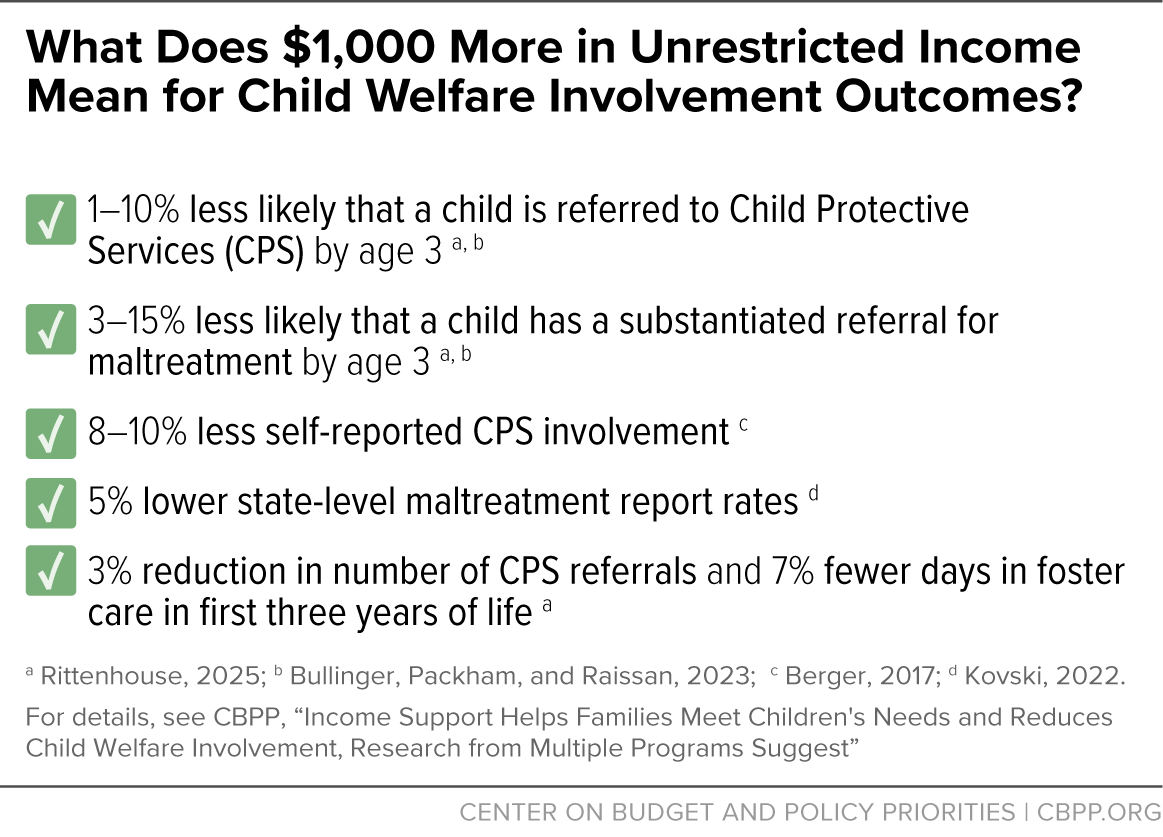
The consistent findings from multiple types of programs strengthen the case for income's role in child maltreatment outcomes. If the only evidence were from the Earned Income Tax Credit (EITC), which has been found to boost both income and maternal employment, one might wonder whether employment was what mattered most. If the only evidence was from increased child support payments induced by policy changes that also incentivize paternity establishment, one might wonder if improved parental relations are more influential on child maltreatment than income. The evidence for income's effect on child maltreatment is strengthened because the effect is observed across multiple programs with differing structures, such as SNAP, which has not been found to increase near-term employment.[20]
We describe the studies and their findings in greater detail below.
Federal Cash Assistance
In 1996, Congress passed legislation replacing the existing federal cash assistance program with TANF and introduced new restrictions, including lifetime limits and sanctions for noncompliance. A substantial body of evidence links losses of flexibility and generosity in federal cash assistance with increased risk of referrals for neglect, CPS investigations, substantiated child maltreatment cases, and foster care placements.[21]
By default, states retain child support payments from noncustodial parents to families participating in TANF and split collected support with the federal government to reimburse cash assistance provided to the family. Over half of states have adopted policies that allocate all or a portion of the child support payment to “pass-through” to the custodial parent and children.[22] In a randomized experiment in which TANF participants were assigned to either a partial or full pass-through of child support dollars, families assigned to receive the full pass-through were about 10 percent less likely than families in the partial pass-through group to be screened-in for child maltreatment over a two-year period, suggesting that the increased income may have protected against maltreatment.[23]
States have wide discretion over TANF implementation; states may adopt or reject TANF policies that depress caseloads, such as imposing work requirements on mothers of infants and harsher sanctions for failing to meet burdensome work requirements. A 2022 study used state TANF policy choices to predict caseload changes and found that every 1 percent increase in TANF caseloads from eased requirements was associated with 1.3 percent fewer children in foster care with substantiated reports of maltreatment for neglect and 1.2 percent fewer children in foster care with any substantiated report of maltreatment.[24]
A 2023 study estimated effects of TANF requirements on factors including material hardship, maternal anxiety and depression, and a measure of negative feelings about parenting their child, which may help explain the link between TANF and child welfare involvement.[25] The most consistently significant results in this study suggest that more restrictive TANF policies increase material hardship, a risk factor for child welfare involvement.[26] The authors’ findings on associations between TANF requirements and maternal mental health and affect were largely not significant with two exceptions: (1) making TANF benefits conditional on naming the child’s father was associated with increased maternal depression and (2) experiencing lost or reduced benefits after not fulfilling TANF requirements was associated with more negative feelings about parenting. More research is needed to understand potential connections between income supports, behavioral and mental health, and child maltreatment.
Federal Food Assistance
SNAP is another important source of household resources for families with low incomes. States have several options to increase flexibility of SNAP requirements so more people can be eligible, including raising income limits and raising asset tests under the BBCE policy.[27]
Recent research finds that state adoption of these flexibilities in SNAP is associated with reductions in total reports to CPS, neglect-related reports to CPS, number of children with any substantiated maltreatment report, children with substantiated neglect reports, and foster care entries.[28] (See Figure 2.)

One such study examined how stacking more flexible or generous SNAP policies affect states’ SNAP caseloads, and how caseload changes relate to child maltreatment outcomes. Their findings suggest that every 5 percent increase in SNAP caseload is associated with between 11 and 13 percent fewer children in foster care with substantiated reports of maltreatment.[29]
Refundable Tax Credits
The federal EITC and Child Tax Credit are two refundable tax credits that primarily benefit working families with children; for families whose credit exceeds their income tax liability, they can receive part or all of their credit as a lump-sum refund at tax time. Some states have also adopted credits that largely mirror eligibility and design of the federal credits.
For the EITC and Child Tax Credit, generosity varies by number of qualifying children born as of December 31 of the tax year. This means that a family with a child born in December would be eligible for a larger tax credit than an otherwise similar family whose child was born a few weeks later in January. Using random variation in birth month and linked administrative data from California, a 2025 study finds the likelihood that a child in a family with low income has a substantiated referral by age 3 is 3 percent lower for each additional $1,000 in tax refund that their family is eligible. The study shows that these effects persist through at least age 8.[30]
Three studies consider effects of state adoption of a state refundable EITC on state-level rates of foster care entry using the same data but different methods. The two more recent studies estimated that adoption of a refundable EITC was associated with approximately 50 fewer foster care entries per 100,000 children in a state, equivalent to an 11 percent decrease in state-level foster care entries.[31] The earlier of the three, published in 2018, estimated a slightly more modest reduction in foster care entries of 7.4 percent.[32] The more recent of the three studies applied modern statistical methods for estimating income’s role and found that the reduction in foster care entries was not statistically significant until six years after state refundable EITC implementation. The authors suggested this finding may be related to increases in average generosity of state EITCs during the study period.[33]
Another paper considers variation in state EITC generosity on reports and substantiations of maltreatment. The authors estimate that a 10-percentage point increase in the generosity of refundable state EITC benefits was associated with 241 fewer neglect-related referrals per 100,000 children, equivalent to a 9 percent decline. Reductions were significant among children younger than age 5 and children ages 6 to 17 but were larger for the younger group.[34] There is suggestive evidence that increases in state EITC generosity may have also reduced total reports and substantiated cases of maltreatment, but these reductions did not meet traditional thresholds for statistical significance.
Another study from the same group of authors looked at short-term effects of tax refunds on child welfare involvement and found that state-level rates of maltreatment referrals fell 5 percent following issuance of state and federal tax refunds (16.8 fewer reports per 100,000 children in the five-week period after refund issuance) for every additional $1,000 in refunds issued per child. The authors also found a smaller reduction in the rate of substantiated reports (1.3 fewer substantiations per 100,000 children) that was not statistically significant.[35] To isolate the effects of per-child EITC and Child Tax Credit issuances on state-level rates of child welfare involvement, this study exploited a federal policy change in 2017 that delayed tax refund issuance timing relative to previous years.
Among families with low incomes and headed by single mothers, an analysis of longitudinal survey data found that a $1,000 increase in income from changes in state and federal EITC generosity was associated with a 3 to 4 percent decline in behaviors indicating neglect and an 8 to 10 percent decline in self-reported CPS involvement. However, the study found no significant relationship with self-reported behaviors indicating physical or emotional abuse.[36]
Universal and Unconditional Cash Programs
Alaska’s Permanent Fund Dividend (PFD) presents an uncommon opportunity to assess effects of unconditional cash payments delivered to a state’s entire population. The PFD distributes profits from Alaska oil revenue each October based on the number of people in a household as of December 31 in the previous year. Whether a child is born just before or after December 31 therefore affects how much money a household will receive early in a child’s life. A 2023 study exploits this feature of the program and uses linked administrative data to generate causal estimates of the effects of income on CPS referrals. The authors find that an additional $1,000 distributed to families early in a child’s life reduces the likelihood that a child is referred to CPS by age 3 by an average of 2 percentage points, representing a 10 percent reduction.[37] Similarly, they find that an additional $1,000 is associated with a 15 percent reduction in the likelihood that a child has a substantiated case of maltreatment, which is driven by reductions in substantiated cases of neglect.
A similarly universal and unconditional program is Rx Kids, which started in Flint, Michigan. Rx Kids provides every expectant family[38] living in Flint with $1,500 during pregnancy and $500 per month for the first year after birth, totaling up to $7,500 per pregnancy/infant.[39] Findings from a 2026 study that used administrative data from Michigan CPS suggest that the implementation of Rx Kids was followed by a significant 7.0 percentage point reduction in investigated child maltreatment allegations in the first six months of life among children born in Flint as compared to those born in similar Michigan cities, which corresponds to a 32 percent decline.[40] With bipartisan support from the legislature, Rx Kids has expanded to many more Michigan localities and more findings are forthcoming.[41]
Guaranteed Income Experiments
In the last decade, over 100 local guaranteed income pilot programs have provided participants with monthly unconditional cash payments.[42] Several of these programs were large, rigorously evaluated randomized controlled trials (RCTs) that may offer insights into the effects of cash on family processes and child maltreatment.
The two largest of these experiments to date are Baby’s First Years (BFY) and the OpenResearch Unconditional income Study (ORUS). Though neither has published findings on child maltreatment, both experiments found that parents assigned to receive a larger monthly cash payment rated higher on measures of parenting quality relative to parents who received less.[43]
In ORUS, participants were randomly assigned to receive monthly payments of either $1,000 or $50. Parenting quality was measured using the Alabama Parenting Questionnaire, a series of survey questions measuring parenting behavior across five domains: use of corporal punishment, inconsistent discipline, parental involvement, poor monitoring/supervision, and positive parenting (see box, “What Is Positive Parenting”). Tentative findings from the ORUS study suggest that the improvement in parenting quality may be driven by declines in corporal punishment and improved supervision. Estimated effects of the larger monthly payment on parenting quality were largest among single parents and parents with household income below the federal poverty threshold at baseline. Use and quality of non-parental child care arrangements may have also improved among parents with income below the poverty threshold who were assigned to the larger payment.
In BFY, mothers were assigned to receive monthly payments of either $333 or $20. Mothers with the higher payment scored significantly higher on the Parent-Child Activities Index, which measures how often mothers report engaging in activities such as reading books or playing with their children; they were also less likely to report using spanking as a disciplinary strategy at age 2. Both BFY and ORUS overlapped with the COVID-19 pandemic, which could have muddied the findings, given the pandemic-related assistance many families received (like larger SNAP, Child Tax Credit, and unemployment insurance benefits) and pandemic-related changes in employment and schooling. More research is needed to clarify the relationship between unconditional cash and parenting behaviors.
More evidence is expected from an ongoing RCT in Illinois; the Empower Parenting with Resources (EmPwR) study is the largest guaranteed income RCT for families involved in the child welfare system and began in 2025.[44] EmPwR is specifically designed to understand the effect of cash on families at highest risk for child maltreatment and will use a combination of survey and administrative data to track outcomes.
Parents Describe Why Income Support Matters to Them
In addition to quantitative analysis, many guaranteed income pilots collect rich qualitative data, gathering first-person accounts from participating parents on how the cash payments affected their family’s stability and material security.
- Regina, a mom to three kids ages 4, 8, and 10, described how having more money meant she had to make fewer difficult tradeoffs: "Other people say, 'you need to put in more hours.' That might sound logical to some people, but if you think about it, who's gonna watch your kids for you to work more hours?" ... "[With Madison Forward Fund,] I'm not choosing between bills anymore, which one to pay now and which one to wait on to pay later."
- Ivy, who participated in the ORUS study, said the cash transfer helped her get out of a bad situation and afford a home for herself and her kids: "I was able to be responsible for myself and my kids. And I didn’t need as much help from everyone. And so everyone was able to see me get on my feet, because before I had the [cash transfer] I was in a really bad situation and bad point in my life… I was able to put me and my kids in a home where I was able to pay for the bills."
- Tameka, another ORUS study participant, described the ongoing impact of having more cash during the study period: "[The cash transfer is] still impacting my life. It's still impacting the lives of my children. My children probably have a hope for something that they probably didn't have hope for before, because we've done something that we've never done. Something that always seemed like maybe a dream is a reality for them because, hey, we have our own home… Them seeing how we went through this process, I'm sure it gave them hope that life can look different."
Evidence of Income’s Effect on Maltreatment Outcomes Is Strongest for Neglect
Observed reductions in total substantiated maltreatment cases appear to be chiefly driven by reductions in neglect, the most commonly substantiated form of maltreatment, based on four papers that estimate effects of additional resources on overall maltreatment, neglect, and abuse separately.[45] These studies do not consider subtypes of neglect, but these protective effects may be driven largely by reductions in material hardship, which is definitionally similar to physical neglect, and has an established association with income supports.[46] Another possibility is that more resources may lower the likelihood of parents relying on insufficient child care arrangements, either because they are able to reduce time spent working and increase time with their child or they are better able to cover the cost of safe child care, and therefore reduce cases of supervisory neglect.[47]
Estimates of protective effects of income supports against physical abuse are generally smaller and less precise than those on total or neglect-related outcomes.[48] Some studies have found suggestive evidence that more generous income supports may reduce child maltreatment identified during emergency department visits, including pediatric head trauma attributed to abuse, but more research is needed.[49] A small number of studies estimated the effects of income support programs on sexual, psychological, or emotional abuse of children, which make up a small share of substantiated reports, and reported no significant effects.[50]
Future studies may serve to clarify the pathways through which increased household resources reduce child maltreatment.[51]
By Expanding Access to Cash and Improving Economic Security Programs, Policymakers Can Help Families Raise Their Children in Safe and Healthy Environments
Evidence points to a clear opportunity to help keep children safe at home by shoring up inadequate family income and expanding supports. Given the federal shifts and uncertainties related to access to and funding for economic security programs, it is more important than ever that states take appropriate action to support families and children.
The reconciliation law enacted on July 4, 2025, deeply cuts federal funding for SNAP and shifts significant costs to states. States may respond to new fiscal pressures by making SNAP less accessible or withdrawing from the program altogether. Among other provisions, the reconciliation law expands harsh and ineffective work requirements for SNAP to include parents and other caregivers of children age 14 and older and introduces the same requirements for Medicaid. [52] This could mean fewer resources for families, higher risk of hunger and food insecurity, increased health costs for families, less access to health care for parents, and, in turn, an increased risk for child welfare involvement.
The Trump Administration has also proposed a rule to allow state and local housing agencies and private owners of subsidized housing developments to impose stringent work requirements and time limits on many households receiving rental assistance. The proposed restrictions would put as many as 3.7 million people, including 1.9 million children, at risk of losing needed assistance.[53] If a final rule substantially similar to the proposed rule goes into effect, it would worsen housing insecurity, which is associated with families becoming involved with the child welfare system.[54]
There are a number of policy options available to states:
- Create or expand state Child Tax Credits that provide the full credit to all children whose families have lower incomes. Currently, the federal Child Tax Credit and some state Child Tax Credits provide only a partial credit, or none at all, to millions of children because their families’ incomes are too low. Expanding Child Tax Credits so that all children in low- and moderate-income families receive the full amount helps families who are struggling the most to meet their children’s basic needs.[55]
- Create or expand refundable state earned income tax credits, which help working parents paid low wages afford their family’s basic needs.[56]
- Increase TANF cash assistance benefit levels and expand access to TANF benefits to help families with children afford housing and other basic needs.[57] TANF is well-situated to support very low-income families, including those where parents are between jobs or unable to work at least temporarily due to health, caregiving needs, or crisis situations like domestic violence.[58]
- Allow all child support payments to pass directly to families receiving TANF (and former TANF recipients), instead of being retained and divided between the state and federal governments.[59]
- Reject program changes that reduce access to SNAP (or end SNAP altogether) and use state-level SNAP options to maintain and improve flexibility, including expanding eligibility through modestly higher income limits and eliminating asset tests using the BBCE option.[60]
- Create and expand guaranteed income programs and other unconditional cash transfer programs to promote economic security while supporting autonomy and dignity. These efforts should come with robust evaluations so we can continue to build our understanding of what works in helping families thrive.
- Reject efforts to expand work requirements through state policies and take steps to reduce harm from the requirements already in place in TANF, SNAP, and Medicaid. Work requirements take away support families need to afford essentials, such as food and housing; unmet basic needs increase the risk of child welfare involvement — and can make it harder for families that are child welfare-involved to stay together or reunify.[61] States can protect families by instituting thoughtful exemption, ensuring data systems are in place to identify people who should be exempt, reducing red tape related to showing employment or qualifying for an exemption, and providing state-funded help to individuals and families, rather than taking health coverage, food assistance, or rental assistance away from them.
- Create safeguards for families so that income gained through participation in cash transfer pilots or experiments does not result in barring families from benefits or reducing benefit amounts.[62]
- Revise benefit amounts regularly to reflect actual costs of living.
- Reduce administrative burdens that create barriers to housing, food, health, and income assistance.[63] For example, states can use data from one program to automatically extend eligibility in other programs; utilize third-party databases, as well as state data, to verify ongoing eligibility; use texting to make sure program participants know what they need to do to maintain their eligibility for programs like WIC, SNAP, Medicaid, and TANF; and develop ways for families to participate in interviews virtually and “on demand” when they have time in their day.
- Remove drug testing policies and lift restrictions on food, income, and housing assistance for people with prior involvement in the criminal legal system.[64]
- Invest in proven affordable housing and homelessness solutions, including rental assistance; housing instability is associated with increased risk of CPS contact.[65]
- Enact and enforce laws that prohibit discrimination against people participating in basic assistance programs, such as prohibiting landlords from discriminating against people who will use rental assistance to help pay rent.
- Ensure that children always have access to basic needs programs, regardless of their own or their parents’ immigration status, and families are not deterred from accessing benefits due to immigration-related fears.
Access to other more targeted services can complement state efforts to increase and expand economic and health supports. Families may need other forms of support based on their individual needs, such as mental health services, child care, respite care when parents are caring for children or adults with disabilities, or other supports. Economic stability efforts can make these services more effective. For example, a parent with a mental health condition will be better able to succeed in treatment and contribute to family well-being if they are stably housed, have adequate food, and access to health care.
Unfortunately, federal lawmakers have recently taken actions to reduce economic security and make health care less accessible. As a first step, Congress should reverse the harm done by the unprecedented cuts in the 2025 reconciliation law that are projected to take away food assistance and health coverage from millions of U.S. households. These federal cuts will increase hardship and risk of child welfare involvement for many families and create new strain on state budgets, which in turn makes it harder for states to invest in families.[66]
But reversing harm is not ultimately enough to protect and support children — federal lawmakers should also take affirmative steps. This includes making the full Child Tax Credit available to all children in families with low- and moderate-incomes and investing in areas like housing, income supports, and child care to address the affordability challenges many families face.
Conclusion
Taken together, the weight of the current body of evidence indicates helping families afford the basics through economic supports is associated with reduced instances of child maltreatment. Emerging evidence from ongoing studies, including Rx Kids in Michigan and EmPwR in Illinois, may clarify and extend this literature.
Aligning child welfare policy with current evidence can help states shift from reactive systems to proactive investments that keep children safe, supported, and at home.
Appendix
| APPENDIX TABLE 1 | |||||
|---|---|---|---|---|---|
Summaries of Studies Designed to Answer Whether Income Support Programs Affect Child Maltreatment Outcomes Reviewed in This Paper | |||||
| Author(s) | Year | Title | Program or Experiment | Primary Outcome of Interest | Publication |
| Agarwal et al. | 2026 | Cash Transfers in the Perinatal Period and Investigations of Infant Maltreatment | Rx Kids | Share of investigated maltreatment allegations within the first six months of life | JAMA Pediatrics |
| Austin et al. | 2023 | State expansion of Supplemental Nutrition Assistance Program eligibility and rates of foster care entries | Supplemental Nutrition Assistance Program (SNAP) | Rate of foster care entries per 1,000 child population per year in a state | Child Abuse & Neglect |
| Austin et al. | 2023 | Association of State Expansion of Supplemental Nutrition Assistance Program Eligibility with Rates of Child Protective Services–Investigated Reports | SNAP | Number of CPS-investigated reports, overall and specifically for neglect and physical abuse, per 1,000 child population | JAMA Pediatrics |
| Berger et al. | 2017 | Income and child maltreatment in unmarried families: evidence from the earned income tax credit | Earned Income Tax Credit (EITC) | Mothers’ self-reports of investigations by CPS and of behaviors approximating child abuse and neglect | Review of Economics of the Household |
| Biehl & Hill | 2018 | Foster care and the earned income tax credit | EITC | Number of foster care entries per 1,000 child population per year in a state | Review of Economics of the Household |
| Bullinger, Packham, & Raissian | 2023 | Effects of Universal and Unconditional Cash Transfers on Child Abuse and Neglect | Alaska Permanent Fund Dividend | Share of children with a CPS-investigated report through age 3, overall and specifically for neglect and physical abuse | National Bureau of Economic Research |
| Bullinger & Boy | 2023 | Association of Expanded Child Tax Credit Payments With Child Abuse and Neglect Emergency Department Visits | Child Tax Credit (CTC) | Number of patients treated in the emergency department for reasons involving child abuse and neglect on a daily level | JAMA Network Open |
| Cancian, Yang, & Slack | 2013 | The Effect of Additional Child Support Income on the Risk of Child Maltreatment | Temporary Assistance for Needy Families (TANF) | Share of mothers with a child subject to a screened-in child maltreatment report in a two-year period | Social Service Review |
| Coffey et al. | 2024 | The impact of refundable state earned income tax credits on foster care entry rate trends | EITC | Number of foster care entries per 1,000 child population by state and year | Child Abuse & Neglect |
| Ginther & Johnson-Motoyama | 2022 | Associations Between State TANF Policies, Child Protective Services Involvement, And Foster Care Placement | TANF | Number of child maltreatment reports accepted for CPS investigation, number of substantiated reports, and number of children in foster care per 100,000 children | Health Affairs |
| Johnson-Motoyama et al. | 2022 | Association Between State Supplemental Nutrition Assistance Program Policies, Child Protective Services Involvement, and Foster Care in the US, 2004-2016 | SNAP | Number of child maltreatment reports accepted for CPS investigation, number of substantiated reports, and number of children in foster care per 100,000 children | JAMA Network Open |
| Klevens et al. | 2017 | Effect of the Earned Income Tax Credit on Hospital Admissions for Pediatric Abusive Head Trauma, 1995-2013 | EITC | Rate of non-fatal hospital admissions for abusive head trauma per 100,000 children age under 2 per year in a state | Public Health Reports |
| Kovski et al. | 2022 | Association of State-Level Earned Income Tax Credits With Rates of Reported Child Maltreatment, 2004–2017 | EITC | Rate of screened-in reports of child maltreatment by maltreatment type per 100,000 children per year in a state | Child Maltreatment |
| Kovski et al. | 2022 | Short-Term Effects of Tax Credits on Rates of Child Maltreatment Reports in the United States | EITC and CTC | Weekly state rates of child maltreatment reports per 100,000 children | Pediatrics |
| Krause et al. | 2025 | The Impact of Unconditional Cash Transfers on Parenting and Children | OpenResearch Unconditional income Study | Parents’ self-response to survey measures of parenting behavior and quality, parental satisfaction and stress, children’s development and stress, the use and quality of non-parental care, household spending on items for children, and characteristics of the home environment | National Bureau of Economic Research |
| Magnuson et al. | 2025 | Effects of unconditional cash transfers on family processes and wellbeing among mothers with low incomes | Baby's First Years | Mothers’ self-response to survey measures of economic hardship, psychological distress, relationship quality with child’s father, and parenting quality | Nature Communications |
| Rittenhouse | 2025 | Income and Child Maltreatment: Evidence from a Discontinuity in Tax Benefits | EITC and CTC | Number of referrals to CPS and number of days spent in foster care in the first three years of a child’s life | The Review of Economics and Statistics |
| Rostad et al. | 2020 | Reducing the Number of Children Entering Foster Care: Effects of State Earned Income Tax Credits | EITC | Number of children entering foster care per 1,000 children per state | Child Maltreatment |
| Walker et al. | 2023 | The Impact of Temporary Assistance for Needy Families Benefit Requirements and Sanctions on Maternal Material Hardship, Mental Health, and Parental Aggravation | TANF | Mothers’ self-response to survey measures of material hardship, mental health, and parental aggravation in the first year of the child’s life | Maternal and Child Health Journal |
End Notes
[1] The authors thank Anna Zhou, former CBPP intern, for excellent research assistance.
[2] Signe-Mary McKernan, Caroline Ratcliffe, and Breno Braga, “The Effect of the US Safety Net on Material Hardship over Two Decades,” Journal of Public Economics, Vol. 197, May 2021, https://doi.org/10.1016/j.jpubeco.2021.104403.
[3] Katherine Rittenhouse, “Income and Child Maltreatment: Evidence from a Discontinuity in Tax Benefits,” The Review of Economics and Statistics, December 2025, https://doi.org/10.1162/REST.a.1690; Lindsey R. Bullinger, Analisa Packham, and Kerri M. Raissian, “Effects of Universal and Unconditional Cash Transfers on Child Abuse and Neglect,” (Working Paper No. 31733), National Bureau of Economic Research (NBER), September 2023, https://doi.org/10.3386/w31733.
[4] Based on the share of adults ages 18 to 64 with family incomes below 200 percent of FPL experiencing material hardship in the past 12 months relative to share of all adults ages 18 to 64, by presence of children younger than 18 in the household in Urban Institute’s Well-Being and Basic Needs Survey, December 2023. See Margot Crandall-Hollick et al., “An Expanded Child Tax Credit Could Help Low-Income Families Facing Material Hardships,” Urban Institute, December 16, 2024, https://www.urban.org/research/publication/expanded-child-tax-credit-could-help-low-income-families-facing-material-hardships.
[5] Nia Heard-Garris et al., “Structuring Poverty: How Racism Shapes Child Poverty and Child and Adolescent Health,” Academic Pediatrics, Vol. 21, No. 8, 2021, https://doi.org/10.1016/j.acap.2021.05.026; Rebecca Dixon and Amy M. Traub, “Desegregating Opportunity: Why Uprooting Occupational Segregation Is Critical to Building a Good-Jobs Economy,” National Employment Law Project, May 2024, https://www.nelp.org/app/uploads/2024/05/Desegregating-Opportunity-May-2024.pdf.
[6] Margaret M.C. Thomas and Jane Waldfogel, “What kind of ‘poverty’ predicts CPS contact: Income, material hardship, and differences among racialized groups,” Children and Youth Services Review, Vol. 136, May 2022, https://doi.org/10.1016/j.childyouth.2022.106400. Controls included: child sex at birth; child low birthweight; mother US-born status; child age, mother age; mother education level; mother housing status; mother marital/co-residence status; mother number of children; father’s contact w/child; mother poor health status; mother depression.
[7] Administration for Children and Families Administration on Children, Youth and Families, Children’s Bureau, “Child Maltreatment 2024,” U.S. Department of Health and Human Services, January 16, 2026, https://acf.gov/cb/report/child-maltreatment-2024.
[8] Children’s Bureau, 2026; Children’s Bureau and Child Welfare Information Gateway, “How the Child Welfare System Works,” May 2025, https://cwig-prod-prod-drupal-s3fs-us-east-1.s3.amazonaws.com/public/documents/how-child-welfare-system-works.pdf.
[9] As of 2025, 28 states include exceptions for reasons of financial inability/poverty to their statutory definitions of child neglect. Stephen Christian, “How States Define Child Neglect: A 50-State Review,” Bipartisan Policy Center, April 2025, https://bipartisanpolicy.org/wp-content/uploads/2025/08/Child-Neglect-State-Definitions.pdf.
[10] Children’s Bureau, 2026; Samita Wilson et al., “Children’s experiences with Child Protection Services: A synthesis of qualitative evidence,” Children and Youth Services Review, Vol. 113, June 2020, https://www.sciencedirect.com/science/article/pii/S0190740919311697.
[11] Kathi L.H. Harp and Amanda M. Bunting, “The Racialized Nature of Child Welfare Policies and the Social Control of Black Bodies,” Social Politics, Vol. 27, Issue 2, Summer 2020, https://doi.org/10.1093/sp/jxz039.
[12] Children’s Rights and Columbia Law School Human Rights Institute, “Racial (In)Justice in the U.S. Child Welfare System,” July 2022, https://e1.nmcdn.io/assets/crsite/wp-content/uploads/imported-files/Childrens-Rights-2022-UN-CERD-Report-FINAL.pdf.
[13] Tia Palermo et al., “Systematic Review of the Impacts of U.S. Social Safety Nets on Child Maltreatment,” American Journal of Preventive Medicine, Vol. 67, Issue 3, September 2024, https://doi.org/10.1016/j.amepre.2024.05.019.
[14] This review considered papers that are either published in a peer-reviewed journal (16 of the 19 included papers) or published as a working paper through the National Bureau of Economic Research (NBER, 3 of the 19).
[15] Maria Cancian, Mi-Youn Yang, and Kristen Shook Slack, “The Effect of Additional Child Support Income on the Risk of Child Maltreatment,” Social Service Review, Vol. 87, No. 3, September 2013, https://doi.org/10.1086/671929.
[16] Dottie Rosenbaum et al., “SNAP’s ‘Broad-Based Categorical Eligibility’ Supports Working Families, Older Adults, and Those Saving for the Future,” CBPP, updated March 17, 2026, https://www.cbpp.org/research/food-assistance/snaps-broad-based-categorical-eligibility-supports-working-families-and-0; Anna E. Austin et al., “State expansion of Supplemental Nutrition Assistance Program eligibility and rates of foster care entries,” Child Abuse & Neglect, Vol. 145, November 2023, https://doi.org/10.1016/j.chiabu.2023.106399; Anna E. Austin et al., “Association of State Expansion of Supplemental Nutrition Assistance Program Eligibility With Rates of Child Protective Services–Investigated Reports,” JAMA Pediatrics, Vol. 177, No. 3, January 2023, https://doi.org/10.1001/jamapediatrics.2022.5348; Michelle Johnson-Motoyama et al., “Association Between State Supplemental Nutrition Assistance Program Policies, Child Protective Services Involvement, and Foster Care in the US, 2004-2016,” JAMA Network Open, Vol. 5, No. 7, July 13, 2022, https://doi.org/10.1001/jamanetworkopen.2022.21509.
[17] Johnson-Motoyama et al., 2022.
[18] Nicole L. Kovski et al., “Short-Term Effects of Tax Credits on Rates of Child Maltreatment Reports in the United States,” Pediatrics, Vol. 150, Issue 1, July 2022, https://doi.org/10.1542/peds.2021-054939; Rittenhouse, 2025.
[19] Bullinger et al., 2023.
[20] Hilary W. Hoynes and Diane W. Schanzenbach, “Work Incentives and the Food Stamp Program,” Journal of Public Economics, Vol. 96, Issues 1-2, February 2012, https://doi.org/10.1016/j.jpubeco.2011.08.006; Lauren Bauer and Chloe N. East, “A primer on SNAP work requirements,” The Hamilton Project, April 9, 2026, https://www.hamiltonproject.org/publication/paper/a-primer-on-snap-work-requirements.
[21] Katherine Maguire-Jack, Michelle Johnson-Motoyama, and Sarah Parmenter, “A scoping review of economic supports for working parents: The relationship of TANF, child care subsidy, SNAP, and EITC to child maltreatment,” Aggression and Violent Behavior, Vol. 65, July – August 2022, https://doi.org/10.1016/j.avb.2021.101639.
[22] Vicki Turetsky and Diana Azevedo-McCaffrey, “Understanding TANF Cost Recovery in the Child Support Program,” CBPP, July 12, 2024, https://www.cbpp.org/research/income-security/understanding-tanf-cost-recovery-in-the-child-support-program.
[23] Cancian et al., 2013.
[24] Donna K. Ginther and Michelle Johnson-Motoyama, “Associations Between State TANF Policies, Child Protective Services Involvement, And Foster Care Placement,” Health Affairs, Vol. 41, No. 12, December 2022, https://www.healthaffairs.org/doi/10.1377/hlthaff.2022.00743.
[25] Andrew Walker, et al., “The Impact of Temporary Assistance for Needy Families Benefit Requirements and Sanctions on Maternal Material Hardship, Mental Health, and Parental Aggravation,” Maternal and Child Health Journal, Vol. 27, Issue 8, August 2023, https://doi.org/10.1007/s10995-023-03699-0.
[26] Thomas and Waldfogel, 2022.
[27] Rosenbaum et al., “SNAP’s ‘Broad-Based Categorical Eligibility’ Supports Working Families, Older Adults, and Those Saving for the Future.”
[28] Austin et al., “State expansion of Supplemental Nutrition Assistance Program eligibility and rates of foster care entries”; Austin et al., “Association of State Expansion of Supplemental Nutrition Assistance Program Eligibility With Rates of Child Protective Services–Investigated Reports”; Johnson-Motoyama et al., 2022.
[29] Johnson-Motoyama et al., 2022.
[30] Rittenhouse, 2025.
[31] Alexandria M. Coffey et al., “The impact of refundable state earned income tax credits on foster care entry rate trends,” Child Abuse & Neglect, Vol. 158, December 2024, https://doi.org/10.1016/j.chiabu.2024.107130; Whitney L. Rostad et al., “Reducing the Number of Children Entering Foster Care: Effects of State Earned Income Tax Credits,” Child Maltreatment, Vol. 25, No. 4, January 24, 2020, https://doi.org/10.1177/1077559519900922.
[32] Amelia M. Biehl and Brian Hill, “Foster care and the earned income tax credit,” Review of Economics of the Household, Vol. 16. No. 3, July 14, 2017, https://doi.org/10.1007/s11150-017-9381-1.
[33] Coffey et al., 2024.
[34] Nicole L. Kovski et al., “Association of State-Level Earned Income Tax Credits With Rates of Reported Child Maltreatment, 2004–2017,” Child Maltreatment, Vol. 27, Issue 3, 2022, https://doi.org/10.1177/1077559520987302.
[35] Kovski et al., “Short-Term Effects of Tax Credits on Rates of Child Maltreatment Reports in the United States.”
[36] Lawrence M. Berger et al., “Income and Child Maltreatment in Unmarried Families: Evidence from the Earned Income Tax Credit,” Review of Economics of the Household, Vol. 15, No. 4, December 2017, https://doi.org/10.1007/s11150-016-9346-9.
[37] Bullinger, et al., 2023.
[38] The Rx Kids research team uses the term “expectant mothers” to refer to the study participants. Only birthing parents are eligible to receive the prenatal payment ($1,500), as it’s intended to support development in utero. Infant payments are intended to follow the child, so if a birthing parent is not the baby’s primary caregiver, the primary caregiver, including fathers, adoptive and foster parents, and other guardians, can sign up for the program.
[39] Rx Kids, “About Rx Kids,” 2026, https://rxkids.org/about/.
[40] Sumit Agarwal et al., “Cash Transfers in the Perinatal Period and Investigations of Infant Maltreatment,” JAMA Pediatrics, May 2026, https://doi.org/10.1001/jamapediatrics.2026.1602.
[41] Rx Kids, “Rx Kids Reaches 42 Michigan Communities With New Expansion to Mount Clemens and Center Line,” April 9, 2026, https://rxkids.org/rx-kids-launches-in-mount-clemens-center-line/.
[42] Stanford Basic Income Lab, Global Map of Basic Income Experiments, updated May 1, 2026, https://basicincome.stanford.edu/research/basic-income-experiments/.
[43] Katherine A. Magnuson et al., “Effects of unconditional cash transfers on family processes and wellbeing among mothers with low incomes,” Nature Communications, Vol. 16, No. 1, August 13, 2025, https://doi.org/10.1038/s41467-025-62438-x; Patrick K. Krause et al., “The Impact of Unconditional Cash Transfers on Parenting and Children,” (Working Paper No. 34040), NBER, July 2025, https://doi.org/10.3386/w34040.
[44] Natalie De Rosa, “’A little bit of cash may help’: Grantees pilot nation’s largest guaranteed income program for child welfare system-involved families,” William T. Grant Foundation, January 10, 2025, https://wtgrantfoundation.org/grantees-testing-the-largest-guaranteed-income-pilot-program-in-the-u-s-ask-do-cash-transfers-reduce-involvement-in-the-child-welfare-system; Empower Parenting With Resources (EmPwR), “Exploring EmPwR: Early Insights,” 2026, https://www.empwrstudy.com/uploads/5/7/4/9/57497137/empwr_earlyinsights_v1.winter2026final.pdf.
[45] Austin et al., “Association of State Expansion of Supplemental Nutrition Assistance Program Eligibility With Rates of Child Protective Services–Investigated Reports”; Bullinger, et al., 2023; Ginther and Johnson-Motoyama, 2022; Kovski et al., “Association of State-Level Earned Income Tax Credits With Rates of Reported Child Maltreatment, 2004–2017.”
[46] McKernan, Ratcliffe, and Braga, 2021.
[47] Bullinger et al., 2023.
[48] Berger et al., 2017; Kovski et al., “Association of State-Level Earned Income Tax Credits With Rates of Reported Child Maltreatment, 2004–2017”; Austin et al., “Association of State Expansion of Supplemental Nutrition Assistance Program Eligibility With Rates of Child Protective Services–Investigated Reports”; Bullinger et al., 2023.
[49] Lindsey Rose Bullinger and Angela Boy, “Association of Expanded Child Tax Credit Payments with Child Abuse and Neglect Emergency Department Visits,” JAMA Network Open, Vol. 6, No. 2, February 16, 2023, https://doi.org/10.1001/jamanetworkopen.2022.55639; Klevens, et al., “Effect of the Earned Income Tax Credit on Hospital Admissions for Pediatric Abusive Head Trauma, 1995-2013,” Public Health Reports, Vol. 132, Issue 4, June 13, 2017, https://doi.org/10.1177/0033354917710905.
[50] Ginther and Johnson-Motoyama, 2022; Kovski, et al., “Association of State-Level Earned Income Tax Credits With Rates of Reported Child Maltreatment, 2004–2017”; Bullinger et al., 2023.
[51] It is also worth noting that most research on child maltreatment outcomes relies on administrative data generated by referrals, investigations, and substantiations by CPS agencies, which cannot perfectly observe all instances of child maltreatment and likely reflects a conservative estimate.
[52] Dottie Rosenbaum, et al., “SNAP Tracker: People Are Losing Food Assistance as the Republican Megabill Is Implemented,” CBPP, Updated July 13, 2026, https://www.cbpp.org/research/food-assistance/snap-tracker-people-are-losing-food-assistance-as-the-republican-megabill.
[53] Erik Gartland, “Nearly 3.7 Million People at Risk of Losing Needed Rental Assistance to Harsh Time Limit and Work Requirement Proposal,” CBPP, April 24, 2026, https://www.cbpp.org/research/housing/nearly-37-million-people-at-risk-of-losing-needed-rental-assistance-to-harsh-time#estimated-number-of-people-at-cbpp-anchor.
[54] Rong Bai, et al., “Exploring the Association Between Housing Insecurity and Child Welfare Involvement: A Systematic Review,” Child and Adolescent Social Work Journal, Vol. 39, No. 2, 2022, https://doi.org/10.1007/s10560-020-00722-z.
[55] Joanna LeFebvre, Samantha Waxman, and Sonali Master, “States Should Invest in Their Communities by Enacting and Expanding Child Tax Credits and Earned Income Tax Credits,” CBPP, August 28, 2025, https://www.cbpp.org/research/state-budget-and-tax/states-should-invest-in-their-communities-by-enacting-and-expanding.
[56] LeFebvre, Waxman, and Master, 2025.
[57] Diana Azevedo-McCaffrey and Tonanziht Aguas, “Continued Increases in TANF Benefit Levels Are Critical to Helping Families Meet Their Needs and Thrive,” CBPP, February 26, 2025, https://www.cbpp.org/research/income-security/continued-increases-in-tanf-benefit-levels-are-critical-to-helping.
[58] Aditi Shrivastava, Maria Manansala, and Tonanziht Aguas, “TANF’s Non-Recurrent Short-Term Benefits Can Provide Necessary Assistance to Meet Families’ Immediate Needs,” CBPP, April 10, 2025, https://www.cbpp.org/research/income-security/tanfs-non-recurrent-short-term-benefits-can-provide-necessary-assistance; CBPP, “TANF and Domestic Violence: Cash Assistance Matters to Survivors,” October 26, 2021, https://www.cbpp.org/research/income-security/tanf-and-domestic-violence-cash-assistance-matters-to-survivors.
[59] Vicki Turetsky and Diana Azevedo-McCaffrey, “Directing Child Support Payments to Families, Not Government, Would Help Families Afford Basic Needs and Thrive,” CBPP, October 8, 2024, https://www.cbpp.org/research/income-security/directing-child-support-payments-to-families-not-government-would-help.
[60] Rosenbaum et al., “SNAP’s ‘Broad-Based Categorical Eligibility’ Supports Working Families, Older Adults, and Those Saving for the Future”; Austin et al., “Association of State Expansion of Supplemental Nutrition Assistance Program Eligibility With Rates of Child Protective Services–Investigated Reports”; Jennifer Wagner et al., “Looking Across the Landscape: State Opportunities to Increase Access to SNAP, Medicaid, and WIC,” CBPP, June 27, 2025, https://www.cbpp.org/research/health/looking-across-the-landscape-state-opportunities-to-increase-access-to-snap#snap-cbpp-anchor; Steven Carlson and Joseph Llobrera, "SNAP Is Linked With Improved Health Outcomes and Lower Health Care Costs,” CBPP, December 14, 2022, https://www.cbpp.org/research/food-assistance/snap-is-linked-with-improved-health-outcomes-and-lower-health-care-costs; Trisha Powell Crain, “Alabama officials warn SNAP changes could force stark choice: pay more, cut error rate or end program,” Alabama Daily News, June 11, 2026, https://aldailynews.com/alabama-officials-warn-snap-changes-could-force-stark-choice-pay-more-cut-error-rate-or-end-program/.
[61] Aditi Shrivastava and Urvi Patel, “Research Reinforces: Providing Cash to Families in Poverty Reduces Risk of Family Involvement in Child Welfare,” CBPP, May 1, 2023, https://www.cbpp.org/research/income-security/research-reinforces-providing-cash-to-families-in-poverty-reduces-risk-of#lack-of-assistance-increases-likelihood-cbpp-anchor.
[62] Mona Hanna and H. Luke Shaefer, “Playbook For Replicating Rx Kids: Utilizing TANF and Protecting Public Benefits,” Rx Kids, July 19, 2024, https://rxkids.org/wp-content/uploads/2024/08/Rx_Kids_TANF_Playbook.pdf.
[63] CBPP, “State Landscape: Detailing Eligibility & Enrollment Practices in Medicaid, SNAP, TANF, and WIC,” January 29, 2026, https://www.cbpp.org/research/health/state-landscape-detailing-eligibility-enrollment-practices-in-medicaid-snap-tanf#; Pamela Herd et al., “Introduction: Administrative Burden as a Mechanism of Inequality in Policy Implementation,” RSF: The Russell Sage Foundation Journal of the Social Sciences, Vol. 9, No. 4, September 2023, https://www.rsfjournal.org/content/rsfjss/9/4/1.full.pdf.
[64] Randy Alison Aussenberg et al., “Drug Testing and Crime-Related Restrictions in TANF, SNAP, and Housing Assistance,” Congressional Research Service, November 28, 2016, https://www.congress.gov/crs-product/R42394; Darrel Thompson and Ashley Burnside, “No More Double Punishments: Lifting the Ban on SNAP and TANF for People with Prior Felony Drug Convictions,” Center for Law and Social Policy, April 2022, https://www.clasp.org/publications/report/brief/no-more-double-punishments/.
[65] Mari Castaldi and Urvi Patel, “State and Local Policymakers Should Invest in Rental Assistance to Reduce Homelessness and Increase Economic Security,” CBPP, August 6, 2025, https://www.cbpp.org/research/housing/state-and-local-policymakers-should-invest-in-rental-assistance-to-reduce; Rong Bai et al., “Exploring the Association Between Housing Insecurity and Child Welfare Involvement: A Systematic Review,” Child and Adolescent Social Work Journal, Vol. 39, Issue 2, April 2022, https://doi.org/10.1007/s10560-020-00722-z; Urvi Patel, “States Should Pursue New Revenue Options to Expand Access and Prevent Cuts to Affordable Housing and Homelessness Solutions,” CBPP, January 12, 2026, https://www.cbpp.org/research/housing/states-should-pursue-new-revenue-options-to-expand-access-and-prevent-cuts-to.
[66] Elizabeth Zhang, “Medicaid Plays an Important Role in Providing Health Coverage to Key Populations,” CBPP, February 25, 2026, https://www.cbpp.org/research/health/medicaid-plays-an-important-role-in-providing-health-coverage-to-key-populations; Katie Bergh, “Congress Must Address SNAP Cost Shift Before Even More Low-Income Families Lose Food Assistance,” CBPP, April 17, 2026, https://www.cbpp.org/blog/congress-must-address-snap-cost-shift-before-even-more-low-income-families-lose-food.