

Medicaid Plays an Important Role in Providing Health Coverage to Key Populations
Nearly 70 million people with low incomes got their health coverage through Medicaid as of October 2025.[1] The program is a critical source of coverage for many populations, but the Republican megabill, enacted in July 2025, cuts more than $900 billion from Medicaid. According to the Congressional Budget Office, this will cause 7.5 million people to lose Medicaid coverage and become uninsured by 2034.[2] Preserving Medicaid coverage is essential to protecting the health of people across a number of populations, including children, adults, and people with disabilities.

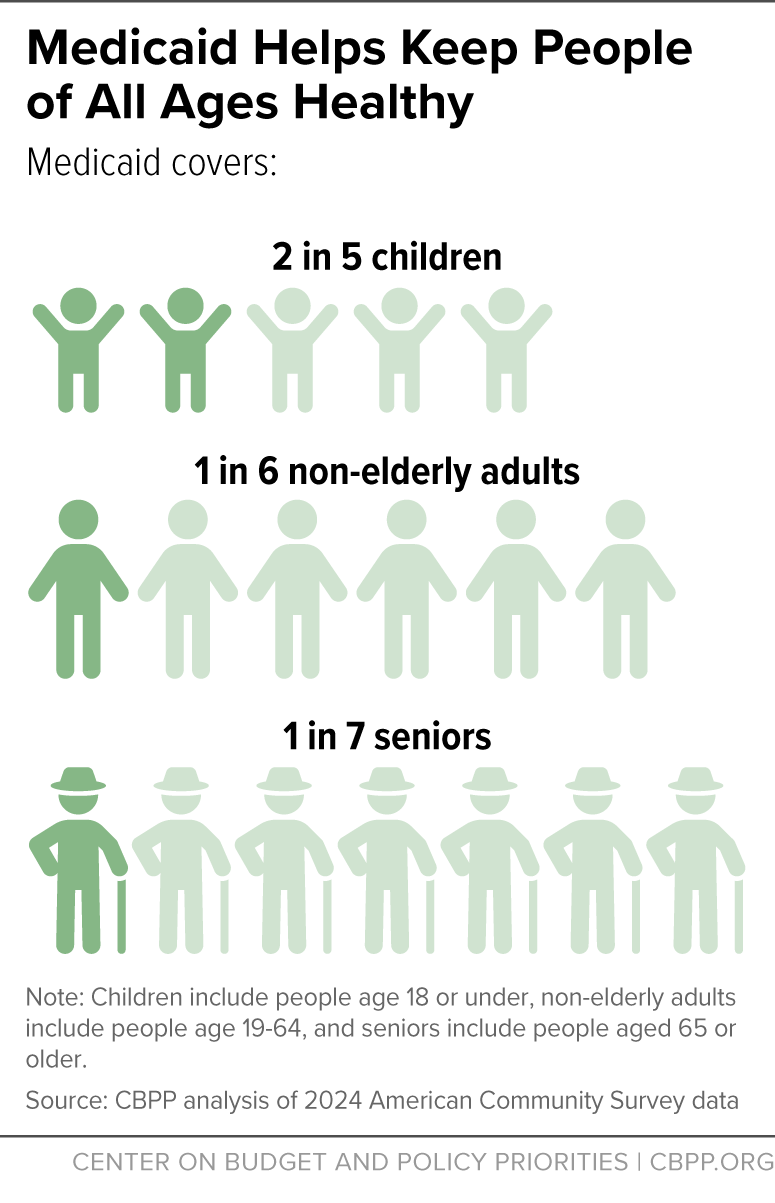
Medicaid ensures that people of all ages have access to the health care they need, covering 2 in 5 children, 1 in 6 non-elderly adults, and 1 in 7 seniors nationwide.[3] (See Figure 1.)
Around 12 million low-income seniors and people with disabilities were enrolled in both Medicare and Medicaid — so-called “dual eligibles” — as of November 2025, representing 1 in 6 Medicare enrollees.[4] Medicaid provides dual eligible enrollees with assistance for Medicare premiums and other out-of-pocket costs, along with coverage for certain services not covered by Medicare, such as non-emergency medical transportation and long-term care.
Medicaid covers 3 in 5 children with disabilities and 2 in 5 non-elderly adults with disabilities.[5] While people can qualify for Medicaid on the basis of a disability, eligiblity through disability pathways is limited to people who meet stringent disability criteria. As a result, income-based eligibility pathways (e.g., children, parents, Affordable Care Act expansion adults) are another important source of coverage for people with disabilities. For instance, 2 in 3 non-elderly Medicaid adults with disabilities do not receive Supplemental Security Income; it is likely that many of these people are enrolled through a non-disability pathway such as the Affordable Care Act’s Medicaid expansion.[6]
Medicaid expansion has substantially improved access to health coverage. As of June 2025, around 20 million non-elderly adults with low incomes were enrolled through the Affordable Care Act’s Medicaid expansion,[7] which gives states the option to extend eligibility for low-income adults. In the 40 states and the District of Columbia that have implemented the expansion, Medicaid covers almost 1 in 5 non-elderly adults, compared with 1 in 10 non-elderly adults in the ten remaining non-expansion states.[8]
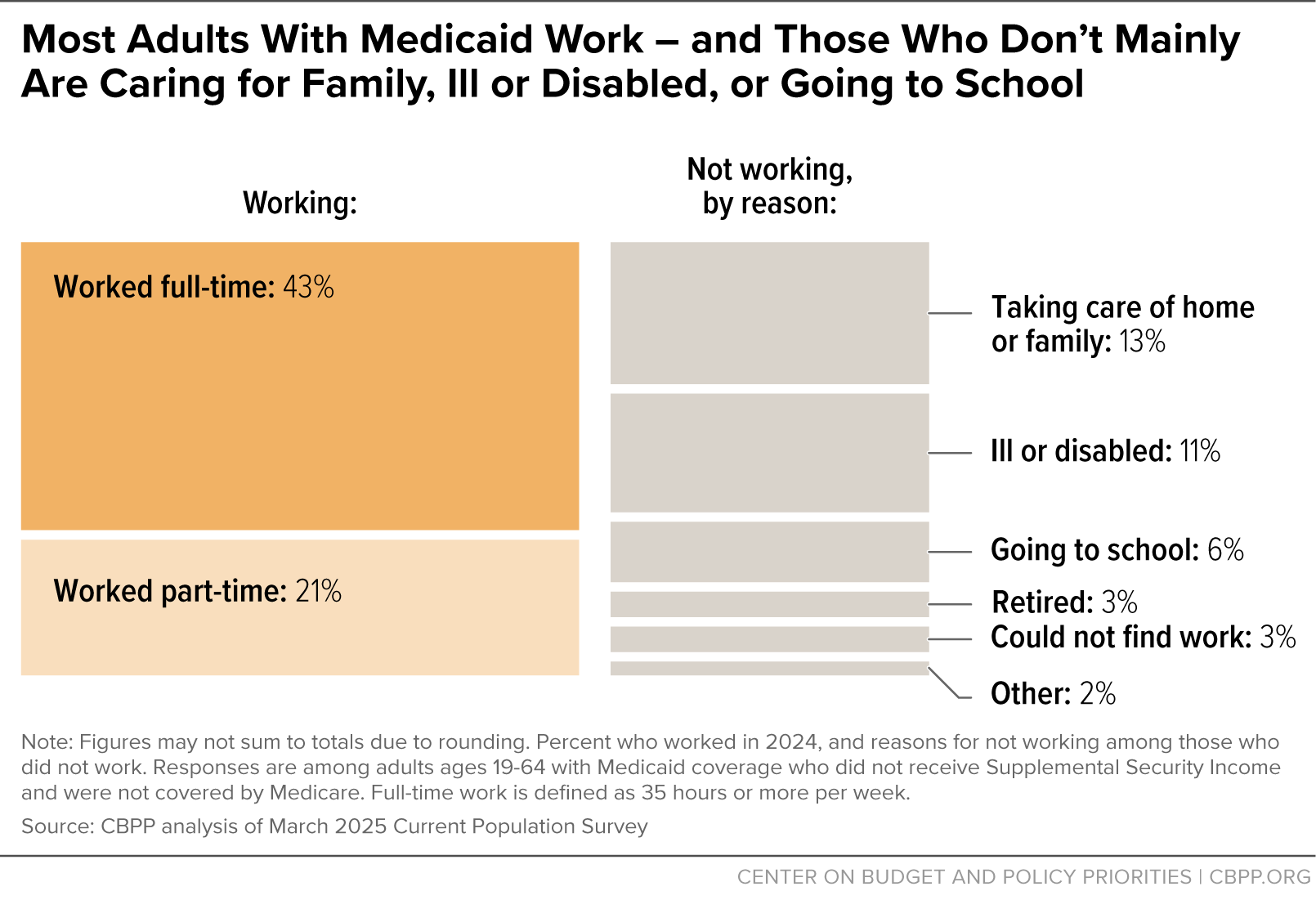
Nearly 2 in 3 adult Medicaid enrollees work — many in low-paying occupations that do not offer job-based coverage — and most enrollees who are not working have a disability, are caring for family members, or are attending school.[9] (See Figure 2.) The Medicaid expansion provides a pathway to affordable coverage for many of these people. Nevertheless, the Republican megabill undermines the expansion by adding unprecedented red tape, including a harsh work requirement and more frequent eligibility redeterminations. As a result of these policies, 6 million people could lose health coverage and become uninsured by 2034.[10]

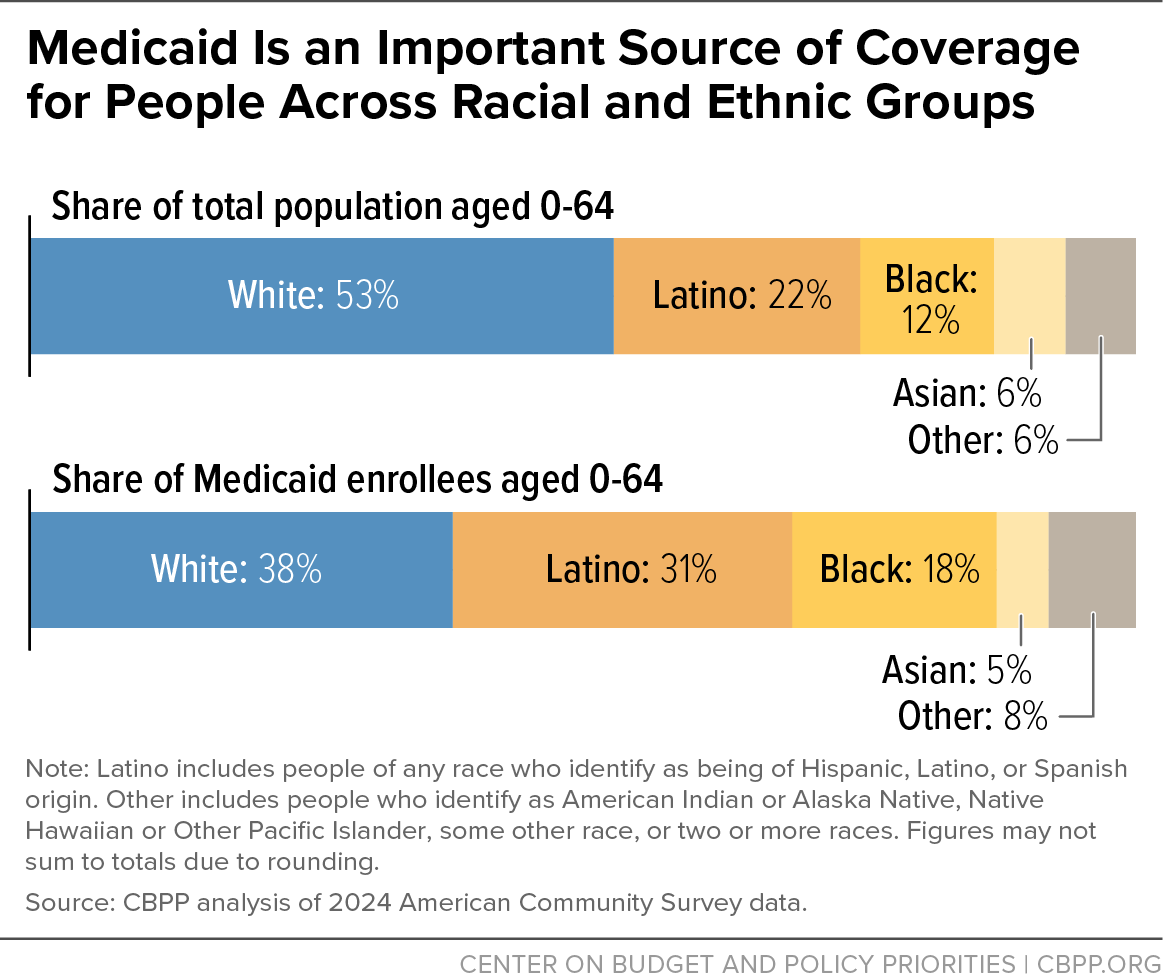
Medicaid provides coverage for people across racial and ethnic groups. For children and adults ages 0 to 64, it covers 1 in 6 white people, 1 in 3 Black people, 3 in 10 Latino people, 1 in 6 Asian people, 2 in 5 American Indian or Alaska Native people, 3 in 10 Native Hawaiian or Other Pacific Islander people, and 1 in 4 multiracial people. [11] In 2024, people of color made up 47 percent of the non-elderly U.S. population, but 62 percent of the non-elderly Medicaid population.[12] (See Figure 3.) While this reflects the systemic inequities that make people of color more likely to have low incomes that qualify for Medicaid, it also shows the critical role Medicaid plays in reducing inequities in uninsured rates.

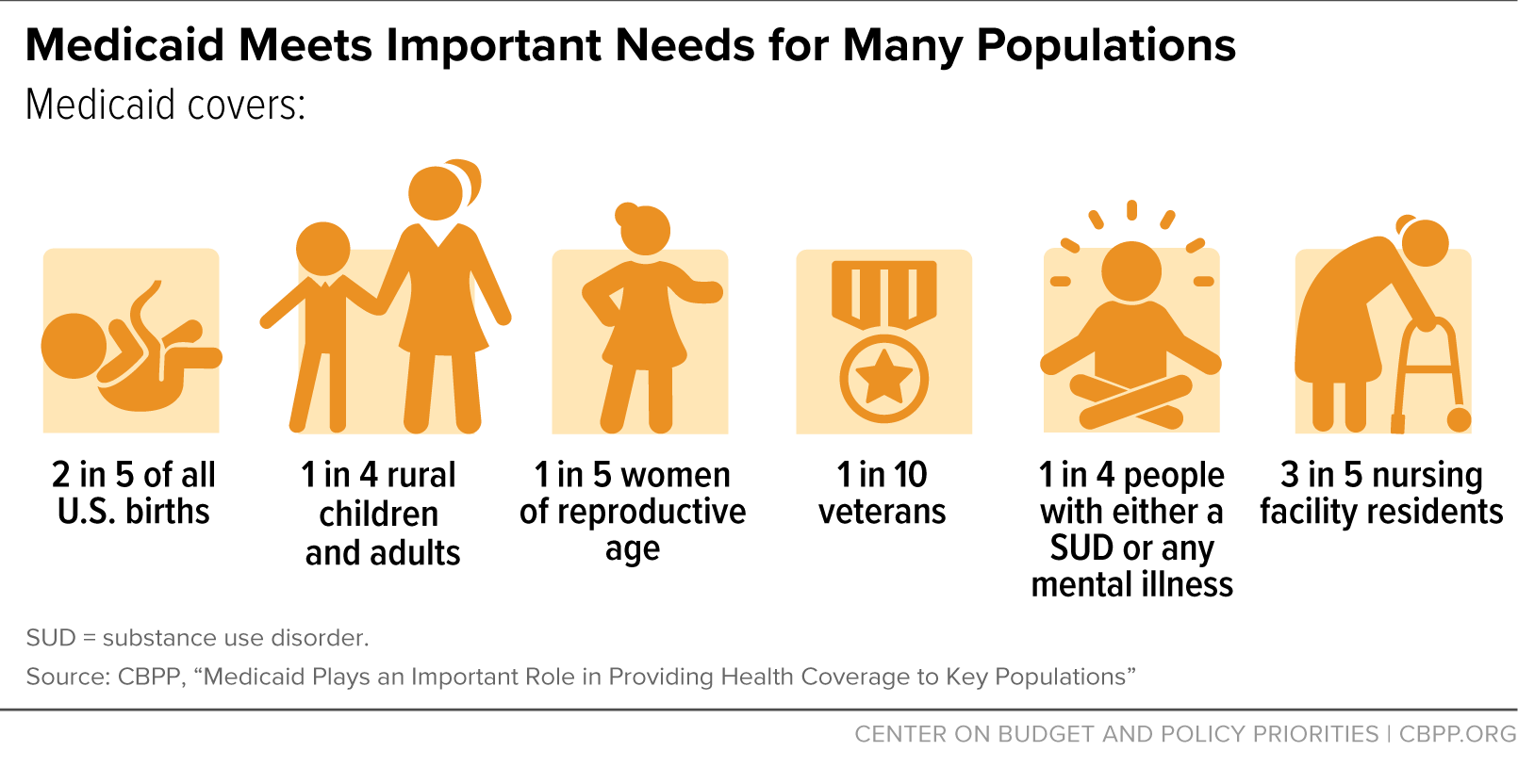
Medicaid meets important needs for many populations. This includes covering:
- 2 in 5 of all U.S. births;[13]
- 1 in 4 rural children and non-elderly adults, compared with 1 in 5 urban children and non-elderly adults;[14]
- 1 in 5 women of reproductive age;[15] and
- 1 in 10 veterans.[16]
Medicaid is also the primary payer of certain key services that people across the country need. For example, Medicaid covers:
- 1 in 4 people with either a substance use disorder or a mental illness;[17] and
- the majority — 3 in 5 — of nursing facility residents.[18] (See Figure 4.)

End Notes
[1] Centers for Medicare & Medicaid Services (CMS), ”October 2025 Medicaid & CHIP Enrollment Data Highlights,” updated January 29, 2026, https://www.medicaid.gov/medicaid/national-medicaid-chip-program-information/medicaid-chip-enrollment-data/october-2025-medicaid-chip-enrollment-data-highlights.
[2] CBPP, “By the Numbers: Harmful Republican Megabill Will Take Health Coverage Away From Millions of People and Raise Families’ Costs,” updated August 27, 2025, https://www.cbpp.org/research/health/by-the-numbers-harmful-republican-megabill-will-take-health-coverage-away-from.
[3] CBPP analysis of 2024 American Community Survey (ACS) data. Children include people age 18 or under, non-elderly adults include people ages 19-64, and seniors include people age 65 or older. Estimates include people who report enrolling in Medicaid, the Children’s Health Insurance Program, or any kind of government-assistance plan for those with low incomes or a disability.
[4] CMS, monthly Medicare enrollment data for November 2025, updated February 19, 2025https://data.cms.gov/summary-statistics-on-beneficiary-enrollment/medicare-and-medicaid-reports/medicare-monthly-enrollment.
[5] CBPP analysis of 2024 ACS data.
[6] CBPP analysis of 2024 ACS data. People who receive Supplemental Security Income generally qualify automatically for Medicaid on the basis of a disability.
[7] CMS, “Medicaid Enrollment Data Collected Through MBES,” April-June 2025 Medicaid MBES Enrollment, February 2026, https://www.medicaid.gov/medicaid/national-medicaid-chip-program-information/medicaid-chip-enrollment-data/medicaid-enrollment-data-collected-through-mbes.
[8] CBPP analysis of 2024 ACS data.
[9] CBPP analysis of March 2025 Current Population Survey data for 2024.
[10] CBPP, “By the Numbers: Harmful Republican Megabill Will Take Health Coverage Away From Millions of People and Raise Families’ Costs,” updated August 27, 2025, https://www.cbpp.org/research/health/by-the-numbers-harmful-republican-megabill-will-take-health-coverage-away-from. The estimate of 6 million people becoming uninsured does not account for interactions between the work requirement and more frequent redeterminations provisions.
[11] CBPP analysis of 2024 ACS data. Latino includes people of any race who identify as being of Hispanic, Latino, or Spanish origin. Other reported groups exclude people who identify as Latino.
[12] CBPP analysis of 2024 ACS data.
[13] Centers for Disease Control and Prevention, 2024 Natality public-use data, CDC WONDER Online Database, https://wonder.cdc.gov/natality-expanded-current.html.
[14] U.S. Census Bureau, 2024 ACS 1-year estimates, table S2704, by residence in a metropolitan statistical area.
[15] CBPP analysis of 2024 ACS data. Estimates include people ages 19-49 reporting sex as female.
[16] CBPP analysis of 2024 ACS data. Estimates include veterans ages 18-64.
[17] CBPP analysis of the 2023 National Survey on Drug Use and Health. Estimates include people ages 18-64.
[18] KFF, “Distribution of Certified Nursing Facility Residents by Primary Payer Source,” data for 2025, https://www.kff.org/state-health-policy-data/state-indicator/distribution-of-certified-nursing-facilities-by-primary-payer-source.