

A Record of Historic Harm in the First Year of Trump’s Second Term
The Trump Administration and congressional Republicans advanced one of the most radically regressive policy agendas in our nation’s history during the first year of President Trump’s second term. As a result, tens of millions of people will be less able to meet the growing cost of their basic needs — whether it’s affording groceries, seeing a doctor, keeping the power on, or paying the rent — even as the wealthiest households get a windfall of more tax breaks. At the same time, President Trump and his Administration have undermined and corrupted many basic functions of government, including the proper and timely allocation of funds approved by Congress, leading to more disruption and harm.
Some of this extreme agenda was enacted in July 2025 in the Republican megabill, H.R. 1. The Trump Administration is advancing other parts administratively, often circumventing the law. Many of these harmful policies were proposed prior to the 2024 election in the highly controversial Project 2025 (see box, below), which then-candidate Donald Trump disavowed, but which he and his Administration have, nevertheless, pushed forward.
The breadth of actions harming low- and moderate-income people over the last year is staggering, with huge cuts to health coverage, food assistance, and other basic needs programs, paired with hikes in tariffs that add to families’ affordability challenges. People are already feeling the impact of some of these cuts and policies, and the squeeze on them will tighten as other cuts get implemented over the next few years. Immigrants, people of color, and transgender people have been specifically targeted by President Trump’s agenda, but its harmful impact will be broadly felt, including by working families of all races, people with disabilities, children, and veterans. If the labor market continues to falter, the harsh impact of some of these policies will be felt even more broadly, as the megabill’s cuts to SNAP and Medicaid diminish those programs’ responses to increased need.
The cuts to critical programs that help people meet their basic needs, while enormous, don’t come close to offsetting the cost of last year’s extension and expansion of huge tax breaks heavily skewed to wealthy households and businesses. The resulting projected deficit increase of over $3 trillion may be used by President Trump and Republican congressional leaders to justify calls for even more cuts to basic needs programs in the future.
As this report shows, the Trump Administration’s agenda during its first year lays the groundwork to, among other things:
- Diminish access to vital public services by pushing out federal workers who operate critical programs and by illegally withholding federal funds.
- Take away health coverage from roughly 15 million people and hit many millions more with higher health care costs.
- Slash SNAP with the deepest cut in history, terminating or substantially cutting food assistance for about 4 million people (including 1 million children), after suspending benefits for the first time ever last November.
- Provide huge tax breaks for the wealthy while low- and moderate-income households see tax cuts that average less than a dollar a day.
- Take away critical health, food, and tax benefits from people with lawful immigration status and their families.
- Threaten housing access, including for formerly homeless people, and allow discriminatory housing practices.
The human cost of these cuts and harmful changes is extremely high — both for the individuals and families who will be denied assistance and ultimately for our nation as a whole. Taking away health coverage, food assistance, and other critical support from people will increase poverty and hardship, undermine the ability of some to find and retain employment, and harm children’s health, well-being, and educational outcomes.
And despite the harm already done, the Administration and Republican leaders in Congress show no signs of recognizing the challenges facing millions of people, as they put forward more harmful proposals that could further raise costs and increase hardship.
There is a vastly better path for our nation. We can have a fairer tax code that promotes economic growth and finances investments in our future. We can take steps to make food, health, housing, and child care more affordable for people who face real challenges making ends meet. And we can invest in people and communities to promote opportunity, equality, and equity, and reject the Administration’s choice to demonize, scapegoat, and terrorize people and escalate violence in communities.
Undermining Public Services: Attacking the federal workforce, delaying and withholding funding, and trying to dismantle agencies without congressional approval
The Trump Administration has undermined government services all of us use by targeting the federal workers responsible for providing or overseeing them, while also undercutting the critical work of federal, state, and nonprofit agencies by delaying and withholding funding (often illegally) that Congress approved for specific purposes.
Attacking the Federal Workforce
Starting with Elon Musk and the so-called Department of Government Efficiency (DOGE) and continuing through President Trump’s first year, the Administration has radically — and frequently illegally — reduced the federal workforce, including through mass layoffs, buy-out offers that led many experts to leave federal service, and attrition. This hollowing out of the federal workforce is negatively affecting everything from helping people after disasters to helping them file for Social Security benefits.
The Office of Personnel Management (OPM) has released data showing that the Administration cut the number of federal employees by nearly 220,000, roughly 10 percent of the civilian federal workforce, between January and November of 2025. These cuts were not authorized by Congress nor were they necessary based on available funding. (In fact, in many cases the Administration used funding Congress had provided to pay staff for the administration, oversight, or delivery of federal programs and services and redirected it to unauthorized financial incentives encouraging federal workers to leave government.)
The cuts are widespread. (See Figure 1.) For example, federal employment at the Department of Veterans Affairs (VA) declined by more than 27,000 workers between January and November of 2025. These cuts come even after a VA Inspector General report found that staffing shortages in the VA medical system increased significantly over the last year, affecting veterans’ access to a range of services, especially psychiatric care.
Another notable example of the Trump Administration pushing out federal workers is the Social Security Administration (SSA), which experienced its largest staff cuts ever over the last year. Between January 2025 and November 2025, the number of staff at the agency fell by 6,500 overall according to OPM, even as the number of people who receive Social Security benefits continues to rise as the baby boom generation retires. Cuts in the number of staff available to serve elderly and disabled beneficiaries at local offices have been significant, with 2,000 field office staff pushed out and at least 1,000 more reassigned to answer the agency’s toll-free number. SSA also eliminated most of the staff in its regional offices, which provide daily support to field staff on complex problems and questions arising from efforts to help those applying for or receiving Social Security or Supplemental Security Income benefits. The changes at SSA have led to considerable frustration for people facing long call wait times and confusing automated systems.
Additionally, untrained DOGE political appointees threatened the security of people’s personal information when they were given unprecedented access to sensitive SSA data. These DOGE staff overrode the agency’s assessment of “very high risk” and placed the sensitive data of hundreds of millions of people in an insecure cloud environment, risking a catastrophic breach.

Another agency that has seen large cuts is the Internal Revenue Service, which fell from over 100,000 employees in November of 2024 to under 80,000 a year later. The IRS had ramped up its staffing during the Biden Administration to improve customer service for households and businesses filing their taxes, modernize IRS systems, and expand enforcement efforts to ensure more of the taxes that are owed are paid.
Finally, workers whose job it is to address fraud and program integrity, namely those in inspector general offices, were also on the chopping block. These cuts in watchdog staff came after President Trump fired 17 inspectors general shortly after taking office.
Delaying, Withholding, and Politicizing Public Funding
Since taking office, the Trump Administration has, for political reasons, engaged in a widespread campaign to delay and withhold funding approved by Congress, often violating federal law. The Administration has blocked and stymied federal grants going to state and local governments, community-based nonprofits, and research institutions nationwide. In one example from early in 2025, the Trump Administration interrupted funds to community health centers in at least ten states, even after a federal court prohibited a freeze on federal grants. This funding disruption caused at least some clinics to reportedly close for a time, denying crucial primary care to people in underserved communities.
In some cases, like when the Administration withheld federal education funding and states sued, the funds were eventually released. In other cases, funding is still at risk. For example, at the beginning of 2026, the Trump Administration announced that it was withholding federal funding to help low-income families with basic assistance, child care, and social services in five states with Democratic governors. (Those states sued and the court issued a temporary restraining order requiring the funds to be unfrozen.)
This is yet another example of the Administration politicizing federal funding – a concern that has previously been linked to disaster relief, with requests from Democratic governors more likely to be delayed or denied. In one glaring illustration, President Trump has still not sent a request to Congress to provide the funds requested by California to help rebuild communities devastated by wildfires. Additionally, the Trump Administration is being investigated for terminating billions of dollars in clean energy projects in states that voted against President Trump in the 2024 election.
The Trump Administration also has used a variety of broader actions, such as impoundments, delays, claw backs, or so-called pocket recissions, to prevent approved funding from reaching the people for whom it was designated. For example, the Administration illegally withheld funding for foreign aid programs until that money was no longer available. Such efforts to withhold funding have eroded Congress’s spending authority and have made it more difficult for legislators to reach bipartisan funding agreements.
Closing or Partially Shuttering Federal Agencies Without Congressional Approval
In another effort to bypass Congress’s authority, the Trump Administration has attempted to close or partially dismantle federal agencies with responsibilities ranging from promoting and funding education to protecting consumers’ rights in the financial marketplace. For example, in the absence of congressional approval for President Trump’s proposed complete elimination of the Department of Education, his Administration is attempting to dismantle the agency piece-by-piece, by transferring a number of its core functions to other federal agencies without the expertise and staff to handle them. For example, the Administration is moving some of the largest elementary and secondary education programs out of the Department of Education, despite the Department’s deep ties to school districts and expertise in the supports and services vulnerable students need.
Federal courts have stepped in to block some of the Trump Administration’s attempts to eliminate congressionally authorized agencies, such as its ongoing effort to shutter the Consumer Financial Protection Bureau (CFPB), which helps people dealing with credit reporting errors, predatory lending practices, discrimination, and other problems with banks and lenders. After a months-long court battle, the Administration indicated that it would fund CFPB in response to a court order in early January, although the Administration may continue its efforts to dismantle CFPB through other means.
Taking Away Health Care: Huge coverage losses, higher costs for consumers, and new costs shifted to states
Health coverage through Medicaid and the Affordable Care Act (ACA) marketplaces improves people’s health by increasing detection, diagnosis, treatment, and prevention of serious medical conditions. It also improves financial well-being, as indicated by the Census Bureau’s Health Inclusive Poverty Measure, which found that Medicaid kept 15 million people above the poverty line in 2024. Medicaid is particularly effective for reducing health coverage inequities for people of color, who in 2023 accounted for 46 percent of the non-elderly U.S. population, but 61 percent of non-elderly Medicaid enrollees.
The ACA’s expansion of Medicaid and the enhancements to the premium tax credit for ACA marketplace coverage led to an all-time low uninsured rate in 2023. But this major advance in health coverage and affordability is now undermined by the $1.1 trillion in health care cuts enacted in the Republican megabill and congressional Republicans’ failure to extend the premium tax credit enhancements.
Huge Coverage Losses
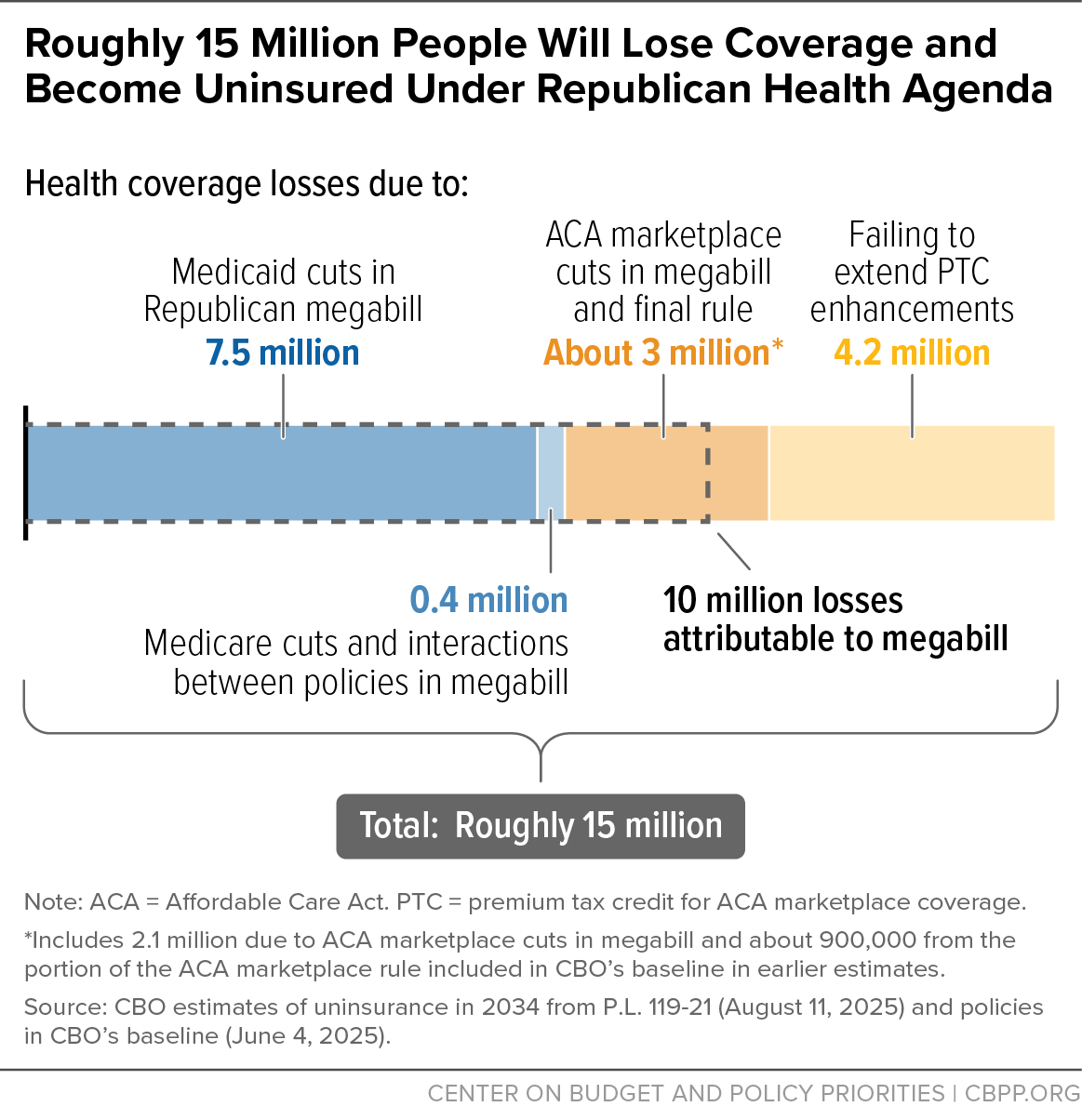
Nearly 15 million people will have their health coverage taken away and become uninsured as a result of the historic cuts in the megabill and the failure to extend the premium tax credit enhancements, based primarily on estimates from the nonpartisan Congressional Budget Office. (See Figure 2.)
More than 5 million people are projected to become uninsured by 2034 because of just one provision in the megabill that will take Medicaid away from people who don’t meet a harsh, red tape-laden work requirement or will prevent them from enrolling in coverage in the first place. Those at risk of losing coverage include people with a disability, even if they should be exempt from the work requirement, and people who are working because they get caught up in bureaucratic red tape. In 2018, Arkansas temporarily implemented a Medicaid work requirement that eliminated health coverage for 1 in 4 of those subject to it, with disabled people “particularly vulnerable” to having their Medicaid coverage terminated given complicated red tape.
Another 700,000 people are projected to lose Medicaid and become uninsured due to the megabill’s requirement that expansion enrollees re-prove their eligibility every six months (instead of annually). An additional 4.2 million people will lose ACA marketplace coverage because President Trump and congressional Republican leaders have refused to extend the premium tax credit enhancements, with extension efforts by Democrats and some Republicans continuing. A further 900,000 people are projected to lose health care because of executive actions taken by the Trump Administration, which, among other things, impose new burdensome verification requirements on people with ACA marketplace coverage and adjust ACA premium calculations in ways that will raise costs.

Finally, over a million immigrants lawfully living in the U.S. will have their health coverage through Medicare, Medicaid, the Children’s Health Insurance Program, and the ACA marketplaces taken away because of changes passed in the megabill.
Higher Costs for Consumers
About 22 million people, including 5 million small business owners and self-employed workers, will see their health coverage costs skyrocket or lose coverage altogether in 2026 because of the failure to extend the premium tax credit enhancements. As an example, a family of four making $70,000 (217 percent of the federal poverty level) who is enrolled in benchmark coverage could face an increase in annual premium costs of over $3,000. Additionally, the megabill will raise costs for many Medicaid expansion enrollees by requiring states to charge working people with incomes just above the poverty line — $16,000 per year for an individual — new cost-sharing charges when they go to the doctor. And new burdensome verification requirements and red tape will make it harder for eligible people to maintain affordable ACA marketplace coverage.
New Costs Shifted to States
The Republican megabill imposes new restrictions on how states finance their Medicaid programs, including by severely limiting provider taxes for states that have expanded Medicaid. The megabill also cuts the federal funding states receive for emergency services provided to individuals who would qualify for the Medicaid expansion if not for their immigration status, adding more costs onto states. States will also be on the hook for potentially substantial costs associated with administering new harsh Medicaid work requirements and uncompensated care when the number of people lacking coverage rises.
One concern is that states facing these cost shifts will not be willing to invest the resources necessary to reduce the harm from policies like red tape-laden work requirements and more frequent eligibility reviews, both of which can drive down enrollment in Medicaid, leaving people without the coverage they need.
Drastically Reducing Food Assistance: Major structural change, historic cuts, and the first ever suspension of SNAP benefits
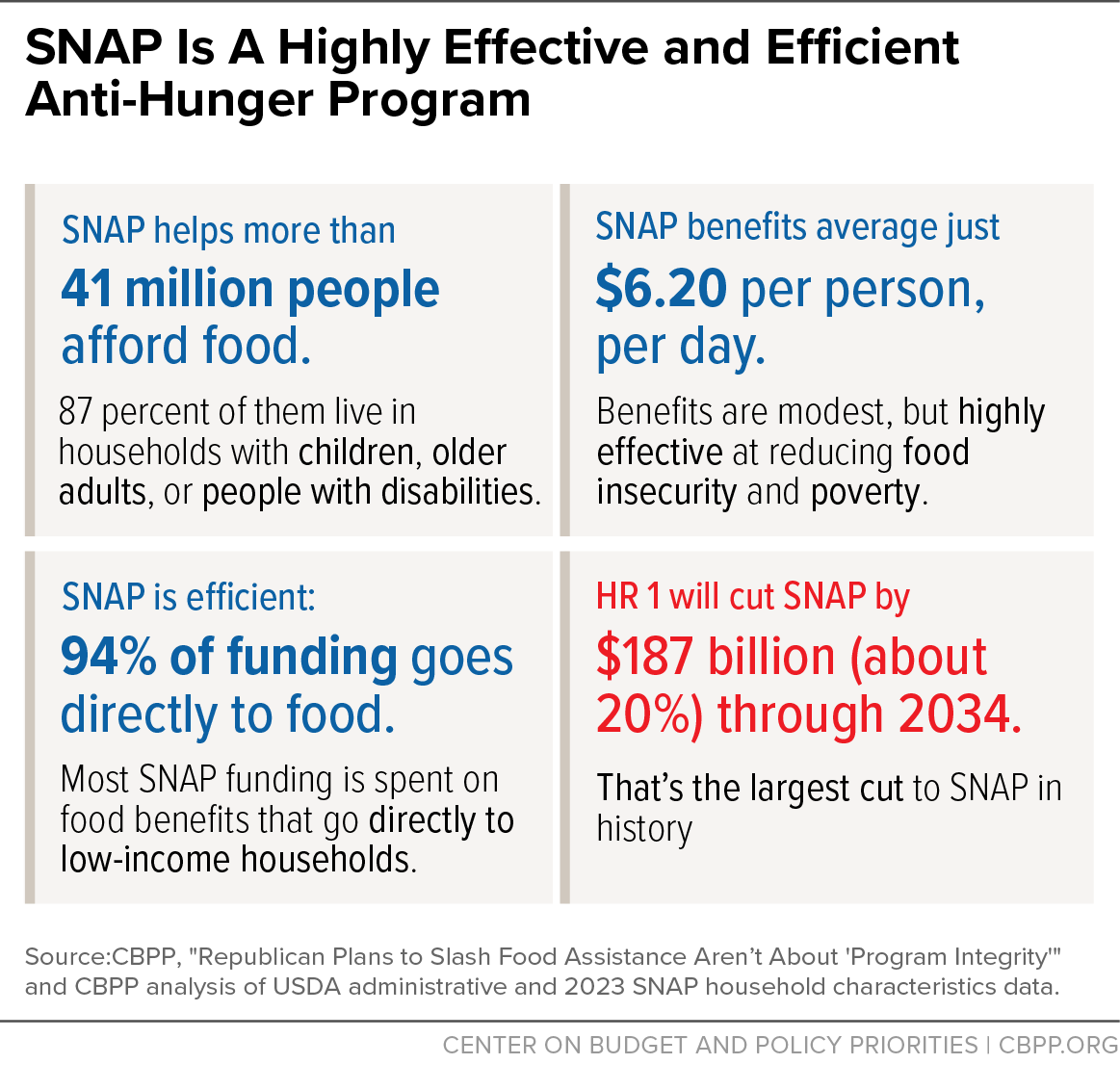
Prior to the July 2025 reconciliation law, SNAP represented a 50-year bipartisan commitment to address hunger regardless of which state a person lives. About 60 percent of SNAP recipients are in families with children, and 37 percent are in households with older adults or people with disabilities. The program is particularly important in supporting the food security of many working families and many households of color, given that food insecurity levels are at least twice as high for Black and Latine households compared to white households.
In total, the Republican megabill will cut SNAP by $187 billion (about 20 percent) through 2034 — the largest cut to SNAP in history. (See Figure 3.) Cutting SNAP will lead to more adults and children experiencing hunger and greater food insecurity, which has long-term adverse effects on adults’ health and children’s health and education. Remarkably, the Trump Administration has stopped the survey that measures food insecurity, the main data source that would document the harm from these cuts, despite adequate funding from Congress to continue the survey.
Major Structural Change to SNAP
For the first time in the history of SNAP, the federal government will no longer ensure that people in need have access to food assistance regardless of the state they live in. The megabill slashes billions in federal funding for states’ SNAP programs and forces unaffordable and volatile costs onto states. Most states will be newly required to pay 5 to 15 percent of food benefit costs; the share of SNAP benefits they have to pay depends on their payment error rate. This amounts to many billions of dollars, in addition to states being required to pay 75 percent (up from 50 percent) of SNAP’s administrative costs.
If a state can’t make up for these massive federal cuts with tax increases or spending cuts elsewhere in its budget, it will have to cut its SNAP program or potentially opt out of the program altogether, ending SNAP food assistance to everyone — children, seniors, people with disabilities, veterans, and other adults — in the state. CBO estimates that state responses to this unprecedented cost shift will result in 300,000 people having their SNAP benefits reduced or terminated in a typical month, but the impact could be far greater if states cut more deeply than CBO anticipated.
Finally, the Trump Administration’s lack of timely and actionable guidance, the rushed and unrealistic implementation timeline for major program changes, and disruption from the government shutdown will all contribute to more SNAP payment errors in 2026, setting states up to get hit with greater cost shifts starting in October 2027. But even as the Administration has been slow to fully provide states with implementation guidance about the SNAP cuts, the Department of Agriculture has been relatively quick to approve paternalistic pilot projects in at least 18 states to restrict the foods families can purchase with SNAP.
Historic Cuts
In a typical month, 2.4 million people will be cut off SNAP under the megabill’s significant expansion of the program’s already harsh and ineffective work requirement, CBO estimates. This policy will now ensnare older adults (ages 55-64), families whose youngest child is at least 14, people who live in areas where jobs are scarce, veterans, people experiencing homelessness, and youth who have aged out foster care. When these adults are cut off SNAP, benefits will be reduced significantly for their remaining household members; we estimate that about half a million additional people will experience a benefit cut as a result, including children, people with disabilities, and older adults.
Over time, the megabill will cut food assistance benefits for all 40 million participants, including 1 out every 5 children in the U.S., by restricting future updates to the Thrifty Food Plan, the basis for SNAP benefit levels. This will lead to SNAP benefits becoming increasingly inadequate to afford a healthy diet.
Other cuts in the megabill include a provision that makes it harder to qualify for SNAP’s Standard Utility Allowance, resulting in an estimated 600,000 households losing roughly $100 per month in food assistance. Additionally, many immigrants living lawfully in the U.S. and who have been granted humanitarian protections will now be denied SNAP benefits; CBO estimates that 90,000 people will lose SNAP in a typical month as a result.
At the same time, the Trump Administration is reportedly considering a regulatory proposal to drastically curtail a SNAP rule, known as broad-based categorical eligibility, that smooths out the benefit cliff for working households and allows seniors to have a little more in savings.
First-Ever Suspension of SNAP Benefits
There has never been a suspension of monthly SNAP food assistance until the Trump Administration refused to provide funding in November 2025 during the government shutdown. The Administration first argued it couldn’t use contingency funds set aside in statute for that purpose and then refused to redirect other funds legally available to it, despite having twice done so for the WIC program. The Trump Administration fought all the way to the Supreme Court to avoid paying full benefits to over 40 million people, until the shutdown ended and benefits finally resumed.

Imposing Regressive Taxes and Tariffs: Huge tax breaks for the wealthy, little benefit for everyone else and most worse off with tariffs, millions of children excluded from Child Tax Credit increase
Many changes in the Republican megabill make our tax system less progressive by providing larger tax cuts to households with high incomes than to households with low or middle incomes. The law also reduces revenues, which are needed to meet existing commitments and make important investments in our nation, and will add $3.4 trillion to the deficit over ten years (or more, if temporary tax provisions are extended without offsets). Further, the megabill on balance worsens income inequality, both overall and across racial and ethnic groups.
Huge Tax Breaks for the Wealthy
Under the Republican megabill, the average household with income of $1 million or more a year will receive an average annual tax cut of over $100,000 in 2027. The law provides $1.4 trillion in tax cuts to households with incomes over $500,000 a year, slightly more than all of the new law’s historic cuts to Medicaid and SNAP.
Significant provisions in the megabill are aimed solely or primarily at benefiting the very wealthy, including a bigger estate tax exemption for wealthy heirs, a tax break for pass-through businesses with over half the benefits going to millionaires, and a cut in the top tax rate for married couples with over $600,000 in taxable income. At the same time, the Trump Administration has continued to weaken tax enforcement for wealthy taxpayers, potentially costing hundreds of billions of dollars in tax collections. Relatedly, Internal Revenue Service staff is down 25 percent since the beginning of 2025.
Little Benefit for Everyone Else and Most Worse Off With Tariffs
The average household earning less than $50,000 will get about $250 in tax cuts in 2027 under the megabill, less than $1 a day. Within this group, over 44 million households will get almost nothing (less than a $100 tax cut in 2027) or see their taxes go up.
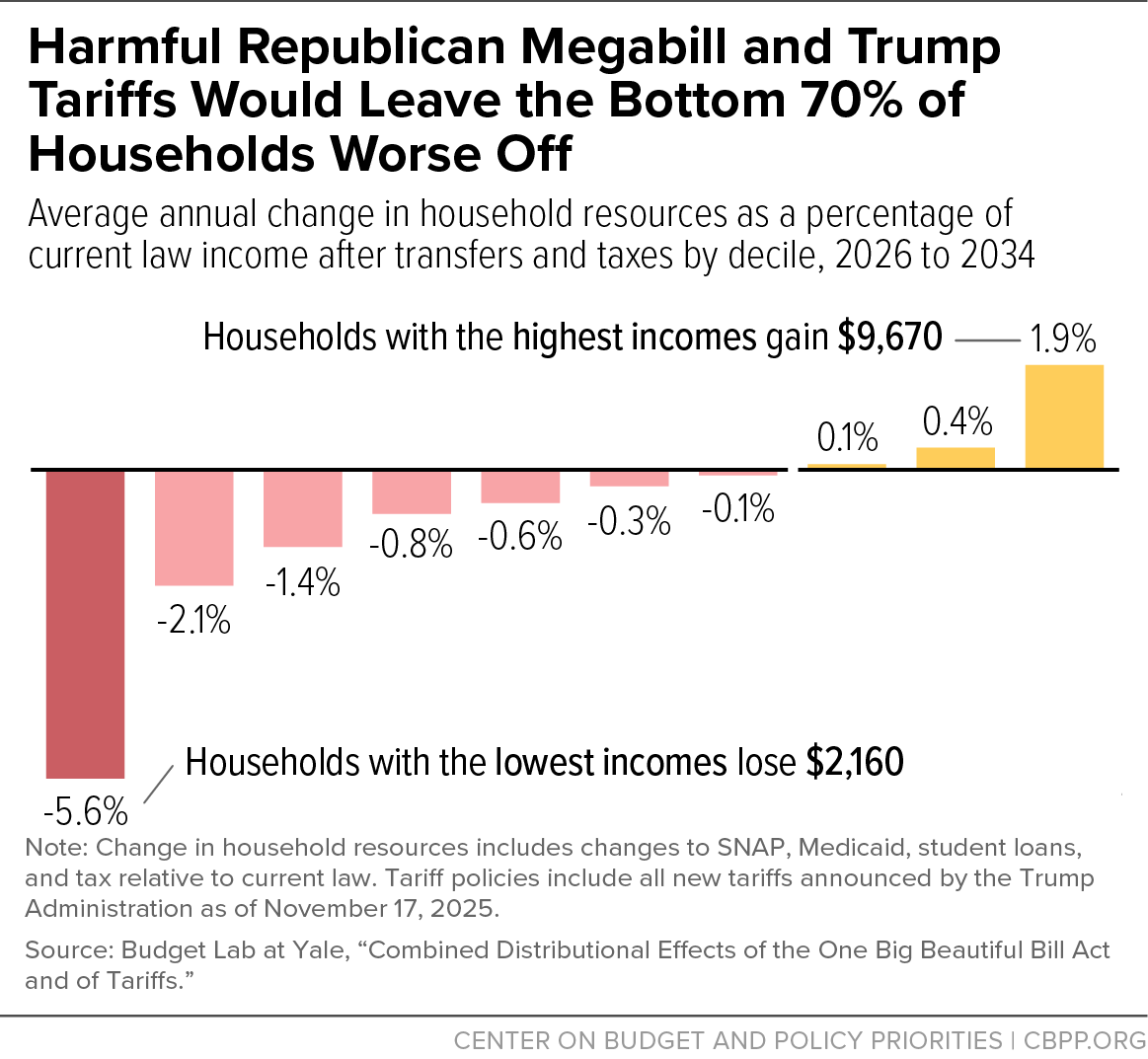
Moreover, even these modest tax cuts are effectively overwhelmed by the Trump Administration’s tariffs, which raise the price of imported goods and impose a larger burden on people with low and moderate incomes, making it harder for them to afford the basics. (See Figure 4.) The megabill also will reduce economic opportunities, harm long-term environmental conditions, and increase families’ energy costs by cutting more than $500 billion in clean energy incentives.
Finally, a number of the tax provisions the Administration has pointed to as helping lower-paid workers may have only limited benefits, especially given many of the same workers may also be losing vital health care and food assistance under the megabill. For example, exempting certain tips from federal income tax is estimated to help about only 1 percent of low-paid workers.

Millions of Children Completely Excluded From Child Tax Credit Increase
An estimated 19 million children will receive less than the full $200-per-child increase in the Child Tax Credit in the megabill — with 17 million of them receiving no increase at all because their parents don’t earn enough. And eligibility for the Child Tax Credit will be taken away from children who are U.S. citizens or have a lawful immigration status because of the megabill’s requirement that at least one of their parents have a Social Security number (SSN). Many studies of tax credits similar to the Child Tax Credit find evidence linking the additional income from the credits to improved health and educational outcomes during childhood, and increased educational attainment, employment, and earnings in young adulthood.
Targeting Immigrants: Blocking benefits for many with lawful immigration status, weaponizing data, and creating fear and confusion for immigrants and their families
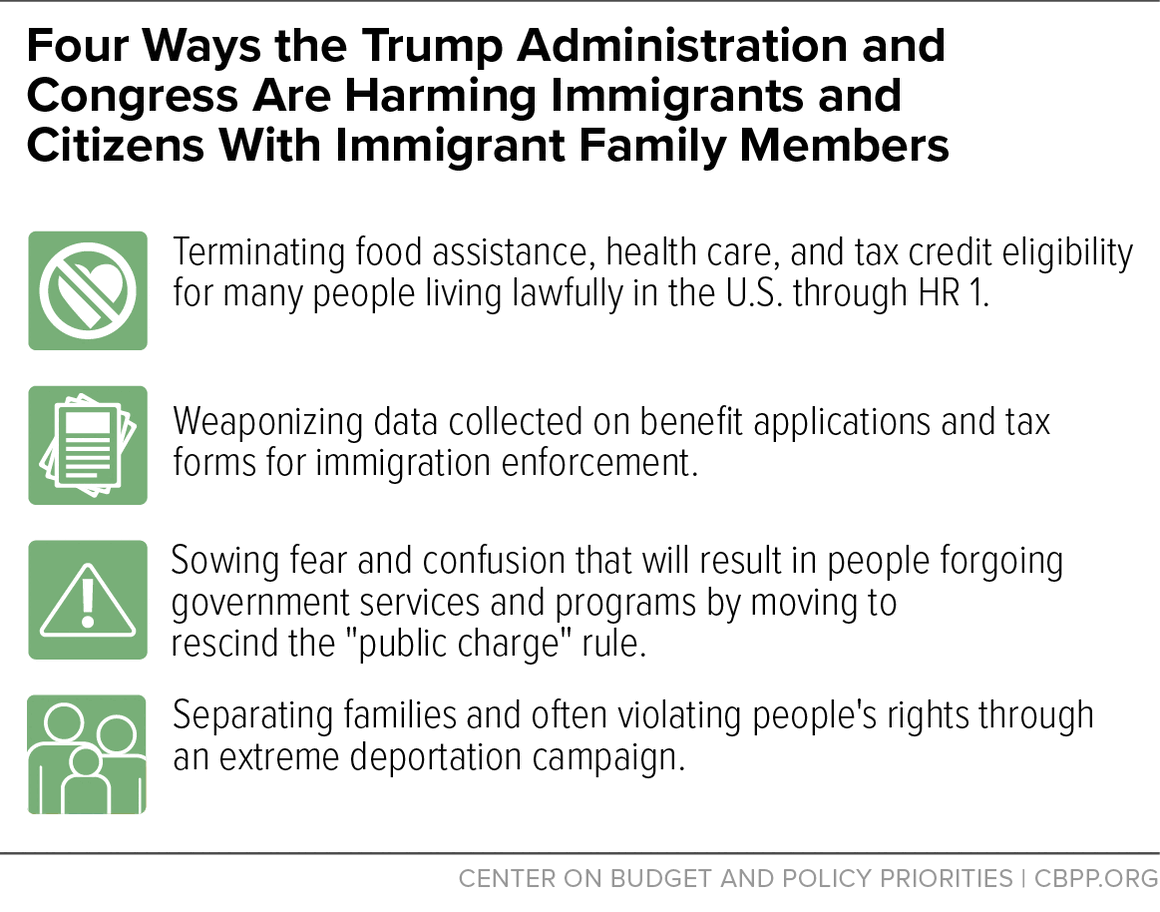
Federal laws have long barred people without a documented immigration status (as well as many people with lawful immigration statuses) from accessing Medicaid, SNAP, and other basic needs programs, even as many immigrants support these programs by working and paying taxes. The Republican megabill takes away these vital benefits from many additional people living in the U.S. lawfully, creating a new, far narrower, group who will remain eligible. On top of that, the Administration’s recent proposal to radically expand the “public charge” rule will have the effect of discouraging people from applying for help they need and for which they are eligible. Finally, the Trump Administration’s extreme deportation campaign has weaponized federal forces who are terrorizing and separating immigrant families, escalating violence in entire communities, and engaging in widespread civil rights violations. (See Figure 5.)
Blocking Health Coverage, Food Assistance, and Tax Credits
The Republican megabill terminates food and health coverage for many people who are living lawfully in the U.S., such as people granted humanitarian protections, including refugees, people granted asylum, and certain victims of domestic violence or labor or sex trafficking. Provisions in the new law related to Medicare, Medicaid, and the ACA premium tax credits will result in roughly 1.4 million people living lawfully in the U.S. losing health coverage by 2034, and 90,000 losing food assistance under SNAP in an average month.
The megabill also will deny the Child Tax Credit to children (including those who are U.S. citizens) who do not have at least one parent with a Social Security number, eliminating eligibility for these tax credits for 2.7 million children, according to one estimate. And just this past November, the Trump Administration indicated its intent to bypass Congress and deny the refundable portion of many tax credits to certain immigrants who are lawfully present, authorized to work in the U.S., and have SSNs. Among those who would lose the refundable portions of the Earned Income Tax Credit and the Child Tax Credit are people who arrived in the U.S. as children and have Deferred Action for Childhood Arrivals (DACA) and people who have applied for asylum.
Weaponizing Data
The Trump Administration has engaged in several efforts to share personal data collected on benefit applications, tax forms, and by other federal agencies with the Department of Homeland Security for immigration enforcement purposes. In an unprecedented break from long-standing practices related to taxpayer privacy, the Trump Administration established a procedure for the IRS to share taxpayer data with U.S. Immigration and Customs Enforcement (ICE) a practice which has since been halted after a U.S. District Court ruling found it likely unlawful. Among other problems, this highly controversial move could have a chilling effect on tax compliance from citizens, immigrants with lawful status, and people without a documented immigration status, who paid an estimated $66 billion in federal taxes in 2023 according to the Yale Budget Lab.
In a similarly stunning shift from long-standing precedent, the Centers for Medicare and Medicaid Services (CMS) issued a notice announcing a new Medicaid data sharing policy with ICE in which CMS will provide certain information to ICE upon request for the purpose of immigration enforcement. While a preliminary injunction is currently in effect limiting Medicaid data sharing with ICE in certain states, the weaponization of their health data is likely to deepen the fear and distrust among many families and dissuade many people from accessing health coverage they qualify for, including U.S. citizens who have immigrants in their families or people who are immigrants with lawful status.
Creating Fear and Confusion for Immigrants and Their Families
By moving to rescind the Biden Administration’s public charge rule, the Trump Administration is sparking fear and confusion among immigrants and their families. Eliminating the clear guardrails limiting officer discretion in the current rule could open the green card process to political and racial bias and arbitrary denials. The proposed rule also is seemingly designed to discourage eligible people and families from applying for vital food, health, and other assistance, stating, “the elimination of certain definitions may lead to public confusion…which could result in decreased participation in public benefit programs by individuals who are not subject to the public charge ground of inadmissibility.”
Threatening Access to Housing: Taking away housing assistance and ignoring discrimination
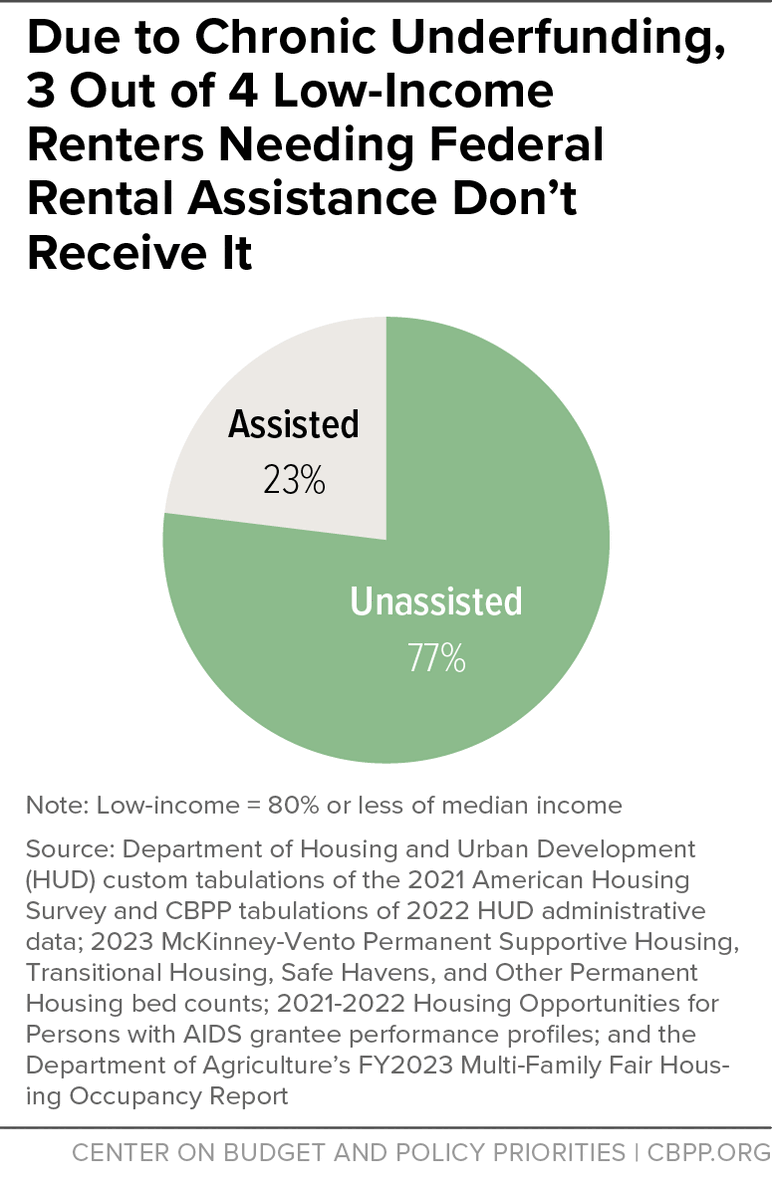



Housing is a basic human need and its high cost is a significant problem for many families, especially for the 3 in 4 households eligible for federal assistance who don’t receive it because of chronic underfunding. (See Figure 6.) There is also a long history of housing discrimination based on race and other factors that impacts people’s ability to find a home. And yet the Trump Administration is threatening housing for people experiencing, or on the brink of, homelessness and is abandoning efforts to enforce protections against discrimination in housing.
Threatening Housing for Formerly Homeless People and Other Threats to Housing Assistance
The Trump Administration issued a funding notice to strip over 170,000 formerly homeless people of their housing assistance, potentially forcing people back onto the streets or into cars or shelters. This is a direct threat to funding that supports evidence-based strategies that pair rental assistance with supportive services. A federal court has temporarily barred the Department of Housing and Urban Development (HUD) from implementing its new funding notice while litigation moves forward. The late timing and the agency’s chaotic approach is causing funding gaps for some providers and widespread uncertainty that are disrupting housing and services for formerly and currently homeless people.
Other looming threats to housing assistance include the Trump Administration’s call to take away rental assistance from people by imposing time limits and work requirements. This comes even as the Administration pushes for people who have lost their homes to be placed in jail or other “long-term institutional settings” that isolate people and limit their freedom of movement.
Weakening Protections Against Discrimination
The Administration has taken numerous steps that halt enforcement of discrimination protections in housing. HUD withheld funding and refused to issue new grants for the nonprofit organizations that consistently investigate the majority of housing discrimination complaints, until the Administration was ordered by a judge to issue grants (which had been appropriated by Congress). The Trump Administration also has moved to weaken fair housing requirements, roll back non-discrimination protections, and slash fair housing staff at HUD. Remaining fair housing staff have been ordered to drop years-long investigations and work only on cases hand-picked by political staff.