

The Child Tax Credit
Enacted in 1997 and expanded multiple times with bipartisan support since 2001, the Child Tax Credit helps make the cost of raising children more affordable for families. The credit is worth up to $2,200 per eligible child (under age 17 at the end of the tax year) for 2025.
The Child Tax Credit boosts families’ incomes and is an effective tool for reducing poverty nationwide. The credit lifted 4.1 million people ― including 2.4 million children ― above the poverty line in 2024.
Child Tax Credit Helps Families, But Leaves More Than 1 in 4 Children in Families With Lower Incomes Out of Full Credit
The Child Tax Credit helps make the cost of raising children more affordable for families by offsetting the federal income tax they owe or, if the value of the credit exceeds the tax they owe, by providing part or all of the credit in the form of a refund. This means that families can benefit from the credit even if their incomes are low enough that they owe little or no federal income tax in a given year. The credit starts phasing out for single parents at $200,000 of income, and for married couples at $400,000 of income.
The value of the Child Tax Credit for families with low and moderate incomes increases with their earnings, up to $2,200 per child. A family who earns between $2,500 and roughly $30,000 to $45,000 (depending on filing status and the number of children) in 2025 receives a partial credit, or less than $2,200 per child. A family who earns less than $2,500 receives no credit at all.
When filing taxes, the credit that families with lower incomes can claim is limited in two ways: the portion they can receive as a refund is equal to 15 percent of their earnings above $2,500 regardless of the number of children in the family, and the refund is capped at a lower maximum value — $1,700 per child for 2025. For example:
- A single mother who earned $20,800 in 2025 and has two children is eligible for a total credit amount of $2,745 (15 percent of $18,300) — which is only about $1,370 per child.
- A married couple who earned $30,000 in 2025 and has two children is eligible for a total credit amount of $3,400 (15 percent of $27,500 is $4,125, but the credit is limited to a maximum of $1,700 per child).

Congress enacted changes to the Child Tax Credit in the July 2025 reconciliation law (P.L. 119-21). These changes increased the maximum credit from $2,000 to $2,200 per child for 2025, took eligibility for the credit away from children who do not have at least one parent with a Social Security number, and indexed the maximum credit for inflation starting in 2026. These changes did not improve the way the credit is structured for families with lower incomes. As a result, an estimated 19 million children — or more than 1 in 4 children under 17 — will receive less than the full $2,200 credit in 2026, or no credit at all, because their families earn too little. This includes half of Black children, more than 4 in 10 American Indian and Alaska Native children, and more than 1 in 3 Latino children, whose families often face the effects of past and current discrimination and barriers to opportunity that have left them overrepresented in low-paying work. Making the full $2,200 credit available to families with lower incomes would also benefit roughly 1 in 5 white and 1 in 6 Asian children.
Families who do not qualify for the Child Tax Credit may be able to claim the $500 non-refundable Credit for Other Dependents (ODC), which was created under the 2017 tax law. For example, filers who use an Individual Taxpayer Identification Number may claim qualifying dependents of any age who have a Social Security number or Individual Taxpayer Identification Number for the ODC. Families with Child Tax Credit-qualifying children as well as ODC-qualifying dependents are eligible to claim the appropriate credit for each dependent.
Reducing Poverty and Expanding Children’s Opportunities
Despite the shortcomings of the Child Tax Credit, which policymakers should address, the credit has been a powerful tool to help lift families above the poverty line. Census data show that the Child Tax Credit lifted approximately 4.1 million people above the poverty line in 2024, including about 2.4 million children, based on the Supplemental Poverty Measure (SPM); it also provided more financial support to another 12.2 million people with incomes below the poverty line, including 5.6 million children.
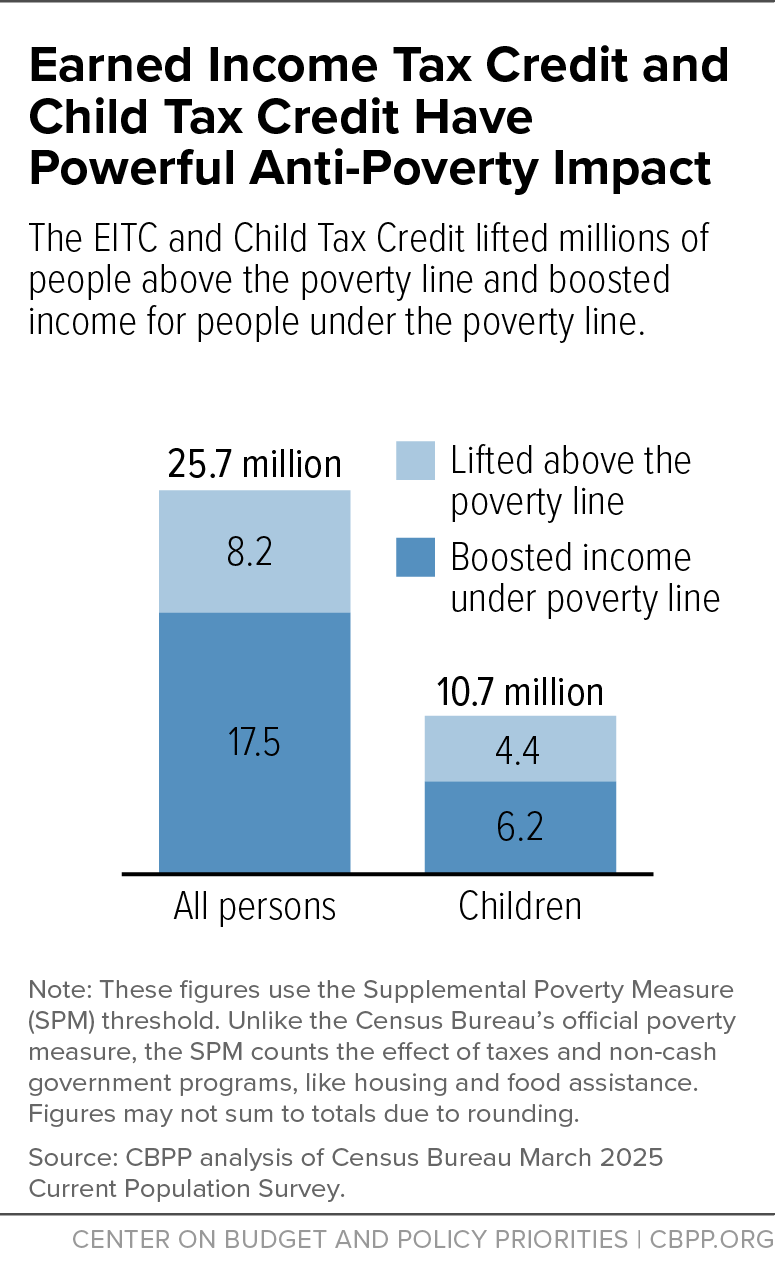
The credit lifted even more families with children above the poverty line when combined with the Earned Income Tax Credit (EITC) for families with children. The EITC and Child Tax Credit together lifted 8.2 million people above the SPM poverty line and provided more financial support to an additional 17.5 million people in 2024. (See figure above.) Many of the affected families with low incomes are ineligible for other tax-based assistance for children, such as the Child and Dependent Care Tax Credit, which is not refundable.
Many studies of tax credits similar to the Child Tax Credit find evidence linking additional income from the credits to improved health and educational outcomes during childhood, and increased educational attainment, employment, and earnings in young adulthood.
Recent Temporary Expansion of the Child Tax Credit
Congress expanded the Child Tax Credit for one year (2021) in the American Rescue Plan Act, enacted in March 2021. The law increased the maximum credit amount from $2,000 to $3,600 per child age 5 and under and to $3,000 per child age 6-17 (including 17-year-olds for the first time). The larger credit amount started phasing out for head of household tax filers at $112,500 and for married couples at $150,000. The underlying $2,000-per-child credit started phasing out for head of household tax filers at $200,000 and for married couples at $400,000.

The Rescue Plan also made the full credit available (generally known as making it “fully refundable”) to children whose parents had low or no earnings in a given year, and therefore previously received a partial credit or no credit at all. Under the expansion of the Child Tax Credit, the Treasury Department was also authorized to issue half of a family’s credit through advance monthly payments from July to December 2021 and half when the family filed their 2021 taxes. More than 90 percent of families with lower incomes used their monthly payments to buy food, pay utility bills, make rent or mortgage payments, buy clothing, and cover education costs.
The Rescue Plan also permanently made the $2,000-per-child credit available to all children living in Puerto Rico. Previously, only families with three or more children were eligible for the Child Tax Credit in Puerto Rico.
Finally, the Rescue Plan made the Child Tax Credit available, for the first time, to children living in other U.S. Territories — American Samoa, Guam, the U.S. Virgin Islands, and the Commonwealth of the Northern Mariana Islands — but just for 2021. These children had been excluded, and now continue to be excluded, from eligibility for this tax credit.
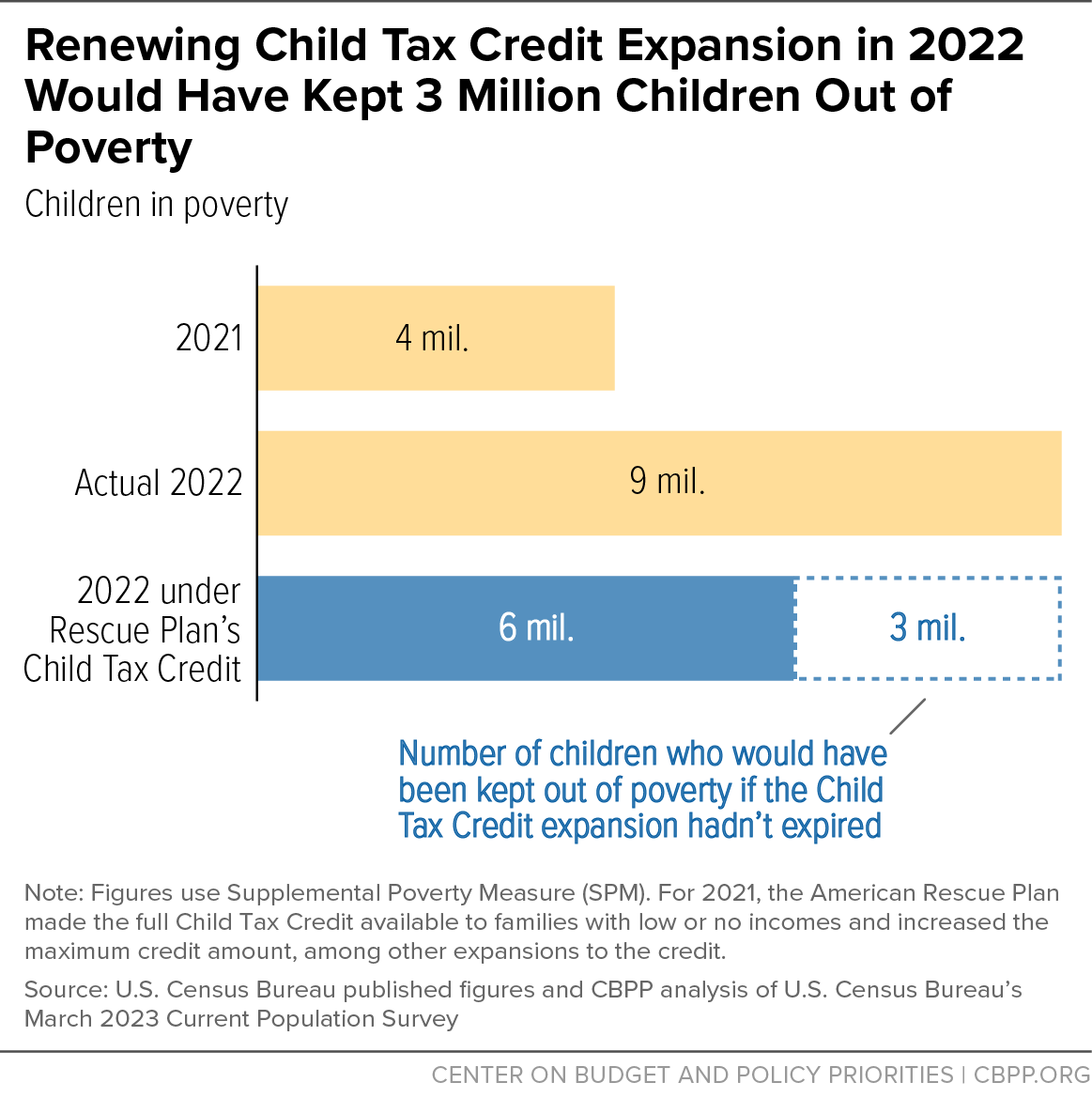
The Child Tax Credit expansion, together with other pandemic relief, helped drive down the number of children experiencing poverty to a historic low in 2021, but that number quickly rose again when the expansion and pandemic aid expired at the end of 2021. Census data show that 5.2 million more children were in families with income below the poverty line in 2022 compared to 2021. An extension of the Rescue Plan’s Child Tax Credit expansion in 2022 would have kept more than half of them — about 3 million children — out of poverty. (See figure above.)