

SNAP’s “Broad-Based Categorical Eligibility” Supports Working Families, Older Adults, and Those Saving for the Future
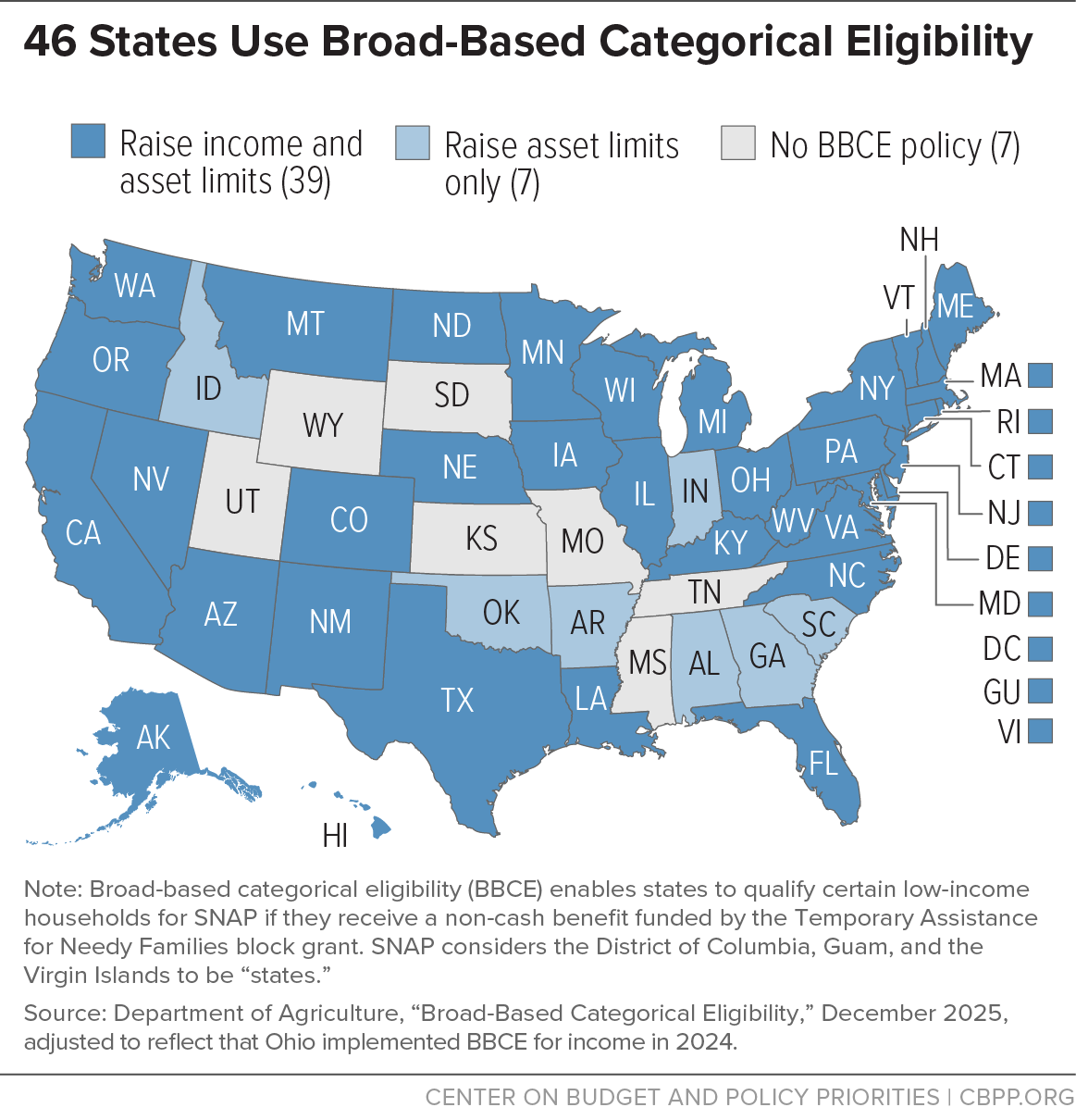
The Trump Administration is poised to issue a proposed regulation[1] essentially eliminating SNAP’s “broad-based categorical eligibility” (BBCE) policy, which 46 states have adopted to better support low-income working families and others, promote asset-building, minimize benefit cliffs, and improve state administration while lowering administrative costs and payment errors. (See Figure 1.)[2]
The Administration’s exact proposal is not yet public, but it would likely end SNAP (Supplemental Nutrition Assistance Program) food assistance for approximately 6 million people, including more than 1.8 million children, based on available estimates, and reduce access to school meals and WIC for many children as a result. (See box, “Eliminating BBCE Would Cut About 6 Million People Off SNAP.” See Table 1 at the end of this report for state-by-state estimates.)
BBCE has been available to states for almost 30 years. It enables them to raise their SNAP income eligibility limits somewhat so that many low-income working families who have difficulty making ends meet, such as those facing housing or child care expenses that consume a sizeable share of their income, can receive help affording adequate food. It also provides modest SNAP food assistance to many older adults and people with a disability whose net income after SNAP’s deductions are taken into account is slightly above the poverty line, who otherwise would not qualify for SNAP. And it allows states to adopt less restrictive asset tests so that families, older adults, and people with a disability can have modest savings without losing SNAP.[3] (See box, “What Is Broad-Based Categorical Eligibility?”)
Cuts to SNAP food assistance from eliminating BBCE would come on the heels of H.R. 1 — the harmful Republican megabill enacted in 2025 — which included the deepest SNAP cuts in history, terminating or substantially cutting food assistance for more than 4 million people, including about 1 million children. H.R. 1 also imposed a major structural change to SNAP: a cost shift to states under which the federal government will no longer ensure that people in need have access to food assistance regardless of the state they live in.[4]

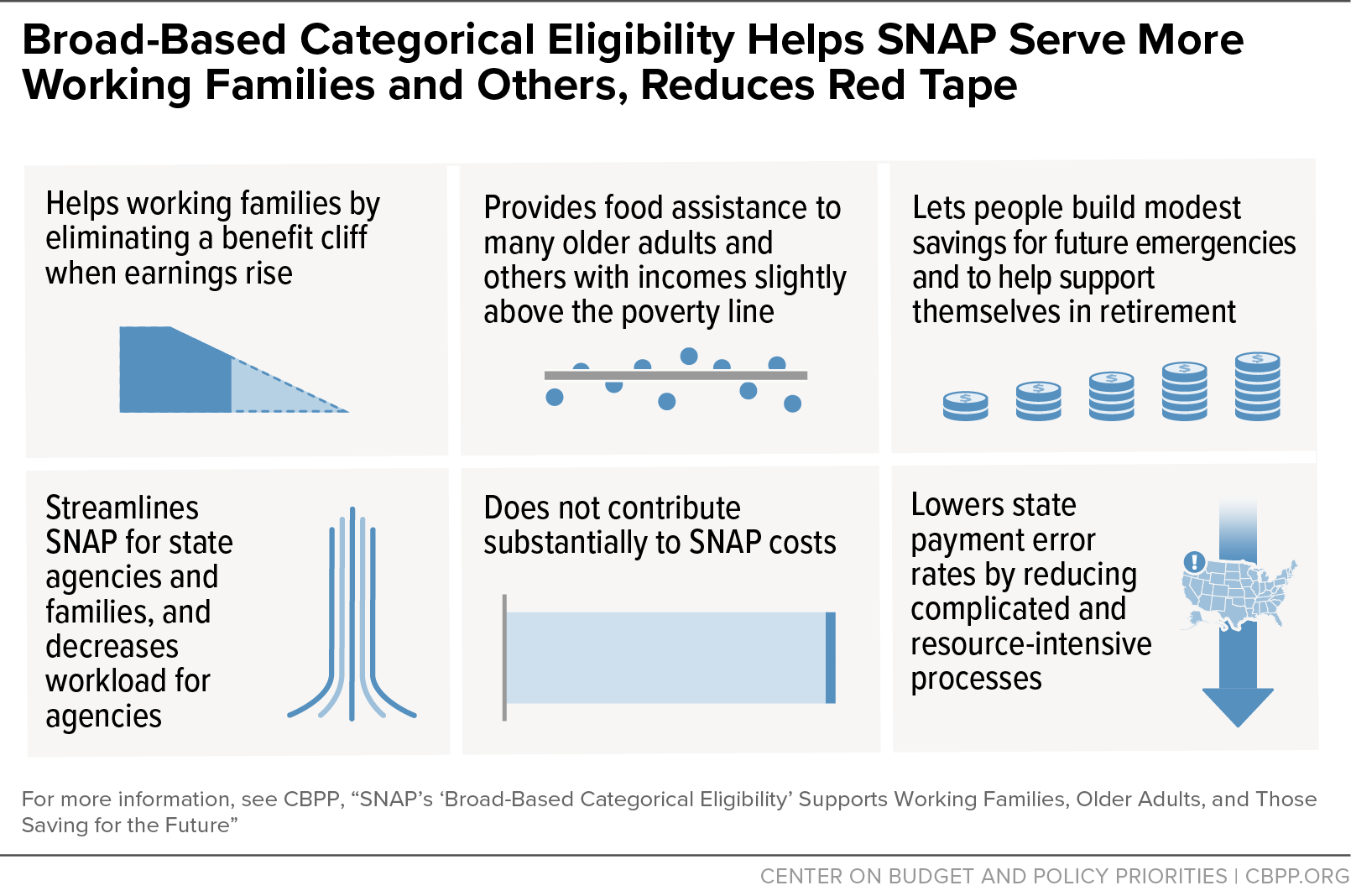
The people losing access to food assistance from SNAP, school meals, and WIC would mainly be working families, older adults, and people with disabilities. In other words, the change would primarily harm groups that federal and state policymakers from across the political spectrum have long sought to help: people who work but are living near poverty; older adults and people with disabilities with low, fixed incomes; and people trying to build modest savings in order to become more economically independent. (See Figure 2.)
BBCE is highly effective. It:
Helps working families by eliminating a “benefit cliff” as their earnings rise. SNAP supports work in part by phasing benefits down gradually — by only 24 to 36 cents for each dollar of increased earnings. But without BBCE, a family can lose substantial SNAP benefits if it has a small earnings increase that raises its gross income over SNAP’s federal eligibility threshold (130 percent of the federal poverty line, or $2,888 per month for a family of three in fiscal year 2026).[5] BBCE allows states to lift this threshold and phase benefits out more gradually, which lets households close to 130 percent of the federal poverty line take modestly higher-paying work and still benefit from SNAP.
About 3.5 million people, or some three-quarters of the individuals helped in 2023 by the higher income limits afforded by BBCE, were in families with earnings — mostly families with children — and 90 percent of the SNAP benefits resulting from the higher income limits went to these families. Their average household SNAP benefit was about $150 per month.
Allows some older adults and people with disabilities to qualify for a modest SNAP benefit. Under SNAP’s regular federal rules, the gross income limit of 130 percent of the federal poverty line does not apply to households with members who are age 60 or older or receive disability benefits such as Supplemental Security Income (SSI). But these households (like all other households) must have net income ― that is, income after deductions for expenses such as shelter or medical costs ― below the poverty line.
Most states that have adopted BBCE allow households that have net income above the poverty line to qualify for a modest SNAP benefit. In 2023, some 1.4 million people in households with older adults or people with a disability qualified for benefits averaging about $35 a month as a result of BBCE.
- Lets low-income households save for the future. Modest assets enable low-income families to avoid debt, weather unexpected financial disruptions, and better prepare to support themselves in retirement. Under regular federal SNAP rules, countable assets cannot exceed $3,000 for most households ($4,500 for households with members who are age 60 or older or have a disability); BBCE lets states increase or eliminate those limits. Low-income households in states that have used the policy to raise asset limits are likelier to have a bank account and have at least $500 in it, an Urban Institute study found.[6]
- Simplifies SNAP administration. BBCE reduces the complexity of the SNAP application process because documenting the modest assets of every SNAP applicant household — few of whom exceed the program’s asset limits — is burdensome for both states and households. BBCE also lowers “churn,” which occurs when households stop participating in SNAP (for procedural reasons or because they briefly become ineligible) and then reapply within a short period. Churn creates added work for state workers and benefit gaps for SNAP households.
- Lowers SNAP error rates. Though few households that participate in SNAP have significant savings, when states fail to accurately account for a household’s assets or when savings rise above the asset limit over time, even by a small amount, that can lead to payment errors under SNAP’s Quality Control system. Under H.R. 1, states will soon be required to pay a portion of SNAP food benefit costs based on their error rate, a measure of how much states over- or underpaid households receiving SNAP, primarily due to administrative mistakes. Because the share of benefits a state must pay increases if the state’s error rate exceeds certain thresholds, even a small increase in the error rate could trigger a large increase in mandated state costs. Among states that did not use BBCE to lift the asset test in 2023, errors related to the asset test added about 1 percentage point, on average, to the states’ error rates ― enough to push many states to a higher cost-share category.[7]
Moreover, BBCE does not contribute substantially to SNAP costs. In its 2019 proposed rule, the Administration estimated that about 4 percent of SNAP program costs were due to BBCE overall.[8] By 2023 the income-limit component of BBCE accounted for about 3.2 percent of benefit costs. We do not have updated estimates of the impact of the asset-limit component of BBCE.

BBCE Helps Working Families Afford Adequate Food, Eliminates Benefit Cliff
SNAP supports work.[9] The large majority of SNAP participants who can work, do work. Fully 91 percent of households that reported receiving SNAP at some point in 2024, included a non-disabled working-age adult, and included minor children had earnings in that year, based on analysis of 2024 American Community Survey data.[10]
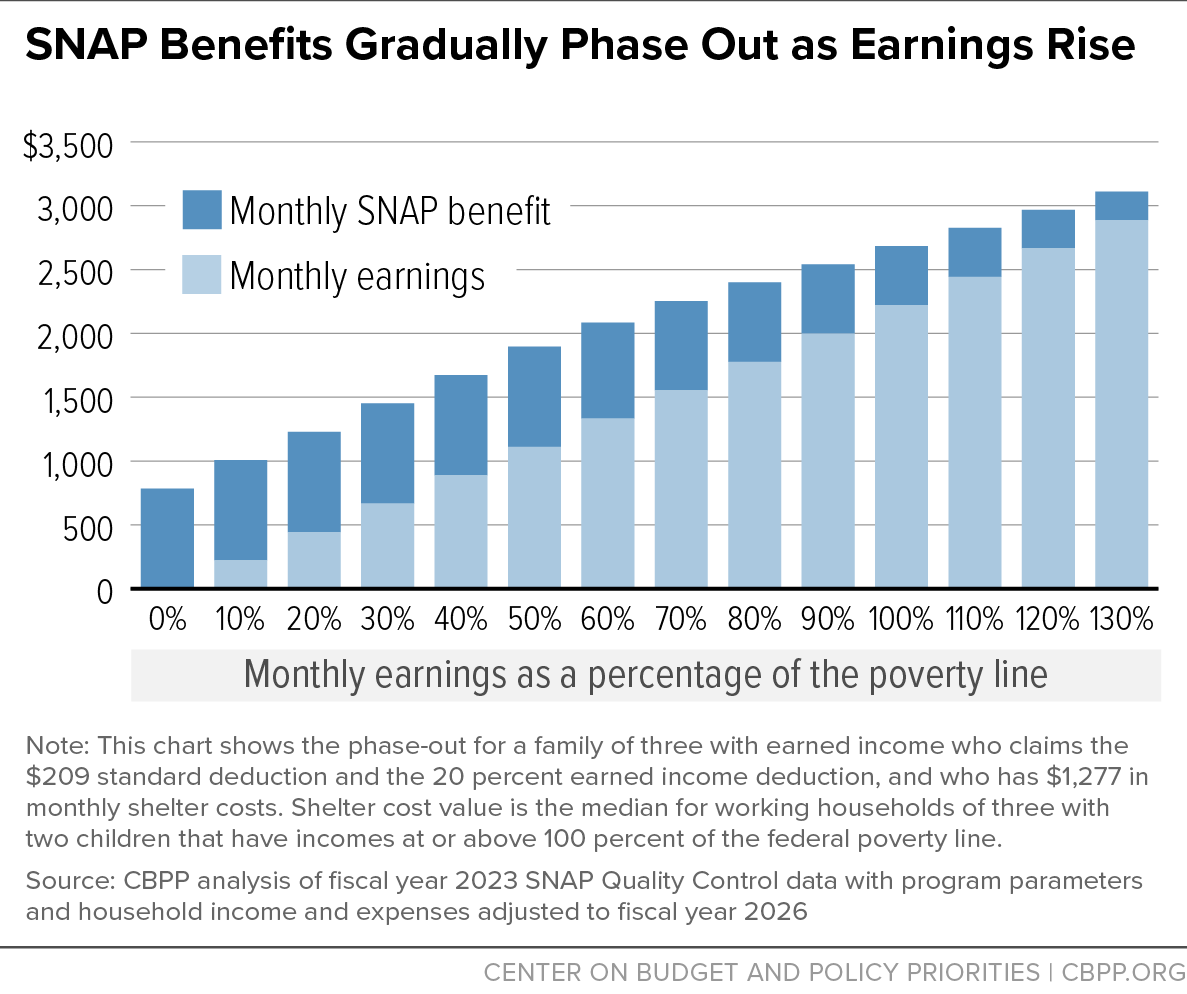
Some policymakers argue that because SNAP benefits fall when participants’ earnings rise, workers might be better off financially by avoiding employment gains that could put their benefits at risk. In reality, however, SNAP’s benefit structure rewards earnings over unearned income, incentivizing participants to work and to seek greater income through higher wages or more hours. SNAP’s earned income deduction disregards 20 percent of participants’ earned income when calculating their income. Also, benefits phase out only gradually as income rises: benefits are reduced by 24 to 36 cents per additional dollar of earnings.[11] (See Figure 3.) As a result, the vast majority of SNAP workers will see an increase in their total income — that is, earnings plus SNAP — when their earnings increase.

While one aspect of SNAP can create a benefit cliff, in which a worker may not be better off financially from increasing their earnings, BBCE helps address this problem. The cliff occurs for working families whose income is close to the gross income limit (130 percent of poverty) and who have high expenses — including housing and child care — that absorb a large share of their income. Families with large deductible expenses have less disposable income from other sources with which to purchase food, so they receive higher SNAP benefits. As a result, they have more to lose from becoming ineligible for food assistance if a modest increase in earnings pushes them above the federal gross income limit. If their earnings rise by less than their SNAP benefit falls, working more or at a higher wage leaves them worse off overall.
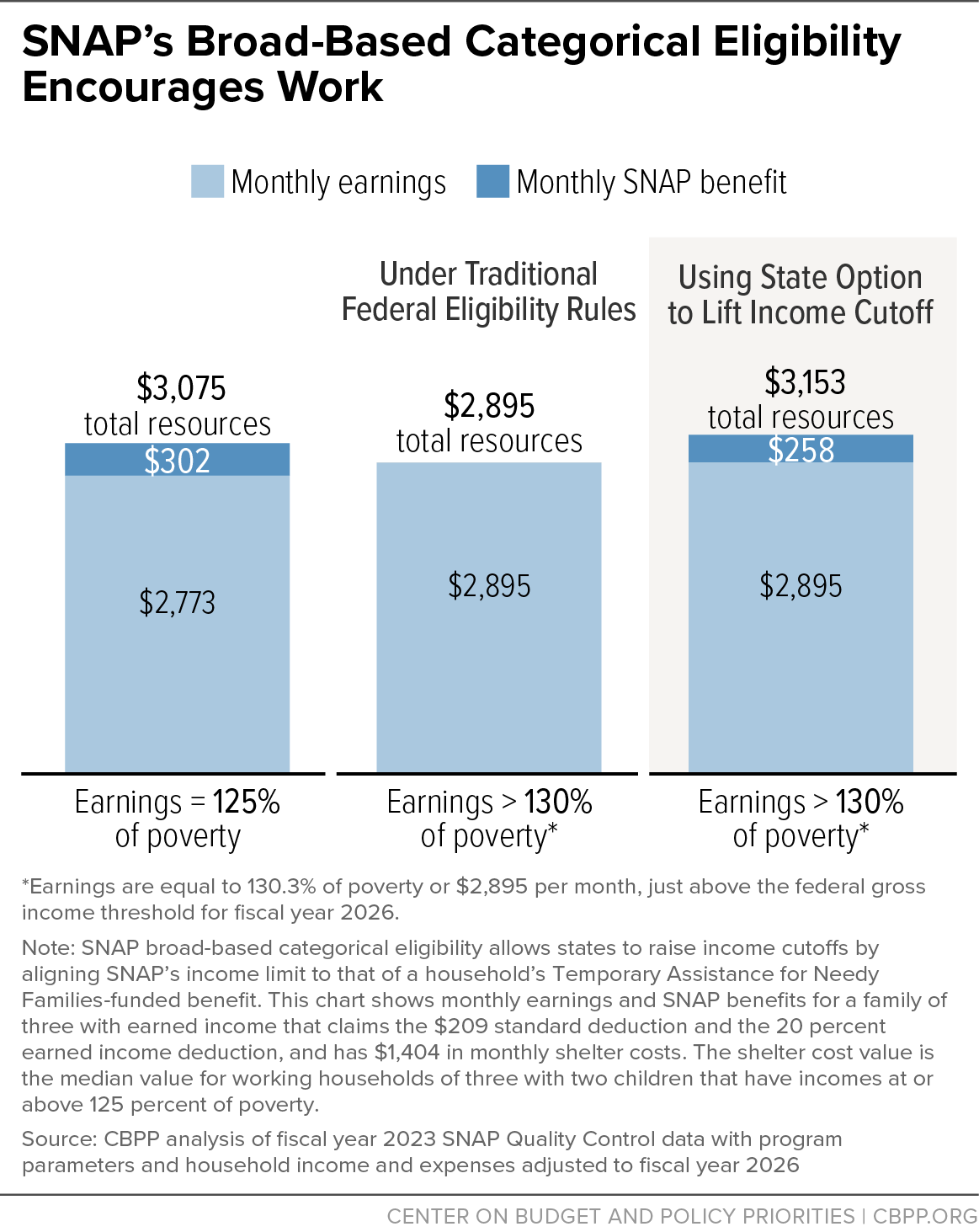
BBCE allows states to lift the gross income limit and provide SNAP benefits to these working families by smoothing their benefit phase-out. (See Figure 4.) This ensures families’ total resources (earnings plus SNAP benefits) don’t decrease if their earnings increase.

Consider, for example, a single mother with two children working full time at $16 an hour; her income is about 125 percent of the poverty level and she receives about $302 a month from SNAP, making up about 11 percent of her total monthly income.[12] If her hourly wage rises by just 70 cents (or $121 a month), lifting her slightly above 130 percent of poverty, she loses her $302 a month in SNAP benefits, leaving her family about $180 a month worse off. But with BBCE, a 70-cent raise would reduce her SNAP benefit by only $44 per month (to about $258), leaving the family $78 per month better off due to her wage increase. (See Figure 5.)


Thus, BBCE helps households close to the income threshold accept modestly higher-paying work while staying connected to SNAP.
Thirty-nine states currently use BBCE to provide SNAP to working families with income exceeding federal income limits. In an average month in 2023, approximately 3.5 million low-income individuals in families with earnings received food assistance as a result of the flexibility under BBCE to ease SNAP’s income limits. The average household with earnings helped by BBCE received about $150 a month in SNAP benefits, or about $60 per person.
The SNAP benefits made available through the higher income limits primarily go to:
- Working families. More than 90 percent of the benefits provided to low-income households that qualify for SNAP because their state uses a higher income limit go to working families; 80 percent of the resulting benefits go to working families with children.[13]
- Households with high expenses. Three-quarters of the resulting benefits go to households whose rent or mortgage and utility costs exceed half of their net income.
- Households only modestly above the poverty line. Nearly 60 percent of the benefits go to households with gross income between 131 percent and 150 percent of the poverty line; more than 80 percent go to households with gross income below 170 percent of poverty.[14]
Improving Children’s Access to Other Food Assistance
BBCE has an important additional benefit. Children in households that receive SNAP because of BBCE also can receive free lunches and breakfasts at school and summer grocery benefits without completing an additional application, because children in SNAP households are directly certified to receive free school meals and Summer EBT.
About 1.3 million children ages 5-17 participated in SNAP in 2023 because of the higher income limits under BBCE and would likely lose automatic eligibility for free school meals and Summer EBT under the Trump Administration’s anticipated proposed rule.[15] While USDA estimated in 2019 that 45 percent of children losing automatic SNAP eligibility under the first Trump Administration proposal would still have qualified for free meals and another 51 percent would have qualified for reduced-price meals, they would likely have to file an application, which not all would do. As a result, some children would lose free or reduced-price school meals and Summer EBT altogether.[16]
Children’s loss of access to SNAP also negatively impacts schools’ eligibility for and reimbursement under the Community Eligibility Provision, an option that allows schools that serve large numbers of children in low-income families to provide meals at no charge to all students. Community eligibility has health and educational benefits for students, reduces their families’ spending on groceries, and simplifies administration of the school meal programs.[17]
Participation in SNAP or Medicaid similarly provides streamlined (or “adjunctive”) eligibility for WIC. Our analysis suggests that about half a million children under age 5 would lose that automatic link if BBCE were limited. Though many could qualify for WIC through participation in Medicaid or could apply and document income, not all would do so.
BBCE Helps Some Older Adults and People with Disabilities Qualify for a Modest SNAP Benefit
Under SNAP’s regular federal rules, the gross income limit of 130 percent of the federal poverty line does not apply to households with members who are age 60 or older or receive disability benefits such as SSI. But these households (like all other households) must have net income ― that is, income after deductions for expenses such as shelter or medical costs ― below the poverty line.
However, most states that have adopted BBCE allow households, including those with older adults or people with a disability, who have net income above the poverty line to qualify for a modest SNAP benefit. In 2023 some 1.4 million people in households with older adults or people with a disability qualified for benefits averaging about $35 a month as a result of BBCE. Households with income over the net income limit generally qualify for very low benefits because benefits phase down as net income rises; many of the households helped by lifting the net income limit have one or two members and qualify for SNAP’s minimum benefit, currently $24 a month in most states.[18]
About 30 percent of the people receiving SNAP because of the income component of BBCE, and about 15 percent of the total amount of benefits from that aspect of BBCE, go to households with older adults or people with disabilities. About two-thirds of such households with net income over 100 percent of the poverty level have net income between 100 and 130 percent of poverty.
As noted, such households must undergo the same certification process as all other SNAP households (though most states do not require them to reapply as often). They must submit an application, participate in an eligibility interview in person or over the telephone, and provide documentation of their income and other circumstances ― all for a SNAP benefit of sometimes less than $1 a day.
BBCE Lets Families, Seniors, People With Disabilities Save for the Future
BBCE also lets states lift SNAP’s very low asset test, which disqualifies families from food assistance if they manage to save as little as $3,000 ($4,500 for households with older adults or disabled members, who are very unlikely to be able to replenish any assets they spend down).[19] Building assets can help low-income families and individuals invest in their future, avert a financial crisis that could push them deeper into poverty or into homelessness, and avoid accumulating debt that can impede economic mobility. Savings also help people prepare for retirement or potential disability for themselves or a family member. Policies that support asset-building are particularly important for people of color, who have historically been disadvantaged in accumulating wealth due to discrimination.
Forty-six states have used BBCE to raise or eliminate their SNAP asset limits, thereby reducing or eliminating the program’s savings disincentive and encouraging savings as a means to support greater opportunity.[20] In these states, low-income households that otherwise would be denied SNAP can receive food assistance in at least three situations:
- Participating SNAP households can begin building modest savings without losing food assistance. This may help them weather financial emergencies and invest in their future, for example by obtaining a vehicle that lets them find and keep a job, buying a home, or saving for their children’s education.
- Families that lose their jobs or experience another short-term financial crisis (such as a divorce or unexpected temporary disability) do not have to liquidate their savings before they can receive help affording groceries from SNAP.
- Households with elderly people or people with disabilities, who may have limited ability to save because they no longer work, can receive SNAP benefits to purchase groceries while they maintain a cushion that can help them weather future financial emergencies.
Most Low-Income Households Have Few Savings
Many Americans have difficulty saving enough to withstand a financial disruption, research shows. A survey of adults across the income spectrum found that 37 percent would borrow or sell something to cover an emergency expense of $400 (rather than pay for it completely using cash or its equivalent), while 45 percent said they did not have emergency savings set aside for three months of expenses if they lost their primary income source. The rates for people of color are higher: 59 percent of Black respondents and 56 percent of Hispanic respondents report lacking three months of emergency savings. Separately, 30 percent of adults report that they could not cover three months of expenses by any means.[21]
Households eligible for SNAP have even lower assets. One analysis found that the median value of liquid assets among those income-eligible for SNAP was only $141 in 2023 dollars.[22] An earlier study using data from 2011 found that only 48 percent of SNAP households had any liquid assets, and the median value among those who did have assets was just $450. (The median value was even lower ― $250 ― if retirement accounts were excluded, as is the case under SNAP rules.) Just over half of SNAP households had a bank account, and the median amount in the account was just $150.[23]
Savings Help Low-Income Households Weather Emergencies
Unexpected life events and unplanned expenses affect all households, but for households with low income that may have trouble meeting routine costs each month, a financial shock such as a job loss, unanticipated car repair, or medical expense can cascade into a major problem and lead to severe hardship.[24] Even modest assets can help a family or individual with fixed income (such as an elderly person) weather such shocks, research shows.
One study found that households with even minimal liquid savings (up to $2,000, the SNAP asset limit at the time of the study) are significantly less likely than otherwise-similar households with no liquid assets to experience multiple hardships, such as food insecurity (inadequate access to food at some point during the year) or a utility shutoff, and that “progressively larger effects are found with larger asset holdings.”[25] Another study found that households without a bank account are 15 percent likelier to be food insecure and 34 percent likelier to experience very low food security, a more severe form of food insecurity.[26]
Thus, policies that support saving and asset-building may protect low-income families against hardship.[27] Savings also can help low-income families avoid the spiraling costs associated with predatory financial products, such as payday loans.[28]
BBCE May Encourage Modest Savings, Research Suggests
SNAP households in states that have raised the asset limit using BBCE are likelier to have at least $500 in assets and to have a bank account, compared to similar households in states that maintain the federal asset limit, an Urban Institute study found. The authors concluded that “changes to reinstate federal SNAP asset limits [such as by eliminating BBCE] will harm family financial stability and security.”[29] Another study found that BBCE increased asset holdings among SNAP households and that removing the asset limit through BBCE increased the amount that SNAP households have in liquid accounts by about 20 percent.[30]
Other research has looked at asset limits in Temporary Assistance for Needy Families (TANF) or its predecessor, Aid to Families with Dependent Children (AFDC). A study in the mid-2000s found that in states with higher TANF asset limits, families receiving TANF were likelier to have a bank account, and they had higher liquid assets overall. These positive effects grew with the length of time since a state raised its asset limits, suggesting there is a learning period for participants to understand and respond to rule changes.[31] An earlier study found that higher AFDC asset limits were strongly associated with higher savings among current and potential AFDC recipients: each $1 increase in asset limits raised savings among female household heads by $0.25.[32]
BBCE Pushes Back Against Nation’s Large Racial Disparities in Wealth
People of color have historically faced barriers to accumulating wealth by buying homes or building other assets. These barriers, deeply rooted in discriminatory public policies and private actions, have led to vast disparities in income and wealth. The average household wealth for white households is about four times that of Black households and five times that of Hispanic households.[33]
The federal and state tax codes include many incentives for asset building, such as special treatment of retirement and education savings and mortgage interest, as well as tax breaks on capital gains and other income from wealth. Low-income families, who are disproportionately people of color, historically could not take advantage of these asset-building opportunities, largely because the economic barriers they face mean they have much less discretionary income.
Policies that help support asset building among low-income families, like BBCE, can begin addressing some of these disparities. Without BBCE, adults age 60 or older — including those who are people of color — need to spend all but $4,500 of their savings before they can receive any help from SNAP in affording groceries.
BBCE Improves Administrative Efficiency, Lowers Error Rates
States have embraced BBCE not only because it helps them better serve working families, older adults, and those saving for the future, as described above, but also because it helps them streamline their operations.
Few low-income households applying for SNAP have assets above the federal limits, but states that have not used BBCE to raise the asset limit must ask all households about assets during the application process and eligibility interview. In many cases, households and state workers will need to gather documents about households’ assets, even when such assets are too small to disqualify the household from SNAP. These activities increase states’ administrative workload and costs. Adopting BBCE thus can make state operations more efficient.
In addition, because reducing paperwork simplifies SNAP’s recertification process, BBCE has been found to reduce administrative churn, which creates unnecessary administrative burdens and costs for states as well as for SNAP households. In states that have adopted BBCE, households are 26 percent less likely to experience churn over the course of a year than similar households in other states, an Urban Institute study found.[34]
Federal changes to BBCE would require states to alter their SNAP eligibility rules, modify their computer systems, retrain staff, and revise applications and program manuals. Such changes also would make SNAP rules considerably more complicated.
Reinstating asset tests would also increase SNAP payment error rates and, as a result, likely increase some states’ costs under the state cost-shift mandates imposed by H.R. 1. When states fail to accurately account for a household’s assets, or when savings rise above the asset limit over time, that can lead to payment errors under SNAP’s Quality Control system, even if the households’ assets exceed the limit by only a small amount.
Under H.R. 1, the share of SNAP benefit costs a state is required to pay is based on its error rate: 5 percent of benefit costs for states with error rates of 6–7.99 percent, 10 percent of costs for states with error rates of 8–9.99 percent, and 15 percent of costs for states with error rates 10 percent or higher.[35] Even a small increase in the error rate could trigger a large increase in mandated state costs if it pushed the state into a higher cost-share category, such as from below 10 percent to over 10 percent. Among states that did not use BBCE to lift the asset test in 2023, errors related to the asset limits added about 1 percentage point, on average, to the states’ error rates ― enough to push many states to a higher cost-share category under H.R. 1.[36]
Moreover the extra time it takes for eligibility workers to track down information about households’ assets would take resources away from other activities states are undertaking to improve their payment accuracy. And H.R. 1 also cut the federal match for state administrative costs in SNAP in half, from 50 percent to 25 percent, further stretching state resources to maintain or improve payment accuracy and program access.
BBCE Has Not Substantially Increased SNAP Caseloads or Costs
In its 2019 proposed rule, the first Trump Administration estimated that states’ use of BBCE to lift their income and asset limits accounted for about 4 percent of SNAP program costs.[37] By 2023 the income-limit component of BBCE accounted for 3.2 percent of program costs.
As noted, we do not have updated estimates of the impact of BBCE’s asset-limit component. Many states implemented the policy during the Great Recession, partly to lower their workloads at a time when caseloads were rising rapidly due to the severe downturn. However, research shows that only about 10 percent of the caseload increase during the recession was due to BBCE.[38]
And SNAP benefits under BBCE continue to go to very low-income households: only about 1 percent of SNAP benefits in 2023 went to households with monthly disposable income (net income after deducting certain expenses) above the federal poverty line.
Conclusion
Nearly every state has used BBCE to extend SNAP’s reach to low-income households, including working families, older adults, and people with disabilities who struggle to afford food but might not otherwise meet SNAP’s rigid income and asset tests. Congress, on a bipartisan basis, has repeatedly rejected proposals to cut SNAP by cutting BBCE. Rolling back BBCE would cause about 6 million low-income individuals to lose their SNAP benefits entirely and undermine the program’s ability to promote opportunity for people who are working and seeking to save for the future.
| TABLE 1 | ||||
|---|---|---|---|---|
Estimated Number of Individuals Who Received SNAP Due to BBCE Option to Raise Income Limits, Fiscal Year 2023 Note: These estimates do not include the impact of raising or eliminating the asset test. | ||||
| State/Territory | Gross Income Limit | Individuals Living in Households Helped by BBCE | ||
| All | In Households With Children | In Households With Older Adults or People With Disabilities | ||
| Alabama | BBCE for assets only | n/a | n/a | n/a |
| Alaska | 200% starting in 2025 | |||
| Arizona | 185% | 130,000 | 99,000 | 25,000 |
| Arkansas | BBCE for assets only | n/a | n/a | n/a |
| California | 200% | 605,000 | 425,000 | 105,000 |
| Colorado | 200% | 65,000 | 45,000 | 15,000 |
| Connecticut | 200% | 65,000 | 53,000 | 13,000 |
| Delaware | 200% | 16,000 | 9,000 | 7,000 |
| District of Columbia | 200% | 13,000 | 4,000 | 5,000 |
| Florida | 200% | 370,000 | 245,000 | 130,000 |
| Georgia | BBCE for assets only | n/a | n/a | n/a |
| Guam | 165% | 3,000 | - | - |
| Hawaii | 200% | 7,000 | 6,000 | - |
| Idaho | BBCE for assets only | n/a | n/a | n/a |
| Illinois | 165% | 250,000 | 145,000 | 110,000 |
| Indiana | BBCE for assets only | n/a | n/a | n/a |
| Iowa | 160% | 31,000 | 21,000 | 11,000 |
| Kansas | No BBCE | |||
| Kentucky | 200% | 41,000 | 29,000 | 14,000 |
| Louisiana | 200% | 39,000 | 25,000 | - |
| Maine | 200% | 29,000 | 19,000 | 10,000 |
| Maryland | 200% | 99,000 | 61,000 | 35,000 |
| Massachusetts | 200% | 165,000 | 110,000 | 35,000 |
| Michigan | 200% | 245,000 | 165,000 | 67,000 |
| Minnesota | 200% | 89,000 | 70,000 | 22,000 |
| Mississippi | No BBCE | |||
| Missouri | No BBCE | |||
| Montana | 200% | 10,000 | 6,000 | 4,000 |
| Nebraska | 165% | 8,000 | 7,000 | - |
| Nevada | 200% | 97,000 | 69,000 | 22,000 |
| New Hampshire | 200% | 12,000 | 12,000 | - |
| New Jersey | 185% | 75,000 | 61,000 | 12,000 |
| New Mexico | 200% | 31,000 | 15,000 | - |
| New York | 150%/200% | 155,000 | 83,000 | 82,000 |
| North Carolina | 200% | 315,000 | 215,000 | 82,000 |
| North Dakota | 200% | 3,000 | 2,000 | - |
| Ohio | 200% starting in 2024 | 64,000 | 23,000 | 51,000 |
| Oklahoma | BBCE for assets only | n/a | n/a | n/a |
| Oregon | 200% | 135,000 | 81,000 | 38,000 |
| Pennsylvania | 200% | 310,000 | 225,000 | 98,000 |
| Rhode Island | 185% | 18,000 | 13,000 | 4,000 |
| South Carolina | BBCE for assets only | n/a | n/a | n/a |
| South Dakota | No BBCE | |||
| Tennessee | No BBCE | |||
| Texas | 165% | 360,000 | 300,000 | 92,000 |
| Utah | No BBCE | |||
| Vermont | 185% | 10,000 | 9,000 | 1,800 |
| Virgin Islands | 175% | 3,000 | 1,800 | - |
| Virginia | 200% | 93,000 | 47,000 | 48,000 |
| Washington | 200% | 155,000 | 110,000 | 34,000 |
| West Virginia | 200% | 34,000 | 17,000 | 17,000 |
| Wisconsin | 200% | 150,000 | 100,000 | 55,000 |
| Wyoming | No BBCE | |||
| United States | Over 4 million | About 3.1 million | Over 1.4 million | |
Notes: Cells with a dash ( - ) refer to estimates that have been suppressed due to small sample sizes. The U.S. total in this table will not match the sum of the state totals due to rounding and the suppression of cells with small sample sizes. States without BBCE for income may have narrow categorical eligibility (beyond cash assistance, but not affecting large numbers of households) and may also have some households that would be cut off from SNAP under a proposed rule. Some individuals in households with older adults or people with disabilities are helped by the income component of BBCE due to the higher net income limit. According to USDA, as of December 2025, 46 states had adopted BBCE, 38 of which had higher income limits. Ohio and Alaska adopted BBCE for income in 2024 and 2025, respectively, so the impact was not reflected in the 2023 data. In New York, households with dependent care expenses are eligible up to 200 percent FPL, and households with earnings are eligible up to 150 percent FPL. Alabama, Arkansas, Georgia, Idaho, Indiana, Oklahoma, and South Carolina used the state option under BBCE to eliminate the asset test, but not the option to raise the income limits. Sources: USDA, Food and Nutrition Service, Broad-Based Categorical Eligibility Chart and CBPP analysis of FY 2023 SNAP Quality Control Data. See https://www.fns.usda.gov/snap/broad-based-categorical-eligibility. | ||||
End Notes
[1] See regulation pending review at the Office of Management and Budget, https://www.reginfo.gov/public/do/eAgendaViewRule?pubId=202504&RIN=0584-AF10. The first Trump Administration issued a similar proposed rule, which was not finalized and later withdrawn by the Biden Administration: “Revision of Categorical Eligibility in the Supplemental Nutrition Assistance Program,” Federal Register, Vol. 84, No. 142, July 24, 2019, 35570-35581, https://www.federalregister.gov/documents/2019/07/24/2019-15670/revision-of-categorical-eligibility-in-the-supplemental-nutrition-assistance-program-snap.
[2] The District of Columbia, Guam, and the Virgin Islands are considered states under SNAP law. Puerto Rico does not participate in SNAP but instead receives a block grant for Nutrition Assistance.
[3] The Food and Nutrition Act of 2008, which authorizes SNAP, requires households that receive a TANF-funded benefit to be categorically eligible for SNAP. Broad-based categorical eligibility is commonly referred as an “option” because states have the option whether to provide households with the TANF-funded benefits that trigger categorical eligibility. For details, see box, “What Is Broad-Based Categorical Eligibility?”
[4] CBPP, “By the Numbers: Harmful Republican Megabill Takes Food Assistance Away From Millions of People,” updated August 14, 2025, https://www.cbpp.org/research/food-assistance/by-the-numbers-harmful-republican-megabill-takes-food-assistance-away-from.
[5] Households that contain individuals with disabilities or seniors do not face a gross income test under federal rules. BBCE allows states to create parity across all households with respect to this rule.
[6] Caroline Ratcliffe et al., “The Unintended Consequences of SNAP Asset Limits,” Urban Institute, July 2016, https://www.urban.org/sites/default/files/publication/82886/2000872-The-Unintended-Consequences-of-SNAP-Asset-Limits.pdf.
[7] These figures are based on information from USDA, Food and Nutrition Service, “Supplemental Nutrition Assistance Program, Quality Control Annual Report, Fiscal Year 2023,” September 2025, Supplemental Nutrition Assistance Program (SNAP) Quality Control Annual Report Fiscal Year 2023.
[8] The Congressional Budget Office (CBO) has estimated that BBCE accounts for only about 2 percent of SNAP costs and about 5 percent of SNAP participation. These estimates are based on CBO’s re-estimate of President Trump’s 2020 budget proposal to restrict SNAP categorical eligibility to only households receiving cash assistance under TANF. (CBO’s re-estimate of this policy is available at https://www.cbo.gov/system/files/2019-05/55215-snap.pdf.) The CBO estimate of the number of participants eligible because of BBCE is based on 2016 SNAP household characteristics data and earlier CBO estimates of the number of people who would be affected by eliminating BBCE.
[9] Joseph Llobrera and Lauren Hall, “SNAP Provides Critical Benefits to Workers and Their Families,” CBPP, April 28, 2025, https://www.cbpp.org/research/food-assistance/snap-provides-critical-benefits-to-workers-and-their-families; and Elizabeth Wolkomir and Lexin Cai, “The Supplemental Nutrition Assistance Program Includes Earnings Incentives,” CBPP, June 5, 2019, https://www.cbpp.org/research/food-assistance/the-supplemental-nutrition-assistance-program-includes-earnings-incentives.
[10] CBPP Analysis of 2024 American Community Survey data.
[11] Kenneth Hanson and Margaret Andrews, “State Variations in the Food Stamp Benefit Reduction Rate for Earnings: Cross-Program Effects from TANF and SSI Cash Assistance,” USDA, Economic Research Service, March 2009, https://ers.usda.gov/sites/default/files/_laserfiche/publications/44317/9663_eib46.pdf.
[12] The calculation assumes the family has only earned income, claims the $209 standard deduction and 20 percent earned income deduction, and has $1,404 in monthly shelter costs (the median value for working households of three with children that have incomes at or above 125 percent of poverty, based on fiscal year 2023 SNAP household characteristics data adjusted to 2026 dollars).
[13] Based on a CBPP analysis of fiscal year 2023 SNAP household characteristics data. These figures are for an average month of the fiscal year for households that would be ineligible if the component of BBCE that allows states to raise their income limits were eliminated; they do not include the effect of the component that allows states to lift their asset tests.
[14] Ibid.
[15] USDA estimated 1 million children would lose the automatic link to free and reduced-price meals under its 2019 proposed rule. USDA, “Revision of Categorical Eligibility in SNAP - Informational Analysis,” October 15, 2019, https://www.regulations.gov/document/FNS-2018-0037-16046.
[16] Families with income at or below 130 percent of the federal poverty line qualify for free school meals. Children in households that receive SNAP are considered categorically eligible for free school meals, and states use a data match to certify them based on their SNAP participation (this is known as “direct certification”). Children in households at or below 185 percent of poverty qualify for reduced-price meals, capped at a price of 30 cents for breakfast and 40 cents for lunch.
[17] See “Benefits of CEP” section of Federal Register, Vol. 88, No. 56, March 23, 2023, https://www.govinfo.gov/content/pkg/FR-2023-03-23/pdf/2023-05624.pdf.
[18] The minimum benefit is higher in Alaska, Hawai’i, Guam, and the Virgin Islands.
[19] Under federal SNAP rules, resources that could be available to the household to purchase food, such as amounts in bank accounts, count as assets. Resources that are not accessible, such as the household’s home, personal property, and retirement savings, do not count. The rules count the market value of most vehicles above $4,650 toward the asset limit. In the absence of BBCE, states would retain flexibility to apply less restrictive vehicle asset rules under another state option, but they would have to modify state policy to do so.
[20] Five states (Arkansas, Idaho, Indiana, Nebraska, and Texas) use BBCE to raise their SNAP asset limits. The other 41 states use BBCE to eliminate the SNAP asset limits, though income from assets continues to count toward SNAP eligibility.
[21] Board of Governors of the Federal Reserve System, “Economic Well-Being of U.S. Households in 2024,” May 2025, https://www.federalreserve.gov/publications/files/2024-report-economic-well-being-us-households-202505.pdf.
[22] Elizabeth Cox, Chloe East, and Isabelle Pula, “Beyond Hunger: The Role of SNAP in Alleviating Financial Strain For Low-Income Households,” Brookings Institution, June 20, 2024, https://www.brookings.edu/articles/beyond-hunger-the-role-of-snap-in-alleviating-financial-strain-for-low-income-households/.
[23] Caroline Ratcliffe et al., “Asset Limits, SNAP Participation, and Financial Stability,” Urban Institute, June 2016, https://www.urban.org/sites/default/files/publication/81966/2000843-Asset-Limits-SNAP-Participation-and-Financial-Stability.pdf.
[24] Signe-Mary McKernan, Caroline Ratcliffe, and Katie Vinopal, “Do Assets Help Families Cope with Adverse Events?” Urban Institute, December 14, 2009, https://www.urban.org/research/publication/do-assets-help-families-cope-adverse-events.
[25] Gregory Mills and Joe Amick, “Can Savings Help Overcome Income Instability?” Urban Institute, December 2010, https://www.urban.org/sites/default/files/publication/32771/412290-Can-Savings-Help-Overcome-Income-Instability-.PDF.
[26] Katie Fitzpatrick, “Bank Accounts, Nonbank Financial Transaction Products, and Food Insecurity among Households with Children,” Journal of Consumer Affairs, Vol. 51, No. 3, Fall 2017, https://onlinelibrary.wiley.com/doi/abs/10.1111/joca.12158.
[27] Signe-Mary McKernan et al., “Building savings, ownership, and financial well-being,” Urban Institute, April 2020, https://www.urban.org/sites/default/files/publication/101992/building-savings-ownership-and-financial-well-being_0_1.pdf.
[28] “Payday Lending in America: Who Borrows, Where they Borrow, and Why,” Pew Charitable Trusts, July 2012, https://www.pewtrusts.org/~/media/legacy/uploadedfiles/pcs_assets/2012/pewpaydaylendingreportpdf.pdf.
[29] The study found that living in a state that adopted BBCE increases the likelihood that a low-income household has savings of at least $500 (by 8 percent) and has a bank account (by 5 percent). Ratcliffe et al., “Unintended Consequences,” op. cit.
[30] Jessica Todd, Young Jo, and James Richard Boohaker, “The Impact of Supplemental Nutrition Assistance Program Policies on Asset Holdings,” Applied Economic Perspectives and Policy, Vol. 41, No. 2, June 2019, https://onlinelibrary.wiley.com/doi/abs/10.1093/aepp/ppy014.
[31]Yunju Nam, “Welfare Reform and Asset Accumulation: Asset Limit Changes, Financial Assets, and Vehicle Ownership,” Social Science Quarterly, Vol. 89, No. 1, March 2008.
[32] Elizabeth T. Powers, “Does means-testing welfare discourage saving? Evidence from a Change in AFDC Policy in the United States,” Journal of Public Economics, Vol. 68, 1998. Other studies, however, have found no statistically significant relationship between asset limits and households’ liquid assets. The inconclusive research literature likely reflects the fact that most low-income families hold very few assets, so the SNAP asset limits are not binding for the vast majority of households that apply for (or consider applying for) SNAP. Lifting the asset limits thus has little impact on most households.
[33] Ana Hernández Kent, “The State of U.S. Household Wealth,” Federal Reserve Bank of St. Louis, June 2025, https://www.stlouisfed.org/open-vault/2025/june/the-state-of-us-household-wealth.
[34] Ratcliffe et al., “Asset Limits,” op. cit.
[35] Paradoxically, H.R. 1 provides an exception for states with the highest error rates. If a state’s error rate multiplied by 1.5 is at or above 20 percent (meaning the error rate is above 13.33 percent) for fiscal year 2025, the state will not be required to pay a cost share in fiscal year 2028. If the error rate is above this threshold for 2026, the state will not be required to pay a cost share in fiscal year 2028 or 2029.
[36] See note 7.
[37] See note 8.
[38] For example, Ganong and Liebman found that this option accounted for about 8 percent of the caseload increase between 2007 and 2011, and Dickert-Conlin et al., found that BBCE “only explains up to 12 percent of the recent caseload increase.” Peter Ganong and Jeffrey B. Liebman, “The Decline, Rebound, and Further Rise in SNAP Enrollment: Disentangling Business Cycle Fluctuations and Policy Changes,” American Economic Journal: Economic Policy, Vol. 10, No. 4, November 2018, https://www.aeaweb.org/articles?id=10.1257/pol.20140016&&from=f; Stacy Dickert-Conlin et al., “The Downs and Ups of the SNAP Caseload: What Matters?” SSRN, December 1, 2016, https://papers.ssrn.com/sol3/papers.cfm?abstract_id=3052570.