

SNAP Helps 1.2 Million Veterans With Low Incomes, Including Thousands in Every State
About 1.2 million veterans live in households that participate in the Supplemental Nutrition Assistance Program (SNAP, formerly known as food stamps).[1] Thousands of veterans in every state — who may be unemployed, working in low-paying jobs, or have disabilities — use SNAP to supplement their low income to put food on the table for themselves and their families. (See Table 1 for state-by-state estimates.) Yet some Republican members of Congress are considering proposals that would take food away from millions of low-income households, including veterans, who turn to SNAP for help affording groceries. Proposals on the table include:
- Rolling back the 2021 update to the Thrifty Food Plan (TFP), the basis for SNAP benefit levels, and freezing the TFP’s cost going forward outside of annual inflation adjustments. This would immediately cut SNAP food assistance for all participants, including veterans, by an average of 22 percent, and the cut would grow over time.
- Requiring states to pay a portion of SNAP benefits for the first time. This radical change to SNAP’s funding structure would likely lead states to reduce SNAP food assistance by cutting benefits, eligibility, or both, likely affecting food assistance for veterans.
- Taking food assistance away from millions of people by expanding SNAP’s punitive work requirement. Some Republicans have proposed expanding the requirement to people up to age 65, some individuals in families with children, and people who live in areas without sufficient jobs. While the Fiscal Responsibility Act of 2023 specifically exempted veterans (as well as individuals experiencing homelessness and young adults previously in foster care) from SNAP’s work requirement, some Republicans have called for ending those exemptions.[2]
Policymakers should reject such proposals, which would only worsen food insecurity for veterans with low incomes and other people who struggle to afford food for their families.
Many Veterans Face Employment, Health, Other Challenges
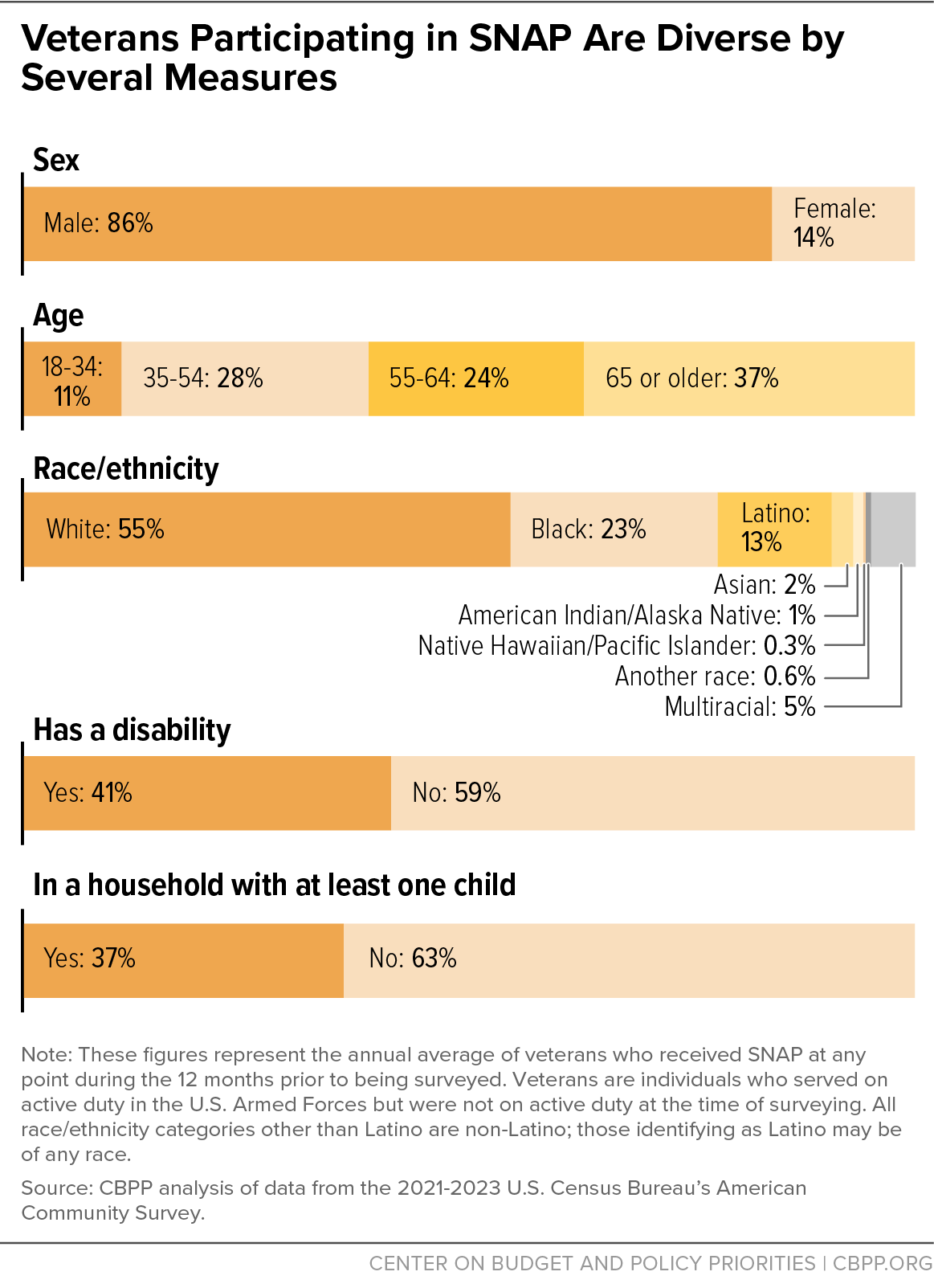
While veterans are a diverse group (see Figure 1), many face challenges making ends meet.
Lower employment rates. Historically, veterans have been slightly more successful than non-veterans at finding jobs when they look for work. However, a smaller share of all veterans are employed compared to non-veterans. [3] Veterans’ lower employment rate is largely due to the fact that fewer veterans are looking for work, since they have more health conditions and lower educational attainment.[4]
Also, Black and Latino veterans experience higher unemployment rates than white veterans ― a reflection of biased hiring practices, redlining, and other past and present systemic factors that limit economic mobility and opportunity.[5] The Department of Veterans Affairs projects that the share of veterans who identify as Black or Hispanic will increase over the next 25 years.[6]

Veterans may face barriers to employment such as little work experience beyond military service, trouble finding employment that matches their skills, discrimination by employers, or lack of access to support services (e.g., military-to-civilian transition and veteran hiring services).[7] Many younger veterans are highly skilled, but civilian employers often undervalue their military experience. As a result, a larger share of younger veterans hold jobs for which they are overqualified compared to younger non-veterans with similar skills, which can add to job dissatisfaction and turnover. Also, some veterans are only offered low-paying jobs, which can make it difficult for them to meet their basic needs.[8]
Health conditions. Some veterans also face challenges from physical and mental health conditions related to their service that can affect their well-being. For example, some conditions that are more prevalent among recent veterans, such as traumatic brain injuries or post-traumatic stress disorder, have been linked to negative outcomes such as reduced labor force participation, increased risk of poor physical and mental health, and worse quality of life, including difficulty with community reintegration.[9] About 30 percent of all veterans have a service-connected disability — double the 2008 rate. And post-9/11 veterans, the youngest cohort, are more likely to have a service-connected disability than other veterans. Veterans with service-connected disabilities have a lower labor force participation rate than those without one.[10]
Homelessness and other hardships. Due in part to the above factors, many veterans struggle to meet basic needs. According to the Department of Housing and Urban Development’s annual point-in-time survey in January 2024, 33,000 veterans were experiencing homelessness, about 5.3 percent of all homeless adults.[11] Veterans with disabilities and without health insurance are also more likely to experience difficulty paying medical bills.[12] Veterans who lack stable employment, housing, or resources to cover medical expenses are likely to have difficulty affording enough to eat.
SNAP Can Help Address Food Insecurity Among Veterans
According to the Department of Agriculture, 11 percent of veterans aged 18 to 64 experienced food insecurity in 2015-2019. [13] Veterans were 7 percent more likely than non-veterans to experience food insecurity, after controlling for a range of socioeconomic and demographic characteristics that may contribute to differences in food insecurity rates between the two groups. Veterans of color were more likely than white veterans to experience food insecurity. In addition, veterans who had a disability, were unemployed, or had lower educational attainment were at greater risk of food insecurity. Another study found that among veterans, depression and suicidal thoughts were more common among those who were food insecure.[14]
For veterans struggling to feed their families, SNAP can make a crucial difference. However, research suggests that low-income veterans are less likely to participate in SNAP than the low-income population.[15] Among veterans, SNAP participation is higher for those who are most likely to be food insecure, including those who are young, have lower educational attainment, or are unemployed.[16]
In every state, thousands of low-income veterans rely on SNAP to help feed their families. California has the largest number of veterans participating in SNAP (115,000), followed by Florida and Texas (99,000 each). Oregon and Washington, D.C. have the highest share of veterans participating in SNAP, with about 14 percent of veterans living in households that receive SNAP, followed by Louisiana, New Mexico, and West Virginia, with 11 percent.
SNAP provides critical support for veterans across the country who are struggling to feed their families after returning home from military service.
| TABLE 1 | |||
|---|---|---|---|
Veterans Receiving SNAP Food Assistance, 2021-2023 Average | |||
| State | Estimated Number of Veterans Receiving SNAP | Estimated Total Number of Veterans | Estimated Share of Veterans Receiving SNAP |
| Alabama | 24,000 | 309,000 | 8% |
| Alaska | 4,000 | 57,000 | 6% |
| Arizona | 31,000 | 448,000 | 7% |
| Arkansas | 10,000 | 176,000 | 6% |
| California | 115,000 | 1,295,000 | 9% |
| Colorado | 24,000 | 342,000 | 7% |
| Connecticut | 9,000 | 136,000 | 7% |
| Delaware | 4,000 | 59,000 | 7% |
| District of Columbia | 3,000 | 19,000 | 14% |
| Florida | 99,000 | 1,338,000 | 7% |
| Georgia | 49,000 | 602,000 | 8% |
| Hawai‘i | 7,000 | 84,000 | 8% |
| Idaho | 6,000 | 115,000 | 6% |
| Illinois | 43,000 | 475,000 | 9% |
| Indiana | 19,000 | 329,000 | 6% |
| Iowa | 8,000 | 162,000 | 5% |
| Kansas | 7,000 | 150,000 | 5% |
| Kentucky | 17,000 | 228,000 | 7% |
| Louisiana | 24,000 | 215,000 | 11% |
| Maine | 7,000 | 96,000 | 7% |
| Maryland | 21,000 | 325,000 | 6% |
| Massachusetts | 21,000 | 238,000 | 9% |
| Michigan | 39,000 | 463,000 | 8% |
| Minnesota | 12,000 | 265,000 | 4% |
| Mississippi | 9,000 | 153,000 | 6% |
| Missouri | 21,000 | 347,000 | 6% |
| Montana | 5,000 | 83,000 | 6% |
| Nebraska | 4,000 | 102,000 | 4% |
| Nevada | 18,000 | 196,000 | 9% |
| New Hampshire | 5,000 | 90,000 | 5% |
| New Jersey | 14,000 | 272,000 | 5% |
| New Mexico | 15,000 | 133,000 | 11% |
| New York | 56,000 | 589,000 | 9% |
| North Carolina | 47,000 | 618,000 | 8% |
| North Dakota | 2,000 | 41,000 | 4% |
| Ohio | 45,000 | 605,000 | 7% |
| Oklahoma | 21,000 | 239,000 | 9% |
| Oregon | 33,000 | 246,000 | 14% |
| Pennsylvania | 60,000 | 635,000 | 9% |
| Rhode Island | 3,000 | 44,000 | 7% |
| South Carolina | 21,000 | 348,000 | 6% |
| South Dakota | 3,000 | 57,000 | 5% |
| Tennessee | 26,000 | 394,000 | 7% |
| Texas | 99,000 | 1,406,000 | 7% |
| Utah | 5,000 | 111,000 | 5% |
| Vermont | 3,000 | 32,000 | 8% |
| Virginia | 35,000 | 624,000 | 6% |
| Washington | 42,000 | 476,000 | 9% |
| West Virginia | 12,000 | 107,000 | 11% |
| Wisconsin | 18,000 | 290,000 | 6% |
| Wyoming | 1,000 | 41,000 | 3% |
| United States | 1,223,000 | 16,203,000 | 8% |
Notes: Estimates are for veterans living in households that received any SNAP income during the 12 months prior to being surveyed. Estimates of SNAP participation in a given month would be lower. Estimates use three-year averages due to small sample sizes in some states in one-year data. These three-year estimates are rounded to the nearest thousand and do not add up to totals. Source: CBPP analysis of data from the U.S. Census Bureau, American Community Survey 1-year series, 2021 to 2023 | |||
Notes on Methods
CBPP analyzed the 2021 to 2023 American Community Survey (ACS) 1-year Public Use Microdata Sample for this state-level analysis. Veterans were identified as individuals who served on active duty in the U.S. Armed Forces but were not on active duty at the time of surveying.
The figures presented here represent our best estimate of the number of veterans living in households that received SNAP at some point during the 12 months prior to being surveyed. The analysis combines three years of data to improve the reliability of the state estimates. The ACS includes housing unit addresses and residents of group quarters, including shelters, but it omits any individuals experiencing homelessness who are not staying at an address for more than two months (e.g., with friends or family) or at a shelter at the time of surveying. Given that the Department of Housing and Urban Development’s 2024 Annual Homelessness Assessment Report found that 43 percent of veterans experiencing homelessness were unsheltered, the ACS likely undercounts homeless veterans. Additionally, survey respondents, including those in the ACS, often underreport program participation.
Disability as defined in Figure 1 includes anyone who self-reported having a disability in at least one of six core areas: hearing, seeing, cognitive, ambulatory, self-care, and/or independent living. SNAP’s definition of disability, for purposes of receiving special consideration within the program, is narrower and does not cover all individuals who may have disabilities. SNAP considers a person as disabled if they receive at least one of several types of disability benefits.
End Notes
[1] CBPP analysis of data from the 2021 to 2023 U.S. Census Bureau’s American Community Survey. This figure represents the annual average number of veterans who received SNAP at any point during the 12 months prior to being surveyed. Veterans are individuals who served on active duty in the U.S. Armed Forces but were not on active duty at the time of surveying. These estimates likely undercount veterans who receive SNAP because they omit veterans who are unsheltered; see Notes on Methods.
[2] Katie Bergh, “Millions of Low-Income Households Would Lose Food Aid Under Proposed House Republican SNAP Cuts,” CBPP, February 24, 2025, https://www.cbpp.org/research/food-assistance/millions-of-low-income-households-would-lose-food-aid-under-proposed-house; Dottie Rosenbaum, Katie Bergh, and Wesley Tharpe, “Imposing SNAP Food Benefit Costs on States Would Worsen Hunger, Hurt States’ Ability to Meet Residents’ Needs,” CBPP, revised March 21, 2025, https://www.cbpp.org/research/food-assistance/imposing-snap-food-benefit-costs-on-states-would-worsen-hunger-hurt-states.
[3] U.S. Bureau of Labor Statistics (BLS), 2003-2025 seasonally adjusted labor force participation rate, employment-population ratio, and unemployment data for 18-year-olds and older by veteran status, https://data.bls.gov/timeseries/LNS11349526&series_id=LNS11349601&series_id=LNS12349526&series_id=LNS12349601&series_id=LNS14049526&series_id=LNS14049601.
[4] A New York Federal Reserve Bank analysis found that veterans’ employment rate is about 3 to 5 percentage points lower than comparable non-veterans’. See Rajashri Chakrabarti, Dan Garcia, and Maxim Pinkovskiy, “Do Veterans Face Disparities in the Labor Market—And What Accounts for Them?” Federal Reserve Bank of New York, May 25, 2023, https://libertystreeteconomics.newyorkfed.org/2023/05/do-veterans-face-disparities-in-the-labor-market-and-what-accounts-for-them/.
[5] BLS, 2000-2025 unemployment data for 18-year-olds and older by veteran status and race/ethnicity, https://data.bls.gov/timeseries/LNU04049526&series_id=LNU04049601&series_id=LNU04049532&series_id=LNU04049607&series_id=LNU04049535&series_id=LNU04049610&series_id=LNU04049538&series_id=LNU04049613&series_id=LNU04049529&series_id=LNU04049604. See Erik Gartland et al., “Where Households Using Federal Rental Assistance Live,” CBPP, March 5, 2025, https://www.cbpp.org/research/housing/where-households-using-federal-rental-assistance-live#milwaukee-highly-segregated-by-race-cbpp-anchor, for a brief example of the impact of redlining in Milwaukee, Wisconsin. Also see Cary Funk and Kim Parker, “Blacks in STEM jobs are especially concerned about diversity and discrimination in the workplace,” Pew Research Center, January 9, 2018, https://www.pewresearch.org/social-trends/2018/01/09/blacks-in-stem-jobs-are-especially-concerned-about-diversity-and-discrimination-in-the-workplace/.
[6] Katherine Schaeffer, “The changing face of American’s veteran population,” Pew Research Center, November 8, 2023, https://www.pewresearch.org/short-reads/2023/11/08/the-changing-face-of-americas-veteran-population/.
[7] Mary Keeling, Sara Kintzle, and Carl A. Castro, “Exploring U.S. Veterans’ post-service employment experiences,” Military Psychology, Vol. 30, Issue 1, February 28, 2018, https://www.tandfonline.com/doi/abs/10.1080/08995605.2017.1420976; Congressional Budget Office, “Labor Force Experiences of Recent Veterans,” May 2017, https://www.cbo.gov/system/files/115th-congress-2017-2018/reports/52418-laborforceveterans_0.pdf; Lisa Stern, “Post 9/11 Veterans With Service-Connected Disabilities and their Transition to the Civilian Workforce: A Review of the Literature,” Advances in Developing Human Resources, Vol. 19, Issue 1, December 19, 2016, http://journals.sagepub.com/doi/full/10.1177/1523422316682928; Institute of Medicine, “Returning Home from Iraq and Afghanistan: Assessment of Readjustment Needs of Veterans, Service Members, and Their Families,” National Academies Press, March 12, 2013, https://www.ncbi.nlm.nih.gov/books/NBK206864/; Rosalinda Maury, Brice Stone, and Jennifer Roseman, “Veteran Job Retention Survey,” Syracuse University Institute for Veterans and Military Families, https://ivmf.syracuse.edu/wp-content/uploads/2016/10/VetAdvisor-ReportFINAL-Single-pages.pdf.
[8] Maury, Stone, and Roseman, op. cit.; Kim Parker et al., “The transition to post-military employment,” Pew Research Center, September 10, 2019, https://www.pewresearch.org/social-trends/2019/09/10/the-transition-to-post-military-employment/; Sara Kintzle et al., “Exploring the Economic & Employment Challenges Facing U.S. Veterans: A Qualitative Study of Volunteers of America Service Providers & Veteran Clients,” University of Southern California School of Social Work Center for Innovation and Research on Veterans & Military Families, May 2015, https://voa-production.s3.amazonaws.com/uploads/pdf_file/file/762/A_Study_of_Volunteers_of_America_Service_Providers_and_Veteran_Clients.pdf; Melissa Boatwright and Sarah Roberts, “Veteran Opportunity Report: Understanding an untapped talent pool,” LinkedIn, https://socialimpact.linkedin.com/content/dam/me/linkedinforgood/en-us/resources/veterans/LinkedIn-Veteran-Opportunity-Report.pdf; Joseph Llobrera and Lauren Hall, “SNAP Helps Millions of Workers in Low-Paying Jobs,” CBPP, updated July 30, 2024, https://www.cbpp.org/research/food-assistance/snap-helps-millions-of-workers-in-low-paying-jobs.
[9] Colleen E. Jackson et al., “Associations Among Increases in Posttraumatic Stress Symptoms, Neurocognitive Performance, and Long-Term Functional Outcomes in U.S. Iraq War Veterans,” Journal of Traumatic Stress, Vol. 34, Issue 3, March 2, 2021, https://onlinelibrary.wiley.com/doi/10.1002/jts.22663; Helen Phipps et al., “Characteristics and Impact of U.S. Military Blast-Related Mild Traumatic Brain Injury: A Systematic Review,” Frontiers in Neurology, Vol. 11, November 1, 2020, https://www.frontiersin.org/articles/10.3389/fneur.2020.559318/full; Alicia A. Swan et al., “Long-term physical and mental health outcomes associated with traumatic brain injury severity in post-9/11 veterans: A retrospective cohort study,” Brain Injury, Vol. 32, Issue 13-14, October 1, 2018, https://www.tandfonline.com/doi/full/10.1080/02699052.2018.1518539; Rajeev Ramchand et al., “Prevalence of, risk factors for, and consequences of posttraumatic stress disorder and other mental health problems in military populations deployed to Iraq and Afghanistan,” Current Psychiatry Reports, May 2015, https://www.ncbi.nlm.nih.gov/pubmed/25876141.
[10] BLS, “Employment Situation of Veterans – 2024,” March 20, 2025, https://www.bls.gov/news.release/pdf/vet.pdf; Jonathan Vespa and Caitlin Carter, “Trends in Veteran Disability Status and Service-Connected Disability: 2008-2022,” U.S. Census Bureau, November 2024, https://www2.census.gov/library/publications/2024/demo/acs-58.pdf.
[11] Tanya de Sousa and Meghan Henry, “The 2024 Annual Homeless Assessment Report (AHAR) to Congress,” U.S. Department of Housing and Urban Development, December 2024, https://www.huduser.gov/portal/sites/default/files/pdf/2024-AHAR-Part-1.pdf.
[12] Liyun Wu, Gang Wang, and Charles M.S. Birore, “Disabilities Status, Health Insurance, and Medical Hardship among Veterans,” Social Work in Public Health, Vol. 33, Issue 7-8, November 30, 2018, https://www.tandfonline.com/doi/full/10.1080/19371918.2018.1546253.
[13] Matthew P. Rabbitt and Michael D. Smith, “Food Insecurity Among Working-Age Veterans,” U.S. Department of Agriculture (USDA), Economic Research Service, May 2021, https://ers.usda.gov/sites/default/files/_laserfiche/publications/101269/ERR-829.pdf?v=45327. In this study, food insecurity is measured at the household level — individual veterans and non-veterans were assigned their household’s food insecurity status.
[14] Nipa P. Kamdar et al., “Risk for depression and suicidal ideation among food insecure US veterans: data from the National Health and Nutrition Examination Study,” Social Psychiatry and Psychiatric Epidemiology, Vol. 56, March 26, 2021, https://link.springer.com/article/10.1007/s00127-021-02071-3.
[15] One study estimated about 1 in 5 low-income veterans (with incomes less than 185 percent of the federal poverty line) participate in SNAP, using data from 2008 to 2012. While not a direct comparison, USDA reported that 83 percent of all eligible SNAP people participated in 2012, suggesting low-income veterans are less likely to participate in SNAP than the low-income population. See Andrew S. London and Colleen M. Heflin, “Supplemental Nutrition Assistance Program (SNAP) Use Among Active-Duty Military Personnel, Veterans, and Reservists,” Population Research and Policy Review, August 7, 2015, https://link.springer.com/article/10.1007%2Fs11113-015-9373-x and Karen E. Cunnyngham, “Reaching Those in Need: Estimates of State SNAP Participation Rates in 2012,” USDA, February 2015, https://www.fns.usda.gov/research/snap/reaching-those-need-estimates-state-participation-rates-2012.
[16] Jennifer A. Pooler et al., “Prevalence and Risk Factors for Food Insecurity Among Low-Income US Military Veterans,” Public Health Reports, Vol. 136, Issue 5, January 21, 2021, https://journals.sagepub.com/doi/abs/10.1177/0033354920974662.