

Procedural Hurdles Deny Many Households in Need of SNAP Food Assistance
New research finds that 1 in 3 people applying for SNAP benefits are denied not because they are ineligible, but because they don’t make it through the complex process.[1]
These procedural denials happen when people newly apply for SNAP benefits as well as during eligibility recertification. The result is that families lose out on assistance they need to afford groceries. Procedural denials also generate unnecessary paperwork and administrative burden for both families and state eligibility workers.
The harmful 2025 Republican reconciliation law will further increase red tape and put pressure on states to restrict access to SNAP. Despite these challenges, there are ways for states and counties to reduce administrative burden and help more families get food on the table.
New Findings on High Procedural Denial Rates
The study, by Jason Cook, Elizabeth Cox, and Chloe East, examines about a decade of one state’s administrative data to determine the share of SNAP applications and recertifications that were denied and the reasons for those denials. The researchers found that:
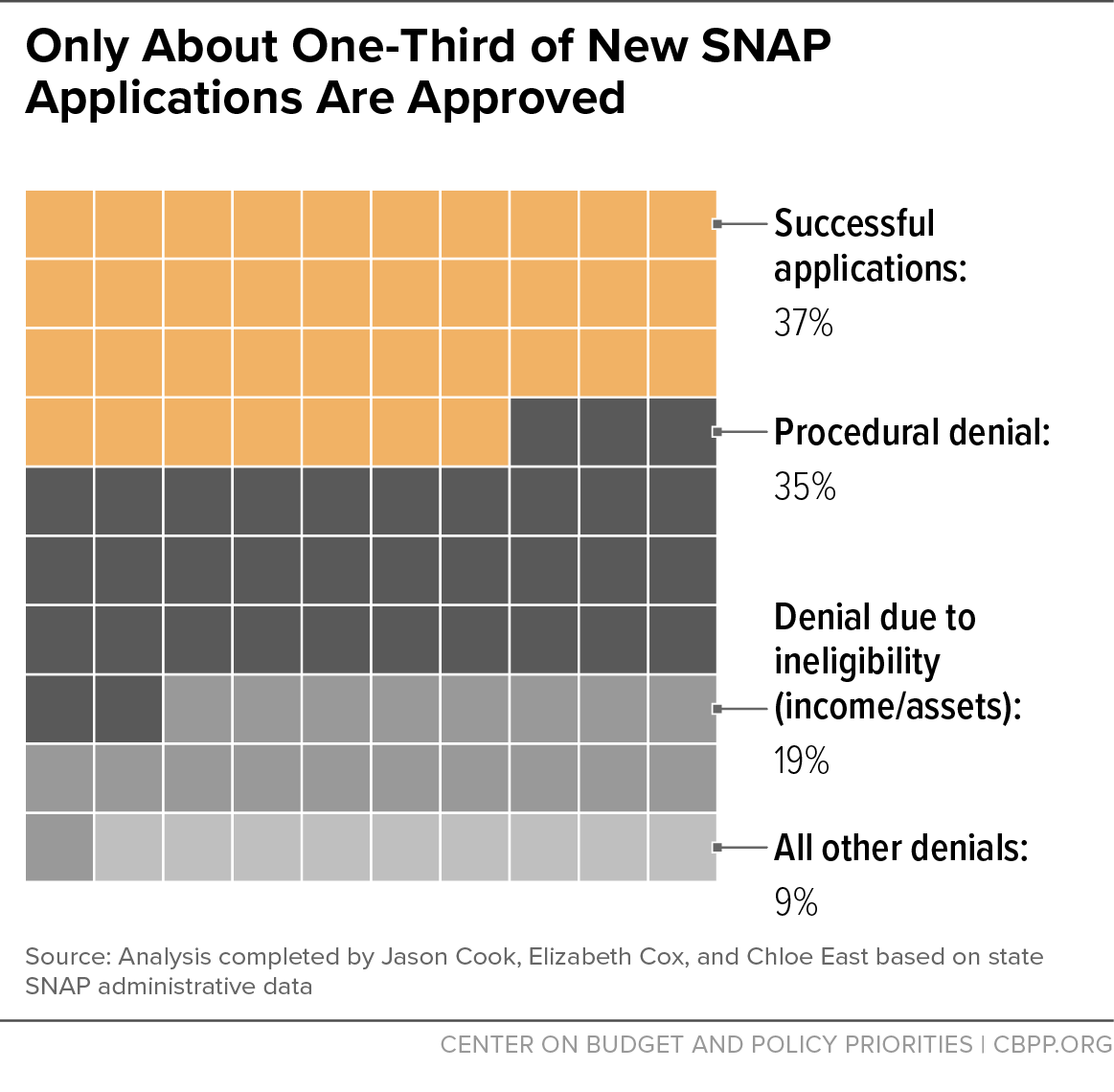
- Nearly 2 in 3 new applications were denied. (See Figure 1.) Over half of these denials were for procedural reasons, meaning the family was denied because they were unable to navigate or complete the application process, not because they were ineligible. In total, 35 percent of new applications were denied for procedural reasons — almost as many as were approved.

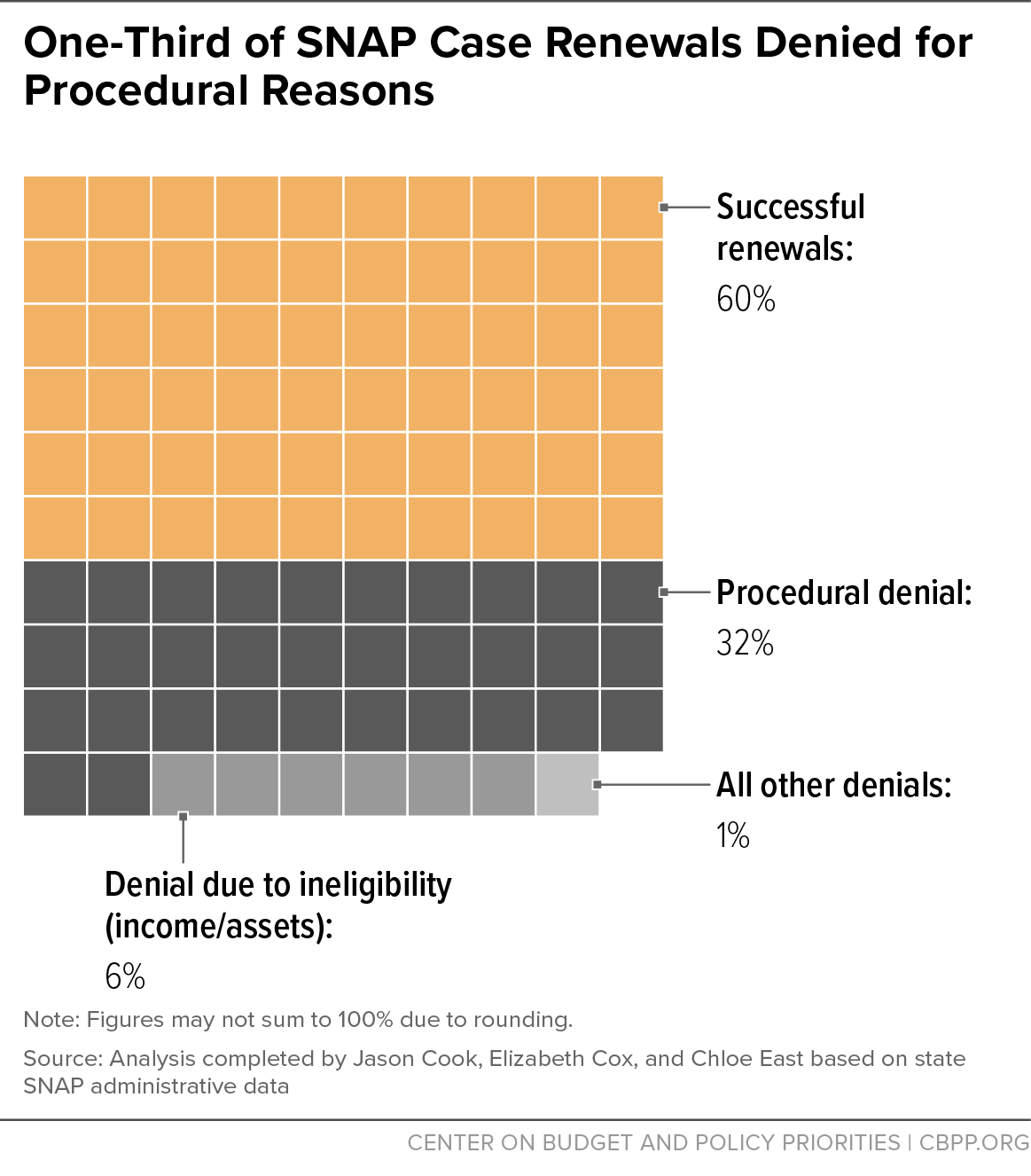
- Two in five eligibility recertifications were denied. Over 80 percent of these denials were procedural. In total, nearly 1 in 3 eligibility recertifications (32 percent) were denied for procedural reasons. (See Figure 2.) Other studies have found that “program churn” like this is costly not only for families, whose benefits are interrupted and have to reapply, but also for state agencies, because re-enrolling a family after they have fallen off SNAP requires significantly more resources than recertifying them.[2]

- People without earnings faced the same high rates of procedural denials at recertification, even though they were very likely still eligible due to their low incomes. They include people who are older, have a health condition that affects their ability to work, or have caregiving responsibilities.[3]
- Work requirements add red tape, which makes accessing SNAP even more difficult. The overall denial rate was higher when work requirements were in effect (65 percent) than when work requirements were waived (60 percent). The study found that the higher denial rate was entirely due to a greater risk of a procedural denial.
Policy Implications for States
Thoughtful policy and process design can reduce procedural denials and help preserve access to economic supports like SNAP. Some government-led initiatives have aimed to better understand the administrative burden people face and improve benefit systems using human-centered design, a process to ensure tools and products meet people’s needs with clarity, consistency, and ease.[4] Many states and counties have made policy and process choices that improve program delivery and lower access barriers.[5] These strategies also result in more efficient and cost-effective government operations.
For instance, flexible interviews allow people to complete their SNAP interview at a time that works best for their schedule instead of being assigned a time by the state.[6] This approach, particularly when combined with the use of text messaging, can reduce procedural denial rates and deliver benefits faster. Streamlining verification processes can also simplify the SNAP experience by relying on a combination of client statements and available data sources.[7] There are promising strategies in other programs as well. Medicaid “ex parte” renewal processes, which rely on the use of validated data sources to confirm eligibility rather than requiring an enrollee to fill out a form, have reduced administrative costs and helped eligible people keep their health coverage.[8]
Unfortunately, the 2025 Republican reconciliation law will increase red tape for people in need of food assistance and has put states in a difficult position.[9] States are scrambling to reduce their SNAP payment error rates in order to avoid being required to pay a portion of benefit costs under the law. The tight federal timeline for implementing this cost shift to states increases the likelihood that states will lower their error rates by restricting access and increasing procedural hurdles. Note that SNAP’s payment error rate does not include cases where the state improperly denied or ended benefits to an eligible household.
The reconciliation law also expands work requirements, even though these requirements have proven ineffective at increasing employment or wages.[10] The law takes SNAP away from many people after three months if they cannot prove that they’re completing at least 20 hours of work or related activities each week or that they should be exempt from the work requirements.
Evidence from across the country shows that state efforts to quickly reduce SNAP error rates have made it even more difficult to access food assistance, with many people cut off from SNAP altogether.[11] The expansion of work requirements is also playing a significant role in people losing their food assistance.
State and local policymakers have long sought to maintain timely and accurate SNAP operations. Despite the obstacles presented by the reconciliation law, states and counties can still take steps to reduce administrative burden, including:
- Improving accuracy through simpler policies and processes. Less complex policies and processes are easier for eligibility workers and families to understand and follow. As a result, they reduce workloads and minimize opportunities for mistakes. For example, implementing simplified reporting — which streamlines the changes in their income or other circumstances that a family must report — allows the state to focus on tracking the most important changes.
- Shifting from requiring paper documentation to using data sources and consent-based data verification tools. As states examine how their verification policies are impacting SNAP error rates, they can also review their use of data sources and explore opportunities to leverage consent-based verification tools (which rely on users logging into their personal payroll, bank, or other accounts and consenting to share their income information with the agency) to securely transmit earnings information. Requiring paper documentation is significantly more burdensome for families and eligibility workers. It also often delays processing and leads to a loss of benefits if the right document isn’t submitted and processed on time.
- Clearly communicating what is required. States should improve the readability of their applications, forms, and notices by using plain language and avoiding jargon. States can also redesign forms to prevent common errors.[12] For example, online forms can be designed to prompt people to complete a missing field.
- Measuring the human experience of accessing benefits. Traditional measures of program performance say little about what it is actually like for a person to participate in the program, including how often paperwork hurdles and other procedural steps trip people up as they try to keep their benefits current.[13] States can track metrics like procedural denials and closures, backlogs, and churn to understand how changes in the system are impacting families. Ideally, states would make this data publicly available on a regular basis.
End Notes
[1] Jason Cook, Elizabeth Cox, and Chloe East, “Administrative Burden and Procedural Denials in the Supplemental Nutrition Assistance Program,” CBPP, September 18. 2026, https://www.cbpp.org/research/food-assistance/administrative-burden-and-procedural-denials-in-the-supplemental-nutrition.
[2] Dottie Rosenbaum, “Lessons Churned: Measuring the Impact of Churn in Health and Human Services Programs on Participants and State and Local Agencies,” CBPP, March 20, 2015, https://www.cbpp.org/research/lessons-churned-measuring-the-impact-of-churn-in-health-and-human-services-programs-on.
[3] Joseph Llobrera and Lauren Hall, “SNAP Provides Critical Benefits to Workers and Their Families,” CBPP, updated April 28, 2025, https://www.cbpp.org/research/food-assistance/snap-provides-critical-benefits-to-workers-and-their-families.
[4] See Pamela Herd, Donald Moynihan, and Amy Widman, “Identifying and Reducing Burdens in Administrative Processes,” Administrative Conference of the United States, December 5, 2023, https://www.acus.gov/document/identifying-and-reducing-burdens-administrative-processes-final-report; General Services Administration, “Government-wide CX Efforts,” https://www.performance.gov/cx/projects/.
[5] CBPP, “State Landscape: Detailing Eligibility & Enrollment Practices in Medicaid, SNAP, TANF, and WIC,” updated July 13, 2026, https://www.cbpp.org/research/health/state-landscape-detailing-eligibility-enrollment-practices-in-medicaid-snap-tanf.
[6] Code for America, “Reducing Barriers to SNAP in Boulder County,” https://codeforamerica.org/success-stories/reducing-barriers-to-snap-in-boulder-county/.
[7] CBPP, “How to Streamline Verification of Eligibility for Medicaid and SNAP,” July 18, 2024, https://www.cbpp.org/research/health/how-to-streamline-verification-of-eligibility-for-medicaid-and-snap.
[8] Jennifer Wagner, “Medicaid Ex Parte Renewals Are an Efficient Strategy to Ensure Eligible Enrollees Have Health Care, Increase Accuracy, and Reduce Administrative Costs,” CBPP, February 25, 2025, https://www.cbpp.org/blog/medicaid-ex-parte-renewals-are-an-efficient-strategy-to-ensure-eligible-enrollees-have-health.
[9] Katie Bergh and Dottie Rosenbaum, “Many Low-Income People Will Soon Begin to Lose Food Assistance Under Republican Megabill,” CBPP, September 10, 2025, https://www.cbpp.org/research/food-assistance/many-low-income-people-will-soon-begin-to-lose-food-assistance-under.
[10] LaDonna Pavetti et al., “Expanding Work Requirements Would Make It Harder for People to Meet Basic Needs,” CBPP, March 15, 2023, https://www.cbpp.org/research/poverty-and-inequality/expanding-work-requirements-would-make-it-harder-for-people-to-meet.
[11] Nicole Ludden, “The truth behind Arizona’s SNAP free fall,” Arizona Agenda, April 17, 2026, https://www.arizonaagenda.com/p/the-truth-behind-arizona-s-snap-free-fall; Dottie Rosenbaum et al., “SNAP Tracker: People Are Losing Food Assistance as the Harmful 2025 Republican Reconciliation Law Is Implemented,” CBPP, August 26, 2026, https://www.cbpp.org/research/food-assistance/snap-tracker-people-are-losing-food-assistance-as-the-republican-megabill.
[12] Food and Nutrition Service, U.S. Department of Agriculture, “SNAP Model Notice Toolkit,” https://fns-prod.azureedge.us/sites/default/files/resource-files/SNAP-Model-Notice-Toolkit-Introduction.pdf.
[13] Alicia Huguelet, Dottie Rosenbaum, and Jennifer Wagner, “What We Measure Matters: Enhanced Performance Metrics for SNAP and Medicaid Would Promote a More Human-Centered Delivery System,” CBPP, August 30, 2023, https://www.cbpp.org/research/food-assistance/what-we-measure-matters-enhanced-performance-metrics-for-snap-and-medicaid.