BEYOND THE NUMBERS
Medicaid Ex Parte Renewals Are an Efficient Strategy to Ensure Eligible Enrollees Have Health Care, Increase Accuracy, and Reduce Administrative Costs
Ex parte renewals are an effective and efficient process for ensuring eligible Medicaid enrollees keep their coverage. Most Medicaid enrollees must complete a renewal of eligibility every 12 months (in addition to reporting changes that may affect eligibility in between renewals). However, before sending the enrollee a renewal form, federal regulations require Medicaid agencies to first attempt to complete a renewal of eligibility based on information available to the agency from the case file or data sources — an ex parte renewal. If the Medicaid agency confirms that the enrollee continues to be eligible, the enrollee doesn’t have to take any action, and they keep Medicaid coverage.
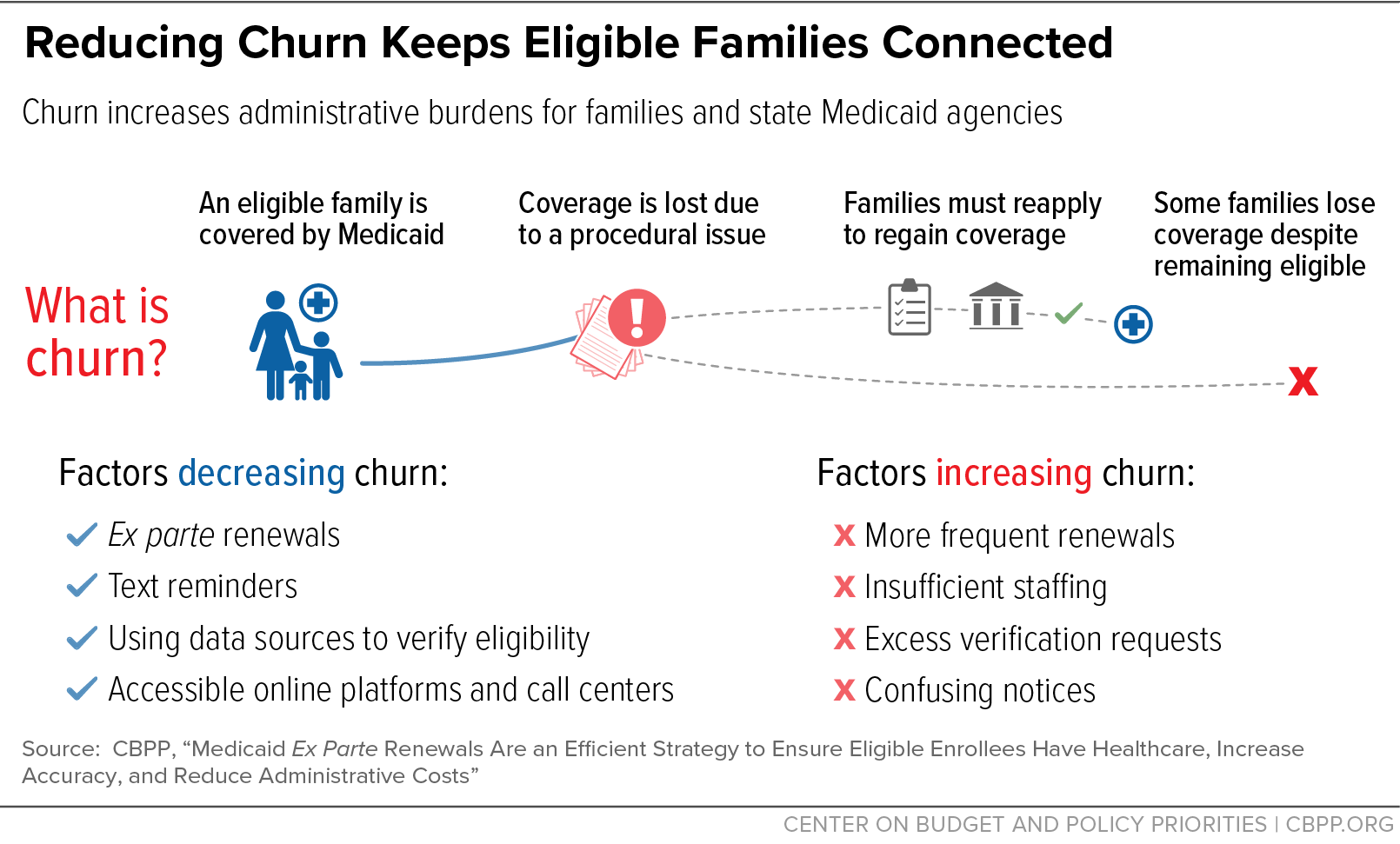
Ex parte renewals increase program accuracy. They ensure eligible people stay enrolled and reduce costs for Medicaid agencies through automation and decreased “churn” — having to re-enroll eligible people who lost coverage due to administrative error (see graphic). People who get private health insurance through their employer or the Affordable Care Act marketplace often get automatically re-enrolled each year if they want to keep the same plan. The same should be true for people who get health insurance through Medicaid. Ex parte renewals are the modern technology-driven process that we should expect from government.

Although ex parte renewals have been required for all Medicaid enrollees for over a decade, it wasn’t a high-priority area until states began preparing to renew eligibility for millions of enrollees after the COVID-era continuous coverage protection ended in spring of 2023 (known as “unwinding”). When unwinding began, the national rate of ex parte renewals was only around 30 percent; the vast majority of renewals required cumbersome paperwork that enrollees had to complete and eligibility workers had to manually process. After significant work by states, with the support of the Centers for Medicare & Medicaid Services (CMS), U.S. Digital Services (USDS) (prior to its transition to U.S. DOGE Services), and others, states are now processing over half of their Medicaid renewals ex parte.
Ex parte renewals reduce administrative burdens in Medicaid, which fall disproportionately on people of color, by not requiring enrollees whose ongoing eligibility can be confirmed through data sources to complete complex renewal forms. And they save significant administrative costs for states, since ex parte renewals are often automated in eligibility systems and eligible individuals who are successfully renewed don’t “churn” off the program and reapply for coverage, a time-consuming process for individuals and agency staff.
Code for America and the Center on Budget and Policy Priorities worked with Minnesota to stand up ex parte renewals for eligible older adults and disabled people, resulting in an estimated $4.6 million in annual savings in staff time. USDS estimated that their work helping states increase ex parte rates led to over 5 million more people whose Medicaid coverage was renewed ex parte and saved over 2 million hours of eligibility worker processing time in 2024.
CMS has released guidance explaining what states must do to comply with ex parte renewals regulations and what they can do to continue using ex parte renewals after unwinding.
- CMS clarified how states must conduct ex parte renewals and the inefficient practices states must avoid.
- CMS also released information on how states can continue employing useful strategies that proved effective at increasing accuracy and efficiency and reduced waste during unwinding.
- Finally, CMS provided additional information and detailed examples of how states must perform ex parte renewals.
Maximizing ex parte renewals increases program integrity and accuracy by keeping eligible people enrolled and allowing caseworkers to spend time on more complex cases. Medicaid agencies should continue to maximize this efficient process that reduces cost.