

A Balanced Budget Amendment Doesn’t Change the Math
Testimony of Brendan Duke, Senior Director for Federal Budget Policy, Center on Budget and Policy Priorities, Before the House Judiciary Committee’s Subcommittee on the Constitution and Limited Government
Thank you, Chair Roy, Ranking Member Scanlon, and members of the Subcommittee. My name is Brendan Duke, and I am Senior Director for Federal Budget Policy at the Center on Budget and Policy Priorities (CBPP). CBPP is a nonpartisan research and policy institute that advances federal and state policies to help build a nation where everyone has the resources they need to thrive and share in the nation’s prosperity.[1]
Addressing the nation’s long-term fiscal problems with any constitutional amendment to require annual balanced budgets would be highly ill-advised. It would threaten significant economic harm while raising a host of problems for the operation of Social Security and other vital federal functions. Policymakers who support lowering deficits should craft tax and budget policies to lower deficits, not rely on an unworkable constitutional amendment.
Moreover, addressing long-term fiscal challenges responsibly and with public support requires policymakers to recognize several realities:
- tax cuts enacted over the last three decades have increased near- and long-term deficits markedly;
- an aging population means that we will need to spend more to meet our obligations to seniors in Medicare, Medicaid, and Social Security; and
- the American people favor a broad range of critical public services, investments in our economy such as education and research, and supports for seniors, people with disabilities, and individuals and families who need help affording food, health care, and housing.
Given these realities — which are rooted in rigorous analysis and people’s deeply held values — there is no path to improving our long-term fiscal sustainability without raising significant revenue.
An Aging Population Will Require More Revenue
Let me first begin with an analysis of our fiscal situation. Analyses of the U.S. federal budget typically focus on government spending and revenue as shares of the economy. In 2024 revenue was 17 percent of GDP, very similar to the average over the past 40 and 50 years and to the same as its the level in 1984. Programmatic spending, on the other hand, grew from 18.8 percent to 20.4 percent between 1984 and 2024.
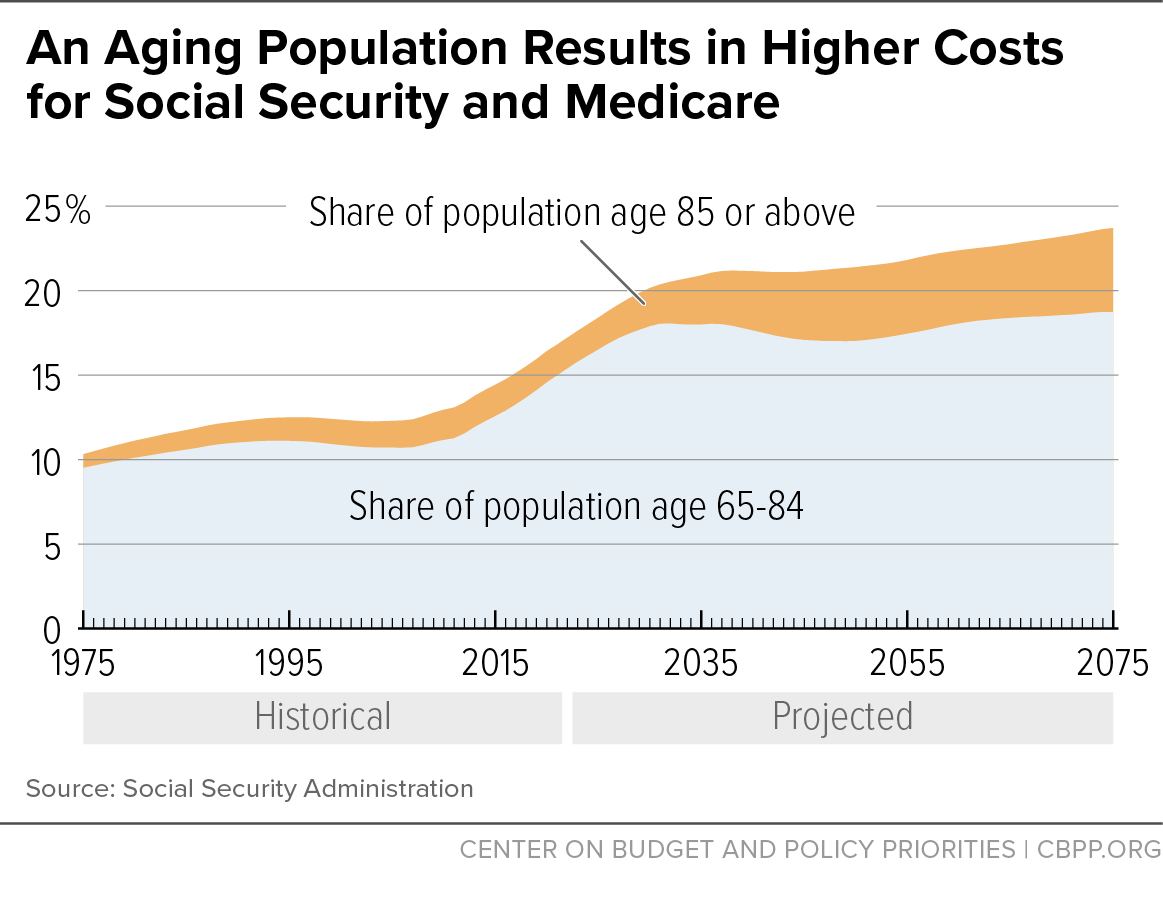
These simple facts lead many in Congress to conclude “we have a spending problem, not a revenue problem,” but that phrase ignores the reality that the country has gotten older and so spending on Social Security and Medicare has gone up. Programmatic spending outside of these programs is actually lower as a share of the economy today than in 1984.[2] All of non-defense discretionary spending, for example, fell from 3.8 percent to 3.3 of GDP between 1984 and 2024.
Forty years ago members of the baby-boom generation (those born between 1946 and 1964) were in or still approaching their “prime working years”; today they are in their “prime retirement years,” with all but the very youngest now eligible for Social Security and Medicare. And over the next 40 years, this trend of an aging population will continue.

The combination of population aging and basic arithmetic means we will face a choice: either we raise revenue above the 17 percent level set when the country was younger, or we make drastic cuts to programs and go back on commitments we’ve made, including to seniors in Medicare, Social Security, and Medicaid (which is the largest payer of long-term care services in the country).
With Social Security, Medicare, long-term care in Medicaid, defense spending, and spending on veterans comprising two-thirds of federal program spending, there is simply no way to significantly flatten the debt trajectory while shielding these programs from cuts without additional revenue.
The work of this Congress and Administration shows both how damaging these cuts would have to be and how deeply we would have to cut to address our fiscal imbalances. The Trump Administration has attempted to illegally close whole agencies, engaged in mass layoffs, and refused to spend congressionally appropriated funds with little or no savings to show for it. Similarly, congressional Republicans failed to offset the full cost of their tax law despite a 22 percent cut to the Supplemental Nutrition Assistance Program (SNAP) and 18 percent cut to Medicaid by 2034 while encountering very substantial public pushback. And even the Trump Administration ostensibly opposes cuts to Social Security and Medicare benefits — indeed, large bipartisan majorities increased Social Security benefits one year ago by repealing Social Security’s the windfall elimination provision and government pension offset.[3]
Meeting long-standing retirement and health care commitments to seniors and managing the future risks associated with higher debt will, therefore, require substantially more revenue. The Trump Administration once again helps prove this. The deficit as a share of the economy fell from 6.3 percent to 5.9 percent of GDP between fiscal years 2024 and 2025 in large part because of about $120 billion in additional tariff revenue. These tariffs — while legally questionable, regressive, and economically destructive — reflect the reality that revenue needs to be part of the fiscal discussion.
Without 25 Years of Unpaid-for Tax Cuts, Our Debt Today Would Be Lower and Stable
The retirement of the baby-boom generation was a predictable and predicted development. And at the beginning of the 21st century, at least, our fiscal system was projected to deliver adequate revenue to meet our needs, as revenue was projected to rise above 17 percent. But that was before costly tax policy changed the trajectory.
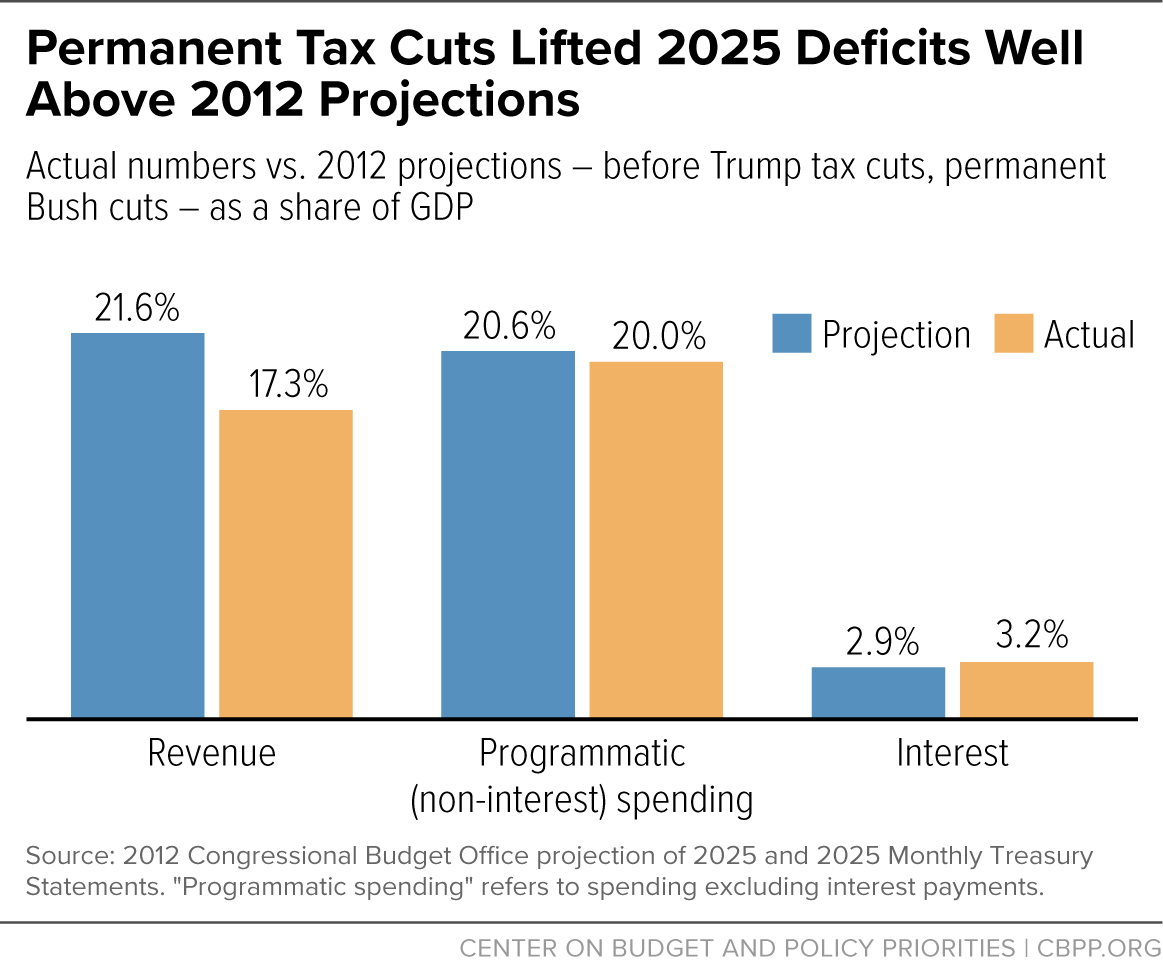
One way to see this is to look at Congressional Budget Office (CBO) projections from 2012 — the year before more than four-fifths of the Bush tax cuts were made permanent and before the Trump tax cuts became law. This means that CBO’s projections for 2025 at the time assumed the Bush tax cuts would expire as scheduled and the Trump tax cuts would never happen.
In 2012 CBO projected that the fiscal year 2025 deficit would be 1.8 percent of GDP — low enough for economic growth to keep the debt from growing endlessly.[4] But in reality, the 2025 deficit was 5.9 percent of GDP. The reason for this increase in the deficit relative to projections is simple: despite rising costs due to the aging of the baby-boom generation and our investment deficit, policymakers have enacted unpaid-for tax cuts in the past two decades that have eroded the revenue base.
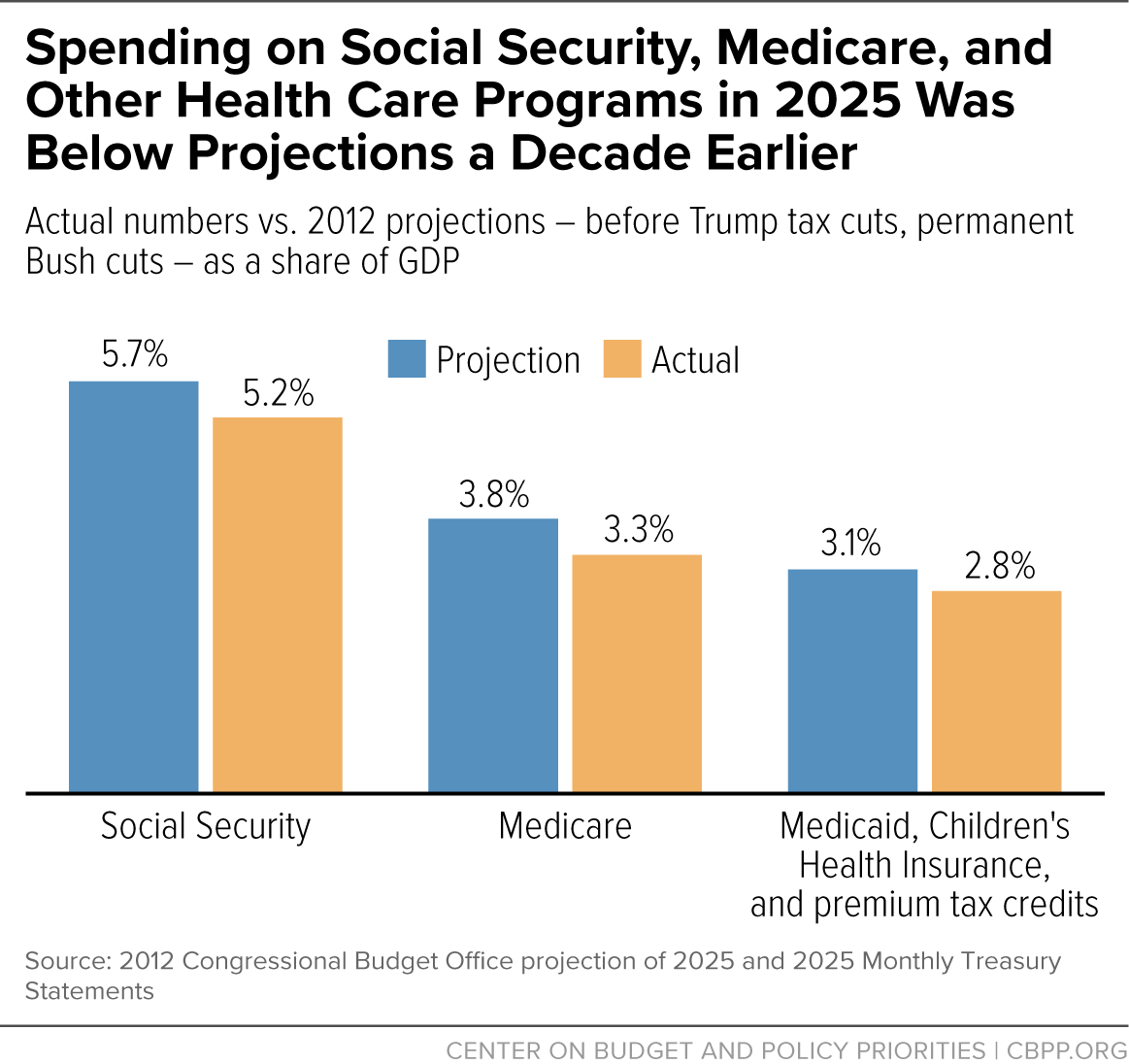
The increase was not because of higher spending on programs. CBO’s 2012 projection of programmatic spending making up 20.6 percent of GDP in 2025 was above the actual level of 20.0 percent. The higher deficit is entirely attributable to the drop in projected revenue as a share of the economy, from a projected 21.6 percent to 17.3 percent, mostly as a result of the two rounds of tax cuts.

Importantly, key programs — such as Social Security; Medicare; and Medicaid, the Children’s Health Insurance Program, and the Affordable Care Act’s Premium Tax Credits — also came in below CBO’s 2012 projections. What this shows is that it’s entirely possible to meet our commitments to our seniors while ensuring millions of low- and moderate-income Americans have health care if we are willing to raise the revenue to do so. Notably, the 2025 costs of non-Medicare major health programs are lower than the 2012 projections for 2025 despite the subsequent enactment of premium tax credit enhancements, which are unfortunately slated to expire at the end of the year.

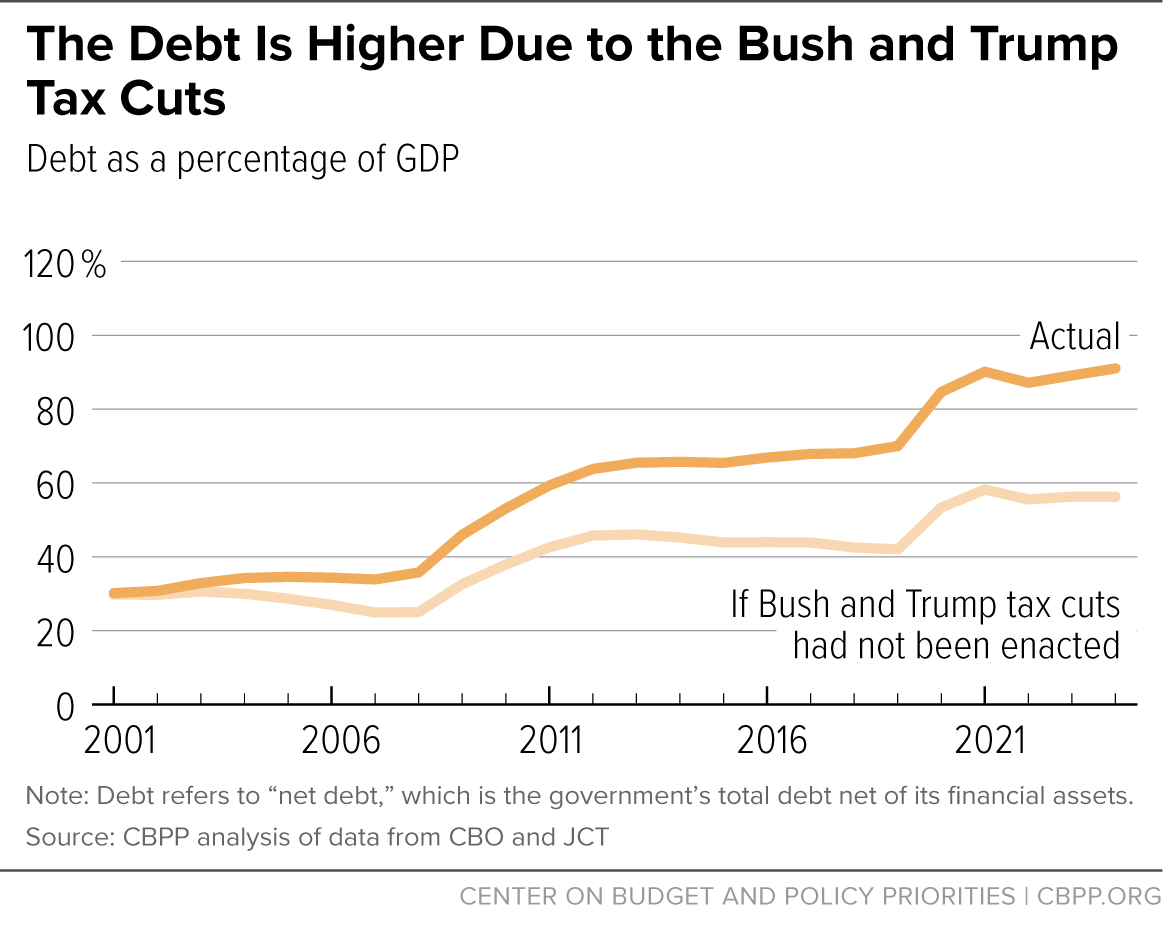
Switching from deficits to debt, we can directly see the burden that decades of unpaid-for tax cuts have placed on our fiscal system. My CBPP colleagues estimate that if the Bush tax cuts, their extensions under President Obama, and the 2017 Trump tax cuts had not been enacted, the debt ratio would be considerably lower: 56 percent of GDP in 2024 compared to the actual 92 percent.[5]

All of the above leads me to conclude that stabilizing our fiscal trajectory will require reversing the revenue losses from the Bush and Trump tax cuts. This solution is mathematically simple, if politically difficult. But it’s substantially less politically difficult than amending the U.S. Constitution or walking away from our commitments to Medicare and Social Security, slashing spending for defense and veterans, and taking food assistance and health coverage away from people who need help affording the basics.
Congress missed an opportunity to learn this lesson earlier this year. Instead, it doubled down on the mistakes of the Bush tax cuts, their deficit-financed Obama-era extensions, and the first round of Trump tax cuts. CBO estimates that H.R. 1, the harmful Republican megabill, will cost a net of $3.4 trillion through 2034, adding $4.1 trillion to the debt after including the additional interest payments from more borrowing. Even worse, this could be $5 trillion if the legislation’s new set of tax cuts, currently set to expire in 2028 and 2029, are extended.
No independent organization—including right-leaning ones such as the Tax Foundation and the American Enterprise Institute[6]--has found that economic growth would meaningfully offset the cost of these tax cuts. Indeed, some like the Budget Lab at Yale and the Penn Wharton Budget Model find that accounting for economic growth effects would increase its price tag.[7]
Tariffs are bringing in revenues. The President unilaterally has imposed this regressive tax, which is raising prices on everything from food to baby strollers to manufacturing inputs such as industrial chemicals. The net effect of the megabill’s tax cuts and the tariffs is a big windfall for the wealthy — an average $8,200 increase in income for the top 10 percent of households (a 1.6 percent gain).[8] The bottom 80 percent of households, on the other hand, are worse off from this combination of policies, with the incomes of the bottom 10 percent falling an average of $2,600 (a 6.6 percent decline).
We can and should have a discussion about addressing our fiscal imbalances that relies on a better approach than financing income tax cuts tilted to the wealthy by cutting programs to help families afford food and medicine while raising taxes on food and medicine that the Administration has relied on.
A Balanced Budget Amendment Is a Deeply Flawed Answer to Our Fiscal Challenges
The nation faces real but solvable long-term fiscal challenges, but a balanced budget amendment to the U.S. Constitution is an ill-advised way to address them. It would require a balanced budget every year regardless of the state of the economy, unless a supermajority of both houses overrode that requirement.
Economic Concerns
The most serious concern about a balanced budget amendment is how it would exacerbate and prolong recessions.
When the economy weakens, revenue growth drops and revenue may even contract. And as unemployment rises, so do expenditures for programs such as unemployment insurance (UI) — and to a lesser but significant degree, SNAP and Medicaid. These revenue declines and expenditure increases are temporary; they largely or entirely disappear as the economy recovers. But they are critical for helping struggling economies avoid falling into recessions and for moderating the depth and length of recessions that do occur.
During economic downturns, consumers and businesses spend less, which in turn causes further job loss. The drop in tax collections and increases in UI and other benefits that occur automatically cushion the blow by keeping purchases of goods and services from falling more. That is why economists use the term “automatic stabilizers” to describe the declines in revenue and increases in UI and other benefits that help stabilize the economy when it turns down.
A constitutional balanced budget amendment, however, effectively suspends the automatic stabilizers. It requires that federal spending be cut and/or taxes increased to offset the automatic stabilizers and prevent a deficit from occurring — the opposite course from sound economic policy. That would launch a vicious spiral: a weak economy would lead to higher deficits, which would force policymakers to cut spending or raise taxes more, which would weaken the economy further. If interest rates hit the zero lower bound during a recession, as they did during the last two, the Federal Reserve would not be able to offset any of this fiscal drag by further cutting interest rates.
Over the years, leading economists have warned of the adverse effects of a constitutional balanced budget amendment. For example, when Congress was considering a constitutional balanced budget amendment in 1997, more than 1,000 economists, including 11 Nobel laureates, issued a joint statement that said, “We condemn the proposed ‘balanced-budget’ amendment to the federal Constitution. It is unsound and unnecessary. . . . The proposed amendment mandates perverse actions in the face of recessions. In economic downturns, tax revenues fall and some outlays, such as unemployment benefits, rise. These so-called ‘built-in stabilizers’ limit declines of after-tax income and purchasing power. To keep the budget balanced every year would aggravate recessions.”[9] In 2011, five winners of the Nobel Prize for Economics issued a statement opposing a constitutional balanced budget amendment for this reason.[10]
The amendment’s proponents likely will respond to these admonitions by noting that a proposed amendment could allow a vote of a supermajority of the House and the Senate to waive the balanced budget requirement. However, as the paralysis that often marks the Senate’s work indicates, it is difficult to secure supermajority votes for any major legislation. Moreover, some of the hard data on the economy come with a lag of several months, and it could well take many months after the economy has begun to weaken before sufficient data are available to convince supermajorities of both houses of Congress that economic conditions warrant waiving the balanced budget requirement, if a supermajority were willing to waive the requirement at all.
Furthermore, it is all too likely that even after the evidence for a downturn is clear, a minority in the House or Senate could hold a waiver vote hostage to demands for concessions on other matters (such as new, permanent tax cuts). (Even worse, parties might hold such a waiver hostage based on a perception of who would be blamed on election day for a recession.) By the time a recession is recognized and supermajority votes are secured in both chambers, extensive economic damage could have occurred and hundreds of thousands, or even millions, of additional jobs unnecessarily lost.
The bottom line is this: the automatic stabilizers need to continue to protect U.S. businesses and workers, and they need to be automatic, not based on lagging economic data or the whims of perceived political leverage.
Effects on Social Security and Medicare
Consider how this requirement would affect Social Security and Medicare. By design, the Social Security and Medicare trust funds built up reserves — in the form of Treasury securities backed by the full faith and credit of the United States — during the baby-boom generation’s peak earning years, and we are now drawing them down as that generation retires. Currently, Social Security holds $2.6 trillion in Treasury securities and the Medicare Hospital Insurance (HI) trust fund holds about $250 billion. The Social Security trustees project that Social Security will be able to pay full benefits until 2034 and the Medicare trustees project that Medicare HI would be able to pay full hospital costs until 2033.
But under the balanced budget amendment, it would essentially be unconstitutional for Social Security and Medicare to draw down these savings to pay promised benefits — we would face their funding cliffs immediately instead of in the 2030s. Instead, benefits would have to be cut, because all spending would have to be covered by tax revenue collected during that same year. More precisely, Social Security and Medicare would be allowed to use their accumulated Treasury securities to help pay benefits only if the rest of the federal budget ran an offsetting surplus (or if the House and Senate each mustered supermajority votes to permit deficit spending).
In other words, a balanced budget amendment would serve as an effective backdoor way to immediately cut Social Security and Medicare benefits.
Effects on the Banking System
The potential effects on the banking system also are cause for concern. The Federal Deposit Insurance Corporation (FDIC) holds substantial reserves, in the form of Treasury securities, to insure the savings of depositors. These reserves are called upon when banks fail. Similarly, the Pension Benefit Guarantee Corporation (PBGC) has assets to draw upon if a corporation’s defined benefit pension plan goes bankrupt.
Here, too, the balanced budget amendment would make it unconstitutional for the FDIC and the PBGC to use their assets to pay deposit or pension insurance since doing so generally would constitute “deficit spending.” Such payments could be made only if the rest of the budget ran an offsetting surplus that year (or if Congress achieved the necessary supermajorities to override the balanced budget requirement).
In general, a constitutional requirement that all spending during a given year be covered by tax revenues collected in the same year would undercut all U.S. government insurance and loan guarantees. Those range from the “full faith” backing by the U.S. government to pay interest on Treasury securities to deposit insurance, pension insurance, Federal Housing Administration loans, small business loans, flood insurance, and the nuclear power industry’s liability insurance under the Price-Anderson Act.
Henceforth, the U.S. government would only be able to fulfill its legal commitments if their cost did not cause a deficit, or if both houses of Congress voted by a supermajority to waive the balanced budget requirement. The entire purpose of deposit insurance and other U.S. financial commitments is to guarantee financing in case of calamity. How reliable is the “guarantee” if the balanced budget requirement places it at risk or forces it to be withdrawn just when it is needed most?
Mistaken Analogies to States and Families
Proponents of a constitutional amendment sometimes argue that states and families must balance their budgets every year, and the federal government should do so, too. But statements that the constitutional amendment would align federal budgeting practices with those of states and families are not accurate.
While states must balance their operating budgets, they can borrow to finance their capital budgets — to finance roads, schools, and other projects. Most states do so. States also can build reserves during good times and draw on them in bad times without counting the drawdown as new spending that unbalances a budget.
Families follow similar practices. They borrow — they take out mortgages to buy a home or student loans to send a child to college or car loans to buy a car. They also draw down savings when times are tight to cover expenses that exceed their current incomes. Ask yourself what share of Americans would own a home if they could not take out a mortgage and they could not use savings? What share of people could possibly buy a home out of their wages or salaries earned in that year?
But the proposed constitutional amendment would bar such practices at the federal level. The total federal budget — including capital investments — would have to be balanced every year; no borrowing to finance infrastructure or other investments to boost future economic growth would be allowed. And if the federal government ran a surplus one year, it could not draw it down the next year to help balance the budget.
More broadly, many other countries have similar fiscal “rules,” but no country’s rule — even those referred to as “budget balance rules” — require total budget deficits to be zero in every year, according to an International Monetary Fund analysis. Instead, they allow countries to run deficits during recessions and surpluses during booms by setting targets for the “structural” or “cyclically adjusted” budget, targeting the budget balance over the course of an economic cycle, or targeting balance only in the operating budget, as states do. In other words, the fiscal rule being discussed today would be more extreme than any other country’s.
A Balanced Budget Amendment Doesn’t Change the Math
A balanced budget amendment doesn’t change the basic facts that tax cuts have worsened our fiscal trajectory, that the aging of the population means spending has to rise as a share of the economy, and that there is broad public support for keeping our commitments in Medicare and Social Security, supporting public services and investments that we all depend on and that strengthen our nation’s economy, and helping people afford the basics, including food, housing, and health care.
Rather than spend time on an unworkable and economically calamitous amendment to the Constitution, policymakers should focus on policies that can improve the fiscal trajectory while meeting the public’s wise priorities about what government should do.
End Notes
[1] My testimony draws extensively on the previous written work of my CBPP colleagues including Robert Greenstein and Richard Kogan, “A Constitutional Balanced Budget Amendment Threatens Great Economic Damage, Raises Host of Problems for Social Security and Other Key Federal Functions,” Center on Budget and Policy Priorities, July 27, 2011, https://www.cbpp.org/sites/default/files/atoms/files/6-6-11bud2.pdf; Richard Kogan et al, “More Revenue Is Required to Meet the Nation’s Commitments, Needs, and Challenges,” Center on Budget and Policy Priorities, June 17, 2024, https://www.cbpp.org/research/federal-budget/more-revenue-is-required-to-meet-the-nations-commitments-needs-and; Chye-Ching Huang and Chloe Cho, “Balanced Budget Amendment Proposal Is Extreme by International Standards,” Center on Budget and Policy Priorities, May 3, 2016, https://www.cbpp.org/sites/default/files/atoms/files/5-3-16bud2.pdf
[2] Programmatic spending is outlays excluding net interest expense. Spending on net interest is ultimately the result of both Congress’s programmatic spending and revenue decisions since the beginning of the Republic, i.e., the resulting level of net debt, in addition to the market forces that determine interest rates.
[3] Kathleen Romig, "Repealing Social Security’s WEP and GPO Rules Would Be Misguided," Center on Budget and Policy Priorities, https://www.cbpp.org/research/social-security/repealing-social-securitys-wep-and-gpo-rules-would-be-misguided
[4] CBO’s 2012 projection assumed the Alternative Minimum Tax (AMT) would continue not to be indexed for inflation and would thus cause the revenue-to-GDP ratio to rise (it was then indexed to inflation later that year as part of the legislative package that made most of the Bush tax cuts permanent). But the legislation making most of the Bush tax cuts permanent still significantly reduced revenue, even setting aside its changes to the AMT. The analysis of the debt trajectory below — which separates out the effect of adjusting AMT for inflation and the Bush tax cut extension — still shows that the debt-to-GDP ratio would be approximately stable without those tax cuts while adjusting the AMT for inflation. And it is still the case that program costs in 2025 are lower than CBO had projected in 2012; the increased deficits are still entirely the result of tax cuts.
[5] As noted above, this analysis assumes that Congress already “patched” the Alternative Minimum Tax (AMT) by permanently adjusting its parameters for inflation, so the costs of such a patch does not count as part of the Bush tax cuts.
[6] Kyle Pomerleau, “A Preliminary Macroeconomic Analysis of the “One Big Beautiful Bill Act”,” June 12, 2025, https://www.aei.org/articles/a-preliminary-macroeconomic-analysis-of-the-one-big-beautiful-bill-act/; Garrett Watson et al, “One Big Beautiful Bill Act Tax Policies: Details and Analysis,” The Tax Foundation, July 4, 2025, https://taxfoundation.org/research/all/federal/big-beautiful-bill-senate-gop-tax-plan/#timeline
[7] Budget Lab, "Long-term Impacts of the One Big Beautiful Bill Act, as Enacted on July 4, 2025," July 30, 2025, https://budgetlab.yale.edu/research/long-term-impacts-one-big-beautiful-bill-act-enacted-july-4-2025; Penn Wharton Budget Model, "President Trump-Signed Reconciliation Bill: Budget, Economic, and Distributional Effects," July 8, 2025, https://budgetmodel.wharton.upenn.edu/issues/2025/7/8/president-trump-signed-reconciliation-bill-budget-economic-and-distributional-effects
[8] Budget Lab, “Combined Distributional Effects of the One Big Beautiful Bill Act and of Tariffs,” August 12, 2025, https://budgetlab.yale.edu/research/combined-distributional-effects-one-big-beautiful-bill-act-and-tariffs-0 [See September update sheet]
[9] Senate Judiciary Report, "The Balanced Budget Constitutional Amendment," February 3, 1997, https://www.congress.gov/committee-report/105th-congress/senate-report/3/1
[10] Center on Budget and Policy Priorities and Economic Policy Institute, "Nobel Laureates and Leading Economists Oppose Constitutional Balanced Budget Amendment," July 19, 2011, https://www.cbpp.org/press/press-releases/nobel-laureates-and-leading-economists-oppose-constitutional-balanced-budget