

Trump, Congressional Republican Agenda Has Harmed Rural Communities
Policies adopted by the Trump Administration and Republicans in Congress have adversely impacted individuals and families living in rural communities, along with millions of other people across the country. Policies that supporters claimed would advance rural prosperity, such as the harmful 2025 Republican reconciliation law, the Administration’s chaotic and haphazard tariff regime, and its violent and costly immigrant deportation and detention campaign, have instead made life more difficult for rural residents.
The reconciliation law cut nearly $200 billion from the Supplemental Nutrition Assistance Program (SNAP) and more than $1 trillion from Medicaid and the Affordable Care Act (ACA) marketplaces. At the same time, it extended the expiring 2017 tax cuts, which provide the biggest gains to the wealthy, but did not extend the expiring premium tax credit enhancements, which helped families afford marketplace health coverage.[1] Considering the law as a whole, households with the lowest incomes will end up worse off — they will lose significantly more from the cuts in health care and food assistance than they will gain from the tax cuts — while the wealthiest households will be better off, according to the Congressional Budget Office.[2]
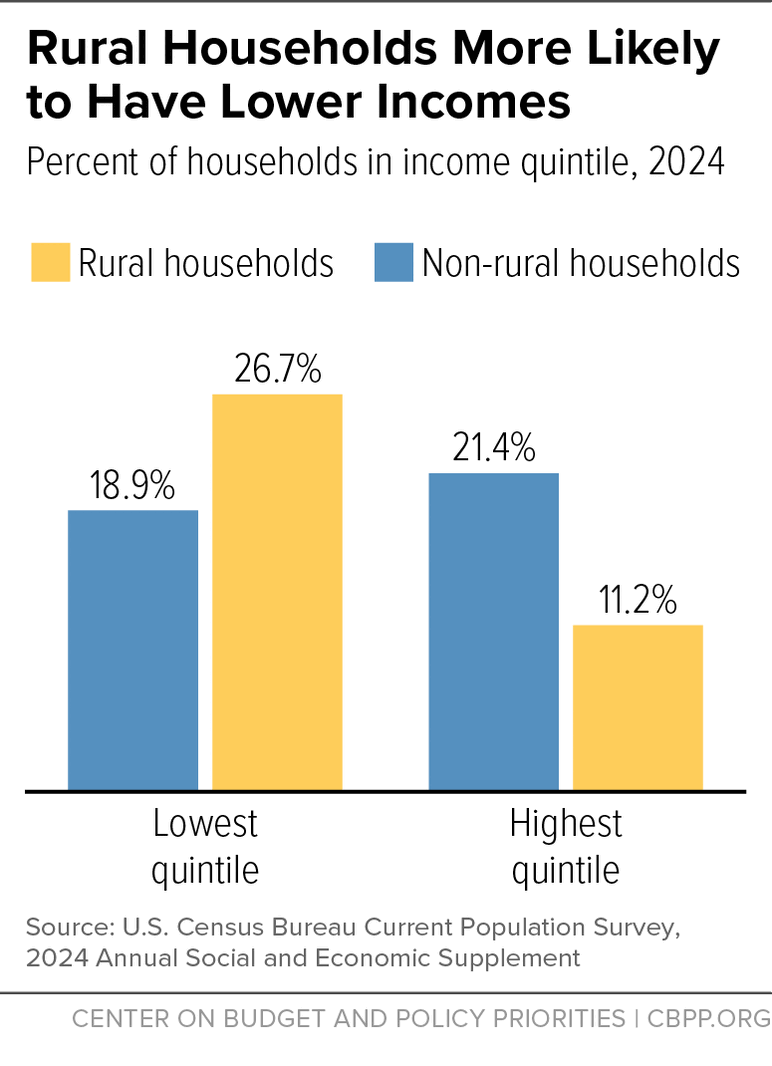
The reconciliation law hurts rural communities disproportionately because a larger share of rural residents have low incomes and experience material hardship than urban residents; rural residents also are more likely to receive health coverage through Medicaid and food assistance through SNAP. Fully 85 percent of the nation’s counties that are persistently poor have entirely rural populations.[3] Households in rural areas are over-represented at the lower end of the income spectrum and under-represented at the top. (See Figure 1.) The reconciliation law — with its tax cuts tilted to the top and its cuts in Medicaid and SNAP — will worsen these inequities.
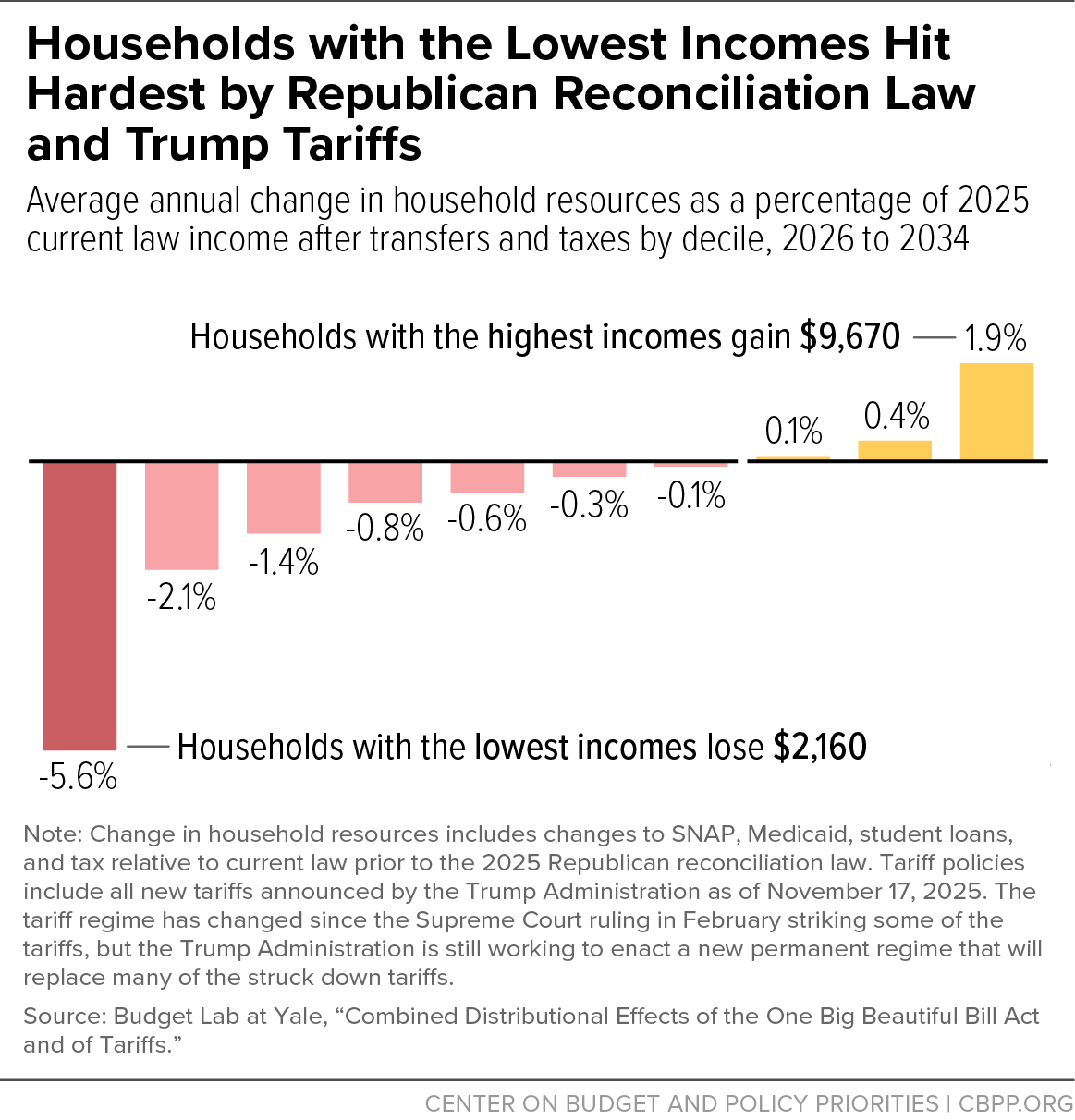
The reconciliation law is being implemented in an environment where prices are rising due to the Administration’s tariffs and the war with Iran. Thus far in 2026, overall inflation has outpaced average wage growth, and both inflation measures — the Consumer Price Index and the Personal Consumption Expenditures Price Index — are over 3 percent, well above the Federal Reserve’s 2 percent target.[4] Inflation especially hurts households with low or moderate incomes, many of whom are already struggling with the reconciliation law’s cuts to health care and food assistance. A study by the Budget Lab at Yale found that together, the reconciliation law and the tariffs will leave households with incomes in the bottom 70 percent worse off.[5] (See Figure 2.)

Adding to the damage from higher prices and cuts in food assistance and health care, rural communities are also being harmed by the Administration’s cruel and violent immigration deportation and detention campaign. People who are immigrants play an essential role in mitigating rural population loss, strengthening rural labor markets, and revitalizing civic life in rural communities.
Recent Tax Changes Will Do Little for Rural Residents
The reconciliation law extends the expiring individual tax cuts in the 2017 Trump tax law and adds new tax cuts on top, such as increasing the amount that heirs of the largest estates can receive tax-free and adding highly skewed corporate tax breaks. Households with incomes in the top 1 percent will receive tax cuts over three times the size of those for households with incomes in the bottom 60 percent, measured as a share of after-tax income. And the 1.2 million households with annual incomes above $1 million (roughly the top 0.6 percent) will receive more total tax cuts than the 127 million households with incomes below $100,000.[6]
This skewed distribution means that rural communities, which generally have lower incomes than urban areas, will benefit relatively little from the tax cuts — and this is before taking the impact of the SNAP and Medicaid cuts into account.
Republicans in Congress and supporters of the law argue that certain tax provisions in the reconciliation law benefit rural areas, in particular its tax breaks related to the estate tax and “Opportunity Zones.”[7] But those arguments don’t hold up under scrutiny.
Claims that the law’s extension and expansion of previous cuts in the estate tax will help family farmers are highly misleading. Under prior law, only 0.3 percent of farm households or 141 estates owed any estate tax, according to the U.S. Department of Agriculture (USDA).[8] And no small farm or small business (those with farm or business assets of $5 million or less) paid any estate tax in 2023, the Tax Policy Center estimated.[9] The reconciliation law increased the amount that a wealthy couple can exempt from the estate tax — and thus pass on to their heirs tax free — to $30 million. That’s $1.7 million more than the exemption would have been under a simple extension of the 2017 tax law. As a result of this change, the number of estates owing tax will shrink further, thereby further enriching wealthy families without any added benefit for the vast majority of farm households.[10]
Similarly, the reconciliation law’s changes to the Opportunity Zone tax break likely won’t help rural areas or residents significantly. As established under the 2017 tax law, the tax break lets investors defer capital gains taxes by “rolling” those gains into funds that invest in designated low-income areas, called Opportunity Zones; investors who keep their investments in the funds for at least five years also get a 10 percent capital gains exemption (plus extra tax breaks if the investments are held longer). Under the 2025 reconciliation law, investors who put their gains in funds that primarily invest in rural census tracts get a 30 percent capital gains exemption. They also benefit from weakened requirements to improve rural property: in general, Opportunity Zone funds must “substantially improve” — that is, make major investments in — assets they buy, like real estate, but funds that primarily invest in rural areas only have to invest half as much in asset improvements as is required in other Opportunity Zones.
Adding extra benefits for investment in rural census tracts does not fix the Opportunity Zone tax break’s major flaws, which result from its failure to target investment to the places and people that need the most help.[11] Because the incentive is structured as a capital gains tax break, the largest benefits will continue to go to the projects with the highest financial returns — likely in rapidly growing, primarily urban areas.
This is consistent with research on the 2017 law’s Opportunity Zone provision. While investment did increase in designated zones,[12] much of the investment went to census tracts that had greater pre-existing private investment, rather than higher-need areas with the lowest-income residents.[13]
SNAP Cuts, Cost Shifts Could End SNAP Entirely in Rural Areas
The reconciliation law’s cuts in food assistance will increase poverty, food insecurity, and hunger, including among children — and the impact could be particularly severe in rural areas. Some 8.1 million rural residents received food assistance through SNAP in an average month of fiscal year 2024.[14] The share of residents receiving SNAP is higher in rural areas (13.8 percent) than in urban areas (11.4 percent).[15]
While many of the law‘s SNAP cuts are still phasing in, SNAP participation nationwide has already fallen by roughly 5 million people (12 percent) between the law’s July 2025 enactment and May 2026 (the latest month available as of the date of this report). We estimate that well over 1.5 million fewer children are receiving SNAP nationwide, based on available data from 25 states.[16]
The reconciliation law takes away food assistance, in part, by expanding SNAP’s harsh work requirement, which previously applied to most non-elderly, non-disabled adults without children in their homes but now also applies to adults with children aged 14 and older and adults ages 55 to 64. The law also ends exemptions for veterans, people experiencing homelessness, and young people who recently aged out of foster care. People subject to the requirement can only receive food benefits for three months in a 36-month period unless they can document they are working at least 20 hours per week or can prove, through a red-tape-laden process, that they qualify for an exemption (such as a physical limitation that prevents them from working).[17]
Meeting work requirements can be especially difficult in rural communities, where unemployment is generally higher, jobs are often farther away and harder to reach (particularly since public transportation tends to be less robust), and high-speed internet access is more limited.[18] Plus, the reconciliation law makes it harder for states to exempt a community from SNAP work requirements if jobs there are scarce; while volunteering counts toward the requirement, volunteer opportunities often are less available and accessible in rural areas.[19]
In addition, the most common area of employment in rural areas is the service sector,[20] where work hours are often uncertain and volatile.[21] Rural workers risk losing food assistance if they cannot get enough work hours consistently to meet the law’s stringent requirements.
Another piece of the reconciliation law, the requirement that most states pay part of the cost of SNAP benefits starting in 2027, will also adversely affect rural states. The amount states will be required to pay will depend on their “error rate,” which measures the accuracy of each state’s eligibility and benefit determinations and largely reflects unintentional mistakes by state agencies and households. We estimate that states will face a collective bill of roughly $9 billion the first year this requirement is in effect, with nearly half of states required to pay $100 million or more to sustain SNAP.[22]
States that are unable or unwilling to pay these costs could end their SNAP programs entirely, leaving children, seniors, workers, people with disabilities, parents, and veterans without access to food assistance. Conservative-leaning states and those with fewer resources — including many states with large rural populations — may be more likely than other states to end or sharply scale back their SNAP programs as a result of these new cost burdens.
A large decline in the number of SNAP participants due to work requirements and cost shifts would also hurt the retailers that serve them. These retailers range from national retail chains to small, locally owned businesses such as private groceries, convenience stores, and farm stands. For locally owned small businesses, SNAP can be an important revenue source — particularly in higher-poverty areas, where SNAP purchases can account for a significant share of a retailer’s total sales. One analysis found that rural counties make up 77 percent of all counties where retailers are at greatest risk of harm from SNAP cuts due to their high SNAP participation and low number of SNAP retailers.[23]
SNAP plays an especially important role in the economy during downturns. Every $1 in additional spending on SNAP benefits in a slowing economy generates $1.54 in economic activity as households use their benefits to shop at local grocery stores and supermarkets, spurring new spending throughout local economies across the country and supporting jobs throughout the food supply chain.[24] A weakened SNAP program will be less able to support rural economies in the next recession.
Health Care Cuts Will Hurt Rural Residents and Hospitals
Rural residents need health coverage that they can use to access the care they need, when they need it, from the full range of providers in their communities — including primary care doctors at community clinics and rural hospitals. Coverage gives enrollees agency to choose their providers and stabilizes the full provider network by paying providers when people access care. Coverage is also crucial for the financial viability of rural hospitals. Hospitals in the most vulnerable communities, like those experiencing persistent poverty in rural counties, are more likely to experience financial distress.[25]
Uninsured rates in rural areas have fallen substantially under the ACA, as millions of rural residents have obtained coverage through Medicaid (including the ACA Medicaid expansion) and the ACA marketplaces. More than 12 million rural residents — including 47 percent of children in rural areas — receive health care through Medicaid, which financed nearly half of all births in rural areas in 2023.[26] Just under 3 million marketplace enrollees in the 32 states using HealthCare.gov in 2026 lived in rural areas.[27] The reconciliation law, however, imposes a harsh new work requirement that takes Medicaid away from adults who can’t meet its conditions or paperwork burdens, including people who are between jobs and people who should be exempt but get caught in bureaucratic red tape. It also creates incentives for states to further restrict access to health coverage and care.[28]
In addition, the law makes many immigrants with lawful statuses who previously were eligible for Medicaid, the Children’s Health Insurance Program (CHIP), ACA marketplace coverage, and Medicare ineligible for coverage through these programs, including refugees, asylees, and others with humanitarian protections.
Overall, rural hospitals may be particularly vulnerable to Medicaid cuts because they tend to rely more on Medicaid funding, operate with thinner margins, and face greater risk of closure.[29]
The ACA’s Medicaid expansion has not only improved health coverage in rural areas but also provided a lifeline for rural hospitals and other providers, keeping them afloat by reducing the uncompensated costs they incur from serving uninsured residents.[30]
Now all of that is at risk due to the severe cuts in the reconciliation law. Like the law’s SNAP work requirements, its Medicaid work requirements will disproportionately harm rural workers and families in states that have adopted the expansion. Unemployment is higher in rural areas and jobs are often farther away and harder to reach,[31] making it more difficult for rural residents to meet the work requirement.[32]
The reconciliation law includes a five-year Rural Health Transformation Program (RHTP) that’s meant to mitigate the harm to rural communities from the health care cuts. But the program’s $50 billion in one-time funding pales in comparison to the permanent Medicaid cuts, which total more than $900 billion over ten years — about $137 billion of which will impact rural areas, according to KFF.[33]
While some states are using RHTP funds in thoughtful ways, implementation is proving difficult and the money is not reaching some of the most at-risk communities.[34] For instance, states are limited in how they can use the funds to support struggling rural hospitals. [35] To meet the terms of the grant, some states are cutting services such as dialysis or labor and delivery or converting hospitals into Rural Emergency Hospitals, which offer no in-patient care.[36] Ultimately, the fund will neither replace affordable health care nor offset the large-scale reductions in federal funding from the reconciliation law’s other provisions.[37]
On top of enacting the harmful reconciliation law, Congress failed to renew the premium tax credit enhancements that helped working families afford marketplace coverage in recent years. Their expiration at the end of 2025 has driven up families’ premium costs across the country.
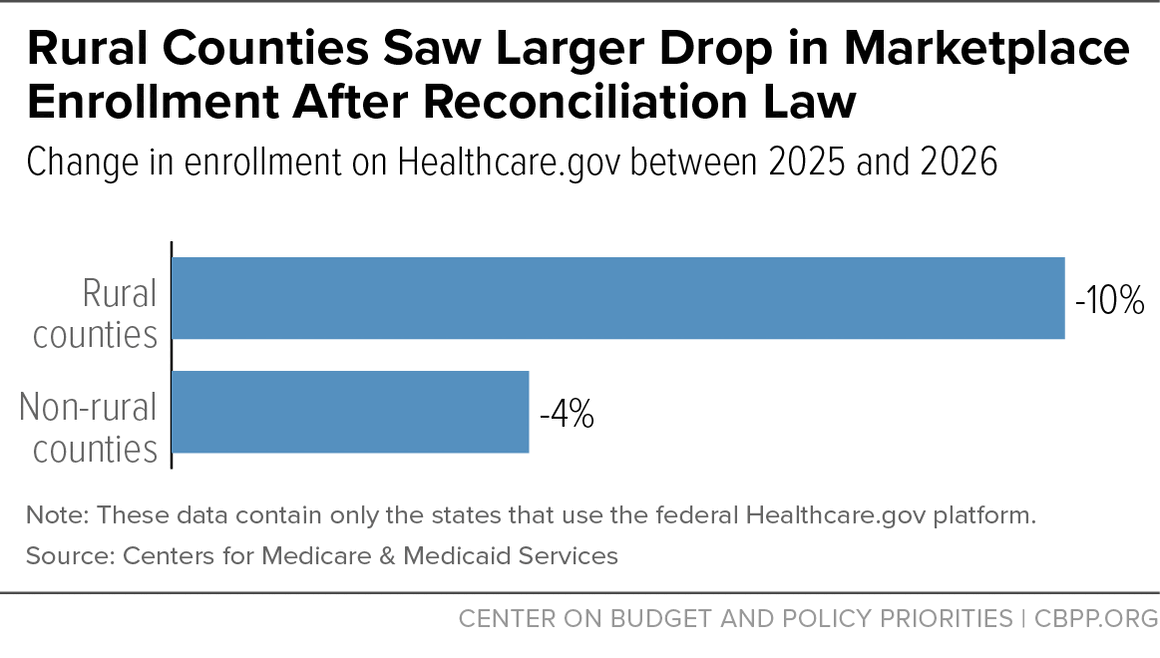
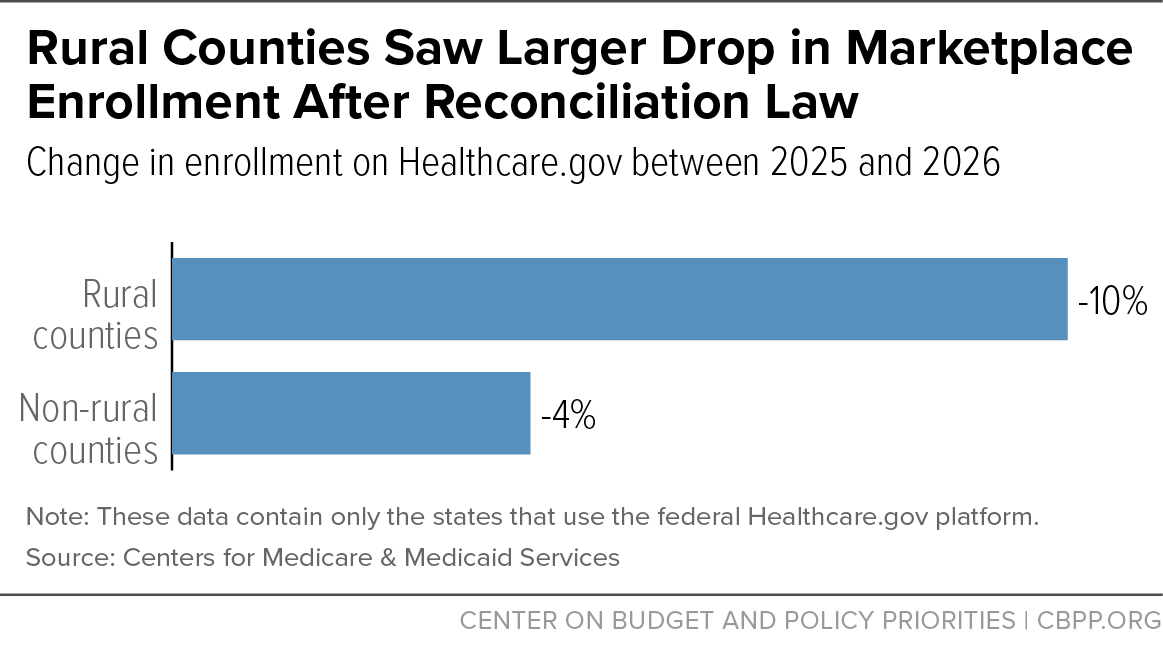
Many people have shifted towards skimpier plans with lower premiums but are now facing higher deductibles and other out-of-pocket costs.[38] Many others have dropped coverage entirely as unaffordable: in 2026, 1.2 million fewer people selected marketplace plans than in 2025. [39] Enrollment fell more than twice as much in rural areas — by 10 percent (roughly 300,000 people) — as in non-rural areas, which declined by 4 percent.[40] (See Figure 3.) The enrollment declines have only grown during 2026, to nearly 3 million so far.[41]
Tariffs, Iran War Adding to Economic Pressure on Rural Areas
The Trump Administration’s sweeping tariffs have imposed large burdens on rural residents, including farmers and small businesses. Research shows that U.S. businesses have borne around 90 percent of the tariffs, some of which they have passed on to consumers.[42] Tariffs are harming the agricultural sector of the economy, raising the prices that farmers must pay for inputs like fertilizer and farm equipment made with imported steel and aluminum.
Tariffs have been an ongoing focus of this Administration. On April 2, 2025, the President announced a wide-ranging tariff scheme imposing a minimum tariff rate of 10 percent on over 70 countries. When the market reacted negatively, he postponed many of these tariffs and backtracked on several others. This was indicative of how tariffs would proceed through the rest of 2025. Adding to the volatility, the President repeatedly threatened tariffs in response to outside issues, such as disputes over control of Greenland.[43] On February 20, 2026, the Supreme Court struck down the President’s use of the International Economic Emergency Powers Act to impose tariffs in April 2025, but the President has continued imposing broadly similar tariffs using different authorities (though these moves face further legal challenges). [44]
Further, the war in Iran is pushing up prices for already strained farmers, with higher costs for fertilizer and energy on top of the tariffs. Gas prices have been rising throughout 2026 due to the closure of the Strait of Hormuz. Rural households are disproportionately harmed by higher gas prices because they tend to have higher rates of vehicle ownership, longer commutes, and less access to public transit than urban households.[45] Diesel prices are going up as well, which impacts inputs like agricultural machinery. In addition, since one-third of the world’s fertilizer supply goes through the Strait, its closure has also raised fertilizer prices. In short, the combination of the Administration’s tariff policies and the Iran war is significantly driving up the cost of gas, food, and energy for rural families, as well as the rest of the country.
Anti-Immigrant Campaign Weakens Rural Communities
The Trump Administration is relentlessly pursuing a multi-tiered effort aimed at reducing the number of immigrants in the United States. This has included sweeping efforts to curtail lawful immigration through travel bans,[46] the decimation of the refugee program,[47] and the systematic termination of Temporary Protected Status and other forms of humanitarian protection.[48] The Administration has also poured billions into a large and often violent detention and deportation apparatus that is separating families[49] and violating the legal and constitutional rights of many immigrants[50] and others[51] who get swept up by this cruel dragnet.
In addition, the Administration has engaged in a variety of policies and actions aimed at discouraging or otherwise obstructing immigrants and their families from accessing vital benefits they need and for which they are eligible. Agencies have shared personal data collected on benefit applications and tax forms with the Department of Homeland Security to support its mass deportation efforts;[52] they also have sought to restrict access to vital services that, for decades, both Republican and Democratic administrations have interpreted as open to eligible members of the public regardless of immigration status.[53] These actions threaten to undo immigrants’ many contributions to rural economies and communities, alongside other harmful impacts.
People who are immigrants have played a key role in repopulating and revitalizing rural communities, where population growth began slowing in the early 1990s and population actually declined in the 2010s.[54] Annual deaths in nonmetro counties have exceeded annual births since 2017,[55] so any population growth (or reduction in population decline) must come from more people moving into rural communities — including immigrants — than moving out. This has been the case in the 2020s, where the nonmetro population has been increasing due to migration.[56] One study found that 78 percent of the rural places where population declined starting in 1990 would have experienced a greater decline if not for immigrants.[57] Another study found that in most rural counties with positive net annual migration between 2022 and 2024, it was driven entirely by newly arriving immigrants.[58]
Immigrants’ positive impact on rural areas goes much further than mitigating population loss.[59] Immigrants help fill labor shortages, bring skills needed in rural labor markets, and contribute to the local economy by spending, starting new businesses, and paying taxes. Immigrants make up the largest share of employment in the construction, agriculture, and accommodation and food services industries, which are prevalent in rural areas; more than 1 in 4 rural agriculture workers — 28 percent of them — are immigrants. [60] In addition, immigrants are an important part of the rural health care workforce, which faces severe shortages. Immigrants account for 14 percent of physicians in rural areas, well above their 5 percent share of the overall rural workforce.[61] This contribution will become increasingly vital as the rural population ages and the demand for health care workers rises.
Beyond strengthening the rural workforce, many immigrants who move into rural communities open businesses and revitalize “main streets.” Immigrants are more likely than U.S.-born workers to own businesses and are more likely to own “main street” businesses (storefront institutions like grocery stores, nail salons, gas stations, and restaurants).[62] Immigrants also contribute to the civic life of rural places, as well as to community safety.[63]
For rural areas, the Administration’s anti-immigrant campaign will likely mean fewer workers, fewer people starting new businesses, and fewer people supporting local economies and adding to local communities.
End Notes
[1] Brendan Duke, “Republican Megabill Trades Essential Support to Low-Income People for Skewed Tax Cuts,” CBPP, updated February 11, 2026, https://www.cbpp.org/research/federal-tax/republican-megabill-trades-essential-support-to-low-income-people-for-skewed.
[2] Congressional Budget Office (CBO), “How the 2025 Reconciliation Act (Public Law 119-21) Will Affect the Distribution of Resources Available to Households,” August 11, 2025, https://www.cbo.gov/interactive/2025-reconciliation-act.
[3] Tracey Farrigan, “Rural Poverty & Well-Being,” USDA, February 13, 2026, https://www.ers.usda.gov/topics/rural-economy-population/rural-poverty-well-being. This analysis “defined counties as being persistently poor if 20 percent or more of their populations were living in poverty based on the 1980, 1990, and 2000 decennial censuses and 2007-11 ACS 5-year estimates.”
[4] Malik Woullard and Gbenga Ajilore, “Inflation: Key Measures to Understand,” CBPP, January 16, 2026, https://www.cbpp.org/research/economy/inflation-key-measures-to-understand.
[5] Yale Budget Lab, “Combined Distributional Effects of the One Big Beautiful Bill Act and of Tariffs,” updated December 2025, https://budgetlab.yale.edu/research/combined-distributional-effects-one-big-beautiful-bill-act-and-tariffs-0.
[6] Samantha Jacoby, Chuck Marr, and Kris Cox, “Republican Megabill Tax Provisions Are Skewed to the Rich, Fail to Deliver for Families, and Are Fiscally Irresponsible,” CBPP, December 17, 2026, https://www.cbpp.org/research/federal-tax/republican-megabill-tax-provisions-are-skewed-to-the-rich-fail-to-deliver-for.
[7] House Committee on Ways and Means, “Working Family Tax Cuts Keeps Family Farming Alive and Growing in America,” March 20, 2026, https://waysandmeans.house.gov/2026/03/20/working-families-tax-cuts-keeps-family-farming-alive-and-growing-in-america/.
[8] USDA, “Federal Tax Issues – Federal Estate Taxes,” February 9, 2026, https://www.ers.usda.gov/topics/farm-economy/federal-tax-issues/federal-estate-taxes.
[9] Tax Policy Center, “Who Pays the Estate Tax?” January 2024, https://taxpolicycenter.org/briefing-book/who-pays-estate-tax.
[10] Samantha Jacoby, “House Republican Tax Bill Extends – and Expands – Costly Tax Breaks for the Wealthy,” CBPP, June 4, 2025, https://www.cbpp.org/blog/house-republican-tax-bill-extends-and-expands-costly-tax-breaks-for-the-wealthy.
[11] Samantha Jacoby, "Potential Flaws of Opportunity Zones Loom, as Do Risks of Large-Scale Tax Avoidance,” CBPP, January 11, 2019, https://www.cbpp.org/research/federal-tax/potential-flaws-of-opportunity-zones-loom-as-do-risks-of-large-scale-tax.
[12] David Wessel, “How did the One Big Beautiful Bill Act change Opportunity Zones?” Brookings, July 8, 2025, https://www.brookings.edu/articles/how-did-the-one-big-beautiful-bill-act-change-opportunity-zones/
[13] Kevin Corinth et al., “The Targeting of Place-Based Policies: The New Markets Tax Credit Versus Opportunity Zones,” NBER Working Paper 33414, January 2025, https://www.nber.org/papers/w33414.
[14] Ben Ward and Mia Monkovic, “Characteristics of Supplemental Nutrition Assistance Program Households: Fiscal Year 2024,” USDA, May 2026, https://www.fna.usda.gov/research/snap/characteristics-fy24.
[15] U.S. Census Bureau, “American Community Survey: S2201: Food Stamps/Supplemental Nutrition Assistance Program,” 2024, https://data.census.gov/table/ACSST1Y2024.S2201?q=s2201&g=010XXC0US_010XXH0US.
[16] Dottie Rosenbaum et al., “SNAP Tracker: People Are Losing Food Assistance as the Harmful 2025 Republican Reconciliation Law Is Implemented,” CBPP, updated August 26, 2026, https://www.cbpp.org/research/food-assistance/snap-tracker-people-are-losing-food-assistance-as-the-republican-megabill.
[17] USDA, “SNAP Work Requirements,” updated August 29, 2025, https://www.fns.usda.gov/snap/work-requirements.
[18] Emma Parker-Newton, “Medicaid Work Requirements Undermine Rural Healthcare,” National Health Law Program, April 7, 2025, https://healthlaw.org/resource/medicaid-work-requirements-undermine-rural-healthcare/.
[19] Jie Jenny Zou, “’Blindsided’ Counties Struggle to Implement Trump’s SNAP Work Rules,” New York Focus, November 10, 2025, https://nysfocus.com/2025/11/10/trump-counties-snap-work-rules.
[20] Thomas Hertz, “Service industries account for the largest share of rural and urban employment,” USDA, March 25, 2016, https://ers.usda.gov/data-products/charts-of-note/chart-detail?chartId=78844.
[21] Elizabeth Ananat, Anna Gassman-Pines, and Olivia Howard, “Work requirements penalize workers in volatile occupations,” Hamilton Project, May 22, 2025, https://www.hamiltonproject.org/publication/post/work-requirements-penalize-workers-in-volatile-occupations/.
[22] Katie Bergh and Joseph Llobrera, “States’ First-Ever Bill for SNAP Benefits Could Cost Billions,” CBPP, June 24, 2026, https://www.cbpp.org/blog/states-first-ever-bill-for-snap-benefits-could-cost-billions.
[23] Kyle Ross and Kennedy Andara, “SNAP Cuts Are Likely To Harm More Than 27,000 Retailers Nationwide,” Center for American Progress, May 8, 2025, https://www.americanprogress.org/article/snap-cuts-are-likely-to-harm-more-than-27000-retailers-nationwide/.
[24] Diana Spahia, Carla Sinclair, and Stephanie Rosoff, “Global Roots, Local Impact: A Research Review of How Immigrants Impact the Economies, Health, and Safety of their Communities,” CUNY Institute for State and Local Governance, April 16, 2026, https://islg.cuny.edu/resources/global-roots-local-impact.
[25] Tyler L. Malone, George H. Pink, and George M. Holmes, “An updated model of rural hospital financial distress,” Journal of Rural Health, October 3, 2024, https://onlinelibrary.wiley.com/doi/10.1111/jrh.12882.
[26] Scott Hulver et al., “5 Key Facts About Medicaid and Hospitals,” KFF, March 5, 2025, https://www.kff.org/medicaid/issue-brief/5-key-facts-about-medicaid-and-hospitals/.
[27] KFF, “HealthCare.gov Marketplace Plan Selections by Rural Status,” 2025, https://www.kff.org/affordable-care-act/state-indicator/healthcare-gov-marketplace-plan-selections-by-rural-status-2/.
[28] Allie Gardner, “Proposed Medicaid Provider Tax Rule Will Further Cut Federal Medicaid Spending,” CBPP, July 21, 2026, https://www.cbpp.org/research/federal-budget/executive-action-watch?item=30710.
[29] Fredric Blavin, Michael Simpson, and Laura Skopec, “Rural Hospital Revenue Could Drop by $87 Billion over 10 Years Because of the Reconciliation Bill and Expiring Enhanced Tax Credits,” Urban Institute, June 30, 2025, https://www.urban.org/urban-wire/rural-hospital-revenue-could-drop-87-billion-over-10-years-because-reconciliation-bill.
[30] Medicaid and CHIP Payment and Access Commission, “Report to Congress and Medicaid and CHIP,” Chapter 3, March 2024, https://www.macpac.gov/wp-content/uploads/2024/03/Chapter-3-Annual-Analysis-of-Medicaid-Disproportionate-Share-Hospital-Allotments-to-States.pdf.
[31] Parker-Newton, op. cit.
[32] CBPP, “How Medicaid Work Requirements Will Harm Rural Residents – And Communities,” March 10, 2020, https://www.cbpp.org/research/health/how-medicaid-work-requirements-will-harm-rural-residents-and-communities.
[33] Zachary Levinson and Tricia Neuman, “A Closer Look at the $50 Billion Rural Health Fund in the New Reconciliation Law,” KFF, August 4, 2025, https://www.kff.org/medicaid/a-closer-look-at-the-50-billion-rural-health-fund-in-the-new-reconciliation-law/.
[34] Tyler Dedrick, “At-Risk Communities Shortchanged by Rural Health Transformation Program, Research Shows,” Daily Yonder, April 27, 2026, https://dailyyonder.com/at-risk-communities-shortchanged-by-rural-health-transformation-program-research-shows/2026/04/27/.
[35] Sarah Jane Tribble and Arielle Zionts, “Backed by Threat of Clawbacks, Feds Wield Tight Grip on $50B Rural Health Fund,” KFF Health News, June 16, 2026, https://kffhealthnews.org/rural-health/rural-health-transformation-program-federal-cms-clawbacks-state-plans/.
[36] Michael Brady, “The $50B rural health transformation fund is pushing many hospitals to shrink,” Healthcare Dive, June 24, 2026, https://www.healthcaredive.com/news/rural-health-transformation-fund-50-billion-push-hospitals-shrink/823206/.
[37] Allison Orris and Gbenga Ajilore, “Rural Health Fund Will Do Little to Offset Harm to Rural Providers in Republican Megabill,” CBPP, September 26, 2025, https://www.cbpp.org/blog/rural-health-fund-will-do-little-to-offset-harm-to-rural-providers-in-republican-megabill.
[38] Jennifer Sullivan and Elizabeth Zhang, “Higher Marketplace Premiums Take a Toll on Enrollment and on Marketplace Enrollees,” CBPP, May 18, 2026, https://www.cbpp.org/research/health/higher-marketplace-premiums-take-a-toll-on-enrollment-and-on-marketplace-enrollees.
[39] Nicole Rapfogel, “New Data Show Marketplace Consumers Facing Higher Costs, Selecting Lower-Quality Coverage,” CBPP, April 2, 2026, https://www.cbpp.org/blog/new-data-show-marketplace-consumers-facing-higher-costs-selecting-lower-quality-coverage.
[40] Author’s calculations from Healthcare.gov database.
[41] Claire Heyison, “ACA Marketplace Enrollment Shrank in Nearly Every State After Premium Tax Credit Enhancements Expired,” CBPP, July 20, 2026, https://www.cbpp.org/blog/aca-marketplace-enrollment-shrank-in-nearly-every-state-after-premium-tax-credit-enhancements.
[42] Mary Amiti et al., “Who is Paying for the 2025 U.S. Tariffs?” Liberty Street Economics, February 12, 2026, https://libertystreeteconomics.newyorkfed.org/2026/02/who-is-paying-for-the-2025-u-s-tariffs/.
[43] Chad P. Brown, “Trump's trade war timeline 2.0: An up-to-date guide,” Peterson Institute for International Economics, February 20, 2026, https://www.piie.com/blogs/realtime-economics/2025/trumps-trade-war-timeline-20-date-guide; Ana Swanson, “Trump Returns to a Familiar Role: Sowing Trade Chaos,” New York Times, January 22, 2026, https://www.nytimes.com/2026/01/22/us/politics/trump-trade-chaos.html.
[44] Herb Scribner and Courtenay Brown, “Trump signals new tariffs plan. Here's how Section 122 works,” Axios, February 20, 2026, https://www.axios.com/2026/02/20/trump-tariff-plan-section-122-trade-act; Kimberly Clausing and Maurice Obstfeld, “What the Supreme Court’s tariff ruling changes, and what it doesn’t,” Peterson Institute for International Economics, February 23, 2026, https://www.piie.com/blogs/realtime-economics/2026/what-supreme-courts-tariff-ruling-changes-and-what-it-doesnt; Courtenay Brown, “Trump employs unused law in new tariff playbook,” Axios, July 21, 2026, https://www.axios.com/2026/07/21/trump-tariffs-imports-canada.
[45] Alex Dorman, “The ripple of rising gas prices: Transportation burden, food prices, and rural communities,” Center for Community Solutions, April 6, 2026, https://www.communitysolutions.com/resources/the-ripple-of-rising-gas-prices-transportation-burden-food-prices-and-rural-communities.
[46] U.S. Department of State, “Suspension of Visa Issuance to Foreign Nationals to Protect the Security of the United States,” updated February 2, 2026, https://travel.state.gov/content/travel/en/News/visas-news/suspension-of-visa-issuance-to-foreign-nationals-to-protect-the-security-of-the-united-states.html.
[47] Rumbidzai Muzirwa and Nikki Carrion, “Policies Affecting Refugees in the United States: Suspension of Admissions, Re-Vetting, and New Detention Authority,” Global Refuge, March 10, 2026, Policies-Affecting-Refugees-in-the-United-States_Suspension-of-Admissions-Re-Vetting-and-New-Detention-Authority-1.pdf.
[48] Aaron Reichlin-Melnick, “Confusion and Worry Grow as Temporary Protected Status Set to Expire for Hundreds of Thousands,” American Immigration Council, July 15, 2026, https://www.americanimmigrationcouncil.org/blog/trump-administration-ending-temporary-protected-status-worry/.
[49] Diana Fishbein, “ICE’s family separations are forcing children to parent themselves,” The Hill, August 8, 2025, https://thehill.com/opinion/immigration/5441487-ice-raids-trauma-children/.
[50] Kyle Cheney and Myah Ward, “Trump’s new detention policy targets millions of immigrants. Judges keep saying it’s illegal,” Politico, September 20, 2025, https://www.politico.com/news/2025/09/20/ice-detention-immigration-policy-00573850.
[51] Rebecca Schneid, “‘Military-Style’ ICE Raid On Chicago Apartment Building Shows Escalation in Trump’s Crackdown,” TIME, October 4, 2025, https://time.com/7323334/ice-raid-chicago-pritzker-trump/.
[52] Kris Cox, “IRS-ICE Agreement Poses Risks for All Taxpayers,” CBPP, April 7, 2025, https://www.cbpp.org/research/federal-budget/executive-action-watch?item=29822; Rene Marsh, “IRS begins sharing sensitive taxpayer data with immigration authorities to find undocumented migrants,” CNN, August 8, 2025, https://www.cnn.com/2025/08/08/politics/irs-dhs-share-taxpayer-data-undocumented-immigrants.
[53] Margot Dankner, “Trump Administration Seeks to Take Away Head Start, Medical Care, and Other Vital Services From Lawfully Present Immigrants,” CBPP, July 16, 2025, https://www.cbpp.org/research/federal-budget/executive-action-watch?item=30181.
[54] Justin B. Winikoff, “Population & Migration,” USDA, February 13, 2026, https://www.ers.usda.gov/topics/rural-economy-population/population-migration.
[55] Sarah Alexander Melotte, “Half of All Rural Counties Are Losing Population. What Is Contributing to Those Declines?” Daily Yonder, April 15, 2026, https://dailyyonder.com/half-of-all-rural-counties-are-losing-population-what-is-contributing-to-those-declines/2026/04/15/.
[56] Winikoff, op. cit.
[57] Silva Mathema, Nicole Svajlenka, and Anneliese Hermann, “Revival and Opportunity: Immigrants in Rural America,” Center for American Progress, September 2, 2018, https://www.americanprogress.org/article/revival-and-opportunity/.
[58] Winikoff, op. cit.
[59] Nicolas Morales, “Can Immigration Help Boost Rural Economies in the Fifth District and Beyond?” Federal Reserve Bank of Richmond, May 2022, https://www.richmondfed.org/publications/research/economic_brief/2022/eb_22-18.
[60] Alex Fitzpatrick and Kavya Beheraj, “These industries are the most reliant on noncitizen workers,” Axios, August 12, 2025, https://www.axios.com/2025/08/12/noncitizen-foreign-workers-industries.
[61] Drishti Pillai and Samantha Artiga, “What Role Do Immigrants Play in the Rural Workforce?” KFF, August 4, 2025, https://www.kff.org/racial-equity-and-health-policy/what-role-do-immigrants-play-in-the-rural-workforce/.
[62] Immigration Research Initiative, “The Entrepreneurial Spirit: A Profile of Business Owners Across the United States,” March 19, 2026, https://immresearch.org/publications/the-entrepreneurial-spirit-a-profile-of-business-owners-across-the-united-states/.
[63] Spahia, Sinclair, and Rosoff, op. cit.