The Minimum Wage
Minimum wage laws set the lowest hourly rate an employer can legally pay certain workers. The federal minimum wage is currently $7.25 per hour. Where states and municipalities have enacted their own higher minimum wage laws, employers must pay at least the state or local minimum. As of March 2026, 30 states and the District of Columbia have minimum wages above the federal minimum wage, of which 19 have set it at $15.00 or above.
Who Is Covered by the Federal Minimum Wage?
Most workers employed in the United States are covered by minimum wage requirements. Employees, including workers such as guards and custodians, must be paid at least the minimum wage if they work for a private business or enterprise that has gross annual sales or business done of at least $500,000 or that participates in interstate commerce. Minimum wage requirements also cover employees of federal, state, and local government agencies; hospitals and schools; and most domestic workers. Certain exceptions apply to young workers (under age 20), full-time students and student learners, and workers with disabilities. Further, tipped workers have a minimum base wage of $2.13 per hour. If such a worker’s tips in a given pay period plus the base wage do not add up to the regular minimum wage of $7.25 per hour, the employer is required to pay the difference; this requirement, however, can be hard to enforce.
Who Is Paid the Minimum Wage?
In 2024, 843,000 workers were paid hourly wages at or below the federal minimum, according to the Bureau of Labor Statistics (BLS). This total reflects about 1 percent of all hourly wage earners, down significantly from 13 percent in 1979 (the first year data were collected) due to the declining value of the federal minimum wage and the proliferation of higher state-level minimum wages (as discussed below).
Nearly 60 percent of workers being paid at or below the federal minimum wage were over age 25, and over a third worked full time. More than four-fifths had high school degrees, and more than one-quarter had bachelor’s or associate degrees. Women were more likely to hold minimum wage jobs than men, and Black people were more likely to hold minimum wage jobs than people of other races and ethnicities. Almost 73 percent of those who were paid the minimum wage or below were in the service industry, and about 11 percent were in management and financial operations.
History of the Minimum Wage
The first U.S. minimum wage was instituted under the Fair Labor Standards Act of 1938. Since then, Congress has raised the minimum wage 22 times and changed who is covered under it. It was last increased in 2009, making this the longest stretch with no increase since the federal minimum wage was established.

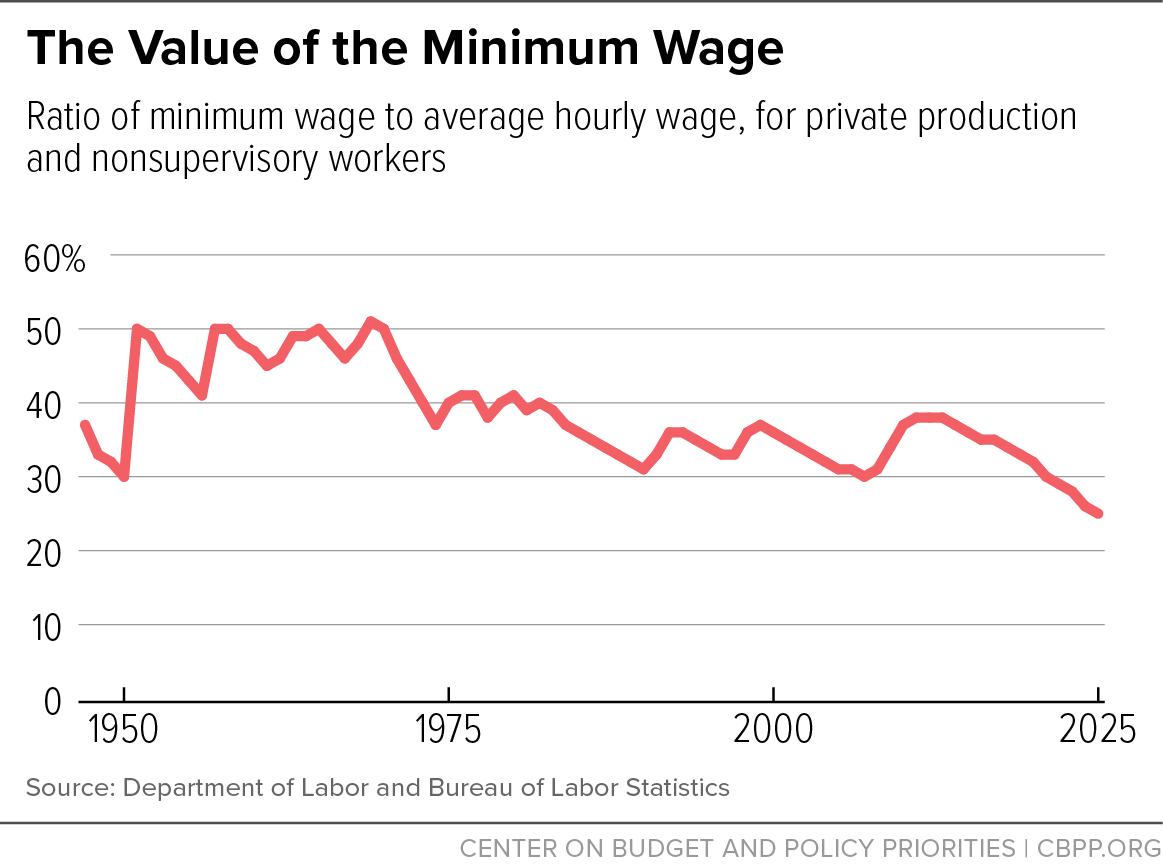
Because the minimum wage is not adjusted automatically for inflation, its real, or inflation-adjusted, value tends to fall in the years between enacted increases. This happened during the 1980s when the real value of the wage floor fell by 30 percent, from the mid-1990s until 2007 (20 percent decline), and after 2009 (34 percent and falling). Such declines in the purchasing power of the minimum wage lower living standards for workers who are paid the minimum wage. Today, the minimum wage is roughly 25 percent of the average wage for blue-collar factory workers and non-management service employees, as compared to being around half of that typical wage in the late 1960s (see chart). As a result, the annual income of a full-time worker earning the federal minimum wage is currently below the poverty line for a household of any size.
Economic Effects of Raising the Minimum Wage
An increase in the minimum wage can have effects beyond boosting the earnings of workers in low-paying jobs. According to simple supply-and-demand theory, employers may respond to a minimum wage increase by:
- hiring fewer workers,
- reducing the number of hours their employees work,
- passing on some of the cost of higher wages to their customers in the form of higher prices, and/or
- absorbing some of the cost of higher wages in the form of lower profits.
Beyond simple supply-and-demand theory, increasing the minimum wage may also spur businesses to operate more efficiently. A higher wage can encourage worker productivity, which in turn may drive employers to invest more in employee training or better equipment. This combination of efficiency improvements from both employers and employees decreases job turnover, reduces employers’ hiring costs, and can lead to employment gains.
Theory alone does not tell us how large any of these effects are, and it is ambiguous about the direction. Indeed, empirical studies suggest that the effects of minimum wage increases on employment have historically been slightly negative, negligible, or sometimes even positive.
In its analyses of proposals to raise the federal minimum wage, the Congressional Budget Office (CBO) estimates that low-paid workers as a group gain more income from the higher wage than they lose from reduced employment. The same can be true for most individuals, as well, if the employment losses are spread broadly over the low-paid population. CBO finds that a new higher minimum wage would also impact some workers being paid slightly above the minimum. Overall, the affected workers would be concentrated among households in the lowest one-fifth of the income distribution, and the higher wage would lift some out of poverty.
State Actions to Raise State-Level Minimum Wages
Congress last increased the federal minimum wage in 2009 to $7.25 per hour. However, 30 states and Washington, D.C. have taken action to raise their own wage floors above the federal level. Minimum wage rates in these states range from $9 to more than $15 per hour and collectively cover over two-thirds of labor force. As states have raised their minimum wage, they have done so through different designs. Some enacted scheduled increases that set a series of wage hikes through a specified year, after which further increases require legislative action. Other states paired scheduled increases with automatic adjustments indexing the minimum wage to inflation, adjusting the state minimum’s real value over time. A smaller number of states raised their minimum wage to a higher level but provided no mechanism for future adjustment, leaving the real value of the wage floor vulnerable to inflation.