BEYOND THE NUMBERS
With Economic Risks High, Here Are Three Facts to Remember About Recessions
Though President Trump’s April 9 announcement of a 90-day pause in many planned tariffs reduced fears of an imminent economic or financial crisis, many economists continue to warn that the Administration’s chaotic and drastic tariff policies may plunge the economy into a recession. While the Administration has downplayed these warnings, suggesting that any economic pain will be “worth it,” recessions are serious events. They not only affect the economy broadly but also impose tremendous harm on the households and businesses that experience them acutely, including altering their future trajectories.
Here are three vital facts to remember about recessions:
1. Recessions harm workers and businesses. When a recession occurs, people lose jobs and businesses lose customers and revenue. High unemployment disrupts the labor market for individuals. Even those who have jobs may end up underemployed or in a position that is less suited to their skills. This can adversely alter their long-term employment trajectory and earnings potential.
Unemployment carries other serious human costs. It becomes more difficult for families to afford the basics, like food, shelter, and health care. Evidence suggests that families begin to double up, that is, have shared living arrangements, to save on housing costs. Research finds that the burden of job loss after many years of employment has led to rising mortality rates since 1998 among white individuals without a college degree.
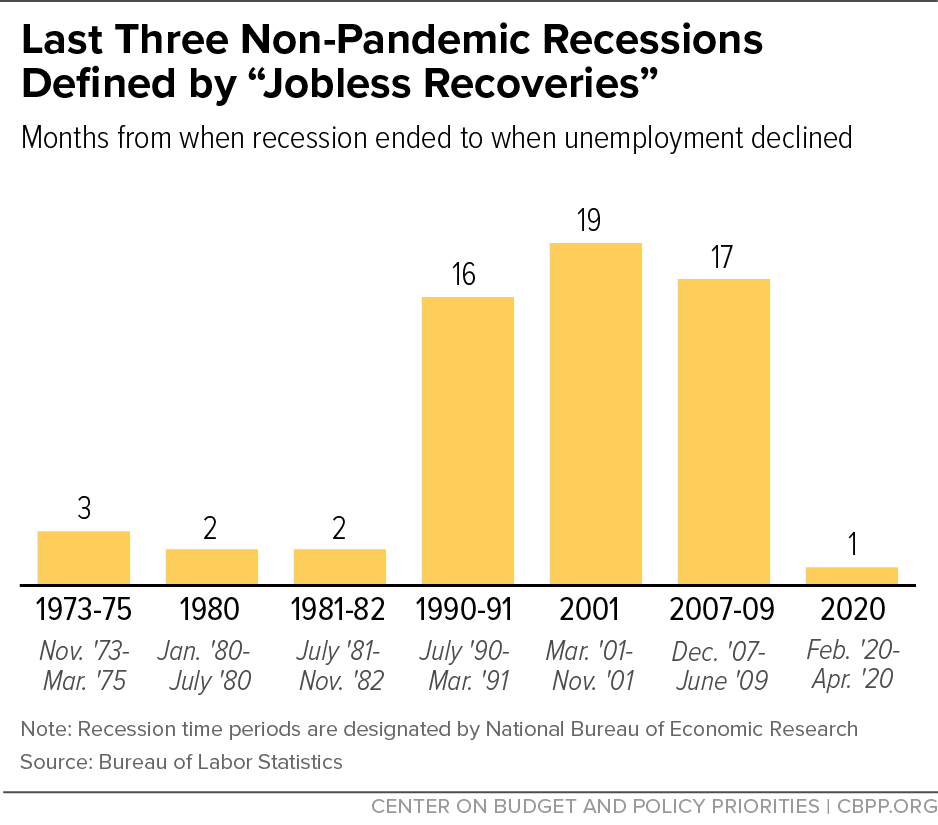
Over the last three non-pandemic recessions (1990, 2001, and 2007), real gross domestic product (GDP) started to grow — and the recession technically ended — long before unemployment began to fall. In earlier recessions, by contrast, unemployment tended to start falling at about the same time as when real GDP began growing and the recession ended. The term “jobless recovery” arose to explain the phenomenon where unemployment does not start to recover despite the economy growing after a recession.

2. Recessions worsen racial and ethnic inequities. Recessions widen existing structural inequities that have long made it more difficult for people of color to meet their basic needs and thrive. Black and Hispanic people have higher unemployment rates even when the economy is strong, and they tend to lose their jobs more quickly during a downturn and get hired later in the recovery.
As the second graphic shows, jobless recoveries hurt Black and Hispanic workers more than white workers. While some economists refer to the 2001 recession as mild because the duration was short, the chart shows that it took Black workers over three and a half years to experience declining unemployment rates, compared to one year and a half for white workers and Hispanic workers.

Among all racial and ethnic groups, people with lower educational attainment tend to have higher unemployment rates and therefore are more likely to struggle during and after a recession.
3. Recessions can have long-term scarring effects. The fact that employment recovered only slowly from the Great Recession speaks to the third important fact about recessions: they can have long-lasting, even permanent harmful impacts on households.
Wage losses persist after recessions, particularly for individuals who graduate from college during a recession. For example, a Census Bureau economist found that younger workers experienced larger losses in employment and earnings (with earnings falling by up to 13 percent) during the Great Recession than other age groups, as they were less able to find employment in higher-paying jobs, and these effects persisted long after they were firmly back in the labor market.
Moreover, new entrants to the workforce struggle to progress up the job ladder if they enter the labor market during a recession. Average incomes take years to get back to pre-recession levels, particularly for workers with low or moderate incomes. For instance, following the Great Recession, it took 11 years for the average incomes of people in the bottom fifth of the income distribution to recover fully and nine years for people in the middle fifth, compared to only four years for people with average incomes in the top 5 percent.
Business investments that bolster labor productivity, yielding long-run payoffs for workers, are also scaled back during recessions. This lower business investment also reduces future production capacity and leads to lower adoption of new innovations.
Recessions can scar entire communities, too. A recent study found that areas with large job losses during a recession tend to experience persistent declines in employment and population in subsequent years as compared to communities that fared better during the downturn. These communities also experience lasting relative decreases in earnings per capita and earnings per worker.
The bottom line: Because a recession can inflict painful, lasting damage on people and communities, policymakers typically take aggressive steps to prevent one or mitigate its harmful effects. If the unemployment rate increased by 2 percentage points and the labor force population stayed the same, this would translate into roughly 3.4 million more people unemployed.
Yet the Administration’s cavalier attitude suggests little concern. Just as troubling, the Republican Congress is taking steps to dramatically cut food assistance and health coverage that provide essential help to millions of struggling families and bolster the economy as a whole during downturns. These policies are deeply misguided, and families who struggle financially — the very people the President pledged he would work to protect — will suffer the worst consequences.