BEYOND THE NUMBERS
Tracking Senate Action on Tax and Budget Reconciliation Plan
The Senate is beginning to consider Republican leadership’s tax and budget reconciliation legislation. The so-called “Big Beautiful Bill” is anything but beautiful; it would cause widespread harm by making among its massive cuts, deep reductions in federal funding for the Supplemental Nutrition Assistance Program (SNAP), which would make it much harder for people to afford the high cost of groceries.
Follow this space for our analyses of the legislation.
Republicans Downplay State Impact of Medicaid Cuts
Newly published estimates from the nonpartisan Congressional Budget Office (CBO) confirm that the House-passed reconciliation bill would result in massive coverage loss, with 7.8 million people projected to lose Medicaid and become uninsured by 2034. Republicans responded by highlighting CBO’s estimate that the bill would reduce state Medicaid spending by $13 billion on net over ten years, but that figure doesn’t reflect the bill’s full impact on states and enrollees. By cutting people off coverage and increasing the number of uninsured people (who would still need health care), the Republican health plans would increase hardship and shift costs to states.
CBO estimates the proposed Medicaid cuts would cost states $201.3 billion over ten years due to reduced federal funding and restrictions on how states can finance their Medicaid programs. The federal cuts would force state changes including “reducing provider payment rates, reducing the scope or amount of optional services, and reducing Medicaid enrollment.” Of the 7.8 million people CBO expects to lose Medicaid and become uninsured, 2 million would lose coverage because of state responses to increased financial pressure.
These new costs to states would be offset by $214.4 billion in savings, resulting in $13.1 million in net state savings, according to CBO. But these savings would largely result from millions of people losing health coverage — hardly an outcome worth celebrating.
Also, large-scale coverage losses would add other costs to states that CBO’s estimates don’t reflect, including increases in uncompensated care, a sicker workforce, job loss in the health care sector, and loss of tax revenue. These impacts would further burden state budgets, which are already under strain.
These considerations should be paramount for senators considering the bill’s impact on their states. And while the final details may shift (since the parliamentarian ruled that some Medicaid cuts violate Senate rules), the bill would still burden states by dramatically increasing the number of people without health insurance.
Technology Won’t Protect Medicaid Enrollees Subject to Medicaid Work Requirements
Senate Republican leaders’ reconciliation bill adds substantial red tape to Medicaid, including a provision blocking Medicaid coverage for applicants and enrollees unless they can show they are working (or doing another approved activity) 80 hours per month or qualify for an exemption. Work requirements can’t be fixed, and technology won’t protect eligible enrollees from losing coverage. It’s workers, caregivers, and people with chronic illnesses who will bear the brunt of this failed policy.
States have a troubled history when it comes to implementing technology to administer basic needs programs, including Medicaid. When eligibility systems fail, families lose access to critical benefits through no fault of their own. The Senate bill, which requires mandatory work requirements and other changes, would force states to deploy massive technological changes while facing significant cuts in federal funding. There’s no reason to believe these circumstances will lead to a different outcome.
Further, technology has its limits. While states can (and should be expected to) automatically identify some exemptions from the work requirement, including caring for a child and receipt of disability payments, no databases are readily available to identify other exceptions, like caring for an elderly parent or having certain medical conditions.
Wage databases have timely information that can be used for about half of traditional W-2 workers (if the state pays the substantial cost to access these databases), but there are no databases available for self-employed or gig workers, like ride-share drivers. This means individuals will have to know they are subject to the work requirement, understand how to comply, and navigate glitchy websites or call centers with long wait times to prove they still qualify for coverage.
And where technology comes up short, the burden falls on already overwhelmed eligibility workers. Many states are struggling to process their current workload timely and accurately, and will be even more overwhelmed by new requirements, meaning more errors and worse customer service.
Medicaid Expansion States Will Be Hard Hit by Anti-Immigrant Health Provisions in Senate Plan
Senate Republicans are trying to create harsh immigration-related restrictions on coverage programs, in flux due to the Senate parliamentarian’s rulings. Also in flux: a provision that levies a penalty on Medicaid expansion states if states provide non-Medicaid comprehensive health coverage (with state-only funds) to people who do not meet very restrictive immigration eligibility standards used by Medicaid. If this provision remains in the Senate bill, many states are likely to drop this coverage, resulting in even more people being uninsured in Medicaid expansion states. Some states may want to maintain their programs or, in the case of New York, may have to maintain their program due to a constitutional requirement. In those cases, states would have the cost of maintaining their Medicaid expansion double due to the penalty.
That’s not the only way the Senate bill singles out Medicaid expansion states: another provision that remains in the bill would take away a significant share of federal funding to pay for emergency care provided to immigrants who are excluded from states' Medicaid expansion due to their immigration status.
Today, states can claim the 90 percent Medicaid matching rate for the costs of covering emergency care for people who would be eligible for the Medicaid expansion but for their immigration status; the Senate bill drops the matching rate down to the state’s regular matching rate of between 50 and 74 percent. To be clear, people ineligible for Medicaid due to immigration status (a group that will be far larger due to the new anti-immigrant eligibility restrictions for those living lawfully in the U.S.) will still seek emergency care when needed, and hospitals will still provide it. States will just need to come up with a larger share of the cost of reimbursing that care or reduce provider payment rates, probably both.
Many People Living in the U.S. Lawfully Remain Targets for Harsh Health Care Cuts in Senate Reconciliation Plan
Though the Senate reconciliation plan remains in flux as Senate Republicans identify ways to proceed after the Senate parliamentarian’s rulings on certain health coverage provisions, it’s clear that many people living in the U.S. lawfully — including many granted humanitarian protections by the U.S. government — remain a target for harsh health coverage cuts.
The House bill includes extremely harsh new eligibility restrictions to Medicare and Affordable Care Act (ACA) subsidies that will leave more than 1.3 million lawfully present people in our nation uninsured, including refugees, people granted asylum, and certain survivors of domestic violence or labor or sex trafficking, among others. The Senate plan incorporates the House bill’s restrictions and adds them to Medicaid and Children’s Health Insurance Program (CHIP) — taking away federal funding for these programs if states use them to cover people in the newly excluded immigration categories.
The parliamentarian ruled the anti-immigrant exclusion in Medicaid and CHIP is out of order for passage with a simple majority, consistent with a ruling she had made about the same anti-immigrant eligibility restriction in SNAP. In response, Republican Senate leaders slightly modified the SNAP provision. However, if the change used for SNAP is adopted for health coverage programs, the plan would still create extremely narrow eligibility criteria that will bar many people living lawfully in the U.S., such as refugees and other people granted humanitarian protections, from health coverage.
Rural Provider Fund Can’t Make Up for Gap Left by Medicaid Cuts
The details on the Senate Republican leaders’ proposal for a rural provider fund shouldn’t comfort Senators concerned about the impact of the bill being rushed through Congress. While proposals ranging from $15 billion to $100 billion have been floated, none can compensate for the harm that the proposed $1 trillion in health care cuts will cause to rural providers and the people they serve.
As initially proposed, the so-called Rural Health Transformation Program would be $15 billion fund that would be allocated over five years. Half of the fund would go to all 50 states, while the other half would be distributed at the discretion of the Centers for Medicare & Medicaid Services’ Administrator, who recently said Medicaid should only go to people who can prove they matter.
This stabilization fund would last only five years, but the proposed Medicaid cuts, along with the expiration of the enhanced premium tax credits, would be permanent.
The fund is supposedly meant to help rural hospitals and other providers like nursing centers and community health clinics shoulder the burden of billions of dollars in cuts from other parts of the Senate bill, but there is no reason to believe this will stem the tide of hospital closures. As long as the Republican leaders’ bill limits access to health care and causes roughly 16 million people to lose coverage, hospitals will continue to struggle.
This fund doesn’t address a fundamental problem: hospitals in the most vulnerable communities, like those experiencing persistent poverty, are more likely to experience financial distress. Medicaid expansion has been vital to keeping these hospitals afloat by keeping uncompensated care costs low. Other parts of the Senate bill strike a blow at the Medicaid expansion, and an increase in the number of uninsured people will also lead to higher rates of uncompensated care.
Rural residents need health coverage that they can use to access the care they need, when they need it, from the full range of providers in their communities — including primary care doctors, including those who practice at community clinics and rural hospitals. Coverage gives enrollees agency to choose their providers and stabilizes the full provider network by paying providers when people access care.
Providing modest and time-limited funds to certain rural providers is less than a band aid — it is a subterfuge from the fundamental problems that taking away health coverage would cause for people who would be left uninsured and the providers in their communities.
Adding Health Savings Accounts to Senate Plan Won’t Help People Afford Health Care
A group of House Republicans are urging the Senate to put health savings account (HSA) provisions into its reconciliation bill. The ten HSA provisions in the House bill, which the Senate draft omitted, would allow greater usage and contributions. Together, they would cost taxpayers $44 billion, overwhelmingly benefit the wealthy, and do nothing to help people afford health care.
Instead of throwing another $44 billion into high-income tax breaks disguised as health policy, the Senate should scrap its plan that would raise costs and cause 16 million people or more to be uninsured.
HSA benefits are highly skewed towards the wealthy, who can afford to contribute more and whose higher tax brackets mean bigger benefits for each dollar saved. Households with incomes over $500,000 were the most likely to report HSA contributions. While only 4 percent of the value of HSAs goes to households with incomes $50,000 or below, 44 percent goes to those with incomes over $200,000.
Although there were 39 million accounts by the end of 2024, half had a balance of less than $500, and 1 in 5 have a balance of $0. Meanwhile, HSAs are rife with junk fees that harm families who are not among the small share of wealthy investors who use them as tax shelters.
Research shows that HSAs do not promote efficiency in the health care system. Moreover, they do nothing to help the millions of people with medical debt and are a bad deal for people with chronic conditions.
Senate Finance Tax Provisions Heavily Tilted to the Wealthy
New analysis from Congress's Joint Committee on Taxation (JCT) concludes that the tax cut proposal from Senate Republican leaders is heavily tilted toward the wealthy. When these tax cuts are coupled with the proposed cuts to health care and nutrition assistance — and President Trump’s tariffs — most families would likely be left worse off.
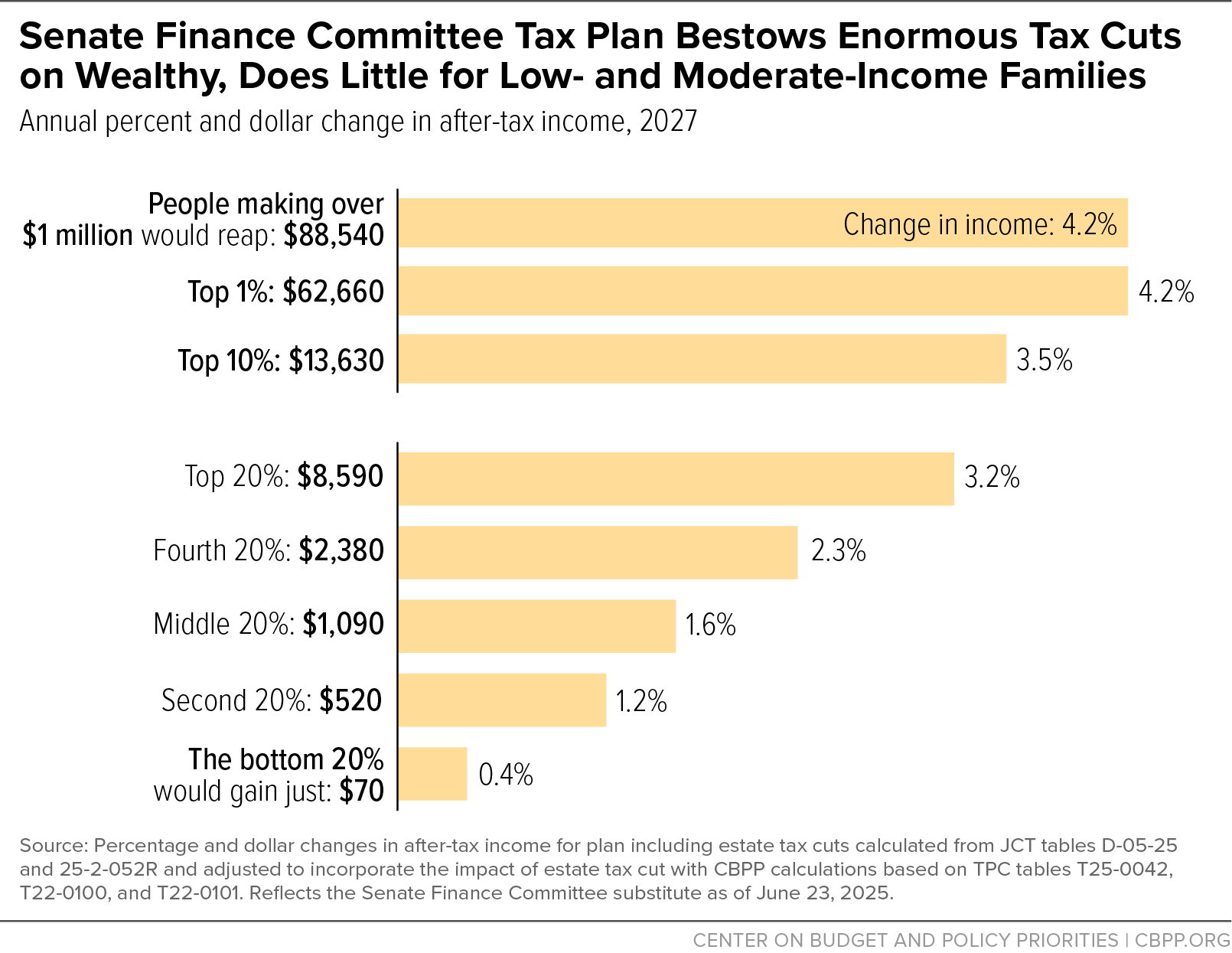
Like the House bill, the Senate Finance proposal features large tax cuts for high-income families while doing little — or worse — for low- and moderate-income families. In 2027, when all of its temporary policies are in effect, the tax cuts as a share of income are ten times larger for households making over $1 million than households in the bottom 20 percent (see chart). In later years, the proposal actually raises taxes on households in the bottom 20 percent.
Notably, the JCT analysis does not include the cuts to Medicaid and food assistance through SNAP in the Senate Republican leaders’ emerging bill that partially finance its $4.2 trillion of tax cuts. After including those and other spending cuts, the Congressional Budget Office found that the very similar House bill would make the bottom 30 percent of households worse off. An analysis from the Budget Lab at Yale found that the bottom 80 percent of households would be worse off from the combination of the House bill and the tariffs President Trump has imposed.

Revised Senate Plan Will Continue to Take Away Food Assistance From People Our Nation Has Granted Humanitarian Protections
Senate Republican leaders’ revised plan will continue to take away SNAP food assistance from people living lawfully in the U.S. who have been granted humanitarian protections, including refugees, people granted asylum, and certain survivors of domestic violence or labor or sex trafficking, among others. The Senate parliamentarian had ruled that the original anti-immigrant eligibility provision in the SNAP portion of the budget bill did not meet the criteria that allow for legislation to pass the Senate by a simple majority vote. To address this issue, the bill’s drafters modified the provision to continue to allow all Cuban and Haitian entrants to qualify for SNAP.
With this change, to qualify for SNAP people with low incomes would have to be a U.S. citizen, a lawful permanent resident (after a five-year waiting period, when applicable), a person granted Cuban or Haitian entrant status, or a person living in the U.S. from a nation under the Compact of Free Association. This extremely narrow eligibility standard goes well beyond ones under a 1996 law that created harsh immigration-related restrictions on certain federal benefit programs, barring many lawfully present immigrants from benefits including SNAP.
If the revised provision satisfies the parliamentarian’s concern and remains in the final bill, many people living lawfully in the U.S. who have demonstrated a need for humanitarian protection and are in need of food assistance will be blocked from SNAP. The bill’s authors proposed the same anti-immigrant eligibility exclusions for Medicaid, Medicare, and Affordable Care Act premium tax credits, so if this bill is enacted, some of the most vulnerable immigrants in our nation will be kept from vital supports that help them find stability, meet their basic needs, and establish their lives in the U.S.
Reported Rural Hospital Fund Is Not a Cure for Reconciliation Bill’s Deep Medicaid Cuts
Republican leaders are reportedly considering adding a rural hospital fund to the reconciliation package they are trying to advance in the Senate. But a capped fund that Congress could shrink or cannibalize in the future isn’t a substitute for the foundation of rural hospital stability: Medicaid.
The idea for a rural fund seems to have emerged, at least in part, because the Senate’s draft bill cuts provider taxes even more deeply than the House bill. The House bill would cut an estimated $800 billion over ten years from Medicaid — an unprecedented gutting of the program, including almost $124 billion cut from provider taxes. When combined with Affordable Care Act (ACA) marketplace policy changes, and the bill’s failure to extend enhanced premium tax credits for ACA marketplace coverage, the House bill would leave roughly 16 million people uninsured by 2034.
Deep provider tax cuts and limits on state directed payments in both bills could disproportionately impact reimbursement for rural providers, which often operate on thin or negative margins. Cutting payment rates to rural providers — coupled with more uncompensated care due to proposals that will take away Medicaid coverage, such as a harsh work requirement and more red tape — may force these providers to reduce the services they offer or close all together.
In light of these and other policies in congressional Republicans’ plans, researchers have found that more than 300 rural hospitals would be at disproportionate risk of closing, reducing services, or ending inpatient care.
This would have a ripple effect on entire communities as access to care in rural areas becomes even more tenuous. And to be clear, rural hospitals are not the only providers in financially precarious situations — a rural hospital fund would not support other hospitals that rely on Medicaid and that would be worse off under congressional Republicans’ proposals.
Keeping people insured is a key component of keeping rural hospitals financially healthy. Rejecting the Senate’s deep cuts to Medicaid is a better way to accomplish this goal.
Recent Analyses Detail How Senate Republican Leaders' Plan Would Take Away Health Care From Millions
We’ve posted several pieces recently detailing the harm the Senate Republican leaders’ bill would cause by taking away people’s health care. The Senate plan doesn’t meaningfully improve the elements of the House-passed bill that would cause some 16 million people to be uninsured, and in some cases the Senate bill is more harmful. It will leave people unable to afford needed care, while slashing about $1 trillion from the health programs communities depend on.
- The Senate plan includes a provision taking Medicaid away from low-income adults — including many parents — who get health care through the Medicaid expansion if they can’t show they are meeting a work requirement or qualify for an exemption. CBPP estimates that the Senate bill would put 9.8 million to 14.8 million people at risk of losing Medicaid coverage in 2034, roughly 160,000 to 380,000 more people than under the House version.
- The Senate plan goes even further than the House-passed bill in targeting the 41 states (including D.C.) that have adopted the Affordable Care Act’s (ACA) Medicaid expansion and the people it covers, imposing extensive new barriers to coverage and health care for adults in the expansion population.
- In addition to the House bill provisions that ended Medicare and ACA subsidies for most lawfully present immigration categories, the Senate bill goes further by taking away Medicaid and Children’s Health Insurance Program (CHIP) coverage for refugees, people granted asylum, certain victims of domestic violence, and survivors of sex and labor trafficking.
- The Senate bill would also impose severe federal penalties to Medicaid programs in 16 states and the District of Columbia if they do not end non-Medicaid coverage they currently provide to certain immigrants.
- The Senate plan adds red tape to the Medicaid eligibility and enrollment processes, which would result in eligible people losing coverage and further burdening overwhelmed eligibility workers.
- The Senate plan would increase the cost of health care for people enrolled in the ACA marketplaces and Medicaid.
- The Senate plan would layer additional costs on states, even more so than the House’s version, through its extreme health care cuts.
Senate Republican Tax Plan Would Mean Higher Energy Costs, Job Losses, More Pollution
The Senate Republican tax plan makes harmful cuts to clean energy tax credits, which would raise households’ energy costs, undermine economic opportunity, and increase harmful air and climate pollution, to partially offset the cost of its tax cuts for the wealthy.
The plan would end or accelerate the phaseout of most tax credits. The value of credits for solar and wind projects would decrease significantly if the projects get underway after 2025 and drop to zero in 2028. Credits for commercial clean vehicles, including electric school buses, and vehicle chargers in rural and low-income communities would also phase out within a year after the bill is enacted. Beginning in 2026, the bill would also prohibit credits for clean energy projects that source a certain percentage of materials from, or have project owners with relationships to, certain foreign countries, including China — currently the largest supplier of such materials.
Through these complicated restrictions and accelerated phaseouts for underlying tax credits, the bill would also make it significantly harder for schools, local governments, and houses of worship to use the Inflation Reduction Act’s direct pay program, which allows tax-exempt entities to claim clean energy-related tax credits.
Collectively, these changes would mean:
- Increased household energy costs. By making it harder for projects to claim tax credits, the plan would slow needed growth in solar and wind, the cheapest forms of energy, resulting in higher electricity prices for households and businesses.
- Fewer clean energy jobs. The plan’s changes would harm investments in the clean energy industry, threatening jobs in a sector that grew at twice the rate of overall job growth in 2024. Already thousands of jobs and projects have been canceled due to the uncertainty caused by threatened cuts.
- More pollution. By making it harder to install clean energy and easier to extract and use fossil fuels, the plan would increase dangerous air pollution. This has severe health consequences, especially for children, people with disabilities, and older adults. IRA funding was set to reduce air pollution by more than 36 percent by 2030.
Senate Bill Further Targets Medicaid Expansion States and Enrollees
The Senate Republican leaders’ reconciliation plan goes even further than the House-passed bill in targeting the 41 states (including D.C.) that have adopted the Affordable Care Act’s Medicaid expansion and the people it covers, including millions of parents, people with disabilities, and veterans, among others who may have no other pathway for health coverage.
The Senate plan imposes extensive new barriers to coverage and health care for adults in the expansion population. These include: a provision taking away coverage from people not meeting a work requirement, eligibility checks twice a year instead of annually, required cost sharing for certain services for those with income above the poverty line, and restrictions on retroactive coverage. The combination of additional red tape and increased out-of-pocket costs would put people at greater financial risk and could jeopardize their health.
The Senate plan also imposes financial penalties on expansion states that wouldn’t apply to non-expansion states. These include adding more draconian restrictions on their use of provider taxes to help finance their Medicaid programs as well as more restrictive limits on states’ use of directed payments to ensure access to an adequate provider network.
The Senate plan also cuts federal funding to expansion states for emergency services for people who would qualify for Medicaid expansion if not for their immigration status, shifting more costs to states. And, like the House bill, it cuts funding to expansion states that use their own funds to provide comprehensive coverage to people without a “qualified” immigrant status, doubling the state cost of expansion coverage.
The Senate plan wouldn’t just harm expansion enrollees. Their children would also be at greater risk of losing coverage, optional benefits like home- and community-based services could be reduced due to budgetary shortfalls, and states may have to make cuts in public services that would have far-reaching effects on residents. The changes would also weaken state health care systems, potentially reducing access to health care for entire communities.
Eligible Medicaid Enrollees Would Face More Red Tape Under Senate Plan
By adding substantial red tape to Medicaid eligibility and enrollment processes, the Senate Republican leaders’ reconciliation plan would cause eligible people to lose coverage and further burden overwhelmed eligibility workers, undermining service for all applicants and enrollees.
The plan’s biggest change is the addition of work requirements at application and renewal for low-income adults who gained coverage through the Affordable Care Act’s Medicaid expansion. The plan goes even further than the House-passed bill by applying the requirement to many parents. Though the large majority of Medicaid enrollees already work or would qualify for an exemption, many would lose coverage because they couldn’t provide the necessary paperwork to prove it.
In addition, the Senate plan requires expansion enrollees to renew their coverage every six months, instead of yearly. More frequent renewals would lead an estimated 700,000 people to lose coverage — in many cases, not because they no longer qualify but because they didn’t receive a notice or didn’t complete the paperwork by the deadline, or eligibility workers didn’t process their forms on time.
Finally, the Senate plan blocks implementation of two eligibility and enrollment rules that would simplify Medicaid enrollment, particularly for seniors, people with disabilities, and children. (The rules wouldn’t expand eligibility.) A similar House proposal would cut $167 billion from Medicaid, mostly by making it more difficult for eligible people to enroll.
These changes would not only cause eligible people to lose coverage but also increase Medicaid error rates. The vast majority of errors in Medicaid are paperwork mistakes; requiring more paperwork will drive up errors. The House bill severely penalizes states for errors, including paperwork mistakes; even though a similar Senate provision is less extreme, states could still be at risk of facing penalties.
People Would Face Higher Costs for Health Care Under Senate Plan
The Senate bill includes several provisions that increase costs for people enrolled in the Affordable Care Act (ACA) marketplaces and Medicaid. These changes come at a time when families are already struggling to make ends meet in the face of rising costs for food, rent, and other basic needs. The bill:
- Fails to extend enhanced premium tax credits (PTCs) that are set to expire at the end of 2025, which the Congressional Budget Office (CBO) estimates will cause 4.2 million people to become uninsured in 2034. Nearly all marketplace enrollees will have to pay higher premiums, and some would be quite large. For example, a 45-year-old in Alaska with an annual income of $62,000 would pay $7,600 more a year for a marketplace plan.
- Changes how the federal government funds a provision that lowers ACA marketplace cost-sharing charges for some people with modest incomes, in ways that will actually increase premium costs for many enrollees. As a result of these premium hikes, some enrollees may shift to plans with lower premiums but higher out-of-pocket costs, and others will likely drop coverage altogether.
- Requires states to charge Medicaid expansion enrollees with income greater than the federal poverty level ($15,650 per year for an individual in 2025) for certain services — up to $35 per charge, starting in October 2028 — and allows states to permit providers to deny service for non-payment. Consistent with current statute, total charges would be capped at 5 percent of a person’s income. The requirements would not apply to primary care, prenatal, mental health, substance use disorder, pediatric, or emergency room services (other than non-emergency services provided in an emergency room).
Millions in Medicaid Expansion at Risk of Losing Coverage Under Senate’s Work Requirement Proposal
The Senate Finance Committee proposal includes a provision taking Medicaid away from low-income adults — including many parents — enrolled in the Affordable Care Act (ACA) Medicaid expansion who can’t document that they are meeting a work requirement or qualify for an exemption.
The Congressional Budget Office estimated that the similar House-passed version of a work requirement would cut 5.2 million adults from Medicaid (the House version exempted all parents of minor children, while the Senate proposal only exempts parents with children 14 years old and younger). Other analysts, including at CBPP, estimate the coverage losses under the House bill could be higher. CBPP estimates that applying work requirements to parents with children over 14 years old would put roughly 160,000 to 380,000 more people at risk of losing coverage.
More than 90 percent of adults enrolled in Medicaid either work full time or meet exemption criteria laid out in the proposal, such as having a disability or caregiving. But that doesn’t mean they won’t lose their coverage.
That’s because research and real-world experience show that: (1) work requirements don’t help people find or maintain work; (2) they do result in large numbers of people losing coverage; and (3) many of the people who lose coverage are working or should have been exempt but the red tape associated with proving work hours or exemption status can be impossible to navigate.
The Senate bill’s work requirement proposal applies to adults aged 19 to 64 who are enrolled in the ACA Medicaid expansion. It is mandatory for all states and will go into effect on January 1, 2027, unless a state seeks and the Health and Human Services Secretary grants a temporary exemption to delay implementation for no more than two years. As a condition of eligibility, non-exempt Medicaid expansion enrollees must report at least 80 hours per month of work or other qualifying activities. The provision also requires people to be employed to get Medicaid coverage in the first place, which harms people who lose employer coverage after a layoff or who get sick and need care to get better and find work.
The Senate bill is also more extreme than many proposals in states that have already sought to implement a Medicaid work requirement.
Updated June 20, 2025
States Would Face New Costs, Likely Enact Harmful Cuts Under Senate Reconciliation Plan
Like its House counterpart, the Senate Republican leaders’ reconciliation plan would shift considerable new costs to states and localities, posing serious risk to the public services — like education, transportation, health care, veterans’ services, and much more — that states and localities are responsible for and that everyone counts on.
The plan would require most states to pay part of SNAP food benefit costs for the first time. Most states would have to pay 5 to 15 percent of those costs starting in 2028, amounting to tens to hundreds of millions of dollars per state each year. This would force hard tradeoffs. For Kansas, a 5 percent match exceeds state spending on the Office of Veterans Services; in North Carolina, a 15 percent match roughly equals state spending on child development and early education.
If states couldn’t pay the required amounts, they would have to shrink the number of SNAP recipients or even opt out of SNAP entirely. Cuts to food assistance on that scale would seriously harm children and adults alike, with increased hunger and downstream health and educational consequences as well as needs for state- and locally-funded help that would prove costly for states and communities.
The Senate plan’s extreme health care cuts would layer additional costs on states, even more so than the House’s version. The measure includes even sharper limits on provider taxes, which practically all states use to help finance their Medicaid programs. And it goes a step beyond the House in stripping health coverage from certain people who are immigrants, which would either shift substantial costs on to states or lead to widespread coverage losses in these communities. Also both the House and Senate plans would severely penalize states that use their own funds to provide comprehensive health coverage to certain immigrants — effectively doubling the cost of Medicaid expansion for affected states.
The widespread health coverage losses under either Republican plan also would generate significant indirect costs for states and localities, as people stripped of affordable coverage have to forgo routine or preventive care and later show up at emergency rooms and clinics requiring uncompensated care.
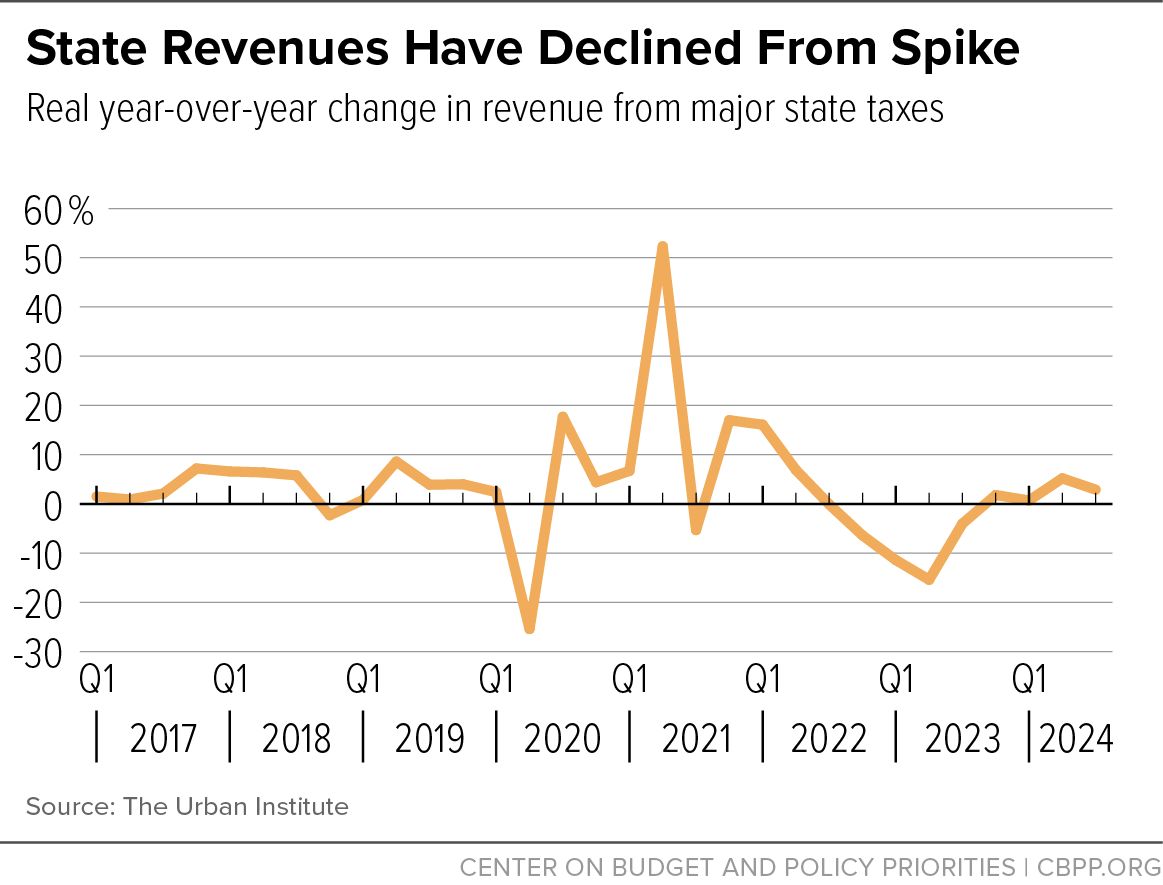
These added costs would be extremely difficult for states and localities to shoulder. For one, they must balance their budgets each year. State finances have also become increasingly strained and will worsen if the economy weakens. Unless states prove willing to fully cover their added costs by raising taxes and fees, they would have to cut health coverage and food assistance and shift funds from other parts of their budgets, such as public schools, child care, housing, and infrastructure.

Senate Finance Committee’s Child Tax Credit Proposal Does Nothing for the 17 Million Children Currently Left Out of the Full Credit
The Senate Finance Committee’s Child Tax Credit proposal fails to improve the credit for the 17 million children currently left out of the full credit because their families earn too little. These children would get nothing from the Senate’s proposed expansion of the credit, even though Republicans claim that their policies would help working families.
The proposed $200-per-child increase in the credit would leave out children whose parents work important jobs for low pay, while giving higher-income families the full amount.
The proposal would also take eligibility for the Child Tax Credit away from children who are U.S. citizens or lawful permanent residents if both of their parents lack a Social Security number — affecting roughly 2 million children by one estimate. Though the Senate bill denies the credit to fewer children than the House, the impact remains large and the children affected are permanent members of our communities and future members of our workforce.
Providing additional income to children in families with low incomes is a sound investment: it boosts children’s health and education outcomes, and leads to higher earnings for them in adulthood, considerable research shows.
But under the Senate proposal, a married couple with two children earning $400,000 would see their credit rise to $4,400, while a single mother with two children earning $16,000 working as a home health aide would get nothing from the expansion, ending up with a Child Tax Credit less than half the size of the higher-income family — despite both having two children.
Senate Republican leaders’ Child Tax Credit proposal shows their upside-down priorities: making it harder for families who need help meeting their basic needs while giving the wealthy large tax cuts.
Senate Republican Plan Goes Further Than House Bill in Harming People Granted Humanitarian Protections
The Senate Republican leaders’ reconciliation plan goes even further than the House-passed bill in leaving people granted humanitarian protections and other lawfully residing immigrants hungrier, sicker, and poorer.
In addition to taking away SNAP, Affordable Care Act (ACA) financial assistance, Medicare, and federal student financial aid from people living lawfully in the U.S. who have been granted humanitarian protections, including refugees, people granted asylum, survivors of domestic abuse, and certain victims of sex and labor trafficking, the Senate plan ends federal funding to help states provide Medicaid to these vulnerable groups. This is harsher than even the extremely harmful House bill.
These are groups that the federal government has determined need protection and supports so they are safe and can stabilize their lives. Understanding this, in 1996 Congress maintained their access to federal benefits even as it enacted a law that severely restricted access to benefits to many immigrants living lawfully in the U.S. The Senate proposal wipes these protections away.
The plan also levies a severe penalty that doubles a state’s cost of the ACA Medicaid expansion if the state provides people who do not have a “qualified” immigration status access to comprehensive health coverage, fully paid for by the state. The “qualified” immigration standard is a narrow list of statuses used to disqualify many immigrants — including many living and working lawfully in the U.S. as well as people who are undocumented — from accessing certain federal benefit programs.
Sixteen states and D.C. have non-Medicaid, state-only funded programs that provide comprehensive coverage to at least some people who do not have a “qualified” immigration status for federal benefits. All would see the state cost of the ACA Medicaid expansion double if they maintained this state-funded coverage.
The proposal also significantly cuts the federal funding states receive for emergency services provided to individuals who would qualify for the Medicaid expansion if not for their immigration status, adding more costs onto states.
The proposal would also strip an estimated 2 million children who are U.S. citizens or lawful permanent residents of eligibility for the Child Tax Credit if both of their parents file taxes without a Social Security number (or, in the case of a single-parent family, if the sole parent on the tax return files without an SSN). This provision will increase economic hardship on children who are a permanent part of our communities and will be part of our future workforce.
Senate Republican Tax Plan Extends, Expands Tax Breaks for Wealthy
Like the House-passed reconciliation bill, which would deliver $1.1 trillion in tax cuts to people making over $500,000, the Senate Republican leaders’ tax plan would extend the highly skewed 2017 tax cuts and add new tax cuts for high-income households and corporations. In contrast, working families struggling to meet their basic needs would largely be left out of the plan’s tax cuts and would be harmed by other core components of Republicans’ reconciliation bill, including massive cuts to health care and food assistance.
The Senate plan’s tax breaks primarily benefiting high-income people include:
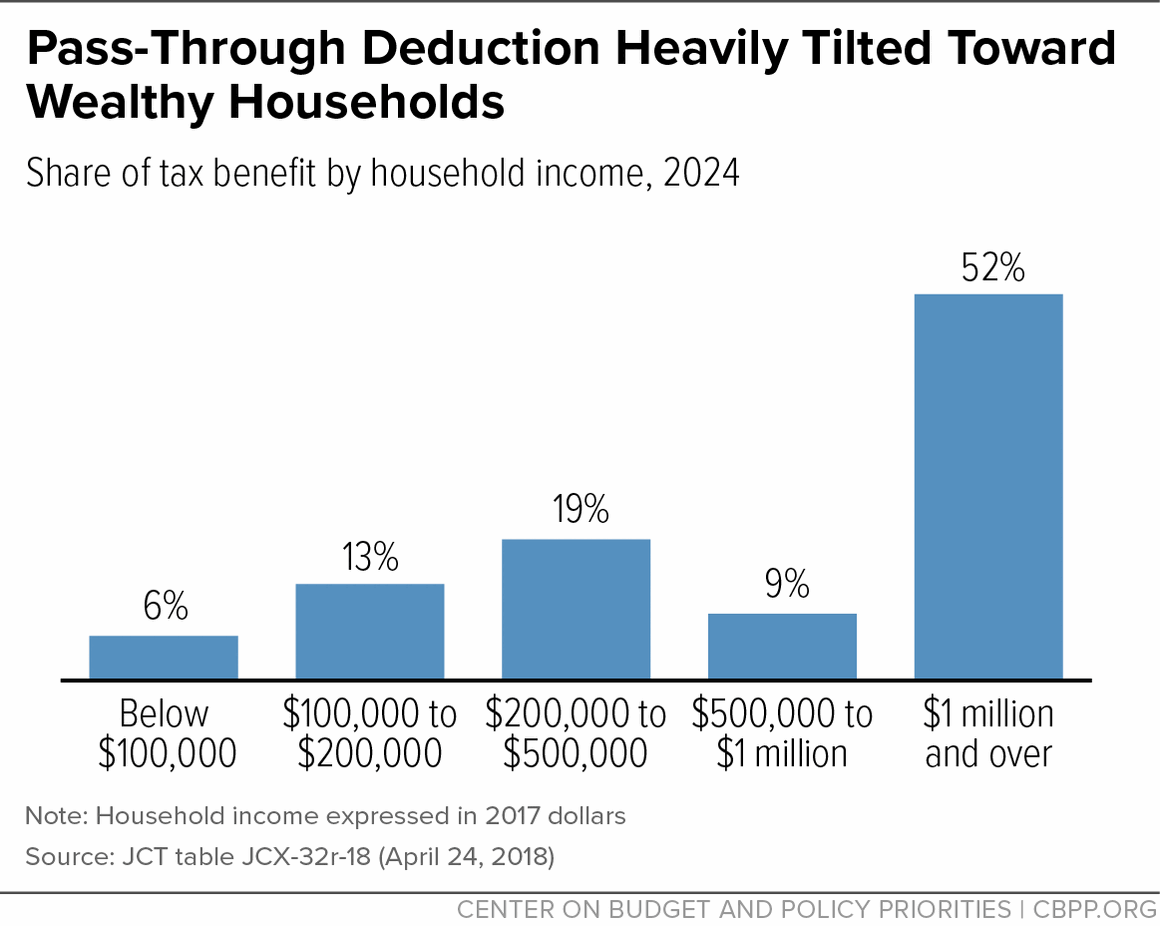
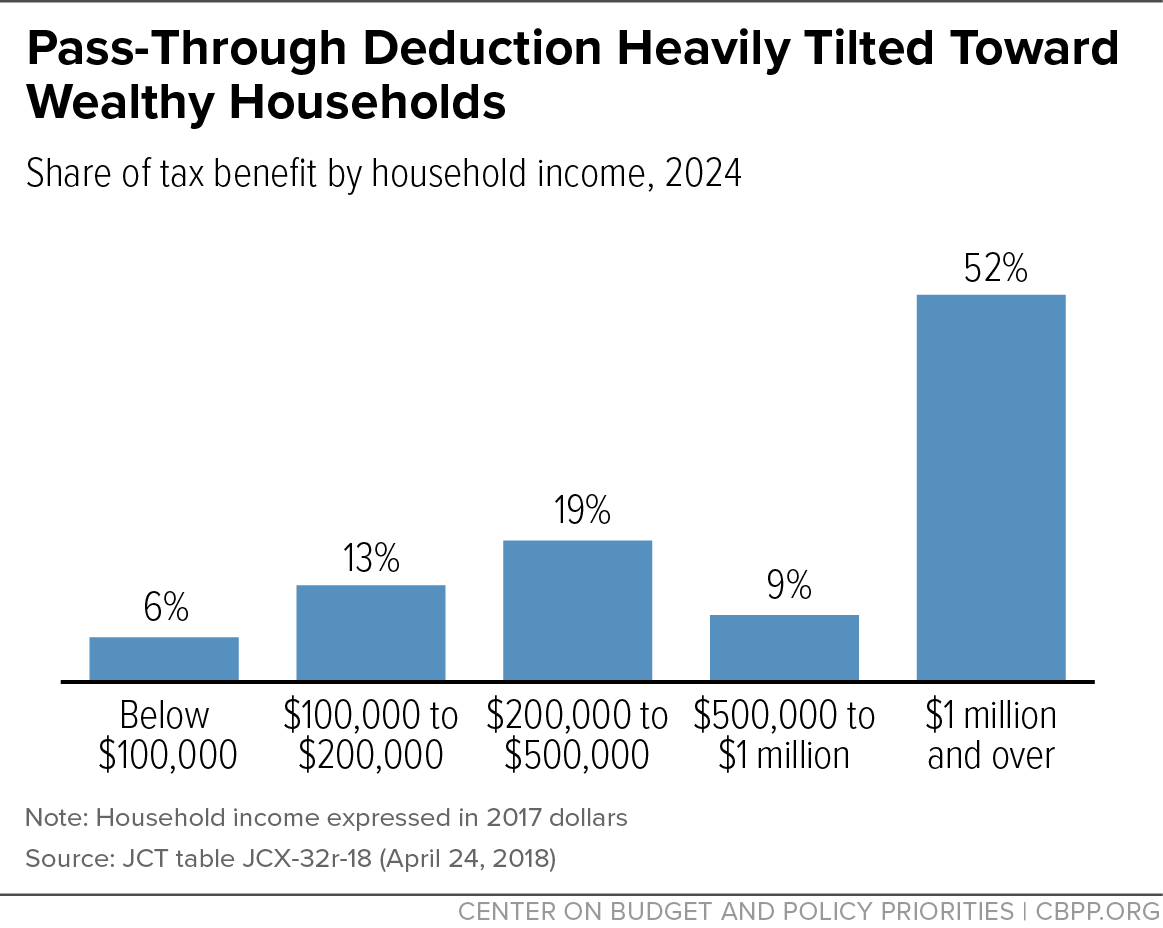
- Extension of skewed 2017 individual tax cuts. The plan permanently extends the 2017 law’s expiring individual income tax provisions, which would benefit wealthy households far more than households with low or moderate incomes. Roughly half the cost of extending the expiring tax cuts would flow to households with incomes in the top 5 percent. The plan permanently extends the 20 percent pass-through deduction, which has failed to trickle down to workers or boost economic activity and largely benefits millionaires (see chart).
- Expanded estate tax cut. The plan extends and expands the 2017 law’s increase in the estate tax exemption, boosting the estate tax cut for the 1 in 1,000 wealthiest estates to $6.3 million. (That’s compared to a $5.7 million tax cut under a simple extension of the 2017 law, which already adjusted the exemption each year for inflation.)
- Permanent corporate tax breaks. The plan permanently repeals business tax increases Republicans included in the 2017 law to partially offset the high cost of its permanent and large cut in the corporate rate. For example, the plan rolls back a limit on business interest deductions, a change that would benefit heavily indebted companies, a lobbying priority for the private equity sector. As a result, while wealthy households will continue to benefit from the corporate tax rate cut, they would receive another windfall from repealing the offsets enacted to help pay for them.
Senate Finance Committee Proposal Would Leave Millions Uninsured
The Senate Finance Committee proposal doesn’t meaningfully improve the elements of the House bill that would cause some 16 million people to be uninsured and unable to afford needed care, while slashing about $1 trillion from the health programs communities depend on. In fact, in several ways the Senate proposal is worse. People with disabilities, older and younger adults, children, veterans, small business owners, people who are immigrants, and many others will lose access to life-saving treatments, routine doctor visits, home- and community-based services, and medications they need. People need health care to live, but Senate Republican leaders are putting tax cuts for the wealthy ahead of people struggling to afford their basic needs.
The proposal includes a damaging provision taking Medicaid away from people not meeting a work requirement. The House exempted parents from the work requirement entirely while the Senate applies the requirement to parents with children over age 14. Even people who are supposed to be protected by exemptions, including people with disabilities, those with other chronic illnesses, and some parents — and those who are working — lose coverage when they get caught in work requirements’ bureaucratic red tape and become uninsured. (The Congressional Budget Office estimated the House provision would leave 4.8 million adults uninsured.)
The proposal imposes additional red tape that prevents eligible people from enrolling in or maintaining their coverage. It also eliminates health coverage for many people who are living lawfully in the U.S., including refugees and others granted humanitarian protection.
The Senate Republican leaders’ proposal also fails to protect millions of Affordable Care Act (ACA) marketplace enrollees from premium spikes, some quite large. About 22 million people will see their health costs skyrocket or lose coverage altogether in 2026 because the proposal does not extend the premium tax credit enhancements, which make ACA marketplace coverage more affordable. It is notable that a package that extends all of the 2017 expiring tax cuts, including those for the very wealthiest households, and adds more on top, allows the enhanced premium tax credits that help low- and middle-income households afford basic health care expire.
And at the same time that coverage losses would force states, providers, and localities to bear the cost of more uncompensated care, the Senate bill would impose even more stringent limits on how states can finance their Medicaid programs. The Senate bill’s more severe limits on provider taxes would shift costs to states and force them to cut provider rates, benefits, or coverage even more deeply.
Like efforts to repeal the Affordable Care Act in 2017, this proposal would make it much harder for tens of millions of families to afford the high cost of health care, and policymakers should reject these extreme proposals to take health coverage away.
A Burdensome, Unfair, and Inefficient EITC “Precertification” Process
The Senate Finance Committee bill would create more red tape for more than 17 million low- and moderate-income working families with children to jump through before they can receive their Earned Income Tax Credit (EITC). (See below for a state-by-state table.) This new, burdensome “precertification” proposal ignores key facts: the Bush Administration tried and abandoned this idea 20 years ago, and the current, depleted IRS is not equipped to administer such an expansive new requirement. Moreover, the provision creates an unfair double standard: imposing burdensome requirements on lower-income tax filers that are absent for higher-income filers.
The Bush Administration conducted several pilots of a smaller, more targeted precertification process and found it “far less efficient in stopping erroneous refunds” than the IRS’s usual error-reduction practices, according to former career Treasury official Janet Holtzblatt. The IRS also found that precertification would have led to some eligible families losing the credit.
The current Senate proposal would expand this failed idea to cover every family with children claiming the EITC, imposing time and paperwork burdens on them each year. During the earlier pilots, those burdens also extended to schools and health care providers, which had to provide necessary documentation to families. To implement with any efficacy, the IRS would have to inform all EITC filers of the new requirement, answer the inevitable deluge of questions in a timely and clear way, and process the myriad pieces of documentation submitted, at a time when the Administration and Congress have sharply reduced funding and staffing for the agency. This will mean that calls and questions will go unanswered, and the barriers to successfully filing for the EITC — a critical support that helps millions of working families cope with high costs and care for their children — will be very high.
One clear example of the proposal’s unfair double standard: while pass-through businesses account for the largest component of unpaid taxes (known as the tax gap) and certain types of pass-throughs, like sole proprietors, have much higher noncompliance rates than EITC participants, the bill proposes no additional compliance measure for pass-throughs, only a permanent tax cut.
Senate Bill Subjects More Than 17 Million Working Families with Low and Moderate Incomes to New Burdensome Requirement to Claim the EITC Number of families with children who claimed the EITC, and number of children claimed, tax year 2022 | ||
|---|---|---|
| Families with children who claimed the EITC | EITC-qualifying children claimed | |
| Alabama | 345,240 | 573,460 |
| Alaska | 27,360 | 49,360 |
| Arizona | 387,930 | 670,450 |
| Arkansas | 206,460 | 354,050 |
| California | 1,714,690 | 2,852,270 |
| Colorado | 199,700 | 338,910 |
| Connecticut | 137,570 | 224,030 |
| Delaware | 50,140 | 84,080 |
| District of Columbia | 31,350 | 52,100 |
| Florida | 1,386,850 | 2,229,290 |
| Georgia | 759,370 | 1,277,330 |
| Hawai'i | 58,070 | 100,110 |
| Idaho | 80,720 | 143,800 |
| Illinois | 593,980 | 1,004,780 |
| Indiana | 348,700 | 601,370 |
| Iowa | 128,500 | 225,460 |
| Kansas | 130,590 | 230,350 |
| Kentucky | 261,850 | 446,950 |
| Louisiana | 368,850 | 606,640 |
| Maine | 53,050 | 86,880 |
| Maryland | 268,630 | 444,590 |
| Massachusetts | 222,790 | 361,850 |
| Michigan | 495,050 | 854,820 |
| Minnesota | 198,010 | 354,100 |
| Mississippi | 266,330 | 438,170 |
| Missouri | 320,560 | 554,370 |
| Montana | 44,460 | 76,740 |
| Nebraska | 83,210 | 148,960 |
| Nevada | 176,080 | 293,820 |
| New Hampshire | 37,940 | 60,830 |
| New Jersey | 381,020 | 623,170 |
| New Mexico | 133,460 | 225,860 |
| New York | 966,510 | 1,596,090 |
| North Carolina | 610,880 | 1,015,850 |
| North Dakota | 27,710 | 48,320 |
| Ohio | 597,370 | 1,027,750 |
| Oklahoma | 244,430 | 430,720 |
| Oregon | 149,000 | 251,980 |
| Pennsylvania | 573,560 | 963,960 |
| Rhode Island | 48,760 | 78,790 |
| South Carolina | 331,500 | 553,220 |
| South Dakota | 37,890 | 67,850 |
| Tennessee | 412,270 | 695,180 |
| Texas | 1,963,140 | 3,422,320 |
| Utah | 114,790 | 206,240 |
| Vermont | 21,980 | 35,890 |
| Virginia | 381,230 | 639,880 |
| Washington | 251,370 | 431,510 |
| West Virginia | 92,000 | 154,610 |
| Wisconsin | 218,930 | 380,910 |
| Wyoming | 22,590 | 39,250 |
Notes: Families with children who claimed the EITC are counts of filers who claimed the EITC with one, two, or three or more qualifying children. EITC-qualifying children claimed reflects only the first 3 qualifying children per family, so the actual number of children in families that claimed the EITC may be higher than the number shown. Source: For national total, IRS Statistics of Income (SOI) Table 2.5, “Returns with Earned Income Credit, by Size of Adjusted Gross Income and Number of Qualifying Children, Tax Year 2022 (Filing Year 2023)”, | ||
Quote from Shelby Gonzales, Vice President for Immigration Policy, Center on Budget and Policy Priorities, on Immigration Provisions in Senate Republican Reconciliation Proposals:
“The Senate reconciliation proposal goes even further than the House bill in harming people granted humanitarian protections in our nation, such as refugees, people granted asylum, victims of sex and labor trafficking, survivors of domestic violence, and others granted humanitarian protection.
“In a move that is harsher than the House bill, the Senate plan denies federally funded Medicaid and CHIP to these groups, either shifting substantial costs onto states who continue coverage to these members of their communities or leading states to take coverage away from these groups who are working to rebuild their lives after fleeing persecution and other vicious crimes.
“Like the House bill, the plan also eliminates food assistance under SNAP and affordable health coverage through the ACA marketplaces and Medicare for these vulnerable groups.
“These proposals mark a stark departure from our nation’s long-standing, bipartisan commitment to supporting people who are fleeing violence and persecution is deeply disappointing and should be rejected.
“The plan would create immense hardship for many people who are immigrants and their families. Contrary to false claims made by some Republican policymakers, the proposal would take away access to federally funded health coverage and food assistance for people living and working legally in the U.S., raising their costs and making it harder for them to afford their basic needs. The reality is that people who lack documentation already are not eligible for federal benefits.
“The proposal also takes away states’ rights to use their own funds to provide comprehensive health coverage to certain immigrants, a dramatic federal overreach. The plan would penalize states by doubling the state’s costs for their Medicaid expansion if they use their own state funds to provide coverage. And the proposal would strip an estimated 2 million children who are U.S. citizens or lawful permanent residents of eligibility for the Child Tax Credit if both of their parents file taxes without a Social Security number.”
Senate Republican Tax Plan Doubles Down on Costly, Skewed Tax Cuts
The Senate Republican leaders’ tax plan doubles down on the failures of the 2017 tax law, which was skewed to the top, very expensive, and increased the nation’s debt — and didn’t produce the promised economic gains for working people.
Like the House-passed bill, the Senate plan would balloon deficits and debt to give large tax breaks to the wealthiest households and large corporations — including costly tax cuts on top of extending the expiring 2017 provisions — while leaving out key policies that would help low- and moderate-income families.
The House tax cuts would cost $3.8 trillion, or $500 billion more than the cost of extending all the 2017 law’s expiring individual income and estate tax provisions. The Senate plan repeats this approach, retaining most of the House bill’s flawed provisions, including permanently extending the highly skewed 2017 tax cuts and an expanded estate tax cut for wealthy heirs.
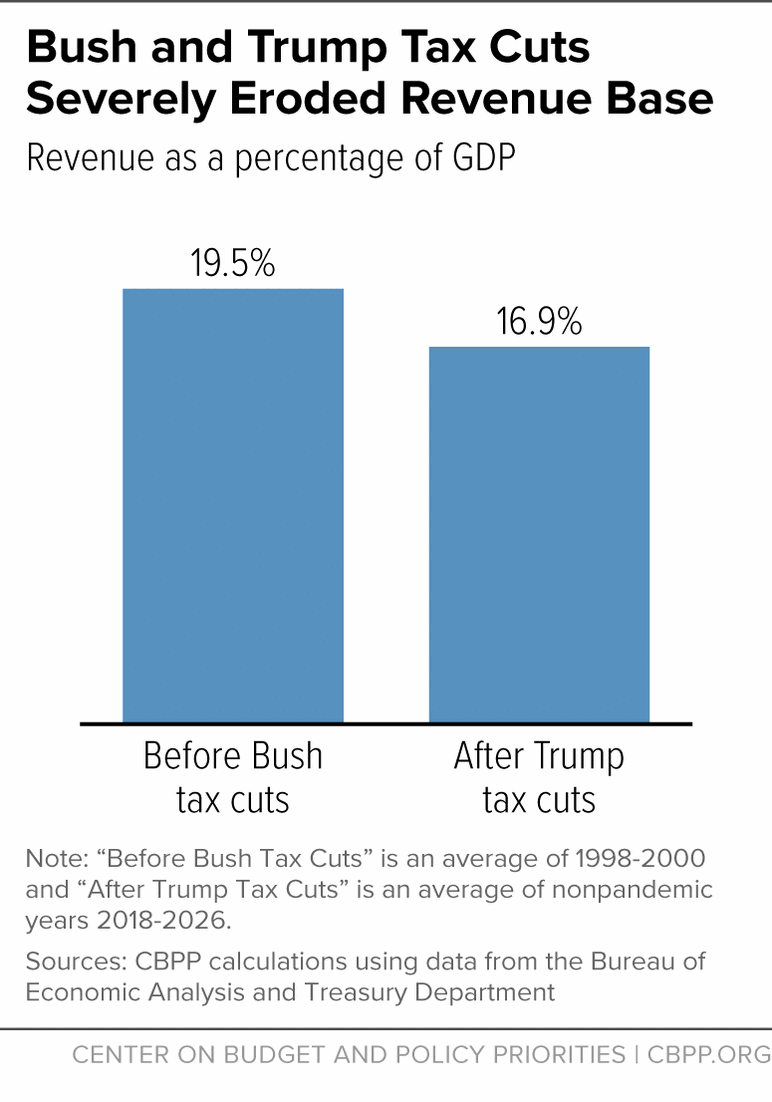
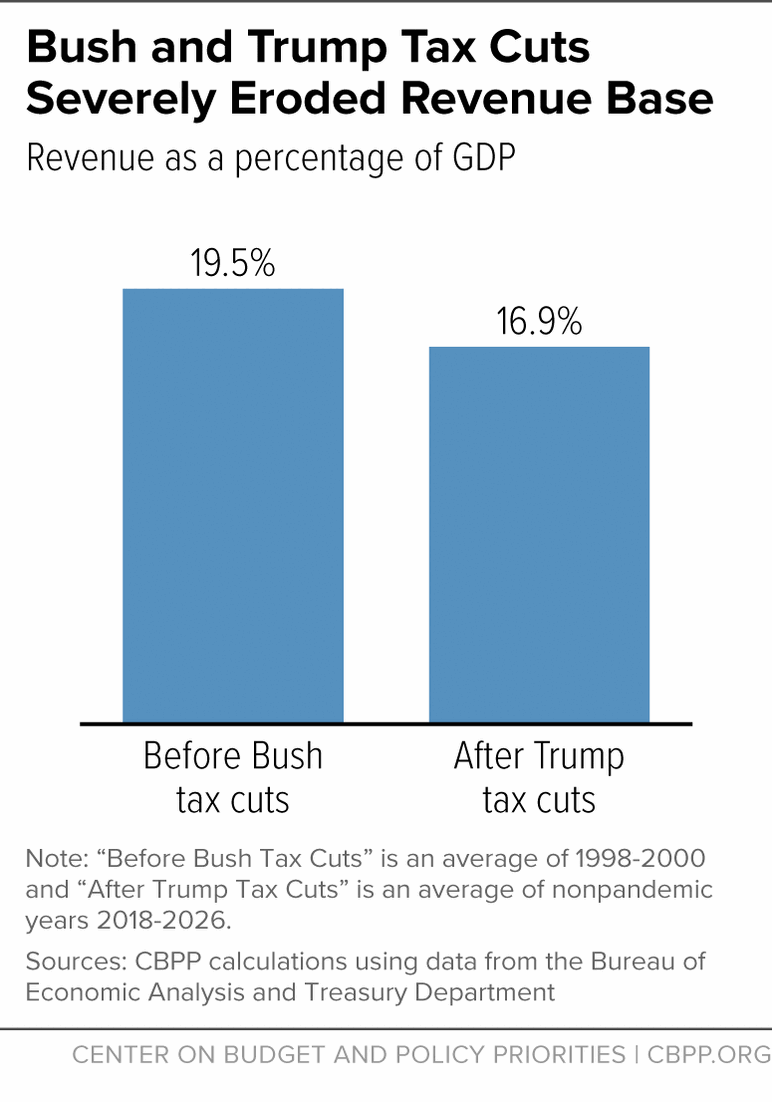
These large tax cuts would worsen the erosion of the revenue base that began with the Bush tax cuts (and their extensions) and continued with the first Trump Administration. (See chart.) Those tax cuts were fiscally irresponsible, and Republicans’ latest tax cut plan would be even more so, given the nation’s much higher deficits and debt, economic uncertainty, and rising needs due to the aging of the baby boom generation and continued underinvestment in public services.
Quote from CBPP Vice President for Federal Tax Policy, Chuck Marr, on Senate Finance Committee Tax provisions:
"Senate Republican leaders are doubling down on a failed approach: costly tax cuts skewed in favor of the richest people in the country and corporations rather than delivering for working families. These tax cuts would further erode the revenues we need to meet our commitments to seniors, make high-value investments in our future, and address our fiscal outlook.
"Senate Republicans’ tax proposal keeps most of the House bill’s flawed provisions, and fails to meaningfully help the hard-pressed working families often featured in Republicans’ rhetoric.
"Senate Republican leaders would partially pay for the tax cuts for the wealthy by taking away health coverage and food assistance from millions of low- and middle-income families. Yet the bill still drives up deficits.
"It’s notable that in a bill that extends tax cuts for millionaires and billionaires and even adds new tax cuts for wealthy heirs, the proposal does not extend a major tax cut that is currently helping 22 million low- and middle-income people afford health coverage though the Affordable Care Act (ACA) marketplaces.
"The tax provisions fail to deliver for millions of working families in other ways as well. The bill’s modest expansion of the Child Tax Credit does nothing to help the 17 million children who don’t currently get the full Child Tax Credit because their families’ earnings are too low, while at the same time it takes eligibility for the credit away from children who are U.S. citizens or lawful permanent residents if both of their parents file taxes without a Social Security number – affecting roughly 2 million children by one estimate. It also throws up new roadblocks for 17 million families with children to get their Earned Income Tax Credit (EITC), even as Republicans have pushed cuts to the IRS that will make it easier for wealthy people to cheat on their taxes.
"When the President’s tariffs are taken into account, this economic agenda would reduce the living standards and raise costs for millions of families with low and middle incomes.
"Senate Republicans should reject this legislation that prioritizes the wealthiest people at the expense of everyone else."
Update, June 17: We have updated the number of people using premium tax credit enhancements to afford marketplace coverage.
Quote from Sarah Lueck, Vice President for Health Policy, Center on Budget and Policy Priorities, on Health Care Provisions in the Senate Finance Committee Reconciliation Proposal:
“The Senate Republican leaders’ health proposals make no meaningful improvements to the elements of the House bill that would raise health care costs and cause roughly 16 million people to become uninsured and unable to afford needed care, while slashing about $1 trillion from the health programs communities depend on. Several changes the Senate is proposing would actually increase harm compared to the House bill. People with disabilities, older adults, children, and many others would lose access to life-saving treatments, routine doctor visits, and medications they need. People need health care to live, but Senate Republican leaders are putting tax cuts for the wealthy before people struggling to afford their basic needs.
“The Senate plan would make it much harder for millions of families to afford the high cost of health care along with other basic needs like groceries and housing, straining families’ budgets in service to tax cuts benefiting the wealthy. Policymakers should reject the bill’s extreme proposals to take health coverage and food assistance away from people who need them.”
Over a Million People Would Lose Food Assistance in Areas Without Enough Jobs
The Senate Agriculture Committee proposal would terminate food assistance for over a million people who live in areas with high unemployment by making it harder for states to seek a waiver from SNAP’s harsh work requirement for these residents.
The Senate Republican leaders’ proposal would limit waivers to areas where unemployment rates exceed a restrictively high threshold of 10 percent. Currently, only ten counties in the entire country would meet that criteria. This is just 1 percent of the over 700 counties that are now eligible in states that historically have implemented waivers. The Senate proposal’s restrictive criteria would undermine SNAP’s ability to support families and local communities during economic downturns, making future recessions longer and more damaging.
Currently waived areas facing economic challenges, such as counties in north-central Pennsylvania hit by catastrophic flooding from Hurricane Debby or rural communities in Maine hit hard by the loss of major employers, would no longer qualify for waivers. Within the first year of the Great Recession, fewer than 400 counties out of over 3,000 across the country had unemployment rates greater than 10 percent.
Under current SNAP rules, most non-elderly, non-disabled adults without children in their homes can’t receive benefits for more than three months out of every three years, unless they document they are working at least 20 hours per week or prove they qualify for an exemption. The Senate proposal seeks an unprecedented expansion of this work requirement to parents, grandparents, and other caregivers of school-aged children aged 10 to 17, on top of the new, restrictive waiver criteria.
Since the creation of SNAP’s work requirement nearly 30 years ago, states have had the ability to temporarily waive the three-month time limit in areas with relatively high rates of unemployment or insufficient jobs. Governors of both parties in every state have used this flexibility at some point to respond to local labor market conditions.
Cutting Federal SNAP Funding and Shifting Costs to States Risks Deep Cuts to Food Assistance
The Senate Agriculture Committee proposal would slash billions in federal funding for food assistance and impose those costs on states for the first time. This would likely lead many states to cut food assistance for low-income families, worsening hunger and undermining SNAP’s ability to meet greater need when the economy weakens. States could even end SNAP altogether if they decide the costs they would bear are too great.
SNAP food benefits have always been 100 percent federally funded, ensuring that eligible low-income families receive food assistance sufficient to afford an adequate diet regardless of the state they live in. The Senate proposal would walk away from that nationwide commitment to address hunger.
Under the Senate Republican leaders’ proposal, most states would be required to pay 5 to 15 percent of food benefits starting in 2028, depending on their error rate (a measure of over- and underpayments that largely reflects unintentional mistakes). Unlike the House version, only states with an error rate of 6 percent or higher would need to pay a portion of food benefits. But over the last two decades, every state but one has had an error rate above this threshold in at least one year.
These costs are very large. For example, North Carolina could be forced to pay up to $438 million in 2028 if it faces the 15 percent state cost share, while West Virginia could owe up to $84 million.
States must balance their budgets and would struggle to absorb these costs. If they can’t fill the gap left by the federal funding cut — by raising taxes or cutting other services like education — they would have to cut food assistance through some combination of restricting eligibility, making it harder for eligible people to access SNAP, or even opting out of SNAP entirely.
The provision in the Senate proposal specifies that the federal government cannot fund more than its share of benefits, which would mean that if a state is unable to afford to provide its share of benefits for everyone on its expected caseload, it would have to cut the caseload back to a number of families for whom it could afford to provide benefits.
The risk that a state can’t fully make up the loss of federal funding would be heightened during recessions. As more people apply for SNAP, the cost of states’ share of benefits would rise. But at the same time, states’ revenues would be declining — forcing states to make even more painful trade-offs and increasing the risk that they couldn’t meet the greater need, leaving people hungry.
Senate Plan Takes Food Assistance Away From People Our Nation Has Granted Humanitarian Protections
The Senate Agriculture Committee’s plan would take away SNAP food assistance from people in the U.S. who have been granted humanitarian protections, including refugees, people granted asylum, and certain survivors of domestic violence or labor or sex trafficking, among others living lawfully in this country. People without a documented immigration status have never been eligible for SNAP, and many people with lawful immigration statuses are already ineligible for SNAP due to program restrictions enacted in 1996. The harsh restrictions enacted in 1996 still ensured that refugees and others granted humanitarian protection would be able to receive the help they need as they rebuilt their lives here.
The Congressional Budget Office estimates this provision would take food assistance away from between 120,000 and 250,000 people who are immigrants over the next ten years; we estimate roughly 50,000 of them would be children, putting them at greater risk of food insecurity and significant harm to their long-term health and cognitive development.
In addition to the direct harm to immigrants who would lose SNAP eligibility, this provision would also cut food assistance for U.S. citizen children who live with them. While these U.S. citizen children would generally remain eligible for SNAP, excluding their immigrant household members means the family would receive a dramatically reduced benefit level, not allowing them to afford the groceries they need. In 2023, about 98,000 U.S. citizen children lived in households with immigrants who would lose SNAP eligibility under this bill.
This is just one example of how this bill ends our nation’s long-standing bipartisan commitment to ensure that vulnerable people who have demonstrated a need for humanitarian protection have access to vital supports that help them find stability, meet their basic needs, and establish their lives in the U.S.
Millions Would Lose Food Assistance Under Expanded Work Requirement, Including Households With Children
Like the House-passed reconciliation bill, the Senate version would take food assistance away from millions of people who don’t meet a red-tape-laden and ineffective work requirement. For the first time, parents and other caregivers with children over age 9 — as well as older adults aged 55 to 64 — would be at risk of being cut off of the Supplemental Nutrition Assistance Program (SNAP) after only three months.
About 8 million people, including about 2.5 million children and over half a million adults who are aged 65 or older or have a disability, live in households that would be at risk of losing at least some food assistance because someone in the household is subject to the newly expanded work requirement. That’s roughly 1 in 5 SNAP participants.
More than 2 million parents and other caregivers would be at risk of losing SNAP, putting the 2.5 million children aged 10 to 17 who live with them at risk of receiving much less food assistance. While the maximum age of dependent children to qualify for an exemption is even lower in the House bill (age 6, versus 9 in the Senate), the Senate bill would still put millions of school-aged children at risk of hunger and food insecurity, which can have lasting consequences for their physical, cognitive, and social development and their educational success.
The roughly 8 million people at risk of losing some or all SNAP benefits also include veterans, people experiencing homelessness, and former foster youth, who are being stripped of their current exemptions from the work requirement; and people living in areas without sufficient jobs who would lose their food assistance if they fail to comply with the work requirement due to the bill’s far more restrictive criteria for area waivers that are based on poor labor market conditions.
Quote from Ty Jones Cox, CBPP Vice President for Food Assistance, on the Senate Agriculture Committee Reconciliation Text:
“Senate Republican leaders released a proposal tonight that would cut or take food assistance away entirely from millions of people, including children, veterans, workers in low-paying jobs, older adults, and people with disabilities, when many families are already struggling to afford the high cost of food and other basic needs.
“Like the House bill, the Senate proposal disguises massive cuts by forcing unaffordable costs onto states — but the end result can’t be hidden: slashing federal funds will leave families without vital assistance to afford groceries when states are not willing or able to make up the difference.
“The proposal would also take food assistance away from millions of parents and grandparents who are working but get tangled in red tape, have a health condition but fall through the cracks and don’t get an exemption, or are between jobs and need temporary help. It also strips the current exemptions from this harsh work requirement for veterans, people experiencing homelessness, and young people who have aged out of foster care.
"And, the proposal takes food assistance away from refugees and others with humanitarian protections, like people granted asylum and victims of labor and sex trafficking — a stark departure from our country’s long, bipartisan history of supporting people fleeing violence and persecution.
“Despite differences around the edges, the Senate proposal mirrors the misguided priorities and harmful impacts of its House counterpart: millions of people would lose some or all of the food assistance they need to afford groceries, all to help to pay for trillions in tax cuts skewed to the wealthy.”
Authors