BEYOND THE NUMBERS
Senate Appropriators Should Reject IRS Cuts That Would Further Weaken Customer Service and Compliance
In the wake of unprecedented cuts to the IRS annual budget in fiscal year 2026, the Trump Administration and House Republicans are proposing yet more cuts for 2027 that would further hinder the IRS’s ability to collect taxes that are legally owed. As Senate appropriators begin considering IRS funding legislation, they should reject House cuts to the IRS budget to avoid further hamstringing the beleaguered agency.
After a decade of budget cuts from 2011 to 2020 that led to deep staffing cuts, plummeting audit rates, and dysfunction across the IRS, the 2022 Inflation Reduction Act (IRA) included nearly $80 billion in mandatory funding over ten years to supplement the IRS’s base budget (which is appropriated annually) and finance a multiyear rebuilding effort. But lawmakers used a series of rescissions to repeal $53.4 billion of the original $80 billion that was supposed to last through 2031, leaving less than $10 billion remaining after accounting for the funds obligated through fiscal year 2025. (Almost all of the remaining funds are for operations support, primarily information technology).
Compounding this problem, Congress froze the IRS’s base budget without any adjustment — even for inflation — from 2022 through 2025. And the recently passed 2026 appropriations package included the largest-ever nominal cut to the IRS’s annual budget – 12 percent or $1.1 billion.
The IRS base budget is now 40 percent below its 2010 level, after adjusting for inflation. Nevertheless, the Trump Administration and House Republicans have proposed further drastic cuts for 2027. House Republicans proposed a 9 percent cut, which would bring the base budget 44 percent below 2010 levels, after adjusting for inflation.
The IRS budget is already well below what the agency needs to provide adequate taxpayer service and ensure that legally owed taxes are paid. Additional cuts would cause more damage.
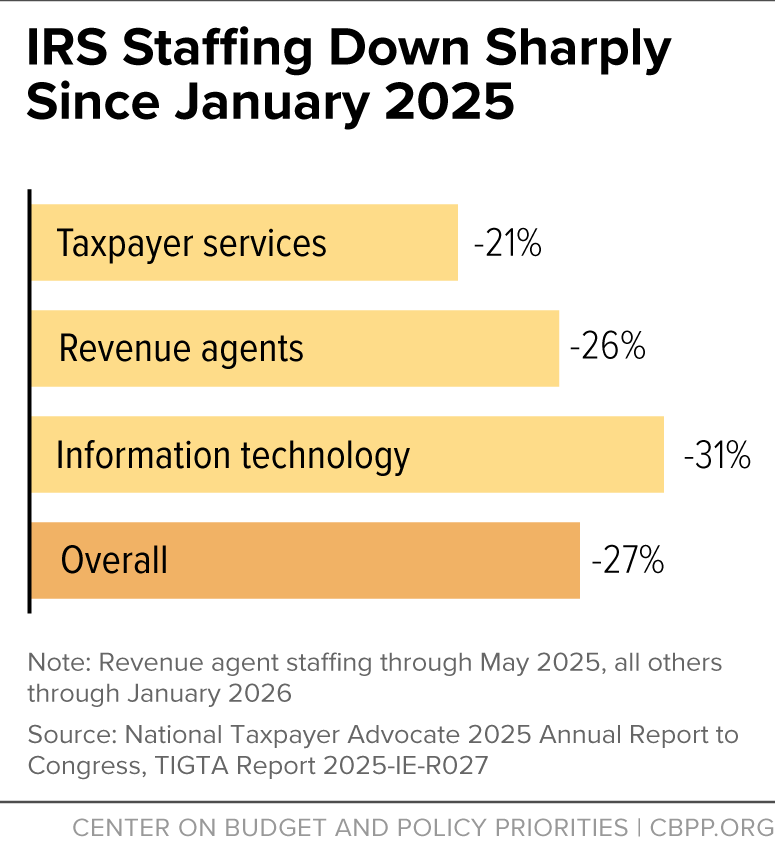
- Weakening customer service. Staffing levels are already down 27 percent from the beginning of 2025, which the agency has attempted to compensate for by re-assigning staff from other departments with little to no relevant experience to taxpayer-facing roles. The agency has closed taxpayer assistance centers and lowered its phone service goals, and technological upgrades to digitize paper returns and speed up return processing are behind schedule. The IRS needs more resources to prevent further weakening of service, but the House proposed budget keeps taxpayer services funding flat, and the supplementary customer service funding from the IRA is virtually gone.

Undermining tax enforcement. The gutting of the IRS is most apparent in tax compliance and enforcement, which the Trump Administration and House Republicans have both targeted for the most extreme cuts. The agency has fewer revenue agents, who audit the most complicated tax returns, than it has had since the 1950s, when the economy was far smaller and the tax code was far less complex. As a result, audit rates for millionaires and the largest corporations fell roughly 84 percent and 57 percent, respectively, between 2010 and 2020.
Cutting the IRS enforcement budget is especially shortsighted. Research shows that every dollar spent on IRS tax enforcement raises multiple dollars in revenue, which means that every dollar cut from IRS enforcement loses more than a dollar of revenue and adds to the deficit. That pattern is already emerging: for example, partnerships account for a large share of the tax gap, but they face near-zero audit rates. The agency has largely abandoned Biden-era efforts to increase audit rates for large, complex partnerships and has withdrawn rules that make it harder for partnerships to avoid taxes.

- Creating long-term challenges. Cuts to the IRS’s annual funding erode the agency’s capacity over time, making it more challenging to rebuild and become the efficient and effective tax collection agency taxpayers deserve. For example, when experienced auditors leave the agency, it can take years to rebuild the specialized expertise needed for complex enforcement work. That’s why investment in new hiring and training is crucial to maintaining skills and expertise. As a result, budget cuts can create lasting capacity gaps in areas requiring long-term investment, like enforcement and technology upgrades, that become increasingly difficult to address over time.