BEYOND THE NUMBERS
Most of the 19 Million Children Left Out of the Full Child Tax Credit Have Parents in Low-Paying Jobs; Policymakers Should Expand It
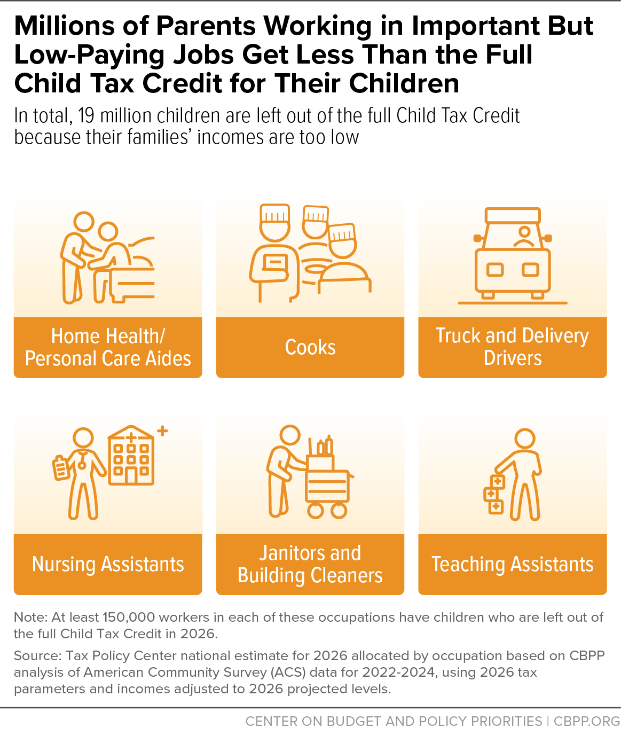
As our nation celebrates Labor Day, policymakers should consider ways to boost the incomes of people who do important work in our communities for low pay. Currently, more than 19 million children under age 17 receive less than the full $2,200 Child Tax Credit because their families’ incomes are too low — and the vast majority of these children have parents (or other caregivers, such as grandparents) who work. (See Figure.) Millions of these parents work in low-paying occupations such as home health aides, truck drivers, cashiers, cooks, janitors, and customer service representatives. These jobs are often characterized by volatile earnings, a lack of paid family or medical leave, a stagnant federal minimum wage, limited wage growth, and erratic hours that make finding stable child care difficult. To help children whose parents work in low-paying jobs, policymakers should provide the full Child Tax Credit to these families.

The number of low-paying jobs is expected to grow. Four of the seven occupations that are expected to add the highest number of new jobs over the next decade have median wages 27 to 39 percent lower than the national median for all occupations. For example, the number of home health and personal care aide jobs is expected to grow by roughly 850,000 (18 percent by 2035), and their median pay is 30 percent lower than the national median.
Millions of workers and their families are left out of the full Child Tax Credit because they have low-paying jobs. Of the four low-paying occupations expected to add the most jobs over the coming decade, three have some of the highest numbers of parents with children left out of the full Child Tax Credit: 334,000 home health and personal care aides, 248,000 cooks, and 132,000 stockers and order fillers. Hundreds of thousands of retail salespeople, child care workers, teaching assistants, nursing assistants, truck and delivery drivers, and others in low-paying occupations are also left out of the full credit. (See Table.)
Consider a single parent who has a toddler and a second-grader and works part-time as a home health aide being paid $18,000 a year. The family will receive a $2,515 Child Tax Credit for tax year 2026, or only about $1,258 per child — much less than the $2,200-per-child amount that a higher-income family would receive. But if policymakers make the full credit available to families with lower incomes, as it is for families with higher incomes, the single parent would instead receive the full credit of $4,400, which they could use to pay for essentials such as food, housing, and child care.
Policymakers should provide the full Child Tax Credit to families with lower incomes as one important and concrete step to better support people with low-paying jobs and their families in meeting their basic needs.
Making the Full Child Tax Credit Available to Families With Lower Incomes Would Benefit Millions of Workers in Low-Paying Jobs and Their Families | |
|---|---|
| Low-paying occupations with the largest numbers of parents or other caregivers getting less than the full $2,200 credit | |
| Occupation | Parents or other caregivers in occupation |
| Home health and personal care aides | 334,000 |
| Cashiers | 325,000 |
| Cooks | 248,000 |
| Truck and delivery drivers | 239,000 |
| Janitors and building cleaners | 225,000 |
| Maids and housekeeping cleaners | 215,000 |
| Customer service representatives | 212,000 |
| Laborers and freight, stock, and material movers, by hand | 196,000 |
| Construction laborers | 195,000 |
| Nursing assistants | 192,000 |
| Retail salespersons | 177,000 |
| Waiters and waitresses | 166,000 |
| Teaching assistants | 150,000 |
| First-line supervisors of retail sales workers | 147,000 |
| Landscaping and groundskeeping workers | 133,000 |
| Stockers and order fillers | 132,000 |
| Child care workers | 108,000 |
| Miscellaneous production workers, including equipment operators and tenders | 104,000 |
| Carpenters | 98,000 |
| Other agricultural workers | 97,000 |
| Receptionists and information clerks | 93,000 |
| Secretaries and administrative assistants, except legal, medical, and executive | 88,000 |
| Food preparation workers | 87,000 |
| Hairdressers, hairstylists, and cosmetologists | 81,000 |
| Couriers and messengers | 75,000 |
| Preschool and kindergarten teachers | 75,000 |
| Other assemblers and fabricators | 69,000 |
| Security guards and gambling surveillance officers | 68,000 |
| Packers and packagers, by hand | 67,000 |
| Office clerks, general | 66,000 |
| Taxi drivers | 66,000 |
| Food service managers | 65,000 |
| Painters and paperhangers | 64,000 |
| Fast food and counter workers | 62,000 |
| Automotive service technicians and mechanics | 58,000 |
| Medical assistants | 54,000 |
Notes: Estimates count parents or other caregivers (both members of a couple if married) who are at least age 18, worked at least one week in the year, reported an occupation, and have incomes too low to receive the maximum $2,200 per child under age 17, excluding those who do not meet the 2025 reconciliation law’s requirement that children and at least one parent have a Social Security number. “Home health and personal care aides” combines 232,000 personal care aides (such as escorts for the elderly or those with disabilities) with 102,000 home health aides (such as in-home hospice attendants). Table shows all occupations with below-median hourly earnings and at least 50,000 workers getting less than the full $2,200 credit per child under age 17 because their incomes are too low. Source: Tax Policy Center (TPC) national estimate for 2026 allocated by occupation based on CBPP analysis of American Community Survey (ACS) data for 2022-2024, using 2026 tax parameters and incomes adjusted to 2026 projected levels. We use February 2026 Congressional Budget Office projections to adjust income for inflation through 2026 and further adjust earnings and rental, interest, and dividend income for real growth. TPC, “T25-0258 – Distribution of Tax Units, Children, and Dependents by Size of Child Tax Credit (CTC), 2026,” August 5, 2025, https://taxpolicycenter.org/model-estimates/T25-0258. | |