BEYOND THE NUMBERS
At Its 30th Anniversary, TANF Is Neither A Success Nor A Model for Other Programs
Every family, from Atlanta to Boise, should be able to afford their basic needs and have a foundation of financial stability that creates long-term opportunity for parents and children. Direct cash assistance is a vital lifeline that families with the lowest incomes can use to keep the lights on, buy medicine for a sick child, and put gas in the car. Temporary Assistance for Needy Families (TANF) is still one of the only ways these families can receive cash assistance directly.
When it created TANF, however, Congress weakened direct cash assistance through major policy changes. These included:
- Funding the program through a fixed $16.5 billion block grant, which has lost half of its inflation-adjusted value over 30 years. Over that time period, states have reduced how much TANF funding they allocate toward direct cash assistance. In 2024, 20 states spent 10 percent or less of TANF funds on basic assistance, based on CBPP analysis of TANF financial data from the Department of Health and Human Services.
- Enshrining policies that take away essential cash assistance for people not meeting a work requirement.
- Establishing a 60-month federal time limit. Several states set shorter time limits for TANF families.
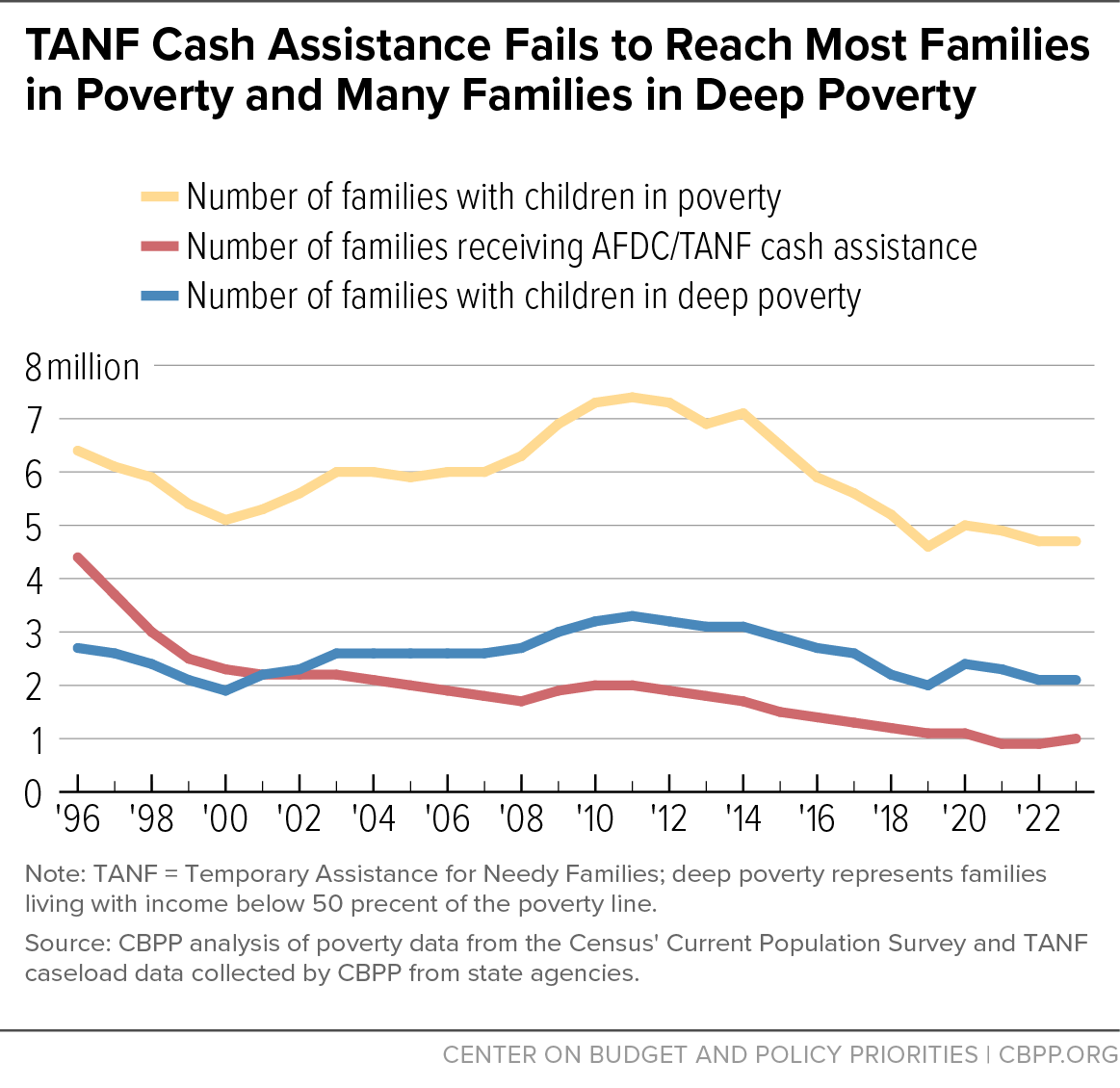
Since TANF’s creation, most states have used their flexibility to reduce the accessibility and adequacy of cash assistance dramatically (see chart). In some states, primarily in the South where Black children are likelier to live, TANF cash assistance has all but disappeared, and many parents who don’t have secure employment can’t access cash assistance to help them meet their basic needs.

Although TANF’s model is not successful in moving families to economic stability, Republicans adopted some of its approach in the harmful 2025 reconciliation law, expanding SNAP’s harsh work requirement and introducing a work requirement for Medicaid.
The stricter work requirement in SNAP would take away food assistance from 2.4 million people “in an average month over the 2025-2034 period,” the Congressional Budget Office (CBO) estimated. CBO assumed that this provision would begin to take effect in fiscal year 2026, when about 75 percent of the full annual impact would occur, meaning about 1.8 million people would be cut from SNAP in an average month in 2026.
Meanwhile, most states are preparing to implement the Medicaid work requirement without enough time and haphazard guidance from federal regulators. Seven million or more people could have their health coverage through Medicaid taken away due to the work requirement.
Evidence from a number of rigorous evaluations shows us that conditioning assistance that people need to afford their basic needs on work doesn’t alleviate poverty or promote stable employment.
Federal leaders should learn the lesson of 30 years of TANF and invest more in economic support for people with the lowest incomes. First, Congress must undo the harm of the Republican reconciliation law, which is taking SNAP and Medicaid away from millions of people and making it harder for them to afford their basic needs. Then lawmakers should look at ending TANF’s punitive policies, which push people deeper into hardship, and requiring states to invest more TANF resources into direct cash assistance to help families with the lowest income better afford the growing cost of living.