BEYOND THE NUMBERS
Congress Should Stanch SNAP Participation Losses, Which Exceed CBO’s Estimates
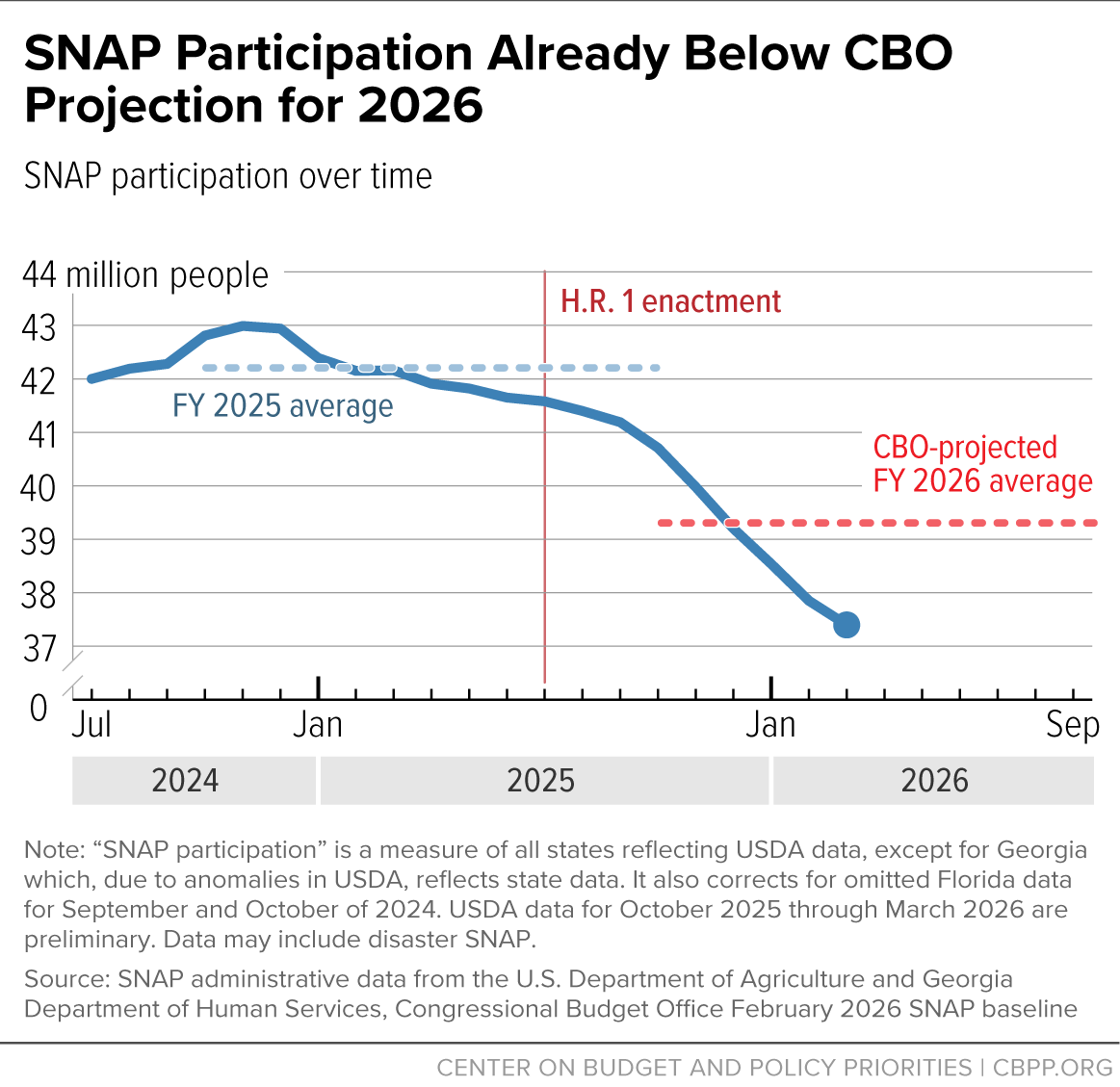
Millions of people are losing food assistance through SNAP due to the 2025 reconciliation law (H.R. 1). This includes many children and others not targeted by H.R. 1’s eligibility restrictions. In fact, more people are losing SNAP, and faster, than the Congressional Budget Office (CBO) predicted. The latest data show that about 4.7 million fewer people participated in SNAP in March 2026 compared to the average month in fiscal year 2025. This single-month number is already far greater than CBO’s prediction of about 3 million fewer people in an average month in 2026 versus 2025.
In other words, with half of fiscal year 2026 left and downward trends likely to continue, the gap between CBO’s estimates and actual SNAP losses will likely grow. (See chart.)
The most likely reason is the impact of H.R. 1’s shifting of enormous new SNAP costs to states, which they owe starting in fiscal year 2028. CBO estimated the cost shift mandate would have no impact until 2028, but it has already led many states to erect barriers to people’s SNAP participation, such as requiring more paperwork and imposing other requirements that states often don’t have the staff to administer. H.R. 1 grants a few states a two-year delay for this harmful cost shift; Congress should extend it to all states now, especially given SNAP losses outpacing predictions and people’s ongoing struggles affording groceries and other basics.

In its most recent February 2026 baseline, CBO projected that 39.3 million people would participate in SNAP in an average month of 2026, compared to about 42 million in 2025. But just 37.4 million people participated in SNAP in March 2026, already about 4.7 million below last year’s average, according to the most recent data from the U.S. Department of Agriculture (USDA). (These calculations reflect state data for Georgia due to anomalies in USDA data for that state.)
For the 2026 year-end average to equal CBO’s forecast, SNAP participation would have to increase for the second half of the fiscal year. But H.R. 1’s eligibility cuts are phasing in, and continued participation declines are evident nearly across the board in preliminary April and May data from states that have reported so far (more than half of them have).
SNAP spending is also substantially lower than CBO’s forecast. CBO’s most recent baseline assumes a 6 percent drop in SNAP spending between fiscal years 2025 and 2026. As of May 2026, SNAP spending for the fiscal year is already 9 percent lower than it was in May 2025.
The outsized drops, much larger than CBO assumed, suggest that people not ostensibly targeted by H.R. 1’s eligibility restrictions are losing SNAP anyway. That includes many children, seniors, and people with disabilities, yet another reason for Congress to delay the cost shift.
At the time of H.R. 1’s enactment CBPP explained that, based on CBO’s estimate, once the law had fully taken effect about 4 million people would be cut from SNAP entirely or lose a substantial amount of their benefits. Now, with just eight months of USDA data since the bill’s enactment, more than 4 million fewer people receive any SNAP. That figure does not include people whose benefits are lower as a result of the new law. And, more losses are almost certain as the law continues to phase in.
That the losses are coming faster than CBO predicted is likely in large part because CBO’s original H.R. 1 estimates did not factor in any effects of the state cost shift mandate until 2028. This is when the law requires states will to start paying for a share of SNAP benefits — 5 to 15 percent of them, potentially hundreds of millions of dollars for many states and roughly $9 billion across all states — based on their error rates for fiscal year 2025 (which just came out) and 2026. In its analysis of H.R. 1, CBO estimated that states would collectively reduce or eliminate SNAP benefits for about 300,000 people in an average month over the 2028-2034 period, which essentially assumes that no impact from the cost shift mandate would occur until states need to start paying the required share. To be sure, exactly what actions states would take was harder for CBO to anticipate, compared to other reconciliation law changes that reduced eligibility or benefit levels but left the structure of the program unchanged. But as we’ve warned, the cost shift threatened harms that were both greater and more immediate than CBO estimated. With states’ 2025-2026 error rates being the basis for what they owe starting in 2028, states are incentivized to reduce error rates quickly, even at the cost of delaying or improperly denying benefits to eligible families — which isn’t counted as a payment error.
When states attempt to reduce errors by requiring substantially more paperwork, shortening certification periods, or adding more case reviews, they make the program more onerous to administer and more difficult for applicants to navigate. Especially in states where administrative capacity was already strained, this is causing delays in application processing, procedural denials, and other bureaucratic obstacles that are restricting access to SNAP. The impacts of those actions are felt across all types of SNAP households and may disproportionately affect seniors, people with disabilities, and working families, who may struggle to wait on hold for hours when calls go unanswered or to travel to a social services office during business hours for help with their paperwork.
And this all comes at a time when the economy’s prognosis is mixed at best. Real wages, for example, have been declining since February and the unemployment rate has been flat since July 2025. In other words, it’s not likely the massive declines in SNAP participation are due to improving household finances and reduced need for help affording groceries.
Meanwhile, it’s likely that two other eligibility restrictions are only partially responsible for the decline in SNAP participation thus far, and are not being fully felt yet. CBO’s cost estimate narrative for H.R. 1 predicted that together, these provisions will cause an average of 2.5 to 3 million people to lose SNAP eligibility altogether over the 2026-2034 budget window (and an average of fewer than 2 million people losing SNAP in 2026).
- Taking SNAP away for not meeting a work requirement. H.R. 1 dramatically expanded SNAP’s already harsh and ineffective work requirement, by extending it to older adults up to age 65 and to parents and other caregivers of children 14 and older. It also substantially narrowed states’ ability to waive the time limit for areas with few job opportunities and eliminated exemptions for veterans, people experiencing homelessness, and former foster youth. Research consistently shows the work requirement cuts many people off SNAP without increasing employment or earnings. CBO estimated this stricter work requirement would account for the greatest of the law’s cuts to SNAP participation: 2.4 million people on average over the 2025-2034 period. CBO assumed that this provision would begin to take effect in fiscal year 2026, when about 75 percent of the full annual impact would occur, meaning about 1.8 million people would be cut from SNAP in an average month in 2026.
- Cutting eligibility for people who are immigrants. CBO estimated about 90,000 people would be cut from SNAP from the provision that denies SNAP to many people who are immigrants living lawfully in the U.S., having been granted humanitarian protections. There is emerging evidence that additional immigrants and their citizen family members have lost SNAP because of confusion over the rules and the climate of fear the Trump Administration has stoked around human services programs available to immigrants. But CBO did not assume such individuals would be cut from SNAP, and this likely represents a relatively small share of the decline in caseloads given that immigrants and citizens in mixed-status families represent a relatively small share of SNAP participants.
All told, SNAP losses will continue to mount due to the reconciliation law — including among people not targeted by the law, and in magnitudes CBO didn’t predict. At minimum Congress should delay the provision likely most responsible for early, outsized losses: the harmful state cost shift.