BEYOND THE NUMBERS
A Lesson from Louisiana: “Tough-on-Crime” Policies Are Costly and Unnecessary, Divert Funding Away From Education
Everyone wants to live in safe, thriving communities where people have the resources and opportunities they need to succeed. But Louisiana’s recent turn toward punitive and expensive criminal justice policies is pushing the state in the opposite direction, at a time when many states are facing intensifying budget pressures due to federal cuts and stagnant state revenue growth. Just two years after Louisiana lawmakers enacted a slate of misguided “tough‑on‑crime” measures, the consequences are unfolding exactly as expected: while there has been no clear evidence that these policies have improved public safety, prison populations have increased, and lawmakers are now planning extensive cuts to important public investments, such as education, to make up for growing corrections costs.
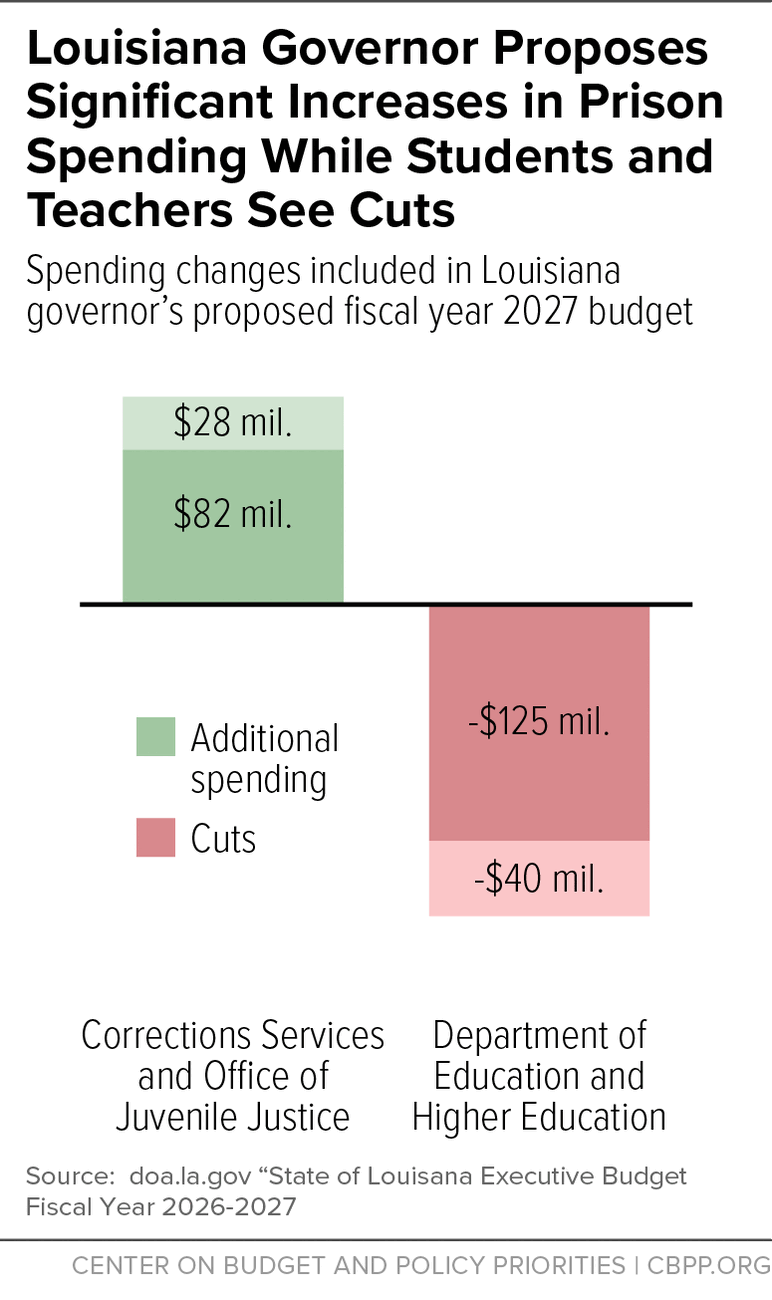
Earlier this year, Governor Jeff Landry unveiled his proposed fiscal year 2027 budget for the state. While other areas of the budget saw cuts or were flat funded, the governor’s proposal included an 11 percent increase (an $82 million boost) in funding for the state’s Department of Public Safety and Corrections (DPSC) and a 15 percent increase for youth detention funding (a nearly $30 million jump). The increase in funding for state prisons and youth incarceration is almost as much as what the state spends annually on the Secretary of State’s office, which manages Louisiana’s elections. House lawmakers in the state passed their version of the budget in mid-April with these increases essentially unchanged.
Both the DPSC secretary and the state’s chief budget administrator acknowledged that a portion of increased prison spending was attributable to the tough-on-crime bills passed in 2024 that lengthened prison terms, restricted parole, and expanded youth incarceration, leading to an increase in the state’s prison population. The number of people behind bars has increased by 7.4 percent since the end of 2023 — roughly 2,000 people — which follows a 6.5 percent increase from the two years prior. Under the proposal, the additional corrections funding will go towards:
- hiring roughly 150 new staff;
- overtime costs for existing personnel; and
- paying for the rapidly rising costs of medical supplies — a particular challenge as prison populations, including Louisiana’s, continue to skew older.
The tradeoffs would be stark — the increase in spending on prisons and youth incarceration would come at the expense of education. The governor’s budget is proposing to cut money for state colleges and universities and allow stipends for K-12 teachers to expire for the next school year, meaning teachers could see reductions in their pay starting in the fall.
Some might argue these tradeoffs are defensible to ensure public safety. But there is little evidence that “tough-on-crime policies” have had an impact on crime because Louisiana’s incarceration rates, and incarceration rates across the country, are already very high. Research has demonstrated that as incarceration rates rise, the public safety impact of incarcerating more people diminishes significantly. In fact, research indicates the likelihood of being caught, not the severity of the penalty — especially when penalties are already harsh — plays a larger role in a person’s decision to commit a crime.
Beyond this, while Louisiana lawmakers passed these punitive measures to fight crime, crime in Louisiana (and across the country) had already been on a steady, long-term decline. The reported violent crime rate in Louisiana has fallen by nearly half since the early 1990s. Nationally, certain crimes, such as murder and car theft, did increase briefly in 2020 and 2021 during the COVID-19 pandemic, but this was driven by pandemic-specific disruptions, and crime rates had reverted to pre-pandemic trends prior to the passage of Louisiana’s 2024 laws.
States should consider better alternatives to “tough-on-crime” policies that involve less punitive measures and do not take away resources from important investments like education. Over the past two decades, many states have enacted a broad range of reforms that have reduced the number of people in prison while experiencing declines in crime. States have revised mandatory minimum sentences, adjusted parole eligibility standards, expanded release opportunities for elderly inmates, and expanded access to good time/earned time credits. Between 2010 and 2019, the number of people locked up in state prisons fell by 10 percent while violent and property crime rates fell by 7 and 28 percent, respectively.
Louisiana’s current trajectory should serve as a cautionary tale: punitive policies are expensive, divert funding away from essential public services, and are not needed to experience reductions in crime. As states grapple with stagnant revenue projections and looming fiscal burdens driven by federal funding cuts to health care and food assistance, lawmakers across the country can and should instead pursue measures that will reduce corrections costs without sacrificing public safety.