

Tracking the Fallout From State Tax Cuts
States are in the midst of a years-long tax-cutting spree that is undermining funding for key community investments like schools, housing, child care, and infrastructure. More than half in recent years have slashed income taxes primarily for wealthy people and corporations, in some cases by extraordinary amounts. Many others have added further harm through a proliferation of property tax cuts and caps and costly new school voucher programs.
And much of that was underway before President Trump and congressional Republicans enacted the harmful federal megabill in July 2025. That law paired enormous tax breaks for wealthy households and corporations with historically deep cuts that will take away people’s vital health care and food assistance, all while foisting considerable new costs and responsibilities onto states and localities that will intensify their budget pressures.
This resource, Tracking the Fallout of State Tax Cuts, covers the story as it unfolds and traces the impact of these decisions on critical goals like enhancing economic opportunity, advancing racial equity, and protecting democracy.
It features:
- stories about cuts to public services and disinvestment stemming from revenue losses;
- case studies on states that should serve as a warning to others; and
- analysis of tax cut trends.
Stay informed on the latest state tax developments. By signing up for email updates, you will be notified when we post new entries that analyze the latest news out of statehouses, track emerging policy trends, and explain how they impact people and communities. You can unsubscribe at any time.
While Arkansans Struggle to Access Health Care, State Leaders Insist on More Tax Cuts for the Wealthy
August 24 — In May, Arkansas Governor Sarah Huckabee Sanders signed the state’s fourth income tax cut in four years, continuing a march toward her stated goal of complete elimination of Arkansas’s income tax.
The legislation cuts the personal income tax from 3.9 percent to 3.7 percent and the corporate tax rate from 4.3 percent to 4.1 percent, at an estimated cost of $192 million in lost revenue next year and about $145 million lost each year after. This is on top of more than a decade of prior income tax cutting, which is now costing Arkansas more than $2 billion each year, or roughly what the state spends on Medicaid.
The new cuts deliver most of their benefits to Arkansas’s top earners. Households with incomes in the bottom 80 percent can expect an average annual tax cut of only $71 or less, compared to $2,729 for those with incomes in the top 1 percent.
But resulting revenue losses from the cuts promise significant risk to the public schools, health care, and infrastructure that Arkansas families count on. Working families are already grappling with rising prices and cuts to health care and food assistance from the harmful 2025 Republican reconciliation law; the new tax cut will do little to nothing to help.
At the same time, all states, including Arkansas, are scrambling to find reliable revenue sources to help mitigate the disastrous funding cuts and revenue losses stemming from the Republican reconciliation law. If Arkansas fails to pursue a sound revenue approach, everyday residents will feel the harm from essential services that are scaled back or cut.
One clear example is Arkansans’ access to health care, especially in rural communities. Over the past several months, hospitals from central to western Arkansas have dramatically reduced services, especially for labor and delivery, because of low reimbursement rates. This loss of medical care will be compounded by the steep cuts to Medicaid in the 2025 reconciliation law, which are already starting to wreak early signs of havoc in several states. And now, Arkansas’s Medicaid expansion program itself appears to be in serious jeopardy, due to a recent decision by the Trump Administration that is sending shockwaves across the state.
In such a precarious situation, what communities need is more funding for education, food assistance, and health care — not top-heavy tax cuts that will make Arkansas’s wealthiest people even richer.
States:
Oklahoma Faces a Child Care Crisis Made Worse by Income Tax Cuts
Oklahoma is staring down a child care crisis as more than 400 child care centers, such as Kids of Faith and Integris Health in Oklahoma City, have closed since November 2025. With the expiration of federal pandemic-era aid that enabled many providers to stay open and a long history of paltry state investment in affordable child care, the number of available providers in Oklahoma — as in many states — has begun to fall sharply from its post-pandemic high, and even those managing to stay open are struggling to survive.
Late last year, the agency administering the program requested about $70 million in the upcoming state budget to help stem the crisis, but that appeal appears to have been ignored. Although the agency then cut its request by $50 million, lawmakers went even further in the state’s final budget, only investing about $12 million in child care overall. That choice cements the financial strain on providers, leaving families with fewer and more expensive child care options.
At the same time, Oklahoma’s leaders keep showing where their fiscal priorities truly lie. In May 2025, Governor Kevin Stitt signed a bill significantly reducing the state’s personal income tax rate, at an estimated annual cost of $397 million in lost revenue. The bill also includes triggers that will further cut or even eliminate the income tax if certain revenue requirements are met in the future. If the triggered tax cuts are fully phased in, the state could lose nearly $6 billion annually in revenue. This new tax cut follows years of costly, regressive tax-cutting that had already put Oklahoma on an unsustainable trajectory.
Oklahoma needs investments in child care programs that will ease the burden on families rather than irresponsible tax cuts that will only benefit the wealthiest Oklahomans and leave working families behind. To maintain crucial child care support along with other vital services Oklahomans count on, the state should consider revenue-generating sources to fill this funding gap, as many other states chose to do this year.
States:
Georgia Cuts Medicaid, School Buses, and Domestic Violence Shelters to Fund Growing Cost of Tax Cuts
In May, Georgia Governor Brian Kemp signed a bill that cut the state’s flat income tax rate from 5.19 percent to 4.99 percent, scheduled additional rate cuts in the future, increased the standard deduction, and exempted some income from overtime and tips. The new law creates a $1.2 billion revenue shortfall and is expected to cost more than $6 billion annually once fully implemented. Rather than continuing on a path of deep tax cuts that primarily benefit wealthy households and corporations, Georgia lawmakers could have used the revenue to provide better health care, quality education, and safety for communities.
To partially make up for the lost revenue and balance the state budget, Governor Kemp vetoed and disregarded $344 million in public spending. He said, “The General Assembly failed to account for this loss of revenue in the appropriations process, instead prioritizing general taxpayer relief.”
Simply put, Governor Kemp said the quiet part out loud: he acknowledged that to pay for these expensive and skewed tax cuts, lawmakers are ready and willing to sacrifice key services that Georgians depend on. That tradeoff has been a recurring theme among anti-tax policymakers in numerous states in the past few years.
Here are some of the specific investments Governor Kemp removed in favor of tax cuts:
- $48 million in new Medicaid reimbursement rate increases to support providers and facilities, including primary care, dental care, and psychiatric residential treatment.
- $30.7 million for additional school transportation and support for bus operations.
- $9.4 million in funding for domestic violence shelters and $3.3 million for sexual assault centers.
Deeper spending cuts are inevitable as the new tax cut law will continue to reduce the state’s personal income tax by one-eighth of a percentage point each year for eight years if certain revenue triggers are hit. These cuts to the tax rate will further skew Georgia’s upside-down tax code to benefit the wealthy and provide only minimal gain for everyday Georgians. Middle-income households in Georgia will see an average tax cut of just $119 in the first full year of the plan, compared to $3,411 for the state’s highest-income 1 percent.
Georgia had an opportunity to deliver for communities who are currently dealing with rising prices and loss of medical care and food assistance due to the fallout from last July’s Republican reconciliation law. But instead, the new Georgia law will deliver more tax cuts to the top 1 percent and wealthy corporations than to the first 60 percent of Georgia households combined – while further jeopardizing the public investments that allow everyday Georgians to have the best chance to succeed.
States:
Some States Continue Down Tax Cut Path, Compounding Harms of Republican Megabill
West Virginia Gov. Patrick Morrisey recently cited an $11 million cost when vetoing a program that would have helped youth transitioning out of foster care to live independently, find work, and enroll in higher education. Yet Morrisey also just greenlit $230 million in annual costs — with outsized benefits going to wealthier people and corporations — by signing a 5 percent reduction to the state’s personal income tax and by linking the state’s tax code to expanded federal tax cuts.
West Virginia is just one of many states wrestling with the budgetary fallout from the harmful Republican megabill. That law shifted more responsibilities and costs to states and cut federal funding for essentials like Medicaid health coverage and SNAP’s grocery benefits for millions of people from coast to coast.
These budgetary pressures and dramatic benefit cuts pose significant harm for people in every state. States can minimize the impacts by implementing revenue-raising policies to partially offset the federal funding cuts to health care and food assistance, while protecting funding for quality public schools, safe infrastructure, and other essential services.
But in West Virginia and elsewhere, some lawmakers are instead doubling down on a recent wave of income tax cuts, even if it means billions in lost revenue and even less ability to invest in people and communities:
- Georgia. In April the state legislature passed a law accelerating a planned income tax cut, which will benefit wealthiest Georgians the most at an enormous cost to everyday people struggling to get by. If fully implemented, the measure would eliminate about one-third of Georgia’s income tax by 2034, reducing state revenues by more than $6.5 billion each year.
- Missouri. State lawmakers recently approved a constitutional amendment that would put the state on a path to eliminating its income tax entirely — paid for in part by raising sales taxes — which would likely cost billions in lost revenue while also raising taxes on many lower- to middle-income people. The measure will now go before Missouri voters later this year.
- South Carolina. In March, lawmakers approved legislation that could eliminate the state’s individual income tax over time, with short- and long-term benefits enormously weighted toward the wealthy. This will reduce revenue in South Carolina by $309 million this year, while full income tax elimination would cost over $6.6 billion a year if fully implemented — nearly 45 percent of the current state general fund.
Rather than continuing these regressive and harmful tax cuts, states should prioritize policies that offer relief to people facing harm due to the unpopular Republican megabill (and in many cases, to recent harmful state policy choices, as well).
Ideally, more states would choose the path of raising new revenues from those most able to pay — as Washington State and Maine recently approved and others are also considering. We know from states’ recent experience that such policies can help residents from all backgrounds better access economic opportunities and achieve a higher quality of life.
But at the very least, states should reconsider wasteful tax cuts that mostly help those who don’t need it. For example, Hawai’i lawmakers this year appear likely to reclaim some lost revenue by partially trimming an enormous tax cut approved two years ago, and North Carolina may revisit some prior tax cuts, too. And in Louisiana, state legislators recently chose to forgo any additional cuts without at least reviewing prior ones.
States:
Kentucky District Weighs Payroll Loan as State Aid Shrinks and Tax Cuts Tighten Budgets
Kentucky’s Woodford County Public Schools, which serves middle-income families in rural communities outside of Lexington, may need a short-term state loan to make payroll before its November property tax distribution arrives — a red flag for broader school finance instability in a state that has cut revenue sources for schools three times in the last four years.
Schools in Kentucky, as in most states, are supported by both state and local revenue sources. But state support for schools never recovered from the Great Recession, falling by 24 percent since 2008, adjusting for inflation, leading districts to rely more heavily on local property tax revenue with inequitable consequences for students and communities.
Woodford ended FY 2025 with $5.1 million on hand, but officials warn it may not cover payroll and bills until the expected $20 million property tax payment comes. As Woodford Chief Financial Officer Shane Smith told the school board, the district could “get to a point where we don’t have enough cash in the bank to cover the payroll outflow,” leading to instability for teachers and administrators and the students they support.
The funding crunch is not unique to Woodford. Kentucky’s SEEK formula (Support Education Excellence in Kentucky) reduces state aid as local property values rise, leaving districts to backfill with local property taxes. Woodford projects over $3.1 million in SEEK losses from 2022 to 2026, while inflation in salaries, transportation, utilities, and materials keeps pushing costs up. Funding instability in Woodford does not bode well for poorer districts across the state: about 50 percent of students in Woodford live in poverty compared to 60 percent across the state, and the district boasts the 9th highest property value per student in the state. In the face of declining state investment, districts with fewer local resources could fail to meet the needs of all students.
In neighboring Fayette County (Lexington), the school board voted to raise its occupational tax from 0.5 percent to 0.75 percent to fill a $16 million budget hole but was forced to pull the increase after the attorney general said the vote lacked proper notice — underscoring how fragile and contested local funding solutions can be.
Layered on top of this are Kentucky’s ongoing personal income tax rate cuts, which lawmakers can continue when certain revenue conditions are met. These cuts shrink the General Fund that funds SEEK and other core services, leaving schools increasingly dependent on property taxes and short-term fixes. The result is growing inequity between communities with different tax bases: the funding gap between low- and high-poverty school districts has increased by almost 14 percent to $4,247 since 1990. To illustrate the inequities produced by increased reliance on property tax revenue for school funding, consider two counties serving similar numbers of students with different property values: a one-cent increase in taxes levied per $100 of property would have resulted in about three times as much revenue raised in Bourbon County outside Lexington as in Bell County in rural Appalachia in 2022. And districts like Woodford may turn to borrowing just to make payroll — a stark signal that the state’s tax cut-driven revenue policies are leaving classrooms, staff, and students in increasingly precarious territory.
Statewide, experts note that Kentucky’s education funding remains both inadequate and inequitable, with long-standing gaps among districts. Repeated income tax reductions, including the most recent cuts, further shrink state revenues, intensifying pressure on districts to rely on property taxes or short-term borrowing. Experts warn that without restoring state aid, the fiscal strain could force more districts into precarious cash-flow situations, widen disparities, and prevent critical investments in supports for students.
States:
Wyoming Passes 25% Property Tax Cut for Homeowners — Without Replacing Lost Revenue for Local Services
Wyoming lawmakers enacted a sweeping 25 percent property tax cut this year for homes valued up to $1 million. But the legislation passed without any plan to replace the critical funding it will strip from public safety, K-12 education, higher education, libraries, and essential local services like road maintenance and legal services.
Despite warnings from some lawmakers and local officials about the fiscal cliff the bill creates, SF 69 moved forward after backfill provisions were removed — which would have made up for the lost local revenue at the state level — to ensure the governor’s support. Gov. Mark Gordon previously vetoed a similar bill that included backfill.
Sen. Ogden Driskill, R-Devils Tower, was among the few to sound the alarm: “We’re about to lose our only ambulance service,” he said of Crook County. “We’re going to lose part of our firefighting.”
Sen. Larry Hicks, R-Baggs, blasted the legislation for prioritizing a headline-making cut over sustainable local governance, describing the final deal as “fertilizer.”
The tax cuts come as Wyoming communities face growing needs — aging infrastructure, volunteer-run emergency response, rising costs, and shrinking resources. Yet the state has now locked in a permanent 25 percent reduction in its largest local revenue source — property taxes — without new tools for counties or municipalities to fill the gap. As a result, local officials are having to cut their budgets by up to 23 percent, and the state is now facing a $686 million school funding deficit by 2030.
Adding to the pressure, lawmakers also passed a universal school voucher program this session, diverting millions of public dollars to private schools — with no income limits for K–12 families and limited accountability for how the vouchers are spent.
SF 69 is part of a broader national trend: state legislatures pushing aggressive tax cuts without corresponding plans to sustain vital public services. In Wyoming’s case, lawmakers opted for a short-term win over long-term stability — leaving local governments to do more with far less.
States:
Iowa to Use Over $900M in Reserves to Cover Tax-Cut Fallout
Iowa lawmakers have approved a new state budget that lays bare the growing cost of the state’s tax-cut agenda: to balance the books, they’re now planning to use over $900 million in state reserves to cover declining revenue. The gap is largely due to major personal and corporate income tax cuts enacted in recent years — with more reductions still phasing in.
Gov. Kim Reynolds and legislative leaders touted the $9.4 billion budget as balanced and responsible, but beneath that label is a troubling and unsustainable pattern: using one-time cash to fund ongoing expenses.
While Republicans insist that the state’s $6 billion in savings will cover temporary shortfalls until revenues grow, that optimism is built on shaky assumptions. The long-term cost of Iowa’s flat tax and other reductions is expected to reach over $2 billion annually, threatening the state’s ability to meet future budget needs without deep cuts to essential services.
The budget maneuvering comes at a time when Iowa has already dropped below the national average in education investment and faced scrutiny for underfunding state services, including health care and infrastructure.
By using reserves to backfill lost revenue — rather than reversing course on tax cuts — Iowa is pushing the hard decisions further down the road. And when the reserve funds run out, the pressure to cut services, raise other taxes, or borrow will only grow.
Let Iowa’s case serve as a warning: when states commit to permanent tax cuts without sustainable revenue plans, even the largest cash reserves won’t last forever.
States:
Missouri Poised to Enact Appalling Giveaway to its Richest Residents
Missouri legislators in May approved an alarming tax policy change: eliminating the state income tax on capital gains, a first-of-its-kind move that will deliver enormous gains to wealthy households and little to no benefit for almost everyone else. Widely expected to be signed by the governor in the next two weeks, the change is part of a broader pattern of tax reductions over the past decade that have weakened the state's ability to fund essential services that all Missourians count on.
The capital gains cut will completely exempt all income from stocks, bonds, cryptocurrency, real estate, and other investments from Missouri state taxes — something that no state with an income tax currently does. The vast majority of this benefit will go to the wealthiest Missourians, who are far more likely to earn significant capital gains. The state’s highest-income 5 percent will receive an estimated 80 percent of the tax cut, while the state’s richest 1 percent will reap about two-thirds of it.
Meanwhile, the top-heavy policy will likely spell serious trouble for Missouri’s ability to fund key services, especially now that significant federal budget cuts are likely on the way as well. The exemption could reduce state revenues by around $600 million each year, according to the Institute on Taxation and Economic Policy, roughly equal to the cost of funding 11,000 public school teachers’ salaries. That comes on top of a series of tax reductions in recent years that have already impacted Missouri's fiscal health. The Missouri Budget Project notes that when fully implemented, prior tax cuts will reduce state general revenue by $3 billion annually — more than the amount the state sends via formula to local public schools.
As state revenues show continued signs of strain nationwide and a torrent of harmful federal budget cuts for health care, food assistance, and other essential needs now looming over state finances nationwide, the recent capital gains giveaway raises serious concern about Missouri's futures. State policymakers there should reverse the reckless and regressive cuts as soon as possible, and shift course toward an approach that prioritizes education, health care, infrastructure, and stable revenues for all Missourians over tax cuts for the rich.
States:
Idaho Swaps Support for Public School Families for Private School Vouchers
Idaho lawmakers have dismantled a widely used grant program that supported public school families — just weeks after creating a $50 million school voucher program for private school tuition and related expenses. The change reflects a deeper trend in states’ priorities: public funds increasingly flowing toward private education, while support for public school students stagnates or shrinks.
The now-defunct Empowering Parents grant program offered families up to $1,000 per child ($3,000 per household) to pay for education-related items like laptops, tutoring, internet, and school supplies. While the program wasn’t a solution to Idaho’s lack of public school funding, at least 81 percent of the program’s funds went to public school students this year, supporting more than 24,000 kids — many from low-income, rural communities.
And while the funding for Empowering Parents could have been distributed more equitably by investing it directly in technology and tutoring at public schools, eliminating prohibitive application processes, this stop-gap program provided important resources to students:
- A fifth grader in Nampa School District received her first laptop, finally able to do homework at home.
- A student in southern Idaho raised her math grade from a D to a B+ with paid tutoring.
- In rural districts, the grants covered basic needs like backpacks and laptops.
That program is now gone. In its place is a new tax credit voucher, $5,000 that private-school families can use on any number of things with little oversight. Unlike Empowering Parents, the new tax credit voucher is off-limits to public school students, and accountability is minimal — families must only prove how they used the money if audited.
State lawmakers funneled a total of $50 million into private school vouchers and shortchanged 94 percent of students who attend Idaho public schools. All the while, Idaho comes in dead last for per-pupil funding out of all 50 states and the District of Columbia, spending one-third less than the national average. This failure to invest in the state’s future has resulted in inadequate education for many Idaho students, including subjecting them to abysmal learning environments like freezing classrooms and leaky, soggy ceilings at risk of collapse. The portion of Idaho’s gross state product that goes toward K-12 funding, or its “effort,” has fallen by 25 percent since 2006, suggesting that the state has the capacity to increase investments in the public schools that most students attend, if lawmakers choose to.
The Idaho Freedom Foundation, a vocal backer of the school voucher program, openly proposed shifting the $30 million from Empowering Parents to expand the private school voucher — suggesting public education dollars be used to subsidize 6,000 more non-public students.
The repeal of Empowering Parents creates a stark double standard: public school families who relied on modest grants for essentials like internet or calculators are now told there’s no money for them, while families already in private schools may claim thousands in state-funded school vouchers.
This shift reflects a growing national trend: school voucher policies that steadily divert public funds into private, less accountable alternatives. The long-term risk isn’t just fiscal — it’s the erosion of equitable, inclusive support for the 94 percent of students who attend Idaho’s public schools.
States:
Nebraska’s Surplus Turns to Shortfall After Tax Cuts and One-Time Windfall Fades
Just two years ago, Nebraska lawmakers entered the 2023 session with a record $1.9 billion budget surplus — equal to nearly 17 percent of this year’s total budget. Today, that surplus has vanished, leaving lawmakers scrambling to close a $432 million budget shortfall. And with future deficits already projected, the state’s long-term fiscal outlook is dimming fast.
What caused the swing from abundance to scarcity? In large part, it’s a case of lawmakers using temporary federal aid as a vehicle to shortsightedly justify permanent tax cuts. The surplus was driven by one-time federal pandemic relief funds, not recurring growth. But in 2023, lawmakers used that windfall to pass LB 754, a sweeping tax package that lowers both personal and corporate income tax rates to 3.99 percent by 2027. They also passed LB 243, which expanded property tax credits and took funding away from public schools.
Supporters claimed the cuts would jumpstart the economy, but the boom hasn’t materialized. Instead, Nebraska has faced slowing revenues and rising costs. And while federal Medicaid match rate (FMAP) reductions have been blamed for the shortfall, those changes were anticipated and reflect a stronger state economy — not a sudden drop in federal support.
To avoid immediate agency cuts this year, lawmakers resorted to flat budgets for most state agencies and raided $150 million from cash funds, including the rainy day fund. These one-time fixes paper over the deeper problems of declining revenues and rising costs without addressing growing structural imbalances.
Meanwhile, the Legislature declined to consider LB 171, which would have paused the next phase of income tax cuts. That decision could prove costly, as more revenue reductions are set to phase in, even as the state braces for additional shortfalls in the next budget cycle.
Nebraska’s experience is a case study in fiscal whiplash: a temporary surplus misused to justify permanent tax cuts with long-term negative consequences for the public services Nebraskans rely on. As the federal funds fade and revenue growth slows, policymakers may soon face painful choices — cutting essential programs, draining reserves further, or shifting costs to local governments and families.
The lesson for other states is clear: when one-time money is used to fund permanent tax cuts, the math doesn’t hold — and the bill eventually comes due.
States:
Backing Vouchers and Tax Cuts, Texas Lawmakers Fuel a Perfect Storm of Underfunding
Texas is hurtling toward fiscal instability, driven by a sweeping school voucher program and lawmakers’ support of massive, untargeted property tax cuts — both funded by fleeting budget surpluses.
At the same time, public schools serving the vast majority of Texas students remain drastically underfunded, and the state has no income tax to stabilize revenues when they fall. These decisions risk locking in structural imbalances that will be difficult — and painful — to undo.
School vouchers divert public dollars as public schools struggle
Against the public’s wishes and after years of failed attempts, Texas Gov. Greg Abbott signed into law a universal school voucher bill that will drain public funds from public schools to subsidize private school tuition. The new law appropriates $1 billion for the program’s first two years; it’s projected to cost $7 billion in its second two years. That price tag is nearly equivalent to what the state would have needed this year to provide the same level of basic education funding students received in 2019 when accounting for inflation.
Most voucher funding is expected to go to families already enrolled in private schools, and the program excludes students without a documented immigration status. That’s even though the U.S. Supreme Court ruled that all students, regardless of immigration status, must be able to attend public schools without cost.
Even as 88 percent of Texas students attend schools that are underfunded to meet national average test scores, lawmakers passed only a modest increase to the state’s basic funding formula that falls far short of keeping up with inflation.
Property tax giveaways now rival the state’s largest budget priorities
Meanwhile, lawmakers are doubling down on property tax cuts. Cuts already on the books are costing Texas $44.5 billion in this biennium, and lawmakers have proposed giving away another $6.5 billion this session.
The scale of these cuts is staggering. If property tax cuts were their own agency, it would be the third-largest in the state budget — more than double what Texas spends on public safety and criminal justice combined, more than the entire two-year operating budget of the Texas A&M University System, and enough to build a high-speed rail line from Dallas to Houston, according to the Texas Tribune.
Taken together, vouchers and property tax cuts are creating mounting strain in Texas: a deeply underfunded public school system, ballooning voucher and tax cut costs, reliance on temporary surpluses, and no income tax to fall back on when revenues decline.
With state surpluses expected to dwindle and federal funding at risk, these costly, untargeted tax breaks will be difficult to sustain. When the surpluses dry up, Texas could face devastating cuts to education and local services.
Instead of locking in billions for tax cuts that benefit wealthy homeowners and businesses and paying private school tuition while underfunding public schools, lawmakers could make meaningful, cost-effective investments in Texans’ well-being. These investments include a meaningful boost in the K-12 funding formula, rebates for renters, property-tax circuit breakers, or enacting a state Earned Income Tax Credit.
States:
Mississippi Moves to Eliminate Income Tax, Deepening Inequality and Threatening Public Services
Mississippi policymakers have taken one of the most extreme steps in state tax policy in recent years: enacting a law that will gradually phase out the state’s personal income tax. Signed by Gov. Tate Reeves in March, the move begins the final stage of a years-long push to dismantle a key pillar of the state’s tax system, which has long helped fund education, health care, infrastructure, and other core services.
This new law follows deep income tax cuts passed in 2022. Once fully implemented, repeal will cost the state roughly one-third of its entire general fund budget. That shortfall will put enormous strain on essential services in the poorest state in the nation — leading to harms such as fewer teachers in classrooms, longer wait times for health care, and deferred repairs to already crumbling infrastructure.
This large, regressive tax cut will also exacerbate income inequality in a state where opportunity already varies widely by race and geography. The highest-income 5 percent of Mississippians will receive nearly 40 percent of the tax cut, according to the Institute on Taxation and Economic Policy, while most families with low or middle incomes will see only minimal reductions. The highest-income 1 percent are expected to get annual tax breaks of nearly $42,000, equivalent to the average starting salary of a new teacher.
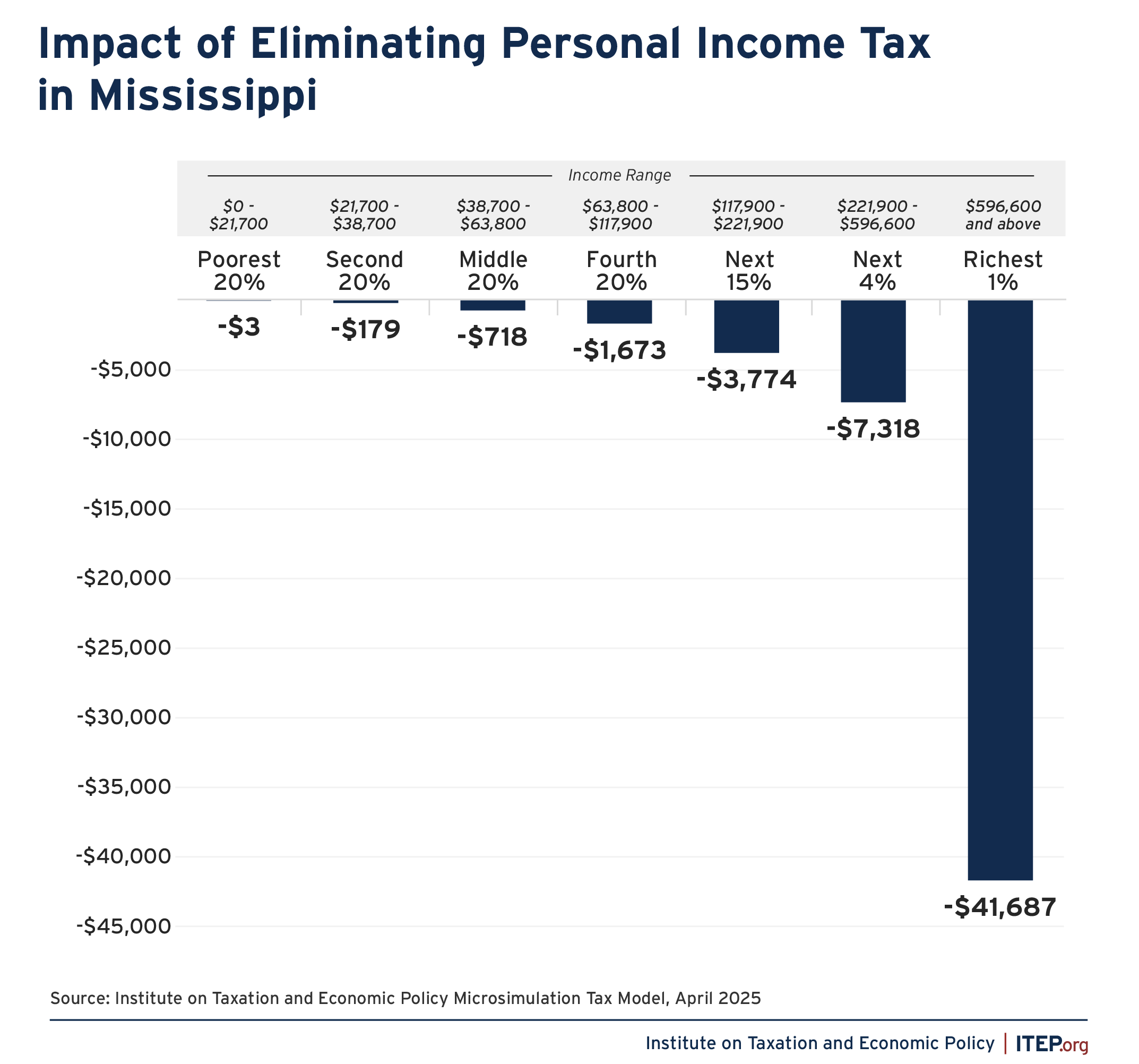
The state’s credit outlook was already downgraded after previous tax cuts, and this latest move could further worsen its financial standing. As in other states, Mississippi lawmakers structured the cuts to phase in over many years, and the final cuts would depend on state revenues and spending meeting certain “triggers.” But this approach doesn’t make tax cuts more responsible; it just makes the harm someone else’s problem. Future revenues that could have helped maintain roads and bridges, reduce child poverty, invest in schools, or support public health initiatives are now off the table.
Mississippi’s income tax elimination reflects a broader trend of shortsighted and regressive state tax policy. But the fact remains that eliminating stable revenue sources doesn’t create prosperity — it undermines it.
States:
Colorado Lawmakers Considering Suit to Overturn TABOR
In a historic step forward for Colorado, a group of Democratic lawmakers introduced House Joint Resolution 1023 on March 31 calling for the legislature to file a lawsuit challenging the constitutionality of the Taxpayer’s Bill of Rights (TABOR), which for decades has severely restricted the state’s ability to raise revenue and manage public spending.
The proposal, sponsored by Reps. Sean Camacho and Lorena Garcia and Sens. Lindsey Daugherty and Iman Jodeh, seeks to determine whether TABOR, a provision of Colorado’s constitution, undermines the principles of representative democracy guaranteed by the U.S. Constitution.
TABOR: A Barrier to Effective Governance
TABOR, passed by voters in 1992, limits the annual growth in state and local spending and revenue to a rigid, arbitrary formula and mandates voter approval of all tax increases, among other restrictions. Over time, TABOR has proven to be a significant obstacle to Colorado’s growth, especially as the state’s population has risen significantly. TABOR’s harmful impacts include:
- Regressive tax system. By prohibiting a graduated income tax, TABOR forces Colorado to maintain a flat income tax. Because sales, excise, and property taxes in Colorado fall more heavily on people with lower incomes, this results in an overall state and local tax system where lower-income Coloradans pay a higher share of their income in taxes than wealthy residents. To make matters worse, fees — which generally don’t fall under the spending limits TABOR imposes — have increased significantly, further exacerbating wealth inequality.
- Chronic underfunding of essential services. TABOR’s revenue caps have left the state unable to adequately fund public services like education, health care, and transportation. Colorado’s K-12 education system alone is underfunded by $3.5 billion to $4.1 billion per year, leading to larger class sizes, underpaid teachers, and unmet student needs. Colorado’s public colleges and universities rely heavily on tuition for their funding, which makes them less affordable to residents. And Colorado’s public infrastructure has suffered due to diminished transportation budgets.
- Inflexibility during crises. The state’s inability to raise revenue or adjust taxes without voter approval has made it harder to respond to economic downturns and emergencies. During the Great Recession, essential services were slashed, leading to cuts in education and critical infrastructure projects.
Colorado Could Better Meet Residents’ Needs Without TABOR
Overturning TABOR would offer Colorado a more balanced and flexible approach to managing its budget and addressing the needs of all residents:
- Allowing a more adaptable and fairer revenue structure. Overturning TABOR would enable Colorado to adjust its revenue system without being constrained by a rigid formula. Colorado could enact tax policies that generate the funds necessary for public goods and services while ensuring wealthy Coloradans pay their share for shared prosperity across the state.
- Making it easier to fund critical services now and in the future. Without TABOR's restrictions, Colorado could more easily allocate funds for essential services like education, health care, and infrastructure, especially during times of economic downturns or budgetary challenges. Colorado would also have more flexibility to make informed, timely decisions on funding priorities, helping the state address the needs of its growing and diverse population.
- Simplifying fiscal decision-making. Overturning TABOR would reduce the state’s reliance on complex voter-approved measures and lengthy ballot processes, streamlining the budget process and allowing for quicker responses to fiscal needs.
By overturning TABOR, Colorado could free itself from the shackles of outdated fiscal policies and embrace a more sustainable, fair, and flexible approach to taxation and public investment.
States:
Iowa’s Property Tax Cuts Threaten Local Budgets and Essential Services
Iowa lawmakers are considering another round of property tax cuts that would primarily benefit wealthy homeowners while straining local budgets and essential services. The proposal would siphon revenue from the state’s general fund to “buy down” school property tax rates — an across-the-board measure that would disproportionately help owners of luxury homes and vacation properties rather than families struggling to afford their mortgages or renters. It would also cap annual local property tax increases at 2 percent, restricting their ability to fund critical services like public safety, emergency response, and road maintenance.
Local Governments Already Feeling the Squeeze
These proposed cuts come on the heels of previous tax reductions that have already forced local governments to reduce services and wiped out hundreds of millions in revenue. Last year, revenue fell in over 200 Iowa cities, even as costs for basic services soared.
- Fairfield had to withdraw $500,000 from its reserves to balance its budget.
- Des Moines faces a $17 million budget shortfall, with officials scrambling to fill the gap.
- Polk County has been forced to delay critical investments in public facilities.
Across the state, local governments are caught in a state-imposed revenue bind, forced to choose between cutting services, issuing more debt, or enacting franchise fees that could raise Iowans’ utility costs.
Officials Warn of Service Cuts
Local leaders are sounding the alarm about the potential fallout. Des Moines’ city manager warned that the 2 percent levy cap would force the city to dip into rainy day reserves, cut services, or even roll back pay raises for police, firefighters, and EMTs — who are already in short supply. Coralville’s city administrator echoed these concerns, noting that even without the proposed cuts, existing limits on property tax growth have failed to keep local budgets on pace with inflation.
With Iowa’s local governments already facing financial struggles, further property tax cuts and limits will only push them further underwater — forcing difficult choices that will directly impact communities statewide.
States:
Oklahoma’s Past Tax Cuts Are Hurting Services — and More Cuts Could Make It Worse
Years of income tax cuts in Oklahoma have already strained state services, and lawmakers are considering digging the hole even deeper. State lawmakers have filed at least 22 income tax cut bills so far this year, including several aimed at eliminating personal or corporate income taxes altogether. As budget pressures mount, the impact of past tax cuts is becoming more apparent, affecting everything from education to health care to public safety.
Damage Done: How Past Tax Cuts Are Straining the State
Oklahoma has repeatedly cut income taxes over the past two decades, reducing the top rate from 7 percent in 2004 to 4.75 percent today. These reductions have drained billions from the state budget, leading to underfunded schools, struggling hospitals, and neglected infrastructure. Today, Oklahoma ranks 45th in per-student K-12 funding and struggles with persistent teacher shortages. Meanwhile, major pieces of critical infrastructure including roads, parks, and university buildings are under increasing strain, with the state facing an estimated $25 billion backlog of deferred maintenance and unmet needs.
Even with rising costs, Gov. Kevin Stitt has instructed most state agencies to submit flat budget requests this year, meaning no additional funding to keep up with inflation, population growth, or higher service needs. As a result, public programs will struggle to keep up, and communities across Oklahoma will feel the effects.
What’s Next? A Looming Budget Crisis
Now, Gov. Stitt and some lawmakers are pushing for more tax cuts, up to and including full income tax elimination — a move that could cost the state at least $5 billion annually. But even more modest cuts would carry significant costs, due to the fact that income taxes account for $1 in every $3 of the state’s budget. The governor’s plan to reduce the state’s top personal income tax rate by 0.5 percent, for example, might sound small at first glance but would still cost an estimated $660 million each year.
If enacted, such plans would further weaken Oklahoma’s ability to fund key services, prevent new investments in aging infrastructure and other unmet needs, and likely force deep cuts, hitting low- to middle-income families hardest. Those same families would also see little to no benefit from the tax cuts; Gov. Stitt’s plan, for instance, would give a nearly $6,000 annual windfall to the richest 1 percent of Oklahomans, while the lowest earners would only get about $15 each year.
Instead of repeating failed experiments like Kansas’ tax-cut disaster, Oklahoma lawmakers must confront reality. The state cannot sustain more tax cuts without severe consequences for schools, health care, and the services residents depend on.
States:
North Carolina’s Budget Woes Worsen as Tax Cuts Drain State Revenues
North Carolina’s financial stability is increasingly at risk as years of tax cuts continue to erode state revenues. With additional tax cuts scheduled and potential federal funding reductions looming, the state faces growing uncertainty about how to sustain essential services such as education, health care, and infrastructure. At the same time, lawmakers must find funding for ongoing recovery efforts from recent storms that devastated communities and have further strained the state budget.
North Carolina’s personal income tax rate has been slashed repeatedly over the past decade, dropping from a graduated top rate of 7.75 percent in 2013 to a flat rate of 4.25 percent today — with further cuts scheduled to bring it down to 3.99 percent by 2026 and as low as 2.49 percent by 2029, if the state hits certain revenue benchmarks. The corporate income tax, meanwhile, is scheduled to phase out completely by 2030.
Proponents claimed these reductions would boost North Carolina’s economy but instead, they’ve overwhelmingly benefited wealthy households and corporations while limiting the state’s ability to invest in long-term prosperity. The result? A growing gap between what North Carolina needs to thrive and what it can afford.
The impact of these revenue losses is becoming clearer. Revenues are projected to remain essentially flat in the upcoming 2026 fiscal year that starts in June, before turning negative the year after. At the same time, North Carolina is struggling to keep up with the costs of public education and other key services like child care. State per-student funding for K-12 education, for example, remains among the lowest in the nation, ranking 48th — a direct consequence of declining revenues.
The problems are only going to get worse. Recent tax cuts are projected to cost at least $8 billion annually by 2031, and potentially more than $13 billion by that time if a series of automatic tax triggers are met. It also faces a daunting $60 billion price tag for recovering from Hurricane Helene, which wiped out roads, bridges, businesses, and homes across much of the state last October.
Meanwhile, the looming threat of federal budget cuts could further compound the state’s financial instability. Last fiscal year, North Carolina received about $30 billion in federal funds for health care, education, workforce development, and other vital investments — a total roughly equal to the state’s entire General Fund. The risk of cuts to that federal support could further jeopardize funding for the state’s recent Medicaid expansion and many other critical services.
As revenue losses worsen and federal threats loom, North Carolina needs a course correction. Without one, the state’s ability to provide essential services and support economic growth will increasingly falter.
States:
West Virginia Struggling to Afford School Security Upgrades, Other Essential Needs in Wake of Tax Cuts
Students in West Virginia schools are facing heightened security risks as a state funding shortfall prevents the implementation of basic safety measures.
Security measures such as controlled entry points — the first line of defense against a school shooting — remain unfunded even as a recent increase in school threats put students, teachers, and staff at greater risk.
Gov. Jim Justice established a school safety task force, but it’s no match for the sweeping tax cuts he signed into law in recent years.
This is the most recent example of how Justice’s tax breaks for wealthy households and corporations in the past two years are pushing West Virginia further into financial crisis.
In the 2023 cuts’ first year of implementation, the state suffered its largest year-over-year revenue decline in 25 years — outpacing the historic decline in the Great Recession — and losses could accelerate due to tax cut “triggers” adopted as part of the plan. Combined with additional tax cuts adopted this year, lost revenues from tax cuts are projected to swell to about $958 million by fiscal year 2026.
Amid growing revenue losses, policymakers are being forced to cut funding for public safety, education, foster care, and other essential services. So far:
- Public schools are facing a historic wave of consolidations and closures, disrupting families and local communities statewide, due to a combination of tax cuts, expensive private school vouchers, and a failure to update the state’s school funding formula.
- Dozens of child care centers and family care homes have closed, causing hundreds of families to lose access.
- This spring the state narrowly avoided a $147 million cut to Medicaid after a special legislative session, but a funding cliff set for March 2025 will jeopardize health care once again without further appropriations.
- Recent tax cuts and years of underfunding have led to building maintenance backlogs, unfilled correctional officer positions in jails and prisons, layoffs at West Virginia University, and the lowest teacher pay of any state.
- Funding constraints are delaying rural health facility support, public transportation projects, and infrastructure repairs.
The 2023 tax cuts have also deepened economic inequality across the state, with nearly two-thirds of the benefits going to the top 20 percent of earners. While the wealthiest 1 percent of West Virginians receive an average tax cut of $10,000 per year, residents with incomes in the bottom 20 percent receive only about $21, leaving working families to shoulder the burden of declining public services.
As revenues fall and state lawmakers insist on yet more tax cuts, West Virginia risks further depleting the resources it needs to pay for school security, child care, health services, and infrastructure. Without a course correction, the state will increasingly struggle to provide essential services, jeopardizing families, communities, and children’s current and future well-being.
States:
Iowa’s Big Tax Cut for the Rich Already Straining State Services
Iowa is bracing for a $1.1 billion budget hit as it phases in its 2022 flat tax, according to new revenue forecasts. The 3.8 percent flat income tax structure benefits Iowa’s wealthiest residents far more than low- and middle-income families, who already pay a greater share of their income in state and local taxes than the wealthy. Recent estimates from the state’s Department of Revenue show that nearly half of the tax benefits go to the top 5 percent of taxpayers. Millionaires in Iowa will see an average tax cut of $23,471, while households earning under $20,000 will receive just $24 on average — a disparity of over 900 times.
While cutting taxes, Iowa has underfunded services, budgeting only about 80 percent of available resources for four straight years. Iowa’s anti-tax leaders have instead excessively padded the state’s reserve funds, feeding a nearly $4 billion fund set aside for more tax cuts and creating a “flush-with-cash” narrative that has been used to justify these and future cuts. They’ve also compounded the damage by diverting public funds to a new private school voucher program that is already proving costlier than anticipated.
Lower-income residents will face the brunt of reduced funding for public services, education, and health programs as the state shifts resources to fund tax cuts for the wealthy. For example, the projected $517 million revenue gap this year alone could have covered almost a third of the state cost of Medicaid or nearly all of the state’s spending on its three flagship universities. Already, health care and student tuition are big challenges for families. Now, Iowa will need to find alternative sources to make up these funds or consider cutbacks in critical services for families and communities.
Gov. Kim Reynolds and some Iowa policymakers have also called for eliminating income taxes entirely, a move that would put even more money in the pockets of the wealthy while taking away funding for the essential public services that help Iowa thrive. Until the recent cuts started, income taxes accounted for about half of Iowa’s state revenue, and their elimination would give massive savings — estimated at around $5,000 a month — to the wealthiest 1 percent of residents, while providing only minimal benefits for most Iowans. This approach would make the tax code even more regressive, widening the gap between wealthy households and the rest of the state’s residents.
As the revenue drop becomes evident, it’s clear a policy of tax cuts for the wealthy is not sustainable. Iowa’s 2022 tax cut experiment is already showing the strains on public resources, limiting the state’s ability to invest in critical needs for Iowa families and communities.
The scale of revenue loss Iowa is already experiencing — an 11 percent reduction over two years — is comparable to Kansas’ disastrous tax cuts a decade ago. Billed as a way to boost the state economy, the 2012 Kansas tax cuts led instead to plunging revenues and cuts in K-12 schools, higher education, and other public services. In 2017 Kansas lawmakers agreed on a bipartisan basis to repeal most of the tax cuts.
States:
Automatic Tax Cuts Threaten State Budgets
States are finding themselves at the mercy of automatic tax cuts as the consequences of years-old tax policies take aim at state budgets. Budget writers and analysts in several states have begun to raise the alarm about “triggered” tax cuts enacted in recent years — measures once tucked away in the fine print that are now forcing governors and legislators to scramble as revenue growth begins to slow.
In 2021, Louisiana voters approved a tax plan that combined a reduction in personal income tax rates with the end of a costly federal tax deduction. While this move was initially considered revenue neutral, the law also included provisions for automatic personal and corporate income tax cuts in the future. Starting next year, if certain conditions are met — such as reaching a specific rainy day fund balance and revenue growth target — these tax cuts will be triggered at an uncertain cost to the state. At the time of the 2021 tax reforms, Louisiana's state economists and fiscal analysts refrained from even estimating the eventual cost of the triggered cuts, citing the unpredictability of future revenues. It now looks like the state is on track to trigger an across-the-board income tax cut that would gut revenues by $200 million to $400 million a year, even if additional tax cuts currently on the table don’t come to fruition.
Other states are also grappling with the repercussions of triggered tax cuts. West Virginia is on track for an automatic 4 percent income tax cut in 2025, due to trigger provisions included in the state’s massive 2022 tax cut plan, and is now cutting further through legislation adopted during a special legislative session that just adjourned. Kentucky policymakers, who passed legislation that same year to phase out personal income taxes entirely, are already having to admit that the state's current financial outlook makes such plans untenable. And in Colorado, financial experts are warning about tight times ahead due, in part, to a series of triggered tax cuts on the horizon required by that state’s harmful set of tax and budget limits.
Such phased-in cuts, often presented as a more fiscally responsible approach, simply obscure their long-term costs. By 2028, we estimate that the annual price tag from the 2021-2023 wave of state tax cuts could grow to around $30 billion nationwide. Many of these cuts were designed to take effect gradually; for example, Pennsylvania’s 2022 decision to cut its corporate income tax in half over eight years means the state will see annual costs soar from $127 million in 2023 to nearly $1 billion by 2028. This approach allows current policymakers to avoid both spending cuts and increases in more regressive revenue sources, such as sales tax, needed to pay for prior income tax cuts. However, it also pushes the financial burden onto future administrations, potentially limiting funding for critical services like education and health care.
Not to mention the fact that it also undermines democratic accountability. By drawing out the implementation of deep income tax cuts, policymakers can punt their full cost — and harm — many years down the road, effectively making them someone else’s problem. In Michigan, for instance, tax rates automatically fell in 2023 due a triggered tax cut passed in 2015, when none of that state’s current legislators were even in office.
As these tax cuts take hold, states face shrinking revenues, making it harder to invest in key areas that directly impact families and communities. The bill for these cuts is coming due, and states must now confront the reality of their financial decisions. To protect vital services, policymakers should reconsider these automatic cuts and prioritize revenue solutions that address long-term needs.
States:
State Tax Cuts Lead to Budget Pressures
States that have prioritized tax cuts over public investment are now facing serious budget constraints, making it harder to fund new initiatives or expand baseline services, including public education, health care, transportation, and more.
After several years of revenue collections surpassing projections, state tax growth is slowing, leaving many states struggling to provide essential services that families, workers, and communities rely on. A major contributor to the weakening revenue trend is a series of income tax cuts passed since 2021, which have begun to take a toll on state budgets.
Take North Carolina, for instance, where the state’s budget director recently pointed to deep income tax cuts enacted in recent years as the primary driver of “sluggish tax revenue growth,” jeopardizing that state’s ability to fund key priorities. States like Arizona and West Virginia are also facing immediate fiscal challenges, in large part because of ill-advised tax policies, with policymakers scrambling to fill holes in community college funding and Medicaid programs.
The fallout from these tax cuts is exacerbated by other economic factors, including a weak stock market in 2023 and high interest rates curbing consumer and business borrowing. Historic federal investments during the COVID-19 pandemic helped keep money flowing through state economies, but now that aid is expiring. Nationwide, governors’ recommended budgets for the 2025 fiscal year were down 6.2 percent from the prior year’s estimated spending levels. While the situation remains manageable in some states, continued revenue declines could lead to deeper cuts in essential services, including public education.
It didn’t have to be this way. Over the past four years, more than half of states have reduced their personal or corporate income tax rates, and in many cases both, benefiting wealthier households and slashing billions from public coffers. From July 2023 to June 2024, a span corresponding to the prior fiscal year in most states, 26 states reported inflation-adjusted declines in personal income tax collections, with nine states experiencing double-digit drops. Corporate income tax revenues are also down in 30 states, 13 of which saw double-digit declines.
States experiencing declining revenues will need to reconsider their tax policies or face the risk of further cuts to vital services upon which millions of residents rely. A good place to start would be looking to states like Massachusetts, Minnesota, and Washington, where policymakers have instead chosen a different path, opting to pursue revenue-raising policies focused on the wealthiest residents and corporations. These states have been able to maintain or even increase revenues to fund public schools, expand child care, address climate change, or advance other vital priorities.
States:
Nebraska’s $1.85 Billion Math Problem
Nebraska Gov. Jim Pillen is calling legislators back into session this week, assigning them the impossible task of finding $1.85 billion to redirect toward local property tax cuts. Policymakers can run the numbers as many times as they want, but the problem remains that the state will either face deep budget cuts or must raise taxes elsewhere to fund Pillen’s latest plan — or both.
Last year, Nebraska used the cover of temporary budget surpluses to pass sweeping income tax cuts that primarily benefitted wealthy people and out-of-state corporations. These cuts will cost more than $900 million each year once fully phased in. That leaves legislators bent on cutting local property taxes with three options: abandon the income tax cuts, embrace massive spending cuts, or expand regressive fees and sales taxes on everything from vet services to car repairs to home maintenance.
Nebraska families with the lowest incomes — those making about $50,000 a year or less — would bear the brunt of a sales tax expansion. They already pay five times more in sales taxes as a share of income than families with the top 1 percent of incomes, and relying more heavily on the sales tax would only make things worse.
A sweeping property tax cut would also jeopardize hundreds of millions of dollars in funding for the state’s K-12 education system, which has been weakened by a new private school voucher program that siphons money away from public schools. Property taxes are the primary revenue stream for public education in Nebraska and nationally, accounting for more than one in three dollars spent by schools. They pay for classroom books, vocational and technical programs, mental health counseling, and teachers’ salaries, among many other things.
Research suggests that property tax cuts result in disproportionately less funding for districts that serve large numbers of students of color and low-income students. In Nebraska, districts serving the most students of color receive roughly $3,500 less in funding per student than districts serving the fewest students of color. The governor's proposal could worsen this divide.
Collectively, these changes are a recipe for weaker schools, greater inequality, and higher taxes for working people. Creating a fairer tax system — one that generates enough revenue to fund public education and many services Nebraska families rely on — requires a balanced approach, not a wholesale shift to the state’s most regressive tax.
If policymakers really want to help Nebraskans stay in their homes, they should explore “circuit breaker” policies, which guarantee that people’s property tax bills don’t exceed their ability to pay. And longer term, the state should grapple with how to adequately fund K-12 education, lessening local school districts’ reliance on property taxes to keep the lights on and increasing the amount of funding going to schools overall. But a special session is not the right mechanism for such a massive undertaking, which must balance the needs of students and all Nebraskans.
States:
Arizona Faces Sweeping Budget Cuts, Driven by Flat Tax and Private School Vouchers
Arizona is facing sweeping budget cuts thanks to the exorbitant costs of implementing a flat personal income tax and universal private school vouchers. Enacted one after the other, these policies have led to a nearly $1.6 billion deficit through fiscal year 2025, an eye-popping figure and warning signal for legislators elsewhere.
Nearly every agency will be forced to cut its budget by 3.5 percent. Colleges and universities, programs that will help recruit teachers or teach adult workers new skills, and many other vital public services will face reductions. The state also plans to eliminate funding for water system upgrades and to delay road work and highway construction.
States that have passed significant tax cuts, dramatically expanded private school vouchers, or done both should be alarmed by how quickly Arizona found itself in a deep fiscal hole.
In 2021, Republican lawmakers and then-Gov. Doug Ducey approved legislation cutting the state's graduated income tax rate to a flat 2.5 percent, a move that primarily benefited the wealthiest Arizonans. The policy was enacted with brazen disregard for Arizonans, who months prior voted to increase taxes on millionaires to boost funding for public schools.
It also came with a massive price tag, which is only growing larger with time. Analysts originally estimated the cut would cost $2 billion per year in lost revenue. However, the tax cut has cost $700 million more than expected during the first full year of implementation, which has blown a hole in Arizona’s budget.
The ballooning cost of the state’s universal private school voucher program is also driving the state’s revenue shortfall. Adopted in 2022, it is the most expansive private school voucher program in the country and is expected to cost more than $900 million this year — 15 times more than initially projected. Public school districts are now being forced to consolidate and close local neighborhood schools as tax dollars are siphoned off to unregulated private and religious schools.
Data show that — like the flat tax — wealthy people are seeing most of the benefits from the program, and families in the richest communities are securing a disproportionately high share of these vouchers.
States:
Kentucky Legislators Admit Plan to Eliminate Income Tax Doesn’t Add Up, Abandon Efforts
Kentucky Speaker of the House David Osborne admitted in late May that state Republicans’ plan to eliminate the personal income tax doesn’t add up. He said the General Assembly will abandon its efforts to ratchet down the rate to zero — heeding warnings from the Kentucky Center for Economic Policy and other experts who said the move would lead to political and fiscal disaster.
The personal income tax generates 41 percent of the state’s revenue, but conservatives have been seeking to undermine it for years. In 2022, the legislature passed HB 8, which set in motion a series of phased-in cuts that would cut the state’s 5 percent income tax up to a half point per year. In 2023, they doubled down on the plan, passing a second bill that put into law the goal of eventually eliminating the tax.
With the rate having now fallen to 4 percent, the tax cuts are already costing the state $1.3 billion annually — more than it spends on its entire system of public colleges and universities. Wealthy Kentuckians have seen most of the benefit, with 65 percent of the tax cuts going to the richest 20 percent of people.
With elimination off the table, legislators announced a new target tax rate of 3 percent. In the past, tax-cut proponents have proposed partially offsetting the lost revenue by increasing sales taxes. The state has already expanded the sales tax to some new services, including parking, moving costs, repair services, taxi cabs, and family portraits, to cushion the blow of previous rate cuts. But that expansion was far too modest to replace the massive revenue losses from income tax cuts. All told, the state has now raised only $1 for every $18 lost by moving to a 4 percent income tax.
If lawmakers enacted a larger sales tax in the future, that would hurt working families and worsen inequality. Families with the lowest incomes already pay five times as much as wealthy Kentuckians in sales and excise taxes as a share of their income. Not only would families with low incomes see little to no benefit from cutting the income tax further, they would also end up paying even more for essential items like household products, clothing for their kids, and school supplies.
States:
West Virginia Temporarily Averts Medicaid Crisis, But Income Tax Cuts Threaten Future Funding
West Virginia temporarily avoided a health care funding crisis after Gov. Jim Justice demanded legislators restore funding for the state’s Medicaid program. Lawmakers initially slashed Medicaid appropriations by $147 million, saying the state faced "fiscal uncertainty” following passage of one of the biggest tax cuts in the country. They reversed course during a special session held this month.
However, the reprieve is likely to be short-lived because the legislature included a provision in the appropriations bill that creates a new funding cliff in March 2025. Nearly 30 percent of West Virginians are enrolled in Medicaid. If the legislature does not maintain appropriations, state officials said they will be forced to cut enrollment, reimbursement rates, or critical services that families use, including prescription drugs, substance use treatment, physical therapy, and disability programs.
This year’s scramble is a harbinger of worse things to come. West Virginia is expected to see major decreases in revenue after enacting a sweeping personal income tax cut that could cost more than $800 million annually starting in 2025. The tax cut law tilted the tax code further toward the wealthy, with the top 20 percent of households receiving nearly $2 out of every $3 in tax cuts. The top 1 percent of filers (those making $467,000 or more) will get around $10,000 apiece, while the bottom 20 percent of filers (those making under $19,000) will receive just $21 per year on average. Meanwhile, the revenue loss could grow over time, because the law includes new triggers that could eventually eliminate the income tax altogether.
If the state continues marching toward income tax elimination, the tax code will only become more lopsided. Phasing out the income tax would also obliterate the state’s main funding stream not only for Medicaid but also for other vital public services, including schools and universities, community health programs, and various anti-poverty efforts.
West Virginia’s tax cuts risk immediate harm and will hamstring the state’s long-term potential by sapping revenues that could have been used to confront challenges such as declining infrastructure or child poverty. For example, lifting all poor West Virginia families with children above the poverty line would cost about half as much as the recent tax cut.
States:
Mississippi Credit Downgrade Sends a Warning to All States About Cutting Taxes
S&P Global Ratings lowered Mississippi’s credit outlook from stable to negative amid concerns about phased-in tax cuts, slowing revenue growth, and debt held by the state’s pension plan. Mississippi is currently the only state in the country with a negative outlook. But the downgrade sends a warning to other states that have recently made or are considering deep tax cuts.
Mississippi cut personal taxes starting in 2024. This tax cut will result in nearly $2 billion in lost revenue over the next five years. Yet Gov. Tate Reeves has already called for legislators to take further action and entirely eliminate the personal income tax, which generates about 30 percent of the state’s general fund revenue.
Bond ratings determine the cost states pay to borrow for water and transportation projects as well as other infrastructure needs. Lower ratings mean states have to pay higher interest rates. This in turn means states must either spend more to finance infrastructure projects or scale them back.
If Mississippi continues down this fiscally dangerous path and credit agencies downgrade the state’s bond rating, it will cost Mississippi millions more to complete urgently needed infrastructure upgrades. In the capital city of Jackson, for example, 145,000 people still lack reliable, clean drinking water while they wait for improvements to the city’s water system.
It can take years to reverse a bond rating downgrade, creating long-term challenges for states facing overdue investments in communities. For example, it took six years for S&P to raise Louisiana’s bond rating to stable after bad state financial decisions — including tax cuts — led to a downgrade in 2017.
States:
Ohio Governor Says Tax Cuts Are Causing Revenue Shortfall
Ohio Gov. Mike DeWine said that a series of recent tax cuts, which provide an outsized benefit to the wealthy and corporations, are one of the driving factors behind lower-than-projected revenue collections in the state. Revenue is down by roughly half a billion dollars compared to expectations for this point in the year. This is a significant shortfall, equal to more than two years of funding for the state’s need-based college grant program.
Republican members of the state legislature are blaming slowing economic growth for the emerging revenue gap, but that is likely compounding the problem rather than causing it. The more straightforward culprit is a pair of personal income tax cuts passed in 2021 and 2023. The cuts are already costing the state nearly $2 billion in lost revenue each year — roughly double the amount the state spends on its Department of Children and Youth, which provides child care, early learning, adoption and foster care, and child welfare services.
Ohio legislators and governors have been enacting tax cuts that disproportionately benefit the wealthy for the past two decades. Today, the richest 1 percent of Ohioans on average pay $50,000 less in income taxes than they did in 2005, and the most recent income tax cuts reinforced the state’s upside-down tax system. Low-income Ohioans pay more than twice as much of their income in state and local taxes as the richest do.
Legislators’ attacks on the state’s personal income tax have also helped entrench white wealth and influence. White households hold 87 percent of all wealth across the country. Because Ohio’s income tax cuts benefited wealthier households, average benefits were higher for white households than Black households.
Ohio also made a flurry of other costly tax and budget choices last year. Most notably, the state cut its Commercial Activity Tax and removed income limits for its private school voucher program, leading to a spike in enrollment. These changes, which mostly benefit corporations and wealthy families, could exacerbate the state’s revenue shortfalls.
States:
Tracking State Disinvestment in Public Services
As states’ 2024 legislative sessions continue, several states are beginning to experience the fallout from counterproductive fiscal policy decisions made over the past few years. The combined effects of large tax cuts, costly new school voucher programs, and other factors such as expiring federal fiscal aid are starting to make themselves felt — a trend that’s likely to continue. We’re launching a new CBPP resource, Tracking the Fallout of State Tax Cuts, to trace the impact on public services and the consequences for communities.
Several states are already facing tough choices about adequately funding their existing budgets or seeing some early warning signs about their ability to do so down the road. For example:
- In Arizona, lawmakers are scrambling to address an unexpected budget shortfall and avoid harmful cuts in public services after the state’s massive 2022 tax cuts and significant expansion of its private school voucher program both proved costlier than anticipated.
- In Mississippi, a major credit rating agency cited the state’s 2022 tax cut — the largest in state history — in its recent decision to downgrade the state’s credit outlook. If the negative trend continues and credit agencies take the additional step to downgrade the state’s bond rating, it would cost the state millions in higher interest payments and make it harder for policymakers to access funds for improving roads, schools, water quality, and other long-neglected public assets.
- And in West Virginia, a massive income tax cut enacted last year that’s heavily tilted toward wealthy households is furthering a trend toward austerity budgets. In recent years, underfunding has forced the state to forgo building repairs, leave jobs unfilled in jails and prisons, and lay off faculty and discontinue many degree programs at West Virginia’s flagship public university.
The growing pressure on funding for public services doesn’t come as a surprise. The past three years have seen a historic wave of state tax-cutting, as more than half of the states slashed their income taxes — in some cases by extraordinary amounts, and often accompanied by gimmicks to mask the full cost, such as triggers and phase-ins.
In Kentucky, North Carolina, and West Virginia, mechanisms now in place could eventually eliminate taxes on personal or corporate income altogether, with devastating effects on state services and outsized gains for taxpayers at the very top. The tax-cutting trend has continued into 2024, with Colorado, Georgia, Idaho, Iowa, and Utah having already cut rates this year, a major tax cut in Hawaii currently awaiting the governor’s likely signature, and states such as Arkansas, Kansas, Louisiana, and Oklahoma potentially following.
Many states have gone beyond income tax cuts to layer on additional harm, particularly through a rapid proliferation of private school voucher programs that redirect money away from public schools and toward private schools (often with little accountability) or home-school families. Some others are also considering drastically cutting or even eliminating state and local property taxes, which would fundamentally undermine public funding of public education — a bedrock of our nation’s democratic system.
Meanwhile, the expiration of remaining federal aid for schools will likely put additional strain on state and local education budgets, and other COVID-response fiscal aid that federal policymakers provided for a range of state and local needs is drawing to an end as well.
The combined effects of these forces on state revenues and services are already starting to peek through, and history suggests worse is yet to come. In the decade following the Great Recession of 2007-2009, for example, widespread cuts in state personal and corporate income tax rates led to harms such as sharp increases in public college tuition, cuts in school funding, and a weakening of income supports like unemployment insurance — all of which hurt people and communities and slowed economic recovery.
Our new resource will highlight cases where state decisions to cut or divert revenues are jeopardizing funding for current public services, such as K-12 schools and health care, and preventing states from investing to meet emerging or long-standing needs such as updating aging infrastructure, expanding Medicaid, or reducing families’ child care costs. We’ll also highlight new state tax cut proposals, identify emerging tax policy trends, and show how decisions on tax policy can affect efforts to reduce income inequality, make progress on racial equity, or even protect democracy.
It will take time for the damage from this most recent wave of counterproductive state policy choices to fully emerge, and the specific impacts will vary from state to state. But this resource will strive to capture that story as it unfolds. It will also help policymakers and others understand that tax cuts come with tradeoffs, and that some states have taken a different and better approach: rejecting policies that undermine vital public services in favor of ones that protect and raise revenues to support investments that help all families and communities thrive.