

Medicaid Cuts Endanger Maternal and Child Health
The cuts to Medicaid included in the 2025 Republican reconciliation law explicitly target the Affordable Care Act’s Medicaid expansion, but the law’s harms will extend well beyond the adults in the expansion group who lose coverage. The deep, damaging cuts to federal Medicaid funding will affect all individuals with Medicaid coverage, including children and those who get Medicaid coverage for pregnancy and postpartum-related care. Given the well-documented long-term benefits of Medicaid coverage during childhood and pregnancy,[1] the consequences of the law could have long-term adverse effects on children’s health, educational attainment, and financial outcomes later in life.
Medicaid Is Critical for Children and Mothers Across the Country
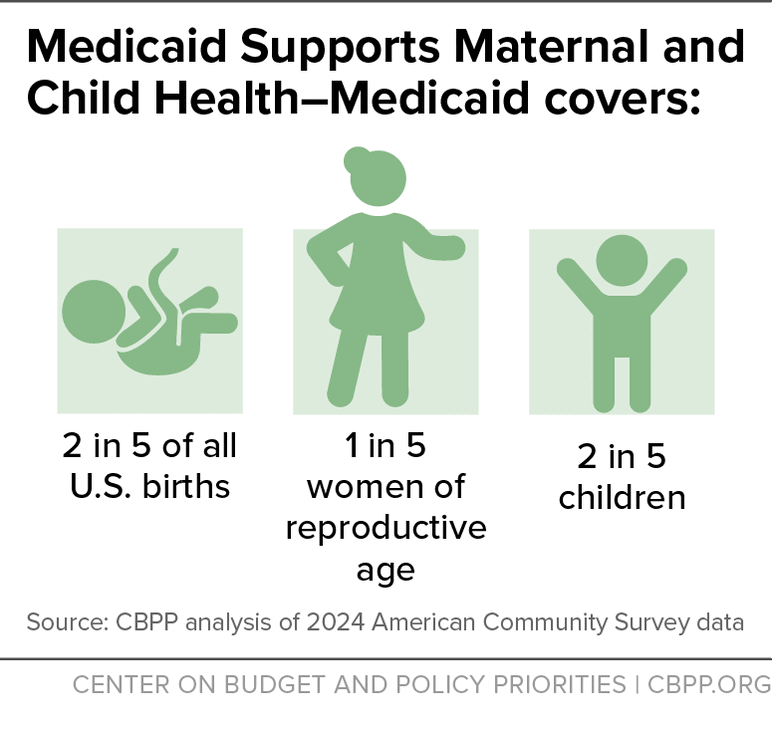
Medicaid plays a vital role in supporting maternal and child health, providing affordable coverage to millions of families with low incomes that ensures they have access to appropriate care. It covers nearly 28 million children[2] and provides the pediatric-specific Early and Periodic Screening, Diagnostic, and Treatment (EPSDT) benefit, which ensures that children under age 21 enrolled in Medicaid receive preventive care and all medically necessary services to treat, correct, or reduce any illnesses or conditions.[3] Taken together, Medicaid and the Children’s Health Insurance Program (CHIP) cover almost half of children across the country.[4]
Medicaid also pays for almost 40 percent of births[5] — with an even greater share in rural areas (45 percent) — and coverage of comprehensive and continuous postpartum care continues during the 12 months after delivery in almost every state.[6] And almost 1 in 5 women of reproductive age have health coverage through Medicaid, which provides access to important preventive and reproductive care services that have been shown to promote healthier pregnancies and improved birth outcomes for parents and babies.[7]
Medicaid Cuts Take Away Coverage, Directly and Indirectly
Some of the adverse impacts of the 2025 reconciliation law on infants, children, and individuals who are pregnant or postpartum are direct. For example, the law rolls back the three-month retroactive eligibility period that can protect families from unexpected medical expenses including costly bills from premature births.[8] The law also takes away Medicaid and CHIP coverage from people in most lawful immigration categories, limiting enrollment to a far narrower group.[9] Although it did not end the option that allows states to provide Medicaid and/or CHIP to lawfully residing children and pregnant individuals,[10] those living in states that have not adopted this option can now only access Medicaid or CHIP if they fall into the new narrower group created by the 2025 reconciliation law (and in some cases, they also go through a five-year waiting period).[11]
Other policies in the 2025 reconciliation law are less direct but will nevertheless threaten coverage disruptions or losses for children and parents. The red tape barriers in the law — namely the work requirement and more frequent redeterminations — put children and pregnant and postpartum individuals at greater risk of losing Medicaid coverage despite remaining eligible and being largely excluded from its provisions. Children and pregnant people may face delays when enrolling in Medicaid or getting the assistance they need to get or maintain coverage, as state systems come under strain. As of June 2026, many states are already seeing significant warning signs of overloaded systems such as increases in call wait times and large application and renewal backlogs.[12] The strain on state systems is likely to get worse as the 2025 law’s biggest Medicaid changes take effect.
While some parents are exempt from the 2025 reconciliation law’s Medicaid work requirement that takes coverage away from millions of people, they are still expected to be among those losing coverage as they get caught in the law’s additional red tape. Parental coverage loss is likely to affect their child’s coverage as well; research has shown children are more likely to have health coverage when their parents are insured.[13] Therefore, similar to the unwinding of the continuous enrollment condition, coverage losses among parents raise the concern that more children will become uninsured despite remaining eligible.[14] While some states had implemented policies that could help prevent children from disruptions in coverage, the Administration has indicated it will no longer permit these policies moving forward.[15]
Pregnant people are similarly excluded from the law’s work requirement and more frequent eligibility determinations, but they may still fall through the cracks. More than 100,000 pregnant and postpartum individuals are estimated to be enrolled in the Medicaid expansion eligibility group.[16] This could cause them to be disenrolled or experience temporary gaps in coverage that could prevent them from getting recommended prenatal and postpartum care.[17] Coverage loss also threatens women’s ability to access important pre-pregnancy care that supports healthier pregnancies and better birth outcomes.[18]
Loss of Coverage and Providers Jeopardize Access to Care and Health Outcomes
Those who are able to avoid coverage disruptions are still at risk of experiencing diminished access to care. As hospitals, physicians, and other health care providers contend with cuts to provider reimbursement — whether directly from the restrictions on state directed payments[19] and state actions reducing payment rates or indirectly through having fewer insured patients — there are likely to be reductions or closures of important services like obstetric services or specialty pediatric care.[20] Threats to access will be especially high in rural areas, where providers are at greater risk of closure,[21] and for maternity care services, given that over a third of U.S. counties already lack appropriate providers or birthing facilities.[22] Reduced care availability will require families to travel long distances for services or delay necessary care, which could have significant consequences for children and pregnant individuals’ health. While some states have proposed using a portion of their funding from the law’s Rural Health Transformation Program to promote maternal and infant health, this funding is woefully inadequate compared to the over $900 billion in federal Medicaid cuts and given CMS’s cap on RHTP funds going directly to providers.[23]
The gaps in coverage and decreases in access to timely, comprehensive preconception and maternity care resulting from the 2025 reconciliation law will increase the risk of adverse health outcomes for parents and babies.[24] People of color are likely to be disproportionately affected as maternal mortality is already significantly higher among Black mothers than white mothers, and people of color experience higher shares of negative maternal and infant outcomes, such as preterm and low-weight births, than white mothers.[25] While there have been concerted efforts in recent years to address high maternal mortality,[26] particularly among Black mothers, the large-scale cuts to Medicaid and worsening shortages of appropriate providers will undermine this progress.
Children who become uninsured or experience gaps in coverage may be delayed in getting recommended doctors’ visits or have trouble accessing care. Research has found that children with a gap in coverage are more likely to lack a usual source of care and are less likely to see a physician throughout the year.[27] Regular doctors’ visits are very important for children to support their growth and development, receive recommended immunizations, and detect and treat conditions early as they arise. These well-visits are most frequent and particularly important for infants and toddlers given the rapid growth and development that occurs during these ages; yet, the uninsured rate for children under 3 has been growing in recent years, a trend that is at risk of getting worse as the 2025 reconciliation law’s health care cuts go into effect.[28] If families delay these recommended visits due to lack of insurance, children may be at greater risk of illness, higher health care costs, or complications due to delayed interventions. Loss of Medicaid coverage, even temporarily, could also harm a child’s long-term health outcomes.[29]
Cuts Undermine Household Stability and Investments in Child and Maternal Health
Parents who lose coverage due to the 2025 reconciliation law’s new paperwork requirements either have to spend more on health care — leaving less money for food, rent, and other household necessities — or they will delay needed care, which may make it harder for them to focus on supporting their children.[30] Families may also incur increased financial burdens from the rollbacks to the retroactive coverage period, which exposes households to medical debt from a sudden illness or medical event. Recent data shows that the majority of families with incomes below $40,000 a year (around 150 percent of the federal poverty line for a family of three) would not be able to pay for an unexpected $500 medical bill or would have to go into debt to pay the bill.[31]
These additional costs come as households are currently struggling to afford basic needs; for example, almost two-thirds (62 percent) of low-income families have reported experiencing diaper insecurity, while 21 percent of households facing diaper insecurity indicated someone in their household lost Medicaid coverage in the past year.[32] Many families are already contending with losing access to food assistance, including millions of children, jeopardizing their short- and-long-term health.[33]
As states face substantial budget pressures from the 2025 reconciliation law and other fiscal factors,[34] they may be forced to consider making cuts to optional benefits like home- and community-based services as some states have already done. This may make it harder for children or their family members with special health care needs to get needed care in their homes rather than institutional settings. States could also look to cut optional eligibility groups, which cover an estimated 1 in 5 children on the program.[35]
Even if states maintain current benefits and eligibility levels, future coverage expansions or adoption of additional optional policies will be much more difficult given the new constraints on funding.[36] For example, this could stall progress made to expand school-based Medicaid programs that support children getting the physical and mental health care they need.[37] States could be unable to continue providing state-funded coverage to all children regardless of immigration status,[38] coming as the 2025 reconciliation law’s restrictions have left thousands of people with lawful immigration status without coverage. Budget pressures may also cause states to scale back or forgo programs or investments aimed at improving quality of care or addressing systemic issues, such as covering doula or midwifery services to combat the maternal mortality crisis.[39]
| TABLE 1 | ||
|---|---|---|
Number and Share of Child Medicaid Enrollment by State | ||
| Number of Children with Medicaid | Share of Child Population with Medicaid | |
| Alabama | 469,667 | 39% |
| Alaska | 71,137 | 39% |
| Arizona | 593,147 | 35% |
| Arkansas | 319,265 | 43% |
| California | 3,181,056 | 36% |
| Colorado | 389,379 | 30% |
| Connecticut | 336,367 | 43% |
| Delaware | 90,300 | 40% |
| District of Columbia | 76,651 | 55% |
| Florida | 2,115,277 | 44% |
| Georgia | 1,099,330 | 41% |
| Hawaii | 128,908 | 42% |
| Idaho | 129,437 | 26% |
| Illinois | 951,645 | 33% |
| Indiana | 527,963 | 32% |
| Iowa | 249,616 | 32% |
| Kansas | 203,019 | 28% |
| Kentucky | 433,166 | 40% |
| Louisiana | 505,515 | 45% |
| Maine | 117,619 | 45% |
| Maryland | 466,844 | 32% |
| Massachusetts | 483,954 | 33% |
| Michigan | 703,626 | 31% |
| Minnesota | 589,396 | 43% |
| Mississippi | 305,037 | 42% |
| Missouri | 430,502 | 30% |
| Montana | 68,504 | 28% |
| Nebraska | 132,659 | 26% |
| Nevada | 264,856 | 37% |
| New Hampshire | 65,334 | 24% |
| New Jersey | 537,315 | 25% |
| New Mexico | 261,824 | 56% |
| New York | 1,772,747 | 42% |
| North Carolina | 1,007,867 | 40% |
| North Dakota | 45,348 | 24% |
| Ohio | 877,802 | 32% |
| Oklahoma | 416,270 | 41% |
| Oregon | 283,876 | 32% |
| Pennsylvania | 1,114,509 | 40% |
| Rhode Island | 76,731 | 35% |
| South Carolina | 484,120 | 40% |
| South Dakota | 61,418 | 27% |
| Tennessee | 636,330 | 38% |
| Texas | 2,633,586 | 33% |
| Utah | 126,184 | 13% |
| Vermont | 50,668 | 42% |
| Virginia | 594,259 | 30% |
| Washington | 748,404 | 43% |
| West Virginia | 152,152 | 41% |
| Wisconsin | 431,162 | 33% |
| Wyoming | 33,878 | 26% |
| Total | 27,845,626 | 36% |
Source: CBPP analysis of June 2026 Center for Medicare and Medicaid Services Medicaid and CHIP enrollment data and 2024 American Community Survey data of total child population age 18 and under. Note: The number of children enrolled in Medicaid comes from June 2026 CMS enrollment data and the share of children enrolled in Medicaid uses June 2026 CMS enrollment data and 2024 ACS data on the total child population age 18 and under. | ||
End Notes
[1] Edwin Park, Joan Alker, and Alexandra Corcoran, “Jeopardizing a Sound Investment: Why Short-Term Cuts to Medicaid Coverage During Pregnancy and Childhood Could Result in Long-Term Harm,” The Commonwealth Fund, December 8, 2020, https://www.commonwealthfund.org/publications/issue-briefs/2020/dec/short-term-cuts-medicaid-long-term-harm.
[2] Centers for Medicare & Medicaid Services (CMS), “June 2026: Medicaid and CHIP Eligibility Operations and Enrollment Snapshot,” September 25, 2026, https://www.medicaid.gov/resources-for-states/downloads/eligib-oper-and-enrol-snap-jun2026.pdf.
[3] CMS, “Early and Periodic Screening, Diagnostic, and Treatment,” https://www.medicaid.gov/medicaid/benefits/early-and-periodic-screening-diagnostic-and-treatment.
[4] CMS, “Children’s Health Insurance Program,” https://www.medicaid.gov/chip; CBPP analysis of June 2026 Center for Medicare and Medicaid Services Medicaid and CHIP enrollment data and US Census Bureau 2025 national population estimates.
[5] KFF, “Births Financed by Medicaid by Metropolitan Status,” https://www.kff.org/medicaid/state-indicator/births-financed-by-medicaid/?currentTimeframe=0&sortModel=%7B%22colId%22:%22Location%22,%22sort%22:%22asc%22%7D.
[6] KFF, “Medicaid Postpartum Coverage Extension Tracker,” July 15, 2026, https://www.kff.org/medicaid/medicaid-postpartum-coverage-extension-tracker/.
[7] Elizabeth Zhang, “Medicaid Plays an Important Role in Providing Health Coverage to Key Populations,” CBPP, February 25, 2026, https://www.cbpp.org/research/health/medicaid-plays-an-important-role-in-providing-health-coverage-to-key-populations; Maggie Clark, Ema Bargeron, and Alexandra Corcoran, “Medicaid Expansion Narrows Maternal Health Coverage Gaps, But Racial Disparities Persist,” Georgetown CCF, September 2021, https://ccf.georgetown.edu/wp-content/uploads/2021/09/maternal-health-and-medex-final.pdf.
[8] Mary-Beth Malcarney and Christine Nguygen, “New Restrictions Limiting Access to Medicaid Retroactive Coverage,” Families USA, April 2026, https://familiesusa.org/wp-content/uploads/2026/05/HR-1-Retroactive-Coverage.pdf.
[9] Margot Dankner, “Last Year’s Reconciliation Law Is Even More Extreme Than the 1996 Law That Took Away Benefits From People with Lawful Immigration Status,” CBPP, September 10, 2026, https://www.cbpp.org/blog/last-years-reconciliation-law-is-even-more-extreme-than-the-1996-law-that-took-away-benefits.
[10] Kelly Whitener, “HR 1 Does Not Block States From Offering Medicaid and CHIP To Lawfully Residing Children and Pregnant Women,” Health Affairs, July 20, 2026, https://www.healthaffairs.org/content/forefront/hr-1-does-not-block-states-offering-medicaid-and-chip-lawfully-residing-children-and.
[11] Alabama, Alaska, Arizona, Idaho, Indiana, Kansas, Mississippi, Missouri, Oklahoma, South Dakota, and Tennessee do not provide coverage for lawfully residing children or pregnant immigrants of less than five years. Florida, Illinois, Louisiana, Montana, Oregon, Texas, and Utah have adopted the option for children but not pregnant women while North Dakota and Wyoming have only adopted coverage for pregnant immigrants. Data available at, https://www.kff.org/medicaid/medicaid-and-chip-eligibility-enrollment-and-renewal-policies-as-states-prepare-for-major-medicaid-policy-changes/ - Table-3.
[12] Georgetown CCF, “Tracking State Readiness to Implement HR 1,” August 28, 2025https://ccf.georgetown.edu/2025/08/28/tracking-state-readiness-to-implement-hr-1/.
[13] Julie L. Hudson and Asako S. Moriya, “Medicaid Expansion For Adults Had Measurable ‘Welcome Mat’ Effects on Their Children,” Health Affairs, Vol. 36, No. 9, September 5, 2017, https://www.healthaffairs.org/doi/10.1377/hlthaff.2017.0347.
[14] Allexa Gardner, “Preventing the ‘Unwelcome Mat’ Effect: Ensuring Eligible Kids Remained Covered,” Georgetown CCF, May 31, 2023, https://ccf.georgetown.edu/2023/05/31/preventing-the-unwelcome-mat-effect-ensuring-eligible-kids-remain-covered/.
[15] Centers for Medicaid & CHIP Services, “Section 1115 Demonstration Authority for Continuous Eligibility Initiatives,” July 17, 2025, https://www.medicaid.gov/resources-for-states/downloads/contin-elig-ltr-to-states.pdf.
[16] Laura Barrie Smith, et. al., “Ensuring Continuous Coverage for Pregnant and Postpartum Medicaid Enrollees Under OBBBA,” Urban Institute, March 31, 2026, https://www.urban.org/research/publication/ensuring-continuous-coverage-pregnant-and-postpartum-medicaid-enrollees-under.
[17] Georgetown CCF, “How Medicaid Supports Maternal and Infant Health,” 2025, https://ccf.georgetown.edu/2025/02/28/how-medicaid-supports-maternal-and-infant-health/; Aubrianna Osorio, “New Report Shows Coverage Gains for New Mothers – But Progress has Stalled with New Threats on the Horizon,” Georgetown CCF, July 23, 2026, https://ccf.georgetown.edu/2026/07/23/new-report-shows-coverage-gains-for-new-mothers-but-progress-has-stalled-with-new-threats-on-the-horizon/.
[18] Usha Ranji, et. al., “5 Key Facts About Medicaid and Pregnancy,” KFF, May 29, 2025, https://www.kff.org/medicaid/5-key-facts-about-medicaid-and-pregnancy/.
[19] Allison Orris, “CMS Proposed Rule Goes Beyond H.R. 1 Requirements and Extends Payment Caps to Additional Services,” CBPP, May 20, 2026, https://www.cbpp.org/research/federal-budget/executive-action-watch?item=30628.
[20] Manatt Health, “No Place to Hide: Children Will Be Hurt By Medicaid Cuts,” May 2025, https://assets-us-01.kc-usercontent.com/9fd8e81d-74db-00ef-d0b1-5d17c12fdda9/361453ca-53e0-4174-ba88-31cfd7c98295/No Place to Hide %E2%80%93 Children Will Be Hurt by Medicaid Cuts %E2%80%93 Executive Summary FINAL 05 06 2025.pdf.
[21] Heather Saunders, Alice Burns, and Zachary Levinson, “How Might Federal Medicaid Cuts in the Enacted Reconciliation Package Affect Rural Areas?” KFF, July 24, 2025, https://www.kff.org/medicaid/how-might-federal-medicaid-cuts-in-the-enacted-reconciliation-package-affect-rural-areas/.
[22] March of Dimes, “Nowhere to Go: Maternity Care Deserts Across the U.S.,” 2026, https://www.marchofdimes.org/sites/default/files/2026-08/MCDR_2026_Report_English.pdf.
[23] Tanesha Mondestin and Nancy Kaneb, “Maternal and Infant Health in State Rural Health Transformation Proposals Set Promising Priorities in an Uncertain Landscape,” Georgetown CCF, March 20, 2026, https://ccf.georgetown.edu/2026/03/20/maternal-and-infant-health-in-state-rural-health-transformation-proposals-set-promising-priorities-in-an-uncertain-landscape/.
[24] Judith Solomon, “Closing the Coverage Gap Would Improve Black Maternal Health,” CBPP, July 26, 2021, https://www.cbpp.org/research/health/closing-the-coverage-gap-would-improve-black-maternal-health.
[25] Latoya Hill, et. al., “Racial Disparities in Maternal and Infant Health: Current Status and Key Issues,” KFF, December 3, 2025, https://www.kff.org/racial-equity-and-health-policy/racial-disparities-in-maternal-and-infant-health-current-status-and-key-issues/.
[26] Tanesha Mondestin, Elisabeth Wright Burak, and Kay Johnson, “State Momentum for Maternal Health Legislation Continues: Congressional Cuts Would Turn Back the Clock,” Georgetown CCF, May 22, 2025, https://ccf.georgetown.edu/2025/05/22/state-momentum-for-maternal-health-legislation-continues-congressional-cuts-would-turn-back-the-clock/.
[27] Aubrianna Osorio and Joan Alker, “Gaps in Coverage: A Look at Child Health Insurance Trends,” Georgetown CCF, November 21, 2021, https://ccf.georgetown.edu/2021/11/22/gaps-in-coverage-a-look-at-child-health-insurance-trends/.
[28] Elisabeth Wright Burak, “Uninsured Infants and Toddlers Now Above 5% Nationally,” Georgetown CCF, August 21, 2026, https://ccf.georgetown.edu/2026/08/21/uninsured-infants-and-toddlers-now-above-5-nationally/.
[29] Park, et. al., op. cit.
[30] Georgetown CCF, “How Covering Adults Through Medicaid Expansion Helps Children,” November 2024, https://ccf.georgetown.edu/wp-content/uploads/2024/11/Medicaid-expansion-v2-2.pdf.
[31] KFF, “Americans’ Challenges with Health Care Costs,” October 23, 2026, https://www.kff.org/health-costs/americans-challenges-with-health-care-costs/.
[32] Kelly E. C. Massengale, “The NDBN Diaper Check 2026: Diaper Insecurity Among U.S. Children and Families,” National Diaper Bank Network, April 15, 2026, https://nationaldiaperbanknetwork.org/the-ndbn-diaper-check-2026/.
[33] Dottie Rosenbaum, et. al., “SNAP Tracker: People Are Losing Food Assistance as the Harmful 2025 Republican Reconciliation Law Is Implemented,” CBPP, October 23, 2026, https://www.cbpp.org/research/food-assistance/snap-tracker-people-are-losing-food-assistance-as-the-harmful-2025; Joseph Llobrera, “Number of Children Receiving SNAP Continues to Drop Under Harmful 2025 Republican Reconciliation Law,” CBPP, July 21, 2026, https://www.cbpp.org/blog/number-of-children-receiving-snap-continues-to-drop-under-harmful-2025-republican.
[34] Wesley Tharpe, “Roundup: State Budgets Increasingly Strained as House, Senate Republican Plans Would Impose Major Costs,” CBPP, June 24, 2025, https://www.cbpp.org/research/state-budget-and-tax/roundup-state-budgets-increasingly-strained-as-house-senate.
[35] Sarah Rosenbaum, et. al., “Deep Medicaid Spending Cuts Put Health Care Coverage at Risk for One of Five Enrolled Children,” The Commonwealth Fund, May 5, 2025, https://www.commonwealthfund.org/blog/2025/deep-medicaid-spending-cuts-put-health-care-coverage-risk-one-five-enrolled-children.
[36] Alice Burns, et. al., “5 Questions and Answers About Medicaid Provider Taxes,” KFF, August 20, 2026, https://www.kff.org/medicaid/5-questions-and-answers-about-medicaid-and-provider-taxes/#35af31e1-c6d7-432f-a313-02091c9cc8e3--h-3-what-are-new-federal-rules-related-to-provider-taxes.
[37] Healthy Schools Campaign, “School Medicaid Expansion Map,” https://healthystudentspromisingfutures.org/map-school-medicaid-programs/; Jessie Mandle, et. al., “How Medicaid Cuts Will Harm Students & Schools,” Healthy Schools Campaign, March 2025, https://healthyschoolscampaign.org/dev/wp-content/uploads/2025/03/How-Medicaid-Cuts-Will-Harm-Students-Schools.pdf.
[38] Tanya Broder, “Medical Assistance Programs for Immigrants in Various States,” National Immigration Law Center, August 24, 2026, https://www.nilc.org/resources/medical-assistance-various-states/.
[39] “Doula Medicaid Project: Current Efforts at Expanding Access to Doula Care,” National Health Law Program, https://healthlaw.org/doulamedicaidproject/#current-efforts-at-expanding-access-to-doula-care; National Academy for State Health Policy, “Medicaid Financing of Midwifery Services – A 50-State Analysis,” May 2023, https://eadn-wc03-8290287.nxedge.io/wp-content/uploads/2023/04/NASHP_Medicaid-Financing-of-Midwifery-Services_Brief_FINAL_updated-06.01.2023.pdf.