

By Coordinating With Medicaid and SNAP, State WIC Programs Reach Additional Eligible Low-Income Families With Young Children
Collaboration Has Become More Widespread Over Past Five Years
Collaboration between the Special Supplemental Nutrition Program for Women, Infants, and Children (WIC), Medicaid, and the Supplemental Nutrition Assistance Program (SNAP, formerly food stamps) is an important way to give eligible low-income families with children access to a range of health, nutrition, and supportive services they need to become and stay healthy.[2] By enrolling a greater share of Medicaid and SNAP participants in WIC, states can support healthier pregnancies, improve birth outcomes, and improve child health and cognitive development for low-income families, potentially reducing striking racial inequities.
This report draws on information the Center on Budget and Policy Priorities (CBPP) collected from WIC state agencies during 2021, 2022, the fall and winter of 2023-2024, and most recently in the winter of 2025-2026. The report describes several ways that WIC state agencies are collaborating with their state’s Medicaid and SNAP programs and shows a striking trend of increased collaboration between WIC and Medicaid, and WIC and SNAP.
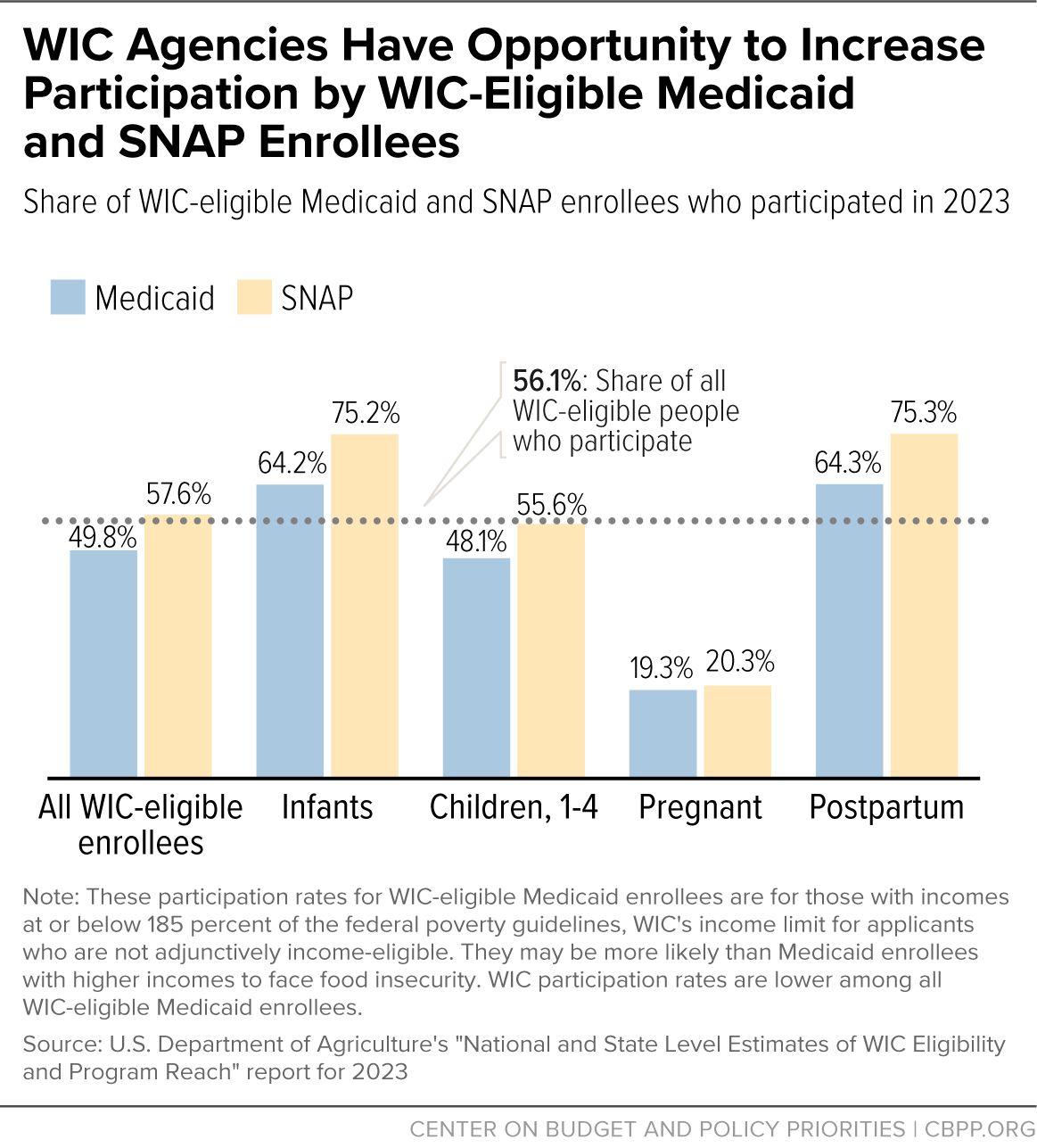
WIC provides nutritious foods, nutrition education, breastfeeding support, and referrals to health care and social services to low-income pregnant and postpartum people, infants, and children under age 5. A large body of research demonstrates that WIC improves participants’ health, developmental, and nutrition outcomes, including outcomes that are aligned with Medicaid core quality measures.[3] Yet only about half (56.1 percent) of eligible people were enrolled in WIC during 2023 (the most recent year for which U.S. Department of Agriculture, or USDA, estimates of WIC coverage are available).[4]
WIC works alongside Medicaid and SNAP to help families weather financial distress, improve health and wellness, and boost economic prospects. To simplify eligibility determinations, a WIC applicant who already receives Medicaid or SNAP is automatically considered income-eligible, or adjunctively eligible, for WIC.[5] Medicaid and SNAP enrollees can benefit from WIC’s nutritious foods and services, but many do not participate. Despite being adjunctively eligible, nearly half of WIC-eligible Medicaid and/or SNAP enrollees did not participate in WIC in 2023. Only 19.3 percent of eligible pregnant people and 48.1 percent of children ages 1 through 4 who were enrolled in Medicaid participated in WIC. Similar percentages of eligible pregnant people (20.3) and children (55.6) participating in SNAP participated in WIC.[6] (See Figure 1.)

Interest in cross-program collaboration has grown in recent years. More state WIC programs not only collaborate with Medicaid and SNAP, but have entered into written cross-program agreements, which sometimes allow for sharing data that can be used for targeted outreach and streamlined enrollment. This report provides a state-by-state compilation of cross-program collaboration efforts involving WIC, Medicaid, and SNAP. CBPP collected information from states on coordination between WIC and Medicaid and/or SNAP during 2021, 2022, the fall and winter of 2023-2024, and 2025-2026.[7]
The most recent responses, from 48 of the 51 WIC geographic state agencies and the District of Columbia, show positive trends, including:
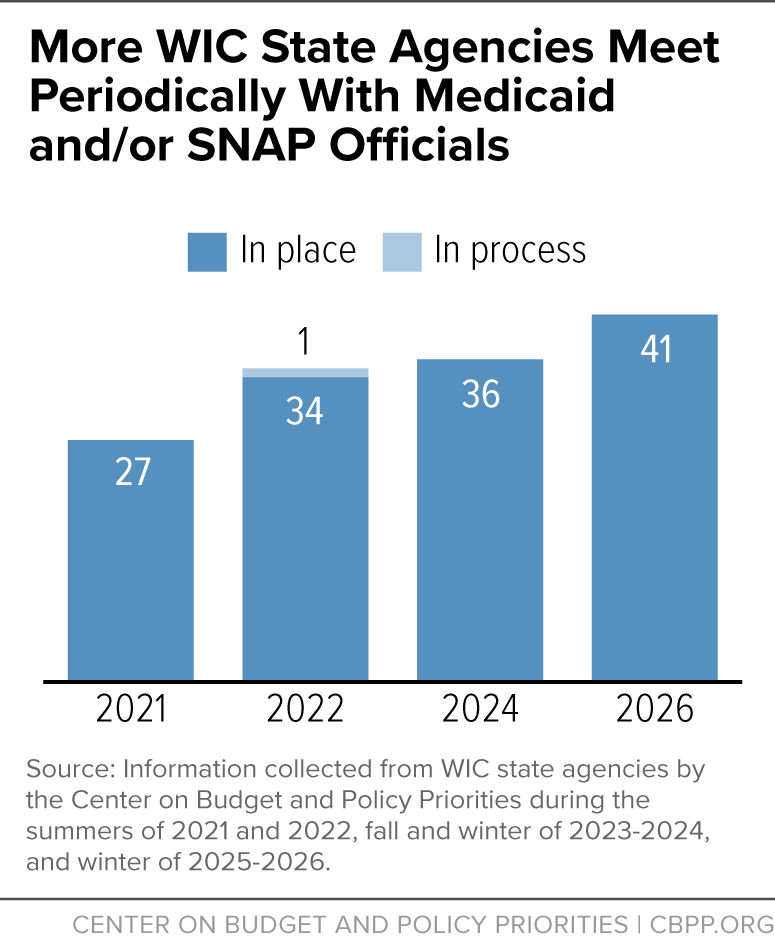
- At least 41 WIC state agencies now meet periodically with Medicaid and/or SNAP officials, compared to only 27 state agencies that reported having periodic meetings with these programs in 2021.
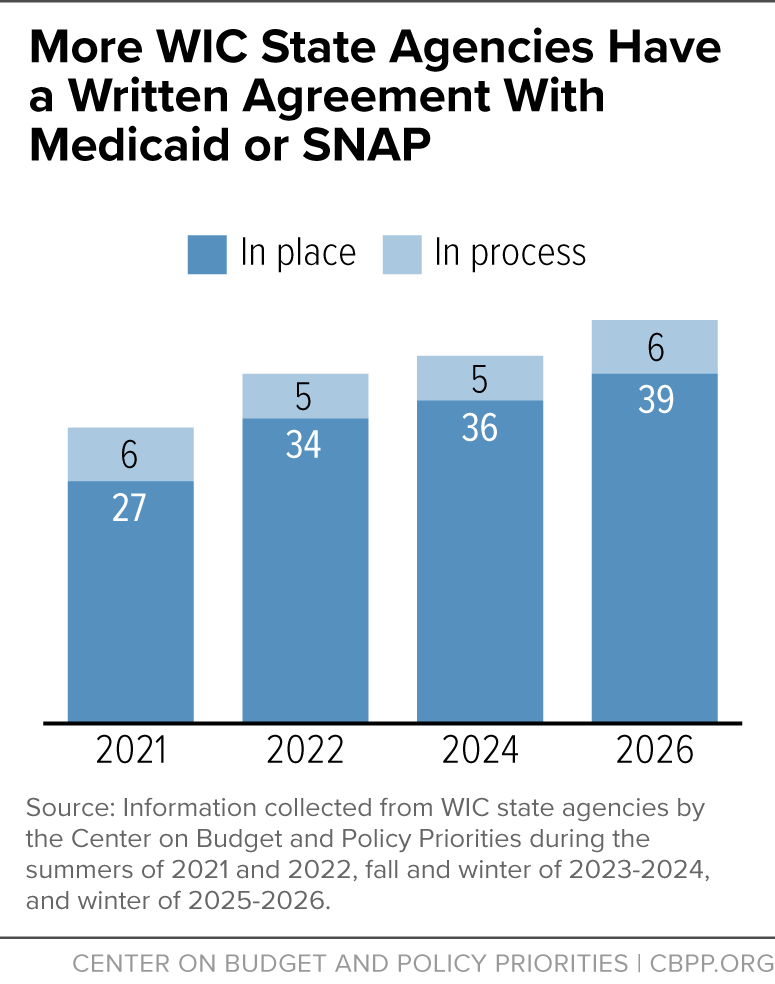
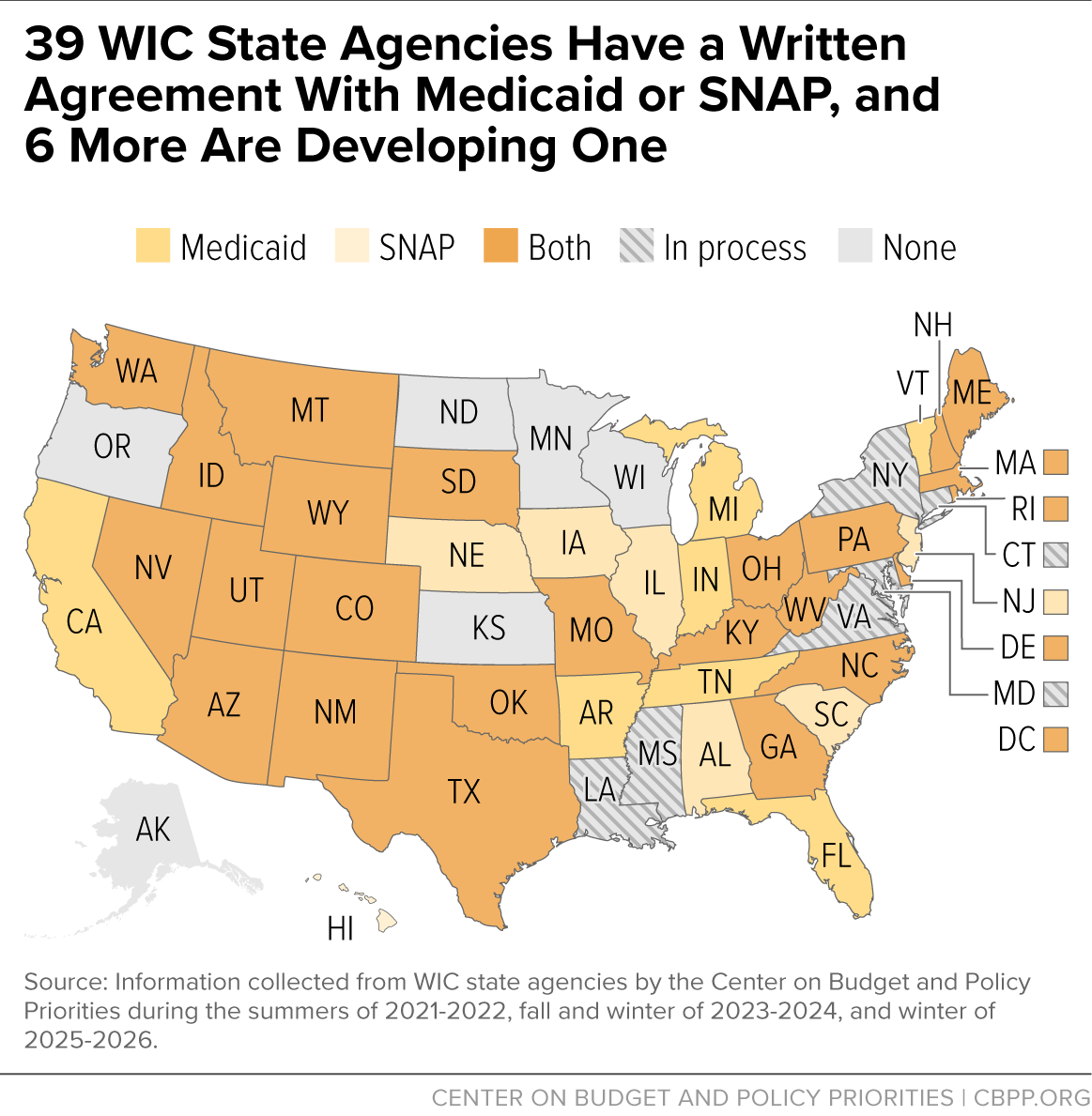
- At least 39 WIC state agencies have a written agreement on coordination or data sharing with Medicaid and/or SNAP and six more are developing an agreement with one or both programs, a notable increase from 2021 when only 27 states had agreements in place.
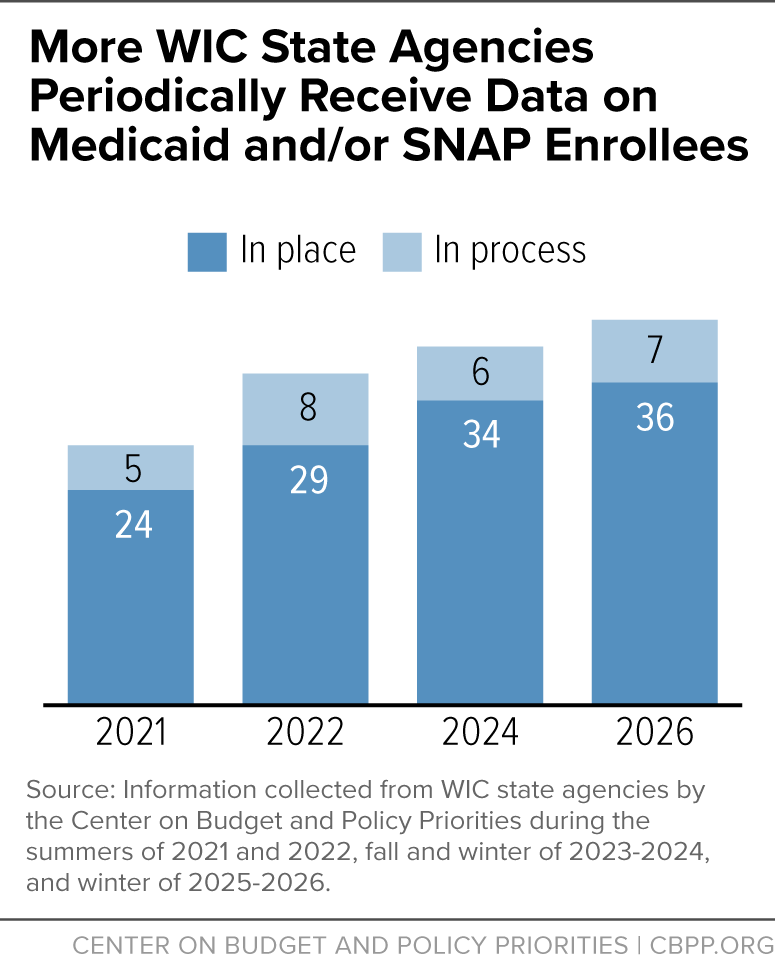
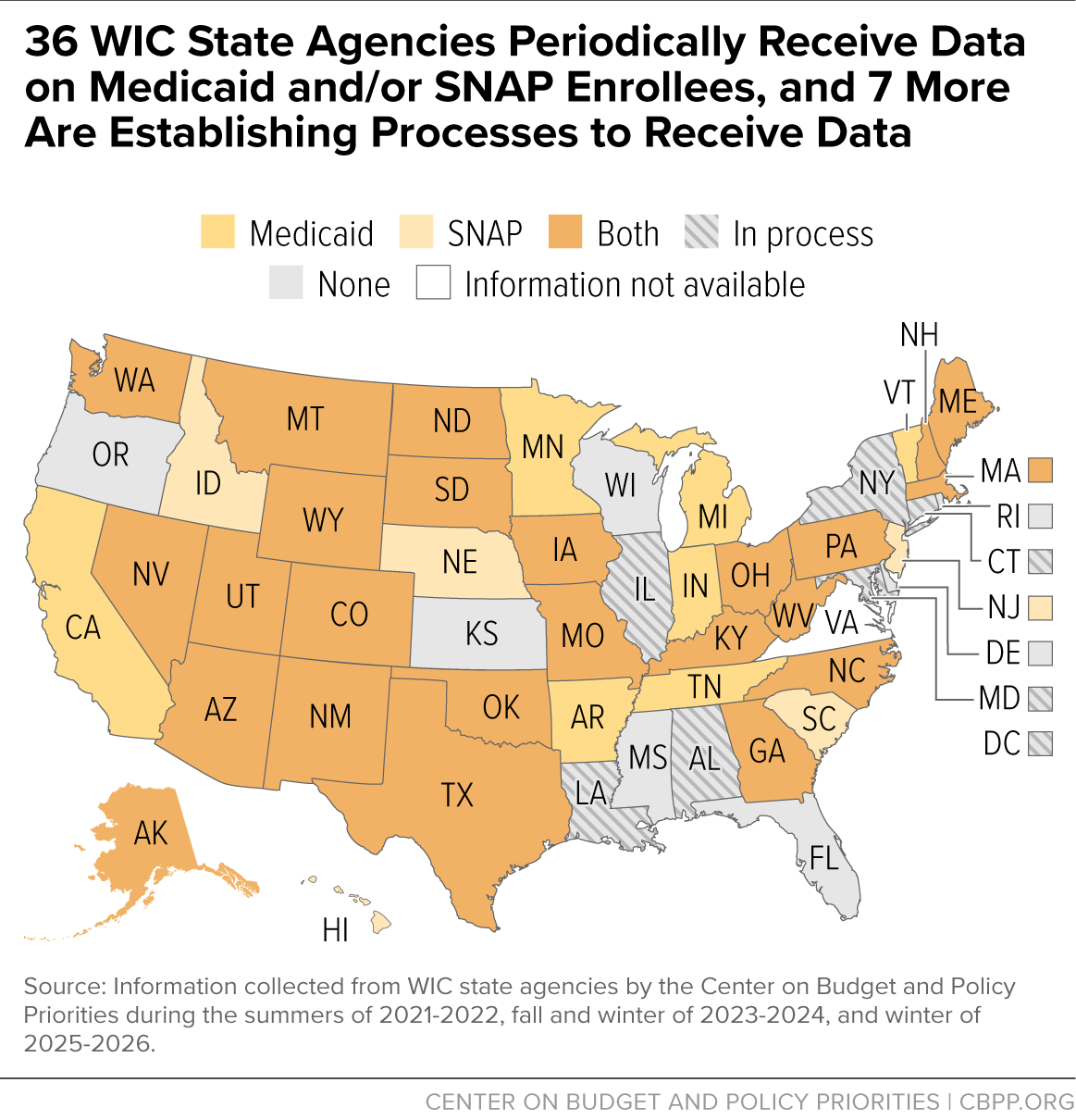
- At least 36 WIC state agencies periodically (anywhere from daily to annually) receive data on Medicaid and/or SNAP enrollees, and seven more are establishing processes to receive data, a large jump from 2021 when only 24 WIC state agencies reported receiving data periodically.
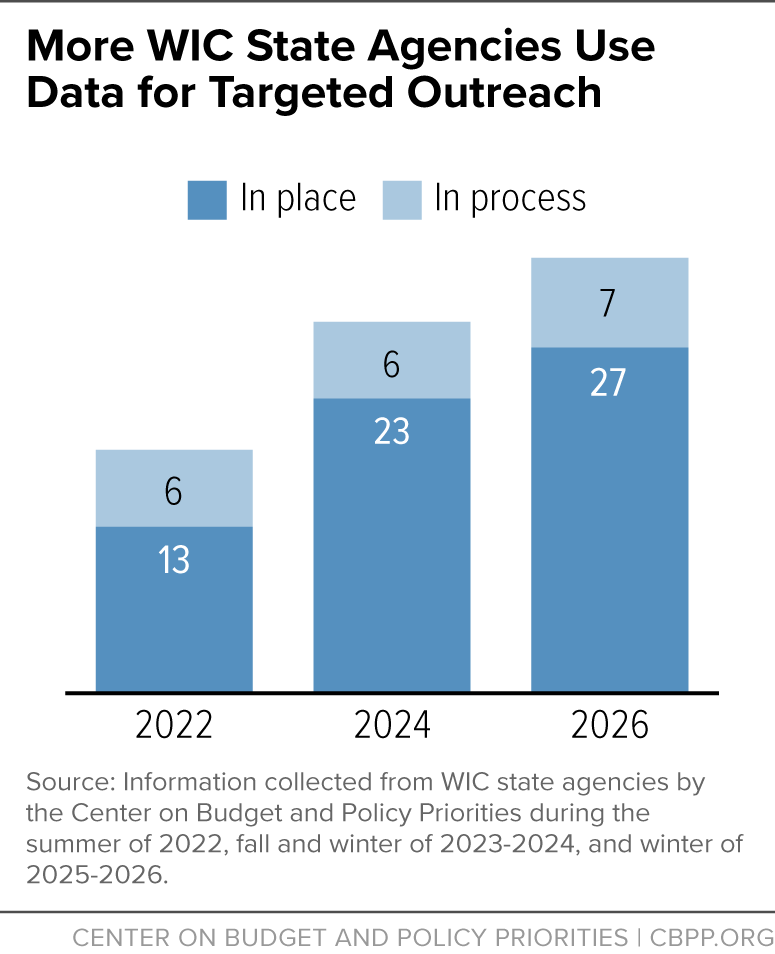
- At least 27 WIC state agencies conduct targeted outreach to WIC-eligible individuals identified by matching WIC data with data on individuals or families enrolled in Medicaid or SNAP, a striking increase from 2022 (the first year WIC state agencies were asked about this) when only 13 used the data for targeted outreach; seven more are establishing processes to conduct targeted outreach.
Pilot programs have demonstrated that by matching data across programs to identify and conduct outreach to families enrolled in Medicaid or SNAP but not WIC, states can increase WIC enrollment, especially among Medicaid participants, which may improve health and developmental outcomes.[8]
USDA is providing support for WIC collaboration with Medicaid and SNAP. In 2023, the department issued a policy memorandum encouraging WIC state agencies to collaborate with Medicaid and SNAP agencies in their states to explore data sharing and outreach opportunities.[9] USDA also entered into a cooperative agreement with the Johns Hopkins Bloomberg School of Public Health in 2023 to launch the MORE WIC! Project that provides grants and technical assistance to support WIC state agencies with data matching and outreach initiatives. In 2024, five state agencies were selected for the first round of funding and technical assistance, and the second group of state agencies will be selected during 2026. The project team, including the National WIC Association, assists WIC state agencies interested in launching or expanding data sharing and matching to identify WIC-eligible families enrolled in programs such as Medicaid and SNAP, but not enrolled in WIC.[10] The project also helps states conduct outreach and streamline enrollment processes to increase these families’ WIC participation.
Examples in this report of how WIC agencies are collaborating with their state’s Medicaid and SNAP programs can help states that are interested in launching or expanding such collaboration identify other states undertaking similar work and confer with them or draw on the lessons they learned. There are additional opportunities within the Medicaid program to connect applicants and enrollees with WIC when they interact with the state Medicaid agency, managed care organizations, or health care providers. In addition to sharing data to facilitate targeted outreach, state Medicaid agencies can strengthen referrals by developing a standardized and streamlined mechanism for health care providers; build and define a community-based health workforce that can make linkages to WIC; and work with health care providers and Medicaid managed care organizations to include WIC enrollment as a strategy to improve quality and address health-related social needs.[11]
Assessing the Extent of WIC Coordination With Medicaid and SNAP
Cross-program coordination can take many forms. One common approach is for WIC staff to meet periodically with Medicaid and/or SNAP officials. In addition to facilitating outreach, such collaboration fosters better coordination of services and supports for families participating in more than one program.
A growing number of WIC state agencies have a written agreement with Medicaid or SNAP (such as a data-sharing agreement or memorandum of understanding). A written agreement describing how these programs will coordinate, how to make referrals across programs, and how to protect data privacy can benefit both state and local WIC agencies.[12] It may also allow data exchanges and describe the information that will be shared and how often. This allows WIC state agencies to periodically receive files with information about participants in the other program who are eligible for WIC. These files can then be matched with files of WIC enrollees to assess how many WIC-eligible individuals are not enrolled, and state or local WIC agencies can contact those individuals to offer to enroll them.
Though not the focus of this report, collaboration between WIC and Medicaid and/or SNAP also occurs at the local level. Local WIC agencies periodically meet with employees of the other programs to educate them about WIC’s eligibility requirements and services and how to make a referral to WIC. Some WIC local agencies send staff to Medicaid/SNAP offices to conduct direct outreach and help clients apply for WIC. Other local WIC agencies have agreements with the programs to receive contact information for clients who may be eligible for WIC to facilitate targeted outreach to them.
Since 2021, the Center on Budget and Policy Priorities has periodically collected information from states on coordination between WIC and Medicaid and/or SNAP. In 2021 and/or 2022, 49 of the 51 WIC state agencies located in geographic states and D.C. responded to questions regarding coordination with Medicaid and SNAP programs in their states.[13] Forty-eight states provided updates in response to the following questions during the winter of 2025-2026.[14]
- Are there periodic (at least annual) meetings between state-level WIC representatives and representatives from Medicaid and/or SNAP programs?
- What information about applying for WIC does Medicaid provide to enrollees who may be WIC-eligible?
- What information about applying for WIC does SNAP provide to enrollees who may be WIC-eligible?
- Is there a state-level data-sharing agreement or memorandum of understanding between WIC and Medicaid and/or SNAP?
- Does Medicaid and/or SNAP share data on enrollees with WIC to identify enrollment gaps?
- If Medicaid and/or SNAP data are shared with WIC, are the data used for targeted outreach by mail, telephone, or text?
- If Medicaid and/or SNAP data are shared with WIC, how often are they shared?
Their responses show a notable upward trend in WIC state agency collaboration with the Medicaid and/or SNAP programs in their state; nearly 90 percent have or are developing written agreements with another program; and close to 90 percent also currently receive enrollee data from Medicaid, SNAP, or both, or are in the process of setting up procedures to receive such data.
Responses from WIC state agencies are summarized below, along with examples of ways WIC works with Medicaid and SNAP to coordinate, establish agreements, and use shared data. Table 1 shows each state’s response to each question.
Cross-Program Collaboration

WIC is usually administered by a different state agency than the agency that administers Medicaid and SNAP, while Medicaid and SNAP are sometimes administered by the same agency, but not always. Thus, coordination often must occur not only across programs, but across agencies. Regular cross-program meetings provide an opportunity to share information, develop referral processes, identify cross-enrollment opportunities, and coordinate outreach and service delivery.
Forty-one of the 51 WIC state agencies reported that they periodically meet with representatives of Medicaid and/or SNAP. This is a sizable increase since 2021 when 27 states reported periodic meetings with one or both of the other programs. (See Figure 2.) The increase in meetings between the programs may be contributing to greater data sharing and collaborative outreach. Most state agencies also indicated that Medicaid and/or SNAP provide their enrollees with information about WIC, ranging from general program information, such as the WIC website or a toll-free WIC phone number, to a link to an online application. WIC state agencies that coordinate with other programs can recommend language for them to use in their communications with enrollees to ensure it is accurate and engaging.

Application processes for Medicaid and SNAP vary across states, with some emphasizing online service more than others. In all scenarios, there are opportunities to make referrals to WIC and provide information about how to apply.
One way to facilitate referrals from other programs to WIC is to incorporate online tools into the WIC certification process for families. These tools range from electronic forms that collect basic contact information or allow an applicant to request a certification appointment to online applications where families enter most of the demographic and basic health information needed for certification, upload eligibility documents, and read and electronically sign required forms.[15] Links to online tools can then be included in the referral materials that Medicaid or SNAP provides to WIC-eligible families.
Several WIC state agencies indicated that they provide the other programs with a link to such an online tool to include in their outreach messages.[16] This approach helps eligible families initiate enrollment in WIC without having to make a phone call or navigate a website to find information about how to enroll. By offering a unique link, WIC state agencies can also monitor whether Medicaid or SNAP enrollees are initiating WIC enrollment.
Including WIC in an online eligibility screener or program application is another way to connect families applying for Medicaid or SNAP with WIC. These are usually set up and operated by state agencies that administer Medicaid and SNAP. Some of these screeners and applications contain information about WIC, but families who may be eligible are often referred to a separate website for information about how to apply. Other applications automatically refer applicants who are categorically eligible to WIC or allow families to request that their relevant information be shared with WIC to initiate the enrollment process.[17]
Agreements Between WIC and Medicaid and/or SNAP
A written agreement describing how WIC, Medicaid, and/or SNAP will coordinate, how to make referrals across programs, and how data will be shared and used can be beneficial for state and local WIC agencies.[18] Federal law allows Medicaid and SNAP to share enrollee data with WIC, and states have demonstrated that data can be shared securely, protecting families’ privacy while improving their access to essential benefits and services.[19]
Thirty-nine WIC state agencies reported that they have a data-sharing agreement or memorandum of understanding with Medicaid and/or SNAP (an increase from 27 in 2021); an additional six reported that they are in the process of establishing an agreement. (See Figures 3 and 4.)

Developing a written agreement that includes data sharing involves staff from multiple programs with expertise in areas including program policy, law, data security, and technology. Thinking through in advance how shared data will be used, and how the impact of those uses will be evaluated, helps states craft strong, secure, and flexible data-sharing agreements.[20] Consulting with states that have a data-sharing agreement in place or with national organizations with relevant experience can help states anticipate key issues and overcome challenges that arise.
Data Sharing Between WIC, Medicaid, and SNAP
Sharing data from Medicaid and SNAP with WIC allows state agencies to measure cross enrollment in the aggregate to assess the extent to which eligible families are missing out on WIC benefits. It also allows for direct outreach to families who are eligible for WIC but not enrolled. If these families enroll in WIC, the certification process may be streamlined because WIC already has information documenting adjunctive eligibility. States interested in launching similar efforts can learn how to effectively conduct data matches and targeted outreach from the states with experience or seek funding or technical assistance through USDA’s MORE WIC! Project.[21]

State and local agencies use Medicaid and SNAP enrollee data for a variety of purposes, including documenting adjunctive eligibility. Most states have an automated telephone- or web-based system that allows them to check whether a WIC applicant is adjunctively eligible.[22] States with such automated systems do not necessarily have a written agreement in place and do not need to receive batches of data to check applicants’ adjunctive eligibility.
Thirty-six WIC state agencies reported in 2025-2026 that they or their local agencies periodically receive data on program enrollees from Medicaid and/or SNAP, as compared to 24 in 2021.[23] (See Figure 5.) The frequency of data sharing ranges from daily to annually.
An additional seven WIC state agencies are in the process of establishing data sharing (See Figure 6.) With nearly three-fourths of WIC state agencies having access to data from Medicaid and/or SNAP and more working toward that goal, there is an opportunity to identify and increase enrollment of WIC-eligible individuals. Once state and local agencies receive data, they typically use the data either to determine enrollment gaps, to conduct outreach to eligible low-income families, or both.
By matching Medicaid and SNAP enrollee data with WIC enrollee data, state and local WIC agencies can assess the enrollment overlap and gap between programs. Measuring the aggregate enrollment gap allows states to measure progress over time in reaching more adjunctively eligible families. Analyzing which groups are more likely to be missing out on WIC allows states to develop more effective referrals and tailor outreach to underserved groups. In 2025-2026, 34 state agencies report that they are using Medicaid and/or SNAP enrollee data to identify WIC enrollment gaps (as compared to 22 in 2021). An additional nine states are in the process of using data from the other programs for this purpose.
Matching Medicaid and SNAP enrollee data with WIC enrollee data also allows state and local WIC agencies to conduct targeted WIC outreach directly to eligible families who are not enrolled. Most states that use Medicaid and SNAP data this way have a written agreement in place that establishes the parameters for sharing and using data.

In 2021, state agencies were asked if the data use agreement or memorandum of understanding between WIC and Medicaid and/or SNAP permitted the data shared with WIC to be used for outreach. At that time, 20 state agencies indicated that the agreement allowed for the Medicaid or SNAP enrollee data to be used by the state or local agencies for targeted WIC outreach.[24] Five additional state agencies were setting up agreements and procedures to use data from one or both of these programs for WIC outreach.
Beginning in 2022, states that are currently receiving Medicaid and/or SNAP data were asked if they are using the data to conduct targeted outreach to specific families. In 2025-2026, 27 states indicated that they are using Medicaid or SNAP data for targeted outreach, employing a combination of text messages, phone calls, email, and mail for outreach to Medicaid and/or SNAP enrollees who are not enrolled in WIC. An additional seven states are preparing to conduct outreach to Medicaid and/or SNAP enrollees. Use of data for targeted outreach has greatly increased from 2022 when only 13 states reported doing so. (See Figure 7.)

States use different outreach methods, based on their infrastructure, local agency capacity, and other factors. In some states, letters with information about WIC and how to apply are sent to families who are eligible for WIC but not enrolled through mass mailings. Other states provide lists with names and contact information for WIC-eligible families to their local agencies to contact by phone. A growing number of states report doing targeted outreach using text messaging. This method has been successful in reaching and enrolling adjunctively eligible families in WIC.[25] Text messages may be sent to all families who are eligible but not enrolled in WIC or they may be sent only to individuals in specific groups, such as people who are pregnant. Regardless of the method, procedures for timely outreach and follow-up with respondents, and a mechanism for monitoring the results, are important for successful outreach.
Conclusion
By collaborating with Medicaid and SNAP, which have much more robust take-up by eligible families, state WIC programs can strengthen referrals, measure the extent to which WIC reaches adjunctively eligible families, conduct outreach to enroll more eligible families, and monitor progress over time. By working across agencies to ensure that low-income families with young children receive the full array of benefits and supports for which they are eligible, administrators of each program can help prevent short-term hardship and put children on a healthier course for life.
| TABLE 1 | |||||||
|---|---|---|---|---|---|---|---|
State-Level Coordination Between WIC and Medicaid and/or SNAP | |||||||
| Legend: MED = Medicaid Program; SNP = Supplemental Nutrition Assistance Program LNK = Link to a pre-application, application, or appointment request; WEB = WIC website; PHN = WIC phone number; OTH = Other; DNK = Do not know Mail = US Mail, TEL = telephone, TXT = text message DLY = Daily; WKL = Weekly; MTH = Monthly; QTR = Quarterly; SEM = Semi-annually; ANN = Annually -- = Information not available | |||||||
| State | Are there periodic meetings between state-level WIC reps. and reps. from Medicaid and/or SNAP? | What information about applying for WIC does Medicaid provide to enrollees who may be WIC-eligible? | What information about applying for WIC does SNAP provide to enrollees who may be WIC-eligible? | Is there a state-level data-sharing agreement or memorandum of understanding between WIC and Medicaid and/or SNAP? | Do Medicaid and/or SNAP share data with WIC to identify enrollment gaps? | If Medicaid and/or SNAP data are shared with WIC, are the data used for targeted outreach by mail, telephone, or text? If yes, enter how outreach is done. | If Medicaid and/or SNAP data are shared with WIC, how often are they shared? |
| Alabama | No | DNK | DNK | SNP | In process (SNP) | No | In process (SNP) |
| Alaska | Yes | DNK | DNK | No | MED, SNP | Yes4 | QTR |
| Arizona | Yes | DNK | PHN | MED, SNP | MED, SNP | TXT, TEL, OTH | MED-WKL, SNP-SEM |
| Arkansas | No | DNK | DNK | MED | MED | In process (Mail) | QTR |
| California | Yes | WEB | WEB | MED | MED | No | ANN |
| Colorado2 | Yes | LNK, WEB, OTH6 | LNK, WEB, OTH6 | MED, SNP | MED, SNP | No | ANN |
| Connecticut | Yes | OTH7 | OTH7 | In process (MED, SNP) | In process (MED, SNP) | In process | In process |
| Delaware | No | OTH7 | OTH7 | MED, SNP | No | ||
| District of Columbia | Yes | PHN, WEB, OTH7 | PHN, WEB, OTH7 | MED, SNP | In process (MED, SNP)8 | In process (TXT, TEL)8 | In process (QTR)8 |
| Florida | No | DNK | DNK | MED | No | ||
| Georgia1 | Yes | WEB | WEB | MED, SNP | MED, SNP | No | DLY |
| Hawai’i3 | Yes | DNK | WEB, PHN OTH7 | SNP | SNP | TEL, MAIL | MTH |
| Idaho | Yes | PHN, WEB | PHN, WEB | MED, SNP | SNP | TXT4 | QTR |
| Illinois | Yes | OTH7 | -- | SNP | In process (SNP) | In process (TEL) | In process (MTH) |
| Indiana1 | No | No | No | MED | MED | No | MTH |
| Iowa | Yes | OTH7 | OTH7 | SNP | MED, SNP | Mail, TEL, TXT | WKL |
| Kansas3 | Yes | DNK | DNK | No | -- | -- | |
| Kentucky | Yes | OTH7 | OTH7 | MED, SNP | MED, SNP | MTH5 | |
| Louisiana | Yes | DNK | PHN | In process | In process (MED, SNP) | In process (TXT) | In process |
| Maine | Yes | No | PHN | MED, SNP | MED, SNP | TXT | MTH |
| Maryland | Yes | PHN | DNK | In process (MED, SNP) | In process (MED, SNP) | ||
| Massachusetts2 | Yes | WEB | WEB | MED, SNP | MED, SNP | TXT | QTR |
| Michigan | Yes | DNK | DNK | MED | MED | No | Ad hoc |
| Minnesota | Yes | WEB | LNK, WEB | No | MED | TXT | QTR |
| Mississippi | No | PHN | OTH7 | In process | No | ||
| Missouri | Yes | DNK | DNK | MED, SNP | MED, SNP | Mail, TEL, TXT | MTH |
| Montana2 | Yes | DNK | DNK | MED, SNP | MED, SNP | No | Ad hoc |
| Nebraska | Yes | No | WEB, OTH7 | SNP, In process (MED) | SNP | Mail, TEL | MTH |
| Nevada | Yes | OTH7 | OTH7 | MED, SNP | MED, SNP | TEL | DLY |
| New Hampshire | Yes | PHN, WEB | PHN, WEB, OTH9 | MED, SNP | MED, SNP | Mail, TEL, TXT | DLY |
| New Jersey3 | Yes | No | WEB, PHN, LNK | SNP | SNP | MTH | |
| New Mexico3 | Yes | OTH7 | OTH7 | MED, SNP | MED, SNP | TEL, TXT4 | DLY |
| New York | Yes | WEB | PHN | In process (MED, SNP) | In process (MED, SNP) | ||
| North Carolina | Yes | DNK | DNK | MED, SNP | MED, SNP | In process | MTH |
| North Dakota | No | No | No | No | Yes | MTH | |
| Ohio | Yes | OTH7 | OTH7 | MED, SNP | MED, SNP | Mail, TEL, TXT | MTH |
| Oklahoma | No | WEB | DNK | MED, SNP | MED, SNP | TXT | QTR |
| Oregon | Yes | PHN, WEB, LNK | PHN, WEB, LNK | No | No | ||
| Pennsylvania | Yes | WEB | WEB | MED, SNP | MED, SNP | Mail, TEL, TXT | MTH |
| Rhode Island | Yes | PHN, WEB | PHN, WEB | MED, SNP | No | ||
| South Carolina | Yes | OTH7 | OTH7 | SNP | SNP | MTH | |
| South Dakota | Yes | PHN, WEB, OTH7 | PHN, WEB, OTH7 | MED, SNP | In process (MED, SNP) | No | DLY9 |
| Tennessee | Yes | DNK | DNK | MED | MED | Mail, TEL, TXT | MTH |
| Texas | Yes | WEB | WEB | MED, SNP | MED, SNP | TEL, TXT | MTH |
| Utah | Yes | WEB | WEB | MED, SNP | MED, SNP | TXT | MTH/QTR |
| Vermont | Yes | WEB, OTH7 | OTH7 | MED | In process (MED) | Mail, TEL, In process (TXT) | MTH11, In process (WKL) |
| Virginia2 | -- | -- | -- | In process12 | -- | -- | |
| Washington | Yes | No | No | MED, SNP | MED, SNP | In process (TXT) | QTR |
| West Virginia | No | OTH10 | DNK | MED, SNP | MED, SNP | EML, TEL, TXT | MTH, QTR |
| Wisconsin | Yes | WEB, Mail | No | No | No | MTH13 | |
| Wyoming | Yes | OTH7 | DNK | MED, SNP | MED, SNP | Mail, TEL, TXT | SNP-MTH, MED-WKL |
1 The responses for Georgia, are from 2022 and the responses for Indiana are from 2024. Georgia did not respond to a request for updates in 2024 or 2025-2026 and Indiana did not provide updated in 2025-2026. 2 Colorado, Massachusetts, Montana, and Virginia participated in pilot projects to match WIC enrollee data with enrollee data from Medicaid, SNAP, and/or TANF to identify individuals who are eligible for WIC but not enrolled. These state agencies conducted targeted WIC outreach using text messaging to the households identified. For more information about the pilot project design and results, see Jess Maneely and Zoë Neuberger, “Using Data Matching and Targeted Outreach to Enroll Families With Young Children in WIC,” CBPP and Benefits Data Trust, January 5, 2021, www.cbpp.org/wicpilotreport. For a customizable shell of a data sharing agreement, see www.cbpp.org/wiccrossenrollmenttoolkit, Planning Tool 5. 3 Hawai’i, Kansas, New Jersey, and New Mexico WIC state agencies collaborated with their SNAP state agencies on projects to implement innovations and interagency coordination to combat childhood hunger. An impact report on each project is available at Share Our Strength and APHSA, “Coordinating SNAP and Nutrition Supports,” https://aphsa.org/coordinating-snap-and-nutrition-supports-csns/. 4 Alaska did not specify the outreach methods used. In Idaho two local agencies are doing text message outreach. 5 In Kentucky, local sites receive data each month on Medicaid and SNAP enrollees who are not WIC participants. The local sites decide whether to use it to conduct outreach. 6 In Colorado, the multi-program PEAK online application allows applicants to choose to share their information with WIC in addition to applying for Medicaid and SNAP. The WIC program provides an online dashboard showing the results of these and other referrals to WIC, which is available at https://www.coloradowic.gov/colorado-wic-data-dashboard. 7 Examples of other ways that Medicaid or SNAP programs inform applicants or enrollees about WIC include providing general program information, notifying them that they may be eligible for WIC and making referrals, or sharing information about how to apply to WIC. 8 The District of Columbia WIC program has a data sharing agreement with the Temporary Assistance for Needy Families (TANF) program in addition to the Medicaid and SNAP programs. Data sharing between WIC and Medicaid, SNAP, and TANF is in process, with the intent of using data matching to identity enrollment gaps between WIC and these programs and to conduct outreach to eligible families enrolled in any of the programs but not in WIC. 9 In New Hampshire and South Dakota, Medicaid and SNAP enrollee data are uploaded into the WIC management information system for local sites to check for adjunctive eligibility. 10 In West Virginia, the managed care organizations include WIC printed materials in welcome packets for Medicaid recipients. 11 Vermont receives a file of new Medicaid enrollees each month and sends a list of potentially WIC-eligible Medicaid enrollees to local agencies for follow up. The state is piloting an automated data matching process using weekly files of Medicaid enrollees with text messaging outreach to those not enrolled in WIC. Vermont plans to implement this kind of outreach statewide in the future. 12 Virginia’s response was updated by the state agency in the National Survey of WIC Data Sharing, Data Matching, and Outreach Activities conducted by Johns Hopkins University in 2025. 13 In Wisconsin, data is not shared with the WIC program, but the Medicaid agency mails WIC outreach information each month to WIC-eligible Medicaid enrollees. | |||||||
End Notes
[1] Lauren Hall contributed to an earlier version of this report.
[2] In addition to health care and grocery benefits, WIC provides services such as nutrition education, breastfeeding support, help with smoking cessation, and referrals to additional services.
[3] See Steven Carlson and Zoë Neuberger, “WIC Works: Addressing the Nutrition and Health Needs of Low-Income Families for More Than Four Decades,” CBPP, updated January 20, 2026, www.cbpp.org/wicworks and Elisabet Eppes et al., “Participating in WIC Can Help Improve Perinatal and Child Health,” CBPP, March 10, 2026, https://www.cbpp.org/research/food-assistance/participating-in-wic-can-help-improve-perinatal-and-child-health.
[4] Courtenay Kessler et al., “National- and State-level estimates of WIC eligibility and WIC program reach in 2023,” Food and Nutrition Service, U.S. Department of Agriculture, December 2025, https://www.fns.usda.gov/research/wic/eer/2023.
[5] Recipients of monthly Temporary Assistance for Needy Families cash assistance payments are also adjunctively eligible for WIC. For more details about the adjunctive eligibility rules, see 7. C.F.R. § 246.7 (d)(2)(vi), https://www.law.cornell.edu/cfr/text/7/246.7.
5 For more information on barriers to WIC participation and how WIC state agencies can overcome them, see Zoë Neuberger, Lauren Hall, and Linnea Sallack, “WIC’s Critical Benefits Reach Only Half of Those Eligible”, CBPP, February 21, 2024, https://www.cbpp.org/research/food-assistance/wics-critical-benefits-reach-only-half-of-those-eligible. For state-by-state fact sheets showing WIC coverage rates and participation over time across various categories, along with maternal and child health measures and an estimate of the additional funding each state would have received with a higher coverage, see www.cbpp.org/wiccoveragefactsheets.
[7] The Johns Hopkins WIC Program conducted a 2025 survey of state WIC agencies, called the “National Survey of WIC Data Sharing, Data Matching, and Outreach Activities,” and shared responses for selected questions with CBPP. The responses were incorporated into the table at the end of this report and sent to WIC state agencies for confirmation or updates. Linnea Sallack, an independent consultant formerly with the Altarum Institute and the California WIC program, helped compile and summarize state responses. This report draws heavily on earlier work conducted in partnership with Benefits Data Trust and on co-authored reports.
8 In 2018 and 2019, CBPP and Benefits Data Trust (BDT) partnered with Colorado, Massachusetts, Montana, and Virginia to conduct pilots to measure how many people were adjunctively eligible for WIC but not enrolled, and to test whether outreach in the form of a series of text messages could help increase these families’ WIC enrollment. The details of these pilot interventions and results are explained in Jess Maneely and Zoë Neuberger, “Using Data Matching and Targeted Outreach to Enroll Families With Young Children in WIC,” CBPP, January 5, 2021, www.cbpp.org/wicpilotreport. BDT continued to partner with states on data sharing and targeted outreach until they closed in 2024. In addition, Share Our Strength’s No Kid Hungry campaign provided grants administered by the American Public Human Services Association (APHSA) to several states to better connect SNAP participants with nutrition supports, including WIC, through activities including data matching and targeted outreach. An impact report on each project is available at Share Our Strength and APHSA, “Coordinating SNAP and Nutrition Supports,” https://aphsa.org/APHSA/Policy_and_Resources/csns.aspx.
[9] Food and Nutrition Service, U.S. Department of Agriculture, “WIC Policy Memorandum #2023-5: Data Sharing to Improve Outreach and Streamline Certification in the Special Supplemental Nutrition Program for Women, Infants, and Children (WIC),” April 25, 2023, https://www.fns.usda.gov/wic/data-sharing.
[10] Johns Hopkins Bloomberg School of Public Health, “More WIC!”, https://publichealth.jhu.edu/departments/international-health/research-and-practice/centers-and-research-groups/more-wic.
[11] For more information on these strategies and examples of how they have been implemented, see Sonya Schwartz et al., “State Medicaid Agencies Can Partner With WIC Agencies to Improve the Health of Pregnant and Postpartum People, Infants, and Young Children,” CBPP and Georgetown Center for Children and Families, December 20, 2023, www.cbpp.org/medicaidwicopportunities. For a toolkit to help state health and human services agencies and other stakeholders assess the various opportunities for Medicaid and WIC agencies to collaborate, see https://www.cbpp.org/research/food-assistance/wic-and-medicaid-collaboration-landscape-toolkit. For additional resources related to how state WIC and Medicaid agencies can partner to improve nutrition and health, see www.cbpp.org/medicaidwicresources.
[12] For more information about how to streamline enrollment across programs, see Sonal Ambegaokar, Zoë Neuberger, and Dorothy Rosenbaum, “Opportunities to Streamline Enrollment Across Public Benefit Programs,” CBPP and Social Interest Solutions, November 2, 2017, https://www.cbpp.org/research/poverty-and-inequality/opportunities-to-streamline-enrollment-across-public-benefit.
[13] State agencies operated by territories or tribal organizations were not surveyed.
[14] The Johns Hopkins WIC Program contributed to the 2025-2026 updates by sharing selected WIC state agency responses to their 2025 “National Survey of WIC Data Sharing, Data Matching, and Outreach Activities.” CBPP incorporated their survey responses into the table at the end of this report and sent it to state agencies to review and confirm or update the information
[15] For more information about tools to facilitate WIC enrollment see CBPP, “Assessing Your WIC Certification Practices,” www.cbpp.org/wiccertificationtoolkit.
[16] Texas, for example, uses an online WIC application. See Texas WIC Program, “Texas WIC Application,” National WIC Association, June 13, 2021, https://thewichub.org/texas-wic-application/.
[17] For example, in New Mexico, when someone applies for SNAP, Medicaid, and/or TANF, they are automatically evaluated for WIC categorical eligibility, and referral information is sent to the WIC eligibility system, where it is linked to family records. WIC staff can access the information and follow up with applicants who are not already enrolled in WIC. Colorado has an online multi-program application that allows applicants to choose to share their information with WIC. National WIC Association, “New Mexico WIC and SNAP Integration,” December 16, 2022, https://thewichub.org/new-mexico-wic-and-snap-integration/. Colorado WIC Program, “Colorado Peak Multi-Program Screener and Application and Online WIC Signup,” National WIC Association, June 9, 2021, https://thewichub.org/colorado-peak-multi-program-screener-and-application-and-online-wic-signup/.
[18] For customizable shells of data sharing agreements, see Planning Tool 5: Sample Data Sharing Agreement in CBPP and Benefits Data Trust, “Toolkit: Increasing WIC Coverage Through Cross-Program Data Matching and Targeted Outreach,” March 1, 2022, www.cbpp.org/wiccrossenrollmenttoolkit.
[19] Food and Nutrition Service, USDA, “WIC Policy Memorandum #2023-5: Data Sharing to Improve Outreach and Streamline Certification in the Special Supplemental Nutrition Program for Women, Infants, and Children (WIC),” April 25, 2023, https://www.fns.usda.gov/wic/data-sharing.
[20] For a discussion of key considerations when developing a data-sharing agreement, see Jess Maneely and Zoë Neuberger, “Matching Data Across Benefit Programs Can Increase WIC Enrollment,” CBPP and Benefits Data Trust, April 27, 2021, www.cbpp.org/wicdatamatching.
[21] For more information on how to launch or strengthen cross-program data sharing, see Maneely and Neuberger, “Matching Data Across Benefit Programs Can Increase WIC Enrollment,” op. cit. Information about the More WIC! Project is available at https://publichealth.jhu.edu/departments/international-health/research-and-practice/centers-and-research-groups/more-wic.
[22] For more information about each state’s practices for checking for adjunctive eligibility, see Zoë Neuberger, “State WIC Agencies Use Federal Flexibility to Streamline Enrollment,” CBPP, updated December 19, 2024, Table 1, www.cbpp.org/wiccertificationpolicies.
[23] The District of Columbia was not included in 2021 but has been included in subsequent data collections and reports.
[24] For examples of state initiatives involving cross-program data matching and targeted outreach, see Maneely and Neuberger, “Using Data Matching and Targeted Outreach to Enroll Families With Young Children in WIC,” op. cit.; No Kid Hungry, “RELEASE: No Kid Hungry invests $2 million in innovative SNAP efforts in six states,” April 15, 2021, https://www.nokidhungry.org/who-we-are/pressroom/release-no-kid-hungry-invests-2-million-innovative-snap-efforts-six-states.
[25] For more information on launching or strengthening targeted text messaging outreach, see Jess Maneely and Zoë Neuberger, “Targeted Text Message Outreach Can Increase WIC Enrollment, Pilots Show,” CBPP and Benefits Data Trust, June 10, 2021, www.cbpp.org/wictexting. For a comparison of these various outreach methods, see Table 2.