

BEYOND THE NUMBERS
People With Low Incomes May Lose $0 Premium Plans — a Lifeline — Unless Congress Acts
Everyone should be able to get the health care they need to thrive, and for that to happen, it must be affordable, high quality, and easily accessible for all. Premium tax credit (PTC) enhancements have been a big step in that direction. They’ve reduced the cost of coverage for enrollees in the Affordable Care Act (ACA) marketplace, in turn providing economic security, greater wellness, and peace of mind. The PTC enhancements have been a lifeline for enrollees with the lowest incomes, offering them $0 premium plans; research shows even small premiums are often a barrier to coverage.
But without congressional action, these PTC enhancements will expire at the end of 2025. This will cause millions —many of these lowest-income enrollees especially — to become uninsured, or to face impossible choices between having health coverage and affording necessities such as food and housing.
If the enhancements expire, people with income between the federal poverty level (FPL) and 150 percent FPL ($15,650 to $23,475 for an individual in 2025) would lose access to a benchmark silver-level plan with $0 premiums. Under the new premium tax credit structure, the same plan would instead cost an individual between $28 and $82 per month (at 101 percent and 150 percent FPL, respectively).
Yet even small premium payments make it more difficult for people to enroll in and maintain health coverage, especially if they have low incomes. Losing access to plans with $0 premiums makes people with low incomes more likely to lose coverage and be covered for fewer days per year. Beyond affordability, administrative burdens and confusion prevent people from paying small premium amounts, substantial research shows.
The PTC enhancements, meanwhile, are benefiting more than 90 percent of the marketplace’s 22 million enrollees, and have been critical for people with very low incomes. From 2020 — the year before the enhancements took effect — to 2025, 7.5 million more people with incomes 100 to 150 percent FPL enrolled in marketplace plans.
If the PTC enhancements expire, the cost of premiums will strain many low-income families’ budgets. Consider a family of two adults with an income of $30,000 in 2025 (142 percent FPL). This family would go from having no premium to paying about $93 per month, or $1,111 for the year, for their benchmark coverage, on top of any deductibles and other cost sharing for health care they receive.
In 2024, 83 percent of people with incomes less than $40,000 per year reported difficulties affording their monthly bills or being just able to pay their bills each month. Even seemingly small increases in health care costs could make people’s financial situations even more precarious.

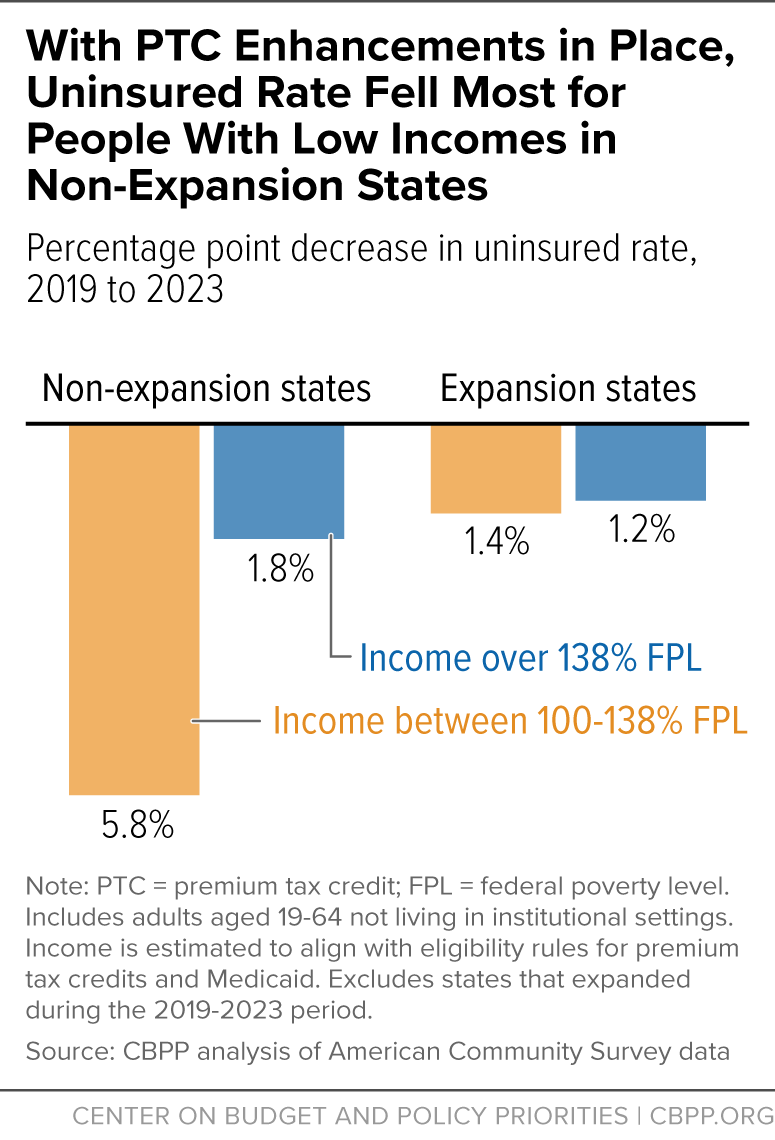
This includes many people in the ten states that have not adopted the ACA’s Medicaid expansion (Alabama, Florida, Georgia, Kansas, Mississippi, South Carolina, Tennessee, Texas, Wisconsin, and Wyoming). In these states, people with incomes from the poverty level to 138 percent FPL are eligible for premium credits (rather than Medicaid) and a $0 silver plan because of the enhancements. In 2025 more than 6.2 million people in non-expansion states with incomes in this range enrolled in marketplace plans. (Notably, in states that expanded Medicaid, people in the same economic circumstances get Medicaid coverage that generally doesn’t require them to pay a premium.)
The $0 premium plans have helped expand access to affordable coverage, progress that is at risk if they are eliminated. Looking just at non-expansion states, people with income between 100 and 138 percent FPL experienced a much more dramatic reduction in their uninsured rate than higher-income people in the same states (see chart). And people in non-expansion states across both income groups experienced greater declines in uninsurance than people in expansion states.
People in the lower-income group saw a greater reduction in their uninsured rates in non-expansion states because their counterparts in expansion states already had access to Medicaid. In other words, the PTC enhancements provided a valuable backstop in states that have not expanded Medicaid. And while people nationwide will lose out if the enhancements expire, people in non-expansion states will be especially hard hit. The number of people who are uninsured would increase 37 percent in the median non-expansion state, compared to 9 percent in the median expansion state, according to estimates by the Urban Institute.