BEYOND THE NUMBERS
Five Reasons HSAs Aren’t the Answer to the Health Care Affordability Crisis
People across the U.S. are struggling to access and afford health coverage and care, in part because the 2025 Republican reconciliation law slashed Medicaid, and Republicans in Congress refused to extend enhancements for premium tax credits that helped millions of people buy coverage on the Affordable Care Act marketplaces. In the wake of their actions that have worsened health care affordability, President Trump and some in Congress have pushed expanding health savings accounts (HSAs) — tax-advantaged accounts in which enrollees in certain health plans can set aside money for medical expenses — as a solution.
The last year’s Republican reconciliation law expanded HSA eligibility, which was originally limited to people with high-deductible health plans, to also include enrollees in bronze plans or catastrophic plans offered in the Affordable Care Act (ACA) marketplaces. Republicans have since put forward several additional ideas for vastly expanding HSAs.
The problem is that HSAs are not the answer to improving health care affordability for the people who need it most. Here are five reasons why:
1. HSAs mainly help people with higher incomes, while doing little for people struggling the most with health care costs.
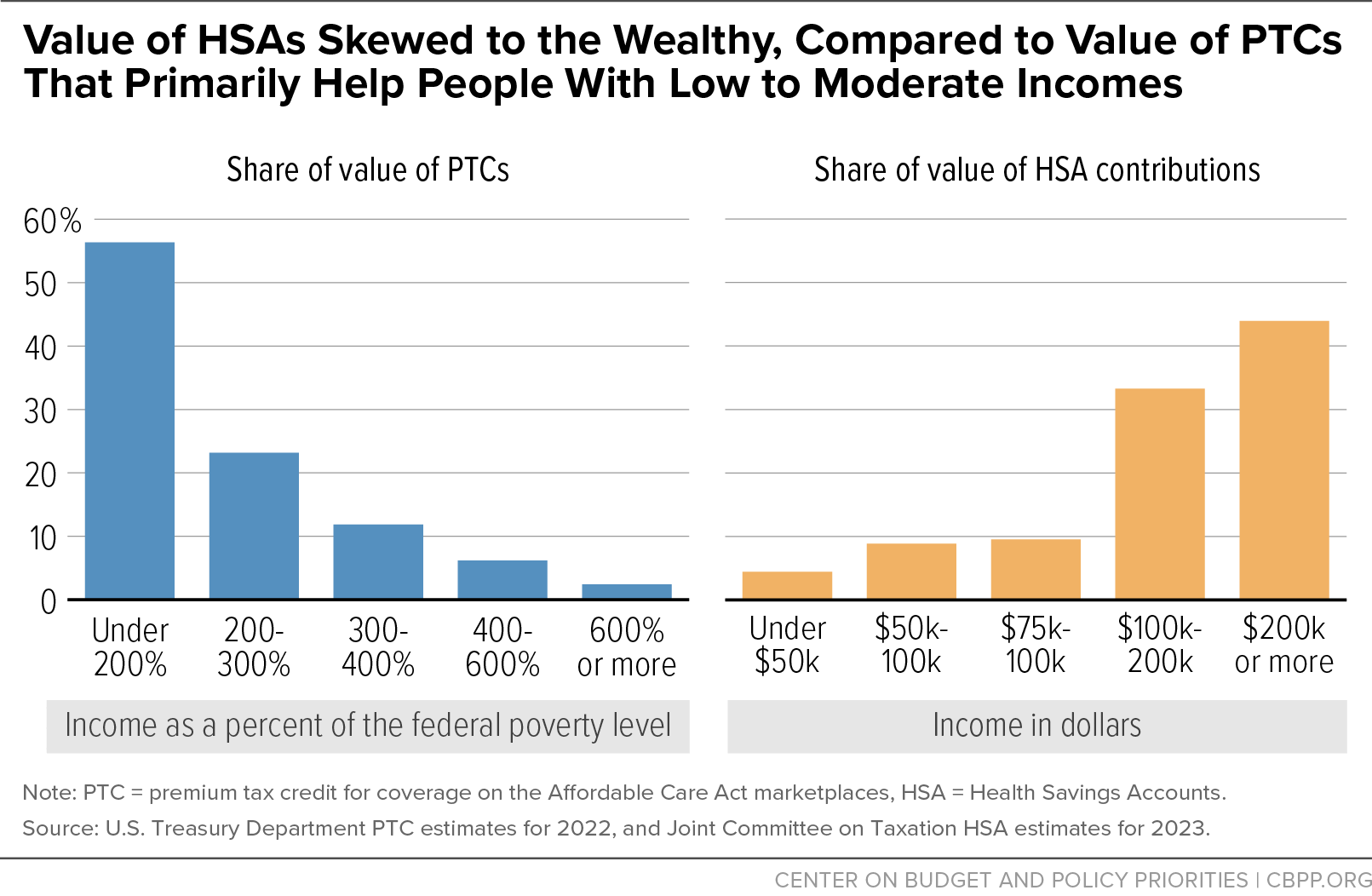
HSAs offer a triple tax advantage that primarily benefits higher-income people: (1) contributions are not taxed; (2) contributions can be invested in stocks and bonds and rolled over indefinitely, with tax-free earnings; and (3) withdrawals are not taxable if they are used for qualified medical expenses that occurred after the HSA was created.
Higher-income people are able to take greater advantage of these tax policies. They not only have more money to contribute and invest but also get a bigger tax benefit for each dollar contributed because they are in higher tax brackets. For example, a married couple making $800,000 saves 37 cents for each dollar contributed to an HSA, while a married couple making $30,000 saves only 12 cents.
Meanwhile, people with low and moderate incomes, who have the greatest difficulty affording health coverage, are less likely to have the cash to contribute to an HSA. They also receive a smaller per-dollar tax benefit for any contributions they are able to make.
2. HSAs benefit insurance companies and banks at the expense of people with low and moderate incomes.
Despite President Trump’s claims that HSAs are a tool to send “the money directly back to the people” instead of insurance companies, HSA providers often have financial relationships with insurance companies that may profit from the accounts. For many HSAs, including those offered with individual market plans, insurers promote a default or preferred HSA to their enrollees. In some cases, the insurer and the entity offering the HSA are subsidiaries of the same parent company (for example, UnitedHealthcare and Optum Bank) or work in close partnership (like Aetna and Inspira Financial), enabling them to steer enrollees into specific HSAs.
Many HSA providers offer enrollees, especially those with low incomes, a bad deal. People who anticipate needing to use their HSA funds to pay for medical care (instead of using their HSA as an investment vehicle because they have enough money to pay for medical care out of pocket) are unlikely to invest their HSA contributions. HSA providers often offer below-market interest rates for uninvested deposits.
The Consumer Financial Protection Bureau found that many HSA providers impose numerous charges, resulting in frequent complaints from consumers about junk and surprise fees. Employers often cover some of these fees when providing an HSA to employees, but when people buying coverage on their own get an HSA, they must pay the fees themselves.
In fact, people whose HSAs have low balances could pay more in fees than they gain in interest from the accounts. For example, a person maintaining a $1,000 balance for a year could accrue 50 cents or less in interest, while paying as much as $47 in fees.
3. HSAs exacerbate racial disparities in wealth.
Among people with private health coverage, Latino and Black people are about half as likely to have HSAs as white and Asian people. Moreover, HSA holders in disproportionately Black or Latino zip codes contribute smaller amounts and have lower balances, on average, than HSA holders in disproportionately white or Asian zip codes.
Against a backdrop of long-standing racial disparities in wealth that can be traced to discrimination in housing, banking, taxation, and other areas — a typical white family in 2022 had six times the wealth of a typical Black family and five times the wealth of a typical Latino family — HSAs provide preferential tax treatment that is disproportionately out of reach for Black and Latino people.
4. HSAs don’t protect people from major health care costs.
Unlike comprehensive insurance coverage, HSAs do not insulate enrollees from owing large amounts of money when they face an expensive health problem. The tax advantages of an HSA coupled with a high-deductible, bronze, or catastrophic health plan are no substitute for higher-quality insurance, like silver or higher-metal level plans available on the ACA marketplaces. In fact, high-deductible plans are associated with reduced or delayed health care and worse survival outcomes among cancer survivors.
5. The cost of HSAs crowds out policies that truly address affordability.
Even under current law, HSAs are projected to cost $182 billion in lost revenues from 2026 to 2035, and many proposals to expand HSAs would add significantly to that amount. Those federal resources could be put to far better use to help the people who struggle the most to afford health care.
For instance, policymakers could restore the premium tax credit (PTC) enhancements that reduced costs for millions of people in the marketplaces, including many gig workers and small business employees (see chart). Or they could undo the reconciliation law’s massive cuts in Medicaid, which will take coverage away from millions of people.