BEYOND THE NUMBERS
Analyzing the Census Bureau’s 2025 Poverty, Income, and Health Insurance Data
On Tuesday, September 15, the Census Bureau will release its 2025 Current Population Survey data on poverty, income, and health insurance. Additional health insurance data from the Census Bureau’s American Community Survey will follow later this year.
The data may show median income could rise, although a key measure of poverty may grow due to the rising cost of basic needs.
The 2025 data will be a key benchmark against which to measure the future effects of the harmful 2025 Republican reconciliation law which takes food assistance and health coverage away from millions of people, as the figures do not yet reflect the bulk of the law’s cuts.
We will be posting our analysis of the data here. See our paper on what to watch for in the 2025 data.
Harmful 2025 Republican Reconciliation Law Left Millions of Children out of Child Tax Credit Expansion, Failed to Address Inequality
Census figures released today show after-tax income inequality stands at its widest point in at least 17 years. Last year’s harmful Republican reconciliation law didn’t help. Rather than pushing against inequality, it prioritized maintaining and expanding tax cuts that favor the wealthy over policies that help families with low and moderate incomes, such as expanding the Child Tax Credit for the 19 million children left out of the full credit because their families’ incomes are too low.
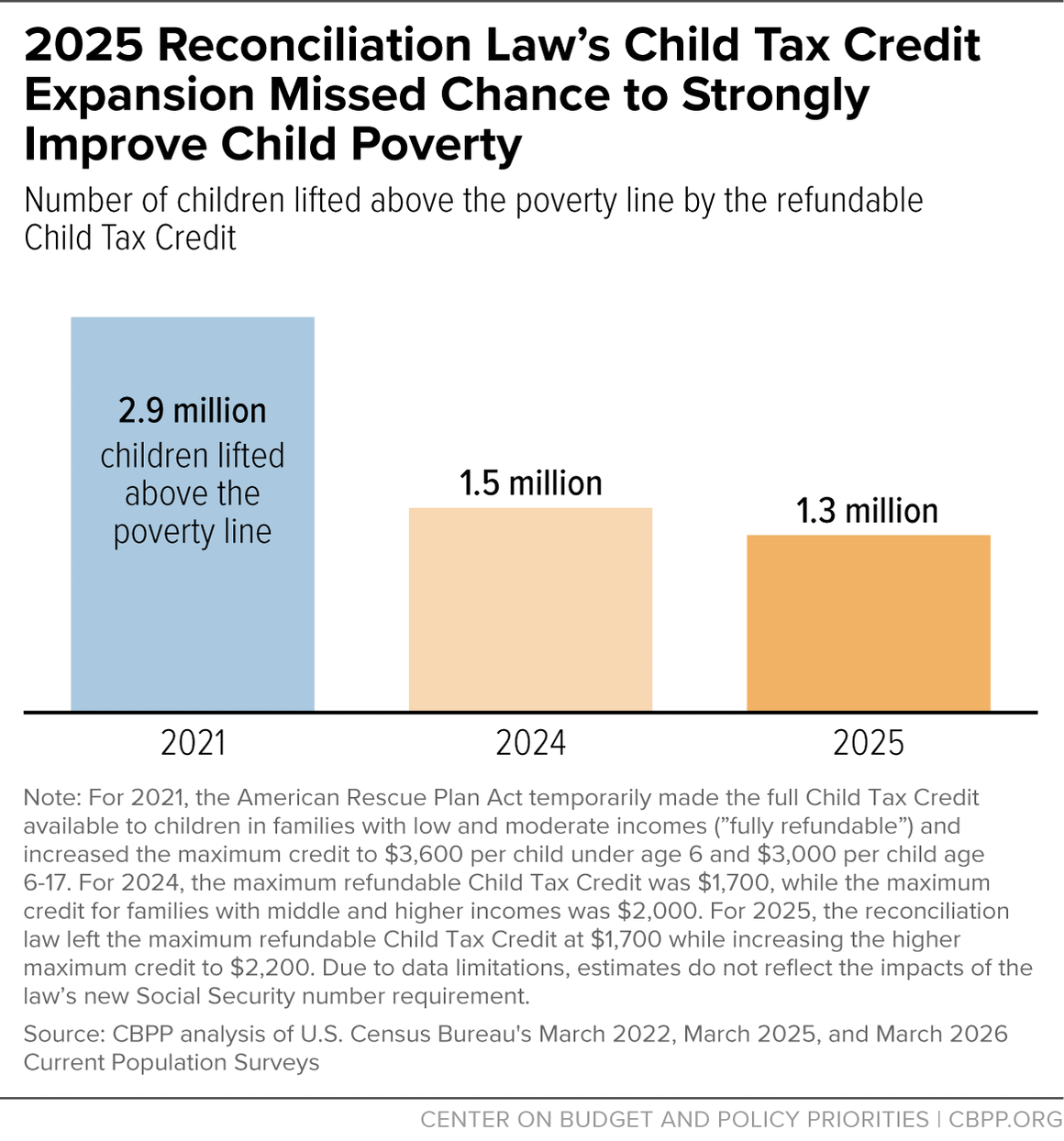
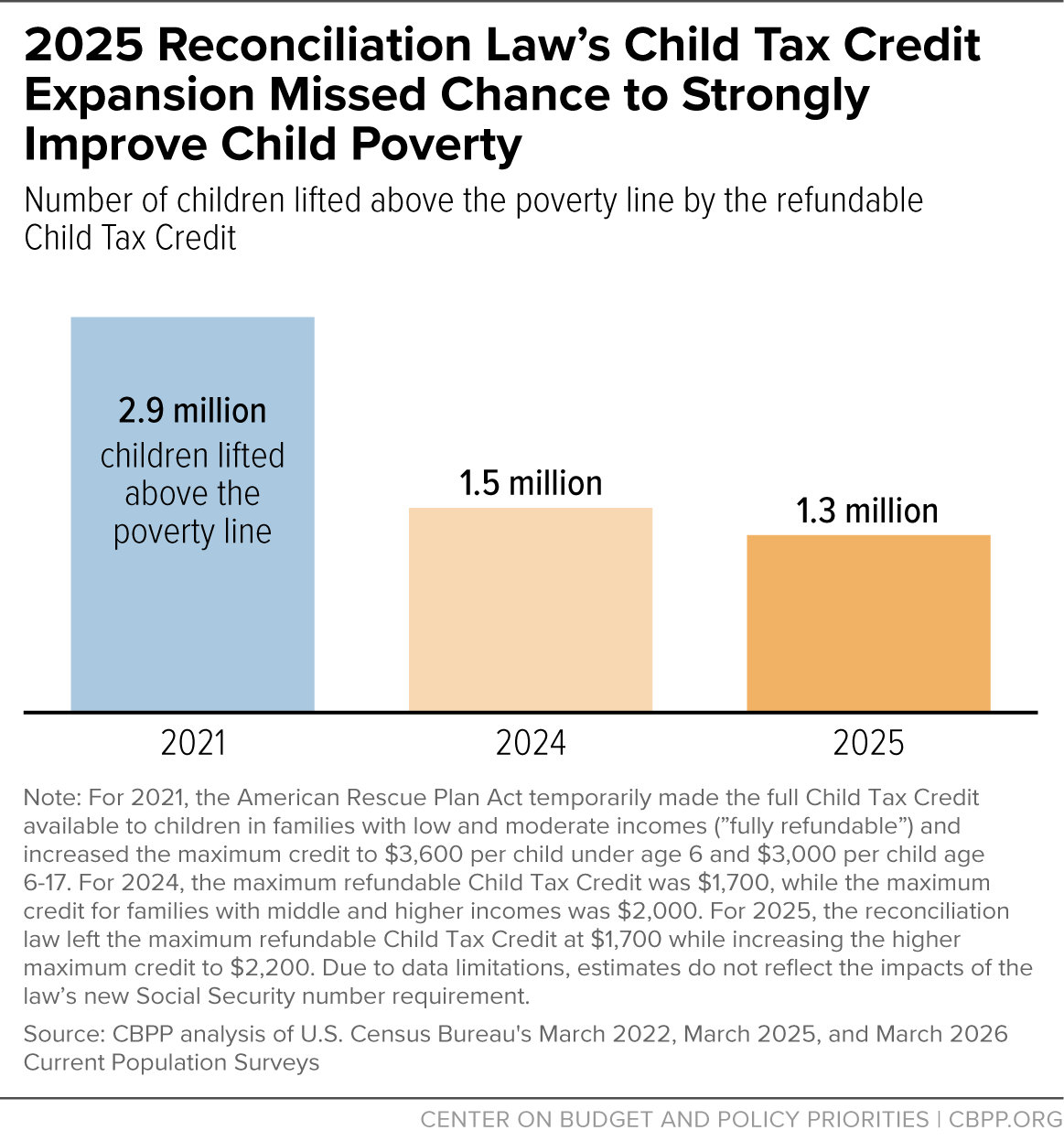
The refundable portion of the Child Tax Credit — the amount that families with lower incomes receive as a refund if their credit exceeds their tax liability — lifted 1.3 million children above the poverty line in 2025, according to Census data released today. That is substantial, but it’s no better than 2024 (1.5 million). It’s also a far cry from 2021, when Census said the significantly expanded and fully refundable Child Tax Credit lifted 2.9 million children above the poverty line.
The 2025 Republican reconciliation law made no improvements to the flawed structure of the Child Tax Credit, which gives children in families with lower incomes a smaller credit than families with middle and higher incomes. But the law increased the maximum credit for families with middle and higher incomes from $2,000 to $2,200. That’s backwards, and a major missed opportunity to help families with children who are struggling the most to afford the basics: we estimated last year that if the full $2,200 credit had been made available to these families, 1.4 million more children would have been lifted above the poverty line.
While not reflected in today’s data, the law also takes the credit away from children who are U.S. citizens or have a lawful immigration status under the legislation’s new requirement that at least one of their parents also has a Social Security number — one of many targeted attacks on families that include immigrants that will only add to hardships.
The income figures show a high-income household with income at the 90th percentile of all U.S. households made 10.01 times as much after taxes as households with incomes at the 10th percentile in 2025, the widest such gap in the 17 years for which these after-tax figures are available.
Despite Recent Threats to Census Bureau’s Independence, Signs Suggest Today’s Data Release Follows Standard Procedures
Today’s release comes as the Census Bureau faces data quality challenges and threats to the agency’s capacity and independence, risking erosion of public trust in federal data. But several reassuring signs suggest that today’s data uphold the Census Bureau’s traditional standards for transparency and rigor.
In August, a report published to the Census Bureau’s website and cited by the White House as evidence of debunked claims of election fraud raised alarm among public data users. Experts flagged the report as highly unusual in several ways — there were no named authors or measures of uncertainty, little discussion of data limitations, and the methodology was described in vague terms. Independent reporting suggests that staff at a think tank aligned with the Trump Administration, not career Census Bureau staff, were involved in producing this report.
Around the same time, the Commerce Department, the Census Bureau’s parent agency, appears to have quietly altered its Scientific Integrity directive to remove language prohibiting political influence over federal data.
Unlike the August report, today’s release of Current Population Survey data included standard measures of uncertainty such as margins of error and was accompanied by the usual reports with named authors, detailed methodologies, and an investigation of nonresponse bias.
Last week, the Administration proposed a regulatory change to exclude some immigrants from the next decennial census (used for apportioning representation in Congress and allocating federal funding among other purposes), a move seemingly at odds with long-standing legal understandings of the 14th Amendment’s requirement that the decennial census count the “whole number of persons.” The proposed rule would also prohibit the Census Bureau from including questions on race, ethnicity, and sexual orientation in the decennial census questionnaire; the decennial count has captured data on race since the first census in 1790.
Beyond the overtly political report and proposed rule, the Census Bureau faces several challenges affecting data availability, quality, and timeliness, including falling response rates, budget uncertainty, and a restrictive new privacy directive.
- At the Administration’s direction, the Census Bureau discontinued collection of long-standing survey measures of food insecurity in 2025 as well as a variety of data on sexual orientation and gender identity. Ending data collection on food insecurity just as the nation’s most important food assistance program, SNAP, is being cut is deeply troubling. These losses are part of a larger pattern of canceled or reduced federal data collection since January 2025.
- From January 2025 to July 2026, the Census Bureau lost 20 percent of its full-time positions, including 33 percent of its senior staff, due largely to the actions of the Trump Administration’s Department of Government Efficiency (DOGE).
- The privacy directive, which came from political appointees outside the agency and was widely criticized by demographers and data users, will prevent Census from releasing data with as much detail as in the past. The directive forced the Census Bureau to delay the release of detailed income, poverty, and health coverage data from the American Community Survey that were expected to be published this week. The delay especially affects smaller demographic groups and smaller geographies such as rural communities.
To ensure reliable data on the nation’s progress and needs going forward, Congress must support the Bureau’s independence by providing oversight and preserving guardrails, and strengthen budgetary support for Census Bureau data collection.
Republican Reconciliation Law Makes Deep Cuts to Assistance That Lifted Millions Out of Poverty in 2025
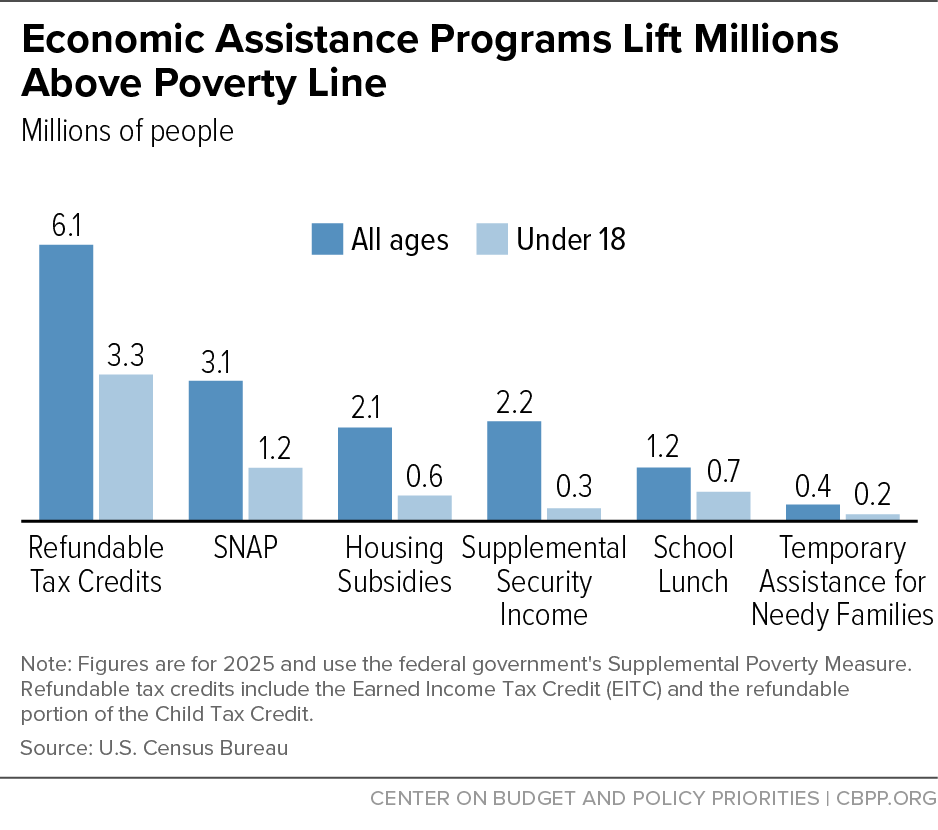
Last year’s Republican reconciliation law made deep cuts to SNAP; in 2025, SNAP lifted 3.1 million people, including 1.2 million children, above the poverty line according to today’s Census data. These figures use the Supplemental Poverty Measure, or SPM, which counts income from non-cash benefits and tax credits; the SPM threshold is adjusted annually for changes in the amount a typical family spends on basic needs.
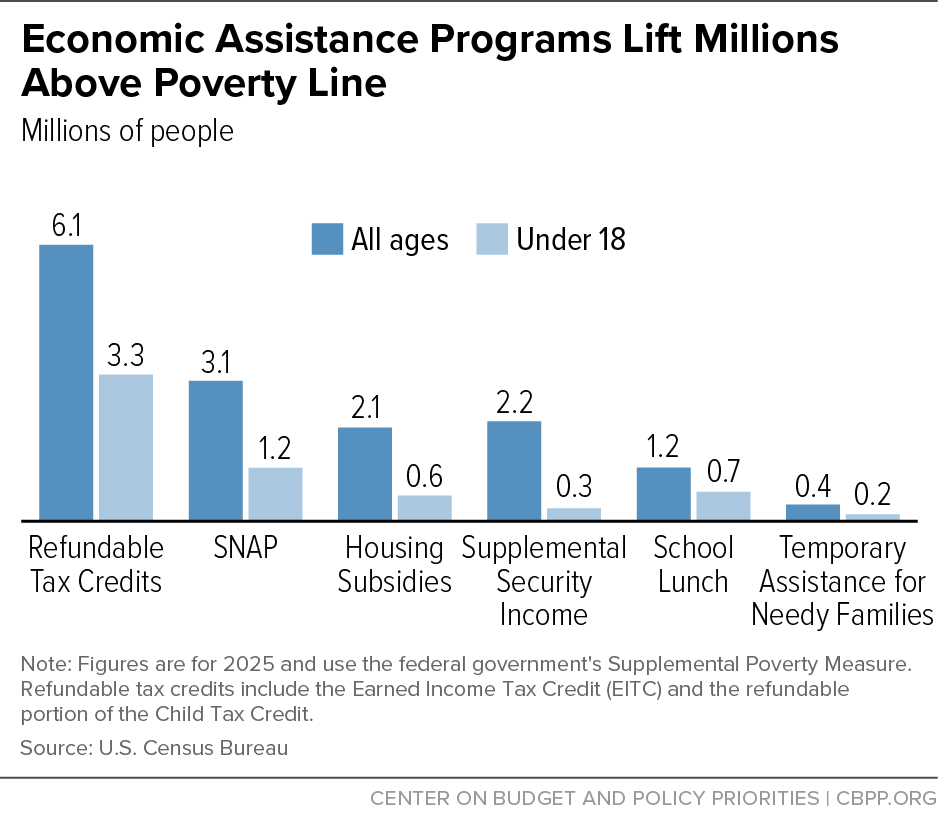
For the most part, today’s poverty data don’t yet reflect the 2025 reconciliation law’s deep cuts to food assistance and health care, but they do show the sizable role these programs have played in protecting people from poverty and providing basic health coverage.
The reconciliation law’s cuts to SNAP – the largest cut in the program’s history – are eroding the program’s poverty-reducing effectiveness. SNAP participation has fallen sharply since July 2025, even among groups such as children whom the law’s supporters claimed would not be harmed.
The number of people losing food assistance could continue to mount as states create more red tape for families trying to apply for or renew their benefits. Even more disturbingly, unless Congress acts, in October 2027 most states will be required to pay between 5 and 15 percent of SNAP benefit costs for the first time in the history of the program. The number of people who lose food assistance could dramatically increase if some states decide they are unable or unwilling to pay these new costs and, therefore, end their SNAP programs entirely.
Medicaid and Affordable Care Act marketplace coverage also reduce poverty as measured by the SPM because they reduce families’ out-of-pocket health care costs. But millions of people are expected to lose Medicaid coverage under the 2025 reconciliation law in the coming years. In addition, millions of people have lost ACA marketplace coverage because of premium spikes after Republicans refused to extend the premium tax credit enhancements and many of those who retained coverage are now paying significantly higher premiums, lowering the amount they have to spend on other necessities.
Uninsurance Rate Held Steady in 2025 CPS Data
The portion of people in the U.S. who lack health coverage remained stable at 7.9 percent in 2025, statistically unchanged from 2024, according to Current Population Survey (CPS) data released today by the Census Bureau. But these data precede the implementation of provisions in the harmful Republican 2025 reconciliation law and other Trump Administration policies that are taking away health coverage and leaving people without insurance in 2026 and beyond.
The steady uninsured rate in the CPS is consistent with the National Health Interview Survey (NHIS), which found no statistically significant change from 2024 to 2025. It is also consistent with the Department of Health and Human Services (HHS) projection of no change in the uninsured rate between 2024 and 2025.

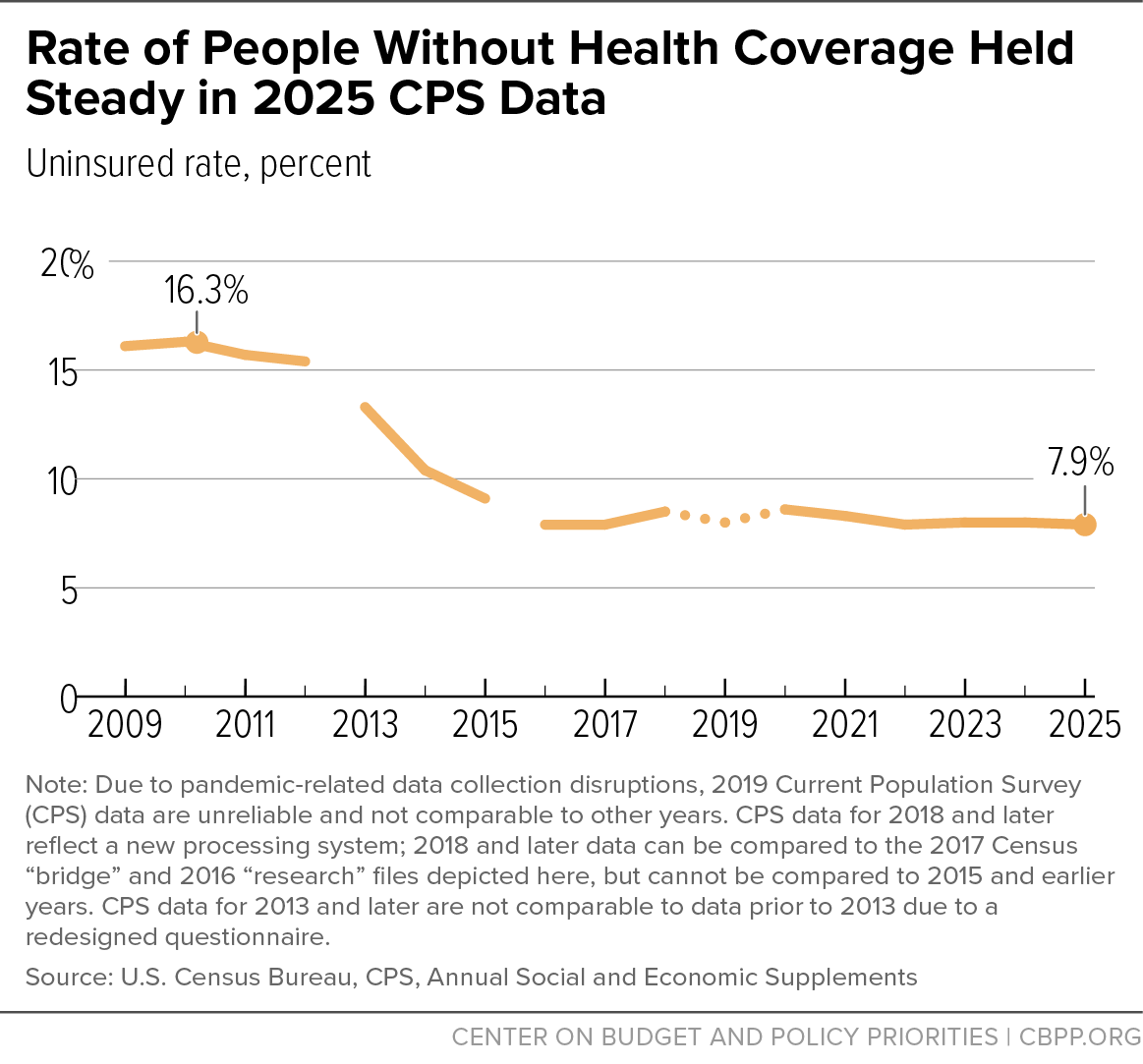
After the Affordable Care Act (ACA) was enacted in 2010, the uninsured rate fell by roughly half as millions found affordable coverage through the ACA marketplace and Medicaid expansion.
Recent steps taken by congressional Republicans and the Trump Administration are now almost certainly driving up the uninsured rate. The Congressional Budget Office projects about 15 million people will become uninsured by 2034 because of the 2025 reconciliation law and other recent Administration policy changes.
HHS data already show that 3 million fewer people were enrolled in ACA marketplace coverage in February 2026, compared to February 2025. The decline came soon after Republicans failed to renew premium tax credit enhancements, which helped people afford health coverage on the marketplace, and people’s premium costs spiked. Other data show that among those who selected plans during the 2026 open enrollment period, more people selected less-generous, higher-deductible bronze plans.
Meanwhile, the Republican reconciliation law’s Medicaid cuts begin this year. The largest cuts hit in 2027, when a policy that takes Medicaid coverage away from people who do not meet a harsh work requirement goes into effect. Other harmful Medicaid and marketplace policies from the Republican reconciliation law and new Trump Administration regulations will take effect at various points over the 2026-2028 period.
Statement: New Census Data Underscore Importance of Food Assistance and Health Coverage Access
At a moment when the cuts enacted in last year’s harmful Republican reconciliation law have begun to take away food assistance and health coverage from millions of people, today’s Census data are a reminder of the important role Medicaid, Affordable Care Act (ACA) marketplace coverage, and SNAP can play in helping families afford the basics — and why the cuts are so misguided.
In 2025, poverty showed signs of improvement, incomes rose as wage gains outpaced inflation, and the uninsured rate remained at historic lows. Even with this progress, some 44 million people — or more than 1 in 8 people overall — lived in families with incomes below the poverty line, 27 million people had no health insurance, and income inequality after taxes stood at its highest in at least 17 years.
Basic needs programs were key to raising incomes above the poverty line and ensuring people could access the health care they needed. Refundable tax credits lifted 6 million people above the poverty line and SNAP lifted more than 3 million people above the poverty line, while the ACA marketplace and Medicaid provided much needed coverage to tens of millions of people.
But these data do not reflect the impact of recent rising inflation or most of the cuts to food assistance and health coverage enacted in the 2025 Republican reconciliation law. That law made the largest cuts to SNAP and Medicaid in our nation's history and failed to extend the premium tax credit enhancements that made the ACA marketplace more affordable and successful in expanding coverage and lowering costs. These cuts are already taking food assistance and health care away from millions of people who need it, driving up poverty and hardship.
If the President and Republicans in Congress had not enacted these deep cuts — and had not taken other steps driving up prices — families would be better off. Moreover, policymakers should have built on the modest progress in 2025 to make gains against poverty and to expand access to affordable coverage.
While the official poverty measure showed child poverty at a record low in 2025, poverty overall and among children as measured by the preferred Supplemental Poverty Measure dropped to its lowest in 2021, when pandemic relief drove down child poverty to 5.1 percent. That showed we have policy tools — like an expanded Child Tax Credit and help for people who lose their jobs — available to reduce poverty markedly. We should use them.
Authors