

SNAP Implementation Must Adequately Protect Tribal Citizens
No one in our country should go hungry, and SNAP (the Supplemental Nutrition Assistance Program) has been our nation’s most effective anti-hunger program for decades. However, sweeping cuts to SNAP enacted in the harmful 2025 Republican reconciliation law take away the help people and families with low incomes need to put food on the table amid the rising cost of living.[1]
These changes particularly threaten food assistance for Tribal citizens, who currently experience food insecurity at the highest rates of any major demographic group.[2] Since the founding of the United States, Tribes have faced systemic barriers to food security due to federal mismanagement of Tribal lands, forced relocation away from traditional foods, the rural nature of many reservations, and other factors. As a result, Tribal citizens are particularly likely to need food assistance and, like all SNAP recipients, face cuts in SNAP benefits under the reconciliation law. However, they have one critical protection in the law: Tribal citizens are categorically excepted from the SNAP work requirement, regardless of where they live. State administrators should work to ensure the new exception is implemented correctly and completely.
State SNAP administrators are required to implement this exception for Tribal citizens regardless of whether there are federally recognized Tribes within the borders of their state. Doing so is a straightforward step administrators can take to mitigate the reconciliation law’s harm.
This categorical exception to the work requirement is new. SNAP administrators must understand how to administer it to maximize the number of eligible Tribal citizens receiving basic nutrition assistance. SNAP administrators may be unfamiliar with the unique nature of Tribes, so it is critical that they understand who qualifies as a Tribal citizen for the exception and how they can work with Tribes to ensure all who qualify receive the exception. Additionally, proper implementation of the categorical exception will require administrators to adopt federal statutory rules and policies that ensure Tribal citizens are not overburdened by requirements to verify their Tribal citizenship, resulting in delay or denial of the exception.
Tribal Citizens and Access to Food Assistance
Understanding Tribal Citizenship
Tribal citizens are a unique group in the United States because they are both citizens of the United States and citizens of a sovereign Tribal government with which the United States has a political relationship. Inclusion in the demographic group is not based on race or ethnicity, but on the relationship between someone’s Tribe and the United States. In federal Indian law, this relationship is the core of the federal trust responsibility — an obligation that the United States, as the colonizing power, owes to the Tribes and their citizens.
The SNAP work requirement exception for Tribal citizens also includes Urban Indians,[3] a term broadly used in Tribal policy to describe Tribal citizens who live away from their reservations. While a Tribal citizen’s choice to leave the reservation may be a result of preference or economic necessity, there is a long history of the United States forcibly removing Tribal children from their families or relocating families away from their reservation as part of the former, official policy of the United States to terminate Tribes. These acts have lingering effects, with 87 percent of Tribal citizens still living away from the reservations of their communities and, as a result, away from the support systems that Tribes are able to provide.[4]
State administrators must now be prepared to verify the eligibility of Tribal citizens for the categorical exception from work requirements, despite many administrators being unfamiliar with the issues impacting Tribes or not knowing that citizens of federally recognized Tribes live in their states.
SNAP’s Role in the Federal Trust Responsibility to Tribes
The provision of food assistance to Tribes has a long history, dating to the founding of the United States.[5] In many cases, this provision of food assistance came after the United States — through force, treaty, or both — took the lands necessary for Tribes to feed their communities in their traditional ways. As a result, the United States has an obligation to ensure that it meets the federal trust responsibility as it relates to nutrition for Tribal citizens. While SNAP and most food assistance programs are broadly available to people based on need, these programs also partially fulfill the United States’ unique obligations to Tribes. As with certain other federal programs that require states to carry out a portion of the federal trust responsibility (like Medicaid), states and other municipalities are sometimes responsible for the administration of federal programs that benefit Tribes.[6]
The Exception for Tribal Citizens and How it Must Be Implemented
Under the new provision of the 2025 reconciliation law, individuals who meet the definition of Indian, Urban Indian, or Californian Indian under the Indian Health Care Improvement Act are excepted from SNAP’s harsh work requirement.[7] All citizens of federally recognized Indian Tribes will qualify as “Indians” under the statutory definition. Relatively few applicants may not be citizens of Indian Tribes but would qualify as a statutorily defined “Urban Indian” or a “California Indian.” The reconciliation law uses the following definitions:[8]
- Indian. An individual is considered an “Indian” if they are a member of an Indian Tribe, band, nation, or other organized group or community, including Alaska Native villages, groups, or regional or village corporations established under the Alaska Native Claims Settlement Act, that is recognized as eligible for federal programs and services provided to Indians because of their status as Indians.[9]
- Urban Indian.[10] An individual is considered an “Urban Indian” if they reside in an urban center[11] and meet at least one of the following:
- They are a member of a Tribe, band, or other organized group of Indians;
- They are an Eskimo, Aleut, or other Alaska Native;
- They are determined to be an Indian under regulations issued by the Secretary of the Interior; or
- They are determined to be an Indian under regulations issued by the Secretary of Health and Human Services.
- California Indian. An individual is considered a “California Indian” if they meet at least one of the following:
- They are a member of a federally recognized Indian Tribe;
- They are a descendant of an Indian who resided in California on June 1, 1852, [12] provided they are a member of the Indian community served by a local Indian Health Service program and are regarded as an Indian by their community;
- They are an Indian who holds trust interests in public domain, national forest, or reservation allotments in California; or
- They are an Indian of California listed in the plans for distribution of assets of rancherias and reservations under the Act of August 18, 1958,[13] including their descendants.
Best Practices for Verifying Tribal Citizenship and Qualification for the Exception
Since the categorical exception for Tribal members is new in SNAP administration, many administrators may be unfamiliar with the nature of Tribal citizenship and what documentation, if any, they should require for those seeking to recognize their status.[14]
It is important for administrators to understand that Tribes have sovereign authority to control their membership rolls, and states cannot require a Tribe to take any verification action for their citizens or share their tribal rolls. First, as a matter of law, Tribes are sovereign and, unless Congress says otherwise, states have no ability to regulate Tribes or compel their participation in any regulatory scheme. Second, as a practical matter, the categorical exception does not require that a SNAP applicant be a citizen of a Tribe in that state. Since there are currently 575 federally recognized Indian Tribes across the United States,[15] it would be impractical for every Tribe to provide any type of consistent verification.
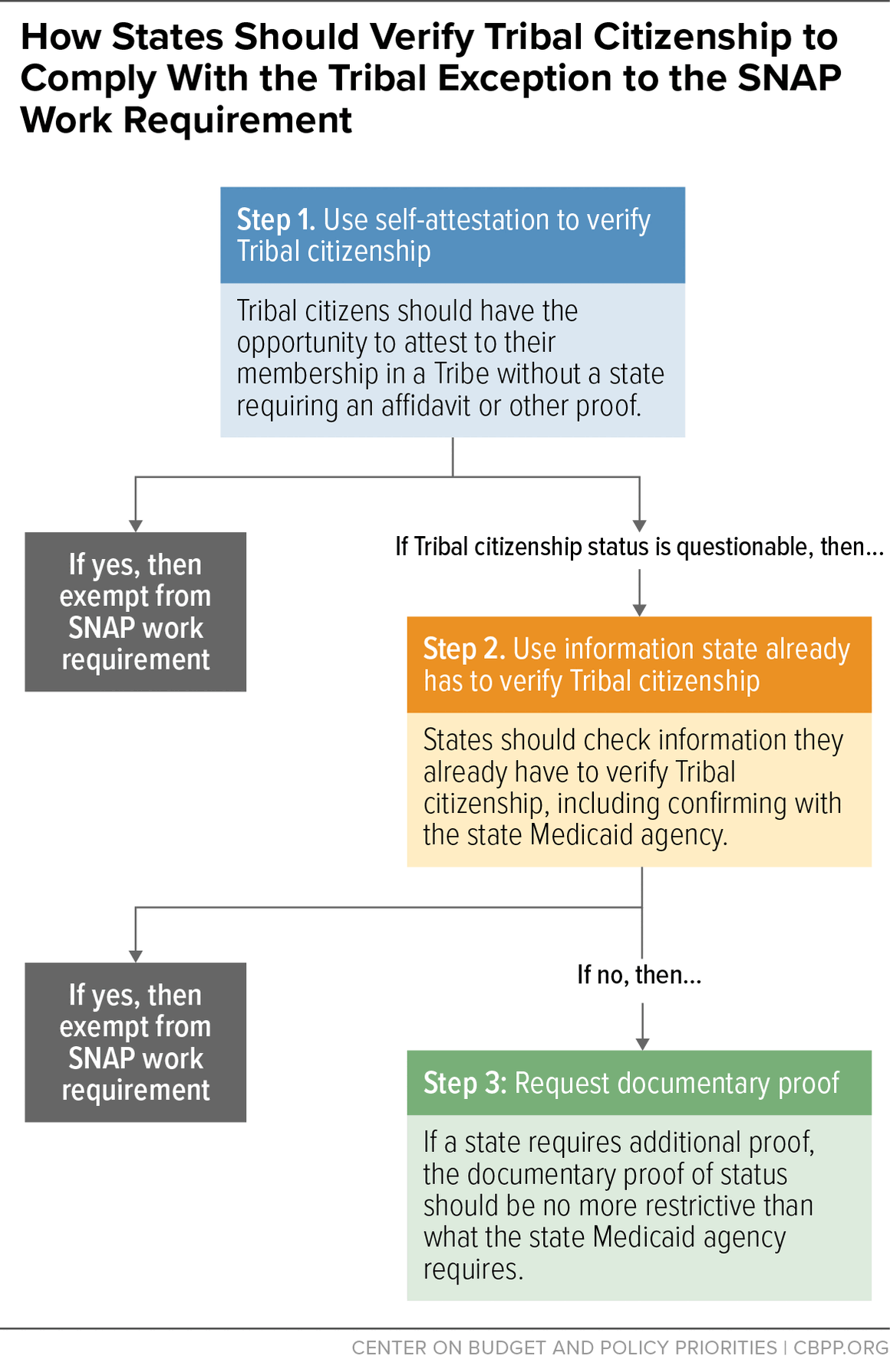
States should instead allow Tribal citizens to attest to their Tribal status. If that information is questionable, SNAP administrators may check Tribal status with Medicaid,[16] which has for years required the occasional verification of Tribal status, either for the purpose of enrolling the individual in a specific Medicaid plan for Tribal citizens or to qualify the state for the full federal reimbursement of costs for services provided at Indian Health Services or Tribal health facilities.[17]
Some Tribal citizens enrolled in Medicaid may not have their tribal status listed in Medicaid records and some state SNAP administrators may not be able to access the Medicaid information. If the information provided by the SNAP applicant or enrollee is questionable and the SNAP caseworker cannot verify Tribal status through Medicaid records, a state can require some documentary proof of status. These include documents commonly accepted by state Medicaid agencies:
- A Tribal identification card or enrollment card (not all Tribes issue identification);
- A Certificate of Degree of Indian Blood (CIB or CDIB) issued by the Bureau of Indian Affairs (BIA);[18]
- A Tribal census document;
- Any other document identifying affiliation with the Tribe.
For Tribal citizens living in urban areas in particular, seeking support from their Tribal government can be challenging, especially when an individual is facing hard times or a family crisis. A Tribal citizen who qualifies for SNAP benefits, for example, may not have the resources or ability to connect with the administration of their Tribe, which may be across the country, have limited staff capacity, or have a complex bureaucracy. As a result, allowing individual Tribal citizens to attest to their Tribal status would ensure the greatest number of Tribal citizens are able to qualify for the categorical exception.
End Notes
[1] Dottie Rosenbaum et al., “SNAP Tracker: People Are Losing Food Assistance as the Republican Megabill Is Implemented” CBPP, May 18, 2026, https://www.cbpp.org/research/federal-tax/republican-megabill-trades-essential-support-to-low-income-people-for-skewed.
[2] Laura J. Hales and Alisha Coleman-Jensen, “Household food insecurity across race and ethnicity in the United States, 2016–21,” U.S. Department of Agriculture (USDA), Economic Research Service, Report No. EIB-269, April 2024, https://www.ers.usda.gov/sites/default/files/_laserfiche/publications/108905/EIB-269.pdf?v=96292.
[3] While the Indian Health Care Improvement Act, 25 U.S.C. § 1602, defines “Urban Indian” as “any individual who resides in an urban center” and meets the criteria for the term “Indian“ in that act, the term is used more broadly in the context of Indian policy to refer to Tribal citizens who live off reservation. The term often indicates that individual Tribal citizens may not have active ties with the administration of the Tribe of their citizenship. The National Urban Indian Family Coalition, “Urban Indian America: The Status of American Indian & Alaska Native Children and Families Today,” January 8, 2008, https://www.aecf.org/resources/urban-indian-america.
[4] The Annie E. Casey Foundation, “A Look at the Latest Population Trends for Native Children,” August 22, 2023, https://www.aecf.org/blog/a-look-at-the-latest-population-trends-for-native-children.
[5] Sara Usha Maillacheruvu, “The Historical Detriments of Food Insecurity in Native Communities,” CBPP, October 4, 2022, https://www.cbpp.org/research/food-assistance/the-historical-determinants-of-food-insecurity-in-native-communities.
[6] Jay Tomkus, “States Should Protect Medicaid Funding in Indian Country,” CBPP, November 21, 2025, https://www.cbpp.org/blog/states-should-protect-medicaid-funding-in-indian-country.
[7] Food and Nutrition Service, USDA., “Supplemental Nutrition Assistance Program (SNAP) Provisions of the One Big Beautiful Bill Act of 2025 – ABAWD Exceptions – Implementation Memorandum,” October 3, 2025, https://www.fns.usda.gov/snap/obbb-abawd-exemptions-implementation.
[8] An Act To provide for reconciliation pursuant to title II of H. Con. Res. 14., 2025, P.L. 119-21, 139 Stat. 81; 25 U.S.C. § 1603(13).
[9] Indian Entities Recognized by and Eligible to Receive Services From the United States Bureau of Indian Affairs, 89 Fed. Reg. 944, January 8, 2024, https://www.federalregister.gov/documents/2024/01/08/2024-00109/indian-entities-recognized-by-and-eligible-to-receive-services-from-the-united-states-bureau-of.
[10] This statutory definition of the term “Urban Indian” applies to the exception under the provisions of the 2025 reconciliation law, though the term is used in Tribal policy discourse to refer more broadly to Tribal citizens who live away from the reservation of their Tribe. In most cases, a Tribal citizen who may refer to themselves as an “Urban Indian” will qualify for the exception under the definition of “Indian.”
[11] An “urban center” is defined as “any community that has a sufficient urban Indian population with unmet health needs to warrant assistance” as determined by the Secretary of Health and Human Services. 25 U.S.C. § 1603(27).
[12] An Act Authorizing the attorney general of the State of California to bring suit in the Court of Claims on behalf of the Indians of California, 1928, 45 Stat. 602, https://www.govinfo.gov/content/pkg/STATUTE-45/pdf/STATUTE-45-Pg602.pdf#page=1.
[13] An Act to Provide for the distribution of the land and assets of certain Indian rancherias and reservations in California, and for other purposes, 1958, P.L. 85-671, 72 Stat. 619, https://www.govinfo.gov/content/pkg/STATUTE-72/pdf/STATUTE-72-Pg619.pdf.
[14] See Food and Nutrition Service, USDA, “SNAP Provisions of the One Big Beautiful Bill Act of 2025: Time Limit Changes – QAs #1,” June 11, 2026, https://www.fna.usda.gov/obbb/snap/time-limit-changes-qas1.
[15] Indian Entities Recognized by and Eligible to Receive Services From the United States Bureau of Indian Affairs, 89 Fed. Reg. 944, January 8, 2024, https://www.federalregister.gov/documents/2024/01/08/2024-00109/indian-entities-recognized-by-and-eligible-to-receive-services-from-the-united-states-bureau-of.
[16] Tomkus.
[17] “Medicaid & CHIP for American Indians and Alaska Natives,” HealthCare.gov, accessed June 4, 2026, https://www.healthcare.gov/american-indians-alaska-natives/medicaid-chip/#:~:text=Verifying%20your%20tribal%20status.
[18] Agency Information Collection Activities; Certificate of Indian or Alaska Native Blood, 85 Fed. Reg. 61768, September 30, 2020, https://www.govinfo.gov/content/pkg/FR-2020-09-30/pdf/2020-21558.pdf.