

A Call to Expand the Child Tax Credit to Reach More Hispanic Families
Hispanic Heritage Month is an annual celebration to honor the history, culture, and contributions of the Hispanic community.[1] Hispanic people make up the nation’s second largest racial or ethnic group — accounting for nearly one-fifth of the U.S. population — and have had significant influence in the U.S. economy and culture including language, sports, and music.[2]
This Hispanic Heritage Month, we are highlighting two important ways policymakers can make the Child Tax Credit reach more Hispanic families. They should make the credit fully available to families with low or no earnings in a given year — often called “full refundability” — and restore eligibility for the credit to children with Individual Tax Identification Numbers (ITINs). At least 675,000 children (across all races and ethnicities) aren’t eligible for a Social Security number (SSN) but may be claimed as tax dependents using an ITIN.[3]
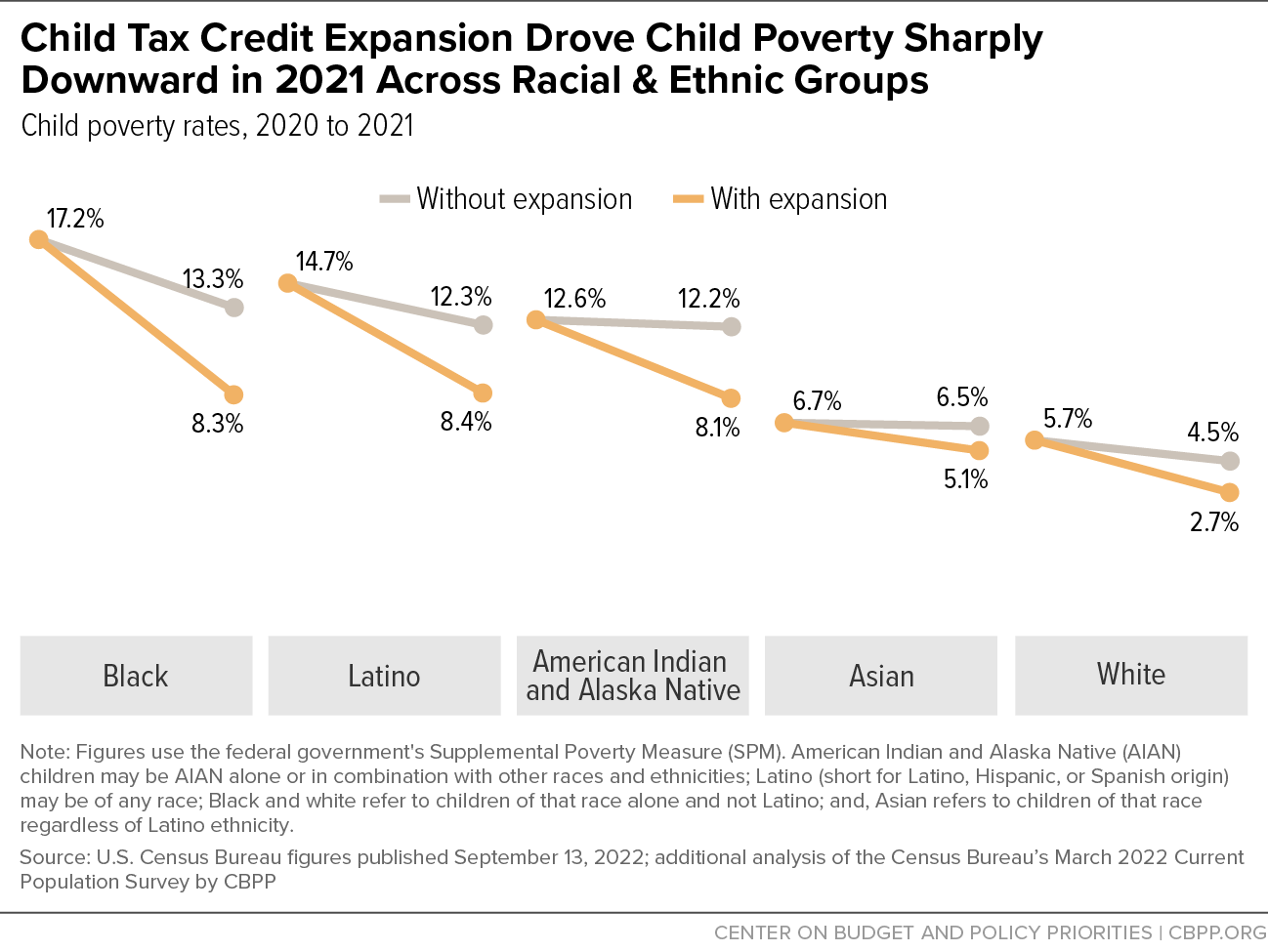
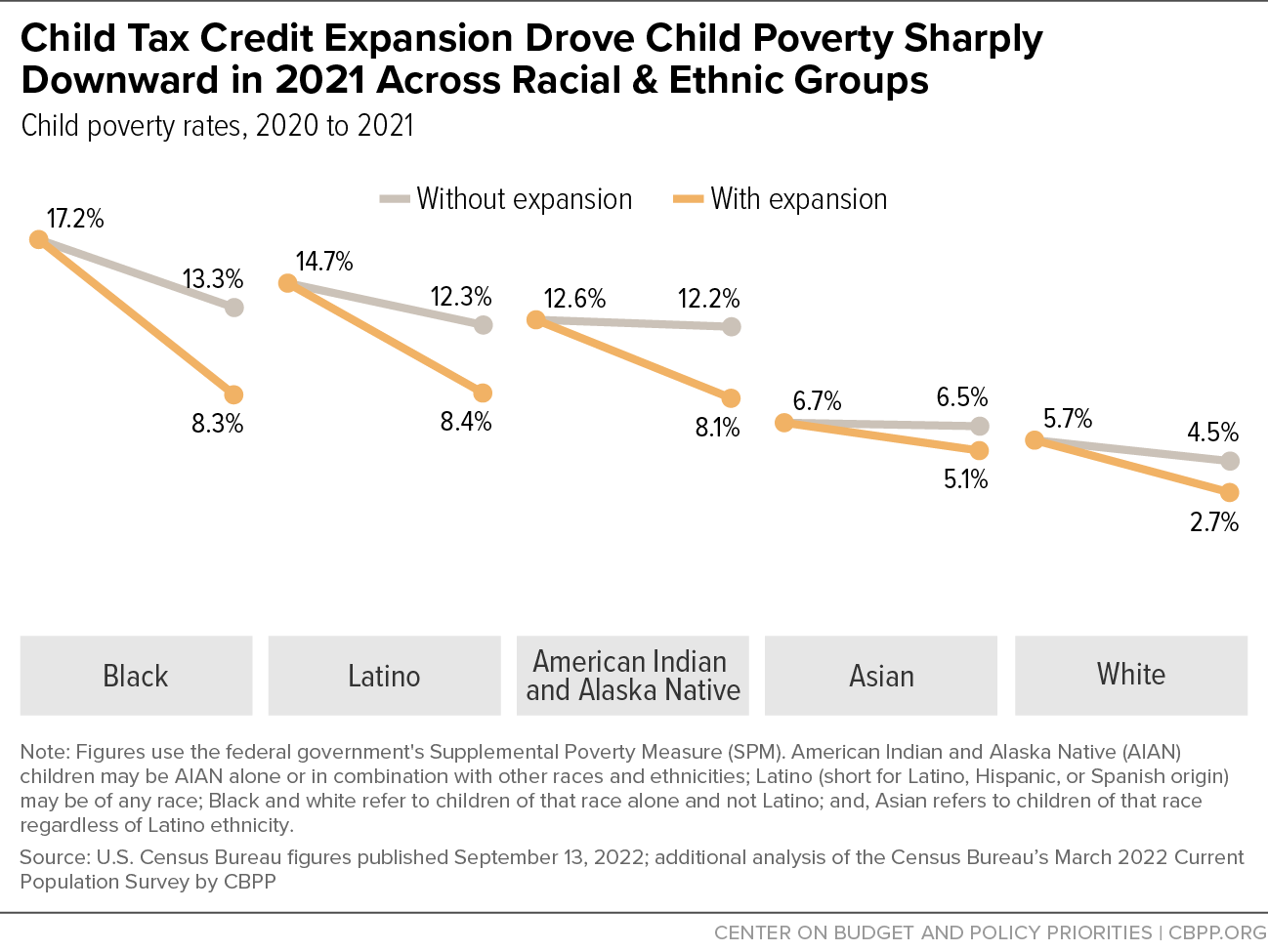
The American Rescue Plan took the first of these two steps — expanding the Child Tax Credit and making it fully refundable; it was only effective in 2021 and the results in that year were striking. Its provision making the Child Tax Credit fully refundable helped drive a historic reduction in child poverty, including a decline in the rate for Hispanic children from 14.7 percent in 2020 to 8.4 percent in 2021.[4] (See Figure 1.)
Before 2018, children with ITINs were eligible for the Child Tax Credit. Eligibility was restricted in the 2017 tax cut law and, unfortunately, the Rescue Plan did not reinstate those children’s eligibility.
Hispanic people make indelible positive contributions to our nation. However, persistent, intersecting systems of oppression and neglect in education, health care, housing, employment, and criminal justice, coupled with racial, ethnic, and anti-immigrant discrimination, produce inequitable conditions that have negatively impacted economic mobility and increased hardship for Hispanic people and other people of color. As a part of its work to help address the economic hardship stemming from these inequities, Congress should expand the Child Tax Credit. In addition, restoring full refundability and eligibility for children with ITINs would strengthen financial security for many Hispanic families and children across the nation.
Congress Should Make Full Child Tax Credit Available to Families With Low and No Earnings
Before the Rescue Plan an estimated 27 million children — including about half of all Hispanic children — were excluded from receiving the full credit because of its upside-down policy design in which children in the poorest households get only a partial credit or none at all.[5] The Rescue Plan fixed this design flaw but only for 2021. Making the credit fully refundable on an ongoing basis is critical for ensuring that those most in need of support can get the same credit as children in families with higher incomes.
Consider a Hispanic mother raising a newborn and 6-year-old and earning $20,000 per year as a part-time cashier. Under current law, she would receive a total credit of $2,685, well short of the $4,000 maximum credit ($2,000 per child). In contrast, if the credit were made fully refundable (and the maximum credit remained at $2,000 per child), her credit would increase by $1,315, giving her more help in making ends meet and resources to support her children’s development.
A fully refundable credit at its current $2,000-per-child level would have a substantial anti-poverty impact. For example, if the $2,000 Child Tax Credit were fully refundable, an additional half a million Hispanic children would be lifted above the poverty line.[6] Full refundability is an important step toward correcting this upside-down policy design to help make sure that the children who need help the most benefit from the full credit.
Congress Should Restore Eligibility to Children With ITINs
In addition to full refundability, Congress should restore Child Tax Credit eligibility to the at least 675,000 children who are ineligible for SSNs but may be claimed as dependents using ITINs. While more than 9 in 10 Hispanic children are U.S. citizens or have an immigration status that makes them eligible for an SSN, Hispanic children still make up a disproportionate share of children without SSNs.[7]
Children with ITINs were eligible for the Child Tax Credit prior to 2018, but the 2017 tax law stripped them of access to the credit through 2025. Although the American Rescue Plan temporarily expanded the credit in 2021, the expansion failed to restore eligibility to children with ITINs. While the temporary expansion of the Child Tax Credit benefited many Hispanic families, the exclusion of children without SSNs limited the number of Hispanic children it lifted above the poverty line and families it helped afford basic needs such as food, utilities, and rent. Making children with ITINs eligible for the credit again would help their families meet basic needs and decrease hardship while better positioning these children, and in turn the future economy, for later success.[8]
The Child Tax Credit has been found to improve the school performance, health, and future earnings of children in low-income families — issues that are important across racial and ethnic backgrounds and citizenship statuses. Restoring Child Tax Credit eligibility to children with ITINs and making the credit fully available to families with low or no incomes would be effective and sound investments in Hispanic communities and the future of the nation.
End Notes
[1] This report uses the term “Hispanic” to refer to people of any race who identify as being of Hispanic, Latino, or Spanish origin, consistent with U.S. Census Bureau usage. This language does not necessarily reflect how everyone that is part of this community would describe themselves. For example, gender-inclusive terms like Latinx and Latine can also be used to refer to this population. These terms have emerged in recent years to represent the diversity of gender identities and expressions that are present in the community.
[2] Cary Funk and Mark Hugo Lopez, “A Brief Statistical Portrait of U.S. Hispanics,” Pew Research Center, June 14, 2022, https://www.pewresearch.org/science/2022/06/14/a-brief-statistical-portrait-of-u-s-hispanics/.
[3] Jeffrey S. Passel and D’Vera Cohn, “U.S. Unauthorized Immigrant Total Dips to Lowest Level in a Decade,” Pew Research Center, November 27, 2018, https://www.pewresearch.org/hispanic/2018/11/27/u-s-unauthorized-immigrant-total-dips-to-lowest-level-in-a-decade/.
[4] Kaylee Burns, Liana Fox, and Danielle Wilson, “Expansions to Child Tax Credit Contributed to 46% Decline in Child Poverty Since 2020,” U.S. Census Bureau, September 13, 2022, https://www.census.gov/library/stories/2022/09/record-drop-in-child-poverty.html.
[5] Chuck Marr, Kris Cox, and Arloc Sherman, “Recovery Package Should Permanently Include Families With Low Incomes in Full Child Tax Credit,” CBPP, September 7, 2021, https://www.cbpp.org/research/federal-tax/recovery-package-should-permanently-include-families-with-low-incomes-in-full.
[6] Estimate is based on the 2018 economy using the U.S. Census Bureau’s March 2019 Current Population Survey, with incomes inflated to 2022 and applying 2022 tax parameters. The 2018 data are the most recent reliable data that are likely to resemble 2022 in terms of employment and other benefits and to be free of major data collection problems associated with surveys gathered during the pandemic. Due to limitations of the Census data, the figures do not reflect IRS rules that require children to have a Social Security number to qualify for the Child Tax Credit.
[7] CBPP analysis of the Census Bureau’s March 2022 Current Population Survey; UnidosUS, “Hispanic Children and the Child Tax Credit,” June 2021, https://www.unidosus.org/wp-content/uploads/2021/08/unidosus_hispanicchildrenandctc.pdf.
[8] Chuck Marr et al., “Congress Should Adopt American Families Plan’s Permanent Expansions of Child Tax Credit and EITC, Make Additional Provisions Permanent,” CBPP, May 24, 2021, https://www.cbpp.org/research/federal-tax/congress-should-adopt-american-families-plans-permanent-expansions-of-child.