

New Proposal Shows Congress Can Enact Guardrails to Ensure a Deal Is a Deal for 2026 Funding
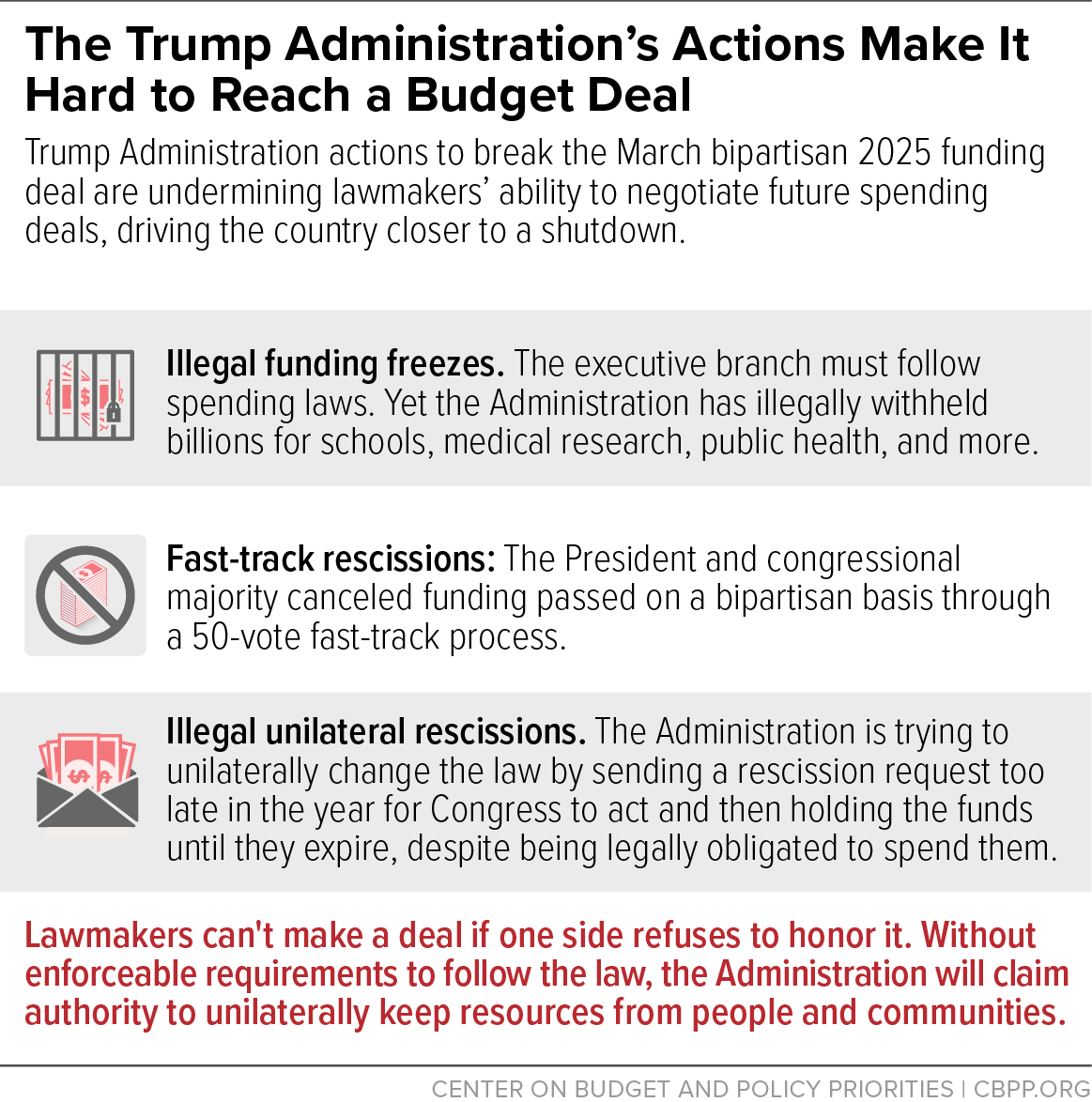
The Trump Administration has taken many steps to undermine the bipartisan deal on fiscal year 2025 funding since the President signed it into law in March, including through illegal funding freezes, fast-track rescissions, and illegal unilateral rescissions.[1] (See Figure 1.) These efforts have created an enormous roadblock for Congress to reach a bipartisan funding agreement for 2026 because lawmakers need to know that if they reach a deal, it will be kept. But there is a path forward for Democrats and Republicans in Congress to work together to curb these Administration abuses and reach a bipartisan agreement.
Senator Patty Murray and Representative Rosa DeLauro, the senior Democrats on the Senate and House Appropriations Committees, have put forward a short-term funding bill that would address the Administration’s actions that have undermined the 2025 funding agreement and limit the Administration’s ability to break future funding deals.[2] By providing greater confidence that the funds Congress provides on a bipartisan basis in a full-year 2026 funding deal will actually reach the communities they are intended to assist — including the types of funding the Administration sought to withhold in 2025, such as for cancer research, early learning and K-12 education, home energy assistance for low-income households, and disaster preparedness — these common-sense proposals would lay the groundwork for bipartisan legislation to fund the government in 2026 and beyond. Republicans in Congress should be willing to include proposals like these in a 2026 funding agreement to ensure it is implemented consistent with the deal they reach.

Blocking the Administration’s Illegal Unilateral Rescissions in 2025; Preventing Them in 2026
The Administration has publicly declared it can, through so-called “pocket rescissions,” unilaterally cancel funding by formally sending a fast-track rescission request to Congress late in the fiscal year — as it did when it recently sent Congress a nearly $5 billion rescission proposal affecting foreign aid funds — and then withholding the funds until they expire, regardless of congressional action.[3] The Administration’s claim that it can unilaterally cancel funds in this manner indicates that it will likely attempt “pocket rescissions” of funds provided in a 2026 funding deal as well.
The Murray-DeLauro proposal would block the Administration’s illegal attempt to unilaterally rescind 2025 funds by extending the expiration date of all funds the Administration has proposed to unilaterally rescind. This extension would ensure that Congress has time to consider the requested rescissions. If Congress doesn’t approve the rescissions, the Administration would be required to use the funds for the purposes Congress provided them.
In addition, the proposal would prevent the Administration from attempting illegal unilateral rescissions in 2026 and subsequent years by taking away its ability to withhold funds in the last three months of the fiscal year. This would preempt Administration claims that it can bypass Congress by sending it a late-in-the-year rescission proposal and then withholding the funds until they expire.
Requiring as Many Votes in the Senate to Cut Funding as to Provide It
Funding deals require 60 Senate votes, meaning they are generally bipartisan compromises. But earlier this year, for the first time ever, the President and Republicans in Congress utilized a fast-track process that requires only 51 Senate votes to rescind 2025 funding that Congress had provided in the March bipartisan funding agreement.[4]
The Murray-DeLauro proposal would prohibit such fast-track rescissions for 2026 and subsequent years, instead requiring that any changes to a bipartisan 2026 funding deal meet the same 60-vote standard as the bipartisan agreement needed to provide the funding in the first place. Such a provision should raise no concerns for the Administration unless it intends to use the fast-track rescission process, with congressional Republican backing, to change a 2026 funding deal without bipartisan support.
The proposal also would partially undo the fast-track cuts enacted by Republicans in July, which eliminated federal funding for local community public radio and television stations that had been provided in advance for 2026 and 2027. This provision would reestablish the decades-long funding relationship between the federal government and domestic community radio and TV stations, which has a long history of bipartisan support, by restoring funding Congress had approved for 2026. This funding is particularly important for smaller, rural, and isolated communities with limited alternatives for local news and public alerts.[5]
Preserving Funding Illegally Withheld by the Administration and Inhibiting Further Illegal Funding Freezes in 2026
In addition to using fast-track and unilateral rescissions to try to cut funding provided by Congress in the March agreement, the Administration has engaged in a series of illegal funding freezes, delaying or blocking the use of funds that the deal lawfully provided.
One primary way the Administration has sought to freeze funding is by abusing the apportionment process — a spending safeguard intended to ensure that appropriated funding is put to its lawful purpose and that funds are spent when they should be throughout the year. Instead, the Administration has used this process to hold back or restrict the use of the funds Congress provided.
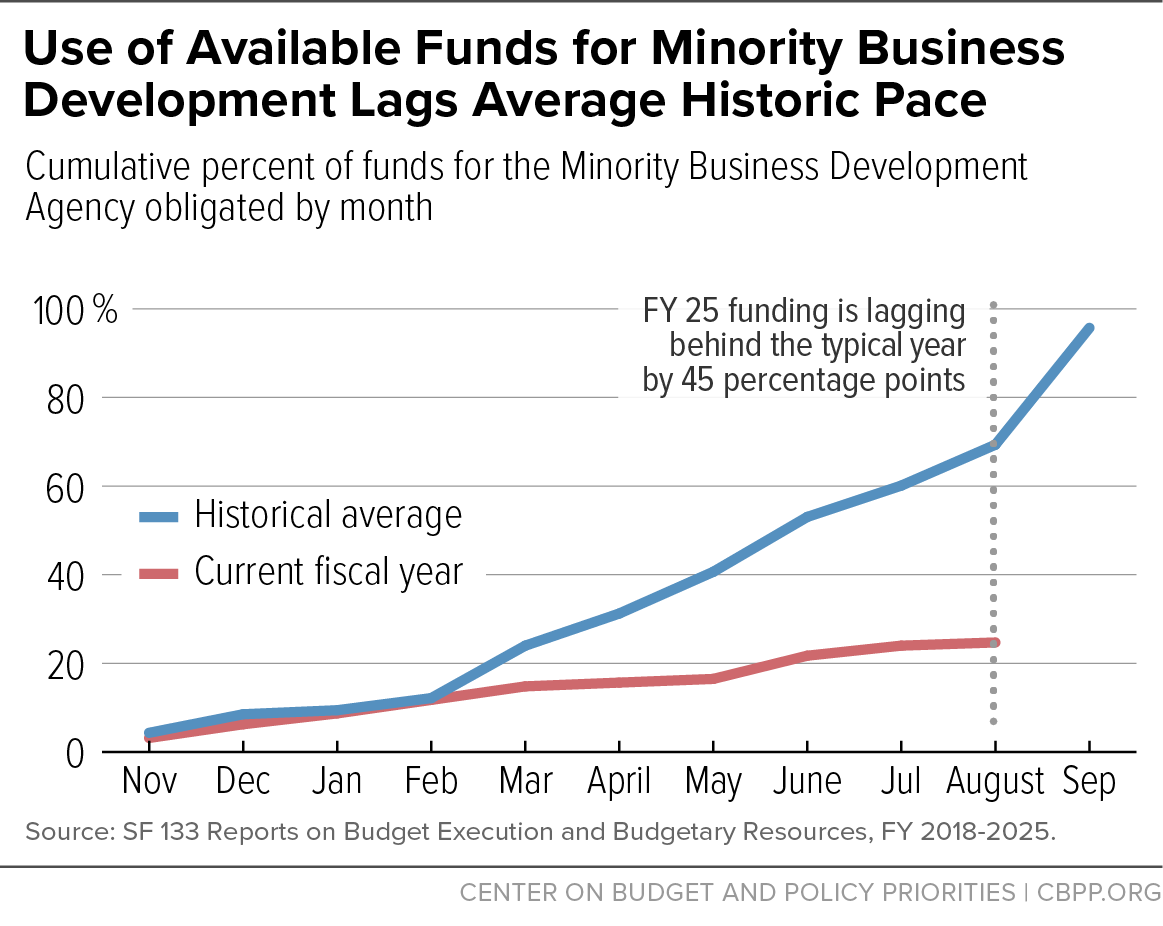
As a CBPP report showed, the Administration often made funding available for use only very late in the fiscal year, if at all, and layered on secret conditions before funds could be made available for use.[6] For example, for public health programs at the Centers for Disease Control and Prevention targeting health promotion and chronic disease and injury prevention, the Administration did not apportion most of the funds until only a little more than two months remained in the fiscal year, and even then it imposed additional requirements before funds would be made available. And for the Commerce Department’s Minority Business Development Agency (MBDA), which promotes the growth and global competitiveness of historically underserved business enterprises, the Administration did not apportion funds following the March funding agreement until September 16, when less than two weeks remained to use the funds.[7] The delay has significantly slowed the obligation of MBDA’s funding. (See Figure 2.)
In fact, a CBPP analysis found that, in 20 of the 25 accounts with the slowest pace of funding commitments through July compared to historical patterns, the Administration apportioned them with restrictive conditions or failed to provide an apportionment at all.[8]

The nonpartisan Government Accountability Office and federal courts have repeatedly determined that the Administration’s disruptions and restrictions have violated funding laws.[9] Even in cases where the Administration has seemingly relented, the delays have had real consequences for the families, communities, and state and local governments that rely on those funds and jeopardized investments in schools, early education, disaster resilience, cutting-edge medical and scientific research, and other critical national priorities.[10] And with only days remaining in the fiscal year, it is still unclear how much funding the Administration will cause to expire through earlier unprecedented terminations of grants and contracts and illegal withholding of funds.
The Murray-DeLauro proposal would address these abuses regarding 2025 funding and make it harder for the Administration to attempt illegal funding freezes in the future. First, for any 2025 funding that is slated to expire at the end of September but that the Administration failed to make fully available to use without additional conditions by early July, the deadline for using those funds would be extended by one year, with all preconditions lifted. This would prevent funds from expiring due to the Administration’s unlawful actions.
For 2026 and beyond, the proposal would ensure that all funds provided by Congress are made fully available to use at least 90 days before they would otherwise expire, preventing the Administration from repeating its 2025 abuses.
The proposal also includes provisions to stop certain program-specific abuses or attempts to evade Congress’s clear intent. For example, it would instruct the Administration to make available the funding Congress provides for activities and projects supported by the National Science Foundation (NSF) at least at the rate needed to avoid disrupting research facilities and grant awards. The Administration has targeted NSF through thousands of grant terminations, large reductions in graduate fellows and academics serving at the agency, and politicized award decisions, and its 2026 budget would slash the NSF’s budget by more than half.[11] Another provision would ensure that the Administration allocates Energy Department funding across programs in line with congressional directives, preempting Administration proposals to severely reduce programs such as those focused on energy efficiency and renewable energy.
These provisions would protect funding in key areas at risk of impoundment, based on the Administration’s behavior to date and its budget proposals, while providing a model that could be extended to other areas.
Conclusion
Perhaps the biggest challenge for Congress in crafting a 2026 funding deal is that the Administration has spent the past six months repeatedly working to undermine the 2025 funding agreement the President himself signed into law. There is little reason for members of Congress to vote for a funding agreement unless they know that a deal is a deal — meaning the Administration won’t unilaterally change funding levels after the agreement is made.
The common-sense provisions included in the Murray-DeLauro short-term spending proposal are important steps to ensure regular order, so that Congress and the Administration follow the normal rules that were in place before the Administration broke them over this past year. These provisions do not advance specific policy objectives; they simply limit the ability of the Administration to undermine future funding deals. Thus, Republicans in Congress should be willing to support the inclusion of provisions like them in any 2026 funding agreement — unless they plan to engage or assist in further abuse of power and misuse of funding, with damaging consequences for the country.
End Notes
[1] Brendan Duke et al., “2026 Appropriations Must Protect Against Further Partisan Cuts and Illegal Withholding of Funds,” CBPP, September 4, 2025, CBPP, https://www.cbpp.org/research/federal-budget/2026-appropriations-must-protect-against-further-partisan-cuts-and-illegal.
[2] For the text of the proposal, see https://democrats-appropriations.house.gov/sites/evo-subsites/democrats-appropriations.house.gov/files/evo-media-document/cr0917h.PDF.
[3] As the Office of Management and Budget wrote on X: “A pocket rescission is a standard rescission, but one sent by the President to Congress with fewer than 45 days left in the fiscal year. In this case, Congress can choose not to vote, to rescind, or continue the funds—it doesn’t change the outcome.” September 3, 2025, 4:47 PM, https://x.com/WHOMB/status/1963342991315046833. This claim is wholly inconsistent with the law. See David Super and Sam Berger, “‘Pocket Rescissions’ Are Illegal,” CBPP, July 30, 2025, https://www.cbpp.org/research/federal-budget/pocket-rescissions-are-illegal.
[4] Jacob Leibenluft and Devin O’Connor, “Rescission Package Would Sabotage Recent Funding Deal, Poison Future Negotiations,” CBPP, July 15, 2025, https://www.cbpp.org/blog/rescission-package-would-sabotage-recent-funding-deal-poison-future-negotiations.
[5] Devin O’Connor, Sam Berger, and Jacob Leibenluft, “Trump Rescission Proposal Builds on Illegal Impoundments, Would Undermine Future Funding Deals,” CBPP, July 10, 2025, https://www.cbpp.org/research/federal-budget/trump-rescission-proposal-builds-on-illegal-impoundments-would-undermine.
[6] Devin O’Connor and Joe Carlile, “Trump Administration Abused Spending Safeguards to Advance Its Agenda — and Illegally Hid Its Actions,” CBPP, September 5, 2025, https://www.cbpp.org/research/federal-budget/trump-administration-abused-spending-safeguards-to-advance-its-agenda-and.
[7] OpenOMB, “Minority Business Development,” File ID 11468927, September 16, 2025, https://openomb.org/file/11468927.
[8] Joe Carlile and Devin O’Connor, “New Data Show Trump Administration’s Illegal, Targeted Withholding of Funds,” CBPP, September 18, 2025, https://www.cbpp.org/research/federal-budget/new-data-show-trump-administrations-illegal-targeted-withholding-of-funds.
[9] For a few recent examples, see Government Accountability Office (GAO), “B337202, Department of Health and Human Services—Application of Impoundment Control Act to Availability of Head Start Program Funds,” July 22, 2025, https://www.gao.gov/assets/890/880226.pdf; GAO, “B-337203: Department of Health and Human Services—National Institutes of Health—Application of Impoundment Control Act to Availability of Funds for Grants,” August 5, 2025, https://www.gao.gov/products/b-337203; GAO, “B-337204.1, Department of Homeland Security–Application of the Impoundment Control Act to Federal Emergency Management Agency Fiscal Year 2025 Federal Assistance Appropriations,” September 15, 2025, https://www.gao.gov/assets/890/881507.pdf; Katherine Tully-McManus, “Trump-backed judge rules administration’s withholding of funds illegal,” Politico, August 11, 2025, https://www.politico.com/news/2025/08/11/judge-administrations-withholding-funds-illegal-00504650; and Chris Cameron, “Federal Judge Blocks Trump’s Move to Cut $4.9 Billion in Foreign Aid,” New York Times, September 4, 2025, https://www.nytimes.com/2025/09/04/us/politics/trump-foreign-aid-cuts-judge.html.
[10] For example, see “Trump Administration Delays Millions for TRIO Programs,” Inside Higher Education, September 12, 2025, https://www.insidehighered.com/news/government/student-aid-policy/2025/09/12/trump-administration-withholds-millions-trio-programs.
[11] Jeffrey Mervis, “Under Trump, NSF faces worst crisis in its 75-year history,” Science, September 19, 2025, https://www.science.org/content/article/under-trump-nsf-faces-worst-crisis-its-75-year-history.