

How Many Weeks of Unemployment Compensation Are Available?
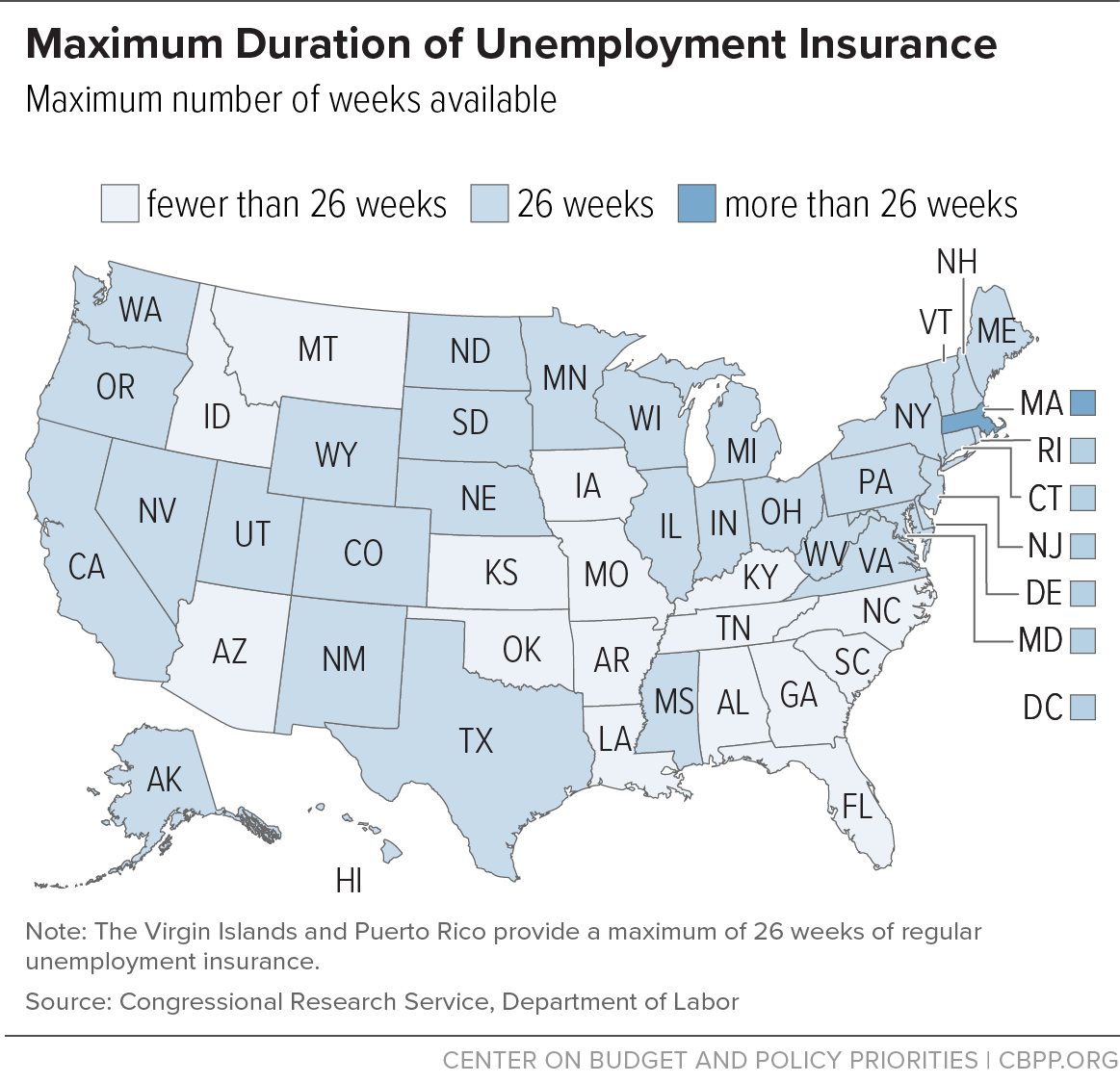
Workers in most states are eligible for up to 26 weeks of benefits from the regular state-funded unemployment compensation program, although 16 states provide fewer weeks, and one provides more. Extended Benefits (EB) are not triggered on in any state.
The federal-state unemployment insurance (UI) system helps many people who have lost their jobs by temporarily replacing part of their wages. (See “Policy Basics: Unemployment Insurance.”) Under certain circumstances, unemployed workers who exhaust their regular state-funded unemployment benefits before they can find work can receive additional weeks of benefits.
The map below shows the maximum number of weeks of benefits that are currently available in each state.
Massachusetts, which currently provides a maximum of 30 weeks, is now the only state providing more than 26 weeks. (Massachusetts provides 26 weeks of UI except when the annual unemployment rate in any of its metropolitan areas exceeds 5.1 percent, which has occurred since April 2025.)
State laws in many states with a maximum of 26 weeks employ a sliding scale based on a worker’s earnings history to determine the maximum number of weeks for which an individual worker qualifies. Except in Connecticut, the District of Columbia, Hawai’i, Illinois, Maryland, New Hampshire, New York, West Virginia, and Puerto Rico, which offer a uniform maximum duration of 26 weeks for all recipients, many UI recipients’ maximum is fewer than 26 weeks.
The states providing fewer than the standard 26-week maximum for all UI recipients include:
- Montana, which provides up to 24 weeks of UI;
- Missouri and South Carolina, which provide up to 20 weeks of UI;
- Iowa, which provides up to 16 weeks of UI; and
- Arkansas, which provides up to 12 weeks of UI.

The remaining eleven states periodically update their maximum weeks of UI available based on changes in the state’s unemployment rate:
- Alabama currently provides up to 14 weeks of UI for new enrollees, with an additional five-week extension for those enrolled in a state-approved training program;
- Florida currently provides up to 12 weeks of UI;
- Georgia currently provides up to 14 weeks;
- Idaho currently provides up to 21 weeks for new enrollees based on its August 2025 unemployment rate;
- Kentucky currently provides up to 16 weeks based on its average unemployment rate of less than 6.5 percent from the past six months;
- Louisiana currently provides up to 12 weeks based on its average unemployment rate of less than 5 percent;
- Arizona currently provides up to 24 weeks based on its average unemployment rate of less than 5 percent;
- Kansas currently provides up to 16 weeks based on its average unemployment rate of less than 5 percent;
- Oklahoma currently provides up to 16 weeks based on its average unemployment insurance claims being less than 5,000;
- North Carolina currently provides up to 12 weeks; and
- Tennessee currently provides up to 12 weeks based on its average unemployment rate of less than 5.5 percent.
The table below shows the latest three-month average unemployment rate for the period ending in April for each state, as well as the maximum number of weeks of benefits currently available through regular UI. EB is currently not triggered on in any state. When EB is triggered, the number of weeks of extended benefits in a state equals the smaller of 13 weeks or half the maximum number of weeks of regular UI in the state — unless the state has adopted an alternative trigger that adds up to seven more weeks when the state’s unemployment rate triggers on a High Unemployment Period (HUP), allowing up to 20 weeks of EB (but no more than 80 percent of the number of regular weeks the state provides).
| TABLE 1 | ||
|---|---|---|
Unemployment Rates and Weeks of Unemployment Insurance (UI) Available | ||
| State | Unemployment (3-month average) | Maximum number of weeks of benefits available |
| Alabama | 3.2 | 14 weeks |
| Alaska | 4.4 | 26 weeks |
| Arizona | 4.8 | 24 weeks |
| Arkansas | 4.1 | 16 weeks |
| California | 5.2 | 26 weeks |
| Colorado | 3.9 | 26 weeks |
| Connecticut | 5.2 | 26 weeks |
| Delaware | 4.9 | 26 weeks |
| District of Columbia | 6.0 | 26 weeks |
| Florida | 4.7 | 12 weeks |
| Georgia | 3.3 | 14 weeks |
| Hawai‘i | 2.6 | 26 weeks |
| Idaho | 3.7 | 20 weeks |
| Illinois | 5.0 | 26 weeks |
| Indiana | 3.3 | 26 weeks |
| Iowa | 3.2 | 16 weeks |
| Kansas | 3.8 | 16 weeks |
| Kentucky | 4.6 | 16 weeks |
| Louisiana | 4.4 | 12 weeks |
| Maine | 3.1 | 26 weeks |
| Maryland | 4.3 | 26 weeks |
| Massachusetts | 4.4 | 30 weeks |
| Michigan | 5.0 | 26 weeks |
| Minnesota | 4.4 | 26 weeks |
| Mississippi | 3.7 | 26 weeks |
| Missouri | 3.7 | 20 weeks |
| Montana | 3.3 | 24 weeks |
| Nebraska | 2.9 | 26 weeks |
| Nevada | 5.1 | 26 weeks |
| New Hampshire | 2.9 | 26 weeks |
| New Jersey | 4.5 | 26 weeks |
| New Mexico | 4.8 | 26 weeks |
| New York | 4.5 | 26 weeks |
| North Carolina | 2.3 | 12 weeks |
| North Dakota | 2.3 | 26 weeks |
| Ohio | 3.6 | 26 weeks |
| Oklahoma | 4.2 | 16 weeks |
| Oregon | 5.2 | 26 weeks |
| Pennsylvania | 4.1 | 26 weeks |
| Puerto Rico | 5.8 | 26 weeks |
| Rhode Island | 4.1 | 26 weeks |
| South Carolina | 4.4 | 20 weeks |
| South Dakota | 2.0 | 26 weeks |
| Tennessee | 3.5 | 12 weeks |
| Texas | 4.4 | 26 weeks |
| Utah | 3.6 | 26 weeks |
| Vermont | 2.6 | 26 weeks |
| Virgin Islands | 2.6 | 26 weeks |
| Virginia | 3.7 | 26 weeks |
| Washington | 5.1 | 26 weeks |
| West Virginia | 4.2 | 26 weeks |
| Wisconsin | 3.3 | 26 weeks |
| Wyoming | 3.2 | 26 weeks |