

States Should Support an Energy System That Is Affordable, Safe, and Reliable for All
They Can Start Now, in Their 2026 Legislative Sessions
Everyone deserves affordable, reliable, safe, and clean energy to meet their everyday needs. But rising energy costs threaten energy access, especially for low-income people and people of color, who experience the highest energy burdens and are also struggling with rising food, health care, and housing costs.[1] Rising energy costs are due in large part to construction cost spikes, reflecting factors like supply chain bottlenecks and tariffs on building materials, and to natural gas price changes as well as increased energy demand, to which data centers are a heavy contributor.
It is clear that capital investments are needed to meet the rising demand for energy. In the face of this, we must find ways to build more resources to reduce energy costs, or at a minimum slow their growth. With the right incentives, investment strategies, and policies, states can harness cleaner energy sources that are less expensive for households and improve people’s health, while helping to ensure the cost of energy is more fairly shared between household and non-household users. This paper describes a range of steps states can take to meet our growing energy needs in a way that works for consumers and helps facilitate the continued transition to clean energy.
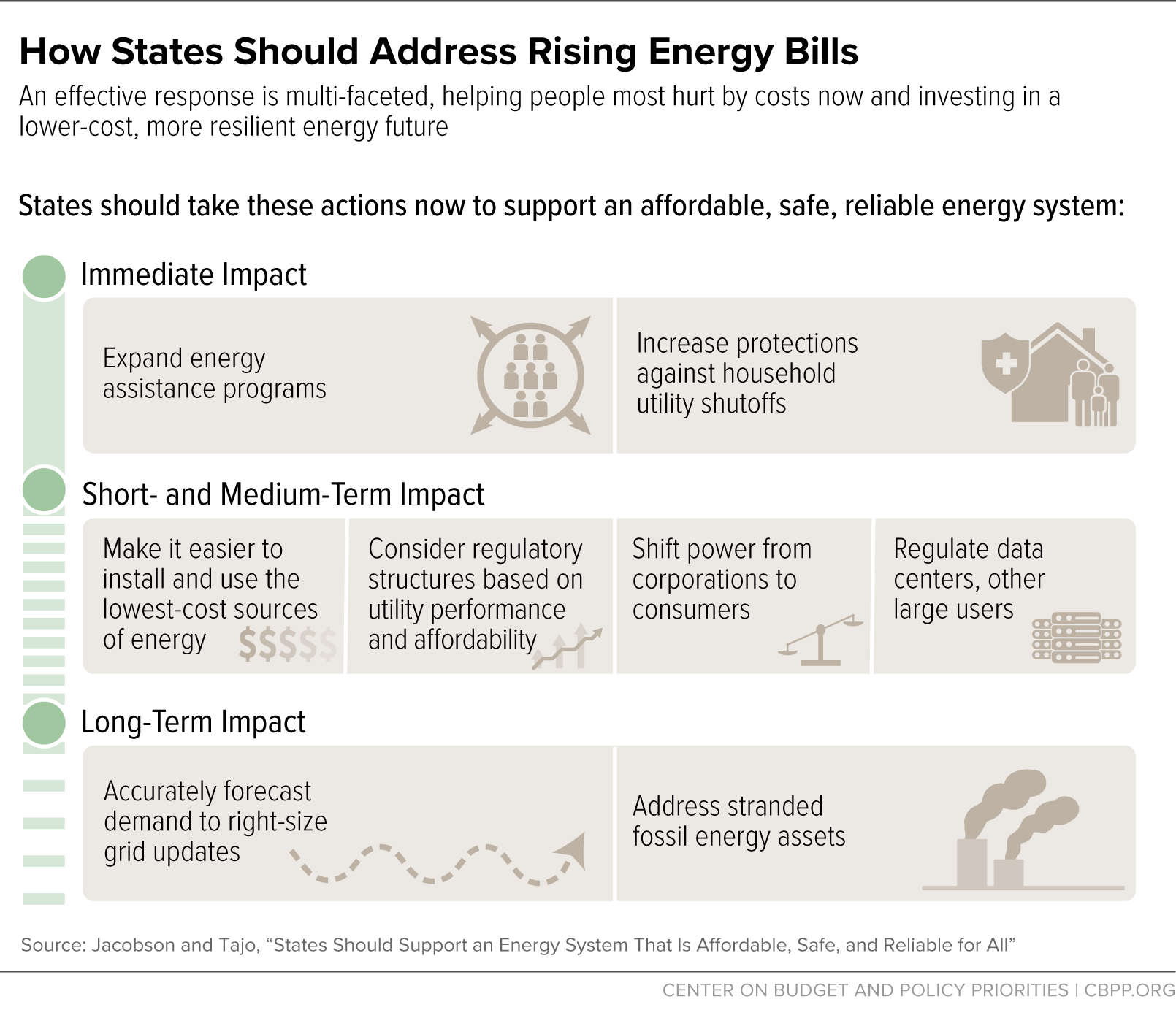
States seeking to address energy affordability during 2026 legislative sessions should:
- provide direct energy assistance to low- and moderate-income households for short-term relief;
- better manage how costs are incurred and allocated to control the rate of medium-term increases; and
- facilitate the continued transition to an energy system dominated by clean and renewable sources for long-term affordability and safety for everyone.
The energy transition is necessary, inevitable, and underway. 2025 saw the U.S.’s first month in which clean energy sources surpassed fossil fuels in electricity generation, driven in large part by the increasing availability of low-cost solar and wind.[2] This energy transition, if done right, will create not just cleaner air and a healthier climate, but lower bills for everyone. States should make smart, informed choices to reduce known challenges and speed up the transition to a system that is affordable, safe, and reliable for all.

Rising Energy Bills Are Driven by Higher Demand, Construction Costs, and the Price of Natural Gas
Solar and wind energy generation is cheaper to build and run than fossil fuels,[3] a trend that will likely only continue as renewables technology continues to improve. What’s more, with the energy transition already in progress, infrastructure and fuel from the fossil energy system are becoming more expensive or obsolete.
But to fully reap the cost benefits of clean energy, electric grid infrastructure and state regulatory and policy systems must be optimized for its use. This will create some short-term costs, and it’s important that states implement measures to mitigate those costs when households are already experiencing rising energy prices due to other factors.
Average U.S. electricity prices are rising faster than overall inflation for the first time in 15 years — and are expected to increase by 7.6 percent this winter.[4] While electricity prices are rising, currently the average price is similar to those experienced in 2010 in inflation-adjusted terms. Some families are already experiencing affordability challenges, and if prices continue to rise, more will strain to afford their energy bills.
The Republican budget reconciliation megabill enacted in July 2025 dismantled key policies that would have mitigated some of these increasing bills for households. The megabill made over $300 billion in cuts to clean energy tax credits and rescinded close to $8 billion in funding for grants and loans for clean energy, energy waste reduction, improvements to the electric grid, and energy upgrades in affordable housing enacted in the Inflation Reduction Act of 2022.[5] These investments had been designed to cover some of the transition costs to cleaner and less expensive energy. Some models project that these cuts will translate into higher energy bills for consumers.[6]
Many households were already struggling to pay their utility bills before the megabill was enacted. Our analysis finds that 6.5 percent of households indicated being behind on utility bills in 2023. For renters, the rate was higher, at 10 percent of households.[7] Analysis from the Century Foundation finds that nearly 1 in 20 households have severe past-due utility debt, meaning their accounts were sent to collections or have been delinquent for more than 89 days and will soon be sent to collections. It also finds the average overdue balance on utility bills has increased .[8]
The national average electricity price rose between 2021 and 2024, driven by large increases in California; the Northeast, and Maine in particular; and the Mid-Atlantic. Prices in many Central, Southeast, and Mountain region states remained flat or fell,[9] but experts predict further increases in all regions in 2026.[10] Key factors behind these increases: rising construction costs for maintaining the electric grid and building new energy generation facilities, increased electricity demand, and natural gas price increases, with households served by for-profit utilities experiencing higher increases.[11]
Rising construction costs: Rising construction costs, due to supply chain bottlenecks, permitting delays, and tariffs on building materials, increase the cost of needed upgrades to the electric grid. These upgrades, which are the most significant contributor to rising energy bills,[12] are necessary to protect against climate change-fueled extreme weather events like wildfires and hurricane-force winds; accommodate new demand from data centers and electrification of transportation, heating and cooling, and appliances; and make it possible to connect new resources like wind, solar, and batteries to the grid. The problem exists nationwide but is more acute in places with higher construction costs, like New York and California. It may also be worse in places where investor-owned utilities (IOUs) are responsible for grid upgrades. IOUs receive a guaranteed rate of return for capital investments and are therefore incentivized to increase capital expenditures.
Increased demand: According to an analysis by ICF, after two decades of mostly flat demand growth, U.S. electricity demand is expected to grow 25 percent by 2030 and 78 percent by 2050.[13] Current demand increases are being driven largely by data centers and manufacturing in certain sectors like semiconductors; in the future, building and vehicle electrification are expected to become significant drivers as well, though the Trump Administration has taken steps to slow vehicle electrification by cutting tax credits and withholding electric vehicle charging funding from states.[14] As electric utilities prepare to meet increased demand, they must expand and improve the electric grid, including by building and connecting new sources of energy to it. Backlogs for connecting these new sources are one reason the Northeast, in particular, is experiencing challenges meeting electricity demand, though these challenges aren’t unique to that region.[15] In an ideal scenario, large electricity users like data centers and manufacturing facilities can drive down prices by helping pay for the cost of upgrades. In reality, households and small businesses often get saddled with financially burdensome infrastructure investments. That is because utility companies may offer deals to large users, resulting in those users not paying their fair share, or a new large energy load may so far outstrip current demand that new infrastructure investments can’t be absorbed at a reasonable price. In some cases utility companies may build in anticipation of demand that fails to materialize, with households left to foot much of the bill [16]
Natural gas (also known as methane gas): Over 40 percent of U.S. electricity is powered by natural gas. In contrast to renewables which have no fuel costs, natural gas is subject to price spikes, like the one caused by the Russia-Ukraine war. High natural gas prices are the leading cause of high energy bills in several states, including Maine, where electricity prices are growing at the third fastest rate in the nation.[17] Natural gas prices are rising and are expected to rise further due to increased exports, which increase international demand for U.S. gas, driving up the price for domestic consumers.[18]
Higher Energy Bills Hurt Low-Income People and People of Color Most
Low- and moderate-income households and households of color are disproportionately feeling these rising energy bills.[19] These households are more likely than others to live in homes that are not energy efficient, either because of lack of insulation or inefficient heating and cooling systems, increasing energy costs.[20] Households whose incomes are below the federal poverty level (FPL) are more likely than others to face severe energy burden. They spend on average 20 percent of their income on energy bills — more than three times the average for households above 200 percent FPL spend on energy bills (on average, these households spend 4 percent of their income on energy bills).
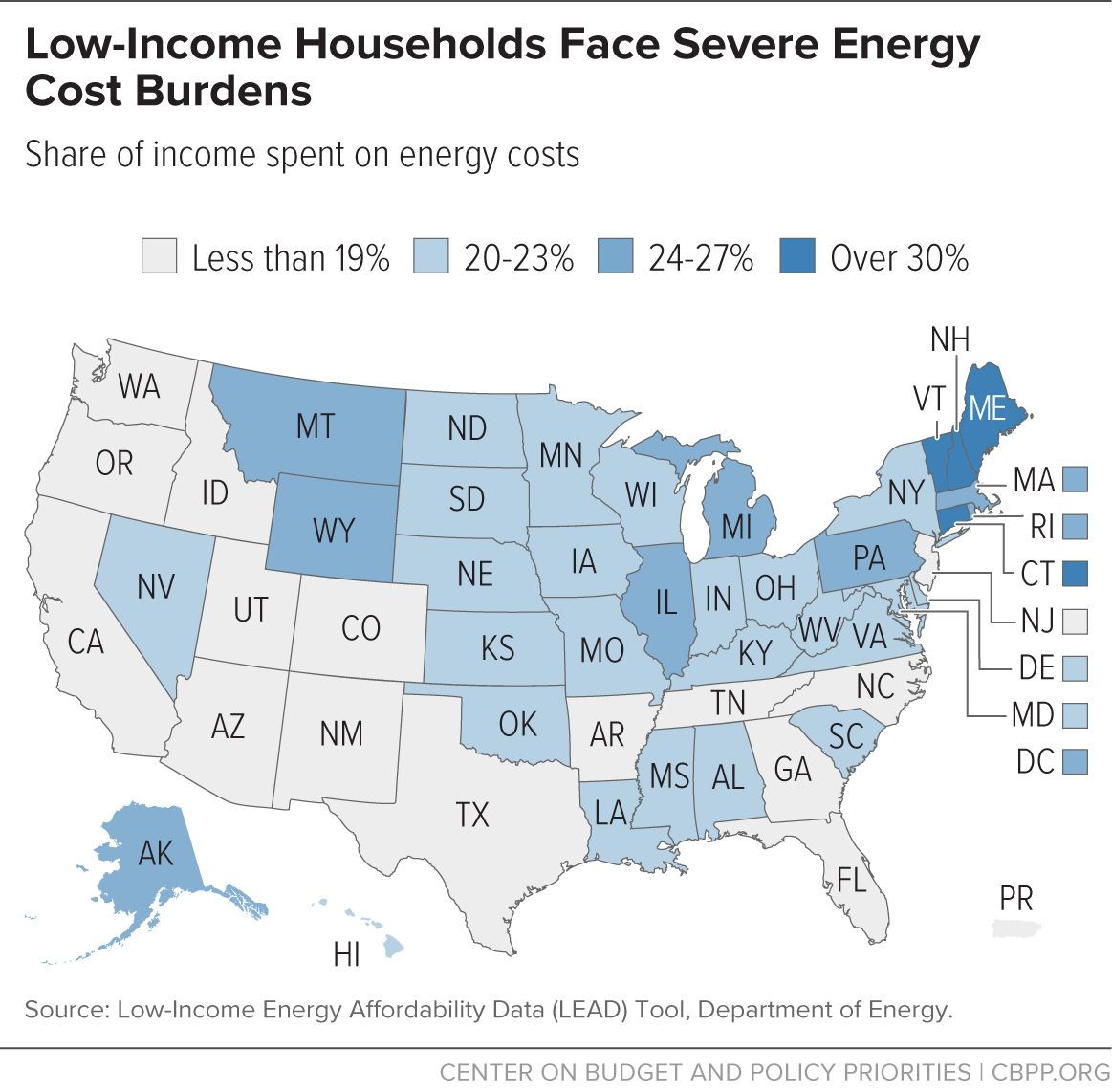
Looking regionally, low-income households in the Northeast and Midwest tend to spend the largest share of their income on energy bills. (See Figure 2.) In Maine and Connecticut, for example, low-income households spend an average of 31 percent of their income on energy bills. [21]

Black, Indigenous, and Hispanic households face significantly higher energy burdens than white households, driven by income inequities and the older housing stock and lower homeownership rates in communities of color that are often the result of past and present discrimination in the economy and housing market.

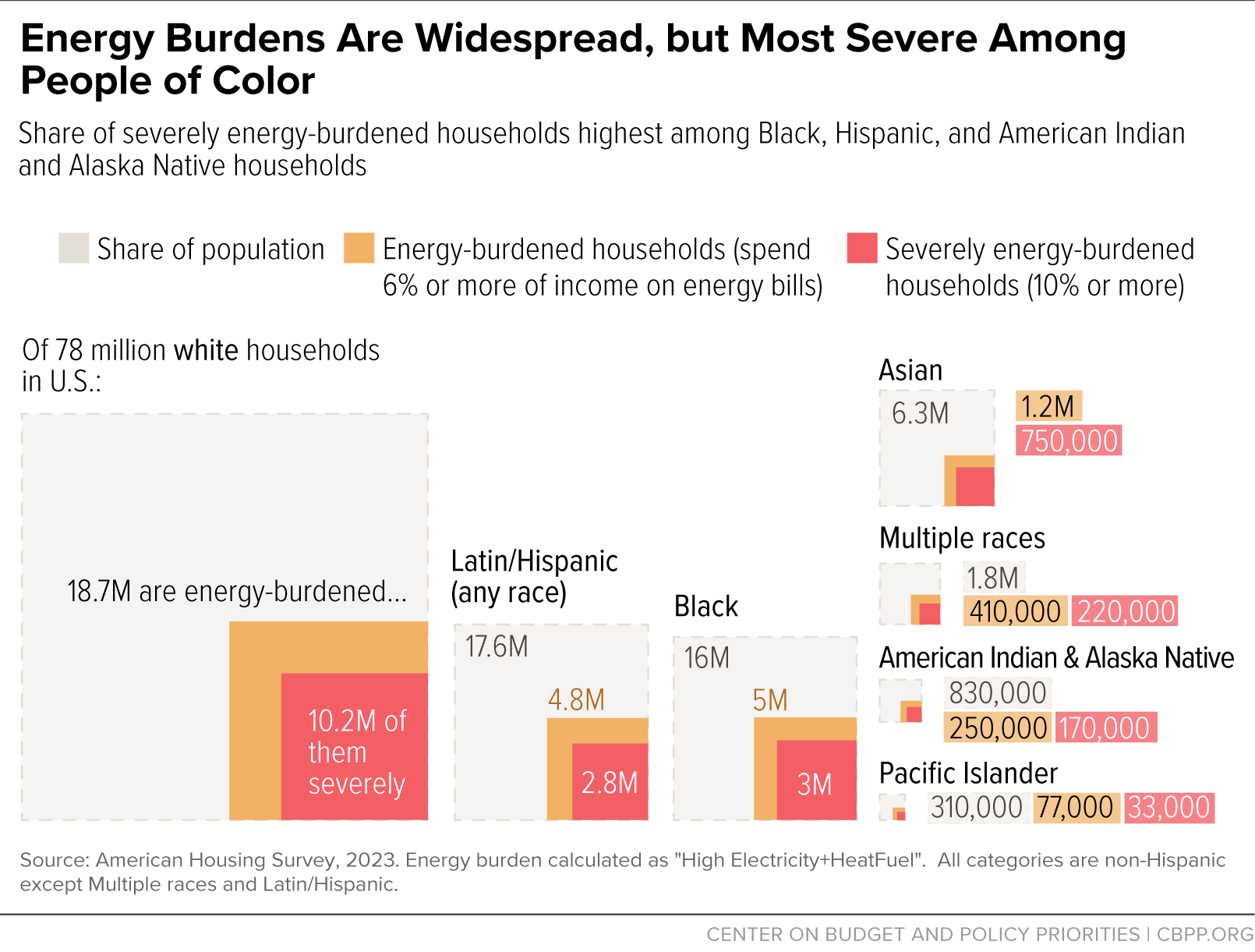
Our analysis finds that 31 percent of Black households, 31 percent of American Indian and Alaska Native (AIAN), and 27 percent of Hispanic households have high energy burdens (energy costs above 6 percent), compared to 24 percent of white households that do so. AIAN households also face the highest frequency of severe energy burden, with 1 in 5 households spending more than 10 percent of their income on energy bills. (See Figure 3.)
Immediate Action: Expand Energy Assistance for Low- and Moderate-Income Households
Low- and moderate-income households have the highest energy burdens and are least able to afford high electricity prices. Energy assistance is a targeted, cost-effective intervention that helps people stay safe in their homes and meet their everyday needs. Energy assistance can be monetary or take the form of prohibitions against shutting off vulnerable households’ electricity.
States can take steps to enact or expand these kinds of vital assistance. Recent threats to federal benefits — like the Trump Administration’s moves to eliminate funding for the Low Income Home Energy Assistance Program (LIHEAP) — make state actions even more important.[22]
- Expanding eligibility and enrollment: Energy assistance programs, like LIHEAP, are funded primarily through federal block grants and supplemented by state funds or utility ratepayers. But chronic underfunding, apart from even the Administration’s current funding threats, means these programs only serve roughly 18 percent of eligible households.[23] In some states, like California and Texas, LIHEAP serves only about 5 percent of eligible households. Additionally, enrollment barriers and income thresholds for eligibility mean the program isn’t always serving those with the greatest energy burdens.[24] States can expand supplemental funding, advocate for increased federal funding, and streamline enrollment and documentation processes. For example, a 2024 Michigan law assesses a utility surcharge to expand funding for the state’s program and extends eligibility to over 300,000 additional households.[25]
- Enacting moratoriums on utility shutoffs: Many, but not all, states have policies that protect vulnerable households from utility disconnection.[26] States can expand these protections. In particular, they can add hot weather disconnection protections — like those they have for cold — as New Jersey did in 2025.[27]
Some states are providing energy bill rebates to all ratepayers, which can be meaningful for some households. But these small, one- or two-time payments aren’t a reliable source of relief for residents who most need it. Additionally, some states are funding these payments using money allocated to vital clean energy and climate resilience projects, potentially delaying the work needed to move to cleaner, less expensive energy sources and forgoing resilience upgrades that would bring down the cost of future infrastructure repairs. If states do offer these payments, they should target them to the households that most need help — as New Jersey did in providing larger payments to low- and moderate-income households — and should avoid funding them by drawing down clean energy and climate resources.[28]
Short- and Medium-Term Action: Change Utility Incentives, Manage Utility Spending, and Assign Costs Equitably
While energy assistance is important to address immediate needs, states should also enact legislation that helps bring down the cost of household energy bills. Doing so requires that states change regulations so that, as utilities make needed investments, they do so in a cost-effective manner that prioritizes safety and affordability. States should also ensure that equity guides how costs are distributed among ratepayers.
States can achieve this by:
- Including affordability in utility regulator mandates. State legislatures have the power to mandate that Public Utility Commissions (PUCs), which regulate utility companies in each state, include affordability as a goal in their regulatory actions.[29] In 2021 Maine tasked its utility commission with mitigating disproportionate energy burdens, and in 2024 Minnesota mandated that its PUC establish standards to fairly share the cost of utility system upgrades between, among other things, residential and non-residential energy users and increase low-income households’ access to energy efficiency programs.[30]
- Considering regulatory structures based on utility performance. Performance-based ratemaking (PBR) is the practice of compensating utilities based on their performance against target outcomes — including cost effectiveness and reliability — instead of solely the cost of service, while minimizing the perverse incentive utilities have to overbuild capital-intensive systems. For example, following the 2018 Camp Fire in California, the state and the utility company underwent protracted negotiations to create a grid upgrade plan that balanced effective wildfire protections and consumer protections from rising energy costs.[31] PBR is gaining traction in several states, such as Connecticut, which passed a comprehensive PBR package in 2023 that included social equity and reduction of greenhouse gas emissions in its target outcomes.[32]
- Making it easier to install and use the lowest-cost sources of energy. Although transmission and distribution costs are the biggest drivers of increased electricity prices, the price of electric generation plays a role as well. Solar and wind are cheaper to run than fossil fuels, a cost advantage that’s likely to only grow as the technology continues to improve and fossil fuels are phased out for economic and environmental reasons.[33] To increase large-scale solar and wind projects, states should:
- Remove barriers to building large renewable energy facilities by streamlining siting and permitting processes, creating state-backed project financing such as revolving loans, and upgrading technology and processes for adding energy sources to the electric grid. California, Illinois, Michigan, New York, and Washington all recently overhauled their permitting systems for clean energy.[34]
- Enable more residents to benefit from renewable energy sources by enacting and protecting “net metering” policies and community choice aggregation. Net metering allows residential and commercial customers who generate their own electricity from solar power to sell the electricity they aren’t using back into the grid, significantly improving the economic case for switching to renewable energy. Community choice aggregation (CCA) allows local governments to procure power for residents and businesses from sources outside their utility company. The utility continues to provide energy transmission and distribution services and CCA participants get cheaper, cleaner power.
- Require the cheapest sources of energy to provide power first, a practice known as “economic dispatch.” Utilities that own power generation resources sometimes run coal plants even when cheaper power is available because they earn profit not from minimizing fuel costs, but from keeping the plants they own in the rate base, that is, the value of property owned by the utility company on which it is permitted to earn a specific rate of return. If the utility company doesn’t operate the coal plant regularly, regulators may deem it no longer “used and useful,” which can force its retirement and reduce the utility’s earnings. But by running the plant — even at a loss — the utility helps justify keeping it in the rate base, while the higher fuel costs are passed on to customers. Utilities may also run coal plants to satisfy minimum purchase requirements in coal supply contracts, even when doing so is more expensive. State regulators can help end this practice by disallowing utilities from recovering costs that result from uneconomic dispatch, and by rejecting inefficient fuel supply contract terms.[35]
- Shifting power from corporations to consumers. Many aspects of utility spending lack transparency. And corporations often have outsized influence in regulatory proceedings due to their large financial, political, and legal resources, resulting in high corporate profits and contributing to inequitable utility rates. Six states have implemented intervenor compensation programs — which compensate consumer advocates for their time and expertise when intervening in electricity rate cases — to level the playing field between investor-owned utilities and consumers.[36] Also, at least seven states have implemented laws prohibiting utilities from recovering lobbying costs from ratepayers.[37] Some, like Maryland, also enhance accountability by requiring utilities to disclose their votes in regional electric grid proceedings.[38]
- Regulate data centers and other large energy users. States can study the costs these users impose on the electric grid; enact surcharges on them and use the revenue for electric bill assistance; or direct regulators to require that utility companies more equitably allocate the costs of energy system upgrades that serve them. States can also pass laws requiring large energy users to disclose their energy use, enabling regulators, utilities, and grid operators to better plan for their needs and help avoid price shocks. Requiring aspects of data center deals to be made public helps utilities avoid pursuing upgrades for loads — and paying customers — that ultimately don’t materialize. Texas SB6, enacted in 2025, seeks to protect residential and small business customers from subsidizing speculative large-load developments by increasing visibility into large-load proposals and requiring upfront financial commitments from developers.[39]
States should also be wary of arguments that giving more power to IOUs will lower electricity prices. Measures to avoid include the practice known as “Construction Work in Progress,” which allows utilities to begin recovering construction costs of new energy generation facilities from ratepayers while they are still under construction. This exposes ratepayers to the risk of paying for new energy buildout with long timelines and no guarantee that the project will be completed. This was the case in Georgia, where ratepayers began paying for the Votgle Plant upgrade in 2010, which was $23 billion over budget and didn’t begin coming online until 2023, resulting in the biggest rate hikes in the state’s history.[40] States where the utility industry is “deregulated,” that is, where utility companies are only allowed to own transmission and distribution infrastructure, should avoid “re-regulation,” because allowing utilities to own energy generation infrastructure in addition to transmission and distribution increases their monopoly power and results in poor outcomes for ratepayers.[41]
Positioning For Long-Term Success: Plan for a Phased Energy Transition That Works for Everyone
The energy transition is necessary, inevitable, and underway. If done right, it will create cleaner air, a healthier climate, and lower bills for everyone. However, during the middle of this transition, with fossil and clean energy operating simultaneously, infrastructure and regulatory systems are not optimized for either system. Smart planning to guide the choices states make regarding energy technology, siting, and operations can address the near-term challenges and speed up the energy transition.
The following are some best practices that states can follow:
- Accurately forecast energy demand to adequately plan for grid upgrades. By supporting utility companies and grid operators to more accurately forecast demand, states can help create the conditions for adequate generation buildout and grid upgrades, thus avoiding price shocks. States can pass laws that promote the forecasts’ robustness and accuracy by requiring use of multiple forecast timelines and scenarios; consideration of new technologies and policies that may affect demand (such as heat pumps, electric vehicles, and electrified buildings); and estimates for peak capacity. As the energy transition brings more distributed energy resources such as rooftop solar and battery storage online, states should ensure their energy demand forecasts account for how these new, flexible resources impact the electric grid.[42]
Address stranded fossil energy assets. As the energy transition progresses, infrastructure and fuel from the fossil energy system is becoming more expensive or obsolete. This results in utility companies passing on to consumers associated higher operating costs and debt recovery.
For example, many coal plants are no longer economical to run, but utility companies are still using them because it’s easier to pass those costs to customers than replace the asset. New gas plants and gas distribution network upgrades are incurring upfront costs now that corporations will expect to recoup from ratepayers regardless of how much longer those systems remain operational, meaning whoever stays on gas (likely lower-income households that can’t electrify without financial assistance) will experience astronomical prices.
To address these problems, states need to implement a set of policies – ranging from future energy system planning to banning fossil fuel use altogether — to limit or prevent utility companies from building out fossil fuel assets. Several states have begun proceedings to plan for a phased, equitable transition off the natural gas system. And, once implemented, New York’s law requiring new buildings to be all-electric (that is, no oil or gas) will slow the buildout of the fossil gas distribution system.[43] States should also help utility companies responsibly retire existing assets faster, such as by providing low-cost refinancing so they can more quickly pay off the remaining cost of the asset.
Unfortunately, many states are pursuing short-sighted policies that prolong existing — or even build new — fossil fuel infrastructure. These policies are often advanced by groups with ties to fossil fuel corporations, lean on outdated assumptions about the energy system, and ultimately will burden ratepayers with stranded asset costs.[44] The same groups often work to block state progress on this issue. New York paused implementation of its all-electric buildings law in a deal to end litigation brought by industry groups, and the Trump Administration has issued stay-open orders for coal plants in four states, in a questionable use of its power to alleviate electric grid emergencies and at a high cost to ratepayers.[45] States should push back against these challenges and continue to use their authority to halt fossil fuel buildout to avoid even higher future energy costs, to say nothing of the severe impacts to health, safety, and the climate. More than that, states can proactively advance racial, economic, and health justice through climate action.[46]
End Notes
[1] CBPP, “Republican Megabill Will Erode Much of the Progress on Health Coverage and Push Poverty and Inequality Higher,” September 9, 2025, https://www.cbpp.org/press/statements/republican-megabill-will-erode-much-of-the-progress-on-health-coverage-and-push.
[2] Ember, “Fossil fuels fall below 50% of US electricity for the first month on record,” April 4, 2025, https://ember-energy.org/latest-updates/fossil-fuels-fall-below-50-of-us-electricity-for-the-first-month-on-record/
[3] Emilliano Bellini, “Despite low gas prices, solar, wind remain cheapest sources of power in U.S.,” PV Magazine, June 17, 2025, https://pv-magazine-usa.com/2025/06/17/despite-low-gas-prices-solar-wind-remain-cheapest-sources-of-power-in-u-s/.
[4] National Energy Assistance Directors’ Association (NEADA), “Winter Outlook 2025–2026: Home Heating Expenditures Projected to Increase by 7.6%,” September 2025, https://neada.org/w p-content/uploads/2025/09/winteroutlook25-26.pdf.
[5] Congressional Budget Office (CBO), “Estimated Budgetary Effects of Public Law 119-21, to Provide for Reconciliation Pursuant to Title II of H. Con. Res. 14, Relative to CBO’s January 2025 Baseline,” July 21, 2025, https://www.cbo.gov/publication/61570.
[6] One model from Energy Innovation finds that, as a result of the tax credit cuts alone, cumulative capital investment in U.S. electricity and clean fuels production will fall $500 billion over the decade, and households will face a 7.5 percent increase in household energy bills by 2030, or $165 per year, rising to a 13 percent increase, or $280 per year, in 2035. Energy Innovation, “Final Analysis: Economic Impacts Of U.S. ‘One Big Beautiful Bill Act’ Energy Provisions,” July 1, 2025, https://energyinnovation.org/report/updated-economic-impacts-of-u-s-senate-passed-one-big-beautiful-bill-act-energy-provisions/.
[7] CBPP analysis of Survey of Income and Program Participation.
[8] Julie Margetta, Mike Pierce, and Eduard Nilaj, “Fueling Debt: How Rising Utility Costs Are Overwhelming American Families,” Century Foundation, November 17, 2025, https://tcf.org/content/commentary/fueling-debt-how-rising-utility-costs-are-overwhelming-american-families/.
[9] Jenya Kahn-Lang and Jesse Buchsbaum, “What’s Happening to Electricity Affordability? in Five Charts,” Resources Magazine, October 5, 2025, https://www.resources.org/archives/whats-happening-to-electricity-affordability-in-five-charts/.
[10] Meris Lutz, “Electricity prices to continue rise in 2026: EIA,” Utility Dive, November 13, 2025, https://www.utilitydive.com/news/electricity-prices-demand-to-continue-rising-in-2026-eia/805395/.
[11] Lucero Marquez, Amanda Levin, and Akshay Thyagarajan, “Residents of 49 States and Washington, D.C., Face Increasing Electric and Natural Gas Bills,” Center for American Progress, October 27, 2025, https://www.americanprogress.org/article/residents-of-49-states-and-washington-d-c-face-increasing-electric-and-natural-gas-bills/.
[12] International Energy Agency, “Rising Component Prices and Supply Chain Pressures Are Hindering the Development of Transmission Grid Infrastructure,” February 25, 2025, https://www.iea.org/news/rising-component-prices-and-supply-chain-pressures-are-hindering-the-development-of-transmission-grid-infrastructure; Marquez, Levin, and Thyagarajan.
[13] Lalit Batra et al., ”Rising Current: America’s growing electricity demand,” ICF, 2025, https://www.icf.com/-/media/files/icf/reports/2025/energy-demand-report-icf-2025_report.pdf?rev=c87f111ab97f481a8fe3d3148a372f7f.
[14] Ian Goldsmith and Zachary Greene, ”3 Ways to Manage Skyrocketing US Electricity Demand,” World Resources Institute, March 20, 2025, https://www.wri.org/insights/managing-electricity-demand-growth-us.
[15] Alex Ambrose, “Why Are New Jersey’s Electricity Bills Going Up, and What Does PJM Have to Do With It?” New Jersey Policy Perspective, May 29, 2025, https://www.njpp.org/publications/explainer/why-are-new-jersey-electricity-bills-going-up-and-what-does-pjm-have-to-do-with-it/.
[16] Abraham Silverman, Suzanne Glatz, and Mahala Lahvis, “Can regulators protect small customers from rising transmission costs for big data centers?” Utility Dive, December 11, 2024, https://www.utilitydive.com/news/regulators-protect-small-customers-rising-transmission-costs-data-centers/735155/.
[17] Elena Krieger, “Where Is Energy Getting the Most Expensive?” Just Solutions, August 25, 2025,
https://justsolutionscollective.org/where-is-energy-getting-the-most-expensive-electricity-price-increases-hit-some-regions-harder-than-others-but-methane-gas-has-gone-up-nearly-everywhere/; Tux Turkel, “Maine’s electricity prices grew at the third fastest rate in the country, analysis show,” April 26, 2025, https://themainemonitor.org/electricity-prices-third-fastest-rate/.
[18] Jean Su and Ryan Richards, “LNG Exports Raise Natural Gas Prices for Americans,” Center for American Progress, November 6, 2023, https://www.americanprogress.org/article/lng-exports-raise-natural-gas-prices-for-americans/.
[19] Scott Horsley, “Electricity prices are climbing more than twice as fast as inflation,” August 16, 2025, https://www.npr.org/2025/08/16/nx-s1-5502671/electricity-bill-high-inflation-ai.
[20] NEADA, 2024, op. cit.
[21] Department of Energy, “The Low-Income Energy Affordability Data (LEAD) Tool,” accessed December 2025, https://www.energy.gov/scep/slsc/lead-tool.
[22] NEADA, “LIHEAP Still Here, But Threats Loom,” 2025, https://neada.org/press/liheap-under-threat/.
[23] Low Income Home Energy Assistance Program, U.S. Department of Health & Human Services, “LIHEAP Data Warehouse, “ https://liheappm.acf.gov/datawarehouse.
[24] Households that don’t meet the income threshold may still be more energy burdened than some that do because they may require more energy to meet their basic needs, for example, needing to run 24/7 electric medical equipment. Enrollment barriers like requiring documentation to receive cooling benefits can make it difficult to access. See Caleb Smith, Annie Carforo, and Juanita Constible, “LIHEAP Needs a Lifeline: A Call to Strengthen the Low Income Home Energy Assistance Program in a Changing Climate,” We ACT for Environmental Justice and Natural Resources Defense Council, August 2024, https://www.nrdc.org/sites/default/files/2024-08/LIHEAP_Needs_Lifeline_Report.pdf.
[25] Michigan Public Service Commission, “MPSC increases funding for Michigan Energy Assistance Program as state expands eligibility for help,” February 11, 2025, https://www.michigan.gov/mpsc/commission/news-releases/2025/02/11/mpsc-increases-funding-for-michigan-energy-assistance-program.
[26] Low Income Home Energy Assistance Program, U.S. Department of Health & Human Services, “Disconnect Policies,” https://liheapch.acf.gov/Disconnect/disconnect.html.
[27] Act of September 9, 2025, New Jersey Assembly Bill 5563, P.L.2025, c.145., (establishing “Summer Termination Program” for certain utility users), https://legiscan.com/NJ/bill/A5563/2024.
[28] Governor Phil Murphy, “Governor Murphy, Senate President Scutari, and Assembly Speaker Coughlin Announce Direct Economic Relief to Lower Monthly Energy Costs for New Jerseyans,” State of New Jersey Office of the Governor, June 5, 2025, https://www.nj.gov/governor/news/news/562025/approved/20250605a.shtml
[29] Jessie Ciulla and Cory Felder, “The Untapped Potential of Public Utility Commissions,” RMI, July 12, 2021, https://rmi.org/the-untapped-potential-of-public-utility-commissions/.
[30] National Caucus of Environmental Legislators, “Utility Briefing Book,” July 30, 2025, https://www.ncelenviro.org/app/uploads/2023/08/CE-Utility-Briefing-Book-3.pdf.
[31] Vermont Journal of Environmental Law, “Gold-Plating vs. Grid Safety: How Cost-of-Service Ratemaking Creates Tension Between Regulators and Utilities and Slows Grid Hardening,” 2024, https://vjel.vermontlaw.edu/top-ten/2023/12/gold-plating-vs-grid-safety-how-cost-of-service-ratemaking-creates-tension-between-regulators-and-utilities-and-slows-grid-hardening/.
[32] As part of the stated motivations for social equity, the state’s Public Utilities Regulatory Authority references not just affordability but direct investment into underserved communities and public participation in decision making. Taren O’Connor and Joe Cooper, “PURA Resets Electric Utility Regulatory Framework to Better Serve the Public,” Connecticut Public Utilities Regulatory Authority, April 26, 2023, https://portal.ct.gov/PURA/Press-Releases/2023/PURA-Resets-Electric-Utility-Regulatory-Framework-to-Better-Serve-the-Public.
[33] Alison F. Takemura, “Chart: Renewables Are on Track to Keep Getting Cheaper and Cheaper,” Canary Media, September 1, 2023, https://www.canarymedia.com/articles/clean-energy/charts-renewables-are-on-track-to-keep-getting-cheaper-and-cheaper.
[34] Charles Harper and Daniela Schulman, “Warp Speed Clean Energy: Expediting Permitting and Equitable Grid Deployment Without Congress,” Evergreen Collaborative, December 2023, https://collaborative.evergreenaction.com/policy-hub/Warp-Speed-Clean-Energy-December-2023.pdf; Climate XChange, “Consolidated State Siting and Permitting Authority,” 2024, https://www.climatepolicydashboard.org/policies/electricity/siting-permitting-authority.
[35] Gabriella Tosado et al., “Improving Energy Affordability Through Economic Dispatch,” RMI, April 2, 2024, https://rmi.org/improving-energy-affordability-through-economic-dispatch/; Zach Zimmerman et al., “The Consumer and Environmental Costs from Uneconomically Dispatching Coal Plants in MISO,” Grid Strategies and Natural Resources Defense Council, July 2024, https://gridstrategiesllc.com/wp-content/uploads/Grid-Strategies-NRDC-Uneconomic-Dispatch-Report-2024.pdf.
[36] Eight more states have authorized but not implemented them. National Association of Regulatory Utility Commissioners, “State Approaches to Intervenor Compensation, “ December 2021, https://pubs.naruc.org/pub/B0D6B1D8-1866-DAAC-99FB-0923FA35ED1E.
[37] Shelby Green, “Tracking State Legislation to Get Politics Out of Utility Bills,” Energy & Policy Institute, May 30, 2025, https://energyandpolicy.org/tracking-states-getting-politics-out-of-utility-bills/.
[38] Brian Martucci, “Electric utilities must disclose PJM votes under new Maryland law,” Utility Dive, May 19, 2025, https://www.utilitydive.com/news/electric-utilities-must-disclose-pjm-votes-maryland-law/748475/; National Caucus of Environmental Legislators, “States Pursuing Utility Accountability Legislation Across the Country,” March 4, 2024, https://www.ncelenviro.org/articles/states-pursuing-utility-accountability-legislation-across-the-country/.
[39] McGuireWoods LLP, “Texas Senate Bill 6 Significantly Expands Regulatory Oversight Over Large Loads in ERCOT,” July 10, 2025, https://www.mcguirewoods.com/client-resources/alerts/2025/7/texas-senate-bill-6-significantly-expands-regulatory-oversight-over-large-loads-in-ercot/; Tim Bernard, “Through 300+ Bills, US Lawmakers Juggle Data Center Priorities,” TechPolicy.Press, September 12, 2025, https://www.techpolicy.press/through-300-bills-us-lawmakers-juggle-data-center-priorities/; Graham Steinberg and Katie Thomas Carol, “How States are Approaching the Data Center Boom,” We Build Progress, November 18, 2025, https://webuildprogress.org/explainer-2025-11-18-data-center-boom; Kristen Soares, “Recap: Data Centers and State Climate Policy,” Climate XChange, May 23, 2025, https://climate-xchange.org/2025/05/webinar-recap-data-centers-and-state-climate-policy/.
[40] Gautama Mehta, “The obscure policy that financed many of the last decade’s riskiest energy investments is back,” Grist, April 16, 2025, https://grist.org/energy/cwip-energy-policies-are-back/; Ethan Howland, “Rein in CWIP to protect ratepayers from bloated infrastructure costs: report,” Utility Dive, December 5, 2025, https://www.utilitydive.com/news/cwip-construction-work-progress-ratepayers-supercycle/807132/.
[41] Ethan Howland, “Reregulation? How utilities and states are responding to PJM’s record capacity prices,” Utility Dive, September 4, 2024, https://www.utilitydive.com/news/pjm-capacity-auction-results-firstenergy-exelon-aep/725952/.
[42] Lisa C. Schwartz et al., State Requirements for Electric Distribution System Planning. Lawrence Berkeley National Laboratory, 2024, https://emp.lbl.gov/publications/state-requirements-electric.
[43] Alison F. Takemura, “New York becomes first state to commit to all-electric new buildings,” Canary Media, July 30, 2025, https://www.canarymedia.com/articles/carbon-free-buildings/new-york-finalizes-gas-ban; Building Decarbonization Coalition, “BDC Presents: Future of Gas,” September 26, 2024, https://buildingdecarb.org/wp-content/uploads/BDC-Presents-Future-of-Gas-Summary.pdf.
[44] For example, the American Legislative Exchange Council’s (ALEC) Equitable Escalation of Electricity Demand bill purports to equitably apportion increased electricity demand costs, but is actually anti-EV and against decommissioning fossil fuels. ALEC’s Electric Generation Facility Closures and Reliability bill purports to ensure adequate, dispatchable electric supply, but is actually an anti-clean energy and anti-fossil fuel decommissioning bill.
[45] Colin Kinniburgh, “Why Did Hochul Back Down on New York’s Gas Ban?” New York Focus, November 26, 2025, https://nysfocus.com/2025/11/26/all-electric-buildings-gas-ban-hochul-new-york; Ella Nilsen, “The Trump Administration Just Ordered Another Retiring Coal Plant to Stay Open. It Could Cost Ratepayers Millions,” CNN, December 31, 2025, https://www.cnn.com/2025/12/31/climate/coal-power-electricity-trump-colorado.
[46] CBPP, “Advancing Racial, Economic, and Health Justice Through Climate Action,” December 12, 2024, https://www.cbpp.org/research/climate-change/advancing-racial-economic-and-health-justice-through-climate-action.