

Climate Change and State Budgets
Climate change is driving long-term shifts in temperature and weather patterns, leading to worsening disasters and other harms. States are incurring more costs by responding to disasters, in their efforts to lessen them through infrastructure upgrades and responsive policies, and through efforts to reduce climate pollution. These costs are putting more pressure on already strained budgets, necessitating that states raise revenue and cut tax expenditures. States should secure funding from climate polluters and design climate investments to benefit communities of color and low-income communities.
Climate change, primarily caused through the reliance on fossil fuels, is driving long-term shifts in temperature and weather patterns, leading to worsening floods, droughts, heat waves, severe storms, and other impacts. States are incurring more costs both by responding to climate change-fueled disasters and in their efforts to lessen them through infrastructure upgrades and responsive policies. Many states are also doing their part to stabilize the climate by transitioning to cleaner forms of energy and transportation and increasing energy efficiency. All of these costs are putting more pressure on already strained budgets, necessitating that states raise revenue and cut tax expenditures.
Notably, the harms of climate change fall disproportionately on people of color (particularly Black, Latine, and American Indian and Alaska Native people) and people with low incomes or low wealth due to interlocking discriminatory systems, including racist housing policies, government disinvestment, and economic exploitation. Therefore, states should design their climate investments to especially benefit communities of color and low-income communities, and ensure their strategies for funding these investments are equitable.
Disasters and Hazards Worsened by Climate Change Drive Up State Expenditures
Disasters and hazards made worse by climate change are raising state expenditures — a trend that will worsen the longer climate pollution continues unabated. The following expenditures make up a large share of state budgets, are highly affected by climate change, or both:
- Disaster spending: Following a climate change-fueled disaster, a state must repair and replace state-owned infrastructure; provide financial support to residents, farmers, small businesses, schools, local governments, and nonprofits for a wide range of needs; and pay the state cost-share of federal assistance. Major disasters like hurricanes require outsized state spending, with fiscal consequences lasting years or even decades. Repeated, smaller disasters like wildfires and floods also strain state budgets over time through the cascading effects of reduced housing availability, a decreased tax base, and emergency revenue allocations. Compounding these pressures, the Trump Administration is shifting more disaster costs to states, and, due to reduced insurance availability, states are paying more to support residents who cannot recoup the loss of a destroyed or damaged home.
- Health care spending: Without proactive investments to protect people, the environment, and the economy from climate impacts, state health care spending will increase as climate change makes residents sicker and poorer. Climate change and fossil fuel pollution worsen health outcomes — including higher rates or severity of diseases, illnesses, injuries, and mental health conditions — and increase health costs. Notably, this could show up as increased state Medicaid spending, which already averages 30.7 percent of state budgets as of 2025.
- Capital expenditures: Climate change exacerbates stresses on state-owned infrastructure like buildings, wastewater plants, and roads, many of which are already in disrepair. If states do not upgrade infrastructure to withstand climate impacts, they will instead bear the costs of expensive maintenance and more frequent asset replacement. For instance, one study estimated that rising temperatures could add $19 billion to U.S. road pavement maintenance costs by 2040.
- Spending on food, utility, and housing assistance: While these assistance programs do not currently make up a large share of state budgets, increased need due to climate change could add up, for instance from worsening climate impacts increasing food and home prices and extreme heat requiring more home cooling. And any unmet need could ultimately show up as increased spending in other areas of state budgets.
- Increased cost of borrowing: Climate change makes investments riskier by increasing the frequency and severity of physical damage, and that risk extends to government bonds. Debt service made up 2.6 percent of state budgets in fiscal year 2025, and S&P and Moodys have recently advanced their methodologies for incorporating climate risk into ratings calculations.
These expenses will be coupled with climate-related economic declines in the agriculture, tourism, and natural resources sectors in certain states; decreases in property values in flood- and wildfire-prone areas; and by residents leaving coastal, agricultural, and wildfire-prone areas. Those factors — combined with issues such as decreased student learning and worker productivity from heat stress — are expected to shrink state revenues and slow GDP growth. Together, the economic impacts of climate change will result in dwindling revenues that make it difficult for states to pay for the costs of climate change. The resulting fiscal pressures and, so far, underinvestment in climate action will translate into greater hardship for low-income people and people of color, as states may cut essential services and more severe climate impacts will exacerbate cycles of poverty and health disparities.
States Should Invest in Climate Resilience and Reducing Pollution to Lower Costs
States can lower the costs of climate change harms through resilience-building actions such as infrastructure upgrades and strong social supports. States can also decrease their part in climate pollution by transitioning to clean energy and lowering energy demand, making it more likely that future climate impacts and climate change-fueled disasters will remain at a manageable scale.
Investments in Climate Resilience
- Capital expenditures: States should upgrade the physical infrastructure they own — such as roads, bridges, wastewater plants, schools, and state buildings — to withstand climate impacts. Examples include changing the size of a culvert to accommodate more water, using fire-resistant building materials, or moving a road to a new location that is protected from coastal flooding. States also need to build (and plant) new infrastructure on state land to serve needs such as protecting shorelines, increasing shade, and managing stormwater. As of 2015, New York law requires all public infrastructure projects to mitigate future physical climate risk due to sea level rise, storm surge, or other flooding.
- Financial support for resilience actions: States should provide financial support in the form of grants, loans, rebates, and tax credits so that local governments, households, schools, businesses, farmers, and others have the resources they need to undertake actions that will improve their climate resilience. Financial support could cover resilience actions such as upgrading roofs to be hurricane resistant, installing air conditioning in schools, creating a flood resilience plan for a local business district, implementing drought-resistant farming practices, or relocating homes out of a floodplain. Several states already administer financial support for homeowners to install stronger roofs using fees from the insurance industry.

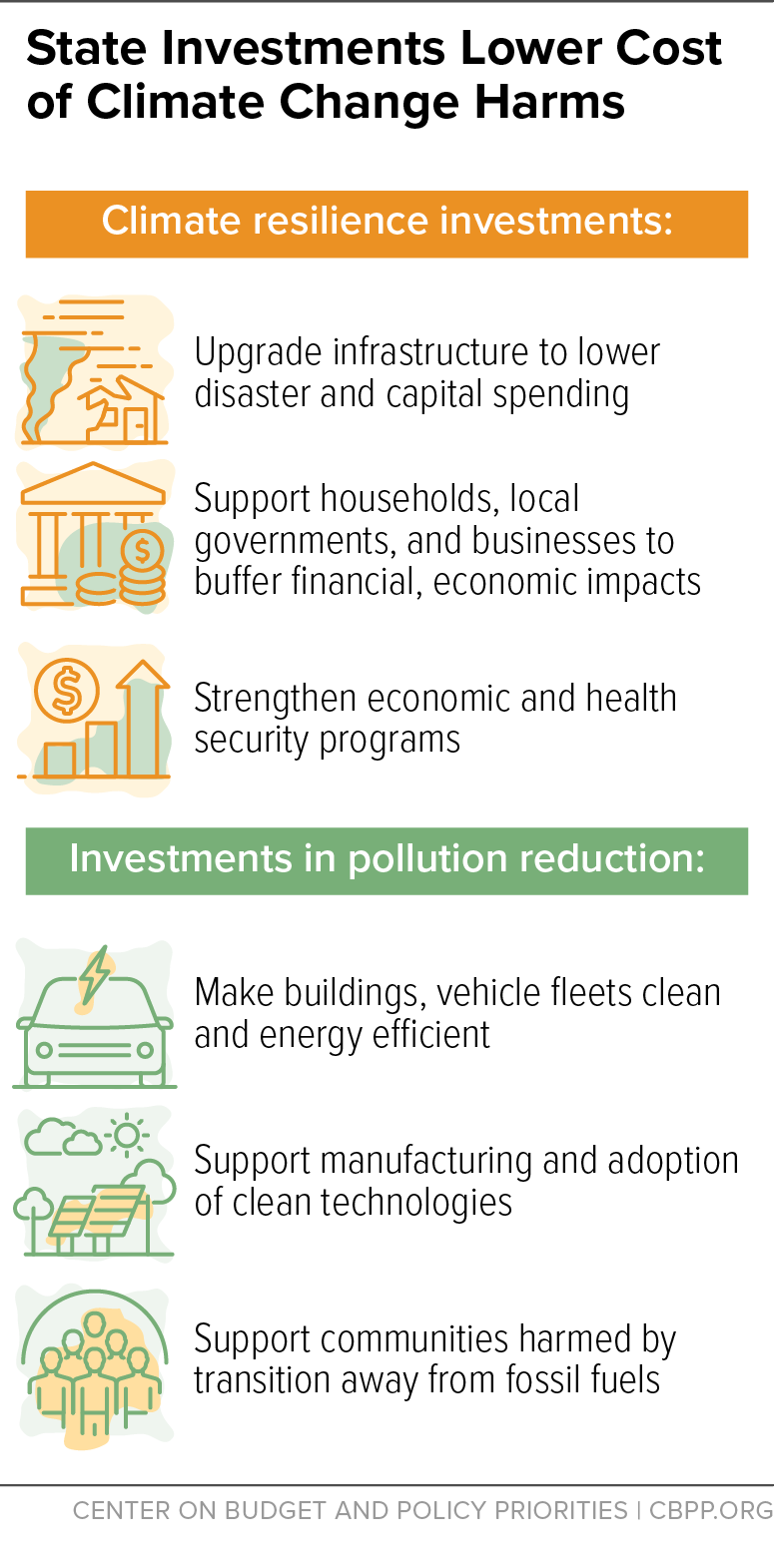
- Economic and health security programs: States should invest in economic and health security programs such as Medicaid, food assistance through SNAP, and the Low Income Home Energy Assistance Program (LIHEAP) in order to increase the capacity of low-income residents to adapt to climate impacts. States can also use economic and health security programs to address specific climate-related needs of low-income residents, as Oregon did when it became the first state to cover air conditioning in its Medicaid program.
Investments in Climate Pollution Reduction
- Transitioning or upgrading state assets: States can update their vehicle fleets, buildings, and other physical infrastructure to run off electricity instead of fossil fuels, be more energy efficient, or use clean fuels. Additionally, states can acquire new assets that play a role in the energy transition, such as state-owned electric vehicle charging stations. In 2023 a Michigan executive order directed state agencies to convert all state vehicles to zero-emission vehicles by 2040.
- Support for clean technologies: States can support the development, manufacturing, and deployment of clean technologies by making direct investments in energy infrastructure, purchasing clean power for use across the state, and offering incentives to companies that develop, manufacture, or install clean technologies. New Jersey, for example, enacted a tax credit in 2025 to encourage clean energy manufacturing in the state.
- Support for clean technology adoption: States can support households, schools, manufacturers, businesses, farmers, and more to adopt clean technologies and use less energy through tax credits, rebates, loans, or education programs. Montana provides low-cost loans to homes, businesses, schools, and nonprofits to install a range of clean energy technologies.
- Support for transition-impacted communities: States should support the people and communities that experience negative impacts from the transition away from historical energy sources. Colorado operates an Office of Just Transition focused on capacity building and financial support for workers and communities that have relied on fossil fuels for jobs and revenue. In 2023 New York proposed legislation that would cap energy costs at 6 percent of household income in conjunction with policies to halt expansion of methane gas infrastructure to ensure low-income households are not left paying higher energy bills.
These state investments in climate resilience and in reducing climate pollution require corresponding administrative investments such as coordination bodies, planning processes, data collection and analysis, and staff capacity-building in order to be effective.
States Should Secure Additional Revenue From Climate Polluters to Cover Climate Change Costs
Currently, states use a mix of general fund dollars, energy revenues, pollution payments, and federal funding to pay for climate change impacts and disasters and to invest in climate resilience and pollution reduction. In the case of climate change-fueled disasters, states also use rainy day funds to cover costs, and for capital expenditures they also use debt financing. Some states have other sources of revenue that support climate investments, such as Florida, which funds grants for sea level rise and coastal resilience for local governments using revenues from the gaming compact between the Seminole Tribe of Florida and the State of Florida.
States should design their climate investments to benefit communities of color and low-income communities and ensure the strategies for funding those investments are equitable. Several states have begun securing funding from climate polluters to bolster their general funds and climate-specific investments, and more should follow suit. There are several options for doing so:
- Cap-and-invest: Thirteen states have a cap-and-invest (also called cap-and-trade) program, a carbon pricing strategy that requires facilities in certain sectors to either limit the amount of greenhouse gas emissions they release or buy permits to emit above the cap. Cap-and-invest auctions have raised over $25 billion for states since 2005. While critics often point to cap-and-invest policies’ potential to pass on costs to consumers, well-designed programs can fully offset these impacts and leave plenty to spare for other uses.
- Climate superfund: Vermont passed the country’s first state-managed fund that taxes historic climate pollution — known as a climate superfund — in 2025, after devastating floods. The same year, New York passed a climate superfund law set to start collecting $3 billion per year from fossil fuel companies beginning September 2026. As of April 2026, similar legislation has been introduced in at least 11 additional states, including Tennessee, Oregon, and Illinois. A climate superfund is a particularly equitable policy because it doesn’t raise consumer prices.
- Carbon tax: Carbon pricing is widely understood to be the most efficient way to reduce climate pollution while collecting revenue. As with cap-and-invest, states can limit any negative effect on households through dividends or other redistribution mechanisms. No state has yet enacted a broad-based carbon tax, though some have taken incremental steps. In Hawai‘i, for example, lawmakers increased the state’s Transient Accommodations Tax in 2025 and began allocating a portion of the revenue to projects that address climate change impacts in a policy change known as the “Hawai’i Green Fee.” The fee went into effect in January 2026 and is an important intermediate step recognizing the high level of climate pollution and natural resource strain resulting from tourism and the potential benefits of taxing activities with a high carbon footprint.
- Charging polluters more to extract, transport, or refine fossil fuels: States with a significant amount of fossil fuel extraction, transportation, or refinement have several options for raising more revenues from those activities while they are still occurring, such as enacting or increasing severance taxes, increasing royalty rates, adding impact mitigation fees, and eliminating fossil fuel subsidies. Since it is unwise to depend on revenue from nonrenewable resources, best practice is to save the revenue in permanent funds or spend it on addressing direct impacts of the fossil fuel activity, rather than depositing it in the general fund. New Mexico is a model for this: in 2025 the state raised its royalty rate from 20 percent to 25 percent, which is expected to grow its Land Grant Permanent Fund by an additional $1.5 billion to $2.5 billion by 2050, with increased revenues reinvested in public schools throughout the state.
Acting Now Saves Costs in Long Run
While some state climate actions require significant upfront expenditures, it’s important to note that many — such as electrifying new buildings and installing flood-resistant landscaping — may cost less than traditional practices. And most infrastructure-focused climate actions will pay for themselves over time.
A 2026 report to the Minnesota legislature — the first such report mandated by a state legislature — found that adapting to climate change is eight to 15 times less expensive than the costs of addressing future climate impacts without adapting to them. Extensive analysis by the National Institute of Building Sciences has shown that upgrades to buildings, roads, and critical infrastructure can reduce future disaster response and recovery costs by as much as $13 for every $1 invested. Tangible examples abound, such as in Vermont, where low-income residents in units for which property managers had invested in flood protection were able to stay in their homes following the state’s catastrophic 2023 floods, while those displaced from less-protected properties struggled to find stable housing despite state and federal assistance, with some ending up in emergency shelters.
Many climate pollution reduction strategies save states money, too. School buildings that combine energy efficiency, electrification, and onsite renewable energy generation can save up to 25 percent in operations and maintenance costs over a 30-year period compared to conventional school buildings.
Climate change-fueled disasters and climate impacts significantly affect state expenditures. By investing in climate resilience and climate pollution reduction, and securing revenue from climate polluters, states can make those costs more manageable and equitably shared.