

BEYOND THE NUMBERS
To Mitigate Unfolding Hunger Crisis, Congress Must Delay the SNAP Cost Shift Before the End of the Year
Too many low-income families are going without the help they need to afford food since the harmful 2025 Republican reconciliation law made unprecedented cuts to SNAP. Already, 5.5 million people, including an estimated 2 million children, have lost SNAP benefits since the law was enacted. This unfolding hunger crisis could get imminently worse if Congress does not act before the end of the year to delay the provision of the law that requires most states to begin paying a portion of SNAP benefits starting in October 2027.
Come January 2027, most state legislatures will begin to grapple with how — or even whether — to fund the massive costs they now face. States that cannot fully cover these costs by raising revenue or cutting elsewhere in their budgets will be forced to further restrict access to SNAP or potentially end the program altogether.
The reconciliation law slashes federal funding for SNAP benefits and imposes those costs on state budgets for the first time. The share of benefits each state will be required to pay depends on the state’s SNAP payment error rate, a measure of over and underpayments to SNAP households that largely reflects unintentional administrative mistakes.
The magnitude of this cost shift and the immense pressure to reduce error rates as quickly as possible has incentivized states to take drastic measures to reduce errors and cut costs, even if that means delaying, denying, or terminating benefits for some eligible low-income families — actions that do not count as “errors.” Efforts to rapidly reduce error rates have likely contributed to deeper than expected declines in SNAP participation across the country, with many people losing food assistance even though they’re still eligible for benefits.
In the long term, Congress must repeal this untenable cost shift entirely. For more than 50 years, SNAP has ensured that children, adults, and seniors in low-income households in every state receive a food benefit that allows them to afford an adequate diet. By creating the risk that some states may end the program, the cost shift abandons this decades-long nationwide commitment to addressing hunger.
At a minimum, states need more time to thoughtfully lower their error rates, reduce their cost-sharing requirements, and ensure eligible low-income families can still access the food assistance they need to afford groceries. It is imperative that Congress delays the SNAP cost shift for all states before the end of the year without making deeper cuts to SNAP. (The Senate Republicans’ farm bill delays the cost shift for one year but makes additional SNAP cuts.)
The cost shift is causing eligible low-income families to lose SNAP. The rushed implementation timeline and immense financial pressure to reduce errors has resulted in some states making it much harder for eligible families to access SNAP and keep their benefits. For example, many states are requiring households to provide substantial additional documentation beyond what is required under federal rules. In some cases, this includes paperwork that is difficult or impractical to obtain, like documentation of panhandling income or a statement from a neighbor confirming who eats in their household.
Without adequate staff to process this additional paperwork, low-income families in some states are waiting in processing backlogs, going months without the benefits they need to afford groceries. Others have been denied SNAP for failing to complete a required interview despite numerous attempts to get through on overloaded phone lines that repeatedly drop their calls.
And these backlogs and barriers could soon worsen if states don’t get more time before they must pay these massive new costs for SNAP benefits. The reconciliation law already cut federal funding for SNAP administrative costs by 50 percent, effective October 1, 2026. As the cost shift for SNAP benefits hits state budgets next year, limited state resources for program administration — necessary to get benefits to eligible families on time and in the right amount — will increasingly be in direct competition with the far larger amount needed for the benefits themselves.
States are already preparing budgets that could drive even deeper cuts — or end SNAP altogether. States are already deep into planning the budgets that will need to cover the first year of this new cost-sharing requirement — and for most states, these costs will be significant.
Based on fiscal year 2025 SNAP error rates, as many as 35 states and Guam will be required to start paying a share of SNAP benefit costs next year (see chart). We estimate that these costs add up to roughly $9 billion in the first year alone, with nearly half of states facing costs of $100 million or more.
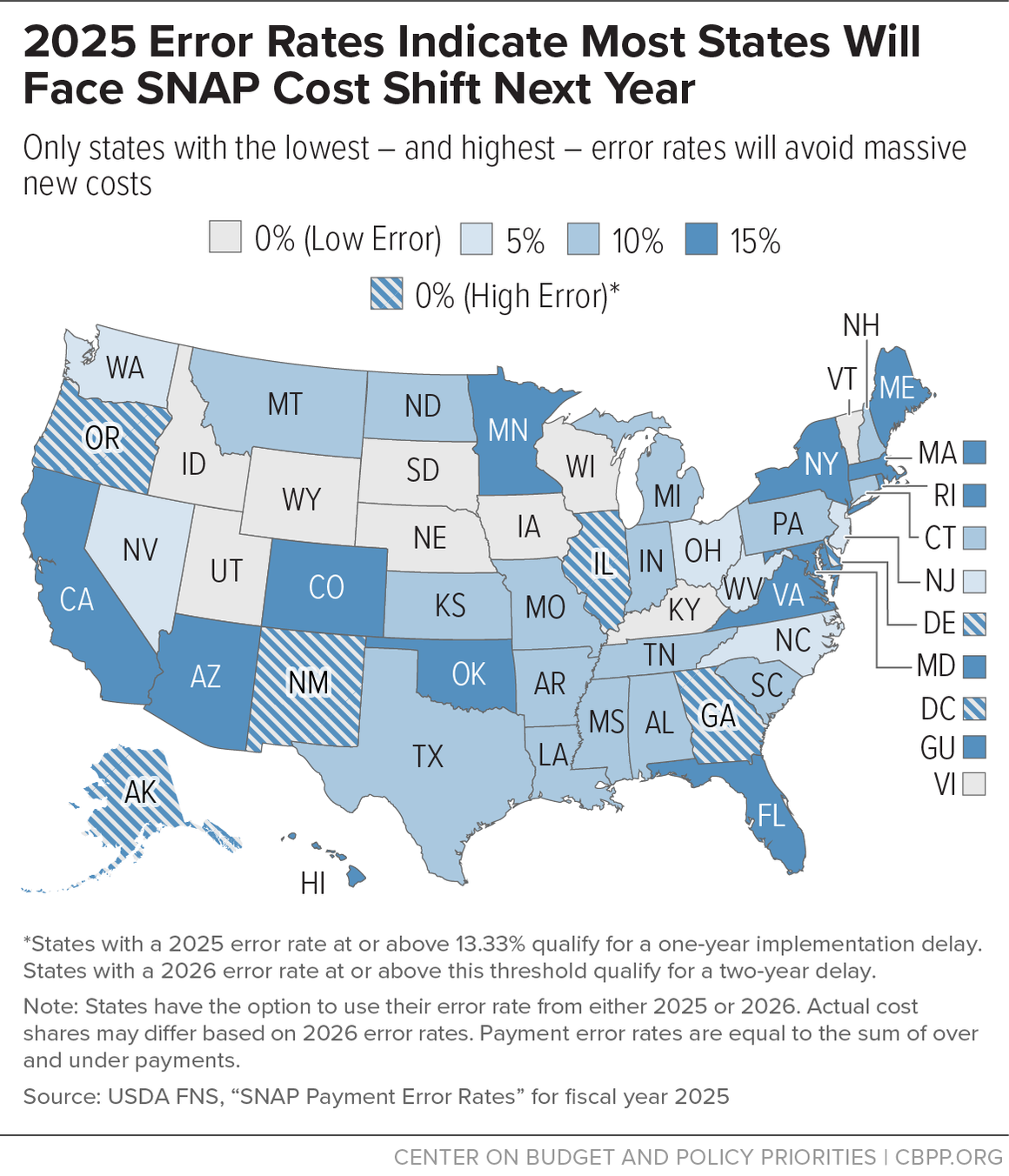
Because states must balance their budgets, absorbing these massive costs will force difficult tradeoffs: raising revenue or cutting spending on other priorities like education, public safety, or housing.
But several states have already acknowledged that they may be unwilling or unable to fully cover these new costs, which would force those states to further restrict access to SNAP or potentially opt out of the program entirely. In a survey conducted by the American Public Human Services Association, 11 states identified narrowing SNAP eligibility policies as a potential impact of the cost shift, and four states indicated a risk that they will pause SNAP or withdraw from the program, which would terminate food assistance for everyone in the state.
Without prompt action from Congress, states may begin enacting these cuts very soon. Most state legislatures will reconvene in January and February, and some will adopt a budget only a few weeks later — leaving federal lawmakers only a brief window to act before states could begin locking in harmful cuts to food assistance or other vital services that families and communities in the state rely on.
The Department of Agriculture (USDA) hasn’t provided key details that states need to implement the cost shift. The SNAP cost shift is a major structural change to how food benefits are funded and issued, which may require states to undertake costly and time-intensive system changes or negotiate contract modifications with their EBT (electronic benefits transfer) processor. But USDA has not yet provided states with actionable information to implement these changes and does not anticipate publishing proposed regulations until December 2026 or later. Without these details, even states that are working in good faith to fully fund and implement the cost-sharing requirement may be unable to complete the required changes before the October 1, 2027, implementation date.