BEYOND THE NUMBERS
SNAP Participation Has Dropped to Its Lowest Point in 17 Years, Even Though Economic Conditions Haven’t Improved
SNAP is our most effective tool in reducing food insecurity and hunger. In each of the last four recessions over the past three decades, it has expanded rapidly to meet increased need for assistance in affording groceries and shrunk as economic conditions improved.
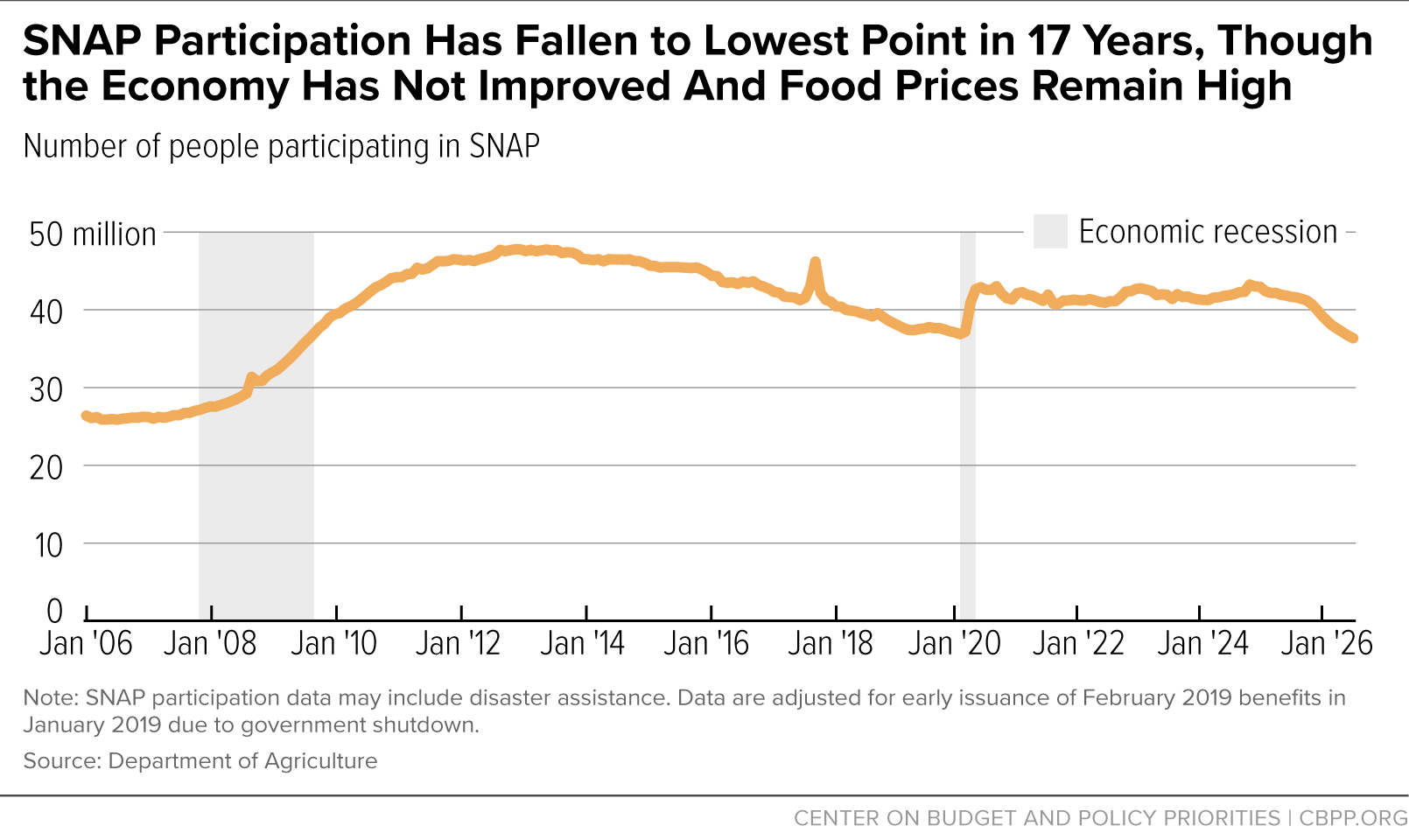
The number of people receiving SNAP food assistance has declined sharply in recent months, even though there is no sign that the decline is due primarily to an improving economy. The harmful Republican reconciliation law, enacted in July 2025, made the largest cuts to SNAP in history, likely accelerating this drop in participation. Since the law’s enactment, the number of people participating in SNAP has fallen by more than 5 million (13 percent), including about 2 million children.
In June 2026, national SNAP participation dropped to its lowest point since August 2009, when SNAP grew to meet increased need in the aftermath of the Great Recession. Half a million fewer people participated in SNAP in June 2026 compared to February 2020, just before SNAP expanded in response to the recession brought about by the COVID-19 pandemic. (See figure below.)
The 2025 reconciliation law will also require most states to pay for a portion of SNAP benefits costs starting in October 2027. Even more people will likely lose SNAP in the coming months as states scramble to respond to this cost shift and fully implement the reconciliation law’s cuts and eligibility restrictions. Congress should delay the cost shift to states and protect SNAP from further cuts.

The large and rapid decline in SNAP participation has already far surpassed the Congressional Budget Office’s (CBO’s) prediction of how many people would lose SNAP due to the reconciliation law in such a short period of time. The last time there was such a steep decrease in participation (other than temporary spikes following natural disasters) was nearly three decades ago, after Congress enacted deep cuts to SNAP (then the Food Stamp Program) in 1996.
The sharp decline likely reflects, in part, the 2025 reconciliation law’s shift of a large share of SNAP benefit costs to states, which most states will start paying in October 2027 for the first time in the program’s history. The size of the cost shift is based on states’ payment error rates, with the first payment based on fiscal year 2025 or 2026 error rates. This has incentivized states to reduce error rates quickly and cut program costs, even if it means denying benefits to eligible households — including households with children. States (many of which already have tight budgets) are struggling to keep up with the law’s requirements and may have to restrict access further or possibly withdraw from SNAP altogether if they can’t fully cover the new costs.
Since July 2025, the number of people participating in SNAP has fallen in every state except Alaska. In some states, the drop is particularly pronounced: SNAP participation fell in Arizona by 52 percent from July 2025 to June 2026. The decline is 46 percent from July 2025 to August 2026, using more recent state data. Caseload declines are close to or greater than 20 percent in other states: Illinois, Louisiana, Nevada, and Oklahoma, and — using more recent state data — also in Florida, Kansas, and Nebraska.
After unemployment insurance, SNAP historically has been the most responsive federal program in assisting families and communities during economic decline, although the 2025 reconciliation law has significantly weakened its ability to act as an automatic stabilizer. The number of people participating in SNAP expanded significantly between 2007 and 2011, due largely to the Great Recession, and then declined after peaking in December 2012. SNAP expanded again in 2020 and 2021 to meet the needs of low-income households during the pandemic. Following a slight decline in 2022, caseloads increased in 2023, when pandemic-related benefits and state flexibilities to make the program more accessible ended and food inflation hit historic highs. Since the most recent peak in participation in October 2024, nearly 7 million fewer people participated in SNAP in June 2026, a decline of 16 percent.
This is not the first time Congress has made the mistake of weakening SNAP and making it harder for people to get the help they need to afford groceries. After Congress enacted very deep cuts to SNAP in 1996, the share of eligible people participating in SNAP dropped to its most recent low of 54 percent in 2002. By the early 2000s, policymakers of both parties grew concerned that eligible households facing difficulty affording food were being cut off from the program or failing to apply. In response, Congress took steps to improve access to SNAP, and by 2012 the share of eligible people receiving SNAP rose to more than 80 percent, where it has remained. In 2022 (the latest data), 88 percent of eligible people were estimated to receive SNAP. It is likely the share of eligible people receiving SNAP has dropped substantially since the enactment of the 2025 reconciliation law.
SNAP’s ability to reach people who need help affording groceries will continue to weaken, increasing the risk of food insecurity and hunger for millions of people in the U.S., unless Congress acts to delay the cost shift to states and stop any further cuts to SNAP.