

BEYOND THE NUMBERS
Four Years After the Inflation Reduction Act: Celebrating Clean Energy Progress and Looking Ahead
The 2022 Inflation Reduction Act (IRA) was one of the most significant climate laws in U.S. history. The IRA created and expanded clean energy tax incentives and established new programs for wind and solar projects in low-income communities, energy upgrades for affordable housing, climate resilience, environmental justice, and more. While the Trump Administration and most congressional Republicans have pushed to gut the IRA’s climate provisions — and have taken other steps that have raised families’ energy costs — the IRA will have a lasting impact on the climate and energy landscape.
The IRA provided more than $145 billion in direct federal grants and loans to federal agencies, state, local, and tribal entities, nonprofits, and others for climate efforts; it also created and expanded tax credits for clean energy projects. Supported by the IRA’s tax incentives, private and public entities invested more than $700 billion in clean energy projects between 2022 and 2025.
By design, many of these projects are in underinvested communities due in part to incentives like the Low-Income Bonus Credit, which gives an additional tax credit for small-scale clean energy projects in low-income areas, on tribal lands, or in federally subsidized housing. Groups leveraged the bonus credit to make $3.5 billion in investments across the country in 2023, the credit’s first year.
The IRA’s innovative tax credit system known as direct pay lets tax-exempt and public entities — such as schools, nonprofits, and state and local governments — use clean energy tax credits. For example, at least 82 schools across 17 states have received reimbursements for solar panels, heat pumps, and other clean energy projects that have improved aging facilities, reduced operating costs, and made schools healthier for students, according to one estimate using self-reported project data.
The IRA also provided billions of dollars for grants and loans that have supported clean energy development, lowered families’ energy costs, improved the environment, and supported local economies. Importantly, roughly two-thirds of the grant funding for new IRA programs spent or obligated during the Biden Administration, meaning these foundational investments will continue to pay off. Examples include:
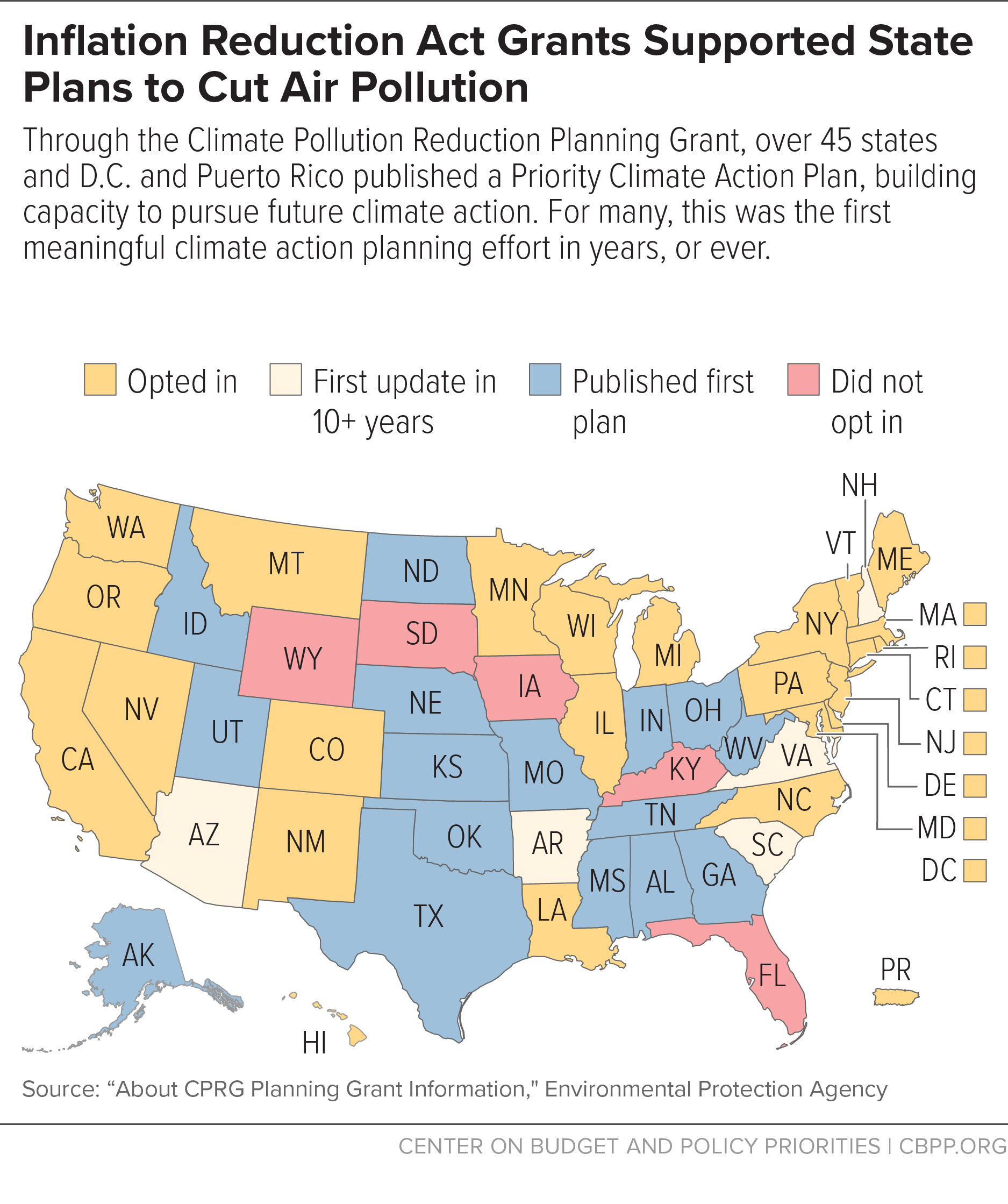
Building state capacity for pollution reduction. States received much of the IRA’s grant funding. For example, the IRA’s Climate Pollution Reduction Grants program awarded $5 billion to state and local governments, tribes, and territories to develop and implement ambitious climate action plans through emissions-reduction projects. Sixteen states, all governed by Republicans, created climate action plans to reduce greenhouse gas emissions and other harmful air pollution for the first time, and many others updated their plans for the first time in a decade (see map).
State and local governments also used the grant funding to build significant project planning infrastructure that they can use to pursue future funding opportunities and continue reducing pollution and advancing clean energy progress.
- Investing in rural communities. The IRA supported the largest investment in rural electrification since the 1936 Rural Electrification Act. For instance, the Department of Agriculture awarded more than $400 million for renewable energy and energy efficiency projects in rural areas across the country.
- Expanding clean energy finance infrastructure. The IRA appropriated $11.7 billion for the Department of Energy’s Loan Programs Office (LPO) to finance new clean energy projects, including projects that help lower the cost of energy and create economic opportunities in low-income and disadvantaged communities. For example, LPO provided a $72.8 million loan guarantee to finance the development of a solar system and microgrid on the tribal lands of the Viejas Band of the Kumeyaay Indians, which is expected to lower energy costs for the tribe.

Unfortunately, since early 2025, congressional Republicans and the Trump Administration have gutted much of the IRA’s federal clean energy tax credits and federal funding for climate programs. These actions will raise households’ energy costs, undermine economic opportunity in struggling communities, and hasten climate change at a time when households are struggling to meet their basic needs.
For example, the harmful 2025 Republican reconciliation law cut more than $280 billion in clean energy tax credits enacted in the IRA through 2034, $170 billion from efforts to cut vehicle pollution, and over $13 billion in grant and loan funding for environmental justice projects, improvements to the electric grid, and energy upgrades in affordable housing. One study estimates that households will face a 13 percent increase ($280 per year) in their energy bills by 2035 because of these cuts.
Additionally, the Administration has attacked IRA investments through grant cancellations, onerous delays and funding freezes, regulatory barriers, and agency staff and budget cuts. (Advocates are fighting the Trump Administration in court to release billions of dollars of frozen and cut clean energy funding, with some already winning court cases that have restored awarded funds.)
Cutting these funds is discouraging the private sector and state, local, and tribal governments from increasing investment in clean energy. For instance, businesses canceled or scaled back clean energy investments totaling more than $28 billion in 2025, according to one estimate. Energy policy analysts from Bloomberg have also estimated that projected clean energy installations will be more than 20 percent lower than they otherwise would have been if Republicans hadn’t cut IRA investments.
While these actions likely will slow clean energy’s replacement of fossil fuel generation, there’s still reason for optimism about clean energy’s future. Solar and wind, for example, are often the least expensive sources of new power generation, even without tax credits. As demand for energy grows, so will clean energy installations. Clean energy sources generated 90 percent of the new energy capacity added in the U.S. in 2025, and solar capacity is expected to grow between 100 percent and 235 percent through 2050, the U.S. Energy Information Administration estimates.
The IRA will continue to have other positive effects. For example, direct pay still exists in the tax code, so tax-exempt entities like state and local governments can continue to take advantage of robust incentives for technologies like geothermal heat pumps and battery storage.
The Inflation Reduction Act has shown the value in investing in the transition to clean energy. As policymakers consider future climate and energy proposals, they should prioritize those that will help the clean energy transition happen faster, more affordably, and more equitably.