

2025 Budget Impacts: House Bill Would Cut Assistance and Raise Costs for Seniors
The House Republicans’ budget reconciliation legislation would reduce assistance that helps seniors and older adults get needed health coverage and afford sufficient food. The so-called “Big Beautiful Bill” is anything but beautiful; it would cause widespread harm by making massive cuts to Medicaid and SNAP, which would raise costs and make it much harder for people to afford the high cost of groceries and health care.
Cutting Health Care for Older Adults
More than 7 million seniors with low incomes receive health coverage and care through Medicaid, with over 3 in 5 nursing home residents having their care paid for by Medicaid. Medicaid also covers other long-term services and supports, including home-based services, and helps cover premiums, deductibles, and cost sharing for some Medicare beneficiaries. By cutting Medicaid and Affordable Care Act (ACA) marketplaces by about $1 trillion, the largest cuts in the programs’ history, the House Republican bill would lead states to make large cuts in eligibility or benefits that could leave many older adults with higher costs and less health care.
Increasing red tape and imposing higher costs on seniors. The House Republicans’ bill includes provisions that will add burdens for seniors, contributing to coverage losses and higher costs. One such provision would block implementation of a rule designed to make it easier for low-income seniors and people with disabilities who receive Medicare to access Medicare Savings Programs, a part of state Medicaid programs that help pay people’s Medicare premiums and cost-sharing charges. According to data from the nonpartisan Congressional Budget Office (CBO), roughly 1.4 million people who are dually eligible for Medicaid and Medicare would no longer receive this cost-sharing assistance and would therefore face increased out-of-pocket costs under the bill.
Threatening funding for home- and community-based care. The House bill would shift costs to states, including through new restrictions on how states can finance their share of Medicaid, which could lead states to cut back on health care services for seniors. States unable to backfill for those cuts may look to cut back on services they aren’t required to provide under Medicaid, including home- and community-based care for frail seniors and people with disabilities.
Taking away Medicaid from people, including older adults, not showing they meet a work requirement. The House bill would take away coverage from low-income adults enrolled in the Medicaid expansion group who can’t document meeting rigid work requirements or show they qualify for an exemption. Even worse, it blocks people from getting coverage unless they are already working and gives states the option to adopt an unlimited “lookback” period, meaning they could require people to report work hours far back into the past as a condition of qualifying for Medicaid.
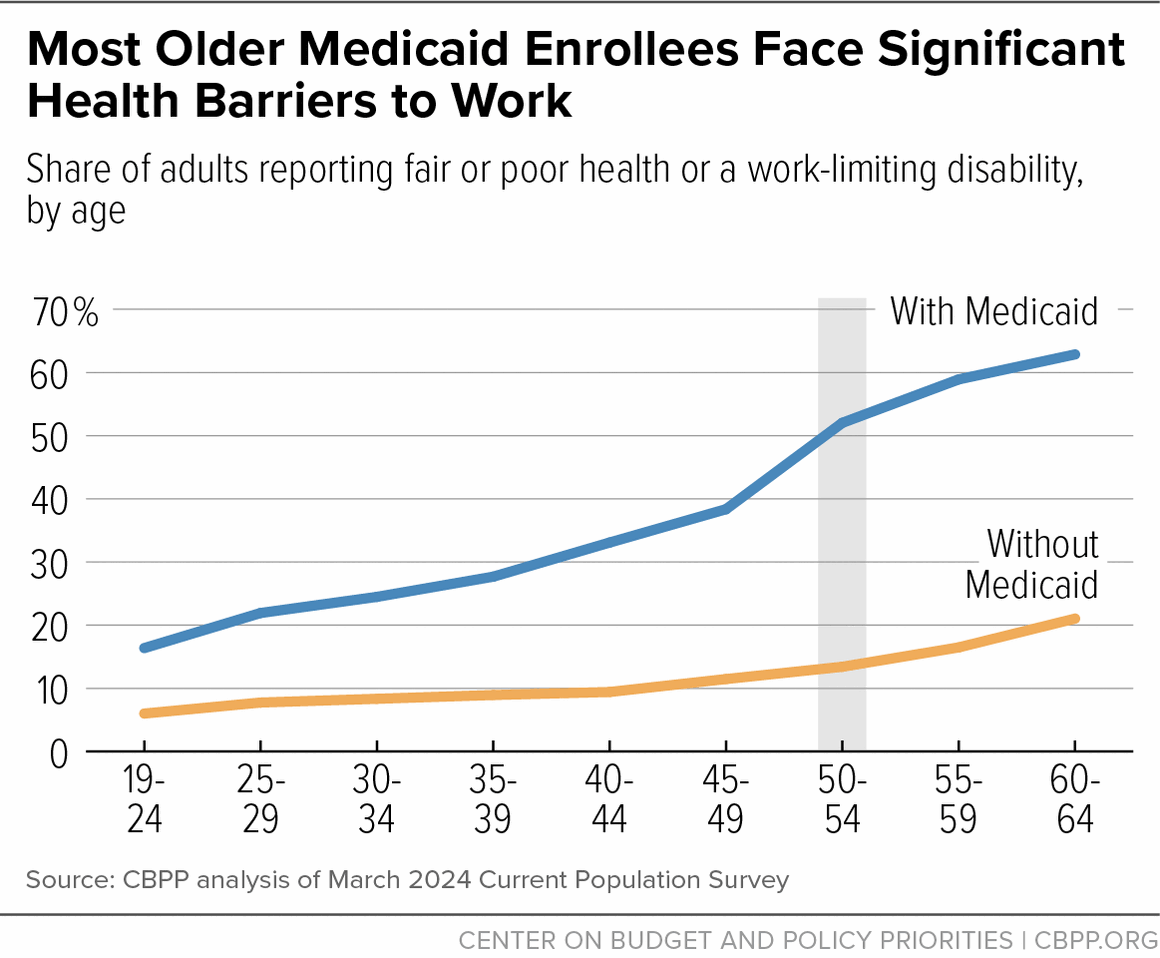
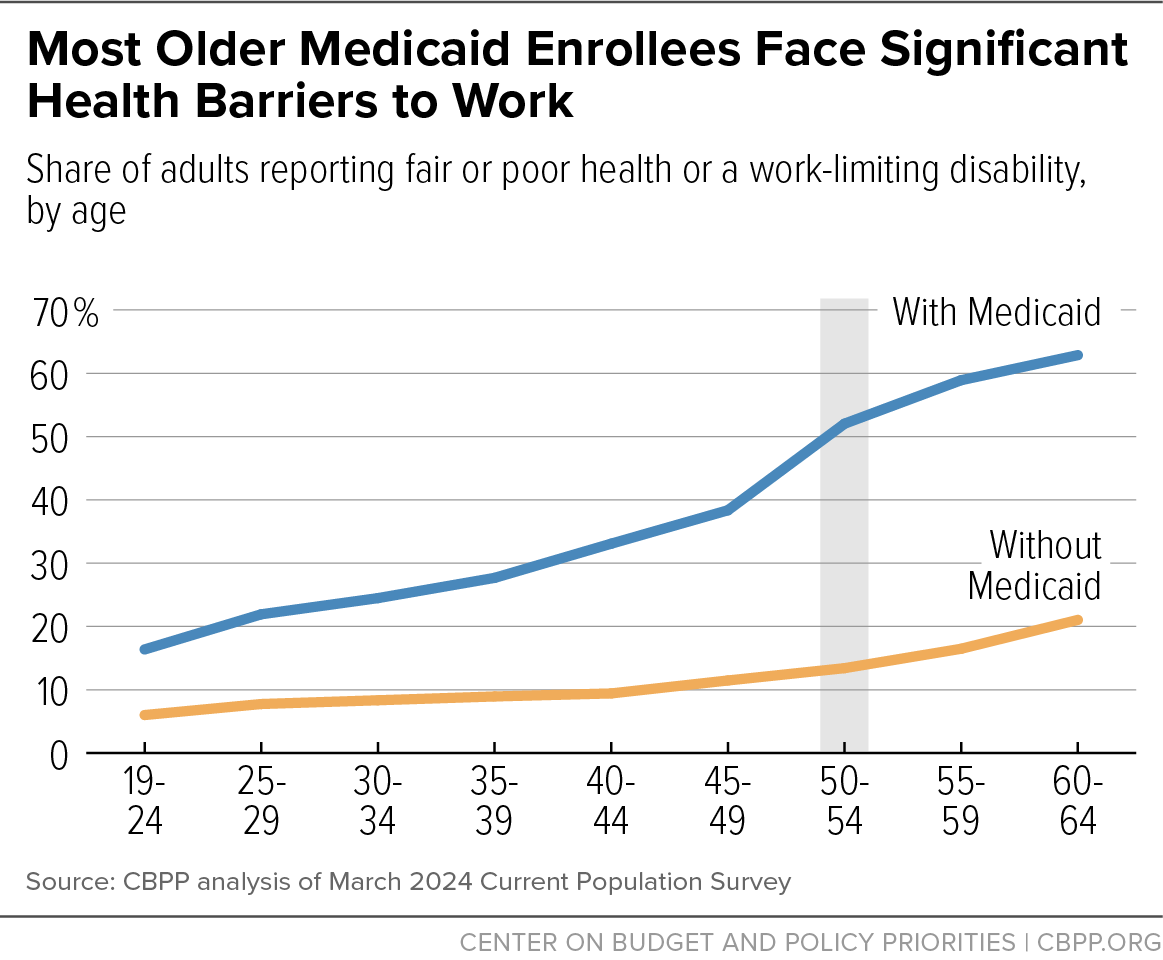
CBO estimates that 5.2 million adults will lose Medicaid under this work requirement, which would apply to individuals up to the age of 64, but many analysts think the number could be higher. Those losing coverage would include people who are working, or who should be exempt because of a disability or other condition, but get tripped up by the requirement’s red tape. Older adults enrolled in Medicaid are at high risk for having disabilities and significant health-related barriers to work, with over half of such adults aged 50 and older reporting a health barrier to employment (see chart).
Taking Medicare away from seniors legally residing in the U.S. The House Republican bill would take Medicare away from most categories of lawfully present immigrants, including refugees, people granted asylum, and people with Temporary Protected Status. Medicare is an earned benefit, meaning that only those who themselves (or whose spouses) have worked in the U.S. for at least 40 quarters — ten years — qualify. Currently, lawfully present immigrants who meet this work history test and other program requirements are eligible for Medicare. This bill would cut off access so that only U.S. citizens, lawful permanent residents, certain Cuban entrants, and people residing in the U.S. from certain Pacific Island (or COFA) nations would be eligible. The bill also would take away marketplace financial assistance from most categories of lawfully present immigrants, such as refugees and people granted asylum, including those who may be seniors.
Reducing the quality of nursing home care. The House Republican reconciliation bill would rescind a rule providing for minimum staffing standards for nursing homes. Lowering these standards would set back efforts to ensure safe, quality care for seniors and other people who need nursing facility services.
Increasing costs for older adults in the ACA marketplaces. Another element of House Republicans’ health agenda targets the ACA marketplaces, which provide coverage and financial assistance to more than 20 million people, including many older people not yet eligible for Medicare. The legislation not only fails to extend the expiring enhanced premium tax credits for marketplace coverage, which will lead to skyrocketing premiums, but it also makes changes that will further increase people’s costs, such as changing how maximum out-of-pocket limits are adjusted.
Cutting Food Assistance for Older Adults
Seniors with low incomes are particularly vulnerable to the consequences of food insecurity, such as hunger, poor dietary quality, and adverse health outcomes such as depression and other chronic illnesses. SNAP, which provides food assistance for more than 40 million people, including 8 million seniors, is linked with better health outcomes for older adults with low incomes, helping them live independently and avoid hospitalization. The House Republican reconciliation bill would cut SNAP by nearly $300 billion through 2034, or 30 percent, according to CBO.
Forcing deep SNAP benefit cuts by radically altering SNAP’s funding structure. SNAP benefit costs have been fully federally funded for 50 years. The House Republican bill would fundamentally alter this structure by requiring states to pay for between 5 and 25 percent of benefit costs. If a state can’t make up for these massive federal cuts with tax increases or spending cuts elsewhere in its budget, it would have to cut its SNAP program (such as cutting benefits or eligibility or making it harder for people to enroll) or it could opt out of the program altogether. CBO estimates that states would cut or terminate benefits for about 1.3 million people in an average month due to this provision. The cuts to nutrition assistance could be far larger if more states than CBO projects deeply cut or end SNAP, and the risk of such cuts would rise during recessions, when state budgets are even more stretched.
Taking SNAP benefits away from older adults who don’t meet rigid work requirements. Under current SNAP rules, adults up to age 54 and without children in their homes are limited to three months of benefits out of every three years if they can’t document they are either meeting a 20-hour-per-week work requirement or are exempt. The House Republican bill would expand this harsh restriction to older adults aged 55-64 and to parents of children over the age of 6, while also significantly limiting waivers for areas with poor economic conditions. CBO estimates that expanding the work requirement would cut SNAP by $92 billion through 2034 and take food assistance away entirely from 3.2 million people in a typical month, including 1 million older adults aged 55-64.
Taking food assistance away from seniors legally residing in the U.S. The House Republican bill would end SNAP for hundreds of thousands of currently eligible immigrants, restricting food benefits only to U.S. citizens, legal permanent residents, certain Cuban entrants, and COFA citizens. People who have proven they have fled persecution, domestic violence survivors, and survivors of sex and labor trafficking are among those whose benefits would be terminated.
Restricting SNAP benefit updates. The House Republican bill would restrict future updates of the Thrifty Food Plan, the basis for SNAP benefit levels, so it wouldn’t reflect current dietary guidance and the types of foods people eat. This would cut benefits for all participants, including seniors, by $37 billion over the next decade, according to CBO.