

States Can Enact or Expand Child Tax Credits and Earned Income Tax Credits to Build Equitable, Inclusive Communities and Economies
Eleven states have enacted a child tax credit, and 31 states plus the District of Columbia and Puerto Rico have enacted their own version of the federal Earned Income Tax Credit (EITC). State child tax credits and EITCs build on the success of both federal credits by helping families afford the basics and reducing poverty, in turn helping them thrive in the long run through improved child and maternal health, school achievement, and other benefits, research has found. Because people of color, women, and people who immigrated to the U.S. are overrepresented in low-paid work and in families with little to no earnings, these two state credits are an important tool for advancing equity. And by bolstering families’ incomes, they also boost local communities and state economies.
The credits complement each other and reach overlapping but distinct populations. The same is true of other programs in the nation’s public assistance system that provide cash and cash-like support. These include the Supplemental Nutrition Assistance Program (SNAP), Temporary Assistance for Needy Families (TANF), and housing assistance among other supports, all of which should be improved or implemented (but which are outside the scope of this report).
Lawmakers in states without their own child tax credit or EITC should enact them. States that have limited their credits should make these credits refundable. States should also expand their credits to those left out of each federal credit, particularly by ending exclusions for immigrants who have an Individual Taxpayer Identification Number (ITIN).
The Basics Are Out of Reach for Too Many Families
Low wages make it hard for families to afford basics such as decent housing in safe neighborhoods, nutritious food, reliable transportation, quality child care, and educational opportunities that can improve their earnings. Furthermore, some people with caregiving responsibilities face high barriers to employment, such as unaffordable child care and inaccessible educational opportunities, which constrain their current and future incomes and make it difficult to provide for their families.
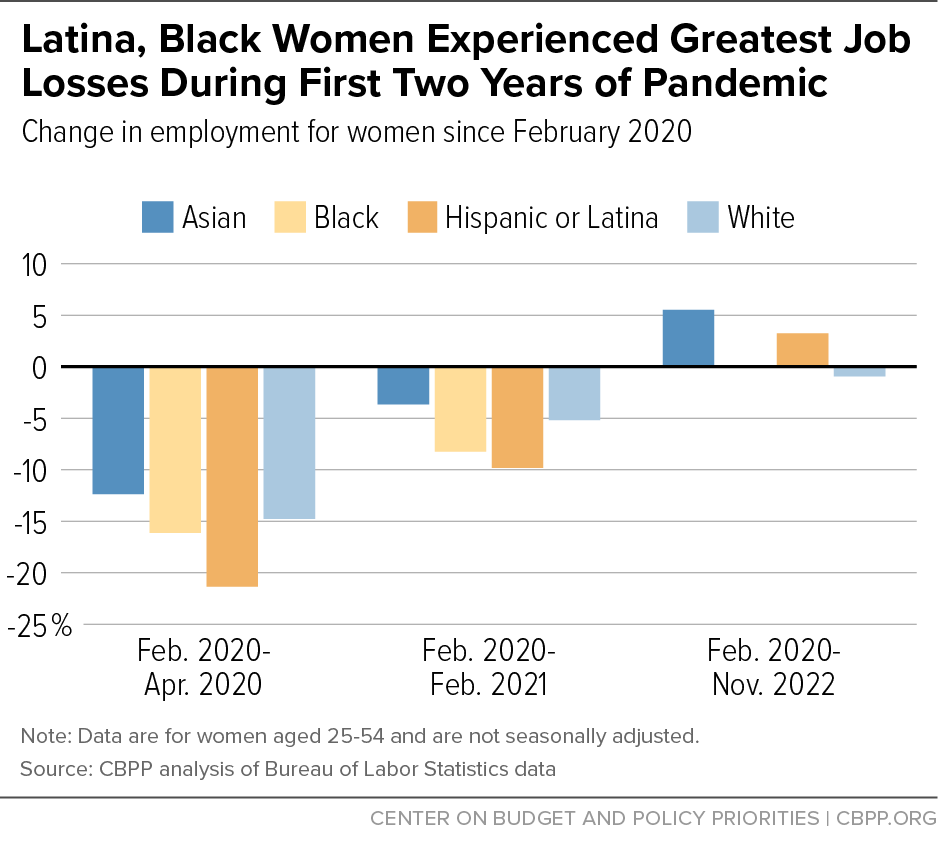
The pandemic and resulting economic downturn hit people with the lowest incomes the hardest. While the economy has rebounded by several measures, many effects are lingering. People of color, women, and immigrants are overrepresented in many jobs that pay low wages,[1] in significant part due to structural barriers such as wealth and income disparities, inadequate access to health care, and discrimination in hiring. As a result, these groups are disproportionately likely to be paid wages insufficient for their basic needs. Many people — disproportionately women and people of color — dropped out of the workforce entirely due to caregiving needs during previous waves of the pandemic, and many have not yet been able to return.[2]
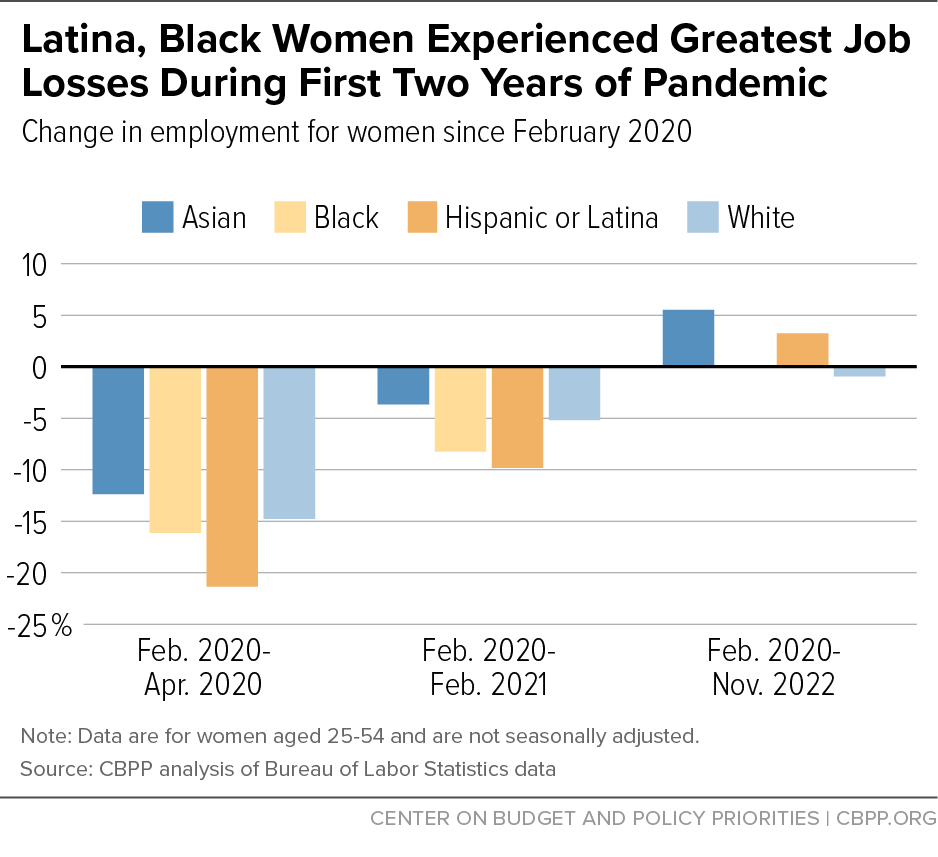
The pandemic recession intensified hardship,[3] but these are long-standing trends. For the most part, wages for lower-paid workers have stagnated or declined over the last 50 years, with the only period of sustained growth from the late 1990s to the early 2000s.[4] Nominal wage growth has been strong recently, especially for lower-paid workers, but high inflation eroded much of those gains. And though increases in state minimum wages have helped boost wages for those earning the least, these gains are meager when compared with significant growth in productivity, which has increased 65 percent since 1979, or 3.7 times as much as pay.[5]
While many families’ wages do not reflect the last 50 years of economic growth, the basics — including housing, child care, and transportation — have gotten more expensive. For example, housing costs for renters continued to increase faster than incomes: from 2001 to 2019, after adjusting for inflation, median renter household income rose just 3.2 percent, while rents rose 17.9 percent, according to Census data.[6] A combination of growing demand for goods and services, supply chain constraints, and Russia’s invasion of Ukraine all led to much higher than average inflation between spring 2021 and the end of 2022. These market forces have driven up the cost of food, energy, and other basics substantially. While many lower-paid jobs have seen rising wages over the past year, on average, those increases haven’t been enough to maintain people’s buying power.[7]
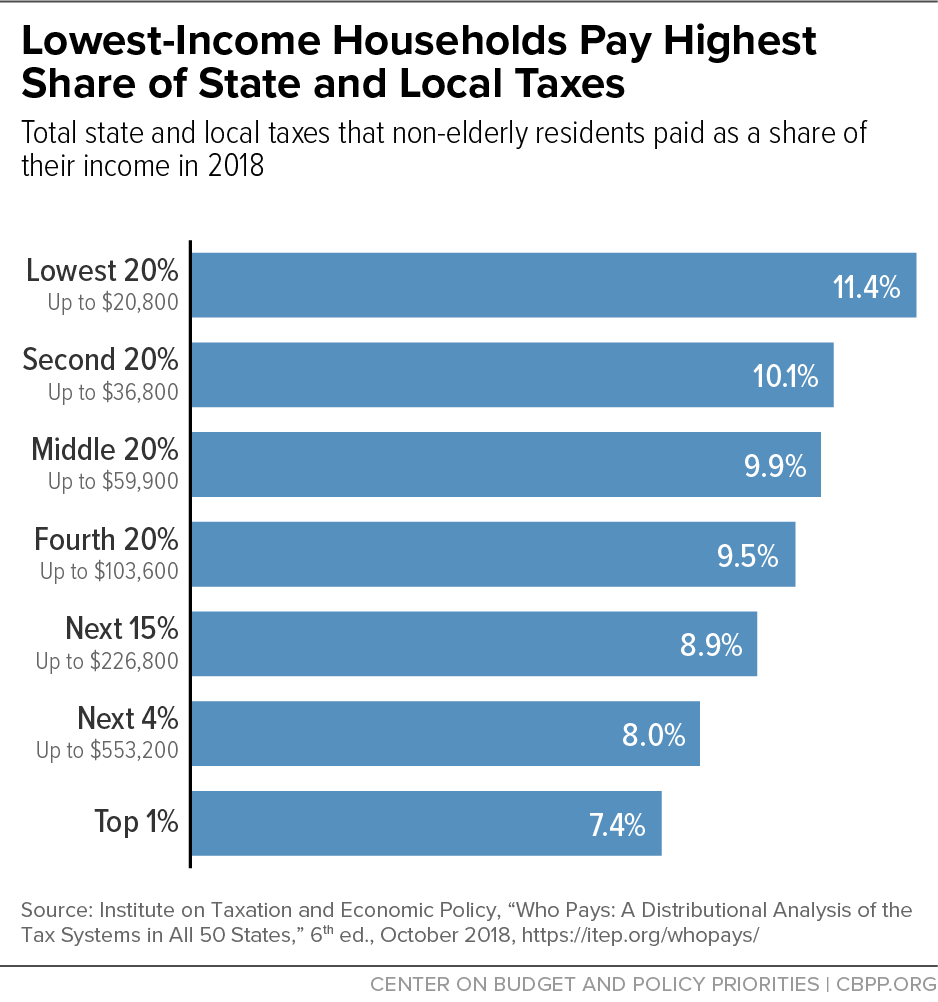
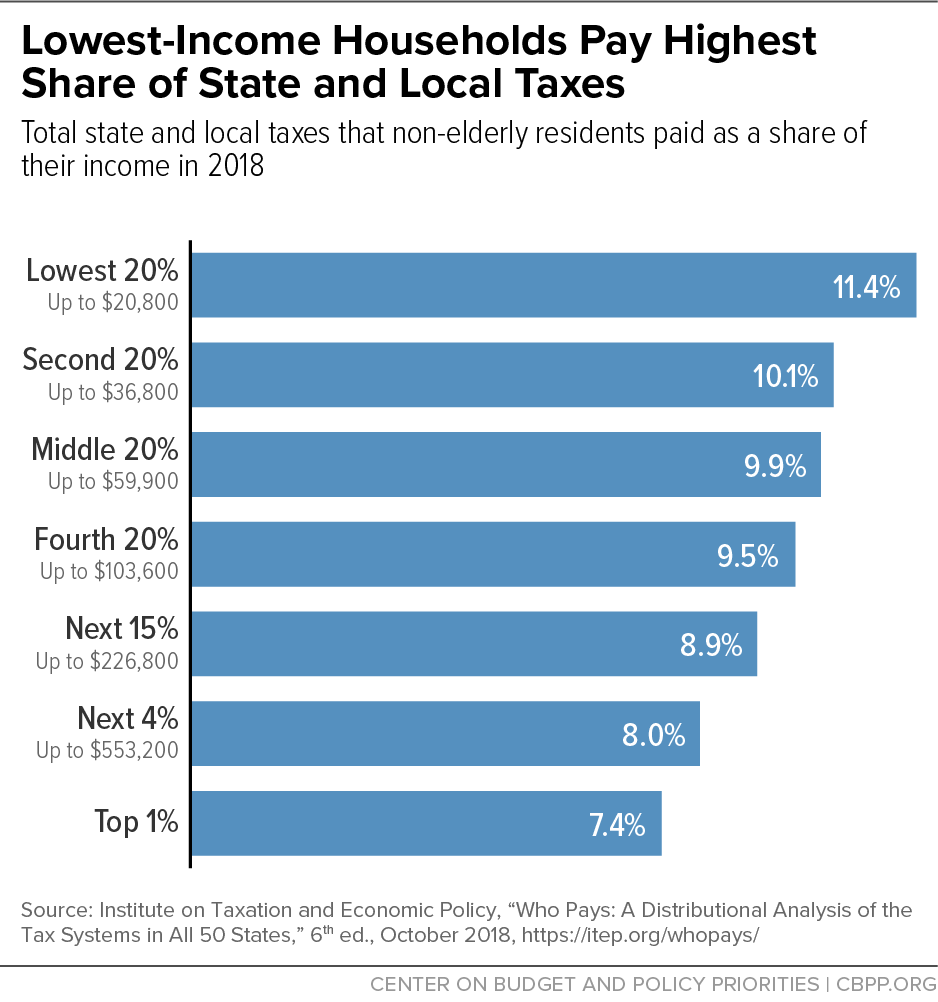
Furthermore, state tax systems that ask the most as a share of income from families earning the least contribute to squeezing families between inadequate wages and increasingly expensive basic needs. In 9 of every 10 states, families earning the least — disproportionately families of color — pay a larger share of their income in state and local taxes than do higher-income families. (See Figure 2.) That means they shoulder more of the load for roads, schools, health care, and other investments that contribute to broadly shared prosperity.[8] Most states’ tax structures worsen racial and ethnic inequities because households of color are more likely to have lower incomes and less wealth than white households due to historical and ongoing discrimination and bias.
Child Tax Credits and EITCs Can Ease Hardship, Promote Opportunity
Child tax credits and EITCs can boost incomes for families paid low wages, for adults not raising children who work low-paid jobs, and for caregivers facing barriers to employment. They can also help address imbalances in the tax system that ask the most of people who earn the least. Eleven states have adopted child tax credits, and 31 states plus D.C. and Puerto Rico have adopted state EITCs. (See Figure 3.)
Refundability is a key feature of these credits and the source of much of their ability to boost income, reduce poverty, and help families in the long run. It means that if the credit exceeds a filer’s tax liability, some or all of the credit is paid out as a refund. In the case of refundable state EITCs, filers can receive the full credit amount they are eligible for based on their earnings, no matter how much they owe at tax time. Refundable state child tax credits provide families with the maximum amount of the credit regardless of earnings (with no phase-in).[9] Without these provisions, the credits leave out families who earn the least.
Most state child tax credits provide a flat amount per child and phase out at a specified income; some are tied to federal eligibility rules and amounts. California and Vermont provide the largest credits: California’s Young Child Tax Credit provides up to $1,083 to families with a child under 6 in the home, and Vermont provides up to $1,000 for each child under 6.
Most state EITCs are modeled directly on the federal credit: they use federal EITC eligibility rules and match a specified percentage of the federal credit. EITCs that provide the full credit filers are eligible for, regardless of tax owed, range from 3 percent of the federal credit in Montana to 100 percent in D.C., the latter once it’s fully phased in in tax year 2026.[10] (See Figure 4 below for characteristics of federal EITC recipients by state, and Appendix Table 1 for more details on each state’s credits.) To help more families make ends meet during the pandemic recovery and beyond, states without a child tax credit or EITC should adopt them and those with these tax credits should continue to expand them.
Child Tax Credits, EITCs Work Together to Boost Family Incomes
By reaching overlapping but different populations, each credit supports some families and individuals that the other doesn’t reach. State child tax credits are generally available to families with low or no earned income on their tax returns. These families may face high barriers to employment as well as high caregiving expenses, which the credits can help them meet. State EITCs are also available to families with children, but they also typically include people paid low wages without children in the home. Adults without children still face the same rising prices that make it hard to afford the basics; they may also be caretakers for people they cannot claim as a dependent on their tax return, such as non-custodial children.
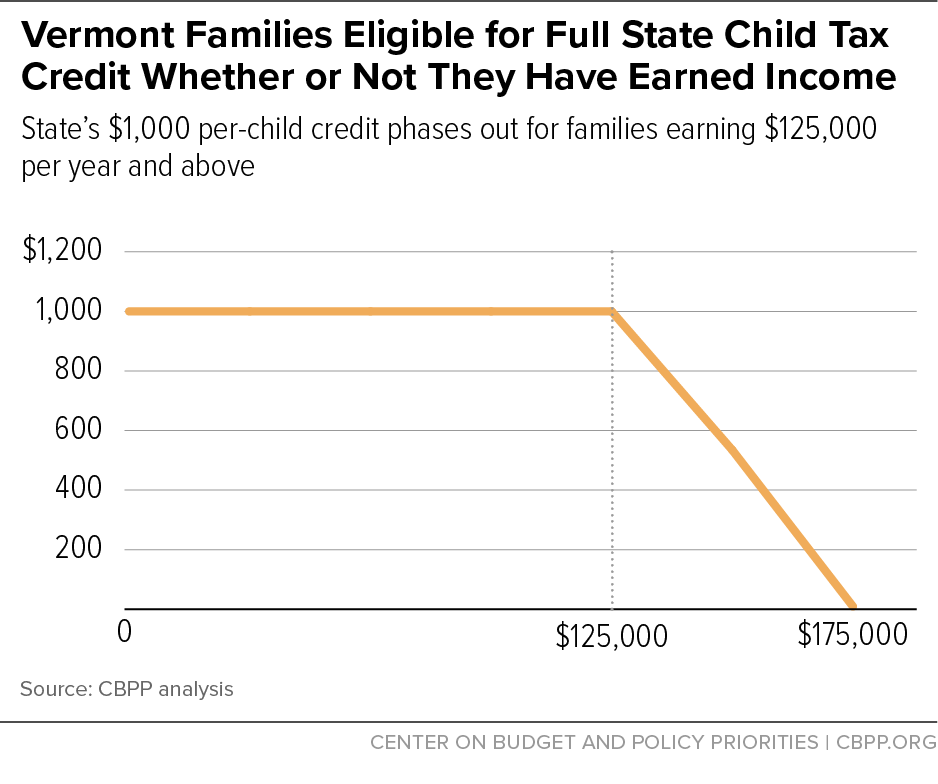
Figure 5 shows how Vermont’s child tax credit works (unlike most state EITCs, which are based directly on the design of the federal EITC, many state child tax credits have their own amounts and phaseouts). The full $1,000 amount is available to all families, whether or not they have earned income. Once a family’s income reaches $125,000, the credit amount begins to decrease, fully phasing out at $175,000. Families receive the credit for each child claimed on their tax return.
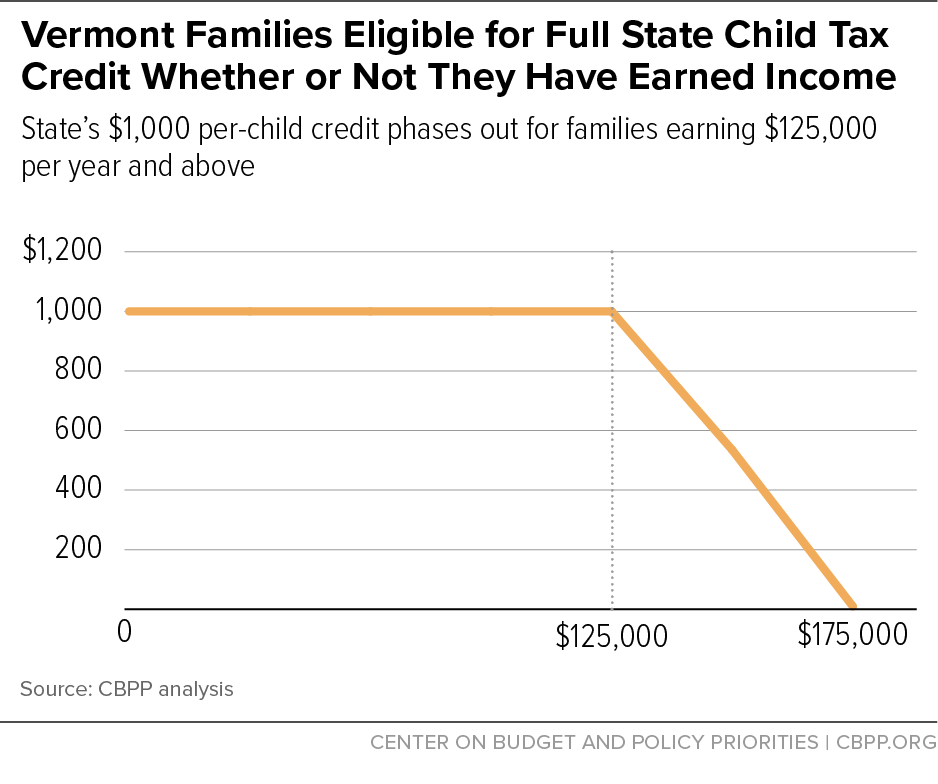
Figure 6 shows how the federal EITC works for a single-parent family with one child earning the federal minimum wage in 2022 (about $15,000 a year for full-time, year-round work). Most state EITCs share a similar structure. For every dollar the parent earns, they get 34 cents in EITC benefits from the federal EITC. The value of the credit continues rising at that rate until their earnings reach $10,980. At that point, the parent receives the maximum benefit of $3,733. Once their earnings exceed $20,130 the credit shrinks by about 16 cents for each additional dollar of earnings until reaching zero at about $43,500. Although the EITC parameters are adjusted for inflation each year, the Tax Cuts and Jobs Act of 2017 included a permanent provision that erodes the credit’s value over time by changing the measure used for inflation indexing from the Consumer Price Index to the “chained” Consumer Price Index, which usually increases at a slower rate. A projection at the time it was enacted found that families will receive a credit that is about $100 to $300 smaller in 2027 as a result, depending in part on family size and earnings.[11]
The American Rescue Plan, enacted in March 2021, expanded the federal Child Tax Credit and EITC for the 2021 tax year. (See Figure 4 for state-by-state data on Child Tax Credit recipients under the Rescue Plan.) It made the maximum value of the child tax credit available to children in families with low or no earnings, raised the maximum credit from $2,000 to $3,000 per child and $3,600 for children under age 6, extended the credit to 17-year-olds, and provided for advance payment of part of the credit. It also increased the EITC for low-paid working adults who are not raising children at home from about $540 to $1,500, increased the income limit for these individuals, and expanded the age range to include younger adults aged 19-24 (excluding students under 24 who are attending school at least part time), as well as people aged 65 and over. It also extended a federal supplement to help Puerto Rico expand its local EITC.[12]
Child Tax Credits, EITCs Boost Family Income, Communities, and Local Economies
Benefits from these credits extend far beyond the dollars that a family receives. By helping families keep up basic spending, the credits help them build economic security, improve longer-term health and well-being, and boost state and local economies. They are especially important when high prices for basic needs hit low-paid workers the hardest, as they did when inflation started rising in early 2021 and peaked in mid-2022 before starting to come down. They:
Reduce poverty, especially in communities of color. Child tax credits and EITCs are helpful to households with children struggling on low wages and to those living below the poverty line. Overall child poverty in the U.S. is much higher than in any of the world’s 18 other similarly wealthy nations: 20 percent of U.S. children live in families with incomes below half of the national median,[13] compared to between 3 and 15 percent in those 18 others. But child poverty is higher still for Latino, Black, and American Indian and Alaska Native children in the U.S. than for white children. Children in some Asian ethnicity groups also face higher child poverty rates than white children, despite low overall poverty rates among all Asian and Pacific Islander children. For example in 2020, 24 percent of Hmong and 25 percent of Bangladeshi children lived in poverty compared with 11 percent of Asian and Pacific Islander children overall.
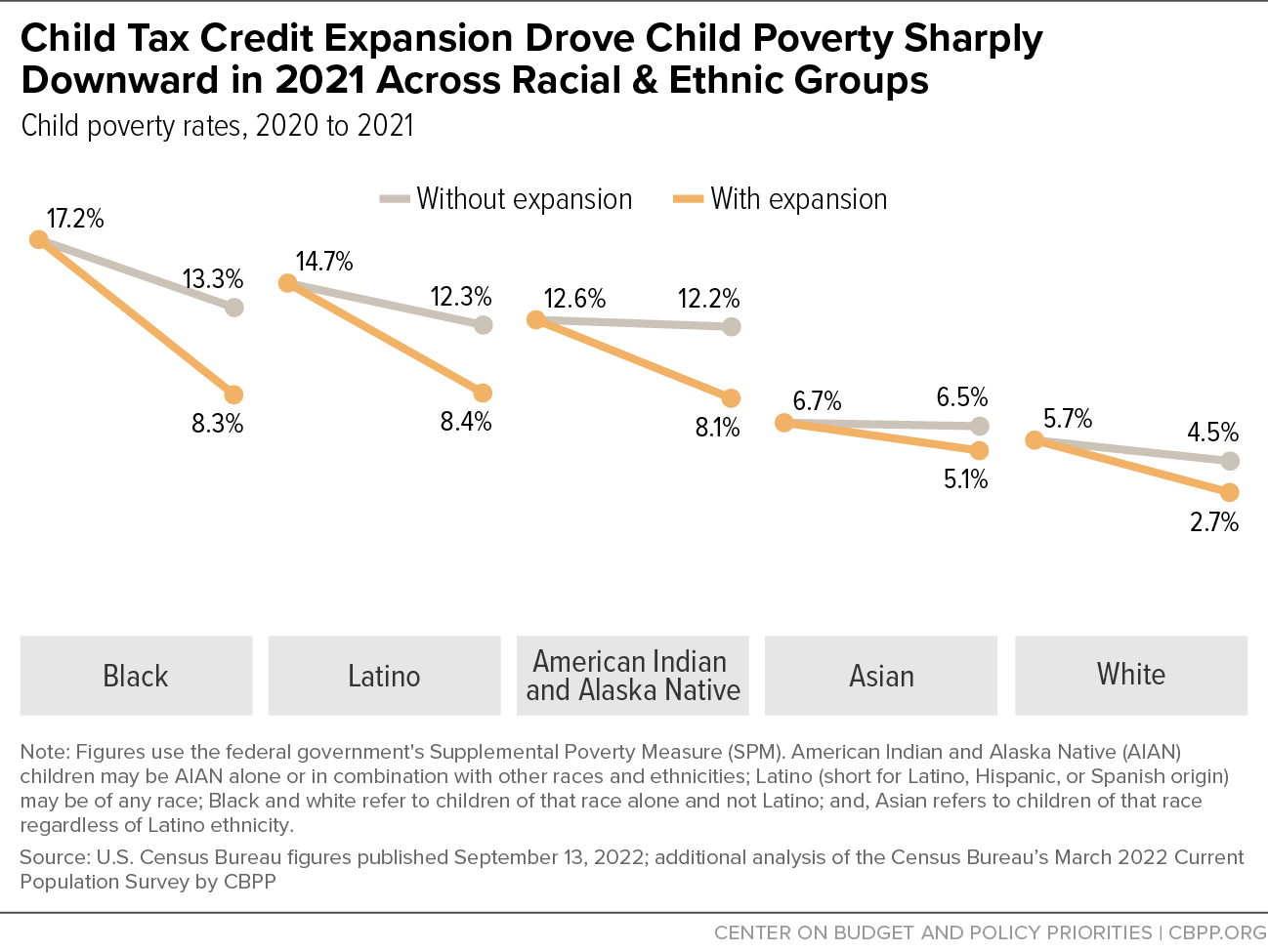
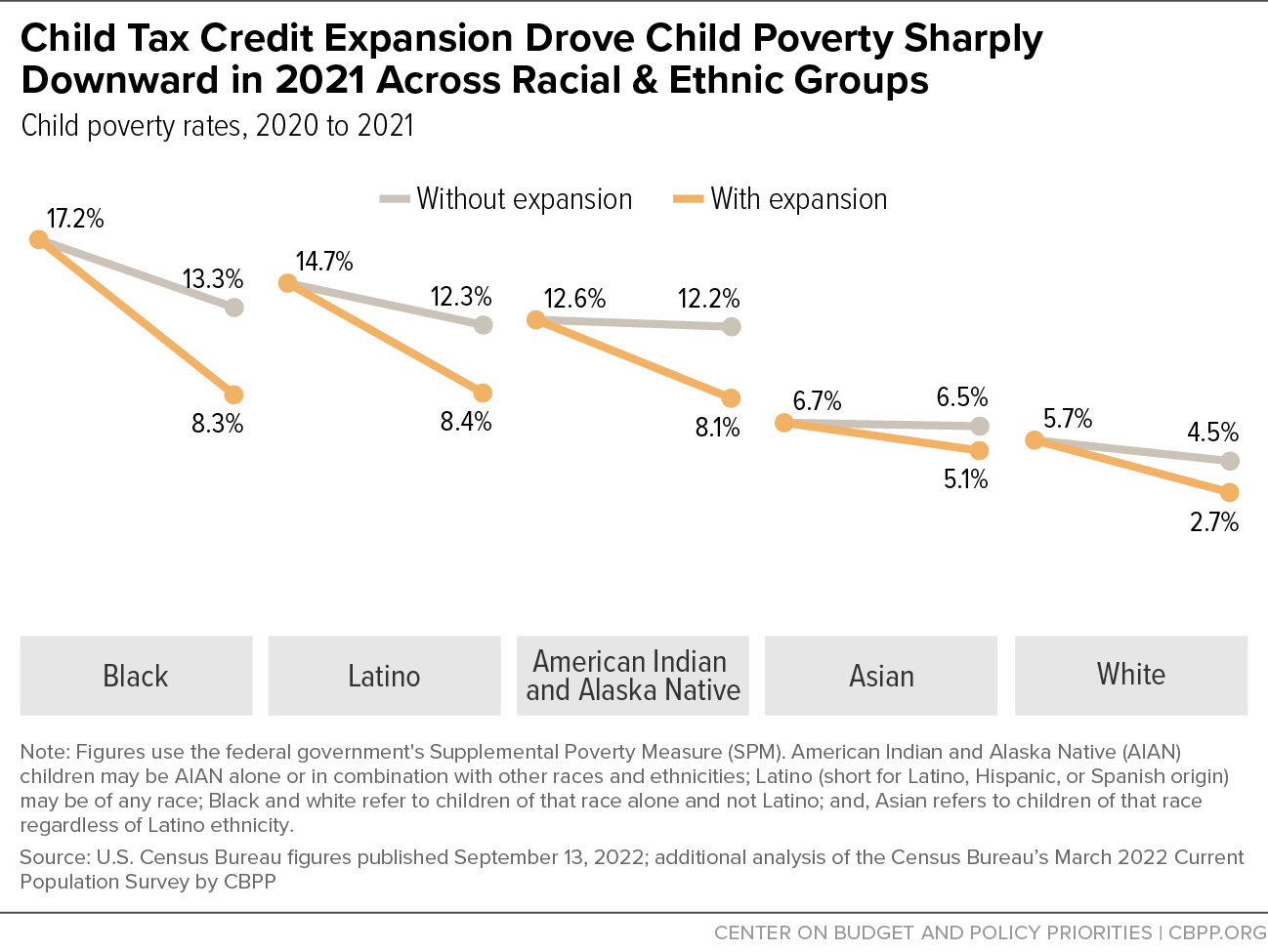
Child tax credits and EITCs both reduce poverty and improve racial equity. The temporarily expanded federal Child Tax Credit, when combined with other pandemic relief measures, drove the child poverty rate to a record low of 5.2 percent in 2021.[14] The Rescue Plan’s expanded credit reduced hardship for children of all races and ethnicities — with the greatest reduction in child poverty rates for Black, Latino, and American Indian and Alaska Native children — and narrowed the differences in poverty rates between them in 2021. (See Figure 7.) A 50-state analysis estimates that a state child tax credit of $2,000 or less (with a 20 percent boost for children under age 6) that’s available to families regardless of earnings would reduce the child poverty rate by at least 25 percent in almost all states.[15]
Meanwhile, state and federal EITCs serve a larger number of white households than any other racial or ethnic group (due in part to population size) but they reach a larger proportion of people of color relative to their population size. And the EITC has an outsized impact in reducing poverty rates for households of color. Due to historical and ongoing racial discrimination, many people of color are overrepresented in work with low wages and face obstacles to building economic security, leading to families struggling to afford the basics and respond to financial emergencies.[16] The EITC helps shrink these disadvantages by lifting low pay. The average state EITC benefit for households headed by a person of color was $120 higher than for white, non-Hispanic households, a recent study found, and state EITCs lift a larger share of people of color and Hispanic populations above the poverty line.[17]
Help children and families thrive. The income from tax credits like the EITC and Child Tax Credit help children from birth throughout their lives. For instance, research links children in families receiving such income to having better childhood nutrition, as well as higher school enrollment, test scores, high school graduation rates, rates of college entry, and earnings into young adulthood.[18] EITCs and child tax credits also may play a particularly important role in helping children of color do better in school and access postsecondary education. Families of color, particularly Black and Latino households, were more likely to use the Rescue Plan’s expanded Child Tax Credit payments for their children’s long-term educational outcomes, such as saving for college and covering K-12 tutoring costs.[19]
Evidence also suggests that additional income from tax credits can support families in meeting the full range of their children’s needs in the short and long term. Studies have found that more generous state EITCs are associated with improved birth outcomes, and states with EITCs that provide the full credit filers are eligible for regardless of tax owed had improved women’s health and healthier birth weights.[20] Even temporary aid to families with low incomes can reduce short-term stresses (which can have long-term consequences), such as hardship events like eviction, food insecurity, or loss of transportation.[21] During the initial monthly payments of the temporarily expanded federal Child Tax Credit in 2021, the number of adults living with children and reporting that their household didn’t have enough to eat fell significantly.[22] Individuals with higher incomes can also more easily afford healthy recreational activities, quality housing, and other opportunities that contribute to their overall well-being.
Boost local economies. Child tax credits and EITCs help families who earn low wages keep up basic spending. This has been particularly important given increases in energy and food prices in the last two years arising from supply chain issues and the war in Ukraine, leading to many families experiencing hardship and causing some local businesses to struggle. Families typically spend their EITCs partially on bigger purchases such as a car repair or a security deposit on an apartment, and partially on routine bills and expenses.[23] The most common way people used the monthly payments of the temporarily expanded federal Child Tax Credit was for food, utilities, clothing, rent or mortgage, and education-related costs such as school supplies, books, tuition, afterschool programs, and transportation to school.[24] When families can keep up basic spending, this in turn helps their local and state economies.
Contrary to some predictions, there is no evidence that the expanded federal Child Tax Credit meaningfully reduced parents’ employment. Most parents received the monthly Child Tax Credit payments starting in July 2021, after which there was no obvious sign of a relative decline in parents’ employment. And rises in employment were similar for the share of adults in families with and without children under 18, both at full time for whole year and among those working the equivalent of at least half the year (1,000 hours), according to Census data.[25] Furthermore, two recent studies examining the issue found that the expanded credit did not meaningfully reduce parents’ employment,[26] in keeping with a number of other analyses that found no meaningful impact on employment.[27] Over 95 percent of families who are currently left out of the full federal Child Tax Credit because their earnings are too low have a parent or caretaker that is working; is between jobs, elderly, ill, or has a disability; or has a child under age 2.[28]
State child tax credits and EITCs also play a role in bolstering family economic security so that more people can create innovative products and services, benefiting individuals and state economies in the long term.[29] Economic insecurity is linked to a range of bad outcomes for children, such as higher stress levels and lower educational achievement, and weakens young people’s likelihood of realizing their economic potential as adults. Working to raise household income and make sure families can access the supports they need is a straightforward way for policymakers to foster more long-term innovation and to improve children’s outcomes and their likelihood of future success.
States Can Build Stronger Futures by Enacting and Strengthening Child Tax Credits and EITCs
Several design aspects of the federal Child Tax Credit and EITC constrain its potential to boost income and help struggling families make ends meet. These aspects in turn limit state credits that are based on these federal credits in whole or in part. A family who earns less than $2,500 receives no federal Child Tax Credit, and a single parent with two children who earns between $2,500 and roughly $30,000 receives only a partial credit. The child credit is only partially refundable, which means that the lowest-income families may not receive the credit’s full value. For people without children in the home, the federal EITC has age restrictions, is small, and phases out at too low of an income level. Both federal credits restrict eligibility for people or children who have ITINs, with the Child Tax Credit excluding children who have ITINs and the EITC excluding individuals and families if any member has an ITIN.
The Rescue Plan temporarily addressed some of these challenges by making the maximum value of the Child Tax Credit available to children in families with low or no earnings, raising the maximum credit and boosting it for children under age 6, and extending the credit to 17-year-olds. It also temporarily expanded the age range of workers eligible for the EITC without children to include younger adults aged 19-24 (excluding students under 24 who are attending school at least part time), as well as people aged 65 and over, and raised the income limit for such workers to qualify. Both expansions were for 2021 only. Congress should take action to expand the federal Child Tax Credit, and the EITC for adults not raising children, and states should continue to improve state credits for workers without children in the home in the meantime.
States can lessen these constraints in their own versions of the credits and take steps to improve the equity of their tax systems by:
- Enacting new, refundable credits. Eleven states have enacted a state child tax credit, and 31 states plus D.C. and Puerto Rico have created a state EITC. Given both credits’ benefits for families, communities, and states, and the need to continue supporting families through this phase of the pandemic recovery, now is an ideal time to act for states that haven’t yet enacted either credit. (See Appendix Table 3 and 4 for estimating the cost of creating a new credit.)
- Making credits refundable (if they are not already). Eight states offer refundable child tax credits, and 26 states, D.C., and Puerto Rico follow the federal practice of offering an EITC that is refundable to families with low earnings in a given year. Without this feature, state child tax credits and EITCs fail to offset the other substantial state and local taxes that families pay, such as sales and property taxes.
- Ending exclusions for individuals using ITINs. States should make their credits more inclusive for people regardless of their immigration status, as six states have already done for their child tax credits and nine have done for their EITCs. That would help expand economic opportunity for all their residents and support essential workers earning low pay who are immigrants. Federal policymakers excluded millions of immigrants from many of the emergency pandemic supports they enacted in 2020 and 2021. Looking at the EITC specifically, many of those same people are ineligible because they lack Social Security numbers and file taxes with an ITIN. If more states with EITCs enacted this change, it would help at least 1.1 million households. (See Table 1.)
In addition, the following principles should guide states as they design their own child tax credits:
- Provide a flat amount per child with a phase-out at higher incomes. This structure is simple to calculate and understandable for families. The full credit should be available to families whether or not they have earned income, with a phase-out beginning at higher levels of income, when families are on more stable footing. The Rescue Plan’s temporary expansion began to phase out the credit at incomes ranging from $75,000 to $150,000 depending on filing status.
- Adjust the credit for inflation so that it maintains its value over time. Especially given the rapid price increases in the past year-plus, this provision ensures that the credit would be available to help families with any increases in the cost of food, fuel, and other necessities. (The federal EITC upon which most state EITCs are based is already adjusted for inflation each year, although as noted the 2017 tax law changed the inflation measure to one that erodes the credit’s value over time.[30])
Provide a credit for all children aged 0 to 17, with an extra boost for children aged 5 and under. There are compelling reasons both to offer a credit that is available to all children aged 0 to 17 and to boost the credit for families with young children. The Rescue Plan took this approach in 2021, offering a credit worth $3,600 for children 5 and under and $3,000 for all other children through age 17.
Families with very young children tend to have lower incomes and experience higher poverty rates than households without children, due to the difficulty of balancing caregiving needs and the need to earn income.[31] In addition, research has found links between poor nutrition and severe stress in early childhood and worse health outcomes later in life. An increased child tax credit for families with young children can boost family incomes when families most need the support, and support children’s health and development in their earliest years.
And providing a child tax credit for all children up to age 18 recognizes that expenses increase as children age, with the highest expenses for families falling in teenage years.[32]Furthermore, additional income such as what the child tax credit and EITC provide has been linked to better educational outcomes while children are in school and may improve higher education access and outcomes.[33]
Furthermore, states should expand EITCs for working adults without children in the home and eliminate age restrictions for these individuals. The federal EITC has limited reach and benefits for people paid low wages who don’t have children in the home, even though they are integral members of their communities and local economies, and many are non-custodial parents or likely future parents. The Rescue Plan increased the federal EITC for low-paid working adults who are not raising children at home from about $540 to $1,500, increased the income limit for these individuals to qualify, and expanded the age range to include younger adults aged 19-24 (excluding students under 24 who are attending school at least part time), as well as people aged 65 and over. An estimated 17.4 million low-paid adults without children across the country benefited from the expanded credit, including roughly 9.7 million white, 3.6 million Latino, 2.7 million Black, and 816,000 Asian workers.[34]
States need not wait for an expansion of the federal credit for working adults without children in the home. Colorado, D.C., Maine, Maryland, Minnesota, and New Mexico have all reduced age restrictions; California and Illinois and New Jersey have eliminated them for workers 18 and older; Puerto Rico has for workers aged 19 and older; and California, D.C., Maryland, and Maine have increased the credit amount for working adults without children in the home.
A provision of the Rescue Plan that limits states’ ability to cut taxes while spending federal pandemic aid through 2026 should not limit states’ ability to enact and improve their state credits. The rule allows states to reduce revenues by less than 1 percent of their 2019 budget, adjusted for inflation; most proposed credit expansions would be less.[35]
| TABLE 1 | ||
|---|---|---|
State EITC Expansions for Tax Filers Using ITINs Would Help an Estimated 1.1 Million People Make Ends Meet | ||
| Assuming participation rates of the currently eligible EITC population* | ||
| State | Estimated EITC ITIN Returns (2015) | Estimated State EITC Refunds (2020 dollars) |
| California | 480,840 | $70,271,000 |
| Colorado | 31,640 | $7,514,000 |
| Delaware | 13,275 | $7,516,500 |
| District of Columbia | 3,445 | $3,140,500 |
| Hawai’i | 205 | $64,000 |
| Illinois | 110,445 | $52,547,000 |
| Indiana | 27,215 | $6,031,000 |
| Iowa | 6,010 | $2,273,500 |
| Kansas | 12,820 | $6,172,500 |
| Louisiana | 6,310 | $903,000 |
| Maine | 45 | $10,500 |
| Maryland | 40,385 | $21,715,500 |
| Massachusetts | 13,230 | $9,326,500 |
| Michigan | 12,440 | $1,971,000 |
| Minnesota | 14,655 | $12,346,000 |
| Montana | 80 | $5,500 |
| Nebraska | 7,485 | $1,848,500 |
| New Jersey | 54,100 | $54,522,500 |
| New Mexico | 11,570 | $5,364,000 |
| New York | 74,195 | $56,576,500 |
| Ohio | 13,205 | $2,796,000 |
| Oklahoma | 15,165 | $996,500 |
| Oregon | 20,440 | $4,740,500 |
| Rhode Island | 2,700 | $1,087,500 |
| South Carolina | 14,400 | $1,559,500 |
| Vermont** | N/A | |
| Virginia | 30,240 | $8,966,500 |
| Washington | 46,565 | $11,324,500 |
| Wisconsin | 22,065 | $7,981,000 |
| Total | 1,085,170 | 359,571,500 |
ITIN = Individual Tax Identification Number. Table lists states with existing state earned income tax credits. * State calculations that adjust for participation are generated by reducing estimates of EITC-eligible ITIN filers by both the federal participation rates as published by the IRS for tax year 2016 (which is the most recently reported rate in EITC Central at https://www.eitc.irs.gov/eitc-central/participation-rate/eitc-participation-rate-by-states) and a further 10 percent reduction to account for attrition between federal EITC and state credit claimants. ** Vermont has a state credit at 36 percent of the federal EITC, but no ITIN returns for Vermont were included in the 2015 IRS data. Sources: Institute on Taxation and Economic Policy analysis of IRS 2015 ITIN Filer Data; “End the tax penalty against immigrant workers,” Center for Community Change, April 2020, Table 1, https://communitychange.org/wp-content/uploads/2020/04/ITIN_EITC_Fact_Sheet_Tables_April_2020-002.pdf. | ||
Appendix
| APPENDIX TABLE 1 | |||||
|---|---|---|---|---|---|
State Earned Income Tax Credits, 2022 | |||||
| Eligibility Expansions Beyond the Federal Credit | |||||
| State | Percentage of Federal Credit | Refundable? | Filers Using Individual Taxpayer Identification Numbers (ITINs) | Individuals Without Children in the Home | Additional Eligibility Expansions |
| Californiaa | 85% of federal credit, up to 50% of the federal phase-in range | Yes | Yes | Workers without children in the home aged 18 and older | $1,083 Young Child Tax Credit for families with children under age 6 (available to families with zero income) |
| Coloradob | 20% | Yes | Yes | Workers without children in the home aged 19-24 | |
| Connecticut | 30.5% | Yes | No | ||
| Delawared | 20% | Yes – 4.5% | No | ||
| District of Columbiae | 70%/ 100% | Yes | No | Workers without children in the home with incomes up to twice the poverty line | Non-custodial parents |
| Hawai’if | 20% | No | No | ||
| Illinoisg | 18% | Yes | No | ||
| Indianah | 10% | Yes | No | ||
| Iowa | 15% | Yes | No | ||
| Kansas | 17% | Yes | No | ||
| Louisiana | 5% | Yes | No | ||
| Mainei | 25%/50% | Yes | Yes | Workers without children in the home aged 18-24 | |
| Marylandj | 45%/100% | Yes | Yes | Workers without children in the home under age 24 | |
| Massachusettsk | 30% | Yes | No | Survivors of domestic abuse who would otherwise be ineligible | |
| Michigan | 6% | Yes | No | ||
| Minnesotal | Avg. 44% | Yes | No | Workers without children in the home aged 21-24 | |
| Missourim | Enacted but not yet available, see footnote | No | No | ||
| Montana | 3% | Yes | No | ||
| Nebraska | 10% | Yes | No | ||
| New Jersey | 40% | Yes | No | Workers without children in the home over 18 | |
| New Mexicon | 20% | Yes | Yes | Workers without children in the home aged 18-24 | |
| New Yorko | 30% | Yes | No | Non-custodial parents | |
| Ohio | 30% | No | No | ||
| Oklahomap | 5% | Yes | No | ||
| Oregonq | 9%/12% | Yes | Yes | ||
| Rhode Island | 15% | Yes | No | ||
| South Carolinar | 104.7% | No | No | ||
| Utah | 15% | No | No | ||
| Vermont | 38% | Yes | No | ||
| Virginias | 20% | Yes – 15% | No | ||
| Washingtont | Follows a separate schedule, maximum credit between $300-$1,200 based on family size | Yes | Yes | ||
| Wisconsinu | 4% – one child 11% – two children 34% - three children No credit – childless workers | Yes | No | ||
| Puerto Ricov | Follows a separate schedule; maximum credit between $1,500-$6,500 based on family size | Yes | No | Workers without children in the home aged 19 and older | |
a. California's credit is available to working families and individuals with wage income below $30,000 depending on family size. The credit is worth 85 percent of a household's federal EITC until household income reaches half of the level at which the federal credit is fully phased in; it then begins phasing out at varying rates, depending on family size. In 2022, the maximum credit ranges from $275 for workers without dependent children to $3,417 for workers with three or more children, plus a $1,000 Young Child Tax Credit for families with children under 6. The value of the credit is set each year by the legislature. For a full list of 2022 parameters see: https://www.ftb.ca.gov/about-ftb/newsroom/caleitc/eligibility-and-credit-information.html. b. Colorado's credit increased from 15 to 20 percent of the federal EITC in tax year (TY) 2022. For TY23-TY25, the credit increases to 25 percent and returns to 20 percent beginning in 2026. The state made the federal expansion in the American Rescue Plan for workers without children ages 19-24 permanent in TY22. d. Delaware's credit is partially refundable by allowing families to choose the higher of a refundable credit worth up to 4.5 percent of the federal EITC or the non-refundable credit, which is worth up to 20 percent of the federal EITC. e. The District of Columbia's credit gradually increases to 70 percent in TY22-TY24 to 85 percent in TY25 and 100 percent beginning in TY26 for adults with dependent children. A portion of the credit will be paid monthly over a 12-month period if an individual's credit exceeds a certain amount. The D.C. EITC also counts the children of non-custodial parents, as long as the worker is aged 18 to 30, and the worker pays child support and is up to date on those payments. Starting in TY23, the credit will allow residents to file with an ITIN. f. Hawai’i’s earned income tax credit will be permanent and refundable starting in TY23. g. Illinois’ credit will increase from 18 to 20 percent of the federal EITC starting in TY23. Eligibility for the earned income tax credit will be extended for people filing with an ITIN as well as to people aged 18-24 and 65 or older also in TY23. h. Indiana decoupled from federal provisions expanding the EITC for families with three or more children and raising the income phase-out for married couples. i. Maine increased the refundable EITC from 25 to 50 percent for eligible individuals without children and from 12 to 25 percent for all others beginning TY22. j. Maryland's credit was 45 percent of the federal credit for families with children in the home for TY20-22 and 100 percent for individuals without a qualifying child (up to $530). The rate returned to 28 percent after 2022. Maryland’s EITC now includes people filing with an ITIN during the same time period. Maryland also offers a non-refundable EITC set at 50 percent of the federal credit. In effect, taxpayers may claim either the refundable credit or the non-refundable credit, but not both. k. In Massachusetts, survivors of domestic violence can file their own tax returns and remain eligible for the EITC. (Otherwise, survivors separated from a spouse must either file joint tax returns with an abuser or claim head of household status, for which they may not be eligible.) l. Minnesota’s credit for families with children, unlike the other credits shown in this table, is structured as a percentage of income rather than a percentage of the federal credit. The average given here reflects total projected state spending for the Working Family Credit divided by projected federal spending on the EITC in Minnesota as modeled by Minnesota’s House Research Department; this average fluctuates from year to year and this table reflects 2020 data. m. Missouri will have a non-refundable EITC worth 10 percent of the federal EITC starting in TY23. The credit will increase to 20 percent if state revenue rises beyond a certain threshold. n. New Mexico's credit will increase from 20 to 25 percent of the federal ETIC beginning in TY23. o. New York non-custodial parents who meet certain requirements may claim 20 percent of the federal credit that they would have received with a qualifying child, or 2.5 times the federal credit for workers without qualifying children. p. Oklahoma's credit became refundable beginning in TY22. q. Oregon's credit is 12 percent for families with children age 3 and younger, otherwise it is 9 percent. The credit is now available to those filing with an ITIN in TY22-25. r. South Carolina's EITC is phased in for six equal installments starting in 2018, to reach 125 percent of the federal credit by 2023. This credit is non-refundable and is less generous than a 5 percent refundable EITC because workers with very low incomes tend to have little to no tax liability. s. Virginia's credit is partially refundable by allowing families to choose the higher of a refundable credit worth up to 15 percent of the federal EITC or the non-refundable credit, which is worth up to 20 percent of the federal EITC for TY22-25. t. Washington enacted a tax rebate in 2008 but never funded it. In 2021, the state enacted an updated version of the rebate, the Working Families Tax Credit. It will provide an annual cash rebate ranging from $300 to $1,200, depending on household size and income level beginning in 2023. The credit allows people using ITINs to claim it. It is structured as a sales tax exemption in the form of a refund, but it functions similarly to an EITC and eligibility is based on receipt of the federal EITC. u. Puerto Rico residents are ineligible for the federal EITC. The American Rescue Plan Act provided $600 million in federal funds to improve the credit, and Governor Pierluisi signed a bill in August 2021 stipulating how the funds would be used. It provides a maximum credit of $1,500 to $6,500 based on income and family size. It also expands eligibility for those who are self-employed and workers without children in the home who are age 19 and older. For additional information about Puerto Rico’s EITC parameters, see: https://espaciosabiertos.org/en/credito-por-trabajo/. | |||||
| APPENDIX TABLE 2 | |||||||||||||
|---|---|---|---|---|---|---|---|---|---|---|---|---|---|
State Child Tax Credits, 2022 | |||||||||||||
| Maximum Credit | Refundable? | Individual Taxpayer Identification Number Filers | Eligibility | Phaseout Begins | Phaseout Ends | ||||||||
| California(a) | $1,083 per household | Yes | Yes | Under age 6 | $25,000 of earnings | $30,000 of earnings | |||||||
| Colorado | 60% of federal Child Tax Credit | Yes | Yes | Under age 6 | $25,000 of AGI (single), $35,000 of AGI (joint) | Over $75,000 of AGI (single), $85,000 of AGI (joint) | |||||||
| Idaho(b) | $205 per qualifying child | No | No | Under age 17 | N/A | N/A | |||||||
| Maine(c) | $300 per qualifying child and dependent | No | No | Under age 17 | $400,000 of ME AGI (joint), $200,000 (all others) | N/A | |||||||
| Maryland(d) | $500 per qualifying child | Yes | No | Under age 17 with a disability | Credit limited to people earning $6,000 or less | N/A | |||||||
| Massachusetts(e) | $180 for one dependent; $360 for two or more dependents | Yes | Yes | Under age 12, age 65 or over, or has a disability | N/A | N/A | |||||||
| New Jersey(f) | Enacted but not yet available, see footnote | Yes | Yes | Under age 6 | $30,000 of NJ taxable income | $80,000 of NJ taxable income | |||||||
| New Mexico(g) | Enacted but not yet available, see footnote | Yes | Yes | Under age 19 | $25,000 of AGI | None | |||||||
| New York | The greater of: 33% of federal Child Tax Credit, or $100 per qualifying child | Yes | Yes | Ages 4 - 16 | If filer does not qualify for federal credit: $110,000 of NY AGI (joint); $75,000 (single or head of household); $55,000 (married filing separately) | N/A | |||||||
| Oklahoma | The greater of: 5% of federal Child Tax Credit; or 20% of the federal Child Care Expenses Credit | No | No | Under age 17 | Credit limited to filers earning $100,000 of AGI | N/A | |||||||
| Vermont | $1,000 per child | Yes | No | Under age 6 | $125,000 of AGI | 175,000 AGI | |||||||
AGI = adjusted gross income. TY = tax year. a. California's Young Child Tax Credit is part of the state's Earned Income Tax Credit. Starting in TY22, the portion of the credit for young children will be available to families with no earned income (as most other state child tax credits are). c. Idaho's child tax credit is worth $205 for each child during TY18-25. If the child is in the custody of one or both of the parent for more than half of the tax year, a court order or written verification from custodial parent that they will not claim the credit can allow a non-custodial parent to claim the state CTC. d. Maryland's refundable child tax credit is only available to families with incomes below $6,000 of AGI who care for a child with a disability. The credit is worth $500 per child and is temporarily available during TY20-22. e. Maine's dependent exemption tax credit has no limit on dependents that can be claimed and is also limited to tax owed, so there is no fixed phaseout end that applies to all families. e. Massachusetts' Household Dependent Tax Credit provides $180 for one dependent or $360 for two or more dependents under the age of 12, 65 or over, or who have a disability. Families can choose the higher of this credit or the state's Dependent Care Tax Credit ($240 for one qualifying person, $480 for two or more). f. During the 2022 legislative session, New Jersey created a child tax credit worth up to $500 per child under age 6. The credit will be available beginning in TY23. g. New Mexico enacted a new child tax credit worth up to $175 per child under age 17 and will be available TY23-31. As income increases, the credit amount decreases but never fully phases out. | |||||||||||||
| APPENDIX TABLE 3 | ||||||
|---|---|---|---|---|---|---|
Estimated Cost of Refundable State Earned Income Tax Credits, Fiscal Year (FY) 2024 | ||||||
| Estimated Cost of State EITC in FY 2024* ($ in millions) | ||||||
| State | Federal EITC Claims in Tax Year 2020 ($ in thousands) | Percent of Total U.S. EITC Claims, Tax Year 2020 | Estimated Federal EITC Claims in FY 2024 ($ in millions) | Set at 5% of Federal Credit | Set at 10% of Federal Credit | Set at 20% of Federal Credit |
| States Without Refundable EITCs | ||||||
| Alabama | 1,245,775 | 2.14% | 1,563 | 70 | 141 | 281 |
| Alaska | 91,035 | 0.16% | 114 | 5 | 10 | 21 |
| Arizona | 1,340,524 | 2.30% | 1,682 | 76 | 151 | 303 |
| Arkansas | 732,056 | 1.26% | 918 | 41 | 83 | 165 |
| Florida | 5,098,780 | 8.76% | 6,396 | 288 | 576 | 1151 |
| Georgia | 2,705,420 | 4.65% | 3,394 | 153 | 305 | 611 |
| Idaho | 276,152 | 0.47% | 346 | 16 | 31 | 62 |
| Kentucky | 894,587 | 1.54% | 1,122 | 50 | 101 | 202 |
| Mississippi | 949,022 | 1.63% | 1,191 | 54 | 107 | 214 |
| Missouri** | 1,134,030 | 1.95% | 1,423 | 64 | 128 | 256 |
| Nevada | 584,970 | 1.01% | 734 | 33 | 66 | 132 |
| New Hampshire | 122,972 | 0.21% | 154 | 7 | 14 | 28 |
| North Carolina | 2,133,774 | 3.67% | 2,677 | 120 | 241 | 482 |
| North Dakota | 89,340 | 0.15% | 112 | 5 | 10 | 20 |
| Ohio** | 2,029,139 | 3.49% | 2,546 | 115 | 229 | 458 |
| Pennsylvania | 1,758,735 | 3.02% | 2,206 | 99 | 199 | 397 |
| South Carolina** | 1158,915 | 1.99% | 1,454 | 65 | 131 | 262 |
| South Dakota | 126,336 | 0.22% | 158 | 7 | 14 | 28 |
| Tennessee | 1,467,217 | 2.52% | 1,841 | 83 | 166 | 331 |
| Texas | 6,939,452 | 11.93% | 8,706 | 392 | 784 | 1,567 |
| Utah** | 396,755 | 0.68% | 498 | 22 | 45 | 90 |
| West Virginia | 314,914 | 0.54% | 395 | 18 | 36 | 71 |
| Wyoming | 75,731 | 0.13% | 95 | 4 | 9 | 17 |
| Other Jurisdictions | 25,485 | 0.04% | 32 | 1 | 3 | 6 |
* Estimates assume that the cost of a state EITC will be 90 percent of the cost of the federal EITC in each state. ** For Missouri, Ohio, South Carolina, and Utah, the cost shown is the total cost of a refundable credit (although Missouri’s is not yet available to tax filers). Since those states already enacted non-refundable credits, the added cost of making the credit refundable would be substantially less than the amount shown. *** The estimates presented here apply only to credits that would be refundable and set at a flat percentage of the federal EITC. Note: These state-by-state cost estimates are calculated based on Internal Revenue Service (IRS) statistics on EITC claims for tax year 2019 and projections by the congressional Joint Committee on Taxation (JCT) of the total cost of the federal EITC for tax year 2023. The state’s share of the federal EITC costs is applied to JCT’s projected total cost of the federal EITC for tax year 2023. The cost estimate is further reduced by 10 percent because many people who receive the federal EITC fail to claim their state’s EITC, especially in the first few years after a state enacts a credit. Compared to the cost if every family claiming the federal credit also claimed the state credit, the actual cost of a newly enacted state EITC in its first year of availability was about 81 percent in Vermont (relative to the full-participation cost), 83 percent in New York, 85 percent in Wisconsin, 88 percent in Oklahoma, 90 percent in Kansas and Minnesota, and 97 percent in Massachusetts. In the EITC’s second year of availability, the cost rose to 85 percent in Vermont, 90 percent in New York, and 93 percent in Minnesota. | ||||||
| APPENDIX TABLE 4 | |
|---|---|
Estimated Costs of a State Child Tax Credit Cost, in millions, of a $1,000 credit for children aged 17 and under, with a $500 boost for those under age 5 | |
| State | Cost in millions, 2023 |
| Total U.S. | $61,617 |
| Alabama | 952 |
| Alaska | 159 |
| Arizona | 1,475 |
| Arkansas | 669 |
| California | 7,060 |
| Colorado | 1,038 |
| Connecticut | 530 |
| Delaware | 157 |
| District of Columbia | 71 |
| Florida | 3,518 |
| Georgia | 2,131 |
| Hawai’i | 259 |
| Idaho | 419 |
| Illinois | 2,333 |
| Indiana | 1,410 |
| Iowa | 662 |
| Kansas | 640 |
| Kentucky | 940 |
| Louisiana | 944 |
| Maine | 217 |
| Maryland | 1,000 |
| Massachusetts | 954 |
| Michigan | 1,911 |
| Minnesota | 1,073 |
| Mississippi | 650 |
| Missouri | 1,249 |
| Montana | 204 |
| Nebraska | 446 |
| Nevada | 619 |
| New Hampshire | 200 |
| New Jersey | 1,389 |
| New Mexico | 420 |
| New York | 3,200 |
| North Carolina | 2,003 |
| North Dakota | 156 |
| Ohio | 2,325 |
| Oklahoma | 900 |
| Oregon | 738 |
| Pennsylvania | 2,225 |
| Rhode Island | 170 |
| South Carolina | 977 |
| South Dakota | 196 |
| Tennessee | 1,378 |
| Texas | 6,305 |
| Utah | 837 |
| Vermont | 98 |
| Virginia | 1,465 |
| Washington | 1,367 |
| West Virginia | 331 |
| Wisconsin | 1,128 |
| Wyoming | 119 |
Notes: Costs reflect a credit that provides the maximum amount regardless of a family’s earnings (no phase-in) and phases down by 5 percent for single-parent families with income over $112,500 (filing as heads of household) and married couples with income over $150,000. Estimates are based on a pre-pandemic economy and assume that the credit was in place for tax year 2022, will be paid when families file taxes, and that the full cost will fall within in the state's 2023 fiscal year. Costs likely would be somewhat lower for a credit instituted in 2024 (tax year 2023) due to inflation and wage growth. Estimates assume that all families who are eligible for the credit will claim it and then are reduced by 10 percent, as some families will fail to claim the credit they are eligible for; this may underestimate participation depending on awareness and ease of filing. Estimates do not account for administrative costs. Source: CBPP estimates based on U.S. Census Bureau’s 2017-2019 American Community Survey (ACS), using 2022 tax parameters and incomes adjusted for inflation to 2022 dollars. | |
End Notes
[1] Institute for Women’s Policy Research, “Gender and Racial Wage Gaps Persist as the Economy Recovers,” September 2022, https://iwpr.org/wp-content/uploads/2022/10/Annual-Gender-Wage-Gap-by-Race-and-Ethnicity-2022.pdf.
[2] Jasmine Tucker and Brooke LePage, “Women Gain Over Six in 10 Jobs Added to Economy in November,” National Women’s Law Center, December 2022, https://nwlc.org/wp-content/uploads/2022/12/Nov-Jobs-Day.pdf; CBPP, “Chart Book: Tracking the Recovery From the Pandemic Recession,” updated February 23, 2023, https://www.cbpp.org/research/economy/tracking-the-recovery-from-the-pandemic-recession.
[3] Molly Kinder and Martha Ross, “Reopening America: Low-wage workers have suffered badly from COVID-19 so policymakers should focus on equity,” Brookings Institution, June 23, 2020, https://www.brookings.edu/research/reopening-america-low-wage-workers-have-suffered-badly-from-covid-19-so-policymakers-should-focus-on-equity/.
[4] Erica Williams, Samantha Waxman, and Julian Legendre, “State Earned Income Tax Credits and Minimum Wages Work Best Together,” CBPP, updated March 9, 2020, https://www.cbpp.org/research/state-budget-and-tax/state-earned-income-tax-credits-and-minimum-wages-work-best-together.
[5] Economic Policy Institute, “The Productivity-Pay Gap,” updated October 2022, http://www.epi.org/productivity-pay-gap/.
[6] Peggy Bailey, “Addressing the Affordable Housing Crisis Requires Expanding Rental Assistance and Adding Housing Units,” CBPP, October 27, 2022, https://www.cbpp.org/research/housing/addressing-the-affordable-housing-crisis-requires-expanding-rental-assistance-and.
[7] CBPP, “Chart Book: Tracking the Recovery From the Pandemic Recession,” updated February 23, 2023, https://www.cbpp.org/research/economy/tracking-the-recovery-from-the-pandemic-recession#Part_III.
[8] Institute on Taxation and Economic Policy, “Who Pays? A Distributional Analysis of the Tax Systems in All 50 States,” 6th Edition, October 2018, https://itep.org/whopays/.
[9] EITCs and child tax credits with these provisions are commonly referred to as being “fully refundable,” despite having different structures. “Fully refundable” child tax credits are also sometimes called “fully available.” Rather than use these terms in this paper, we have chosen to describe the provisions in full, for clarity.
[10] California’s credit can be worth up to 85 percent of the federal credit for some families, but it follows a separate schedule that isn’t directly linked to the federal credit. See Appendix Table 1.
[11] Chuck Marr, “Instead of Boosting Working-Family Tax Credit, GOP Tax Bill Erodes It Over Time,” CBPP, December 21, 2017, https://www.cbpp.org/blog/instead-of-boosting-working-family-tax-credit-gop-tax-bill-erodes-it-over-time.
[12] Javier Balmaceda, “Tax Credit Expansions Expected to Significantly Reduce Poverty in Puerto Rico,” CBPP, March 14, 2022, https://www.cbpp.org/blog/tax-credit-expansions-expected-to-significantly-reduce-poverty-in-puerto-rico.
[13] This is the poverty measure most commonly used for international comparisons. Sharon Parrott, “The Nation Has Made Progress Against Poverty But Policy Advances Are Needed to Reduce Still-High Hardship,” CBPP, July 28, 2022, https://www.cbpp.org/research/poverty-and-inequality/the-nation-has-made-progress-against-poverty-but-policy-advances.
[14] Chuck Marr, “Year-End Tax Policy Priority: Expand the Child Tax Credit for the 19 Million Children Who Receive Less Than the Full Credit,” CBPP, updated December 7, 2022, https://www.cbpp.org/research/federal-tax/year-end-tax-policy-priority-expand-the-child-tax-credit-for-the-19-million.
[15] Sophie Collyer et al., “State Child Tax Credits and Child Poverty: A 50-State Analysis,” Center on Poverty & Social Policy at Columbia University, Institute on Taxation and Economic Policy, and Children’s Research and Education Institute, November 2022, https://itep.sfo2.digitaloceanspaces.com/Report-State-Child-Tax-Credits-and-Child-Poverty-A-50-State-Analysis-2022.pdf.
[16] Areeba Haider, “The Basic Facts About Children in Poverty,” Center for American Progress, January 12, 2021, https://www.americanprogress.org/article/basic-facts-children-poverty/.
[17] Douglas J. Gagnon, Marybeth J. Mattingly, and Andrew Schaefer, “State EITC Programs Provide Important Relief to Households in Need,” University of New Hampshire Carson School of Public Policy, Winter 2017, https://scholars.unh.edu/cgi/viewcontent.cgi?referer=&httpsredir=1&article=1295&context=carsey.
[18] National Academies of Sciences, Engineering, and Medicine, A Roadmap to Reducing Child Poverty, National Academies Press, 2019, https://nap.nationalacademies.org/read/25246/chapter/1; Andrew Bar et al., “Investing in Infants: the Lasting Effects of Cash Transfers to New Families,” Quarterly Journal of Economics, Vol. 137, Issue 4, November 2022, https://doi.org/10.1093/qje/qjac023; Irwin Garfinkel et al., “The Benefits and Costs of a U.S. Child Allowance,” NBER Working Paper No, 29854, 2022.
[19] Leah Hamilton et al., “The impacts of the 2021 expanded child tax credit on family employment, nutrition, and financial well-being: Findings from the Social Policy Institute’s Child Tax Credit Panel (Wave 2),” Brookings Institution, April 2022, https://www.brookings.edu/wp-content/uploads/2022/04/Child-Tax-Credit-Report-Final_Updated.pdf.
[20] Sam Waxman, Arloc Sherman, and Kris Cox, “Income Support Associated With Improved Health Outcomes for Children, Many Studies Show,” CBPP, May 27, 2021, https://www.cbpp.org/research/federal-tax/income-support-associated-with-improved-health-outcomes-for-children-many; Lauren Jones et al., “The long-term effect of the Earned Income Tax Credit on women’s physical and mental health,” Wiley Health Economics, February 20, 2022, https://onlinelibrary.wiley.com/doi/10.1002/hec.4501.
[21] National Academies; Anna Aizer et al., “Children and the US Social Safety Net: Balancing Disincentives for Adults and Benefits for Children,” Journal of Economic Perspectives, Vol. 36, No. 2, 2022, https://pubs.aeaweb.org/doi/pdfplus/10.1257/jep.36.2.149.
[22] Daniel J. Perez-Lopez, “Household Pulse Survey Collected Responses Just Before and Just After the Arrival of the First CTC Checks,” Census Bureau, August 11, 2021, https://www.census.gov/library/stories/2021/08/economic-hardship-declined-in-households-with-children-as-child-tax-credit-payments-arrived.html; Zachary Parolin et al., “The Initial Effects of the Expanded Child Tax Credit on Material Hardship,” NBER Working Paper No. 29285, September 2021, www.nber.org/papers/w29285; Paul R. Shafer et al., “Association of the Implementation of Child Tax Credit Advance Payments With Food Insufficiency in US Households,” JAMA Network Open, Vol. 5, No. 1, January 13, 2022, https://jamanetwork.com/journals/jamanetworkopen/fullarticle/2788110.
[23] Chuck Marr et al., “EITC and Child Tax Credit Promote Work, Reduce Poverty, and Support Children’s Development, Research Finds,” CBPP, October 1, 2015, https://www.cbpp.org/research/federal-tax/eitc-and-child-tax-credit-promote-work-reduce-poverty-and-support-childrens.
[24] Chuck Marr et al., “Policymakers Should Expand Child Tax Credit in Year-End Legislation to Fight Child Poverty,” CBPP, updated October 20, 2022, https://www.cbpp.org/research/federal-tax/policymakers-should-expand-child-tax-credit-in-year-end-legislation-to-fight.
[25] Ibid.
[26] Natasha Pilkauskas et al., “The Effects of Income on the Economic Wellbeing of Families with Low Incomes: Evidence From the 2021 Expanded Child Tax Credit,” NBER Working Paper No. 30533, October 2022, https://www.nber.org/system/files/working_papers/w30533/w30533.pdf; Elizabeth Ananat et al., “Effects of the Expanded Child Tax Credit on Employment Outcomes: Evidence from Real-World Data from April to December 2021,” NBER Working Paper No. 29823, March 2022, https://www.nber.org/system/files/working_papers/w29823/w29823.pdf.
[27] Hamilton et al., and Michael Karpman et al., “Child Tax Credit Recipients Experienced a Larger Decline in Food Insecurity and a Similar Change in Employment as Nonrecipients Between 2020 and 2021,” Tax Policy Center, May 9, 2022, https://www.taxpolicycenter.org/publications/child-tax-credit-recipients-experienced-larger-decline-food-insecurity-and-similar.
[28] Arloc Sherman et al., “Earnings Requirement Would Undermine Child Tax Credit’s Poverty-Reducing Impact While Doing Virtually Nothing to Boost Parents’ Employment,” CBPP, September 23, 2021, https://www.cbpp.org/research/federal-tax/earnings-requirement-would-undermine-child-tax-credits-poverty-reducing-impact.
[29] Wesley Tharpe, “States That Remove Barriers to Innovation Can Promote Wider-Shared Prosperity, Well-Being,” CBPP, December 9, 2020, https://www.cbpp.org/blog/states-that-remove-barriers-to-innovation-can-promote-wider-shared-prosperity-well-being.
[30] Samantha Waxman, “New Federal Tax Law Reduces Value of State EITCs,” CBPP, February 28, 2018, https://www.cbpp.org/blog/new-federal-tax-law-reduces-value-of-state-eitcs.
[31] Amy Traub, Robert Hiltonsmith, and Tamara Draut, “The Parent Trap: The Economic Insecurity of Families with Young Children,” Demos, December 13, 2016, https://www.demos.org/research/parent-trap-economic-insecurity-families-young-children.
[32] Mark Lino, ”The Cost of Raising a Child,” U.S. Department of Agriculture, February 18, 2020, https://www.usda.gov/media/blog/2017/01/13/cost-raising-child.
[33] Waxman, Sherman, and Cox.
[34] Chuck Marr, “Another Tax Day Message for Congress: Time to Expand EITC for Adults Without Children,” April 12, 2022, https://www.cbpp.org/blog/another-tax-day-message-for-congress-time-to-expand-eitc-for-adults-without-children.
[35] Department of the Treasury, “Coronavirus State and Local Fiscal Recovery Funds Final Rule,” January 6, 2022, https://home.treasury.gov/system/files/136/SLFRF-Final-Rule.pdf. See p. 316 for Treasury guidance on the implementation of this rule.