

Sound State Revenue Choices Essential to Counteract Harmful Policies and Build Forward
State and local policymakers nationwide are facing a one-two punch entering 2026. For one, last summer’s harmful Republican megabill paired enormous tax breaks for wealthy households and corporations with historically deep cuts that will take away people’s vital health care and food assistance, all while foisting considerable new costs and responsibilities onto states and localities. The resulting damage to people and communities is expected to be significant. And it comes at a time when many states are also facing intensifying budget pressures from the second threat: their own recent policy choices, like widespread income tax cuts, costly private school voucher programs, and a growing trend of property tax cuts and caps.
This combination of significant new costs and existing fiscal strain could worsen over coming years as state and federal policies continue to phase in.[1] Unless states and localities respond with policies that protect and raise revenue, they will have little choice but to enact steep cuts not just to health care and food assistance, but also to a broad set of public services including education, housing, child care, and infrastructure.
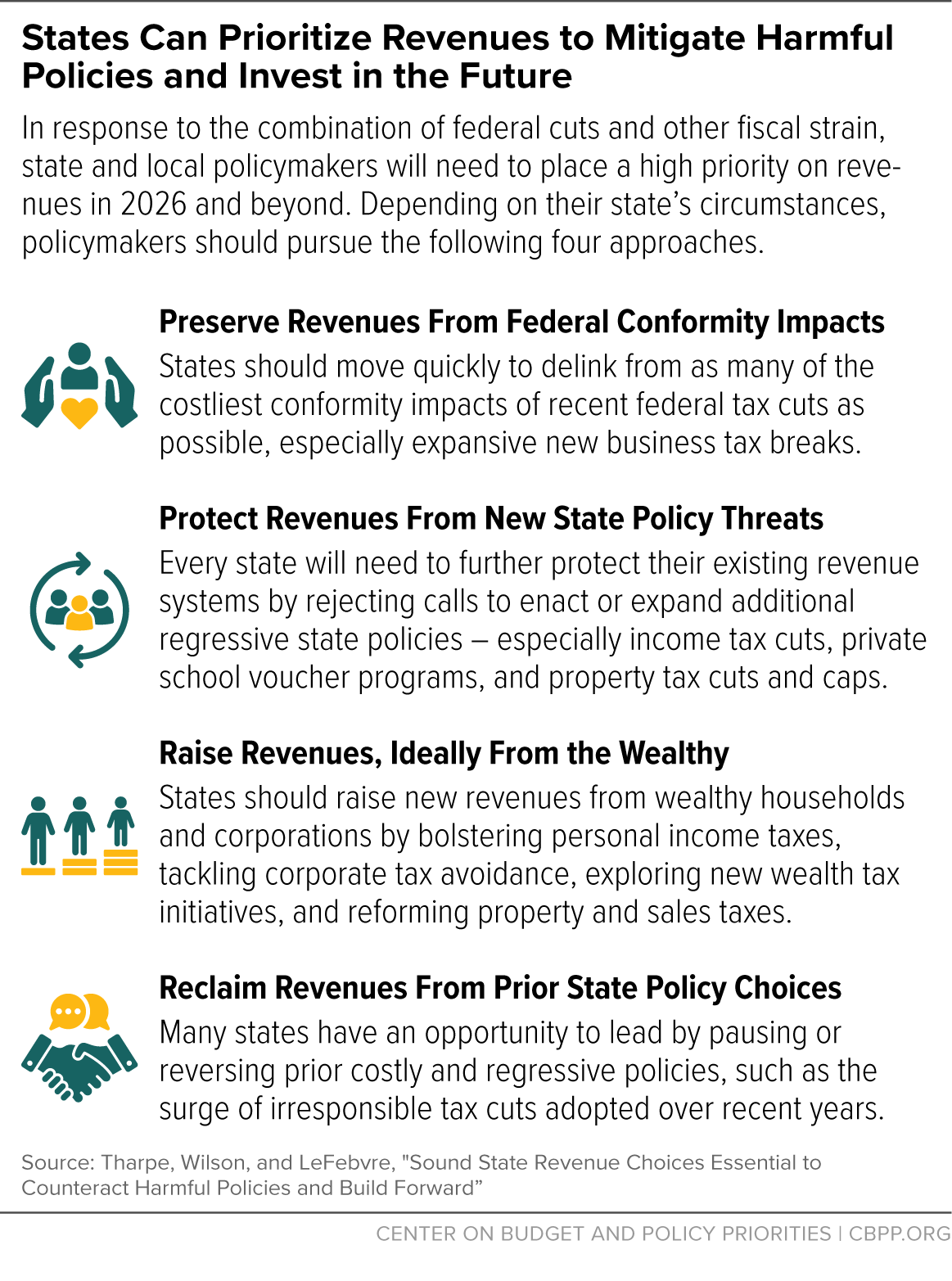
Policymakers in all states should prioritize protecting and raising revenues in 2026 and beyond to prevent these cuts and make critical investments in their states’ people and communities. (See Figure 1.) Depending on their state’s individual circumstances, they should aim to:
- Preserve revenues that would otherwise be lost due to recent federal tax cuts. A first order of business in 2026 for policymakers in most states is to consider the potentially substantial revenue impacts that federal tax cuts will have on state budgets. States should delink from as many of the costliest impacts of “conforming” with the federal tax code as possible — such as expansive new tax breaks for multinational corporations — as policymakers in about a dozen states have already done.
- Protect revenues under threat from new state tax cuts or private school voucher programs. State policymakers must also firmly reject emerging calls to enact or expand costly and regressive state policies — most especially income tax cuts, private school voucher programs, and property tax cuts and caps — that have proliferated in recent years and are once again under consideration in many statehouses. In Georgia, Missouri, and South Carolina, for example, policymakers are weighing proposals to eventually eliminate personal income taxes altogether, while lawmakers in Florida, Michigan, and Oklahoma are considering similarly extreme attacks on the property tax.
- Raise new revenues, ideally through targeted solutions geared toward wealthy households and corporations. To both fill emerging gaps stemming from harmful federal budget cuts and continue investing in their people and economy, states and localities should pursue targeted tax measures designed to bolster their existing revenue systems. Wherever possible, these efforts should focus on the same wealthy households and corporations that just received a historic windfall from tax cuts on the federal level and that — in many cases — are simultaneously receiving outsized gains from recent state tax reductions.[2]
- Reclaim revenues states are already losing due to costly policy choices they enacted in recent years. In many cases, policymakers have a significant opportunity to show leadership by revisiting and revising regressive state policies previously adopted, as states including Hawai‘i and North Carolina are now considering. Pausing or rolling back such policies has precedent — most notably the years-long push in Kansas that led to Gov. Brownback’s extreme “tax cut experiment” being overturned by a bipartisan supermajority and a sustained push in Illinois that effectively ended the state’s school voucher program.
In the wake of deeply harmful federal policy choices and increasingly sharp fiscal pressure, policymakers in every state capitol and community nationwide have an enormous opportunity to meet the moment and build forward in ways that better serve their constituents’ needs. Through ambitious yet thoughtful revenue choices now and in the years to come, states and localities hold real potential to mitigate harm for millions of people and raise the revenues needed to lay the foundation for a more equitable and prosperous future.

Republican Megabill, Other Federal Action Imposing New Costs
Over the past year, President Trump and congressional Republicans have advanced an agenda that spells extensive new costs for states and localities over the coming years.
Chief among these measures is the sprawling megabill enacted in July 2025 (originally dubbed the One Big Beautiful Bill Act by its proponents). It included $4.5 trillion in tax cuts over ten years primarily geared to wealthy households and corporations, financed through a combination of significant deficit spending and sweeping cuts to health care and food assistance.[3] Implementation of that package comes alongside additional federal actions by the Trump Administration with significant state and local fallout, many of them politically motivated and of dubious legality; these include haphazard cuts to federal grants, refusals to provide disaster relief to some states and communities, scattershot layoffs to agency workforces, widespread service disruptions during the government shutdown late last year, extensive targeting of immigrant communities, and an aggressive assault on core civil rights protections under the pretext of federal pullback from “diversity, equity, and inclusion” programs.[4]
The federal megabill itself will push additional costs and responsibilities to the state and local level in a few ways. In some cases, the new costs are immediate, such as revenue impacts on some state tax codes due to linkages with federal tax cuts and a set of requirements for states to operate expansive new administrative hurdles in health and food programs. Additional costs will come online over the next couple of years, including a new requirement for states to shoulder — for the first time in history — a substantial share of benefit costs under the Supplemental Nutrition Assistance Program (SNAP). States will also face strict new limits on state provider taxes that help finance Medicaid costs, which will make it harder for states to sustain current benefits, eligibility, and provider payments. Over time, states and localities are also likely to face significant spillover costs from the megabill’s cuts to affordable health coverage in particular, forcing a surge of newly uninsured people to seek costly, uncompensated care at local emergency rooms and clinics.
Significant Revenue Impacts from ‘Conformity’ Tax Implications
Most states with personal or corporate income taxes use the federal tax code as a starting point for calculations of their own income taxes, creating a series of state-federal policy linkages generally known as “conformity.”[5] Changes to the federal code can therefore affect state tax revenues enormously, especially when those changes are wide-ranging, as was the case after the initial enactment of the Tax Cuts and Jobs Act in 2017.
More often than not, however, states can limit or avoid these new costs because they can decide which federal provisions to adopt.[6] Most follow federal rules for some items and not for others. Choosing to forgo a federal provision is generally known as “decoupling,” and it is particularly common when the federal government enacts a tax break that narrows the tax base and therefore would cost states revenue. (It is important to note that if a state decouples from a federal tax break, the individual or corporation still gets the full benefit of the federal tax cut; the state is simply not adding a state tax break on top.)
Under the federal tax changes enacted last year under the megabill, a series of provisions carry noteworthy implications for states’ tax systems, including their ability to adequately raise revenues. Chief among them are the law’s significant corporate income tax changes, most of which involve expansions to existing business tax breaks and making them permanent.[7] The federal plan also includes a significant expansion to a major tax break for venture capitalists, known as the Qualified Small Business Stock (QSBS) exemption, which overwhelmingly benefits people with incomes over $1 million.[8] And, the law enacts some new, poorly targeted personal income tax carveouts for income from tips and overtime, as well as a costly new deduction for auto loans.[9]
Since the megabill’s enactment, about a dozen states have published official estimates of what these federal tax changes could cost states in lost revenue, contingent on which aspects policymakers choose to conform to or decouple from. (See Appendix.) And most analyses suggest that those impacts could be substantial. Take these states, for example:
- Colorado. Immediately after the megabill’s enactment, the Colorado Office of State Planning and Budgeting found that tax conformity could cost the state $1.2 billion in lost revenue in its current 2026 fiscal year and about $700 million in the upcoming 2027 fiscal year.[10] But in a positive early sign of how policymakers can constructively respond to these impacts, Colorado lawmakers approved key measures largely designed to crack down on corporate tax avoidance and recapture corporate tax revenue to help protect critical investments.[11]
- Montana. The state’s Legislative Fiscal Division estimated that Montana could lose an estimated $114 million in revenue annually from the megabill’s personal income tax adjustments alone. Without legislative action, the annual loss in revenue would kick in immediately since the tax changes are retroactive to January 1, 2025.[12]
- Nebraska. The Nebraska Department of Revenue estimated that reduced corporate and individual income tax collections resulting from the federal megabill could cost the state more than $406 million over the next four years. About two-thirds of those costs would come from the megabill’s corporate linkages ($275 million) with the remaining third coming from personal income tax impacts ($132 million).[13]
New Spending Requirements for Food Assistance
Among the federal megabill’s components is an unprecedented structural change to the nation’s most important and effective anti-hunger program, the Supplemental Nutrition Assistance Program (SNAP), which will require many states to pay a portion of food benefit costs for the first time. If a state can’t make up for these new obligations with tax increases or spending cuts elsewhere in its budget, it will have to cut its SNAP program (such as by restricting eligibility or making it harder for people to enroll), or it could opt out of the program altogether, terminating food assistance entirely in the state.
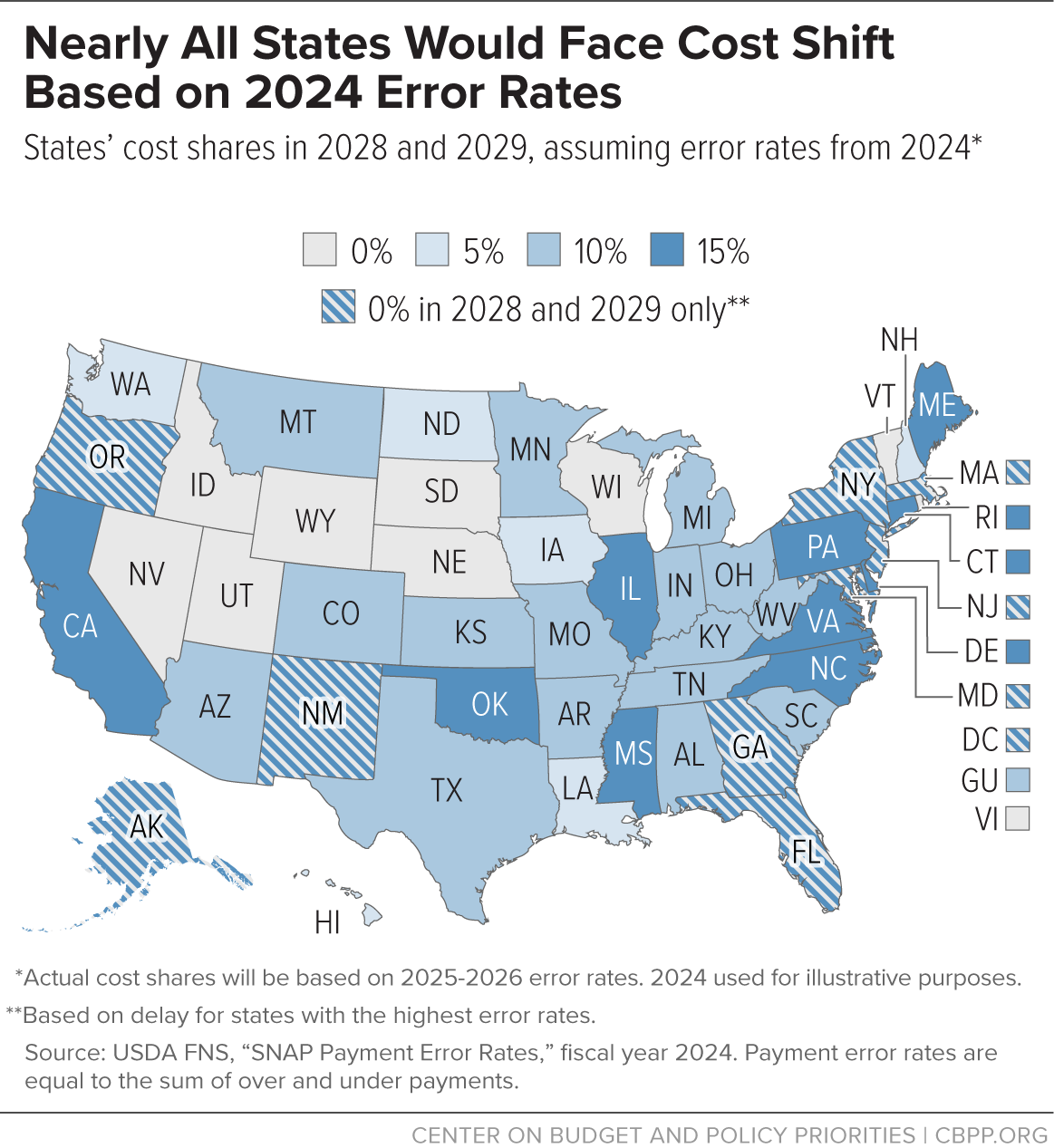
Most states will have to pay between 5 and 15 percent of benefit costs based on their payment “error rates,” which is a measure of the under- and overpayments states made in their SNAP programs.[14] Based on the most recent state error rates from 2024, nearly all states would face new costs passed on by the federal government (see Figure 2), including 27 states with new costs projected at more than $100 million per year. If error rates rise, even a small increase could tip a state over the threshold to owing even more new costs. Of the 32 states that would not already have to pay the highest share of benefits based on their 2024 error rate, 11 were half of a percentage point or less away from crossing that next threshold into a significantly higher share of costs.[15]

Slated to take effect in October 2027, these new requirements equate to significant sums in the context of state budgets.[16] For example:
- At a 5 percent new spending requirement, Louisiana would be on the hook for about $95 million annually, or the equivalent of annual state spending for its Department of Agriculture and Forestry, whose services include food safety and inspection, forest and fire management, soil and water conservation, and food distribution.
- Under a 10 percent spending requirement, Kansas would have to pay almost $41 million each year. That’s equal to more than double the state’s annual spending on its Office of Veterans Services, or nearly all of what it spends on its state Bureau of Investigation.
- Under a 15 percent spending requirement, Massachusetts would owe an estimated $390 million each year, or roughly what the state spends annually on its system of community colleges, which serve more than 77,000 students.
Another new cost that states will have to account for beginning this fiscal year is an increase to the share of SNAP administrative expenses that states are required to cover. Until now, states covered 50 percent of the cost of administering SNAP, with the federal government paying the other half. The Republican megabill increases the state share to 75 percent, a not inconsequential addition for most states to accommodate. In New Mexico, for instance, these increased administrative costs will require the state to pay $47 million more in SNAP costs each year.[17]
Due to the extreme risk this combination of expanded administrative costs and new cost-sharing for benefits poses to both state budgets and food assistance for low-income families, a bipartisan coalition of state and local officials recently called on Congress to delay these requirements.[18] While it would be wisest for federal policymakers to heed that call, it is nonetheless prudent for states to continue planning for the additional costs from their scheduled implementation pending further federal action.
Fiscal Fallout From Historic Health Care Cuts
The federal megabill also includes harmful changes to Medicaid and the Affordable Care Act’s (ACA) marketplace coverage that will strip health coverage from millions of people. About 15 million could lose coverage and become uninsured by 2034 according to the Congressional Budget Office, due to a combination of Medicaid and ACA marketplace cuts, the law’s failure to extend enhanced premium tax credits for ACA marketplace coverage, and other harmful ACA marketplace rule changes. However, how many people actually lose coverage will depend in part on policy and implementation choices states make; there are steps they can take to reduce coverage loss, but they will require resources.
The health coverage cuts will layer on additional costs for states and localities. In some cases these costs are relatively immediate and straightforward, and in others they are longer term or more indirect.
Most immediately, states will have to expend substantial start-up and ongoing costs associated with creating and maintaining a rigid new system for tracking the work requirement for millions of Medicaid expansion enrollees, along with additional new forms of red tape in both Medicaid and the ACA marketplaces. In some cases, these will be one-time expenditures, such as start-up investments in new IT systems, and in others they will be ongoing. For example:
- In Arizona, the state’s health care agency is requesting more than 300 full-time equivalent employees to implement the law’s Medicaid requirement, at an annual cost of about $20 million.[19]
- In Maine, total administrative, staffing, and technology costs for implementing the work requirement are estimated to cost at least $8 million in the upcoming 2027 budget year and about $6 million annually thereafter.[20]
States will then face a set of strict new limits on “provider taxes” that all states but Alaska use to help finance their share of the Medicaid program and that play a significant role in states’ ability to support the program overall.[21] The megabill immediately bars states from instituting any new provider taxes or raising existing tax rates, requires certain states to phase out taxes that treated Medicaid providers differently than non-Medicaid ones, and requires the 41 states (including D.C.) that adopted the ACA Medicaid expansion to phase down the rate of some of their provider taxes over time.[22] Some initial state estimates of these provider tax impacts include the following:
- Oregon’s Chief Financial Office estimated the new limits would reduce revenue for the state’s health agency by about $300 million annually during the 2028 and 2029 fiscal years, rising to $850 million annually during the following two years.[23]
- Vermont's Joint Fiscal Office estimated that by fiscal year 2028 the state’s hospital fee could lose $15 million from provider tax limits, rising to $133 million by fiscal year 2033.[24]
Longer term, additional indirect costs from the megabill’s health cuts are expected to accumulate. The expected surge of people losing Medicaid or ACA marketplace coverage and becoming newly uninsured will likely translate into more people showing up at local emergency rooms and clinics without the ability to pay. The costs for such uncompensated care can be sizable.[25] It puts significant strain on hospitals and other health care providers, especially those — including rural hospitals — that serve disproportionately large numbers of low-income and vulnerable populations, leading to closures. Over the long term, widespread losses to affordable health coverage will also make people less healthy, create barriers to employment, and dampen people’s ability to fully participate in local economies — compounding the harm and generating further indirect costs.
These interlocking costs will interact with each other in ways that are difficult to fully foresee and that will vary based on how states respond. For instance, some provisions in the Republican megabill that are designed to reduce enrollment — like new Medicaid work requirement and more frequent eligibility renewals — may result in some budget savings in certain states, particularly those that do not adopt the policies and practices that can reduce the number of people who lose coverage.[26] Unfortunately, that could tempt some policymakers to simply pocket those savings, rather than committing state resources, as they should, to lessen the megabill’s harm.
Over the longer term, states taking that approach would be especially vulnerable to rising indirect costs, such as having to help health providers pay for skyrocketing uncompensated care costs (and with provider taxes not as able to help finance the cost of this care) while also being responsible for the harm that comes to people unable to get the preventive and life-saving care they need. Minimizing coverage loss — especially among the Medicaid expansion population most vulnerable to some of the changes in the megabill — is also a win for a state’s economy overall.[27] The federal government pays 90 percent of the cost of coverage for people eligible by virtue of the Medicaid expansion, which means that when someone unnecessarily loses Medicaid due to last summer’s megabill, every $1 reduction in state Medicaid spending for that person is accompanied by a $9 cut in federal Medicaid funding.
A much better approach — economically and for the health of their residents — is for states to invest in proactive solutions designed to minimize coverage losses and lessen this long-term fallout. States have options for reducing administrative hassle and mistakes that can lead eligible people to lose their health coverage. By working to ensure as many people as possible still receive the benefits for which they are eligible, states would in turn likely limit increases in uncompensated care and other indirect spillover costs to communities. For example, Maryland’s Medicaid director recently pointed out that while the state could lose out on an estimated $2.7 billion annually in federal funding if the state doesn’t take aggressive action to help eligible people stay enrolled, that figure “could reduce to $1 billion or even much less” if the state successfully minimized the number of recipients who lose coverage needlessly.[28]
State Tax Cuts and School Vouchers Adding Further Strain
Recent federal cuts and added costs would prove difficult for states and localities to manage under almost any circumstance, given that they must balance their budgets every year.[29] Yet the cuts’ timing could hardly be worse: entering 2026, state and local finances continue to show noticeable signs of strain,[30] which would intensify if the economy were to further weaken.[31]
In many cases, this sharpening fiscal strain is in large part a function of the policy trajectory that states have put themselves on over the past few years. These choices include the swelling price of regressive state income tax cuts, a surge in costly new private school voucher programs, and a growing trend of state and local property tax cuts.
Wave of State Income Tax Cuts
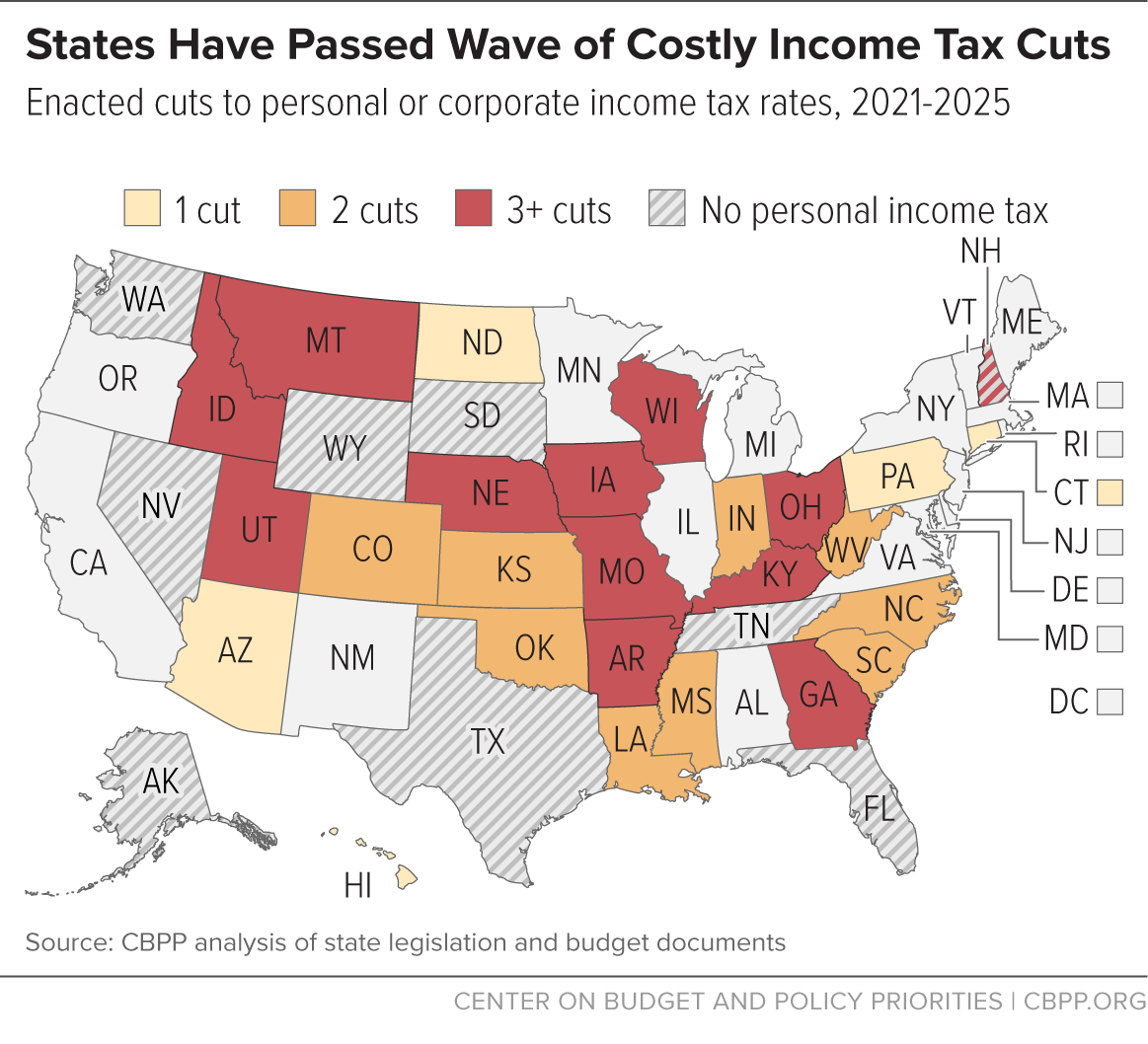
A majority of states have enacted income tax reductions over the past five years. From 2021 to 2025, 26 states cut their personal or corporate income tax rates, 21 of them multiple times. (See Figure 3.) That includes nine states that enacted cuts three different times, two states (Arkansas and Utah) that did so four times, and one state (Idaho) that did so five times.
The income tax is generally the only major state tax that is progressive; in other words, higher-income taxpayers pay a larger share of their incomes in tax. States have tools available to reduce taxes for low- and middle-income people, but this recent bevy of income tax cuts tilts decidedly toward taxpayers that are already doing very well, namely wealthy households and corporations. And while the cost in lost revenue varies, in many states it is staggering: into the billions over the next few years.[32] For example:
- Idaho’s five personal income tax cuts in as many years cost the state an estimated $4 billion in general revenues over the 2021 to 2025 budget years.[33] Due to the cuts, Idaho is now collecting an estimated $1.3 billion less each year than it otherwise would have. That’s equivalent to an estimated 24 percent of the state’s remaining general budget, or more than three times the state’s current annual support for its college and university system.
- Missouri in 2025 became the first state to exempt all income from stocks, bonds, cryptocurrency, real estate, and other capital gains from state taxes. This provided a lopsided payout to the wealthiest Missourians, with the households with incomes in the top 5 percent receiving an estimated 80 percent of the tax cut.[34] The exemption could reduce state revenues by around $600 million each year, roughly equal to the cost of funding 11,000 public school teachers’ salaries.[35] That comes on top of a series of tax reductions in recent years that were already reducing state general revenue by about $3.2 billion annually.[36]
- North Carolina enacted multiple income tax cuts over the past decade, including a complete phaseout of the state’s corporate income tax. The state has estimated that by 2030, compared to tax rates in 2023, the cuts will result in over $8 billion less in revenue each year, and over $13 billion less if all personal income tax “triggers” are met.[37] (These trigger mechanisms enable automatic tax cuts when certain fiscal metrics are met.[38]) For perspective, $13 billion approaches the total amount of personal income taxes the state currently collects and is about three times what the state spends on Medicaid each year.
In many cases, states don’t feel the full impact of these cuts right away. Proponents have often designed them in ways meant to partially obscure their full cost, namely by phasing the cuts in over several years or through complicated triggers. These sorts of gradual or triggered cuts have become both more common and more extreme. In four states — Kentucky, Mississippi, Oklahoma, and West Virginia — structures now in place could eventually eliminate taxes on personal income altogether. A fifth state, North Carolina, is similarly phasing out its corporate income tax.

Rising Costs of Private School Voucher Programs
Over 30 states plus the District of Columbia and Puerto Rico are spending public funds on private school vouchers, when that funding could otherwise be used for public schools and other services. Because these policies overwhelmingly benefit families that were already covering the costs to send their children to private schools themselves, vouchers in effect siphon funding from public schools and apply pressure across state and local budgets more broadly.[39] States spent an estimated $9 billion on private school vouchers in fiscal year 2025 — enough to pay about 130,000 public school teachers, on average.[40]

Similar to many state tax cuts enacted recently, school voucher policies passed in recent years often began as limited programs and then expanded to universal eligibility, exploding in costs. For example, Arizona’s school voucher costs have increased by over 600 percent, from about $190 million in 2022, before universal expansion, to an estimated $1.2 billion in 2027, driven largely by students who were never enrolled in public schools.[41] Although in some states pandemic-era funding for schools and other services allowed lawmakers to enact costly school voucher programs without significantly compromising funding for public schools and other services, the expiration of those funds alongside new costs from the federal megabill and state tax cuts will make it virtually impossible for states to avoid harming public schools and the students they serve if they don’t change course and either scale back vouchers or raise more revenues.
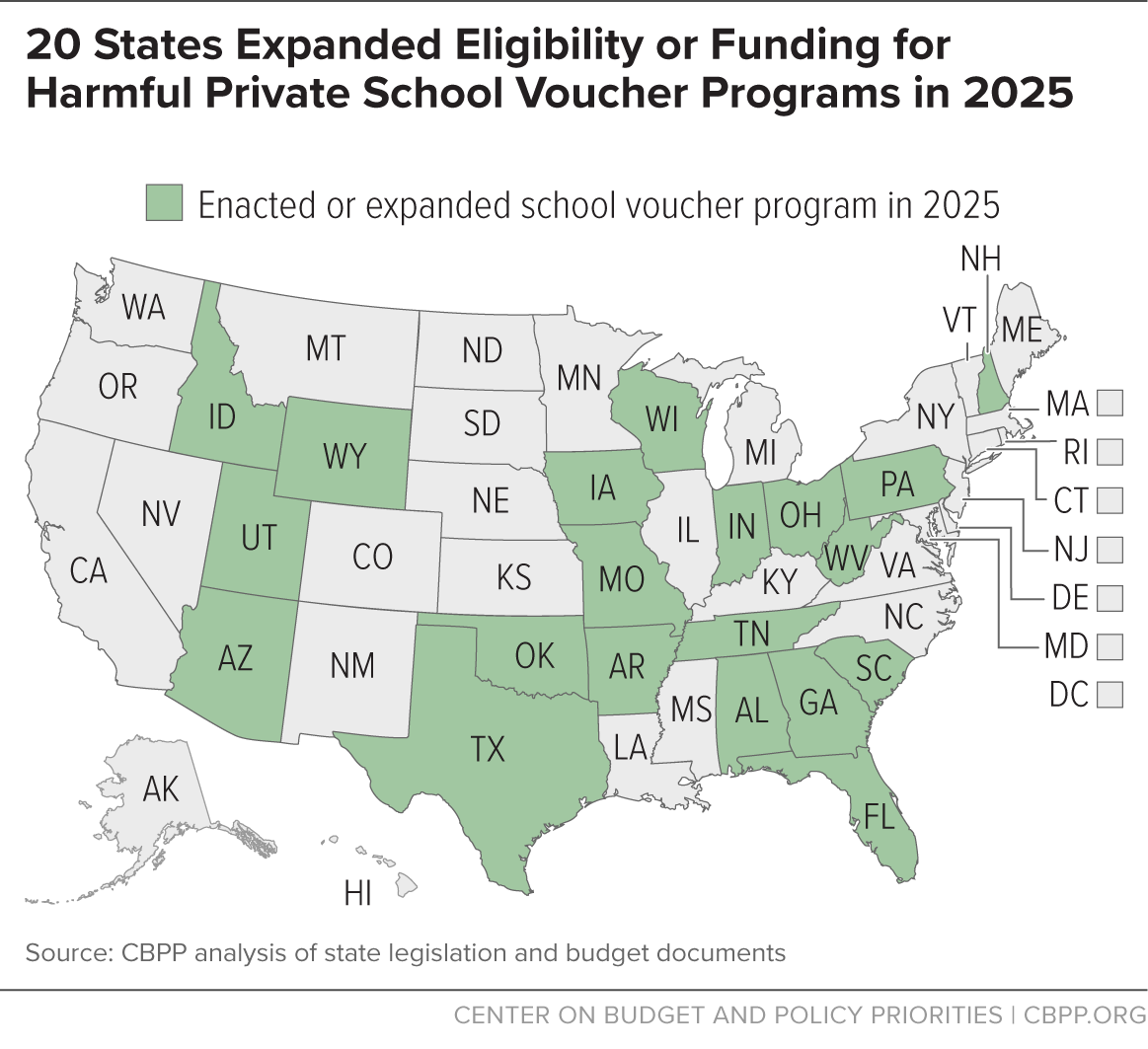
In 2025 alone, 20 states increased funding or expanded eligibility for private school voucher programs, as shown in Figure 4. That includes five states that enacted universal school vouchers for the first time, namely Idaho, New Hampshire, Tennessee, Texas, and Wyoming.
Proliferation of Property Tax Cuts and Caps
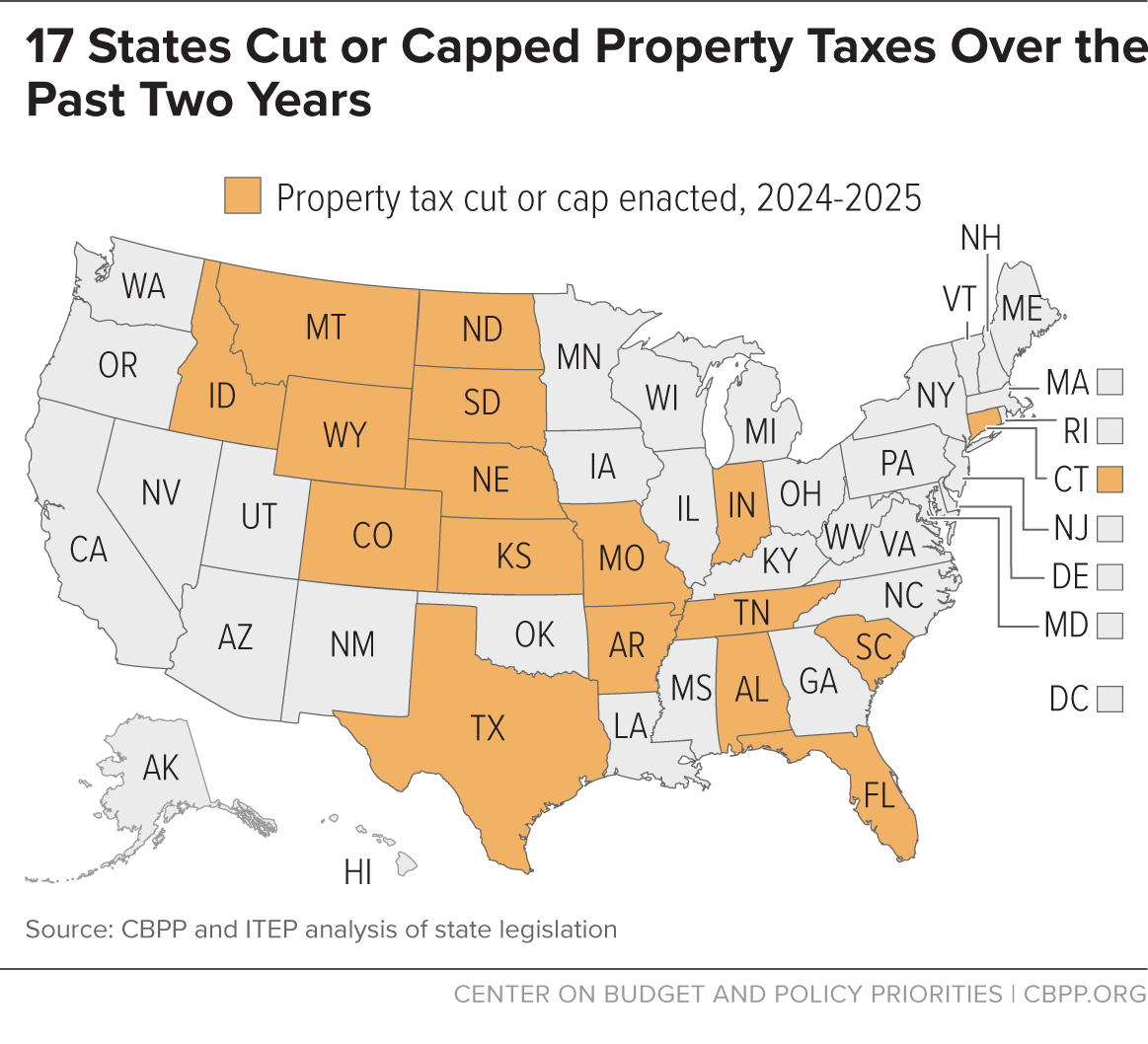
In 2024 and 2025, 17 states enacted property tax cuts or caps that threaten resources for local services like public schools, roads, parks, libraries, and emergency responders.[42] (See Figure 5.) Lawmakers often tout these cuts and caps as attempts to address rising housing costs, but research suggests that suppressing property taxes can increase housing costs. With lower property taxes, mortgage payments can increase to the total amount families were willing to pay for housing with higher property taxes, increasing initial purchasing costs. And older homeowners are incentivized to delay downsizing, thereby limiting housing supply for younger homebuyers.[43] Property tax cuts and caps also reduce revenue for local services while exacerbating racial inequity by disproportionately benefiting owners of higher-value homes, who are more likely to be white due to racist policies like redlining. [44]
Governors and legislators in some states are even considering eliminating property taxes altogether, an extreme policy choice that would devastate funding for local communities. Some lawmakers have suggested replacing property tax revenue with sales tax revenue. But sales taxes are more regressive than property taxes, asking families with low incomes to pay a higher share of their earnings. During economic downturns they are also more volatile and vulnerable to sharp declines than property taxes.[45]
Property tax elimination poses a particular threat to public schools because more than 1 in 3 dollars that fund public schools come from property taxes, and many of the states cutting local property taxes are also incentivizing private schooling through school vouchers at the state level.[46]
The scale of recently enacted school vouchers and property tax cuts and caps is striking:
- Indiana enacted property tax cuts in 2025 that will cost $386 million in the first year, and the state is spending an estimated $546 million on private school vouchers in 2026.[47] Together, this amounts to nearly $1 billion, or about 10 percent of what the state spends on K-12 education.
- Texas will spend $51 billion on recently enacted property tax cuts over the next two years. At the same time, the state will spend about $7 billion per biennium on private school vouchers when they are fully phased in. Combined, this funding being spent on property tax cuts and school vouchers could instead increase school funding by almost 50 percent or fund the construction of a high-speed rail line from Houston to Dallas.[48]
- Wyoming lawmakers cut property taxes for homeowners this year by 25 percent without replacing the $71 million in lost revenue, and they intend to spend $44 million on the state’s newly enacted private school voucher program.[49] These policy choices represent nearly $115 million in losses to local governments, and are already resulting in library closures and cuts to park and road maintenance.[50]

States Can Prioritize Revenues to Mitigate Harmful Policies and Invest in the Future
In response to the combination of federal cuts and existing fiscal strain, state and local policymakers will need to place a high priority on revenues in 2026 and beyond. The specific approach will vary between states with differing political environments and tax systems. But the need for states to position revenues — rather than harmful, broad-based spending cuts — at the center of their policy approach is universal. Depending on their state’s circumstances, policymakers should pursue the following four approaches.
Preserve Revenues From Federal Conformity Impacts
In 2026, a first order of business is for states to move quickly to delink from as many of the costliest conformity impacts of recent federal tax cuts as possible, such as expansive new tax breaks for venture capitalists and multinational corporations.
To date, Colorado, Delaware, the District of Columbia, Idaho, Illinois, Maine, Maryland, Michigan, Pennsylvania, and Rhode Island have already taken deliberate steps to decouple from some of the megabill’s most costly tax breaks.[51] Pennsylvania policymakers, for instance, saved the state more than $1 billion by decoupling from major corporate provisions,[52] while D.C. lawmakers attempted to preserve $432 million over the next five years by doing the same, only to be overturned by recalcitrant federal policymakers.[53]
Beyond decoupling from the megabill’s revenue-losing business tax components, states should also avoid linking to new personal income tax provisions they are under no obligation to follow, namely new poorly targeted tax breaks for tipped income, overtime pay, and car loans. Already, Illinois, Maine, and D.C. have chosen not to conform to the tip exemption, in part because they would have lost significant revenue. By contrast, Michigan policymakers recently chose to conform to the personal income tax provisions. And Arizona and Colorado have indicated that they might, notwithstanding estimated annual revenue losses in the current fiscal year of up to $24 million in Arizona and $90 million in Colorado.[54]
At the same time, while most megabill tax provisions will cost states revenue unless they decouple, there are certain elements of the new law where proactively linking to the changes could help preserve revenues rather than reduce them. One such provision is a helpful revision to federal tax law designed to deter excessive pay for corporate CEOs.[55] Another is a corporate tax change known as Net Controlled-Foreign-Corporation Tested Income, or NCTI. The federal government has been using NCTI and its predecessor, GILTI, for nearly a decade to curb lost revenue caused by corporate tax avoidance. Conforming to the new provision could enable states to more effectively collect revenues otherwise lost when multinational companies artificially shift their profits overseas.[56]
Protect Revenues From New State Policy Threats
Policymakers in every state will need to further protect their existing revenue systems by avoiding any additional costly and regressive measures already under consideration in many statehouses.
That means rejecting calls for expensive new income tax cuts, such as those now under consideration in states like Georgia, Missouri, and South Carolina. In Missouri, for example, policymakers are weighing a constitutional amendment advanced by Gov. Mike Kehoe that would eventually eliminate the state’s personal income tax, which currently accounts for about one-third of all state-generated revenue.[57]
Protecting revenues also means resisting additional efforts to undermine funding for state and local education. State policymakers can, for example, follow the lead of Louisiana’s legislature which recently chose not to expand the state’s private school voucher program as the governor wished, protecting $50 million which in part funds public school tutoring.[58] States will also need to hit the brakes on the recent trend of property tax cuts and caps, especially the most extreme emerging proposals — such as those in Florida, Michigan, and Oklahoma — that call for eliminating property taxes entirely. If Florida were to eliminate its property tax system, the state could lose $43 billion that now funds fire and police services, public schools, and economic assistance programs.[59]
Raise New Revenues, Ideally From Wealthy Households and Corporations
Next, work should begin in earnest to refocus the conversation on raising new revenues at both the state and local level, especially from wealthy households and corporations. States have a wide range of potential revenue-raising levers at their disposal, including bolstering personal income taxes, tackling corporate tax avoidance, exploring new wealth tax initiatives, and reforming property and sales taxes to more closely track ability to pay.[60] They can also lean in on an emerging suite of revenue-raising tools linked to helping fight climate change, such as eliminating tax subsidies for fossil fuel producers.[61]
| Revenue-Raising Tax Change | States That Enacted Change (2021-2025) |
|---|---|
| Personal Income Rate Increase | D.C., Maryland, Massachusetts, New York |
| Personal Income Deduction Limit | Colorado, Maryland, Minnesota |
| Capital Gains Tax | Maryland, Minnesota, New Mexico, Washington State |
| Mansion Tax | D.C., Maine, New Jersey, Rhode Island |
| Corporate Income or Other Business Tax Increase | Colorado, Minnesota, New Jersey, New Mexico, New York, Washington State |
| Payroll Tax | Maine, Minnesota, Vermont |
| Excise Tax | Washington State |
Several states’ actions in recent years offer compelling models of how pursuing new revenues can help pave the way to grow more prosperous and equitable over time. As we detail in a recent report, 11 states and the District of Columbia approved meaningful revenue-raising policies over the past five years. (See Table 1.) Those policy choices are already helping shore up state finances and fuel new investments like universal free school meals, expanded child care and paid leave, school construction and college access, and more affordable housing options.[62]
To highlight just one example, New Jersey policymakers in recent years approved two important revenue-raising measures. One of them — a new graduated mansion tax for property sales of $1 million and above — is now generating about $500 million in yearly revenues to fund affordable housing efforts. The second — a new business transit fee of 2.5 percent on corporate income over $10 million — is expected to raise about $800 million annually to support maintaining and expanding public transit.
Looking further back, even more traditionally conservative states have chosen to protect and bolster revenues during times of significant fiscal strain or to address high-profile public priorities. For instance, 33 states raised taxes to at least some degree in the years following the Great Recession, including significant increases in Arkansas, Florida, Indiana, Kentucky, Mississippi, and North Carolina.[63] In 2015 Georgia approved nearly $1 billion in new annual revenues — primarily through raising and reforming the state’s gas tax — to help upgrade the state’s transportation infrastructure.[64] And in 2018, Oklahoma policymakers responded to an ongoing public outcry over historic underfunding of the state’s public schools by increasing taxes on cigarettes, motor fuel, and oil and gas production.[65]
Reclaim Revenues From Prior State Policy Choices
Lastly, raising revenues in many states should at least start with a focus on pausing or rolling back prior policies as much as enacting new ones. States should especially reclaim revenues from the surge of irresponsible tax cuts and other regressive revenue policies already adopted over recent years.
As detailed, 26 states enacted personal or corporate income tax cuts from 2021 to 2025; 17 states enacted property tax cuts or caps in just 2024 and 2025; and in 2025 alone, 20 states increased funding or expanded eligibility for private school voucher programs. While not all of these policies will realistically be paused or reversed, revisiting the costliest ones offers an important opportunity for state policymakers to show leadership and ensure their states have the resources they need to invest in health care, food benefits, good schools, and other priorities. One compelling place to start could be reviewing recent state income tax cuts that are still in the process of fully phasing in, rather than having completely taken effect; this is true in 13 of the 26 states that have recently reduced rates.[66]
Early developments in 2026 suggest that policymakers and voters in some states may be open to considering this needed path toward reclaiming revenues. For example:
- Hawai’i Gov. Josh Green has called for pausing further implementation of an enormous set of income tax cuts lawmakers approved in 2024, which are currently phasing in additional rate reductions each year through 2031. The new proposal calls for forgoing at least three of these cuts, starting in 2027. That could save nearly $2 billion in revenue over a three-year span, with the expressed intention of devoting $600 million to food security and child care.[67]
- Kentucky voters recently expressed skepticism about the wisdom of further extending the state’s recent tax-cutting trend, which is now draining $2.1 billion annually from the state’s budget. In a recent poll of more than 2,000 Kentuckians, only 9 percent of respondents said those cuts are helping them personally, versus 40 percent who said they hadn’t affected them at all, 43 percent who said they’re not sure, and 8 percent who said they have actually hurt.[68] Kentucky voters also rejected a school voucher ballot amendment in all 120 counties in the state in 2024, sending a message to lawmakers to invest in public education instead.[69]
- North Carolina policymakers remain locked in a budget stalemate due to disagreement between Republican leaders over whether to halt additional personal income tax cuts poised to kick in due to revenue triggers currently embedded in state law.[70]
Pausing or rolling back prior policy choices when needed has precedent. For instance in Kansas, lawmakers in 2017 agreed on a bipartisan basis to repeal most of the tax cuts enacted just a few years prior, after then-Governor Sam Brownback’s so-called “real live experiment” in extreme tax cutting led to severe cuts in public education, two bond rating downgrades, delayed road and infrastructure projects, and a near depletion of the state’s rainy day fund.[71] And in Illinois, state lawmakers in 2024 responded to sustained pressure from advocates and chose not to extend a private school voucher program originally enacted in 2017, which had cost about $75 million annually while leading to poor student outcomes and reported discrimination in the process.[72]
Appendix: State Analyses of the Federal Megabill’s Impacts
End Notes
[1] “Implementing the Harmful Republican Megabill: a Timeline,” CBPP, updated October 8, 2025, https://www.cbpp.org/research/federal-budget/implementing-the-harmful-republican-megabill-a-timeline.
[2] Steve Wamhoff et al., “Analysis of Tax Provisions in the Trump Megabill as Signed into Law: National and State Level Estimates,” Institute on Taxation and Economic Policy (ITEP), updated July 22, 2025, https://itep.org/tax-provisions-in-trump-megabill-national-and-state-level-estimates/.
[3] Brendan Duke, “Republican Megabill Trades Essential Support to Low-Income People for Skewed Tax Cuts,” CBPP, February 11, 2026, https://www.cbpp.org/research/federal-tax/republican-megabill-trades-essential-support-to-low-income-people-for-skewed.
[4] Sam Berger and Devin O’Connor, “The Trump Administration Is Engaging in Increasingly Blatant Efforts to Misuse Federal Funds to Coerce and Punish,” CBPP, January 27, 2026, https://www.cbpp.org/blog/the-trump-administration-is-engaging-in-increasingly-blatant-efforts-to-misuse-federal-funds.
[5] ITEP, “How Does Federal-State Tax Conformity Work?” accessed January 30, 2026, https://itep.org/how-does-federal-state-tax-conformity-work/.
[6] Some states use rolling conformity, in which they automatically adopt federal tax changes as they occur. Other states use fixed-date conformity, in which they conform to the federal tax code as of a specific date. When federal laws change, these states must actively decide whether to adopt the new provisions. If the federal changes are relatively minor and technical in nature, then updating the state tax code to conform to them may be perfunctory, whereas larger changes will merit more scrutiny.
[7] Nick Johnson and Michael Mazerov, “Why States Shouldn’t Go Along With OBBBA’s Corporate Tax Breaks: A Practical Guide,” ITEP, October 27, 2025, https://itep.org/states-obbba-corporate-tax-breaks-a-practical-guide/.
[8] Nick Johnson and Sarah Austin, “States Begin Decoupling from Flawed ‘QSBS’ Tax Break,” November 6, 2025, https://itep.org/states-begin-decoupling-from-flawed-qsbs-tax-break/.
[9] Neva Butkus and Galen Hendricks, “Linking to Tipped and Overtime Income Deductions Would Worsen State Shortfalls, Do Little to Help Workers,” ITEP, December 8, 2025, https://itep.org/tips-overtime-income-tax-deduction-state-budgets/.
[10] Colorado Office of State Planning and Budget, “Tax Policy Impacts from the Federal Reconciliation bill, H.R. 1,” August 5, 2025, https://content.leg.colorado.gov/sites/default/files/ospb-08-05-25.pdf.
[11] ITEP, “State Rundown 9/4: Colorado Tackles Offshore Corporate Tax Avoidance, Paves Way for State Conformity Best Practices,” September 4, 2025, https://itep.org/state-rundown-9-4-colorado-tackles-offshore-corporate-tax-avoidance-paves-way-for-state-conformity-best-practices/.
[12] Keila Szpaller, “Big Beautiful Bill Act to decrease income tax revenue for Montana,” News from the States, July 12, 2025, https://www.newsfromthestates.com/article/big-beautiful-bill-act-decrease-income-tax-revenue-montana.
[13] Nebraska Department of Revenue, “Effects of the One Big Beautiful Bill Act on the State of Nebraska’s Tax Revenue,” September 2, 2025, https://revenue.nebraska.gov/sites/default/files/doc/research/Big%20Beautiful%20Bill%20-%2060%20Days%20Report%20-%20Final.pdf.
[14] Errors largely reflect unintentional mistakes by state workers and households, and the vast majority of households that receive overpayments were indeed eligible for food assistance — they just received an incorrect allotment. Dottie Rosenbaum and Katie Bergh, “SNAP Includes Extensive Payment Accuracy System,” CBPP, updated June 21, 2024, https://www.cbpp.org/research/food-assistance/snap-includes-extensive-payment-accuracy-system.
[15] Katie Bergh and Dottie Rosenbaum, “Congressional Delay of SNAP Cost Shift Urgently Needed to Protect Food Assistance for Low-Income Families,” CBPP, January 8, 2026, https://www.cbpp.org/research/food-assistance/congressional-delay-of-snap-cost-shift-urgently-needed-to-protect-food.
[16] See Table 3 in Katie Bergh, “Senate Republican Leaders’ Proposal Risks Deep Cuts to Food Assistance, Some States Ending SNAP Entirely,” CBPP, June 30, 2025, https://www.cbpp.org/research/food-assistance/senate-republican-leaders-proposal-risks-deep-cuts-to-food-assistance-some.
[17] New Mexico Health Care Authority, “Federal SNAP Changes Will Increase Hunger in New Mexico,” January 9, 2026, https://www.hca.nm.gov/wp-content/uploads/English-and-Spanish-SNAP-onepager_010926.pdf.
[18] National Governors Association, “NGA Joins Coalition Letter Outlining SNAP Recommendations,” January 8, 2026, https://www.nga.org/advocacy-communications/letters-nga/nga-joins-coalition-letter-outlining-snap-recommendations/.
[19] Arizona Joint Legislative Budget Committee, “JLBC Staff Analysis of the Federal Budget Reconciliation Bill (H.R. 1) on Arizona State Budget,” September 18, 2025, https://www.azjlbc.gov/revenues/2025federalbudgetreconciliationbill-stateimpact0918.pdf.
[20] Maine Department of Health and Human Services, “Summary of Federal Changes and the Impact on Maine,” July 11, 2025, https://www.maine.gov/dhhs/sites/maine.gov.dhhs/files/inline-files/ImpactSummary_Medicaid-SNAP-Marketplace_July2025.pdf.
[21] About a third of the money states spent on Medicaid in 2024 came from outside their general funds (including from provider taxes and fees, payments from local governments, and other money held outside their main spending account). See Table 13 in National Association of State Budget Officers (NASBO), “2025 State Expenditure Report,” December 30, 2025, https://www.nasbo.org/reports-data/state-expenditure-report.
[22] Edwin Park, “CMS Issues Final Rule Implementing H.R. 1’s Prohibition of Certain Uniformity Waiver Provider Taxes,” Georgetown Center for Children and Families, November 2, 2026, https://ccf.georgetown.edu/2026/02/02/cms-issues-final-rule-implementing-h-r-1s-prohibition-of-certain-uniformity-waiver-provider-taxes/.
[23] Oregon Department of Administrative Services, “Estimated Impacts of H.R. 1,” August 11, 2025, https://www.oregon.gov/das/Financial/Documents/Federal-Impact-HR1-Initial-Analysis.pdf.
[24] Vermont Joint Fiscal Office, “Provider Taxes : Overview,” January 2026, https://legislature.vermont.gov/Documents/2026/Workgroups/House%20Health%20Care/Orientation/W~Nolan%20Langweil~Provider%20Tax%20Overview~1-7-2026.pdf.
[25] Uncompensated care costs could rise by about $280 billion nationwide over the next decade due to a combination of Medicaid cuts and the ACA premium tax credit enhancements expiring, according to the Congressional Budget Office. Fredric Blavin and Michael Simpson, “State-Level Estimates of Health Care Spending and Uncompensated Care Changes under the Reconciliation Bill and Expiration of Enhanced Subsidies,” Urban Institute, June 13, 2025, https://www.urban.org/research/publication/state-level-estimates-health-care-spending-and-uncompensated-care-changes.
[26] Jennifer Wagner, Symonne Singleton, and Maani Stewart, “A Guide to Reducing Coverage Losses Through Effective Implementation of Medicaid’s New Work Requirement,” CBPP, November 3, 2025, https://www.cbpp.org/research/health/a-guide-to-reducing-coverage-losses-through-effective-implementation-of-medicaids.
[27] Laura Harker and Breanna Sharer, “Medicaid Expansion: Frequently Asked Question,” CBPP, June 14, 2024, https://www.cbpp.org/research/health/medicaid-expansion-frequently-asked-questions-0#how-does-medicaid-expansion-affect-cbpp-anchor.
[28] Danielle J. Brown, “Health official warns that future Medicaid cuts could lead to $2.7 billion loss in federal funding,” Maryland Matters, January 29, 2026, https://marylandmatters.org/2026/01/29/health-official-warns-that-future-medicaid-cuts-could-lead-to-2-7-billion-loss-in-federal-funding/.
[29] That means state and local policymakers are only able to support the amount of public services or goods they can afford with available dollars on hand (from taxes, fees, strategic reserves, or certain types of loans), rather than from running annual deficits. This puts state and local services at inherent risk of cuts during times when revenue declines, either due to external factors, such as a recession, or from policy choices, such as tax cuts.
[30] Josh Goodman, “State Budget Stress Intensifies in 2026 as Federal Aid Fades,” Governing, January 26, 2026, https://www.governing.com/finance/state-budget-stress-intensifies-in-2026-as-federal-aid-fades.
[31] Gbenga Ajilore, “A Weakening Economy, and a Drastically Cut Economic Support System,” CBPP, November 5, 2025, https://www.cbpp.org/blog/a-weakening-economy-and-a-drastically-cut-economic-support-system.
[32] Wesley Tharpe, “States’ Recent Tax-Cut Spree Creates Big Risks for Families and Communities,” CBPP, November 30, 2023, https://www.cbpp.org/research/state-budget-and-tax/states-recent-tax-cut-spree-creates-big-risks-for-families-and.
[33] Kendra Knighten, “2025 Update: Idaho’s String of Income Tax Cuts Continues to Jeopardize Investments in Public Services,” Idaho Center for Fiscal Policy, November 18, 2025, https://idahofiscal.org/2025-update-idahos-string-of-income-tax-cuts-continues-to-jeopardize-investments-in-public-services/.
[34] Wesley Tharpe, “Missouri Poised to Enact Appalling Giveaway to its Richest Residents,” CBPP, June 30, 2025, https://www.cbpp.org/blog/missouri-poised-to-enact-appalling-giveaway-to-its-richest-residents.
[35] Carl Davis, “Missouri is sleepwalking into a half-billion dollar tax cut for the rich,” Missouri Independent, April 22, 2025, https://missouriindependent.com/2025/04/22/missouri-is-sleepwalking-into-a-half-billion-dollar-tax-cut-for-the-rich/.
[36] Missouri Budget Project, “Introduction to Missouri’s State Budget – 2025,” March 10, 2025, https://mobudget.org/intro-mo-state-budget-2025/.
[37] Suzy Khachaturyan et al., “2023-2025 NC Budget Report: Locking in more tax cuts for the wealthy at the expense of everyday North Carolinians,” North Carolina Budget and Tax Center, May 1, 2024, https://ncbudget.org/2023-2024-nc-budget-report-locking-in-more-tax-cuts-for-the-wealthy-at-the-expense-of-everyday-north-carolinians/.
[38] CBPP, “Automatic Tax Cuts Threaten State Budgets,” October 10, 2024, https://www.cbpp.org/blog/automatic-tax-cuts-threaten-state-budgets
[39] Public Funds Public Schools, “Research Shows Private School Vouchers Don’t Work for Students and Harm Public Schools,” March 2020, https://pfps.org/assets/uploads/CR_PFPS_Fact_Sheet_MAR_2020-final.pdf; Iris Hinh, “State Policymakers Should Reject K-12 School Voucher Plans,” CBPP, updated March 21, 2023, https://www.cbpp.org/research/state-budget-and-tax/state-policymakers-should-reject-k-12-school-voucher-plans.
[40] Marguerite Roza, Maggie Cicco, and Annie Connolly-Sporing, “A Financial Analysis of Public Funds Invested via ESAs, Vouchers and Tax Scholarships: FY24-25,” Edunomics Lab at Georgetown University, November 19, 2024, https://georgetown.app.box.com/s/munsu0wctepcs8xf7vwvkjxxrrz72w8h.
[41] Michael Griffith and Dion Burns, “Understanding the Cost of Universal School Vouchers: An Analysis of Arizona’s Empowerment Scholarship Account Program,” Learning Policy Institute, February 12, 2024, https://doi.org/10.54300/682.951; Arizona Center for Economic Progress, “Karma’s a Budget: Arizona’s Past Decisions Are Catching Up Fast,” December 11, 2025, https://azeconcenter.org/karmas-a-budget-arizonas-past-decisions-are-catching-up-fast/.
[42] Anna Phillips, “Untargeted Property Tax Cuts and Limits Shortchange Schools and Local Economies,” CBPP, August 28, 2024, https://www.cbpp.org/blog/untargeted-property-tax-cuts-and-limits-shortchange-schools-and-local-economies; Rita Jefferson, “Local Tax Trends in 2025,” Institute on Taxation and Economic Policy, July 1, 2025, https://itep.org/local-tax-trends-in-2025/.
[43] Jeff Horwich, ”How higher property taxes increase home affordability,” Federal Reserve Bank of Minneapolis, November 14, 2024, https://www.minneapolisfed.org/article/2024/how-higher-property-taxes-increase-home-affordability.
[44] Rita Jefferson, “Anti-Tax Revolts Backfire: What We’ve Learned from 50 Years of Property Tax Limits,” ITEP, July 15, 2025, https://itep.org/effects-of-property-tax-limits/.
[45] Anna Phillips, “Hiking Sales Taxes to Cut Property Taxes Is Unfair for Low-Income Residents,” CBPP, June 25, 2025, https://www.cbpp.org/blog/hiking-sales-taxes-to-cut-property-taxes-is-unfair-for-low-income-residents.
[46] Joanna LeFebvre, “States Should Reverse Course on Defunding Public Education Through Private School Vouchers and Property Tax Cuts,” CBPP, June 3, 2024, https://www.cbpp.org/blog/states-should-reverse-course-on-defunding-public-education-through-private-school-vouchers-and.
[47] Legislative Services Agency, Indiana General Assembly, Fiscal note for 2025 SB 1, https://iga.in.gov/pdf-documents/124/2025/senate/bills/SB0001/fiscal-notes/SB0001.05.ENRH.FN001.pdf; Legislative Services Agency, Indiana General Assembly, Fiscal note for 2025 HB 1001, HB1001.06.ENRS.FN001.pdf.
[48] Jaden Edison and Rob Reid, “Texas officials’ claim that school funding is at an all-time high ignores inflation and temporary federal money,” Texas Tribune, March 28, 2025, https://www.texastribune.org/2025/03/28/texas-school-funding-explainer/; CBPP, “Backing Vouchers and Tax Cuts, Texas Lawmakers Fuel a Perfect Storm of Underfunding.” June 6, 2025, https://www.cbpp.org/research/state-budget-and-tax/tracking-the-fallout-from-state-tax-cuts#series_item_30014.
[49] Wyoming fiscal note for 2025 SF 69 https://wyoleg.gov/Legislation/2025/SF0069; Wyoming fiscal note for 2025 HB 199: https://www.wyoleg.gov/Legislation/2025/HB0199
[50] WyoFile, “Property tax turmoil,” March 15, 2024 through November 20, 2025, https://wyofile.com/wyomings-property-tax-turmoil/.
[51] About another ten states have taken actions to move up the date to which they link their state tax code to federal rules; this has the practical effect of preventing the recent changes from taking effect for now, unless policymakers in those states choose to take further action.
[52] Holland & Knight, “Pa. Decouples from Fed. Corporate Tax Breaks in Budget,” November 13, 2025, https://www.hklaw.com/en/news/intheheadlines/2025/11/pa-decouples-from-fed-corporate-tax-breaks-in-budget.
[53] Samantha Waxman, “Congress Must Allow D.C. to Spend Its Own Local Dollars,” CBPP, January 30, 2026, https://www.cbpp.org/blog/congress-must-allow-dc-to-spend-its-own-local-dollars.
[54] Butkus and Hendricks.
[55] Matt Gardner, “Curbing Tax Deductions for Executive Pay is a Federal Tax Change States Should Get Behind,” ITEP, January 9, 2026, https://itep.org/tax-deductions-executive-pay-obbba-conformity/.
[56] Carl Davis, “NCTI is an Important Part of the Federal Corporate Tax. States Should Adopt It Too,” ITEP, February 12, 2026, https://itep.org/ncti-is-an-important-part-of-the-federal-corporate-tax-states-should-adopt-it-too/.
[57] Jason Hancock, “Gov. Mike Kehoe wants voters to decide whether Missouri should eliminate its income tax,” News from the States, January 13, 2026, https://www.newsfromthestates.com/article/gov-mike-kehoe-wants-voters-decide-whether-missouri-should-eliminate-its-income-tax.
[58] Julie O'Donoghue, “Gov. Jeff Landry’s signature education initiative left out of Louisiana budget,” Louisiana Illuminator, June 12, 2025, https://lailluminator.com/2025/06/12/gov-jeff-landrys-signature-private-education-voucher-initiative-left-out-of-louisiana-budget/.
[59] Esteban Leonardo Santis, “A Risky Proposition: Weakening Local Governments by Eliminating Property Tax Revenue,” Florida Policy Institute, February 25, 2025, https://www.floridapolicy.org/posts/a-risky-proposition-weakening-local-governments-by-eliminating-property-tax-revenue.
[60] CBPP, “State and Local Revenue Options for Advancing a Brighter Future,” https://www.cbpp.org/research/state-budget-and-tax/state-revenue-options-for-advancing-equity-and-prosperity.
[61] See “Pollution Fees” in CBPP, “State and Local Revenue Options for Advancing a Brighter Future,” https://www.cbpp.org/research/state-budget-and-tax/state-revenue-options-for-advancing-equity-and-prosperity#/groups/4.
[62] Wesley Tharpe and Tyler Godding, “States That Raised Revenue Offer Brighter Roadmap for Others,” CBPP, February 2, 2026, https://www.cbpp.org/research/state-budget-and-tax/states-that-raised-revenue-offer-brighter-roadmap-for-others.
[63] Nicholas Johnson, Catherine Collins, and Ashali Singham, “State Tax Changes in Response to the Recession,” CBPP, March 9, 2010, https://www.cbpp.org/research/state-tax-changes-in-response-to-the-recession.
[64] Wesley Tharpe, “Adding Up the Fiscal Notes: Final 2015 Tax Recap,” Georgia Budget and Policy Institute, May 20, 2015, https://gbpi.org/adding-up-the-fiscal-notes-final-2015-tax-recap/.
[65] Deven Carlson, “Not just a ‘red-state revolt’: The story behind the Oklahoma teacher walkout,” Brookings, April 12, 2018, https://www.brookings.edu/articles/oklahoma-teacher-walkouts-backstory/.
[66] Those states include Georgia, Hawai’i, Indiana, Kansas, Kentucky, Mississippi, Missouri, Nebraska, North Carolina, Ohio, Oklahoma, Pennsylvania, and West Virginia.
[67] Dan Nakaso, “Green calls on Legislature to pause tax breaks for all income levels,” Star Advertiser, January 26, 2026, https://www.staradvertiser.com/2026/01/26/breaking-news/upcoming-livestream-gov-josh-green-to-deliver-state-of-the-state-speech/.
[68] KyPolicy, “In New Poll, Kentuckians Say Income Tax Cuts Aren’t Helping,” December 30, 2025, https://kypolicy.org/income-tax-poll-kentucky/.
[69] Jason Bailey, “Kentucky Voters Buried Private School Vouchers. One More Idea Must Die to Truly Reinvest in Our Public Schools,” KyPolicy, December 11, 2024, http://kypolicy.org/kentucky-voters-buried-private-school-vouchers-one-more-idea-must-die-to-truly-reinvest-in-our-public-schools/.
[70] Colin Campbell, “NC likely won't have a new budget until at least April, as tax cut impasse continues,” WUNC News, January 12, 2026, https://www.wunc.org/politics/2026-01-12/nc-new-budget-april-tax-cut-impasse.
[71] Michael Mazerov, “Kansas Provides Compelling Evidence of Failure of ‘Supply-Side’ Tax Cuts,” CBPP, January 22, 2018, https://www.cbpp.org/research/state-budget-and-tax/kansas-provides-compelling-evidence-of-failure-of-supply-side-tax.
[72] Peter Green, “Illinois Becomes First State To Roll Back School Voucher Program,” Forbes, November 10, 2023, https://www.forbes.com/sites/petergreene/2023/11/10/illinois-becomes-first-state-to-roll-back-school-voucher-program/