

Congressional Delay of SNAP Cost Shift Urgently Needed to Protect Food Assistance for Low-Income Families
The Republican megabill enacted in July will require most states to pay a share of SNAP food benefit costs — for many states, potentially hundreds of millions of dollars a year — for the first time in the program’s history. In the face of these massive new costs, states may take away food assistance from people with low incomes or even end SNAP entirely. What’s more, the amount each state will owe (beginning in October 2027) is being determined now, based on error rates reflecting recent circumstances outside states’ control. With states in such a bind and the stakes for low-income families so high, at minimum Congress should use spending legislation it must pass this month to delay this cost shift by two years for all states, not just the limited ones granted this delay under the megabill.
The rushed implementation of the megabill’s sweeping SNAP cuts, the delay in the Department of Agriculture (USDA) providing clear and actionable guidance for states to implement those complex policy changes, unprecedented disruption to SNAP during the 43-day government shutdown, and the imminent cut to federal funding for states’ administrative costs are all setting states up to fail. All of these factors are making administrative errors more likely, spiking the costs that states will be forced to bear and increasing the risk of deep cuts to food assistance and other vital state-funded services if they cannot afford these costs.[1]
The stakes are incredibly high: based on the most recent SNAP error rates, about half of states would face new costs of more than $100 million per year. And 11 states’ most recent error rates are at most half a percentage point short of a significantly higher cost shift. (See Table 2.) States must balance their budgets each year, so if a state cannot fully cover its required share of SNAP food benefit costs by increasing taxes or cutting elsewhere in its budget, it will have to significantly reduce the number of low-income people receiving food assistance. It may even opt out the program altogether, terminating food assistance for all low-income families in the state.
Even states that historically have had low error rates will likely struggle to maintain error rates low enough to avoid a cost-share requirement in the early years this requirement is in effect. Paradoxically, Congress chose to delay this cost shift for up to two years for states with particularly high error rates, unfairly penalizing states with better payment accuracy.
People across the country are already struggling to afford the high cost of meeting their basic needs. If states can’t cover the massive new costs shifted onto them, they may take away food assistance that millions of low-income people count on to afford groceries, causing widespread harm. Many parents will lose the help they need to put food on the table for their children, and some children could even lose access to school meals. A senior might be forced to go hungry if they have to choose between paying for a crucial medication or for the high cost of food, which they can no longer afford without access to SNAP.
Congress must act quickly to give states the time and resources they need to improve payment accuracy by delaying the cost-share requirement for food benefits for all states – not just those with the highest error rates – and by delaying the 50 percent cut to federal reimbursement for states’ administrative costs. Indeed, a bipartisan coalition of groups that represent states and localities is calling on Congress to do just that in legislation due for action this month.[2]
But to preserve SNAP’s more than 50-year status as a nationwide program over the long term and ensure that children, adults, and seniors in low-income households continue to receive a food benefit that allows them to afford an adequate diet – regardless of the state they live in – Congress must work to eventually repeal this untenable cost shift altogether.
States Have No Time to Avoid This Cost Shift
The SNAP error rate is a measure of overpayments and underpayments to households that largely reflects unintentional mistakes by state eligibility workers and SNAP households, or problems with eligibility systems applying policy incorrectly or requiring complex and inefficient workarounds.
Error rates in fiscal years 2025 and 2026 will determine how much each state will be required to pay in the first years of the megabill’s new cost-share requirement for food benefit costs. This means states have virtually no time to reduce errors enough to avoid these massive new costs. Fiscal year 2025 ended on September 30, 2025; the first quarter of fiscal year 2026 has already passed. (See Table 1.)
It is critical that states have the time and resources they need to take a thoughtful approach to improve payment accuracy while maintaining access for families and individuals who need SNAP to put food on the table. Accurate payments also help families avoid missing out on benefits they’re eligible for or having to repay benefits in the case of overpayments.
But reducing errors requires states to undertake detailed analyses to identify the root causes of the errors, as well as targeted solutions. Those include hiring additional staff, upgrading technology, enhancing training, revising workload management processes, and providing additional tools and information to help SNAP participants understand program rules and provide the information needed to accurately determine eligibility and calculate benefits.[3]
It takes time for these efforts to be reflected in the error rate, which is derived from SNAP’s quality control process. Any household receiving benefits can be selected for a quality control review each month, and states typically certify SNAP households for six or 12 months. As a result, states have already made eligibility and benefit determinations for many of the cases that will be sampled and reflected in the error rate for this fiscal year, often before the megabill was even enacted.
With so little time to reduce error rates, some states are already adopting policies and procedures that seek to reduce errors but add significant paperwork burdens that make it far more difficult for eligible households to access and keep the food assistance they need to afford groceries. (Cases where an eligible household is wrongly denied benefits, including denials for procedural reasons when households can’t successfully navigate onerous red tape, are not counted in the SNAP error rate.) While data are not yet available for every state, some of the states that publicly report SNAP caseload data are already showing caseload declines of 10 percent or more over the last year, beyond what would be expected from the implementation of the law’s other SNAP cuts.[4]
Additionally, the megabill will cut federal reimbursement for states’ administrative expenses – including states’ costs for error reduction efforts – from 50 percent to 25 percent starting October 1, 2026. This will reduce federal funding for program administration by nearly $25 billion through 2034, the Congressional Budget Office (CBO) estimates, leaving states with fewer resources to improve payment accuracy as they face a massive cost shift for food benefit costs if they are not successful in doing so.[5]
| TABLE 1 | ||
|---|---|---|
Cost Shift and Error Rate TimingImplementation of the cost shift is delayed to fiscal year 2029 for states with an error rate at or above 13.33% in fiscal year 2025, and to fiscal year 2030 for states with an error rate at or above 13.33% in fiscal year 2026. | ||
| A state is required to pay the SNAP cost shift in… | Based on… | Which USDA finalizes by… |
| Fiscal Year 2028 October 1, 2027 – September 30, 2028 | Either FY2025 or FY2026 error rate, at state option | June 30, 2026 (FY2025 error rate) |
| June 30, 2027 (FY2026 error rate) | ||
| Fiscal Year 2029 October 1, 2028 – September 30, 2029 | FY2026 error rate | June 30, 2027 |
| Fiscal Year 2030 October 1, 2029 – September 30, 2030 | FY2027 error rate | June 30, 2028 |
FY = fiscal year | ||
USDA’s Rushed and Chaotic Implementation of Other SNAP Cuts Will Increase Errors
The Republican megabill will cut SNAP by almost $187 billion through 2034, representing a roughly 20 percent cut, the deepest in the program’s history.[6] Many of the law’s eligibility and benefit cuts lacked specific effective or implementation dates, including the provisions dramatically expanding SNAP’s harsh and ineffective work requirement, stripping eligibility from many people with a lawful immigration status based on humanitarian need, and eliminating a simplified calculation for many households’ utility expenses.
These significant and complex program changes likely would have contributed to errors regardless of USDA’s approach to implementation. They require states to revise policies, train staff, and update eligibility systems, which may take many months. Many of the changes also require states to gather substantial additional information from households before they can make accurate decisions, a time-consuming and burdensome process.
The Trump Administration dramatically increased the likelihood of errors by requiring states to implement these sweeping changes virtually overnight and without the full details they needed. USDA took the position that these changes were effective immediately upon enactment on July 4, 2025, and that this was also the required implementation date. But it waited months to inform states of this.
SNAP rules provide a grace period during which states are held harmless for errors stemming from a change in law or regulations, which begins when a state implements the new policy and ends 120 days after the required implementation date. USDA almost entirely negated this grace period by starting this 120-day clock as soon as the law was enacted while failing to give states the details they needed to implement the new policies – or even informing states that the clock was already running.
USDA first communicated the July 4 effective and implementation date to states nearly two months later, on August 29, when it issued a preliminary memo on the calculation of utility expenses. [7] States were not informed that July 4 was the effective and implementation date for the expanded work requirement until a preliminary memo on September 4; USDA did not provide the additional information states needed to actually implement these policies until October 3.[8]
In the most egregious example, USDA did not provide information about the law’s new eligibility restrictions for many people with a lawful immigration status until October 31, informing states that they had been required to implement those changes nearly four months earlier and that the 120-day grace period ended on November 1, the next day.[9] USDA did not issue guidance clarifying the complex interactions between these new eligibility rules and other long-standing provisions of law until December 9, and it then corrected that guidance on December 10.[10] In the interim, some states relied on the incomplete initial guidance and incorrectly terminated food assistance for people who remained eligible.[11] USDA’s approach was so unreasonable that a federal judge recently issued a preliminary injunction extending the hold harmless period for errors related to this provision until April 9, 2026.[12]
For other provisions, states will be penalized for any errors after November 1, 2025, all but guaranteeing an increase in their error rates. States must have implemented a policy before they can benefit from the hold harmless period. That means states will also likely be penalized if they did not correctly apply these policy changes to households that were certified or recertified for benefits between July 4 and when states were actually able to implement the changes – even if USDA had not yet provided any implementation guidance to states at the time.
Federal Government Shutdown Caused Unprecedented Disruption and Strained States’ Capacity
While states were scrambling to implement the megabill’s significant SNAP cuts, federal funding lapsed on October 1. During the ensuing 43-day government shutdown, SNAP experienced unprecedented disruption that delayed food assistance to millions of low-income families. For the first time, low-income households who were scheduled to receive their November SNAP benefits at the beginning of the month did not receive them.
States were forced to divert significant staff capacity and resources away from implementing the megabill to respond to constantly changing federal guidance during the shutdown. This included an initial instruction to not issue any benefits for the month of November, followed by an unprecedented directive to issue partial SNAP benefits, requiring states to re-calculate benefit amounts for every low-income household receiving SNAP. USDA then revised this directive the next day to correct an error in the partial benefit calculation, though not until after at least one state had already issued partial benefits based on the earlier, incorrect information.[13]
The funding lapse also meant that USDA staff were not available to provide states with the support and technical assistance they needed to successfully implement the megabill’s provisions, further slowing state implementation efforts and likely contributing to additional errors.
With Extenuating Circumstances Making Errors More Likely, States Will Face Enormous Costs
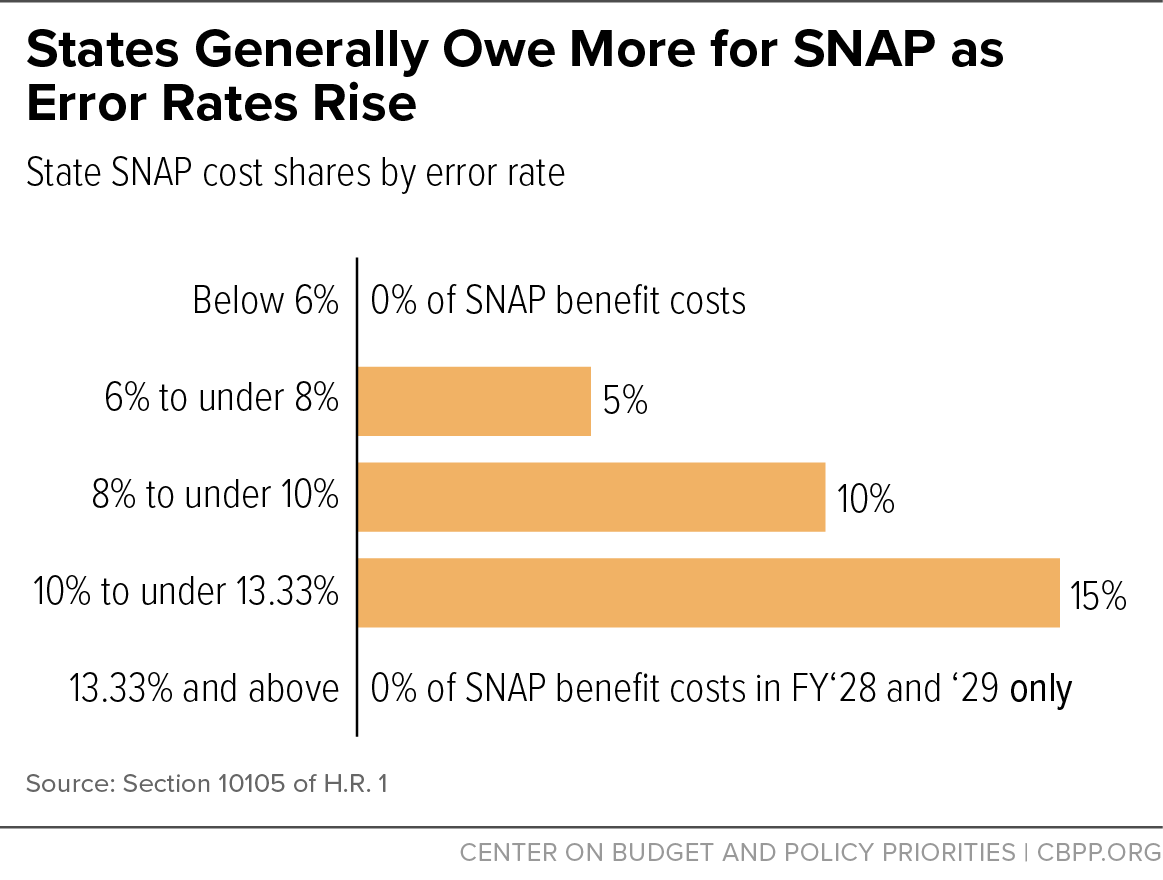
Higher error rates driven by these extenuating circumstances will have significant implications for states’ ability to fund food assistance for low-income families and other important services. States with higher error rates must generally pay a larger share of SNAP benefit costs. Only those with an error rate below 6 percent each year will continue to have food benefits fully funded by the federal government. (See Figure 1). Fewer than ten states, most of them with low populations, would have met this threshold to avoid a cost shift in 2024.
Paradoxically, there’s an exception for states with the highest error rates. Congress stipulated that if a state’s error rate multiplied by 1.5 is at or above 20 percent (an error rate at or above 13.33 percent) for fiscal year 2025, the state will not be required to pay a cost share in fiscal year 2028. If the error rate is above this threshold for fiscal year 2026, the state will not be required to pay a cost share in fiscal year 2028 or 2029. In effect, this rewards states with the worst payment accuracy while penalizing states with lower error rates. As some critics have noted, this could even temporarily encourage states to make more mistakes.[14]

Based on the most recent state error rates from 2024, nearly all states would face a cost shift. (See Figure 2.) Some 27 states would face a projected cost shift of more than $100 million per year, a significant burden on any state’s budget. And if error rates rise, even a small increase could tip a state over the threshold to owe a higher cost shift. Of the 32 states that would not already face the highest cost shift based on their 2024 error rate, 11 were half of a percentage point or less away from facing a higher penalty. (See Table 2).


Without Immediate Action from Congress, Food Assistance and Other Vital Services Will Be at Risk of Deep Cuts
States must balance their budgets every year, so taking on any additional costs will require them to raise an equal amount of revenue or cut funding for other public services that people count on, like education, transportation, or health care. If a state cannot fully pay its required share by increasing taxes or cutting elsewhere in its budget, it would have two main options. It could significantly reduce the number of people receiving food assistance, to the point where it can afford its required share of benefits for the remaining households. Or, it could terminate the state’s SNAP program entirely. The risk that a state would be unable to afford the required cost share will be even greater during recessions, when state revenues would be declining at the same time more people are losing income and turning to SNAP to put food on the table.
When the megabill was enacted, CBO estimated that states would respond to this cost shift by collectively reducing or eliminating SNAP benefits for about 300,000 people in a typical month. Because children who receive SNAP are automatically eligible for free school meals and Summer EBT, CBO also estimated that 96,000 children in a typical month would see cuts in these benefits when their families were cut off SNAP.[15] But the risk of even deeper cuts – or some states even ending SNAP entirely – is now much greater as circumstances outside of states’ control increase the likelihood of errors, driving up the costs states will face.
Congress must act quickly to give states the time and resources they need to improve payment accuracy while protecting access to food assistance for eligible low-income households struggling to afford groceries. At minimum, Congress should delay the cost-share requirement for food benefits for all states – not just the states with the highest error rates – and postpone cuts to federal reimbursement for states’ administrative costs.
While this would mitigate the immediate risk that low-income families lose food assistance due to the cost shift, this policy is fundamentally untenable and must be repealed. For more than 50 years, SNAP has ensured that children, adults, and seniors in low-income households receive a food benefit that allows them to afford an adequate diet, regardless of the state they live in. By creating the risk that some states may opt out of SNAP altogether, the cost shift abandons this decades-long nationwide commitment to addressing hunger.
| TABLE 2 | ||||
|---|---|---|---|---|
Nearly All States Would Face Significant SNAP Cost Shift Based on 2024 Error Rates | ||||
| State | 2024 SNAP Error Rate | Cost Shift Based on 2024 SNAP Error Rate | Projected Cost-Shift Amount Based on 2024 Error Rate (Millions) | Error Rate Increase That Would Trigger Higher Cost Shift |
| Alabama | 8.32 | 10% | $172 | 1.68 |
| Alaska | 24.66 | 15%* | $37 | |
| Arizona | 8.84 | 10% | $200 | 1.16 |
| Arkansas | 9.56 | 10% | $55 | 0.44 |
| California | 10.98 | 15% | $1,844 | |
| Colorado | 9.97 | 10% | $130 | 0.03 |
| Connecticut | 10.25 | 15% | $133 | |
| Delaware | 12.37 | 15% | $38 | |
| District of Columbia | 17.38 | 15%* | $48 | |
| Florida | 15.13 | 15%* | $984 | |
| Georgia | 15.65 | 15%* | $487 | |
| Guam | 9.72 | 10% | $12 | 0.28 |
| Hawai'i | 6.68 | 5% | $36 | 1.32 |
| Idaho | 3.59 | 0% | 2.41 | |
| Illinois | 11.56 | 15% | $666 | |
| Indiana | 9.52 | 10% | $143 | 0.48 |
| Iowa | 6.14 | 5% | $26 | 1.86 |
| Kansas | 9.98 | 10% | $41 | 0.02 |
| Kentucky | 9.11 | 10% | $115 | 0.89 |
| Louisiana | 6.62 | 5% | $95 | 1.38 |
| Maine | 10.26 | 15% | $54 | |
| Maryland | 13.64 | 15%* | $223 | |
| Massachusetts | 14.1 | 15%* | $390 | |
| Michigan | 9.53 | 10% | $304 | 0.47 |
| Minnesota | 8.98 | 10% | $85 | 1.02 |
| Mississippi | 10.69 | 15% | $125 | |
| Missouri | 9.42 | 10% | $150 | 0.58 |
| Montana | 8.89 | 10% | $17 | 1.11 |
| Nebraska | 5.5 | 0% | 0.5 | |
| Nevada | 5.94 | 0% | 0.06 | |
| New Hampshire | 7.57 | 5% | $8 | 0.43 |
| New Jersey | 14.33 | 15%* | $287 | |
| New Mexico | 14.61 | 15%* | $153 | |
| New York | 14.09 | 15%* | $1,095 | |
| North Carolina | 10.21 | 15% | $438 | |
| North Dakota | 7.91 | 5% | $6 | 0.09 |
| Ohio | 9.01 | 10% | $316 | 0.99 |
| Oklahoma | 10.87 | 15% | $224 | |
| Oregon | 14.06 | 15%* | $238 | |
| Pennsylvania | 10.76 | 15% | $636 | |
| Rhode Island | 12.29 | 15% | $51 | |
| South Carolina | 9.25 | 10% | $129 | 0.75 |
| South Dakota | 3.28 | 0% | 2.72 | |
| Tennessee | 9.47 | 10% | $161 | 0.53 |
| Texas | 8.32 | 10% | $717 | 1.68 |
| Utah | 5.74 | 0% | 0.26 | |
| Vermont | 5.13 | 0% | 0.87 | |
| Virgin Islands | 3.54 | 0% | 2.46 | |
| Virginia | 11.5 | 15% | $263 | |
| Washington | 6.06 | 5% | $95 | 1.94 |
| West Virginia | 9.43 | 10% | $56 | 0.57 |
| Wisconsin | 4.47 | 0% | 1.53 | |
| Wyoming | 5.12 | 0% | 0.88 | |
*2024 error rate exceeds threshold to qualify for a delay in the cost shift. Note: Actual cost-shift amounts will depend on each state’s fiscal year 2025 or 2026 error rate and benefit costs in fiscal year 2028. Projections are based on each state’s share of fiscal year 2024 benefit issuance and projected benefit costs in 2028 under the Congressional Budget Office’s June 2024 baseline, assuming each state’s share of the national total is the same as its share in fiscal year 2024, adjusted for a separate provision freezing the cost of the Thrifty Food Plan outside of inflation adjustments. These estimates do not account for other provisions in the megabill that would directly cut food benefits and terminate eligibility for many SNAP participants, reducing each state’s obligation. Puerto Rico, American Samoa, and the Commonwealth of the Northern Mariana Islands are not included in this table because they receive a nutrition assistance block grant in lieu of participation in SNAP. Source: U.S. Department of Agriculture SNAP Data for FY 2024, https://www.fns.usda.gov/pd/supplemental-nutrition-assistance-program-snap. | ||||
End Notes
[1] American Public Human Services Association, “APHSA Policy Recommendations for SNAP Shutdown & H.R. 1,” December 2025, https://aphsa.org/wp-content/uploads/2025/12/2025-12-APHSA_HR1-and-Shutdown-Policy_Deliverable.pdf.
[2] National Governors Association, “NGA Joins Coalition Letter Outlining SNAP Recommendations,” January 8, 2026, https://www.nga.org/advocacy-communications/letters-nga/nga-joins-coalition-letter-outlining-snap-recommendations/.
[3] Food and Nutrition Service (FNS), U.S. Department of Agriculture, “SNAP: Keys to Payment Accuracy, a Guide for State Agencies,” March 2024, archived at https://web.archive.org/web/20250712072705/https://fns-prod.azureedge.us/sites/default/files/resource-files/snap-qc-keys-payment-accuracy-guide-062424.pdf.
[4] For example, state-reported data show a 25 percent decline in SNAP caseloads in Arizona between July and November 2025. Similar declines in the number of adults (-24.5 percent) and children (-26.3 percent) participating in SNAP suggest that the decrease is not being driven by the megabill’s expansion of the three-month time limit for so-called able-bodied adults. See Arizona Department of Economic Security, “Statistical Bulletin November 2025,” December 31, 2025, https://des.az.gov/sites/default/files/dl/dbme-statistical_bulletin-11-2025.pdf?time=1767800652162, and “Statistical Bulletin July 2025,” August 25, 2025, https://des.az.gov/sites/default/files/dl/dbme-statistical_bulletin-07-2025.pdf.
[5] Congressional Budget Office, “Estimated Budgetary Effects of Public Law 119-21, to Provide for Reconciliation Pursuant to Title II of H. Con. Res. 14, Relative to CBO’s January 2025 Baseline,” July 21, 2025, https://www.cbo.gov/publication/61570.
[6]Ibid.
[7] FNS, “SNAP Implementation of the One Big Beautiful Bill Act of 2025 – Treatment of Energy Assistance Payments,” August 29, 2025, https://www.fns.usda.gov/snap/admin/energy-assistance-payments.
[8] FNS, “SNAP Provisions of the One Big Beautiful Bill Act of 2025 – Information Memorandum,” September 4, 2025, https://www.fns.usda.gov/snap/obbb-implementation; “SNAP Provisions of the One Big Beautiful Bill Act of 2025: ABAWD Exceptions – Implementation Memorandum,” October 3, 2025, https://www.fns.usda.gov/snap/obbb-abawd-exemptions-implementation; and “SNAP Provisions of the One Big Beautiful Bill Act of 2025: ABAWD Waivers – Implementation Memorandum,” October 3, 2025, https://www.fns.usda.gov/snap/obbb-abawd-waivers-implementation.
[9] See “Policy Memo” at FNS, “Supplemental Nutrition Assistance Program (SNAP) Implementation of the One Big Beautiful Bill Act of 2025 – Alien SNAP Eligibility,” October 31, 2025, https://www.fns.usda.gov/snap/obbb-alien-eligibility.
[10] The clarification released on December 9 incorrectly stated that victims of severe trafficking were subject to a five-year waiting period after obtaining a green card before they would be eligible for SNAP. This was corrected on December 10, though this revision is not noted in the document. FNS, “SNAP Provisions of the One Big Beautiful Bill – Alien SNAP Eligibility – Question and Answer #1,” updated December 10, 2025, https://www.fns.usda.gov/snap/obbb-alien-eligibility-qas1.
[11] Reply of Plaintiff States to Motion for Preliminary Injunction 4, State of New York v. Rollins, 6:25-cv-02186, (D. Or.), December 12, 2025, https://storage.courtlistener.com/recap/gov.uscourts.ord.190652/gov.uscourts.ord.190652.60.0.pdf.
[12] Margaret Attridge, “Judge gives states more time to meet new SNAP rules for immigrants,” Courthouse News Service, December 15, 2025, https://www.courthousenews.com/judge-gives-states-more-time-to-meet-new-snap-rules-for-immigrants/.
[13] Luis Nuñez and Katie Bergh, “Administration Won’t Spend All SNAP Funds It Says Are Available, Leading to Deep Benefit Cuts for Low-Income Households,” CBPP, November 5, 2025, https://www.cbpp.org/blog/administration-wont-spend-all-snap-funds-it-says-are-available-leading-to-deep-benefit-cuts; Kristle Muessle, “Partial SNAP benefits issued to eligible Nevadans,” Nevada Department of Human Services, November 5, 2025, https://www.dhs.nv.gov/reports/press-releases/press-releases/partial-snap-benefits-issued-to-eligible-nevadans/.
[14] Emily Badger, “Republicans Want to Cut Food Stamp Errors. Their Bill Could Backfire,” New York Times, July 2, 2025, https://www.nytimes.com/2025/07/02/upshot/republicans-food-aid-alaska.html.
[15] Congressional Budget Office, “Estimated Effects of Public Law 119-21 on Participation and Benefits Under the Supplemental Nutrition Assistance Program,” August 11, 2025, https://www.cbo.gov/system/files/2025-08/61367-SNAP.pdf.