MÁS ALLÁ DE LOS NÚMEROS
More States Jeopardizing Local Services With Property Tax Cuts and Caps
Everyone should have the opportunity to live in a community with strong public schools, beautiful parks, and safe roads, but many states are threatening to take away local governments’ ability to build thriving communities by cutting or capping property taxes. Policymakers can make housing more affordable without undermining local budgets by adopting measures like targeted property tax breaks, rental assistance, and steps to increase the supply of affordable housing.
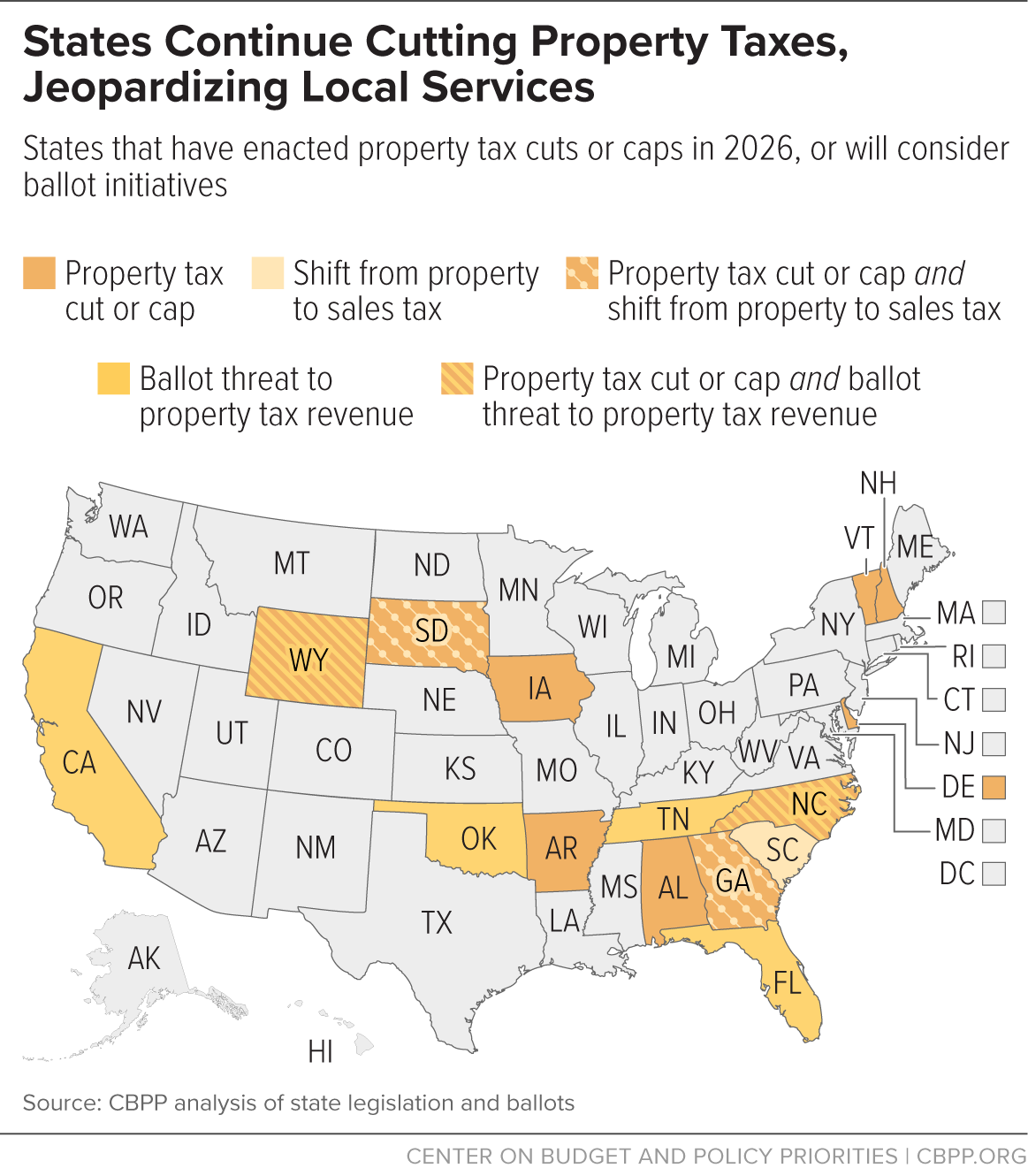
Continuing a recent trend, 11 states have cut or capped property tax revenue for local governments and schools so far in 2026. This includes increasing untargeted tax exemptions and credits, cutting property tax levies, capping allowable increases in property values or property tax assessments, and reducing school districts’ spending.
Even more proposals to cut or cap property taxes could gain approval this year through state ballot initiatives:
- In Florida, to exempt the first $250,000 in property value from non-school-related property taxes on primary homes, reducing county revenues by an estimated $5 billion a year.
- In North Carolina, to amend the state constitution to enable the General Assembly to limit property tax revenue growth by any amount, making it impossible to predict cuts to local services.
- In Oklahoma, to lower the growth limit for home property values from 3 percent to 1.75 percent and for all other property values from 5 percent to 4 percent annually, resulting in revenue losses that could grow to nearly $600 million in the tenth year.
- In Tennessee, to amend the state constitution to prohibit a statewide property tax, which the state does not have.
- In Wyoming, to exempt half of primary residences’ assessed value from property taxes, adding pressure to local budgets already strained from previous property tax cuts.
Broad property tax cuts and caps harm communities because property taxes are the primary source of revenue for over 90 percent of local governments. The benefits from tax cuts and caps tend to accrue to existing and wealthier homeowners. In addition, when local governments are unable to raise adequate revenue, their borrowing costs tend to rise, and when lower revenue leads to local services being cut, schools are often particularly harmed.
Research suggests that cutting property taxes can make homeownership less affordable for first-time homebuyers, because those tax cuts can result in increased property values. Research also suggests that by reducing school funding, property tax cuts and caps lead to increased student-teacher ratios, reductions in the qualifications of new teachers, and declines in students’ reading and math scores.
Property tax cuts and caps enacted this year include:
- Georgia enacted a cap that requires local governments and school districts to limit annual homestead assessment increases to the overall inflation rate. It also gives cities and counties the option to increase regressive sales taxes to fund additional property tax cuts, shifting a larger share of the local tax incidence to lower- and moderate-income families while lowering taxes for higher-income property owners. The state also used part of its budget surplus to fund a one-time, untargeted property tax credit worth $850 million, even as the state faces up to several hundred million dollars a year in added SNAP costs (the amount depends on its payment error rate) due to new federal changes.
- Iowa enacted sweeping legislation that imposes a 2 percent cap on cities’ and counties’ annual property tax revenue growth, cuts property taxes that fund schools by about 6 percent, and replaces existing property tax credits with a costlier exemption. Together, these changes will reduce property tax revenue by about $700 million annually.
- South Dakota reduced the maximum school property tax rate and plans to replace the lost revenue by increasing the state sales tax and giving counties the option of creating a local sales tax. These changes shift the responsibility for funding schools away from homeowners and toward renters.

These cuts and caps come at a time when local governments are already under fiscal pressure from the compounding effects of the massive cuts to food assistance and health care in last year’s Republican reconciliation law, which could increase demand for local services while reducing resources.
A few states will attempt to replace some property tax revenue with sales tax revenue, but sales taxes are a less stable revenue source; they also fall disproportionately on low- and middle-income families, who already pay more sales than property tax in most states. And sales tax revenue does not always make up for lost property tax revenue: a property-sales tax swap that South Carolina implemented in 2007, shortly before the Great Recession caused a sharp drop in sales tax revenue, resulted in shortfalls totaling nearly $1 billion from 2007 to 2020, which the state was forced to reimburse from other sources, including cutting other school funding by $365 million in 2008-2009.
Instead of regressive property tax cuts and sales-tax shifts, states should consider reforms like targeted property tax circuit breakers, which put money back into the pockets of low-income homeowners and renters (who pay property taxes as part of their rent) by capping property tax bills at a percentage of household income. For example, Maine recently increased its Property Tax Fairness Credit, which can be claimed by both homeowners and renters with low incomes.
States also should consider increasing investments in rental assistance for families with low incomes. This is critically important in ensuring families with the lowest incomes can afford housing and complements efforts to expand affordable housing supply.
To help fund investments in affordable housing and other public services, states can consider measures like mansion taxes, which fall on wealthy families who can afford to pay more to support public needs. In the last two years, Maine, New Jersey, and Rhode Island increased tax rates on the sale of high-value properties and Montana and New York City (through the New York state budget) increased tax rates on second homes. Other states should follow suit.