

States Should Fund Rental Assistance as a Frontline Strategy to Address the Housing Affordability Crisis
Everyone needs and should have a place they can call home. Yet housing is unaffordable for more people than ever in the United States,[1] including most low-income renters. Almost half of low-income renters and 87 percent of all extremely low-income renters are spending more than half their income on housing, leaving them one emergency away from housing instability or homelessness.[2] Unsurprisingly, housing affordability has consistently polled as a top concern of people across the United States in recent years.[3]
Rental assistance is a key policy intervention that state policymakers should add to their toolbox to address housing affordability at scale. Rental assistance programs help cover the gap between what a household can afford to pay in rent (typically 30 percent of their income) and the cost of rent, helping them afford housing alongside other basic needs, such as food, medicine, child care, and transportation. Federal rental assistance, which makes up the bulk of overall rental assistance spending nationally, is drastically underfunded compared to need, reaching only about 23 percent of people who would be eligible for support.[4]
There is no “silver bullet” to address the housing affordability crisis — policymakers must simultaneously pursue policies to reign in housing costs, increase affordable housing supply, protect tenants, and sustainably resolve homelessness. Efforts to increase household incomes are another important, but often overlooked, component of accessing and maintaining housing security. Rental assistance is an investment that can play a role advancing solutions across all these categories — and in fact, without increasing access to rental assistance, these policies will fall short of their full potential and fail to meet the needs of people with the lowest incomes, who struggle most to afford housing.[5]
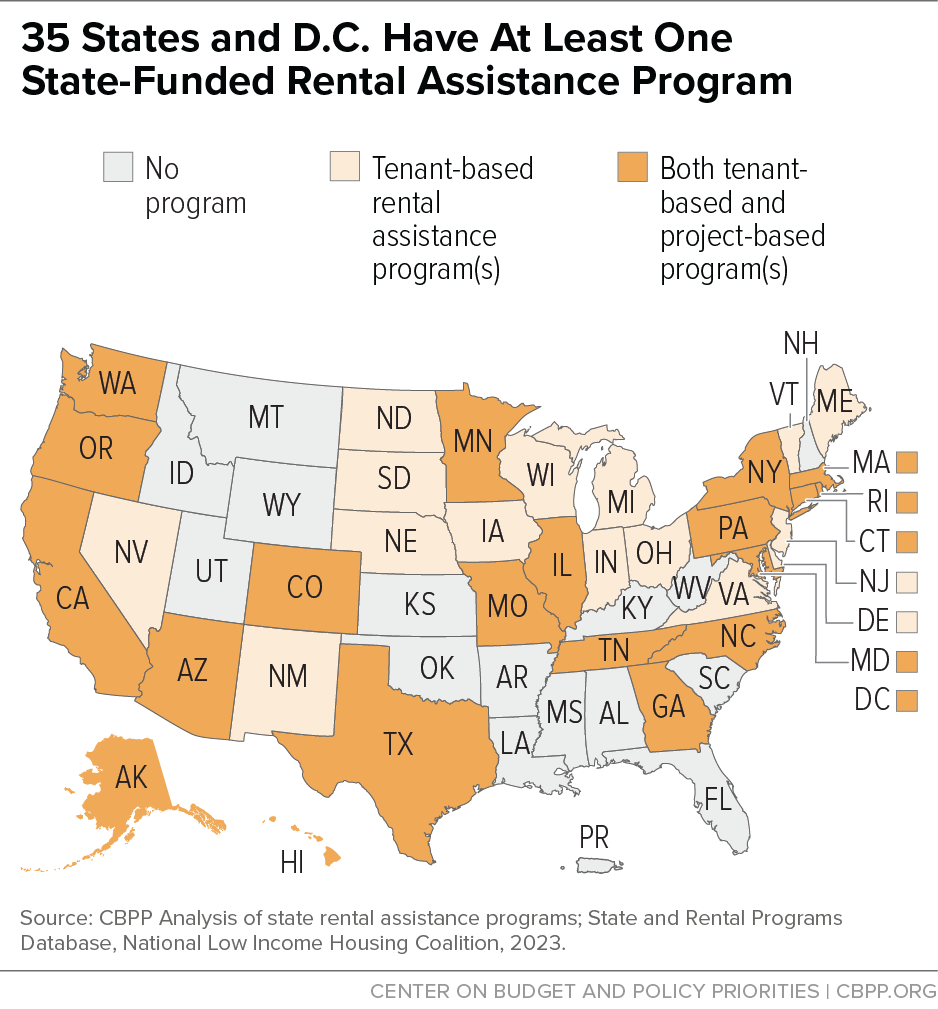
Thirty-five states and Washington, D.C. already fund rental assistance programs, and more states should join suit to either establish new programs or expand existing investments. State policymakers should focus on strengthening and expanding state-funded housing and homelessness programs, especially funding rental assistance to help the lowest-income residents who are most at risk of losing their homes.
This paper provides a first-of-its kind analysis of the current landscape of state investments in rental assistance and offers policy design considerations for state and local leaders seeking to create or expand rental assistance programs.
States Can Build on Existing State-Funded Rental Assistance Programs to Enhance Housing Stability and Resolve Homelessness for More Residents
Despite the widespread impacts of the housing affordability crisis in every state in the nation, state spending on affordable housing only makes up a small fraction of state spending overall. On average, states spend less than 1 percent of their direct spending on housing and community development programs, including capital outlays, many rental and operating subsidy programs, and other housing-related spending.[6]
Despite relatively low levels of state spending on housing compared to other areas, state governments do fund at least 281 programs across 48 states and territories to improve housing affordability.[7] The majority of state-funded housing programs provide capital resources (e.g., construction and other building costs) to subsidize the production and preservation of housing — 53 percent of 281 state programs documented by the National Low Income Housing Coalition’s (NLIHC) State and Local Rental Housing Programs database. Only around 38 percent fund any kind of rental assistance.[8] Our analysis specifically focuses on a dataset of 109 state-funded rental assistance programs, which includes the 106 state rental assistance programs in the NLIHC database and three programs that were established since its publication and identified through our additional research.
States fund different kinds of rental assistance programs, including programs that offer one or both of the following:
- Tenant-based rental assistance: A type of financial help that covers the difference between what a renter can afford and what their housing actually costs, so they can afford to live in a place they choose. Tenant-based rental assistance can be paid to the landlord or to the tenant.
- Project-based rental assistance: a subsidy that is tied to a particular development or housing unit, aimed at bringing down the cost of the housing to a level that people with low incomes can afford.
As of 2025, 35 states and D.C. fund some kind of rental assistance program. Twenty states plus D.C. fund both tenant-based and project-based rental assistance at the state level, and 15 states fund only tenant-based rental assistance programs. (See Figure 1.)[9]

Most State-Funded Rental Assistance Programs Are Relatively Small, Time-Limited, and Focused on Specific Sub-populations
While most states fund some amount of rental assistance, existing programs are typically relatively small, serving only a fraction of people who need help affording housing. Even among long-standing state rental assistance programs, none are large enough to come close to filling the gap in assistance left by federal underfunding. (See Table 1 for examples.)
State rental assistance programs vary in the duration of assistance offered:
- Ongoing assistance provides consistent support to households, ideally for as long as they need and are eligible for support. This is the most effective form of assistance because it provides stability in the face of the persistent gap between household income and the cost of rent.[10] A minority of state rental assistance programs — 35 percent, or a total of 19 states plus Washington, D.C. — provide ongoing assistance. (See Figure 2.)
- Time-limited subsidies provide assistance to households for a specified period. About half (47 percent) of state rental assistance programs provide time-limited assistance, ranging from as short as six months to as long as five years. Among time-limited programs, we found that:
- 78 percent of time-limited programs provide support for less than two years.
- 22 percent of time-limited programs provide longer-term support (more than two years) but fell short of providing ongoing support.[11]
- One-time assistance provides one-time or very short-term support (0 to 6 months) to households, often designed specifically for households shouldering an economic shock or acute crisis. Twelve percent of programs provide one-time or emergency assistance.
- Six percent of programs fund a combination of one-time, time-limited, or ongoing assistance.
State rental assistance programs are administered by a variety of state agencies. While the slight majority — 55 percent of programs — are administered by a state’s housing and community development agency, 27 percent are administered by a social services agency, and 20 percent are administered by a health-focused agency. In states with multiple rental assistance programs, it’s common for multiple agencies within the state to administer distinct programs.
State programs also frequently limit eligibility to specific populations.[12] Often, target populations or groups are particularly likely to face housing or economic hardship — like people experiencing or at risk of homelessness, people facing eviction, survivors of domestic violence, foster youth, or people with disabilities — and rental assistance is a proven solution. For example, the state-funded Georgia Housing Voucher Program specifically provides tenant-based rental assistance and services to help people with serious mental illnesses experiencing homelessness and people exiting state institutions who would otherwise become homeless access permanent supportive housing.[13] The frequency of programs limited to certain sub-populations may also explain why state rental assistance programs are administered by a variety of state agencies. Additionally, because most state rental assistance programs are very small compared to need, limiting eligibility by sub-population is a way to help prioritize or ration resources.
Only seven states (Connecticut, Hawai‘i, Illinois, Massachusetts, Minnesota, New Jersey, Rhode Island) and D.C. use state funding to operate programs more like the federal Housing Choice Voucher program (i.e., ongoing, need-based, voucher-like rental assistance programs for the general population of people with low-incomes).


Like federal rental assistance programs, most state-funded rental assistance programs are available to low-income households — often households below 50 percent of area median income (AMI) — and typically require that the participating household pay a portion of their income in rent, often 30 percent, but in some cases up to 40 percent.
| TABLE 1 | ||||
|---|---|---|---|---|
Largest Ongoing State Rental Assistance Programs Make Assistance Available to More Low-Income Households but Still Fall Far Short of Meeting Need | ||||
| State Rental Assistance Program Name | Number of People Served by State Program | Number of People Served by Federal Rental Assistance Programs | Number of People in Severely Cost Burdened Low-Income Renter Households | |
| Connecticut | State Rental Assistance Program (RAP) | 6,700 | 161,500 | 252,500 |
| District of Columbia | Local Rent Supplement Program (LRSP) | 7,121 | 68,700 | 76,400 |
| Massachusetts | Massachusetts Rental Voucher Program (MVRP) | 9,600 | 363,800 | 500,000 |
| Minnesota | Bring It Home | 5,000 | 195,400 | 255,300 |
| New Jersey | State Rental Assistance Program (SRAP) | 6,323 | 302,700 | 714,600 |
Note: This table reflects programs that provide rental assistance through vouchers to a broad population of people with low incomes rather than specific sub-populations. Washington, D.C. has two other rental assistance programs that are not included in this table: the Permanent Supportive Housing (PSH) program, which is specific to people who are chronically homeless or at imminent risk of becoming homeless, and the Targeted Affordable Housing (TAH) program, which is specific to people who, due to disability, age, or experience of chronic homelessness, require a long-term subsidy to prevent homelessness. Additionally, New Jersey has another rental assistance program called the Supportive Housing Connection (SHC), which is specific to people with” special needs” (meaning people with disabilities). Source: CBPP analysis of 2017-2021 ACS PUMS; CBPP analysis of State Rental Assistance Programs; CBPP National and State Housing Fact Sheets and Data, updated January 2025; Partnership for Strong Communities State-Funded Rental Vouchers: Connecticut and Our Neighbors; Urban Institute Combatting Rising Evictions in the District of Columbia with Housing Subsidies | ||||
States Primarily Fund Rental Assistance Through General Revenue, but Several States Have Dedicated Revenue Sources
Among the state rental assistance programs included in our analysis, 60 percent (65 out of 109) are funded by state general revenue, which may be either ongoing or one-time investments. Seventeen percent (18 out of 109) of programs are funded by dedicated revenue sources, like real estate transfer taxes, sales taxes, revenue from state-owned property, or millionaire taxes.[14] Many programs are funded on a one-time or sporadic basis, and do not receive consistent funding year after year. This may be related to the fact that many states fluctuate between budget surpluses and deficits from year-to-year, creating volatile state budget cycles which may pose both fiscal and political challenges to ramping up new or ongoing spending on housing programs. Among the states that fund voucher-like programs mentioned in the previous section, all of them dedicate some amount of general revenue on an ongoing basis to fund their programs, and several partially fund the program through a dedicated revenue source.
Deeper analysis will be required to understand why certain states tend to spend more than others on housing affordability programs, and why some states provide ongoing or dedicated funding versus one-time or inconsistent funding. What is clear is that state spending on rental assistance and other housing and homelessness programs is an indicator of whether a state has prioritized addressing the affordable housing crisis.
States Should Invest in Ongoing, Need-Based Rental Assistance to Prevent and End Homelessness and Housing Insecurity for People With the Lowest Incomes
As state policymakers consider how to address housing insecurity and homelessness in their states in ways that meet the needs of residents with extremely low incomes, they should fund rental and operating subsidies as cost-effective, evidence-based policy strategies. Many of the limitations of current state rental assistance programs — serving relatively few people compared to need, introducing time limits, and population restrictions — are sub-optimal and likely to be less effective than programs that provide ongoing, deep rental subsidies that cover the full gap between what people can afford and housing costs.[15]While federal policymakers are best positioned to expand funding for rental assistance programs until it is available to anyone who needs it, state policymakers can make meaningful impacts on resolving homelessness and housing insecurity by improving and expanding state rental assistance investments. To design maximally equitable and effective programs, policymakers should apply as many of the following criteria as possible.
Ten Tips for Designing Effective and Equitable State Rental Assistance Programs
Provide assistance to a household as long as they need it. Some households, particularly people with disabilities, older adults on fixed incomes, or workers in communities where rents are well above what they earn, may need long-term support to afford housing. In some areas, especially rural or economically marginalized communities, there just aren’t many higher-paying jobs available. Further, need-based rental assistance without arbitrary time limits helps create sustainable housing outcomes for people experiencing homelessness transitioning from shelter or other temporary housing programs, like Rapid Re-Housing or short-term Medicaid-funded transitional rent where it is available. Evidence shows that ongoing rental assistance has better outcomes for households compared to time-limited subsidies.[16] Data from federal rental assistance programs show that households stay on the program for a median length of four or five years.[17]
If limited resources preclude providing ongoing assistance, states should consider exploring new revenue sources[18] (for example, mansion taxes[19] or closing worldwide combined reporting tax loopholes for corporations[20]). Regardless of funding source, states could also design a program to be a “bridge” to more permanent federally funded programs, for example, by facilitating participants enrollment in the waitlist for federal rental assistance programs, to relieve the state budget obligation for each voucher.
Provide a subsidy that meets the entire gap between what a household can afford — typically 30 percent of their income — and their housing costs. Need-based subsidies are reduced over time as a household’s income increases. In contrast to programs designed to start as “shallow” subsidies, which often provide a set amount of assistance that may be less than the gap between incomes and housing costs, need-based subsidies help ensure people with the lowest incomes can afford housing.
Many state rental assistance programs also set some standards around the maximum rent that a subsidy can reimburse. Many use the federal Fair Market Rent (FMRs) standards, which HUD sets each year at levels it estimates are sufficient to cover rent for moderately priced units in each metropolitan area and non-metropolitan county. HUD’s updates to FMRs sometimes lag behind changes in market rents. State rental assistance programs may be able to better reflect changing local housing market conditions if they design their own rent standards or make adjustments to FMRs, particularly in areas with rapid rent inflation. For example, Washington, D.C.’s Local Rent Supplement Program pays up to 187 percent of the FMR standard to make it easier for residents to have options for housing in the low-vacancy, high-rent D.C. housing market.[21] State programs should also consider setting rent standards at the neighborhood level (similar to Small Area Fair Market Rents set by HUD) to better reflect differences in housing costs across a region and create more opportunities for rental assistance users to access neighborhoods with lower poverty rates and more public services.
Rental assistance programs should also allow for other housing costs beyond rent, including things like utilities (in line with federal rental assistance programs), security deposits, move-in costs, unit holding fees, and renters’ insurance, which can be barriers for those with low incomes. The Emergency Housing Voucher Program at the federal level demonstrated the value of pairing rental subsidies with these additional supports.[22]
- Connect rental assistance programs with new housing supply, including affordable and social housing, to make new housing accessible to people with the lowest incomes. Many programs designed to provide “affordable” housing reduce rents to below market prices and to amounts that people between 50-80 percent of the AMI could afford. However, this housing remains unaffordable to people between 0-50 percent of the AMI. By pairing either project-based or tenant-based rental assistance with housing supply programs, state leaders can ensure that their new housing projects can sustainably operate while being inclusive for people with the lowest incomes who face the most severe housing supply shortages.
- Advance complementary rent stabilization and renter protection policies, such as strong eviction protections, well-designed rent stabilization, and habitability laws. While rental assistance can help prevent evictions due to unpaid rent and help residents afford housing alongside other basic needs, they are not a replacement for just and effective legal protections to ensure landlords are providing high-quality housing free of unjust displacement and exploitation.
- Provide adequate funding for support services, including, at a minimum, housing navigation and landlord engagement services to assist households and housing providers in navigating programs. For people with health conditions, disabilities, or people exiting chronic homelessness, rental assistance can provide a critical component of permanent supportive housing along with robust, voluntary support services. States can also explore funding housing-related services to pair with rental assistance through Medicaid.[23]
- Pair ongoing support with access to one-time emergency assistance. While programs that provide one-time emergency assistance help a household weather an economic shock and avoid eviction, many households who receive one-time assistance may face lasting housing cost burdens without additional ongoing rental assistance, leaving them at high risk of a future eviction and the poor outcomes that often follow. Similarly, people who receive ongoing rental assistance still pay 30 percent of their income towards their rent, but may face emergencies, like losing their job, benefits, or experiencing a health crisis, where they could benefit from access to emergency rent relief to avoid missing their portion of the rent payment. The two strategies are complementary.
- Pass and enforce source of income protections to prevent landlords from discriminating against tenants using rental subsidies, which can increase the likelihood a household with a voucher can successfully lease a home. In addition to source of income protections, states should consider passing additional protections against discrimination based on criminal conviction, eviction records, or credit history, which may disproportionately impact extremely low-income people and people of color who face systemic discrimination in legal systems and the lending market.
- Consider testing the promising model of direct rental assistance, paying assistance directly to households.[24] While federal rental assistance programs typically require all rental subsidy payments to be made to landlords, state-funded programs can allow subsidies to be paid directly to tenants, which could increase autonomy for program participants, simplify administrative processes, and counter widely prevalent landlord discrimination.[25]
- Engage people who use rental assistance and who have been excluded from rental assistance in the design, implementation, and monitoring of state rental assistance programs. Through inclusive program design and implementation processes (including compensation for consultants with lived expertise), state rental assistance programs and the accompanying services have the potential to be more effective and equitable for the people who need them.
- Use state rental assistance to advance universal access to housing. Federal rental assistance programs, beyond excluding most people who would be eligible due to underfunding, also categorically exclude certain populations who, like all people, need an affordable place to live. State rental assistance programs can be designed to serve people with criminal convictions, undocumented people, and any other groups that are left out of federal programs to realize a system in which everyone can access housing they can afford.
Methodology for State Rental Assistance Analysis
To produce the analysis of state-funded rental assistance programs across the country, CBPP used the National Low Income Housing Coalition’s Rental Housing Program Database as a starting point.[26] Our analysis only includes statewide programs, with a dataset of 106 programs. We define the following fields: type of administering state agency, program type (tenant-based and/or project-based), duration, funding type, and priority populations.
State Agency Administering Program
To indicate which type(s) of agencies administered the state-funded rental assistance program, we define four categories under this field:
- Housing and Community Development: These include departments of housing and community affairs, public housing authorities, housing finance agencies, housing development authorities, and other similar agencies.
- Health and Human Services: These include health care or health and human services agencies, as well as departments of behavioral health, developmental disabilities and disability assistance, mental health, addictions services, and other similar departments.
- Social Services: These include departments of health and/or social services, human services, and children and family services.
- Other: These include nonprofit agencies, executive offices, and departments of corrections.
Program Type
Each program was coded as to whether it allows tenant-based assistance, project-based assistance, or both. To indicate the type(s) of rental assistance offered through this program, we define two categories under this field:
- Tenant-based rental assistance (TBRA): A form of income supplement that provides support for tenant households to bridge the gap between housing costs and incomes, helping them rent housing of their choice.
- Project-based rental assistance (PBRA): A subsidy that is tied to a particular development or housing unit, aimed at bringing down the cost of the housing to a level that people with low incomes can afford.
Duration
To indicate the length in which the program is available to participants, we define three categories under this field:
- One-time: Provides one-time or very short-term support (0 to 6 months) to households, often designed specifically for households shouldering an economic shock or acute crisis. Twelve percent of programs provide one-time or emergency assistance.
- Time-limited: Provides short-term (less than two years) or long-term (between two to five years), time-limited assistance to households.
- Ongoing: Provides ongoing assistance to households, ideally for as long as they need and are eligible for support.
Funding Type
To indicate the type of funding that finances the program, we followed the methodology of the National Low Income Housing Coalition’s State and Local Rental Programs Database, including:
- General Revenue: Funding allocated by state or local governments on a one-time or recurring basis through appropriations, annual (or biennial) budgets, etc. This is funding that a state government collects through taxes, fees, and other income. Programs funded by general revenue may be funded in an ongoing or one-time manner.
- Dedicated Funding Stream: A sustainable funding stream that contributes funds to the program on a continuous basis. These streams can include revenue from interest on government accounts, taxes on incomes over a certain threshold, real estate transfer tax, sales tax, revenue from state- or city-owned property, and other sources. The amount of funds the program receives may vary over time depending on the total revenue the government collects from the source.
- Special One-Time Federal Funding: Includes programs funded in whole or in part by the Coronavirus State and Local Fiscal Recovery Funds (SLFRF) program, a $350 billion flexible resource for pandemic recovery and resiliency initiatives created by the 2021 American Rescue Plan Act (ARPA) and managed by the U.S. Department of the Treasury. Although SLFRF is a federal funding source, state and local governments were given considerable flexibility to use this funding for a wide range of initiatives, and many have chosen to invest in new or existing rental housing programs. This category does not include rental housing programs funded exclusively through the Treasury Emergency Rental Assistance (ERA) program.
- Special One-Time Non-Federal Funding: A one-time allocation of funds from a state or local government. Such an allocation differs from general revenue in that there is no clear indication that the funding source will be renewed in the future. This funding can include state or local funds related to COVID-19 response and recovery efforts.
- Tax Expenditure: Government revenue losses resulting from tax exemptions and credits This mostly applies to programs in which tax credits or tax relief are provided to tenants, landlords, properties, or housing developers.
- Unknown: This indicates there was no information about the type of funding.
Priority Populations
Some programs give priority to specific sub-populations. We define several categories under this field:
- People experiencing or at risk of homelessness
- People at risk of eviction
- People with substance use disorders
- People with mental illnesses
- People experiencing domestic violence
- Veterans
- Youth and former foster care youth
- Older adults (people aged 62 and older)
- Disabled people
- Pregnant people
- Formerly incarcerated people
- Households with an income at or below 30 percent of the Area Median Income (AMI)
- Unspecified
CBPP’s database of state-funded rental assistance programs is available upon request.
End Notes
[1] Thyria A. Alvarez and Barry L. Steffen, “Worst Case Housing Needs: 2023 Report to Congress,” Office of Policy Development and Research, U.S. Department of Housing and Urban Development (HUD), September 21, 2023, https://www.huduser.gov/portal/publications/Worst-Case-Housing-Needs-2023.html.
[2] National Low Income Housing Coalition, “The Gap: A Shortage of Affordable Homes,” May 2024, https://nlihc.org/gap. Low-income (LI) renters refer to households with incomes greater than 50 percent and less than 80 percent of area median income. Extremely low-income renters (ELI) refer to households with incomes at or below either the federal poverty guidelines or 30 percent of area median income, whichever is higher.
[3] Geoff Bennett and Courtney Norris, “Housing shortage, soaring costs a major concern for voters this election year, polls show,” PBS News, May 30, 2024, https://www.pbs.org/newshour/show/housing-shortage-soaring-costs-a-major-concern-for-voters-this-election-year-polls-show.
[4] CBPP, “77% of Low-Income Renters Needing Federal Rental Assistance Don't Receive It,” https://www.cbpp.org/77-of-low-income-renters-needing-federal-rental-assistance-dont-receive-it.
[5] Mari Castaldi and Urvi Patel, “State-Funded Rental Assistance Can Reduce Homelessness and Increase Economic Security,” CBPP, August 6, 2025, https://www.cbpp.org/research/housing/state-funded-rental-assistance-can-reduce-homelessness-and-increase-economic.
[6] Urban Institute, “State and Local Backgrounders: Housing and Community Development Expenditures,” https://www.urban.org/policy-centers/cross-center-initiatives/state-and-local-finance-initiative/state-and-local-backgrounders/housing-and-community-development-expenditures, accessed October 31, 2024. The Urban Institute fiscal analysis focused on state expenditures in housing and community development agencies. However, as noted in this paper, many state rental assistance programs are administered by non-housing agencies (like health and human services agencies) so spending on rental assistance may not be consistently included in this estimate.
[7] CBPP analysis of NLIHC State and Local Rental Housing Programs database, available at https://nlihc.org/rental-programs.
[8] Sarah Abdelhadi and Andrew Aurand, “State and Local Investments in Rental Housing: A Summary of Findings from the 2023 Rental Housing Programs Database,” National Low Income Housing Coalition, October 2023, https://nlihc.org/sites/default/files/2023-10/state-and-local-investments-rental-housing-report.pdf. The remaining 10 percent of programs are for tenant tax relief programs.
[9] Each of these states may fund other housing programs, including capital programs or tenant tax relief, and states with no rental assistance program may fund other kinds of housing programs.
[10] A multi-site evaluation comparing homeless families with children that were given ongoing rental assistance to enable them to rent housing to families randomly assigned to other anti-homelessness interventions — such as transitional housing or short-term rapid rehousing assistance — and families not receiving special assistance, found that ongoing rental assistance reduces homelessness, overcrowding, and instability far more effectively than the other interventions. Daniel Gubits et al., “Family Options Study: 3-Year Impacts of Housing and Services Interventions for Homeless Families,” Office of Policy Development and Research, HUD, October 2016, https://www.huduser.gov/portal/sites/default/files/pdf/Family-Options-Study-Full-Report.pdf.
[11] See Methodology Section.
[12] 81 percent of state-funded rental assistance programs in our sample reported limiting eligibility to certain sub-populations.
[13] Georgia Department of Behavioral Health and Developmental Disabilities, “Get Help with Supportive Housing,” https://dbhdd.georgia.gov/be-dbhdd/be-supported/supportive-housing-services.
[14] CBPP analysis of state rental assistance programs. For details, see Methodology Section.
[15] Gubits et al., 2016.
[16]Ibid.
[17] Andrew J. Greenlee and Kirk McClure, “Participant, Transition, and Length of Stay in Federal Housing Assistance Program,” Cityscape: A Journal of Policy Development and Research, Vol. 26, No. 2, 2024, https://www.huduser.gov/portal/periodicals/cityscape/vol26num2/ch2.pdf.
[18] CBPP, “State and Local Revenue Options for Advancing a Brighter Future,” https://www.cbpp.org/research/state-budget-and-tax/state-revenue-options-for-advancing-equity-and-prosperity.
[19] Mari Castaldi, “Taxing Very High-Value Home Sales Is an Equitable an Effective Strategy to Raise Revenue and Fund Affordable Housing,” CBPP, July 19, 2024, https://www.cbpp.org/research/housing/taxing-very-high-value-home-sales-is-an-equitable-and-effective-strategy-to-raise.
[20] Michael Mazerov, “States Can Fight Corporate Tax Avoidance by Requiring Worldwide Combined Reporting,” CBPP, June 27, 2024, https://www.cbpp.org/research/state-budget-and-tax/states-can-fight-corporate-tax-avoidance-by-requiring-worldwide-0.
[21] District of Columba Housing Authority, “Payment Standard,” https://www.dchousing.org/wordpress/vouchers/payment-standard/.
[22] Urban Institute, “How Have Communities Used Emergency Housing Vouchers to Prevent and End Homelessness?” May 2025, https://www.urban.org/projects/how-have-communities-used-emergency-housing-vouchers-prevent-and-end-homelessness.
[23] Allison Orris, Anna Bailey, and Jennifer Sullivan, “States Can Use Medicaid to Help Address Health-Related Social Needs,” CBPP, February 27, 2024, https://www.cbpp.org/research/health/states-can-use-medicaid-to-help-address-health-related-social-needs.
[24] Will Fischer, “Direct Rental Assistance Should Be Tested Through Local Pilots and a National Demonstration,” CBPP, January 22, 2024, https://www.cbpp.org/blog/direct-rental-assistance-should-be-tested-through-local-pilots-and-a-national-demonstration.
[25] HUD’s Moving to Work (MTW) Demonstration program allows a set number of public housing agencies (currently capped at 139 agencies designated by HUD) to alter many of the rules of the Housing Choice Voucher and public housing programs. MTW agencies have the ability to pay rental assistance payments directly to tenants instead of to landlords. They also have authority to pursue more harmful policies, like raising rent levels for participating households and imposing work registration requirements as a condition of assistance. See Will Fischer, “Expanding HUD’s ‘Moving to Work’ Authority Would Harm People Struggling to Afford Housing and Pave Way for Deep Cuts,” CBPP, June 2, 2025, https://www.cbpp.org/research/housing/expanding-huds-moving-to-work-authority-would-harm-people-struggling-to-afford.
[26] National Low Income Housing Coalition, “Rental Housing Program Database,” 2023, https://nlihc.org/rental-programs.