

State and Local Policymakers Should Invest in Rental Assistance to Reduce Homelessness and Increase Economic Security
Everyone needs and should have a place they can call home. A large body of research shows that access to stable housing can improve health, support child development, and advance long-term economic outcomes for people and families.[1] Yet housing is unaffordable for more people than ever in the United States,[2] including most low-income renters.[3] For people with the lowest incomes, high housing costs stretch budgets for families struggling to afford the basics, forcing them to choose between paying for housing, food, health care, and saving for emergencies. The gap between housing costs and incomes also drives increasing rates of eviction and is a root cause of the nation’s homelessness crisis, which left at least 771,000 people without stable housing on a given night in 2024.[4]
These hardships have far-reaching consequences for people and families — but they are not inevitable. They result from policy choices, like underinvesting in public and affordable housing, which can be solved through equitable and effective housing policies and public investments.
Rental assistance is a powerful tool states can use to make housing affordable. Rental assistance programs help cover the gap between what a household can afford to pay in rent (typically 30 percent of their income) and the actual cost of rent. Rental assistance can be tenant-based (supplementing tenant income to bridge the gap between housing costs and incomes in housing of their choice) or project-based (tied to a particular development or housing unit, aimed at bringing down the cost of that housing to a level the tenant can afford). Numerous studies show that robust, need-based rental assistance reduces poverty, homelessness, and housing instability, advances racial equity, and increases access to low-poverty, high-resource communities for those who might otherwise be priced out of them.[5]
Most existing rental assistance resources come from federal rental assistance programs, including Housing Choice Vouchers, Project-Based Rental Assistance, and public housing among other programs, which help 10.1 million low-income people in 5.2 million households afford the rent.[6] Despite the documented benefits households experience when they can access need-based rental assistance, a mere 23 percent of households who are eligible for federal rental assistance get it due to inadequate federal funding.
State Rental Assistance Innovations Can Serve as a Model for the Federal Government
The widely felt and escalating housing crisis has created new urgency for policymakers, especially at the state and local levels, to act. Federal policymakers should increase funding for rental assistance until it is universally available to people with low incomes facing housing cost burdens — starting with people with the lowest incomes — and make improvements to remove barriers and improve equity and effectiveness in the program.[7] However, the Trump Administration’s and Republican-led Congress’s housing policy priorities are poised to worsen homelessness and erect new, unjust barriers to housing assistance and other programs that help families meet their basic needs.[8] As such, it has become even more crucial that state policymakers act to increase access to affordable housing and prevent the worst harms of the housing affordability crisis. One way to do this is through designing state rental assistance programs to help more people who are harmed by housing cost burden and at highest risk of homelessness.
In fact, at least 35 states, as well as numerous local governments, already fund and operate their own smaller rental assistance programs, often alongside programs aimed at addressing housing affordability. Connecticut, Massachusetts, Minnesota, and New Jersey operate state-funded rental assistance programs that provide ongoing housing assistance to people with low incomes, similar to the federal Housing Choice Voucher program. Washington, D.C. also operates such programs. In just the past few years, several states — including Maine, Maryland, Massachusetts, Minnesota, New York, and Oregon — have funded new state rental assistance programs or expanded existing ones.[9]
These state rental assistance investments demonstrate how state leaders are stepping up to ensure their residents can access safe, affordable, and accessible housing, especially given challenging state budgeting environments and balanced budget requirements that can make sustainably funding significant, ongoing investments difficult. Despite these political hurdles, state policymakers should consider following and building on the momentum of numerous states with established ongoing funding for affordable housing programs, in some cases through dedicated revenue streams like real estate transfer taxes.[10]
Ultimately, federal leaders should make rental assistance a guaranteed part of the budget and expand it so everyone who needs help can get it. States and localities can serve as models for how the federal government should strengthen and expand national rental assistance, alongside increasing supply and other prudent policies. Rental assistance is an investment that could increase housing and economic stability, catalyze affordable housing development, advance racial equity, and create stronger communities for us all.
Why States Should Invest in Rental Assistance
There is no “silver bullet” to address the housing affordability crisis — policymakers must simultaneously pursue policies across four key strategies: increasing the supply of affordable housing, limiting excessive housing costs, protecting tenants, and sustainably resolving homelessness. (See Figure 1.) The following sections describe the role that rental assistance can play in advancing solutions across all these categories, while addressing systemic racial disparities in housing and economic outcomes. In fact, without increasing access to rental assistance, other affordable housing policies may fall short of their full potential. (While not discussed in detail in this paper, policies that increase household incomes — such as through expanding access to livable wages and income supports — are an important but often overlooked component of improving housing affordability.)

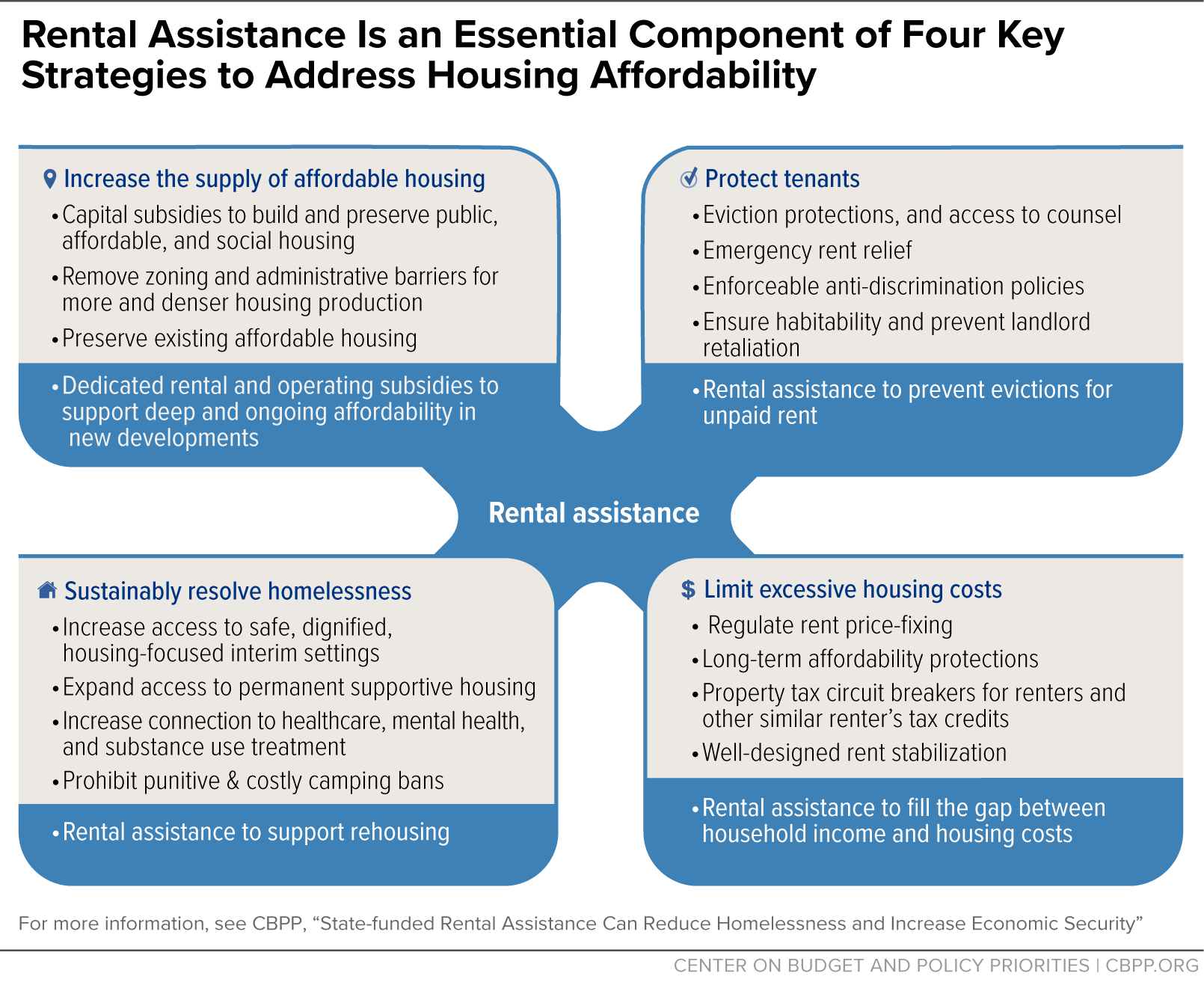
State policymakers should prioritize rental assistance investments, not only to protect current recipients and but also to expand access to more households. Investing in these programs strengthens communities and yields long-term benefits, including preventing eviction and solving homelessness. It is also a prudent investment: preventing eviction and solving homelessness can reduce costs for other public systems, like reducing stays in jails and prisons, emergency room and hospital stays, and foster care, in the short and long run.[11]
The policy choice to underfund and erect policy barriers to federal rental assistance also has created real challenges for households who try to access assistance. Barriers include yearslong waitlists,[12] administrative burdens,[13] and limitations on choice and access due to discrimination and lack of affordable and available housing options.[14] State policymakers can design rental assistance to build on the successes and address some of the shortcomings of federal rental assistance programs so that they work better for people and communities.
Rental Assistance Is Critical to Ensuring New Housing Supply Is Accessible to People With the Lowest Incomes
In the past several years, state policymakers across the political spectrum have prioritized policies aimed at increasing housing supply, and particularly affordable housing supply. Evidence supports the idea that increases in housing supply can limit rent growth or even result in marginal decreases in rent at the regional level.[15] However, even if housing production significantly increases in coming years and does lead to incremental reductions in average housing costs over the coming years and decades, most of that housing will likely still be priced too high for the over 11 million people with extremely low incomes[16] absent additional income support or deeper housing subsidies.[17] As such, both project-based and tenant-based rental subsidies play a critical role in helping people with extremely low incomes, who experience the most concentrated rates of housing hardship, to afford housing and benefit from expanded housing supply.
For example, consider the average household with an extremely low income. Their annual household income was just $12,781 in 2023.[18] (Many households, including those most at risk of homelessness, have even lower incomes.) For housing to be considered affordable for this household using the 30 percent standard cited above, their rent could not exceed $286 a month. But in that same year, the median rent was nearly five times higher, at $1,410.[19] While increasing housing supply could marginally decrease the median rent, there would still be a significant gap before the unit becomes affordable. In fact, that same average rental unit’s baseline operating cost — meaning just the price to pay for property taxes, insurance, utilities, maintenance, and administrative costs without any financing costs or profit to the landlord — was $662 a month, according to an industry survey.[20] This is a form of market failure. Because the housing market is unable to deliver housing that is affordable to the average extremely low-income household, public intervention is necessary to ensure everyone can access a home.
Rental Assistance Helps Units Built With Capital Subsidies Work for People With the Lowest Incomes
Many states are building more affordable housing by combining state money in the form of capital subsidies along with federal programs like the Low-Income Housing Tax Credit (LIHTC), to lower construction costs so rents can be more affordable for tenants. Rental assistance ensures that households with the lowest incomes can afford to live in units produced with these subsidies, which the capital subsidies generally cannot do alone. For example, based on available data, 77 percent of extremely low-income households who live in LIHTC-assisted housing without an additional rental subsidy are cost burdened, paying over 30 percent of their income in rent. Overall, only about 3 percent of LIHTC units are rented at a price that would be affordable to an extremely low-income household that doesn’t have rental assistance.[21] Increasing access to rental assistance makes that housing accessible.
Project-based rental assistance can be combined with newly built or renovated affordable housing to lower the rent even more, making it affordable for people with extremely low incomes — or even no income at all. Furthermore, project-based rental assistance creates a source of stable operating revenue for a development to pay for ongoing operating costs and services, an integral component in the complex financing package that makes constructing or rehabilitating affordable housing possible. In addition, many households use tenant-based rental assistance to help them rent units in developments built with capital subsidies, and owners of properties built with most types of federal capital subsidies are prohibited from discriminating against prospective tenants because they have a voucher or other rental subsidy.
Investments in ongoing rental and operating subsidies also support the potential to expand the model of social housing, which can be either public, nonprofit, or community-owned housing that is deeply and permanently affordable and where tenants have some democratic control over the community where they live.[22]
Rental Assistance Makes the Existing Housing Stock More Affordable
Finally, rental assistance may also be a more cost-effective approach to quickly and stably house people by making more of the existing housing stock affordable to people with low incomes. At present, most people with extremely low incomes have a place to live but may be one financial emergency away from eviction or even homelessness. These families could experience greater housing and economic stability in their current homes and potentially avoid eviction if a rental subsidy brought rent within a level they could afford. Tenant-based rental assistance also ensures steady rental revenue for landlords, especially small landlords who may have narrow margins to operate rental housing. While both are worthwhile investments, research estimates that, overall, vouchers are more cost effective than capital subsidy programs like LIHTC.[23]
Tenant-based rental assistance also gives households more choice in where they can live, giving them an opportunity to access high resource communities or be closer to their jobs or family when the cost of housing might otherwise be prohibitive.[24]
Rental Assistance Pairs With Sensible Tenant Protections
Rental assistance programs are also more effective alongside policies to prevent widespread discrimination in the housing market, particularly to ban discrimination based on “source of income,” meaning receipt of rental assistance or other public benefits. Twenty-two states and D.C. and over 140 localities have protections to prevent discrimination based on source of income,[25] which are associated with a higher “success rate” — the percent of households with access to a rental subsidy that are able to secure a lease.[26] Low-income households may also face discrimination based on factors like credit history, criminal or eviction legal history, all of which disproportionately harm people of color who face systemic discrimination in legal systems and the lending market. State and local policymakers should pass policies with enforcement mechanisms to prevent discrimination and reverse segregationist and exclusionary housing policies so that everyone can access housing and everyone with rental assistance can use it quickly and easily.
Both short- and long-term rental assistance can play a critical role in preventing evictions alongside strong legal protections for tenants, such as “good cause” eviction standards, which prohibit evictions for reasons that are no fault of the renter. While legal protections play an important role in regulating unjust landlord practices, even the strongest eviction protections generally do not prevent the primary cause of most evictions: non-payment of rent.[27] Given both the prevalence of anti-Black discrimination in the housing market as well as the extent of housing cost burden among low-income Black renters, Black people — and Black women in particular — are at higher risk for evictions and experience eviction at higher rates than other demographic groups. Nationwide, Black women make up only 10 percent of renters, but experience 29 percent of eviction filings and 24 percent of evictions.[28] However, numerous studies show that both one-time emergency rent relief and longer-term rental assistance can prevent evictions[29] and, in turn, address some of the downstream effects of racial inequity in housing and economic outcomes and prevent the harms of evictions.
Rental Assistance Is a Necessary Component of State Efforts to Solve Homelessness
Long-term rental assistance, especially when paired with supportive services, is a powerful tool for rehousing people experiencing homelessness.[30] However, less than 1 in 4 eligible people can access federal rental assistance due to underfunding, and most people must wait months or even years on a waitlist to receive any housing assistance. Data show that most people experiencing homelessness have extremely low incomes and would be unlikely to afford housing without some kind of assistance. For example, a recent statewide survey of people experiencing homelessness in California found that in the 12 months prior to becoming homeless, their median income was only $960 per month.[31]
Rental assistance supports those who due to structural marginalization are more likely to be harmed by homelessness. For example, people with disabilities and older adults are overrepresented among people experiencing homelessness because many have extremely low or fixed incomes with benefits set at levels that are insufficient to afford housing absent additional assistance. Black and Indigenous people are also disproportionately likely to experience homelessness and have lower rates of exit to permanent housing due to long-standing income and wealth inequities stemming from structural racism in housing, education, and employment. As such, state-funded rental assistance can prevent people from losing their housing in the first place and help rehouse those experiencing homelessness.
In addition to funding rental assistance, policymakers must seek to ensure that everyone, including people with the lowest incomes and people experiencing homelessness, can readily access services that support housing stability. These include housing navigation, case management, and comprehensive community-based physical and mental health care, substance use services, and long-term care.[32]
Rental Assistance Investments Complement Policies to Contain Housing Costs
While state and local policymakers should consider rental assistance a frontline strategy to address the affordable housing crisis, this should not be at the expense of efforts to contain housing costs. Well-designed rent stabilization policies have the potential to relieve housing cost burdens for people with moderate and lower incomes, protect against large and unexpected rent increases, and allow rents to increase with normal inflation and maintenance cost increases.[33] However, on their own, these policies are unlikely to make rents affordable to millions of people with extremely low or no incomes, who cannot afford rents to cover even the baseline costs of operating and maintaining housing.[34] Rent stabilization policies can also help contain the budget impact of rental assistance programs, which must increase to keep up with rent increases for the programs to be effective. Policies like rent stabilization are most effective at helping people with extremely low incomes when combined with other strategies, like rental assistance.
End Notes
[1] Will Fischer, “Chart Book: Federal Rental Assistance Reduces Hardship, Promotes Children’s Long Term Success,” CBPP, July 5, 2016, https://www.cbpp.org/research/chart-book-rental-assistance-reduces-hardship-promotes-childrens-long-term-success.
[2] Thyria A. Alvarez and Barry L. Steffen, “Worst Case Housing Needs: 2023 Report to Congress,” U.S. Department of Housing and Urban Development (HUD), September 21, 2023, https://www.huduser.gov/portal/publications/Worst-Case-Housing-Needs-2023-Executive-Summary.html.
[3]CBPP analysis of 2023 1-Year ACS data.
[4] Tanya de Sousa and Meghan Henry, “The 2024 Annual Homelessness Assessment Report (AHAR) to Congress: Part 1: Point-in-Time Estimates of Homelessness,” HUD, December 2024, https://www.huduser.gov/portal/sites/default/files/pdf/2024-AHAR-Part-1.pdf.
[5] Anna Bailey, “Policymakers Can Solve Homelessness by Scaling Up Proven Solutions: Rental Assistance and Supportive Services,” June 12, 2024, https://www.cbpp.org/research/housing/policymakers-can-solve-homelessness-by-scaling-up-proven-solutions-rental; Alicia Mazzara, “Expanding Housing Vouchers Would Cut Poverty and Reduce Racial Disparities,” CBPP, May 11, 2021, https://www.cbpp.org/blog/expanding-housing-vouchers-would-cut-poverty-and-reduce-racial-disparities.
[6] CBPP, “Federal Rental Assistance Fact Sheets,” January 23, 2025, https://www.cbpp.org/research/housing/federal-rental-assistance-fact-sheets#US.
[7] Sonya Acosta, “Three Principles for a Rental Assistance Guarantee,” CBPP, October 2, 2024, https://www.cbpp.org/research/housing/three-principles-for-a-rental-assistance-guarantee.
[8] Anna Bailey, “Rising Homelessness Highlights Need to Invest in Proven Solutions, Reject Policies That Worsen Homelessness and Housing Instability,” CBPP, January 7, 2025, https://www.cbpp.org/blog/rising-homelessness-highlights-need-to-invest-in-proven-solutions-reject-policies-that-worsen.
[9] Mari Castaldi and Urvi Patel, “States Should Fund Rental Assistance as a Frontline Strategy to Address the Housing Affordability Crisis,” CBPP, August 6, 2025, https://www.cbpp.org/research/housing/states-should-fund-rental-assistance-as-a-frontline-strategy-to-address-the.
[10] Mari Castaldi, “Taxing Very High-Value Home Sales Is an Equitable and Effective Strategy to Raise Revenue and Fund Affordable Housing,” CBPP, July 19, 2024, https://www.cbpp.org/research/housing/taxing-very-high-value-home-sales-is-an-equitable-and-effective-strategy-to-raise.
[11] Hannah Chimowitz and Adam Ruege, “The Costs and Harms of Homelessness,” Community Solutions, September 25, 2023, https://community.solutions/research-posts/the-costs-and-harms-of-homelessness/.
[12] Sonya Acosta and Brianna Guerrero, “Long Waitlists for Housing Vouchers Show Unmet Need for Assistance,” CBPP, October 6, 2021, https://www.cbpp.org/research/housing/long-waitlists-for-housing-vouchers-show-pressing-unmet-need-for-assistance.
[13] Will Fischer, “Making Rental Assistance Work Better for People Struggling to Afford Housing,” CBPP, April 11, 2024, https://www.cbpp.org/blog/making-rental-assistance-work-better-for-people-struggling-to-afford-housing.
[14] Erik Gartland, “New Report Finds Untapped Potential in U.S. Rental Assistance Landscape,” CBPP, March 5, 2025, https://www.cbpp.org/blog/new-report-finds-untapped-potential-in-us-rental-assistance-landscape.
[15] Vicki Been, Ingrid Gould Ellen, and Katherine M. O’Regan, “Supply Skepticism Revisited,” NYU School of Law, No. 24-12, Housing Policy Debate, Vol. 35, Issue 1, November 13, 2023, https://papers.ssrn.com/sol3/papers.cfm?abstract_id=4629628.
[16] More than 11 million renter households had “extremely low incomes” in 2023, which HUD defines as below the federal poverty line or 30 percent of the local median income, whichever is higher . Past and present structural racism perpetuated through discriminatory housing, education, and employment policies have also resulted in disproportionate representation of Black, Indigenous, and Latine households among renters and people with the lowest incomes.
[17] Been et al.
[18] CBPP analysis of 2023 1-year ACS data.
[19] CBPP, “Federal Rental Assistance Fact Sheets,” January 23, 2025, https://www.cbpp.org/research/housing/federal-rental-assistance-fact-sheets#US.
[20]Institute of Real Estate Management, Building Owners and Managers Association, and National Apartment Association, “Income Expense IQ: 2023,” accessed February 2025.
[21] Dan Emmanuel and Andrew Aurand, “The Role of Vouchers in the Low Income Housing Tax Credit Program,” Cityscape, Vol. 26, No. 2, 2024, https://www.huduser.gov/portal/periodicals/cityscape/vol26num2/article11.html.
[22] “Building Our Future: Grassroots Reflections on Social Housing,” Housing Now!, 2024, https://www.housingnowca.org/buildingourfuture.
[23] Lan Deng, “The cost‐effectiveness of the low‐income housing tax credit relative to vouchers: Evidence from six metropolitan areas,” Housing Policy Debate, Vol. 16, Nos.3-4, 2005, https://doi.org/10.1080/10511482.2005.9521553. Notably, the cost effectiveness of vouchers compared to LIHTC differed across geographic areas; in high-cost areas, the difference was much smaller due to high market rents.
[24] Erik Gartland et al., “Where People With Rental Assistance Live: More Can Be Done to Promote Neighborhood Choice,” CBPP, March 5, 2025, https://www.cbpp.org/research/housing/where-households-using-federal-rental-assistance-live.
[25] Poverty & Race Research Action Council, “Appendix B: State, Local, and Federal Laws Barring Source-of-Income Discrimination,” updated January 2025, https://www.prrac.org/pdf/AppendixB.pdf.
[26] Ingrid Gould Ellen, Katherine O’Regan, and Sarah Strochak, “Race, Space, and Take Up: Explaining housing voucher lease-up rates,” Journal of Housing Economics, Vol. 63, March 2024, https://doi.org/10.1016/j.jhe.2023.101980.
[27] Kyle Nelson et al., “Evictions: The Comparative Analysis Problem,” Housing Policy Debate, March 2021, https://doi.org/10.1080/10511482.2020.1867883.
[28] See Figure 2 in Nick Graetz et al., “A comprehensive demographic profile of the US evicted population,” Vol. 120, No. 41, Proceedings of the National Academy of Sciences, October 2023, https://www.pnas.org/doi/10.1073/pnas.2305860120.
[29] See Gregory Preston and Vincent J. Reina, “Sheltered From Eviction? A Framework for Understanding the Relationship Between Subsidized Housing Programs and Eviction,” Housing Policy Debate, Vol. 31, Nos. 3-5, April 2021, https://doi.org/10.1080/10511482.2021.1879202; Hye-Sung Han, “What explains variation in neighborhood evictions? Investigation of neighborhood characteristics and federal rental assistance: Case study of Kansas City, Missouri,” Journal of Urban Affairs, Vol. 47, No. 3, May 2023, https://doi.org/10.1080/07352166.2023.2198131; Mason Alexander, Matthew Freedman, and Stephanie Casey Pierce, “Can rapid rental assistance avert evictions?” APPAM Fall Research Conference, September 2024, https://appam.confex.com/appam/2024/meetingapp.cgi/Paper/53753; Peter Hepburn et al., “Protecting the Most Vulnerable: Policy Response and Eviction Filing Patterns During the COVID-19 Pandemic,” The Russell Sage Foundation Journal of the Social Sciences, Vol. 9, No. 3, May 2023, https://doi.org/10.7758/RSF.2023.9.3.08; Rebecca Schapiro et al., “The Effects of Rental Assistance on Housing Stability, Quality, Autonomy, and Affordability,” Housing Policy Debate, Vol. 32, No. 3, January 2021, https://doi.org/10.1080/10511482.2020.1846067.
[30] Anna Bailey, 2025.
[31] Margot Kushel and Tiana Moore et al., “Toward a New Understanding: The California Statewide Study of People Experiencing Homelessness,” UCSF Benioff Homelessness and Housing Initiative, 2023, https://homelessness.ucsf.edu/sites/default/files/2023-06/CASPEH_Report_62023.pdf.
[32] Anna Bailey, 2024.
[33] Manuel Pastor, Vanessa Carter, and Maya Abood, “Rent Matters: What Are the Impact of Rent Stabilization Measures?” USC Dornsife Program for Environmental and Regional Equity, October 2018, https://dornsife.usc.edu/eri/publications/rent-matters/.
[34] Peggy Bailey, “Examining Proposals to Address Housing Affordability, Availability, and Other Community Needs,” CBPP, March 12, 2024, https://www.cbpp.org/research/housing/examining-proposals-to-address-housing-affordability-availability-and-other.