MÁS ALLÁ DE LOS NÚMEROS
State and Local Policymakers Should Invest in State-Funded Rental Assistance to Solve the Affordable Housing Crisis
Everyone needs and should have a place they can call home. Yet housing is unaffordable for more people than ever in the United States, including most low-income renters. For people with the lowest incomes, high housing costs stretch budgets for families already struggling to afford the basics, forcing them to choose between paying for housing, food, health care, and saving for emergencies. The gap between housing costs and incomes also drives increasing rates of eviction and is a root cause of the nation’s homelessness crisis, which left at least 771,000 people without stable housing on a given night in 2024. Our two new papers highlight how numerous states are trying to address this problem even as the federal government takes us backwards.
Policymakers investing in rental assistance, which typically covers the gap between 30 percent of a household’s income and the actual cost of rent, is a good decision supported by evidence. A large body of research shows that access to stable housing can improve health, support child development, and advance long-term economic outcomes for people and families. Numerous studies show that robust, need-based rental assistance reduces poverty, homelessness, and housing instability, advances racial equity, and increases access to low-poverty, high-resource communities for those who might otherwise be priced out of them.
Unfortunately, the federal government is not investing in affordable housing solutions, like rental assistance, at levels high enough to meet the need. Federal rental assistance programs reach less than 1 in 4 people who are eligible. That leaves states and localities to attempt to fill in the gaps as they seek to reduce the far-reaching hardships families can face when they can’t pay the rent. State and local policymakers are increasingly realizing that underinvestment in public and affordable housing is a policy choice and can be solved through equitable and effective housing policies and public investments.
The pressure on states and localities is even higher as the Trump Administration and Republican members of Congress make decisions that could result in reductions in available rental assistance, higher household costs, including higher rents, and huge state budget pressures due to changes in Medicaid and the Supplemental Nutrition Assistance Program (SNAP) recently passed into law.
Many state and local governments are leaning in to be a part of the solution and serve as examples to their federal colleagues. In fact, at least 35 states, as well as numerous local governments, already fund and operate their own smaller rental assistance programs, often alongside programs aimed at addressing housing affordability (see map).
Connecticut, Massachusetts, Minnesota, and New Jersey operate state-funded rental assistance programs that provide ongoing housing assistance to people with low incomes, similar to the federal Housing Choice Voucher program. Washington, D.C. also operates such programs. In just the past few years, several states — including Maine, Maryland, Massachusetts, Minnesota, New York, and Oregon — have funded new state rental assistance programs or expanded existing ones. Our recent paper explores the landscape of these state programs and includes insights to help policymakers improve and expand those critical investments.

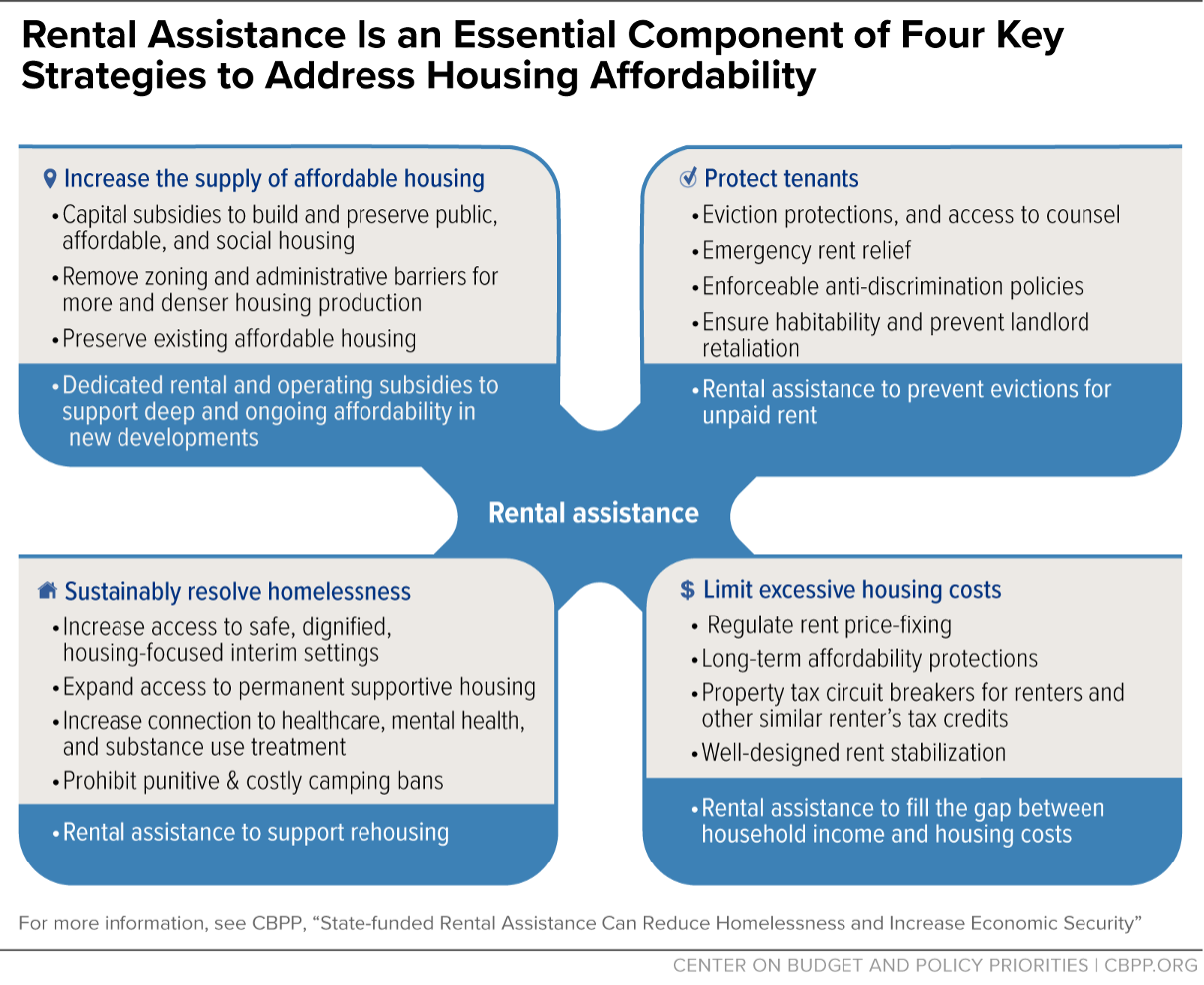
Rental assistance is a proven tool to make housing more affordable for people with the lowest incomes. That said, there is no single “silver bullet” to address the housing affordability crisis — policymakers must simultaneously pursue policies across four key strategies: increasing the supply of affordable housing, limiting excessive housing costs, protecting tenants, and sustainably resolving homelessness. Our companion paper describes the role that rental assistance can play in advancing solutions across all these categories, while addressing systemic racial disparities in housing and economic outcomes. In fact, without increasing access to and funding for rental assistance, other affordable housing policies may fall short of their full potential (see chart).
Even amid challenging state budget environments and in the face of harmful federal funding cuts and policies, states can and must fund cost-effective, evidence-based policy strategies like rental and operating subsidies and protect their existing critical investments in housing and other basic needs. States can explore new sources of revenue, like progressive real estate transfer taxes among other options, to sustainably fund new housing investments.