

Toward Fairer, More Equitable Property Taxes
Targeted Reforms Are the Best Way to Promote Property Tax Equity Without Harming Local Services
Local public services are cornerstones of our communities, ensuring that our children are educated, our communities are safe and healthy, and public spaces like parks and libraries can be enjoyed by all. Unfortunately, local governments’ ability to provide these services is under threat as state legislators across the country have called for inequitable and costly across-the-board property tax cuts under the guise of addressing housing affordability. Most of the proposals this year have failed to benefit those most impacted by affordability — low-income homeowners and renters — while restricting the ability of local officials to raise the revenue they need to support their communities.
States can ensure property taxes are not overwhelming residents without threatening funding for local services by providing targeted, income-based assistance to support families struggling to keep up with higher property taxes. States can also provide stability and increase equity by enhancing local governments’ capacity to conduct regular, unbiased property assessments. Above all, legislators should pursue targeted, cost-effective solutions that maintain or even improve local governments’ response to the rising costs of providing public services, not policies that leave our cities and schools struggling to keep up.
To better balance residents’ affordability needs with local governments’ revenue needs, states should:
Tie property taxes to people’s ability to pay by creating or expanding refundable circuit breaker tax credits and providing them to renters. Circuit breaker credits prevent property taxes from overwhelming people’s budgets by capping property tax bills at a percentage of household income. Because circuit breakers are tied to income, they best reach households whose property tax bills are unaffordable. Across-the-board measures (like rate cuts, assessment caps, or limits to local governments’ ability to raise revenue) mainly benefit wealthy property owners and provide little assistance to those most impacted by high property tax bills. Instead, circuit breakers make each recipient’s tax bill more affordable based on their income.
Circuit breakers should include renters, who pay property taxes as part of their rent. Renters have lower incomes than homeowners on average and are typically left out of most property tax exemptions, such as homestead exemptions or credits available to homeowners. To address this inequity, Maine’s circuit breaker — the Property Tax Fairness Credit — is available to renters and assumes that their “property tax paid” is equal to 25 percent of their gross rent. (Maine’s circuit breaker is also available to people who don’t file income taxes, which helps the credit reach people living on fixed or very low incomes).
- Provide stability to people living on fixed incomes through deferral programs. If states are looking for lower-cost options that assist people most impacted by rising property taxes, they should consider creating or expanding property tax deferral programs. These programs allow people on fixed incomes (such as retirees or people with disabilities) to delay paying their property taxes until they sell their home, when they will have much more cash on hand to pay the bill. Because this policy delays rather than reduces payment, property tax deferral prevents an overall funding decrease for local governments while keeping property taxes affordable for people with low incomes.
Invest in administrative changes to make property assessments fairer and more routine. More frequent, less-biased assessments would make property tax bills less volatile and easier for households to manage. Properties sometimes go years or even decades without being physically reassessed, and sudden increases can be challenging for people with limited income to meet. Ideally, reassessments should occur annually to provide maximum predictability and stability.
States have an important role in improving local governments’ assessment practices. They can invest in better software and data analysis capacity to share with local assessors’ offices. Standardizing and automating reassessments would also make the process fairer. Across the country, lower-value homes are frequently overvalued for property tax purposes, whereas higher-value homes are undervalued. Making reassessment processes more standard and less vulnerable to human error (unintentional or intentional) would result in fairer, more accurate tax bills for property owners. Cook County, Illinois, and Maricopa County, Arizona, for instance, have both adopted better appraisal software that has allowed for more frequent and fairer assessments.
Property taxes are vital for funding local investments. Through targeted changes, state lawmakers can address the impact of property taxes on low- and moderate-income homeowners and renters while ensuring robust funding for schools, public safety, and local infrastructure.
Our tax code works best when it adequately funds the public services that make our society better without putting financial strain on people already struggling to get by. Yet many state legislators across the country are pursuing inequitable property tax cuts that would undermine local governments and benefit wealthy residents over renters, who are more likely to struggle with housing affordability.
Lawmakers in some states including Ohio, South Dakota, and Wyoming, are considering “tax swaps,” cutting property taxes and replacing the forgone revenue with higher sales taxes, either by increasing the sales tax rate or by expanding the goods and services it applies to.
State politicians claim shifting local funding away from property taxes and toward sales taxes is an effort to maintain funding for local services using what they see as a “fairer” tax, or at least a tax that would be easier for households to manage. This swap is ultimately a poor deal for most families, though, as sales taxes are more volatile and take up a greater share of income for people with low earnings.
The kinds of services that property taxes fund, like public education and public safety, require a funding source that is stable regardless of economic conditions. Property taxes are uniquely suited to this task as they remain the most stable of the three major taxes (income, sales, and property) even in the face of economic downturns. Tying local services to property taxes means that the schools we send our children to, the roads we drive on, and the programs that keep our communities safe and healthy will be less vulnerable when recessions strike.
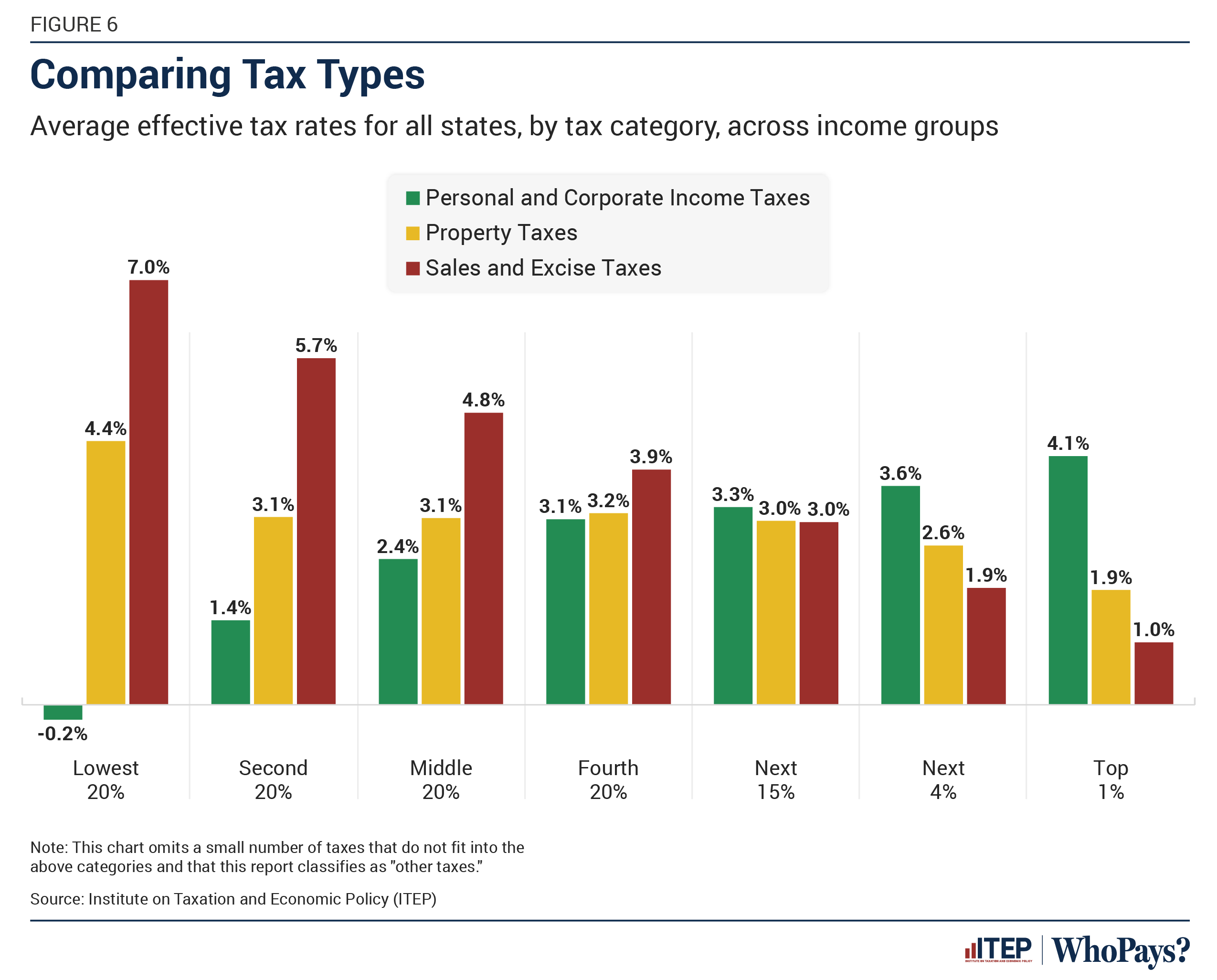
Property taxes also take less of a toll than sales taxes on people who are already struggling to get by. While there is still more to be done to make property taxes fairer, they remain less regressive than sales taxes, which require a greater share of income from people with less financial means and a lower share from people who are well off. Sales taxes also coexist alongside other regressive revenue sources like fines and fees, making local services even more expensive for those with the least ability to pay. Swapping property taxes out for sales taxes would make state and local taxes even more rigged in favor of the wealthy.
Proposals to substitute sales tax revenue for property tax revenue also ignore an important fact: most people already pay more in sales tax than they do in property tax. Nationally, the middle 20 percent of income earners pay 4.8 percent of their income in sales and excise taxes on average, compared to only 3.1 percent of their income in property taxes. This difference is even starker for people with low income, with the bottom 20 percent by income paying 7 percent of their income in sales and excise taxes, compared to 4.4 percent in property taxes.
People are often unaware of this because sales taxes are typically paid in dollars or even cents at a time, with no total invoice for the year. Property taxes, by contrast, are either paid monthly (for people with mortgages) or in lump sums, which are much more visible and less predictable. When you add up the total amount most people pay in a year, though, sales taxes clearly come out ahead.

The disparity between what most people pay in sales taxes compared to property taxes isn’t particularly small, either. In 39 of the 45 states (plus Washington, D.C.) that have statewide sales taxes, the bottom 60 percent of households pay more in sales taxes than property taxes. In at least five states, the bottom 80 percent of households pay at least triple in sales tax what they pay in property tax.
States relying more on regressive sales taxes rather than more equitable options like property or income taxes is no accident. In fact, white lawmakers in Jim Crow Mississippi created the first modern retail sales tax in an explicit attempt to shift taxes away from wealthy white property owners and onto Black families, who owned less property and had few other assets to tax. In Alabama, the 140-year-old limit on local property taxes was created by white legislators post-Reconstruction to shield wealthy white property owners from any increases in property taxes should Black residents regain political power. Modern efforts to limit property taxes and shift the funding of public goods onto people with low incomes are less explicitly racist, but they still carry on an ugly history of tax policy intended to advance white supremacy.
There are better ways lawmakers can make property taxes fairer, particularly for those living on low or fixed incomes. By creating or expanding circuit breaker programs, legislators can better tie property taxes to people’s ability to pay. States can also allow or promote property tax deferrals for people on fixed incomes, allowing them to pay the property taxes on their homes only when those homes are sold, which is when taxpayers will be most able to afford them. Through these and other administrative fixes, state legislators can make property taxes fairer for their constituents without deepening their states’ reliance on regressive sales taxes.
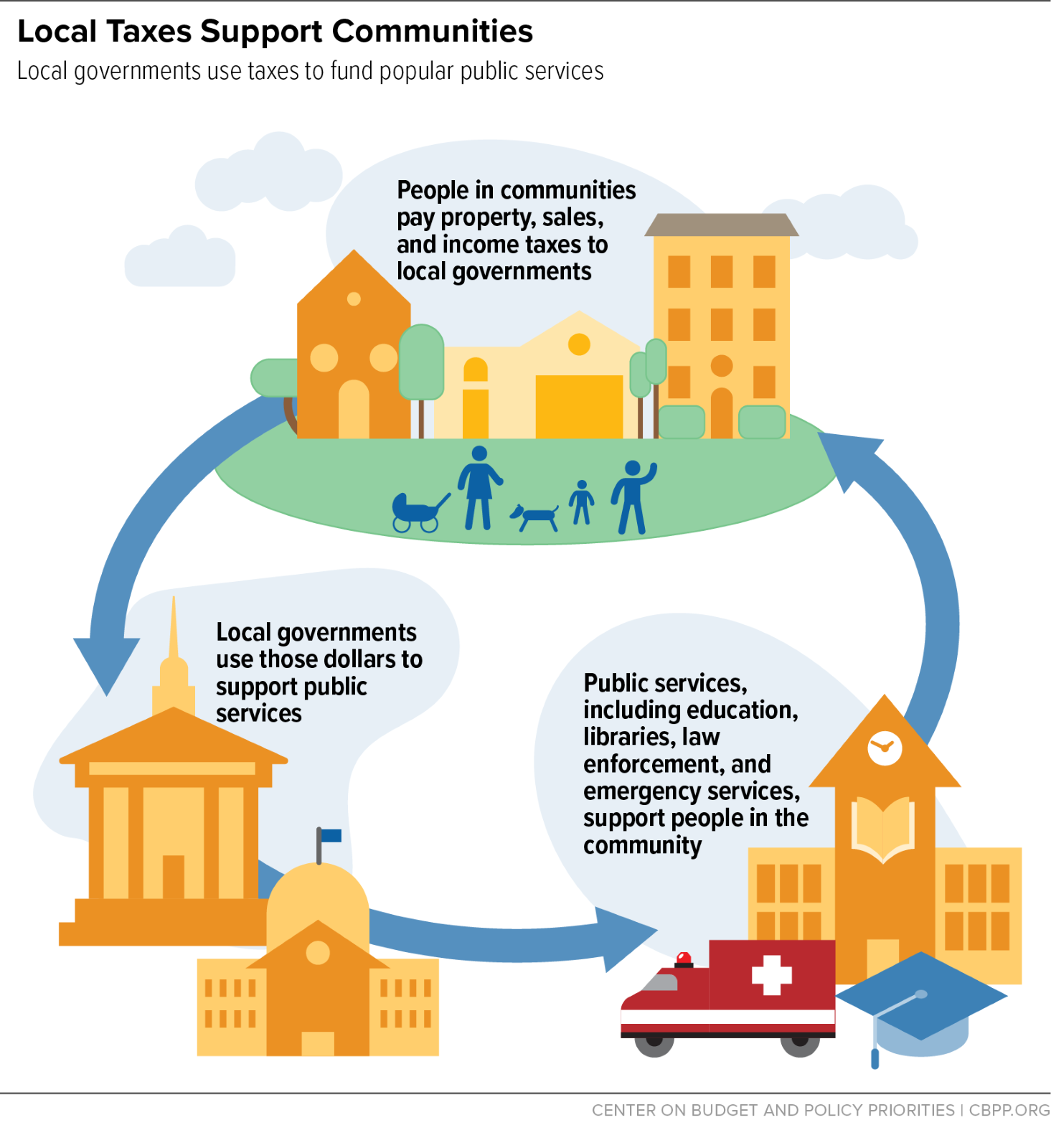
Public services, like properly maintained sidewalks, well-resourced public schools, and responsive emergency services are critical to the well-being of our communities. But these services share something else in common: they are funded and administered primarily at the local level. Local governments provide nearly half of K-12 public education funding, roughly 9 in 10 dollars spent on policing, and a majority of funding for libraries and emergency medical services. Funding for local governments, in turn, relies heavily on property taxes, which are the primary revenue source for over 90 percent of local governments and account for nearly three-quarters of local government tax revenue nationwide.
But this critical source of revenue is under threat as state legislatures across the country restrict the ability of local officials to raise the revenue they need to support their communities. Legislators in at least 23 states have introduced bills this year that would cut or limit property taxes in some way.
Some of these proposals, particularly those that create or expand property tax “circuit breakers,” would reform property taxes in equitable, fiscally responsible ways. But many others would enact across-the-board cuts or limits that would fail to meaningfully assist households with low incomes or address housing affordability, threaten the fiscal stability of local governments, and make states’ tax codes even more regressive. In some states (including Florida, Indiana, Kansas, Missouri, Nebraska, North Dakota, Oklahoma, Pennsylvania, and Texas), legislators or governors have even considered eliminating some or all property taxes in their states outright, which would have devastating impacts on local communities.


These cuts and limits, proposed and enacted at the state level but targeted at the local level, come in the context of a decades-long decline in state and federal support for local governments. They also occur alongside deep, state-enacted cuts to personal and corporate income taxes, costly private school voucher programs that threaten to defund public schools, and incoming federal budget cuts that will shift the cost of paying for health care, food assistance, education, and other investments further onto state and local governments.
Local governments are experiencing fiscal crises of their own, grappling with significantly higher costs in health care, pensions, construction, and infrastructure improvements related to climate change. Faced with higher costs and reduced support from state and federal governments, local administrators have little choice but to turn to property taxes to meet their communities’ needs.
While the property tax has many advantages relative to other types of taxes — it is more stable, transparent, and difficult to avoid than sales or income taxes — it has its flaws, many of which fall most harshly on people of color and people with low incomes. Among these flaws is that property taxes are regressive, meaning they require a greater percentage of income from people with less ability to pay. Unexpected increases in property tax bills can be unaffordable for people with low or fixed incomes (such as retirees or some people with disabilities) and can force long-time residents out of rapidly gentrifying areas.
Unexpected and sometimes dramatic property tax increases have become more common since the beginning of the COVID-19 pandemic as home prices have skyrocketed and commercial property values have declined in many major cities, leaving homeowners and renters on the hook for a greater share of property tax revenue. This is why policies that tie property taxes to people’s ability to pay them, like circuit breaker credits, are critical for ensuring that nobody is forced out of their home due to their property tax bill.
Property taxes also play a role in worsening racial and economic inequality. Studies have shown that homes owned by Black and Latino households are routinely overvalued for property tax purposes, meaning they face higher tax bills than similarly situated white homeowners. Property assessments across the country have also been shown to be regressive on average, meaning that higher value homes are likely to be under assessed for property tax purposes while lower value homes are likely to be over assessed. This pattern of biased assessments makes property taxes less affordable for homeowners with low incomes and allows wealthier homeowners to avoid paying their fair share to support local services.
All of these factors mean that for many people, especially people of color, property tax assessments can be outright predatory. Investing in computer-assisted assessment technology can reduce this bias and better ensure that assessments fairly reflect the value of the properties to which they apply. But the vast majority of the property tax proposals do not address these flaws and could instead deepen the inequity of state tax codes and jeopardize funding that enables people to stay safely housed.
To address affordability issues for people struggling to pay their property tax bills, state lawmakers should create or expand circuit breakers, which tie property taxes to people’s ability to pay, rather than pushing deep and broad-based property tax cuts. Legislators can also standardize property assessment practices to reduce volatility alongside racial and economic bias. Finally, states can reverse course on the deeply harmful cuts to their income taxes, freeing up more revenue that can then support local communities. Through equity-oriented, fiscally responsible policies, legislators can make property taxes fairer and more affordable without harming the local services people rely on and enjoy.