BEYOND THE NUMBERS
In Case You Missed It...
This week at CBPP, we focused on food assistance, health, the federal budget and taxes, immigration, housing, Social Security, state budgets and taxes, and the economy.
- On food assistance, Joseph Llobrera and Catlin Nchako detailed how the Senate Agriculture Committee’s revised work requirement would put more than 5 million people at risk of losing SNAP food assistance. Katie Bergh explained that changes to the Senate Agriculture Committee’s proposal to require states to pay a share of SNAP food benefits do not undo the harm that this provision would cause for low-income households and state budgets.
- On food assistance and health, we posted a new paper and interactive resource from Jennifer Wagner, Elisabet Eppes, Catlin Nchako, Maani Stewart, Luis Nuñez, Rachel Cahill, Symonne Singleton, Emmie DiCicco, and Joseph Llobrera that explores how states can improve access to SNAP, Medicaid, WIC, and TANF.
- On health, Gbenga Ajilore and Allison Orris, respectively, examined why the potential implementation of a rural hospital fund is not a viable substitute for protecting Medicaid, the proven key to rural hospital stability and keeping people insured. Gideon Lukens examined why the Senate should reject the House-backed health savings account provisions which would cost taxpayers $44 billion and overwhelmingly benefit the wealthy. Jennifer Wagner explained why technology won’t protect Medicaid enrollees subject to Medicaid work requirements. Claire Heyison described the Congressional Budget Office’s findings that that the House-passed reconciliation bill would result in massive coverage loss.
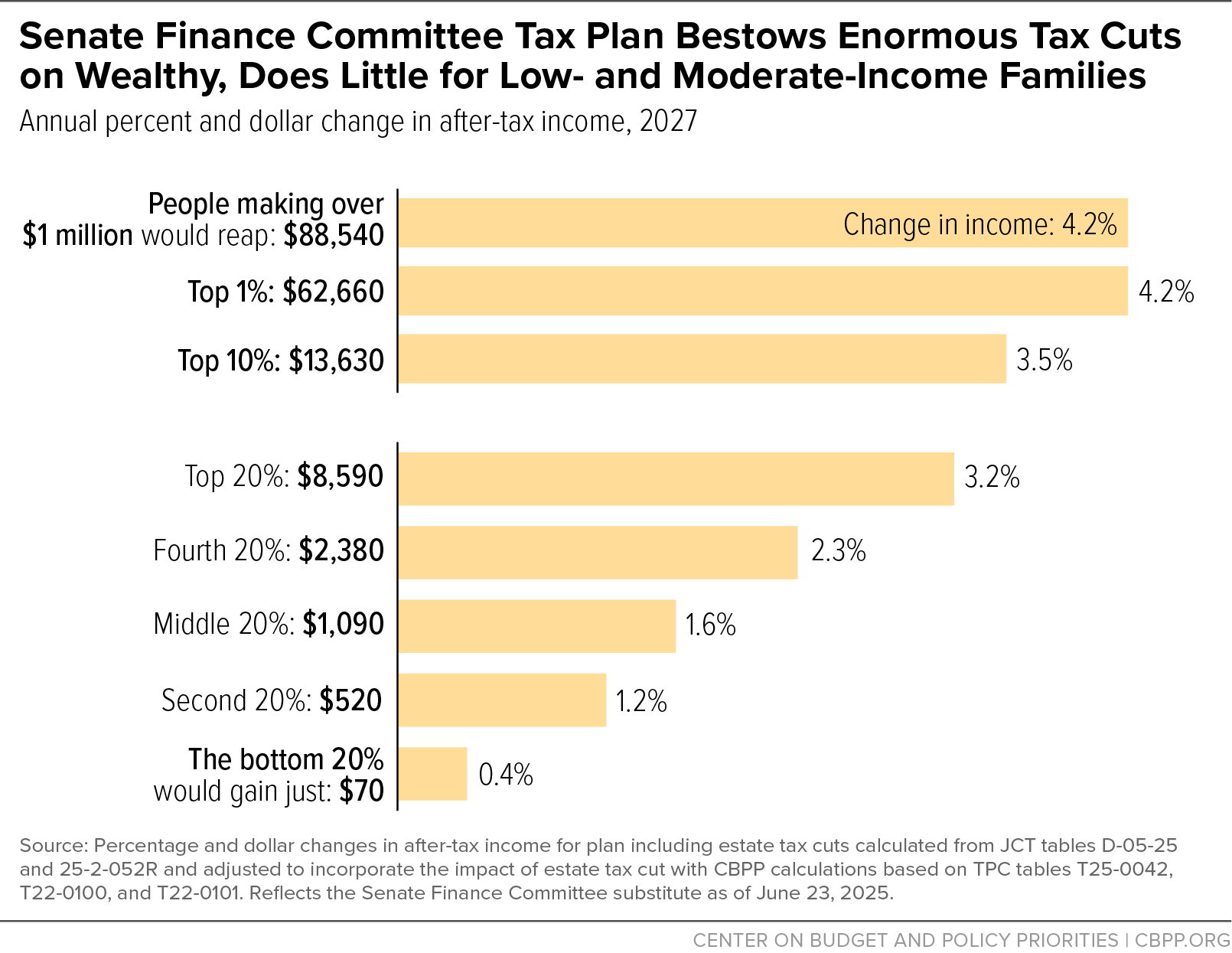
- On the federal budget and taxes, Brendan Duke and Sonali Master highlighted a new analysis that confirms that Senate Republican leadership’s tax provisions heavily benefit the wealthy, leaving behind low- and moderate-income families. We updated our by-the-numbers analysis of Senate Republican leaders’ tax agenda.
- On immigration, Shelby Gonzales and Elizabeth Lower-Basch highlighted how a revised provision in Senate Republican leaders’ budget plan maintains a directive to take away food assistance through SNAP for those granted humanitarian protections. Gonzales also noted that many people living in the U.S. lawfully remain targets for harsh health care cuts in the Senate reconciliation plan, and that states that have expanded Medicaid under the Affordable Care Act will be hard hit by anti-immigrant health provisions in the Senate plan.
- On housing, Sonya Acosta and Mohammed Akel noted that unless Congress funds emergency housing vouchers, close to 60,000 people are at risk of losing rental assistance and could face homelessness.
- On Social Security, Kathleen Romig and Devin O’Connor highlighted how the Trump Administration’s radical transformation of the Social Security Administration threatens to disrupt services for largely older and severely disabled people.
- On state budget and taxes, Joanna LeFebvre examined how Idaho lawmakers have ended a widely used public school grant program while directing $50 million into private school vouchers, which have little oversight. Wesley Tharpe analyzed the states’ fiscal conditions and how potential federal spending cuts would exacerbate the financial pressures currently faced by many states. Anna Phillips identified how lawmakers in states like Ohio, South Dakota, and Wyoming are considering trading out property taxes for sales taxes, which would benefit the wealthy while weakening local services.
On the economy, we updated our backgrounder on how many weeks of unemployment insurance are available per state.

The Center was active on social media this week. Here are some of our posts:
Joanna LeFebvre posted a thread on X and Bluesky examining the harm of the national school voucher proposal in the Senate Republican leadership’s reconciliation plan.
Katie Bergh posted a thread on X and Bluesky highlighting the details of the Senate Republican leaders’ revised plan that would cut SNAP for millions of low-income people.
Ty Jones posted a thread on X and Bluesky explaining that despite minor revisions, the Senate Republican leadership’s SNAP cost-sharing proposal continues to threaten food access during recessions by pushing unsustainable costs onto states.
A variety of news outlets featured CBPP’s work and experts this past week. Here are some of the highlights:
Medicaid cuts still in ‘big beautiful’ bill after parliamentarian ruling CNBC
June 27, 2025
The National Debt Is Already Causing Bigger Problems Than People Realize
New York Times Editorial Board
June 27, 2025
This key provision of Trump’s big bill violates Senate rules. Here’s what to know about provider taxes
PBS News
June 27, 2025
Too Sick To Work, Some Americans Worry Trump’s Bill Will Strip Their Health Insurance
KFF Health News
June 27, 2025
The child tax credit could be worth over $2,000 under Republicans’ spending plan—but millions of families wouldn’t benefit
CNBC
June 26, 2025
GOP mega-bill stuck in US Senate as disputes grow over hospitals and more
News From the States
June 26, 2025
How Awful Is the Republican Megabill? Here Are Four of the Worst Parts.
The New York Times
June 25, 2025
US State Budget Wounds Intensify From Trump, DOGE Policy Shifts Bloomberg
June 23, 2025
Don’t miss any of our posts, papers, or charts — follow us on Bluesky, Twitter, Facebook, Threads, and Instagram.
Authors