

With Stronger Income Support, Young Adults Shifted Focus From Work to School, Major Study Finds
A study in Texas and Illinois found that giving young adults in their 20s a sizable guaranteed income for three years increased the time they spent in education, job search, and other future-oriented activities. The rise in education is not visible in the report’s findings for all ages combined but only when looking more closely by age. Study participants in their 20s spent slightly less time at work (a little under two hours per week), but a majority of the reduced work time was offset by more time spent on education. No impact on employment was detected for study participants aged 30 to 40.
The study, known as the OpenResearch Unconditional income Study (ORUS), is the largest study of guaranteed income in the United States. Between 2020 and 2023, it gave $1,000 per month to one thousand randomly chosen 21- to 40-year-olds with household income no more than three times the poverty line, as well as $50 a month to a control group. In interviews, many participants told the researchers about how they were able to invest the additional income in themselves and their families.
Income Support Increased Time in Education for Participants in Their 20s
The report’s main findings do not show a rise in education when averaging across all ages 21 to 40. But a closer look suggests different impacts by age, which are obscured when age groups are combined.
Adults in their 20s who received the generous income supplement were 2 percentage points more likely to spend time pursuing education, compared to the control group. Counting non-workers in the average (as working zero hours), young adults in their 20s who received the $,1000 income guarantee worked an average of 1.84 fewer hours — about 1 hour and 50 minutes less — per week compared with their peers in the control group. More than half of that dip in work time, however, was offset by an average increase of 1.08 hours — an hour and five minutes — spent in higher education. (See figure.)

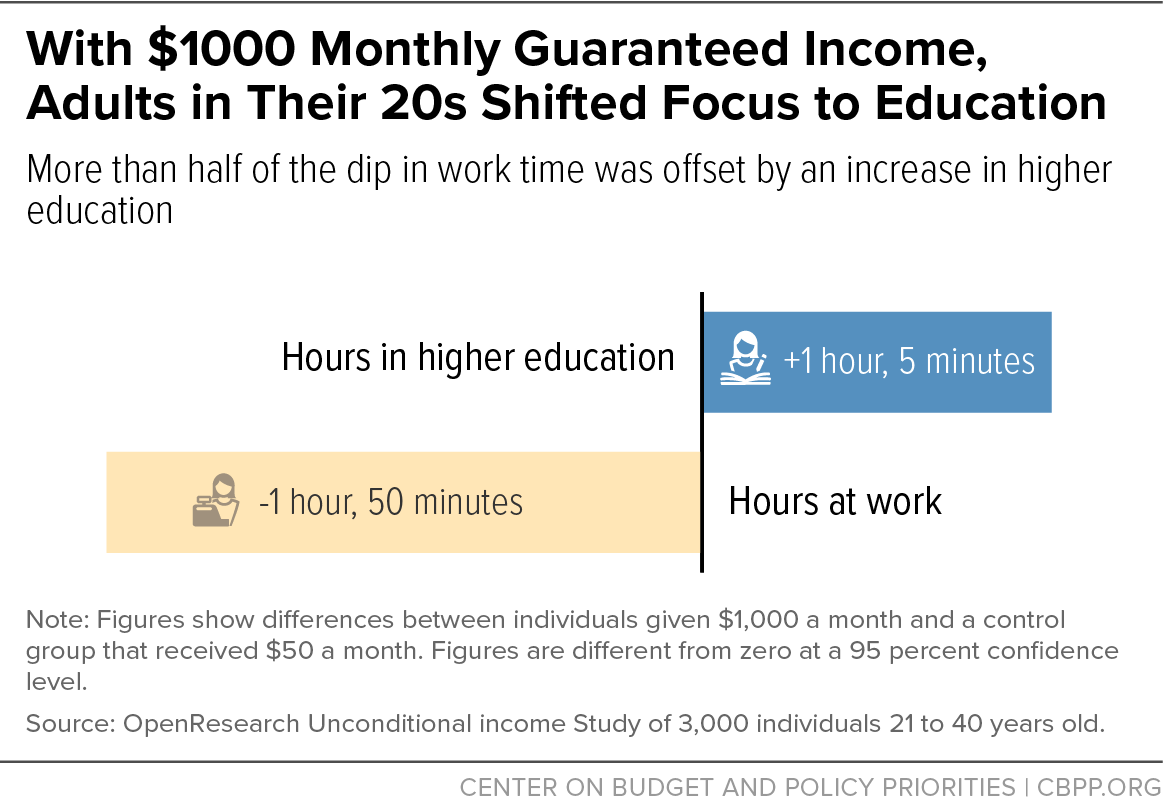
The findings don’t prove that those who worked less were the same people who spent more time on education, but they do suggest that, to a considerable degree, work and school impacts balanced out for this group.
Chelsea, a first-generation college student and a study participant, told researchers the guaranteed income allowed her to further her education. “Being told that I was about to get a thousand dollars a month for three years was life-changing,” she said. “I don't know how I could've done grad school without this money.”
The increase in higher education time doesn’t count any additional hours spent in a GED program or job training. However, the authors note suggestive evidence that slightly more adults in the study as a whole had completed a GED by year three.
No impact on the employment rate was detected for adults aged 30 and older. Participants in this age group, if anything, spent slightly less time (0.6 hours) in higher education if they received the more generous income support.[1]
While the reason for this pattern was unclear, it might be that younger adults tend to choose higher education when they have the means to attend school while older adults are more likely to treat higher education (and higher-education loans) as a last resort to be used, for example, when faced with a layoff and little financial security. People in their 30s who receive more financial support may feel less need to turn to higher education as a fallback if, for example, they lose a job, and may instead focus on more intensive job search or job-specific training. Whatever their reason, the contrasting patterns by age group mean that time spent in higher education did not change significantly for the sample as a whole.
Income Support Increased Other Future-Oriented Activities Such as Entrepreneurship and Job Search
For both age groups, giving people more income support also significantly increased their interest in entrepreneurship, including having an idea about what business to start and their expectation of actually starting it.
One study participant, Anthony, told researchers he used the guaranteed income to find better housing for his family and to buy the equipment and take the classes he needed to get his graphic design business off the ground. By the end of the study, his business was a primary source of income. The guaranteed income was motivating: “The cash assistance program kind of lit a fire on me,” Anthony said.
For all ages combined, the guaranteed income also increased the likelihood of searching for a job and increasing the amount of time participants spent between jobs, possibly because people spent more time looking for better paid or more suitable work.
Acquiring more education and training, planning a new business, and seeking a better job are only a few of the many ways adults can choose to invest in their economic opportunity and well-being.
Before being selected for the study, Vanessa told researchers she was working every day of the week, cobbling together multiple jobs to make $900 a month, often starting her days at 4 a.m. She and her husband had two children, and Vanessa was pregnant with twins. She worked until the twins were due and went back to work shortly after giving birth. With the guaranteed income, Vanessa said, she reduced her work hours so she could dedicate more time to her newborn twins and to teaching her older son to read before he started kindergarten. “This money is life changing for people,” she said.
Future Studies Should Focus on Long-Term Impacts of Investments
Future guaranteed income studies should explore how people invest in themselves and their families when offered greater economic security (including taking time to treat previously untreated illness, purchasing more nurturing or stimulating child care, moving to a safer neighborhood or one with a better school, or even leaving an abusive relationship). Studies should also continue to follow participants to see how such investments pay off in future years.
Many prior studies have found benefits of economic security programs for children, stretching from healthier birth outcomes and more parental engagement with young children (in activities like reading to or playing with their child) to improved health in childhood and beyond, and higher earnings once the children are grown. The ORUS findings are a reminder that economic security for adults can offer them opportunities to invest in their future.
End Notes
[1] The increase in time in school under age 30 was statistically reliable at conventional levels of significance (that is, 95 percent confidence) and the decrease in school time for ages 30 to 39 was weakly significant (90 percent confidence). One caution is that effects with these levels of statistical significance could occur purely by chance, especially in a large study such as this where many different findings are presented. (In any study, about 5 percent of comparisons between a treatment group and control group would be expected to pass a 95-percent-confidence test purely by chance, even if the study had no causal impact.) The notion of a school-work relationship, however, gains added credibility from early income support research showing a strong school-work trade-off. At ages 16 to 21, income support raised the probability of being enrolled in school by 8.8 percentage points while lowering the probability of working by 12.6 percentage points. Steven F. Venti, “The Effects of Income Maintenance on Work, Schooling, and Non-Market Activities of Youth,” The Review of Economics and Statistics, Vol. 66, No. 1, February 1984, https://www.jstor.org/stable/1924691.