

2025 Budget Stakes: Veterans Could Lose Vital Health, Food and Other Assistance
Proposals that Congress could enact this year, including through fast-track “reconciliation” legislation, would take away medical coverage, food assistance, and other aid from veterans, significantly raising their costs for buying groceries and seeing a doctor. These impacts would be on top of the huge staffing cuts being implemented at the Department of Veterans Affairs (VA) and the harmful effects that will have on the care and services provided to former service members and on employment for veterans, who make up over one-quarter of the VA workforce.
SNAP and Medicaid Provide Essential Support to Veterans

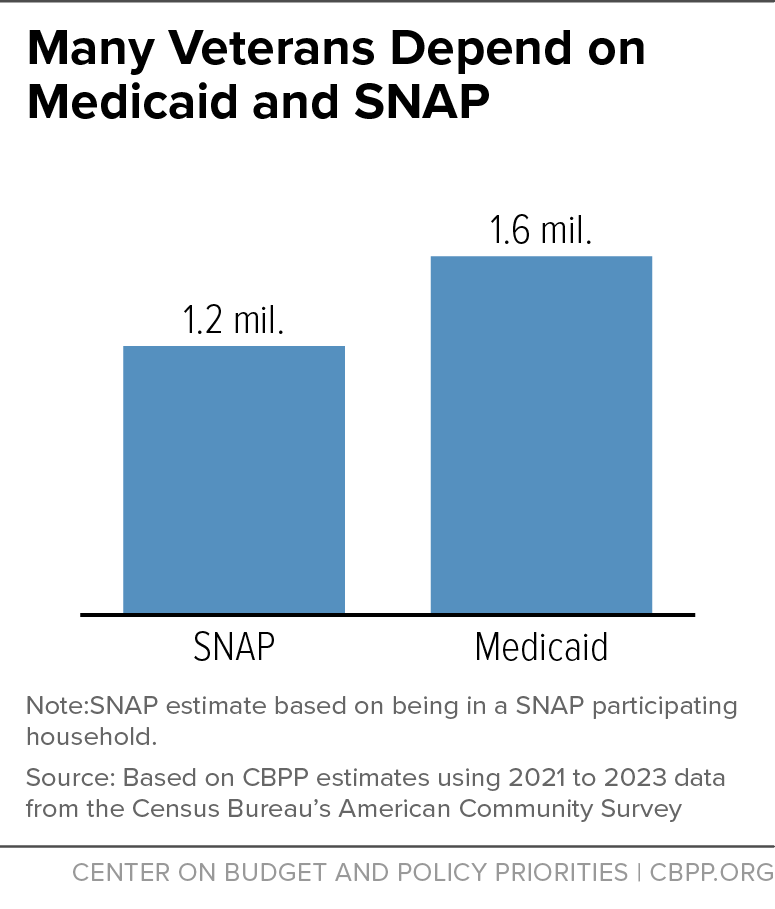
About 1.2 million veterans live in households that receive food assistance through the Supplemental Nutrition Assistance Program (SNAP), according to recent estimates. Thousands of veterans in every state — who may be between jobs, working in low-paying jobs, or have disabilities — use SNAP to supplement their low income to afford food for themselves and their families. Research shows that veterans were over 7 percent more likely than non-veterans to experience food insecurity in 2015-2019, after controlling for a range of socioeconomic and demographic characteristics.
Nearly 1.6 million veterans are enrolled in Medicaid, and many others purchased Affordable Care Act (ACA) marketplace coverage with premium tax credits. (Some veterans are not eligible for or aware of VA services or do not live near a VA facility.) Medicaid both provides coverage to veterans who would otherwise be uninsured, and supplements Medicare, private, veterans’, or military coverage, including by limiting out-of-pocket costs. Veterans, over 30 percent of whom have a service-connected disability, can have complex health care needs, such as chronic health conditions, post-traumatic stress disorder, and traumatic brain injuries. Another roughly 4 million family members of veterans are also enrolled in Medicaid or in the Children’s Health Insurance Program.
In addition to veterans and their families who receive Medicaid and SNAP, tens of thousands of families and households with active-duty service members also receive this assistance.
Veterans Could Lose Assistance Through Broad Cuts to Medicaid or SNAP
Significant changes in the funding structures of Medicaid or SNAP, such as reducing or capping the amount of federal Medicaid matching payments provided to states or requiring states to absorb new costs in SNAP, would threaten health coverage and food assistance for veterans. Many states would likely respond to large cost shifts by reducing assistance or eliminating coverage for certain groups of people. Veterans could be particularly harmed by Medicaid and SNAP cuts given the complexity of their health care needs and their higher prevalence of food insecurity.
Many Specific Policies Threaten Assistance for Veterans
Raising costs for veterans enrolled in marketplace coverage. Some 24 million people, including hundreds of thousands of veterans, are paying lower premiums for private health coverage they bought in the ACA marketplaces because of improvements to premium tax credits in place since 2021. If Congress lets these enhanced credits expire at the end of 2025, nearly all marketplace enrollees, in every state, will face significantly higher premium costs. A typical couple making $42,000, for example, will face a $1,550 annual increase.
Cutting funding for housing assistance. Hundreds of thousands of veterans depend on federal rental assistance programs to afford housing. The nation has cut homelessness among veterans in half since 2009, in part by providing more housing vouchers for homeless veterans through the HUD-Veterans Affairs Supportive Housing program. Proposals that would cut several trillion dollars over the next decade from overall non-defense discretionary funding, which supports rental assistance, homelessness services, and a wide variety of other investments in people, could increase homelessness among veterans.
Taking away health coverage and food assistance from veterans not meeting harsh work requirements. Imposing new rigid work requirements for Medicaid or expanding already harsh work requirements for SNAP — including by eliminating an exemption for veterans from that program’s current requirement — would threaten veterans’ health coverage and food assistance. Veterans often face unique barriers to employment such as little work experience outside of military service, trouble finding employment that matches their skills, and challenges from physical and mental health conditions related to their service. Work requirements don’t account for these realities, and they are laden with red tape that will make it hard for many veterans to document their employment or their eligibility for potential exemptions, including those related to their service-related health challenges.
Shifting SNAP benefit costs to states. Requiring states to pay a portion of SNAP benefit costs, which are currently 100 percent federally funded, would strain state budgets and force states to cut benefits or restrict eligibility, including for veterans who depend on the program. Virtually all states must balance their budgets each year, so shifting even a small portion of SNAP benefit costs to states would require them to cut SNAP, raise revenue, and/or cut funding for other programs — and this strain would grow further during an economic downturn, when the need for SNAP rises.
Alternative Path Can Help Veterans Succeed
The extreme agenda represented by proposals like those being considered by congressional Republicans, which would make millions of veterans worse off while extending and expanding tax breaks for wealthy households and businesses, is the wrong direction for our nation. A much better path would be to help veterans address their needs, including by expanding rental assistance to reach people — including hundreds of thousands of veterans — who need help to afford housing but don’t receive it due to funding limitations.
Additionally, Congress should close the Medicaid “coverage gap.” This would help more than 1.5 million uninsured adults with incomes below the poverty line, including many veterans, who are ineligible for Medicaid because their state hasn’t enacted the ACA Medicaid expansion. More than half of uninsured veterans live in states that have not expanded Medicaid under the ACA: Alabama, Florida, Georgia, Kansas, Mississippi, South Carolina, Tennessee, Texas, Wisconsin, and Wyoming.