

Congress Should Block OMB Grantmaking Rule Permanently to Rein In Administration Abuses
In May, the Office of Management and Budget (OMB) issued a proposed rule that would upend the federal grantmaking process by politicizing both how grant recipients are selected and when their grants can be canceled.[1] The rule has received robust pushback from a broad — and bipartisan — set of voices concerned about its impact.[2] Critics range from scientists working on cutting-edge research to law enforcement officials concerned about its impacts on public safety to cities, states, and nonprofits that serve local communities.
That pushback helped convince Congress to agree on a bipartisan basis to prevent this unprecedented rule from being finalized or taking effect through December 11, the duration of the temporary spending measure for fiscal year 2027. This agreement, which reflects widespread public concern over the rule’s likely impact, offers a temporary reprieve. However, addressing this issue permanently will require Congress to ban finalization of the rule when it provides appropriations for the remainder of the 2027 fiscal year.
Doing so is especially important because the Administration’s actions to date provide clear evidence of the harm the rule would cause. Just in recent weeks, it was reported that the Administration considered issuing an executive order to create an “external committee” of political appointees who would review and veto scientific grants awarded by the National Institutes of Health that they view as conflicting with the President’s political agenda, borne out of the President’s frustration that certain universities are not being sufficiently punished for disagreeing with his views.[3] This would come on top of a much broader set of actions the Administration has taken – both publicly and behind the scenes – to interfere with grantmaking across a wide range of agencies and programs.
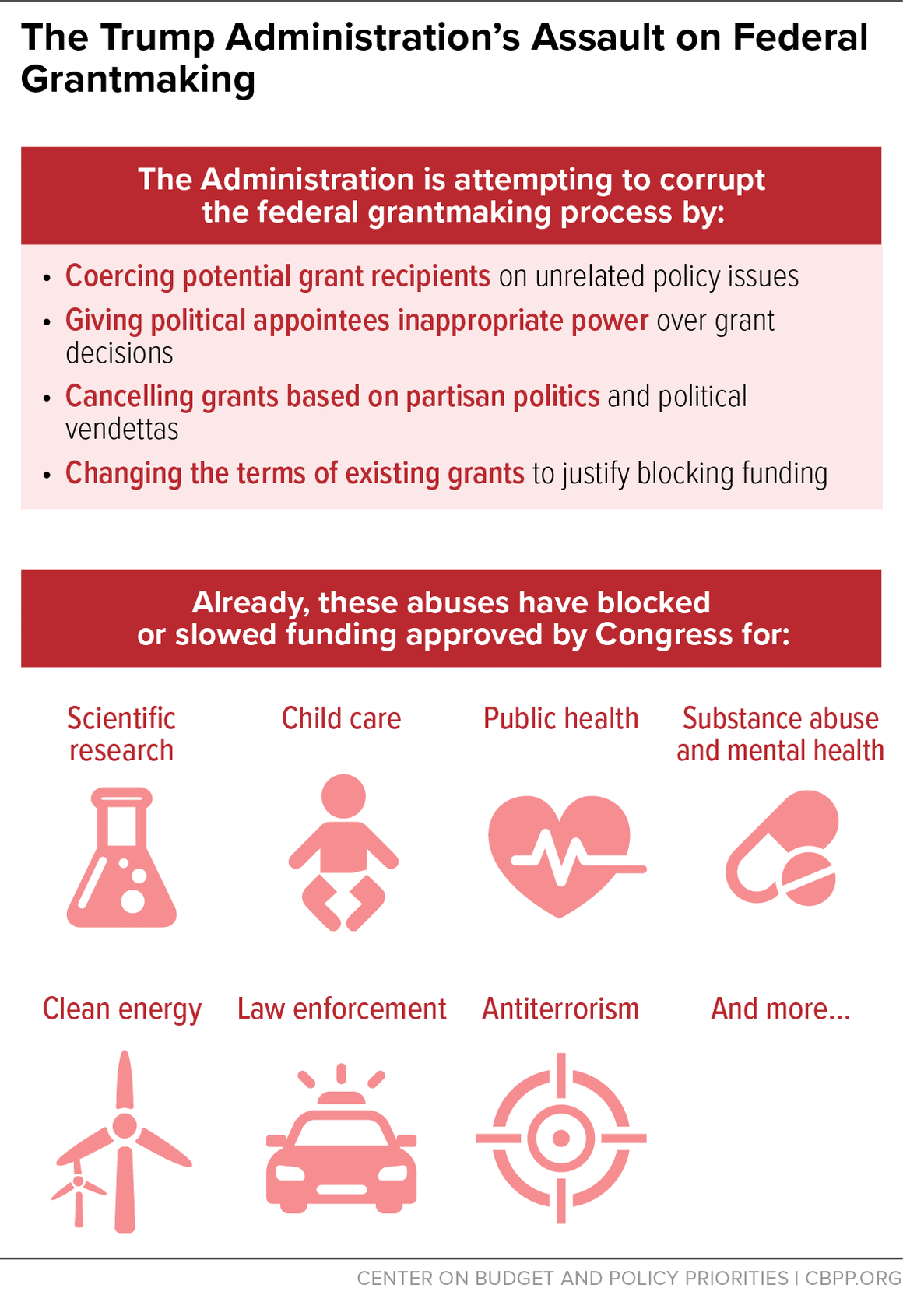
This paper outlines four different ways the Administration has already sought to abuse grantmaking processes; the OMB’s proposed rule would codify these practices and make them regular parts of federal grantmaking. They include:
- coercing potential grant recipients through the grant selection process;
- interfering with grants and adding delays through political review;
- cancelling grants based on issues unrelated to the purpose of the grant, including potentially partisan political issues or political vendettas; and
- inappropriately using grant terms and conditions to slow funding to those legally entitled to it.
Importantly, while the rule’s threat to scientific research – which would set back our country’s leadership and hamper life-saving breakthroughs – has been much discussed, the threat extends far more widely, affecting everything from public safety to education to clean and affordable energy. (See Figure 1.)
By blocking the rule permanently, Congress can help deter future abuses and prevent the Administration from further undermining federal grantmaking and Congress’s power of the purse.
Coercing Potential Grant Recipients Through the Grant Selection Process
OMB’s proposed grants rule would abuse the grantmaking process to advance the President’s interests through unlawful mechanisms. Under the rule, senior political appointees (or their designees) would review all competitive grant awards prior to finalization to determine whether each one “demonstrably advance[d] the President’s policy priorities.” These decisions would be left purely to the political appointees’ discretion, without review. A political official could block an application as unlikely to advance the President’s priorities even if the official’s real motivation was to punish the applicant for insufficiently supporting an unrelated policy or view of the President, or merely because the President doesn’t like the potential grantee.
The Administration has already shown how it would wield this provision abusively. For example, on grants dealing with issues such as terrorism prevention and law enforcement, the Administration has attempted to unlawfully condition funding or coerce applicants over policy interests unrelated to the purpose or performance of the grant.
In June, the Administration released new application requirements for over $1 billion in fiscal year 2026 grant funding for states and territories through three Department of Homeland Security (DHS) terrorism-prevention programs collectively known as the Homeland Security Grant Program (HSGP). Until now, all states have routinely received their full share of these formula-based, congressionally provided funds, whose purpose is to “enhance the ability of state, local, tribal and territorial governments to prevent, prepare for, protect against, and respond to potential terrorist acts and other hazards.” Yet DHS, describing applying for this funding as “voluntary,” attempted to condition receipt of this funding on states’ and territories’ compliance with Administration demands concerning state election policies, such as those outlined in the President’s non-binding and unenforceable March 2025 executive order on election security.[4]
In July, 25 states and the District of Columbia sued to block the new requirements, describing them as part of an “unprecedented campaign to leverage the billions of dollars in federal funding that they [i.e., DHS and the Federal Emergency Management Agency] administer to coerce States into adopting the Administration’s preferred policies.”[5] In 2025, a number of states successfully sued the Administration on similar grounds, invalidating its earlier attempts to condition the receipt of DHS funds like HSGP on cooperation with federal civil immigration law enforcement and to re-allocate HSGP funding away from states that did not comply. A federal court found that DHS was unlawfully attempting to “hold hostage funding for programs like [HSGP] based solely on what appear to be [the Administration’s] political whims.”[6] In September, a federal judge ruled that the Administration’s 2026 actions were also illegal, striking these new requirements and finding that “Congress in no way authorized FEMA to withhold grant funds to achieve the federal government’s policy ends at state and local expense.”[7]
Similarly, in June, the Department of Justice (DOJ) released application requirements for $3 billion in law enforcement support funds provided in the 2025 Republican reconciliation law. Under the new requirements, which the reconciliation law did not allow for, state and local governments must “fully participate” in an otherwise voluntary Immigration and Customs Enforcement (ICE) 287(g) partnership (which authorizes state and local law enforcement to carry out certain federal immigration enforcement duties) and in a Homeland Security Task Force operation or other major DOJ enforcement effort to be eligible for funds.[8]
In yet another example, a DOJ grant opportunity released earlier this year for $300 million to state, local, and tribal governments to strengthen investigative and prosecutorial capacity required applicants to have a “letter of support” from DOJ or another member of a federal Homeland Security Task force. This effectively means that only applicants supported by the Trump Administration would be eligible for funds.[9]
Finalizing the OMB grants rule would further encourage this type of coercive behavior, including by shielding such actions from meaningful oversight and review by Congress, the courts, and the broader public.
Interfering With Grants and Adding Delays Through Political Review
The potential for abuse and coercion through OMB’s proposed rule is particularly significant because the rule would place unprecedented power in the hands of political appointees. It not only requires that “senior appointees” — a term referring to political staff — be responsible for the pre-issuance review of grants but also specifies that these appointees (or their designees) “must not ministerially ratify or routinely defer to the recommendations of others, but must instead use their independent judgment when evaluating Federal award proposals.” In other words, the rule mandates political interference in the grantmaking process, explicitly stating that peer review processes should be purely “advisory” and thus superseded by the preferences of political decision-makers.
Already the Administration has repeatedly interjected political appointees into the grantmaking process, undermining programs in at least two ways. First, it has replaced merit, as assessed by people with relevant expertise, with political considerations in determining who gets money and who does not. There are reported instances of agencies prioritizing applicants who are well connected while excluding others solely on the basis of their political views or unrelated policy disputes.[10] Second, it has slowed the grant selection process in ways that hurt grantees and the communities they serve by impeding the flow of funds they need to provide key services.
A prominent example of the latter is the grantmaking process at the Department of Health and Human Services (HHS), the largest federal grantmaking agency. At HHS’s National Institutes of Health, the addition of layers of political review has created what one senior official called a “graveyard for grants,” as funding that has already gone through peer review and been approved by multiple offices lingers for weeks or months awaiting final approval.[11] Nature reports, “These new layers of review have delayed delivery of funds to labs and research institutions — and have even resulted in the outright rejection of some applications that had been approved by outside and agency scientists,” an outcome that, prior to 2025, was “unheard of.”[12] Similarly, the HHS process for reviewing funding opportunities recently led to “unprecedented delays” in the release of funds to support the 988 suicide hotline, provide treatment for opioid addiction, and combat global disease.[13]
Similar damage is occurring at a number of other agencies:
- At DHS, a contractor closely tied to then-Secretary Kristi Noem and her top aide Corey Lewandowski was reportedly given control over which grants went out the door; she used the power to block grants to disfavored states like California and to Muslim groups and steer grants to Florida for a favored project.[14] Allies of Secretary Noem allegedly directed the winners of even some small-dollar grants, avoiding the typical competitive awards process, while Lewandowski is under investigation for seeking to use his position for self-enrichment.[15] This bottleneck in the DHS grant review process resulted in widespread funding delays.[16]
- Political review of grants at the Interior Department created a backlog of 1,400 grants accounting for $362 million in National Park Service funding as of earlier this summer, delaying funds meant to support youth programs and prevent washouts in parks.[17]
- At the State Department, senior appointees reportedly presented their “own list of organizations that should be funded” in an effort to “bypass the normal open bidding process” and fund favored groups in Europe and South Africa aligned with conservative and anti-immigration movements.[18]
- The National Endowment of Humanities saw nearly 10 percent of its budget go last year to the two largest grants in its history, which were reportedly “handpicked” by political appointees outside the agency’s normal processes. The politicization of the agency led one scholar to describe a potential “chilling effect” discouraging researchers from applying because they do not believe they will receive a fair hearing.[19]
Cancelling Grants for Reasons Unrelated to Programmatic Performance, Including Partisan Politics and Political Vendettas
OMB’s proposed rule would allow an agency to terminate discretionary grants at any time if the agency decides it’s in the agency’s, or the nation’s, interest to do so. Grants could be cancelled even if the recipients were successfully meeting the goals and requirements of a program established in law. Because an agency’s determination of its interest or the national interest is essentially undefined and unbounded, individual grantees could be targeted for essentially any reason — including unrelated personal grievances that the President or other political decision-makers might have toward grantees — with little notice and without an ability to contest the decision.
That the Administration may wish to cancel grants on the basis of political animus is no idle threat. Nor is it pure speculation to suggest that the Administration might mislead the public and grantees about its motivation for cancelling grants, including in areas like clean energy and transportation investments and public health services.
In October 2025, OMB Director Russell Vought announced the cancellation of over $7 billion in clean energy grants to 16 states, none of which had voted for President Trump in the 2024 election, at a time when the President had expressed interest in finding ways to punish Democrats over the government shutdown then occurring.[20] In a press release, the Department of Energy (DOE) claimed the cancellations were based on the determination that those projects “did not adequately advance the nation’s energy needs, were not economically viable, and would not provide a positive return on investment of taxpayer dollars.”[21] However, the Administration later admitted in court that its decision to cancel these grants “was based solely on the political identity of the grant recipient’s state, i.e., whether the recipient’s location and/or place of performance was in a Blue State or a non-Blue State,” and was not “based on any programmatic, statutory, cost-reduction or performance-based factor.”[22]
Similarly, after the President publicly criticized the jailing of a political ally in Colorado following her conviction for election machine tampering, a White House staffer issued a non-public directive to federal agencies to “prioritize Colorado for the purposes of ensuring grants and federal support are in line with administration priorities.”[23] Departments were instructed to find “immediate actions” they could take.[24] Shortly thereafter, the Department of Transportation announced it was cancelling over $100 million in grant projects in Colorado, stretching from rail safety improvements to electric vehicle infrastructure investments. Rather than acknowledging the White House’s directive, the agency announced it was cancelling the projects because they were “redundant” or out of alignment with the President’s agenda.[25]
Some of the clean energy grant cancellations have already been blocked by federal courts as illegal, while the cancellation of the grants to Colorado is being challenged. In both cases, legal challenges have produced stipulations or discovery of evidence showing that the public justifications for the cancellations were at best dishonest and incomplete. Adoption of the OMB rule would allow more agencies to abusively target discretionary grants for cancellation based on flimsy claims of national or departmental interest — and require lawsuits (and rely on the existence of written evidence) to show when ulterior or illegal motivations were hidden.
An administration could wield this provision of the proposed rule to harm not only individual grantees but also entire programs. Recent history shows that a program can be thrown into turmoil virtually overnight by a determination that all existing grants no longer serve the national interest. In January 2026, the Administration announced that it was terminating roughly $2 billion in HHS grants to more than 2,000 nonprofits to provide public health services, including substance abuse and mental health services.[26] Despite strong bipartisan support for the grants in Congress, the Administration said the current grant awards no longer effectuated “the program goals or agency priorities” and that “no corrective action could align the award with current agency priorities.”[27] The Administration had previously proposed in its budget to significantly cut federal support for behavioral health and substance abuse treatment and prevention, but Congress had rejected the proposal on a bipartisan basis.
Though the Administration quickly restored the grants following a public outcry and bipartisan political pressure, its actions demonstrated how an Administration could essentially suspend an entire program on the flimsiest of pretexts, at least for a time. Even if HHS had planned to run a new competition for these funds using its new definition of its priorities (rather than attempting to illegally impound the funds under the guise of reprioritization), the process of competently and fairly recompeting the funds likely would have taken several months at best. The Administration’s first-year cuts of over 40 percent to the staff of the agency in charge of administering the grants, the Substance Abuse and Mental Health Services Administration, would have made the process even more difficult.[28] And nothing in the proposed rule would seem to prevent an administration from subsequently determining that the newly recompeted awards no longer met the agency’s or the national interest and restarting the process over again without having delivered the services that Congress funded in law.
Inappropriately Using Grant Terms and Conditions to Slow Funding to Those Legally Entitled to It
OMB’s proposed rule would give federal agencies a legally dubious new ability to change the terms and conditions of an award, without the grantee’s agreement, after a grant agreement has already been signed.
Even when a state or local government is entitled to a share of federal funding by a formula set in statute, its use of the funds must comply with the terms and conditions of the award, so having those rules be clear from the outset is critical. But under the proposed rule, an administration could unilaterally add onerous new conditions midstream for reasons unrelated to meeting the purpose for which the grant was provided — putting grantees out of compliance or placing grant activities on hold.
The Administration has already attempted to do just that. In January 2026, it tried to block formula-based child care and other social service funding by imposing additional conditions on a small handful of states, all led by Democratic governors.[29]
HHS announced that, due to “serious concerns about widespread fraud and misuse of taxpayer dollars in state administered programs,” it would temporarily freeze the ability of state governments in California, Colorado, Illinois, Minnesota, and New York to receive reimbursement from their share of federal child care and other family assistance funds.[30] HHS provided no evidence or details about its purported concerns. Instead, it informed the five states that their access to the funds would be restricted “until additional fiscal accountability requirements are implemented and necessary information is provided.”
While HHS did not fully define the new process for satisfying its demands or formally state it was changing the grant terms and conditions, it told states they needed to submit certain information within two weeks to relieve the freeze. For example, for Temporary Assistance for Needy Families (TANF), states were required to provide “the complete universe” of administrative data in the states’ possession going back as many years as possible, as well as the Social Security number, address, and birthdate of every TANF recipient, among other data. The states told a court this task would be “impossible” in the timeframe provided even if it were legally allowed. In other words, the addition of the new requirements meant that these targeted states would not be compliant with the requirements of the grant for at least some period of time.
A federal court issued a stay, finding that the Administration had acted contrary to law and exceeded its statutory authority, and that HHS had failed to identify “any binding or persuasive authority” that would allow it to require the additional requested documentation prior to releasing funds.[31]
The unlawful manner in which the Administration acted raises serious concerns that its publicly stated claims about fraud were merely a pretext to add burdensome requirements that would push the states out of compliance and justify freezing their funding. In either case, the Administration’s actions highlight the potential for abuse inherent in a rule that would allow for unilateral changes in the terms and conditions of grants midstream.
Why Congress Needs to Act
Congress can take action to stop the Administration’s assault on nonpartisan grantmaking. While courts can and have played a role in stopping these abuses in specific instances, congressional action is needed to more effectively address these issues on a government-wide basis.
Moreover, the fact that the Administration has already engaged in these abuses does not minimize the importance of blocking the OMB rule before it is finalized. Congressional action to block the abuses proposed in the rule would likely deter some of these abuses in the future and make it easier to stop them in court, given a clear congressional response. Also, if the rule takes effect, it would push even reluctant agencies to standardize the use of these abusive tactics.
Finally, if unchecked, the Administration would likely go even further. For example, while it has often provided a public pretext, however flimsy, for its coercive actions to date, the rule would make it easier for agencies to abuse their powers with even less transparency, by allowing political appointees to select, reject, or cancel grants without having to justify such decisions publicly.
Conclusion
Since its early days, the Trump Administration has made clear it intends to use the grantmaking process to coerce organizations, researchers, universities, states, and localities into complying with demands unrelated to the purposes of the grants and punish its perceived enemies while rewarding its friends. These destructive practices have already touched every part of the grantmaking world, from medical research to public safety to transportation.
The proposed grant rule is intended to make these types of abuses both easier and more widespread. It would explicitly require a politicized grantmaking process where Administration appointees intervene in award decisions, give the Administration unprecedented opportunities to select new grantees and cancel existing grants for political and policy reasons unrelated to the grant in question, and claim a legally dubious authority for the Administration to change grant terms and conditions midstream.
History has repeatedly shown that governments that allow for this level of systemic corruption perform worse than an American system grounded in impartiality, fairness, and merit.[32] Congress was right to recognize the threat the OMB grants rule poses and prevent its implementation during the short-term continuing resolution. Now, Congress must permanently prohibit implementation of this rule and any similar practices when it passes full-year funding for the upcoming fiscal year.
End Notes
[1] Regulation for Federal Financial Assistance, 91 Fed. Reg. 32198 (May 29, 2026). Proposed rule available at https://www.federalregister.gov/documents/2026/05/29/2026-10817/regulation-for-federal-financial-assistance.
[2] Tony Romm, “White House Faces Stiff Pushback on Subjecting Grants to Political Review,” New York Times, July 16, 2026, https://www.nytimes.com/2026/07/16/us/politics/white-house-federal-grants-political-review.html.
[3] Carolyn Johnson et al., “White House Moves to Take Control of N.I.H. Grants,” New York Times, September 20, 2026, https://www.nytimes.com/2026/09/20/science/nih-omb-grants-bhattacharya-vought.html; Dan Diamond and Riley Beggin, “Vought pushes for scrutiny of NIH grants in Oval Office clash,” Washington Post, September 18, 2026, https://www.washingtonpost.com/politics/2026/09/18/vought-pushes-scrutiny-nih-grants-oval-office-clash/.
[4] Reed Shaw, “No, Trump Can’t Withhold Anti-Terrorism Funds to Pressure States to Change Their Election Rules,” Just Security, July 23, 2026, https://www.justsecurity.org/148665/trump-cant-withhold-antiterrorism-funds/; Department of Homeland Security, “DHS Requires States to Adopt Common-Sense Election Security Measures Before Receiving Federal Funds,” July 10, 2026, https://www.dhs.gov/news/2026/07/10/dhs-requires-states-adopt-common-sense-election-security-measures-receiving-federal.
[5] Samantha Valentino, “Beshear joins multistate lawsuit over FEMA, DHS grant conditions,” WKYT, July 24, 2026, https://www.wkyt.com/2026/07/24/beshear-joins-multistate-lawsuit-over-fema-dhs-grant-conditions/.
[6] United States District Court for the District of Rhode Island, “Memorandum and Order,” Case 1:25-cv-00495-MSM-PAS, December 22, 2025, https://storage.courtlistener.com/recap/gov.uscourts.rid.60525/gov.uscourts.rid.60525.53.0_1.pdf.
[7] United States District Court for the District of Columbia, “Memorandum Opinion,” Case 1:26-cv-02886-AHA, September 28, 2026, https://storage.courtlistener.com/recap/gov.uscourts.dcd.295627/gov.uscourts.dcd.295627.42.0.pdf.
[8] U.S. Department of Justice, “DOJ FY 2026 Bridging Immigration-Related Deficits Experienced Nationwide (“BIDEN”) Program,” July 15, 2026, https://www.ojp.gov/funding/docs/bja-2026-172641.pdf.
[9] U.S. Department of Justice, “OJP FY 2026 Special Attorneys Program,” April 21, 2026, https://www.ojp.gov/funding/docs/bja-2026-172587.pdf.
[10] Brianna Sacks, Maria Sacchetti, and Marianne LeVine, “What spending probes at DHS reveal about Kristi Noem’s time in office,” Washington Post, April 7, 2026, https://www.washingtonpost.com/immigration/2026/04/05/noem-trump-dhs-fema-contracts/.
[11] Paige Winfield Cunningham, “‘Graveyard for Grants’: NIH Is Holding Up Medical Research Funding,” Washington Sun, August 17, 2026, https://washingtonsun.com/health-science/nih-holding-up-medical-research-funding-status-19.
[12] Max Kozlov, “Inside the new political screening that’s stalling NIH grants,” Nature, June 26, 2026, https://www.nature.com/articles/d41586-026-01924-8.
[13] Eric Katz and Paige Winfield Cunningham, “The Trump Administration Is Holding Up Billions in HHS Funding,” Washington Sun, June 19, 2026, https://www.washingtonsun.com/health-science/trump-administration-hhs-health-funding-rfk-jr-robert-f-kennedy-grant-money.
[14] Sacks, Sacchetti, and LeVine, op. cit.
[15] Tarini Parti et al., “Chasing Side Deals, Flexing Influence: Lewandowski’s Power Moves at DHS,” Wall Street Journal, September 7, 2026, https://www.wsj.com/politics/policy/corey-lewandowski-influence-dhs-43d3fe03?msockid=3be4e315a9e666360c2af423a850677a.
[16] Sacks, Sacchetti, and LeVine, op. cit.
[17] Eric Katz and Anna Kramer, “Political Reviews Are Causing a Huge Grant Backlog at the National Park Service,” Washington Sun, June 9, 2026, https://washingtonsun.com/climate-environment/political-reviews-grant-backlog-national-park-service.
[18] Anna Maria Barry-Jester and Sharon Lerner, “Trump Officials Want to Use Human Rights Aid to Advocate for White South Africans and Right-Wing Causes in Europe,” ProPublica, July 17, 2026, https://www.propublica.org/article/human-rights-aid-right-wing-causes.
[19] Jennifer Schuessler, “Fired Scholars and Big Grants to Favored Projects: Inside Trump’s N.E.H.,” New York Times, November 16, 2025, https://www.nytimes.com/2025/11/15/arts/national-endowment-humanities-trump.html.
[20] Amelia Benavides-Colon, “Trump Admin Says It’s Canceling Energy Projects in 16 Blue States,” Washington Sun, October 1, 2025, https://washingtonsun.com/trump-white-house/russell-vought-trump-administration-cancel-energy-projects-blue-states-california-new-york; Ivan Pereira, “Trump openly threatens to use shutdown to target Democrats for cuts,” ABC News, October 2, 2025, https://abcnews.com/Politics/trump-openly-threatens-shutdown-target-democrats-cuts/story?id=126151790.
[21] Department of Energy, “Energy Department Announces Termination of 223 Projects, Saving Over $7.5 Billion,” October 1, 2025, https://www.energy.gov/articles/energy-department-announces-termination-223-projects-saving-over-75-billion.
[22] Department of Energy, “Exhibit F(1) Department of Energy Stipulation,” July 15, 2026, https://storage.courtlistener.com/recap/gov.uscourts.cand.450653/gov.uscourts.cand.450653.211.6.pdf.
[23] Reis Thebault, “Colorado Was Targeted as Trump Fumed Over Election Denier, Email Shows,” New York Times, August 14, 2026, https://www.nytimes.com/2026/08/14/us/colorado-trump-tina-peters.html.
[24] Karen Morfitt, “Colorado cites White House email as key evidence in lawsuit against Trump administration,” CBS Colorado, August 21, 2026, https://www.cbsnews.com/colorado/news/colorado-cites-white-house-email-key-evidence-lawsuit-against-trump-administration/.
[25] Jesse Paul and Taylor Dolven, “Trump administration cancels $109M in environmentally focused transportation grants for Colorado,” Colorado Sun, December 16, 2025, https://coloradosun.com/2025/12/16/trump-administration-cuts-transportation-grants-colorado/.
[26] Brian Mann, “Trump administration sends letter wiping out addiction, mental health grants,” NPR, January 14, 2026, https://www.npr.org/2026/01/14/nx-s1-5677104/trump-administration-letter-terminating-addiction-mental-health-grants.
[27] Substance Abuse and Mental Health Services Administration, “Notification Letter to Recipient for Termination of Federal Award for Non-Alignment with Substance Abuse and Mental Health Services Administration (SAMHSA) Priorities,” January 13, 2026, https://www.nabh.org/download/samhsa-grant-termination-letter/.
[28] Office of Personnel Management, “Federal Workforce Data,” September 9, 2026, https://data.opm.gov/explore-data/data/table-builder. The number of SAMHSA employees declined roughly 43 percent between January 2025 (943) and January 2026 (544). As of July 2026, SAMHSA reported 520 employees.
[29] Nick Gwyn, “Trump Administration’s Five-State Funding Freeze Is Unlawful, Harmful, and a Major Threat to People in Every State,” CBPP, January 23, 2026, https://www.cbpp.org/research/federal-budget/trump-administrations-five-state-funding-freeze-is-unlawful-harmful-and-a.
[30] HHS, “HHS Freezes Child Care and Family Assistance Grants in Five States for Fraud Concerns,” January 6, 2026, https://www.hhs.gov/press-room/hhs-freezes-child-care-family-assistance-grants-five-states-fraud-concerns.html.
[31] United States District Court, Southern District of New York, “Opinion & Order,” Case 1:26-cv-00172-VSB, March 10, 2026, https://www.courthousenews.com/wp-content/uploads/2026/03/new-york-vs-administration-for-children-and-families-opinion-and-order.pdf.
[32] International Monetary Fund, “Fiscal Monitor: Curbing Corruption,” April 2019, https://www.imf.org/en/publications/fm/issues/2019/09/27/fiscal-monitor-april-2019-curbing-corruption-46532.