

BEYOND THE NUMBERS
Republican Plans to Slash Food Assistance Aren’t About “Program Integrity”
Republican lawmakers are advancing a budget plan that sets the stage for reckless, sweeping cuts to SNAP, our nation’s largest and most important anti-hunger program, to help pay for tax cuts skewed to the wealthy.
Cutting SNAP to help pay for the tax cuts is widely unpopular, including among people who voted for President Trump. The only way to cut $230 billion from SNAP is to take food assistance away from millions of people, despite some key Republicans claiming otherwise. If enacted, this would be a more than 20 percent cut to SNAP — the single largest cut to food assistance in history — even though low-income households are increasingly struggling to afford groceries. Claims that cuts of this magnitude can be achieved through “program integrity” changes that won’t hurt families are simply false.

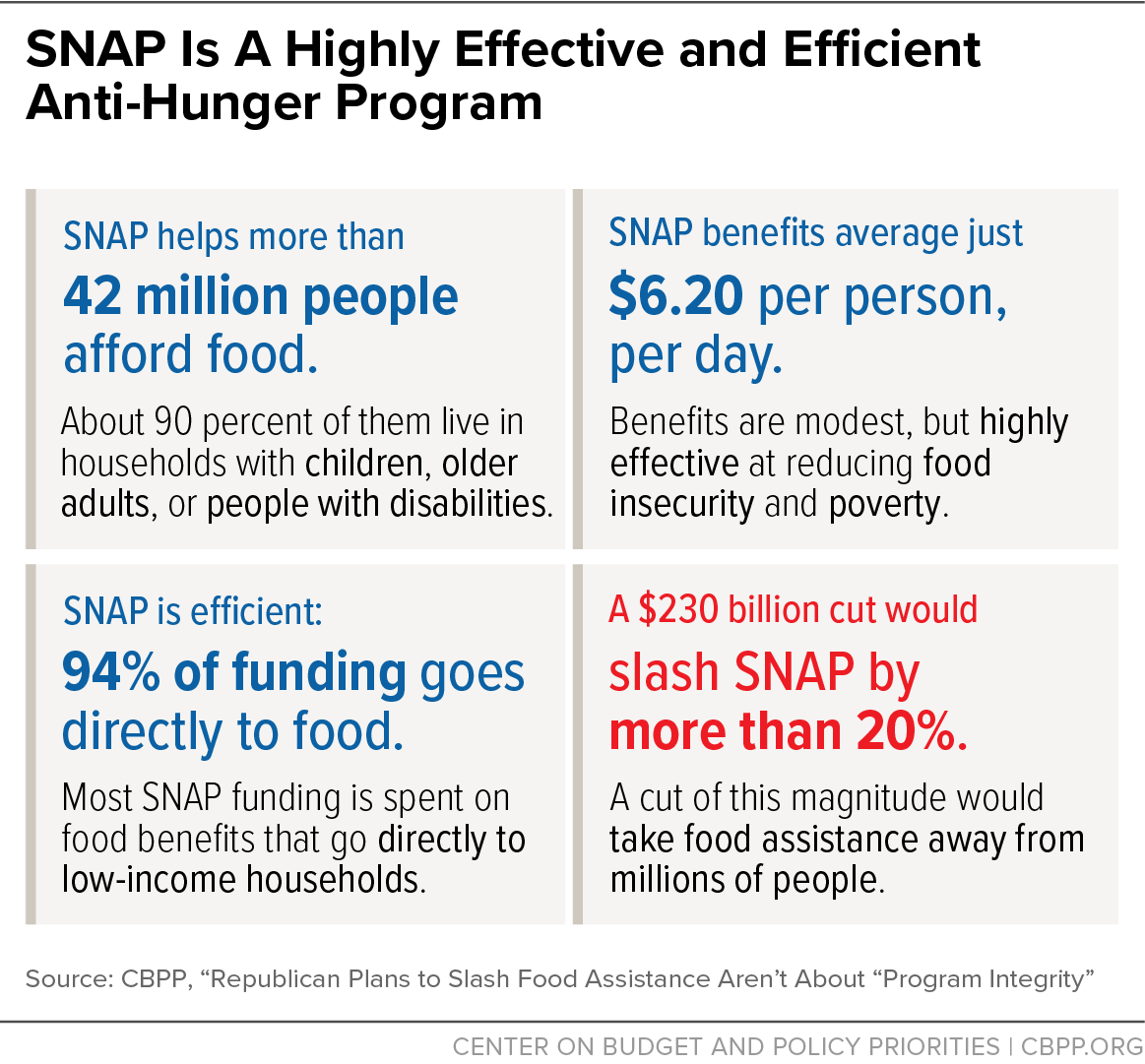
SNAP helps more than 42 million people in low-income households put food on the table. Roughly 90 percent of participants live in households with children, older adults, or people with disabilities. Despite its modest benefits — averaging only $6.20 per person per day — SNAP is highly effective at reducing food insecurity and poverty. And for children, participating in SNAP is linked to long-term improvements in health, education, and employment.
SNAP is also important to the U.S. economy, supporting jobs throughout the food supply chain — from grocery stores and food wholesalers to truckers and farmers — and providing vital economic stimulus during recessions.
SNAP is also highly efficient. Roughly 94 cents of every dollar the federal government spends on SNAP is for food benefits that go directly to low-income households (with the rest being used to administer the program). In addition to upfront eligibility checks, SNAP has one of the most rigorous quality control processes of any federal program to determine if states are delivering benefits to eligible people and in the correct amounts. The Agriculture Department has found that the payment error rate resulting from this process largely reflects unintentional mistakes by state eligibility workers and households rather than intentional fraud by participants, which is rare. The number of SNAP participants disqualified for fraud through criminal prosecution or administrative proceedings each year typically represents about 0.1 percent of the average monthly SNAP caseload.
States already have substantial skin in the game regarding payment accuracy. States with persistently high error rates face federal penalties, which can total many millions of dollars. (Pennsylvania was hit with a nearly $40 million penalty for its high error rate in fiscal year 2023.) Participants also have skin in the game because they must repay any overpayments they receive — even if the mistake was due to the state agency’s error and the household did everything right.
While Republicans haven’t presented a legislative proposal yet, it’s clear from the size of the proposed cuts that they aren’t about reducing payment errors. Even if Congress could eliminate all errors moving forward — which isn’t feasible — overpayments in SNAP won’t add up to anything close to $230 billion between now and 2034. And recent program integrity proposals from Republican lawmakers would actually worsen error rates or increase federal spending, while making it more difficult for eligible people to access benefits.
There are certainly opportunities to strengthen SNAP and improve program administration, but they typically require more funding, not less. Instead, the deep cuts and harmful policy changes under consideration would jeopardize food assistance for millions of low-income people.
For example, some Republicans have proposed requiring states to pay part of SNAP food benefit costs for the first time. While states pay roughly half the cost of administering SNAP, food benefits are 100 percent federally funded, ensuring that people in all states get the food assistance they need. This radical change would impose billions of dollars in new costs on already strained state budgets, likely forcing states — which must balance their budgets every year — to cut food assistance for low-income families, terminate eligibility for some SNAP participants, or both.
This harm would be particularly acute during recessions, when state revenues typically decline. As a result, states may not be able to provide the funding needed as more people lose income, need help meeting basic food needs, and become eligible for SNAP. This would worsen food insecurity and hinder SNAP’s ability to act as an economic stimulus.
Some Republicans have also proposed making SNAP’s harsh work requirement broader and more punitive, putting millions more people at risk of losing food assistance. Most SNAP participants who can work already do so, and research shows that the existing work requirement takes food away from people struggling to find steady, well-paying jobs or facing substantial barriers to employment without improving employment or earnings. Additionally, tracking compliance with work requirements creates substantial red tape for participants and state agencies, causing some people to be cut off SNAP even though they are working or should be exempt.
With economic uncertainty and the risk of a recession rising in response to the tariff policies rolled out by the Administration, now is a particularly bad time to make unprecedented cuts to food assistance — real cuts that would hurt real people.