BEYOND THE NUMBERS
Hardship in America, Part 1: Majority of Poor Children Live in Households with Major Hardships
Note: With Thanksgiving right around the corner, the Center thought this was a good time to look at the latest figures on various indicators of hardship. This is the first in a series of posts on this subject that CBPP will do this week.
Poverty rates rose in 2010 under a variety of poverty measures, as the economic downturn continued and long-term unemployment hit record highs. Lest anyone doubt that this is a serious problem requiring attention, new CBPP analysis finds that more than half (52 percent) of poor children last year lived in households that faced one or more of the following:
- hunger (what the Agriculture Department now terms “very low food security”),
- overcrowded living conditions (more than one person per room),
- failure to pay rent or mortgage on time, or
- failure to receive needed medical care.
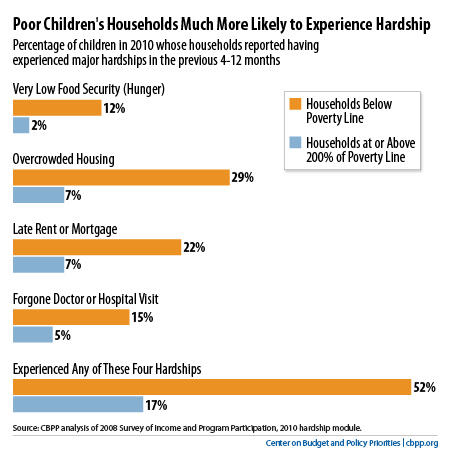
Fortunately, government assistance can make a difference in poverty — and, it is fair to conclude, hardship.
Earlier this month, Census reported that while poverty rose significantly in 2010 under a new poverty measure (the Supplemental Poverty Measure) that takes both cash income and government assistance into account, government assistance kept poverty from being even higher.
Also, a CBPP
found that nearly twice as many people would count as poor in 2010 if one leaves out the income they received from assistance programs. In particular, a handful of government initiatives enacted in 2009 and 2010 kept nearly 7 million people out of poverty in 2010.Unfortunately, those initiatives are expiring, many states have cut programs that help low-income families, and some budget-cutters in Congress are targeting such programs for further cuts.
Related Posts: