

Republican Megabill Trades Essential Support to Low-Income People for Skewed Tax Cuts
The sprawling megabill passed by the Republican-controlled Congress and signed by President Trump in July 2025 will redistribute trillions of dollars upward over the next decade, making it harder for families with modest incomes to meet their basic needs while helping those at the top accumulate more wealth.
To partially finance $4.5 trillion in tax cuts tilted to the wealthiest households, the new law (originally called the One Big Beautiful Bill Act by its proponents) imposes sweeping cuts to programs that help people with low and moderate incomes afford health care and groceries and shifts extensive new responsibilities to states and localities. Independent analyses project that the law will increase the deficit and in the long run provide only a meager boost to the economy and might in fact slow economic growth.
One of the megabill’s most straightforward impacts will be to increase income inequality. The Congressional Budget Office (CBO) finds that the new law’s program cuts and tax cuts will make households with incomes in the bottom 20 percent of the income scale worse off: they will lose more from the cuts in health coverage, food assistance, and other programs than they will gain in tax cuts. [1] Average household incomes will fall by $1,200 (3.1 percent) for those with incomes in the bottom 10 percent of the income scale while rising by $13,600 (2.7 percent) for those with incomes in the top 10 percent, according to CBO.
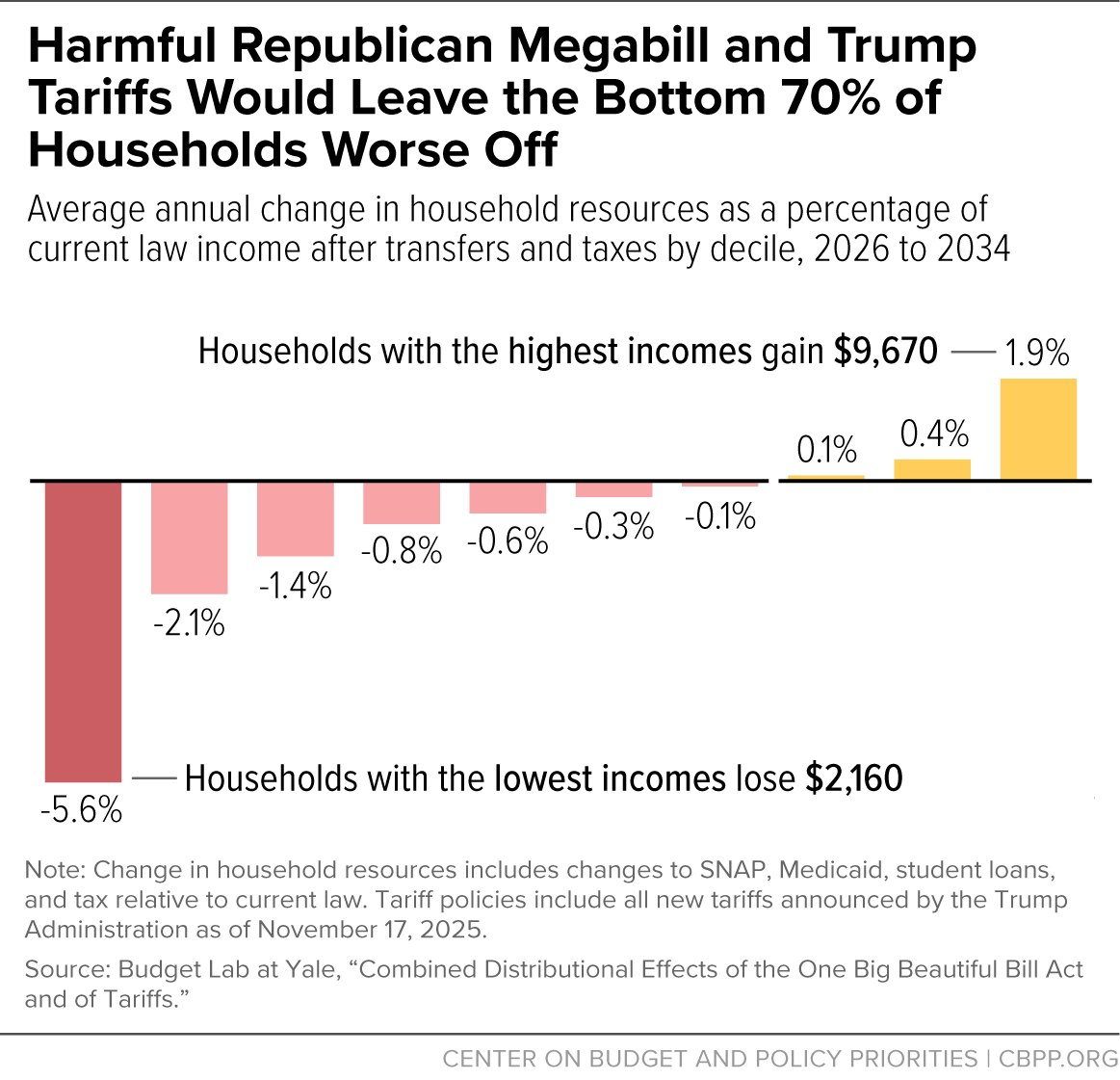
The combined impact of the megabill and the Trump Administration’s sweeping, regressive tariffs (which the Administration claims will help offset the cost of the megabill’s tax cuts) will leave households with incomes in the bottom 70 percent worse off, according to the Yale Budget Lab, with an average $2,160 (5.6 percent) decline in income for households with incomes in the bottom 10 percent.[2] For households in the middle 20 percent, the decline is $480 (about 0.4 percent).
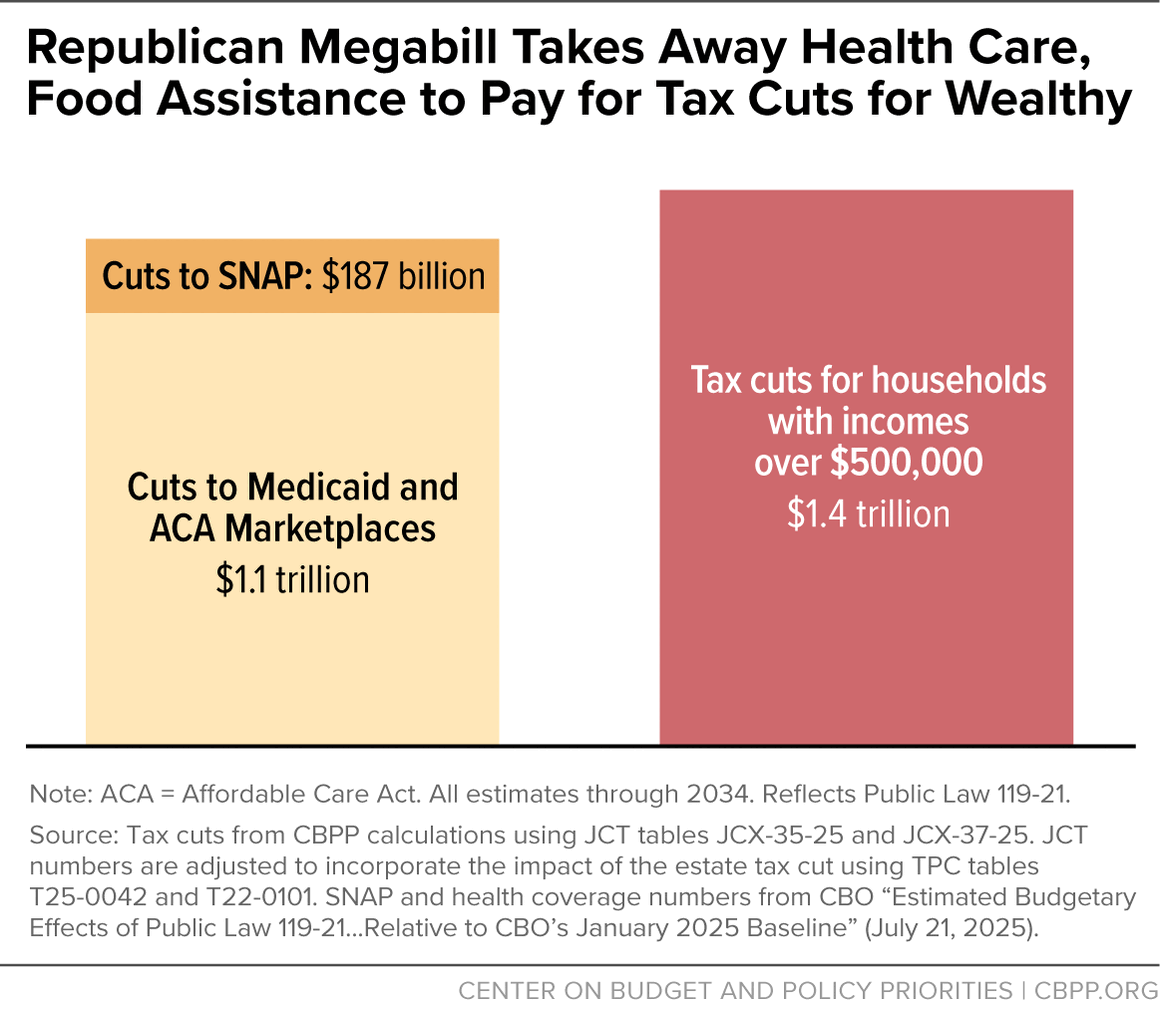
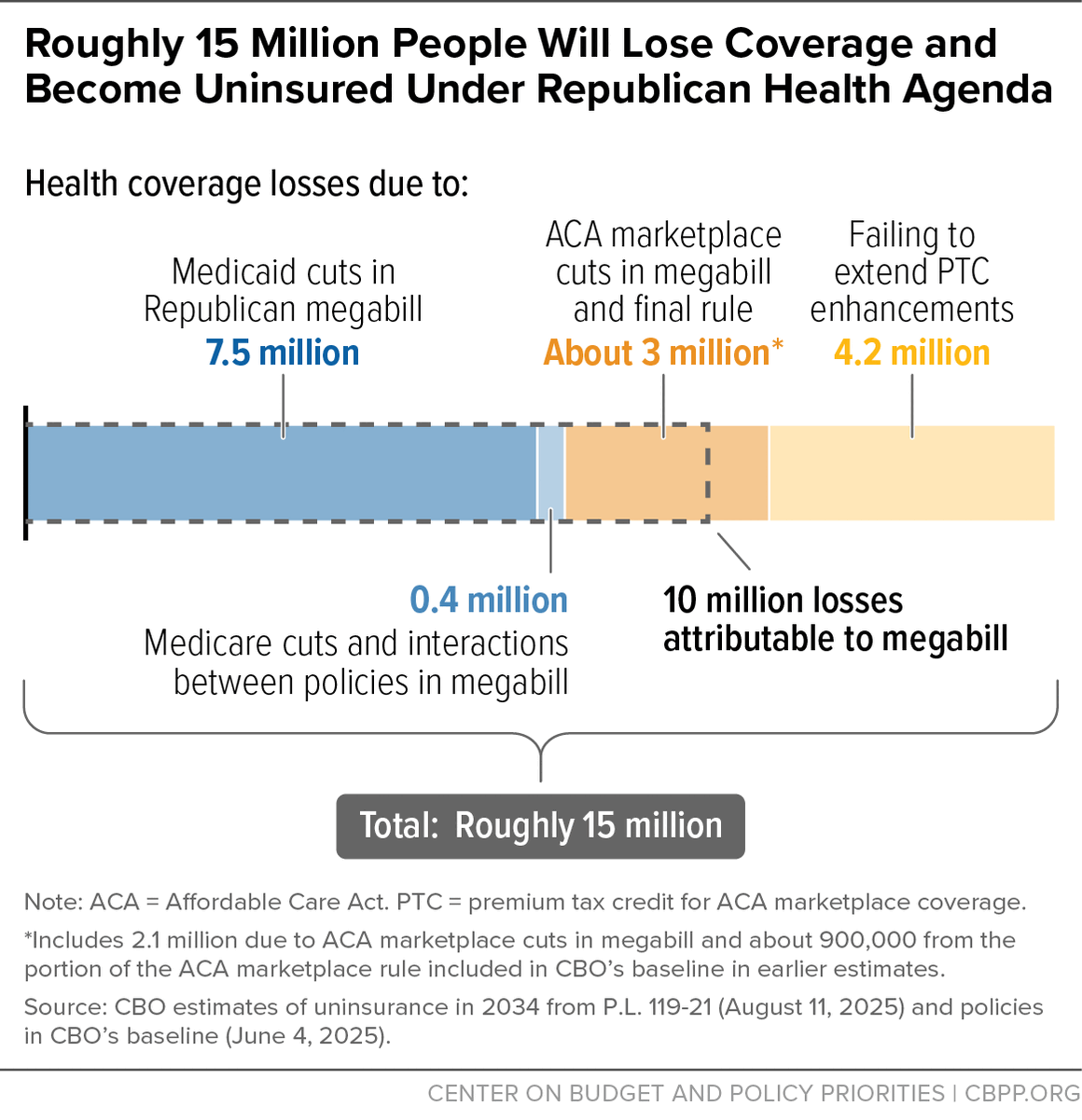
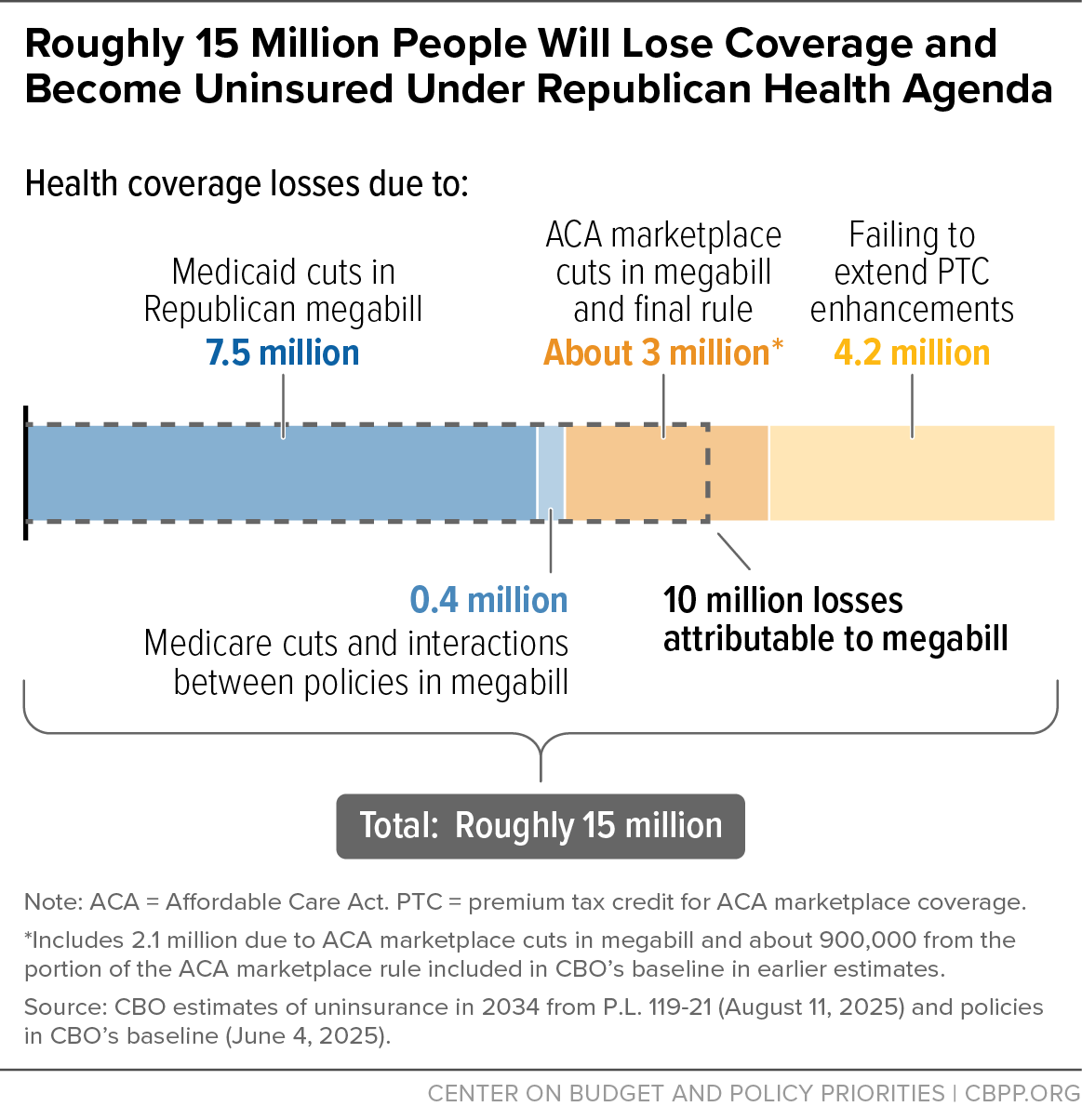
Health coverage cuts. The megabill cuts over $1 trillion from Medicaid and the Affordable Care Act (ACA) marketplaces. Roughly 15 million people are projected to lose health coverage and become uninsured by 2034 due to the combination of these cuts and the new law’s failure to extend premium tax credit enhancements for marketplace coverage and other harmful marketplace changes made by the Administration through regulation.
A major provision of the megabill will take Medicaid coverage away from people who don’t meet a harsh, red-tape-laden work requirement, including many people who meet the requirement or should be exempt but are caught up in a system too hard to navigate, as well as people who have been laid off. As a result, millions of people will be forced to defer needed care, face medical debt, or squeeze their food or rent budgets if they do get care.
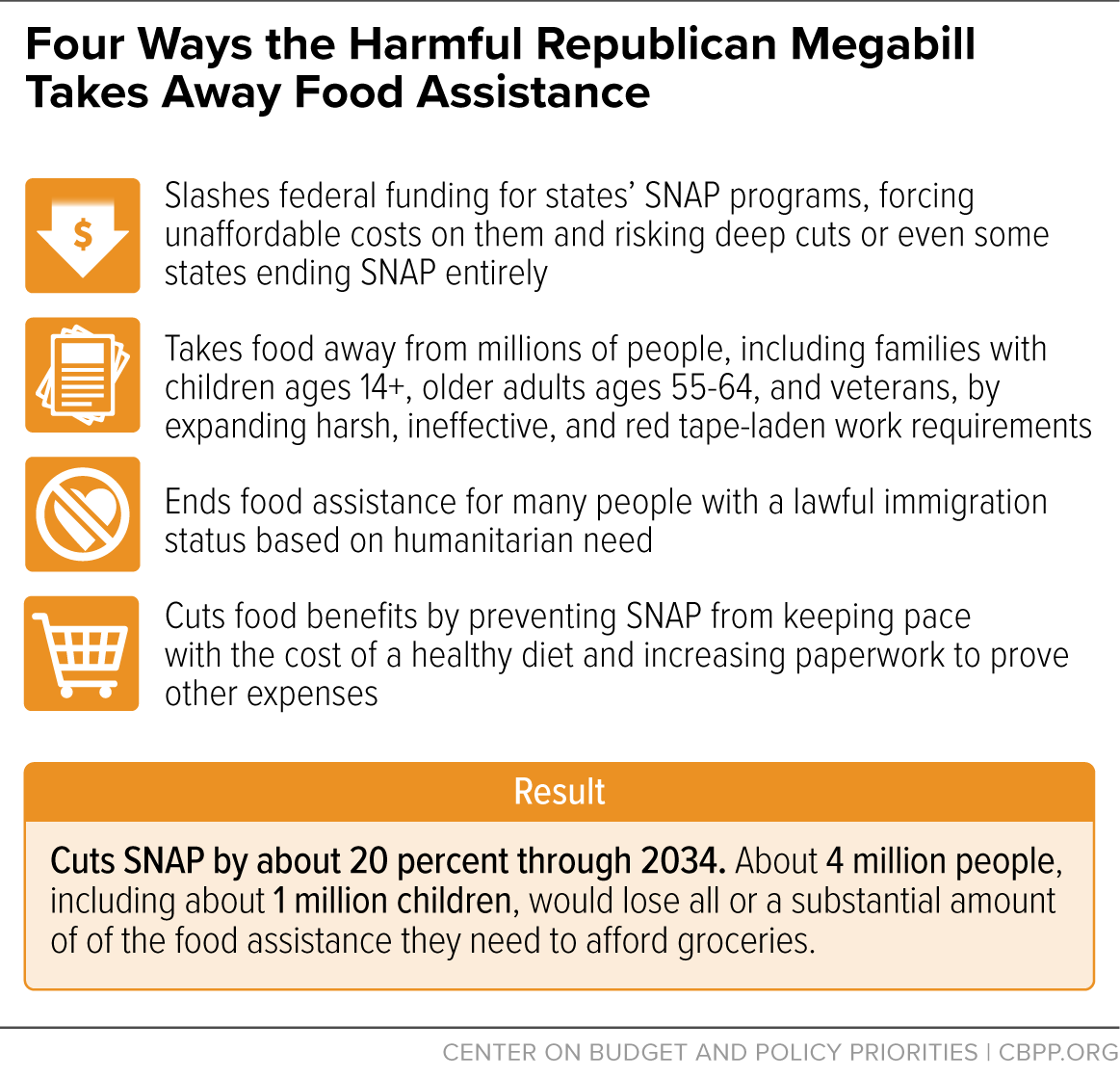
Food assistance cuts. The megabill cuts SNAP by $187 billion or about 20 percent by 2034, taking away help low-income households need to buy groceries. The centerpiece of the SNAP cuts is a structural change that cuts billions in federal funding for basic food benefits in most states and then requires those states to backfill the federal cut. For the first time in the 50-year history of the modern SNAP program, the federal government will no longer ensure that the lowest-income people, including children, older adults, veterans, and people with disabilities, in every state have access to the food assistance they need because states that refuse to pay the cost share could see the program end.
The megabill also expands SNAP’s harsh, ineffective, and paperwork-heavy work requirements to older adults, parents of many school-age children, and others, ensnaring millions more people in requirements that could cost them assistance buying groceries.
Shift in responsibilities from the federal to state governments. The megabill achieves federal budget savings by shifting responsibilities and costs from the federal government to state and local governments. In some ways it does so directly, such as by compelling states to partly finance SNAP benefits. Some Medicaid provisions, like limiting states’ use of taxes on health care providers to support Medicaid, mean that many states will have to come up with new sources of funding to maintain current eligibility, benefits, and/or provider payments, or to fund future increases in Medicaid costs.
Restrictions for lawful immigrants. In addition to funding the Administration’s large detention and deportation scheme, the megabill reserves some of its harshest cuts in health coverage and food assistance for immigrants living lawfully in this country. The bill will also hurt U.S. citizen children who will be denied the Child Tax Credit if at least one of their parents does not have a Social Security number. Together, these changes — as well as Administration efforts to scare people who remain eligible for assistance from accessing it — will leave many people in immigrant families less healthy, less able to buy food for their children, and less able to contribute to their communities.
Increase in student loan costs. The megabill makes it harder for struggling student loan borrowers to repay their loans. In particular, it spikes monthly payments for new borrowers in income-based repayment programs — including for the lowest-income borrowers, who will, for the first time, have to make payments even if their earnings are below the federal poverty line.
Clean energy cuts. The megabill cuts federal funding and tax incentives designed to promote clean energy by roughly $500 billion, which will increase households’ energy costs by an average of 13 percent or $280 per year by 2035, according to one estimate.[3]
High-end tax cuts. The megabill extends the expiring 2017 individual tax cuts and adds new tax cuts on top, such as increasing the amount that heirs of the largest estates can receive tax-free and adding highly skewed corporate tax breaks.
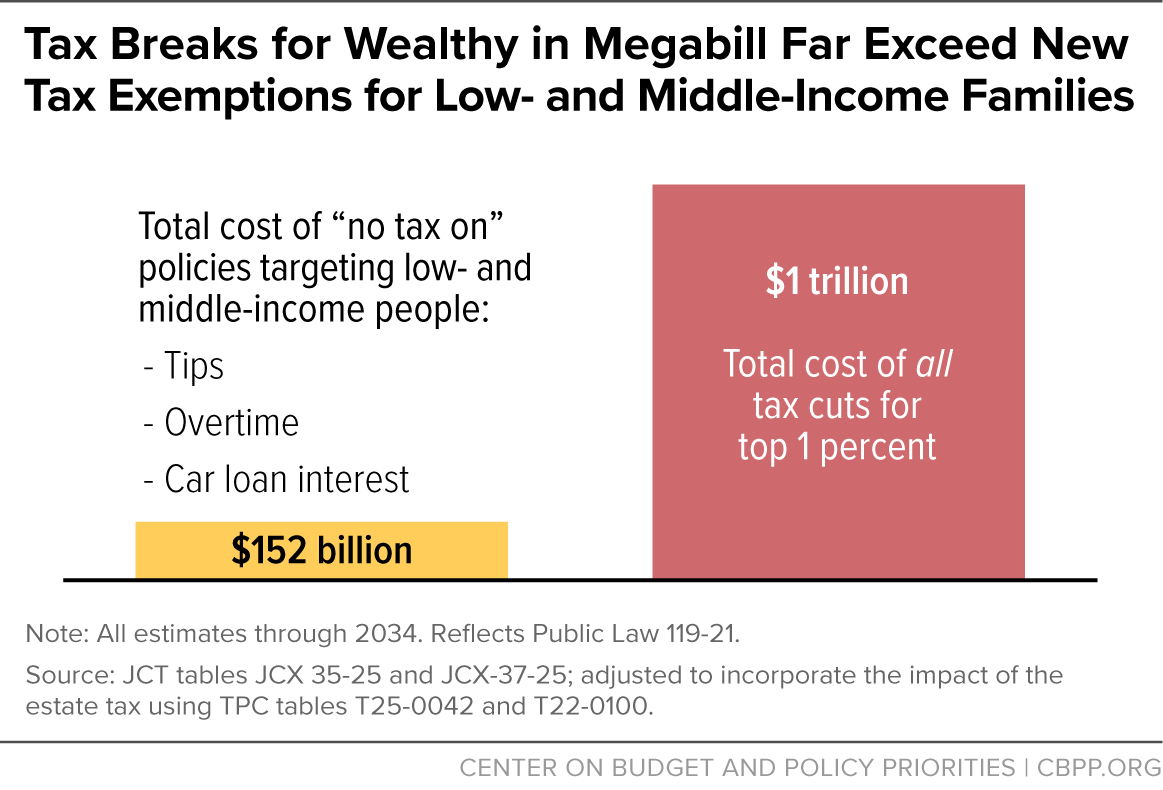
Megabill supporters have highlighted much smaller tax provisions exempting tipped income, overtime pay, and car loan interest payments from income taxes, but these account for just 3 percent of the new law’s tax cuts. Similarly, the law’s expansion of the Child Tax Credit leaves out 19 million children in lower-income families because their families do not earn enough to receive the full credit.
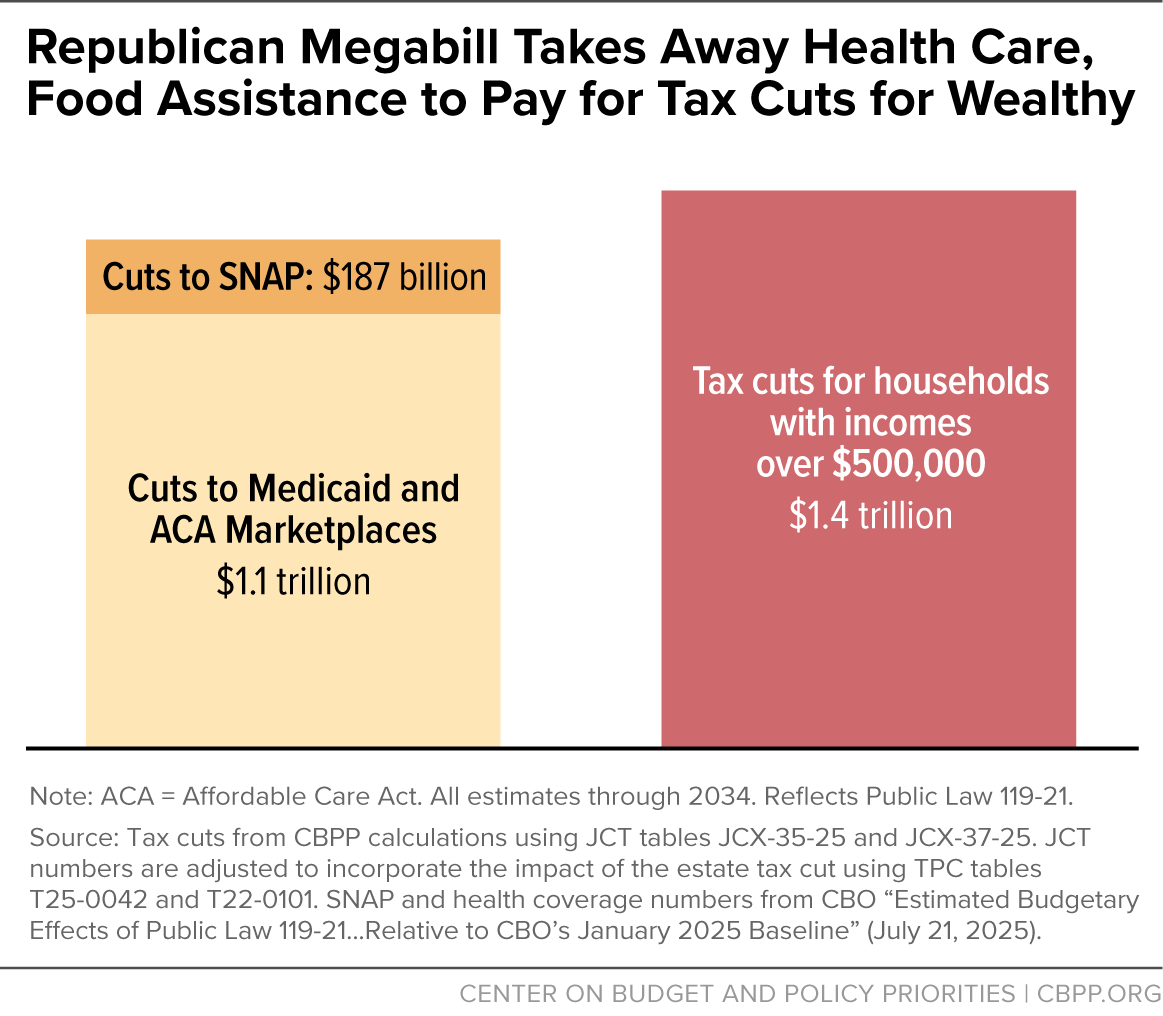
Meanwhile, households making over $500,000 will receive a total of $1.4 trillion in tax cuts from the megabill — an amount that exceeds the law’s cuts to health care and food assistance combined. (See Figure 1.) In other words, Congress could have passed a bill that had the same overall cost but did not cut Medicaid and SNAP if it had chosen not to cut taxes for the roughly 2 percent of households making over $500,000.
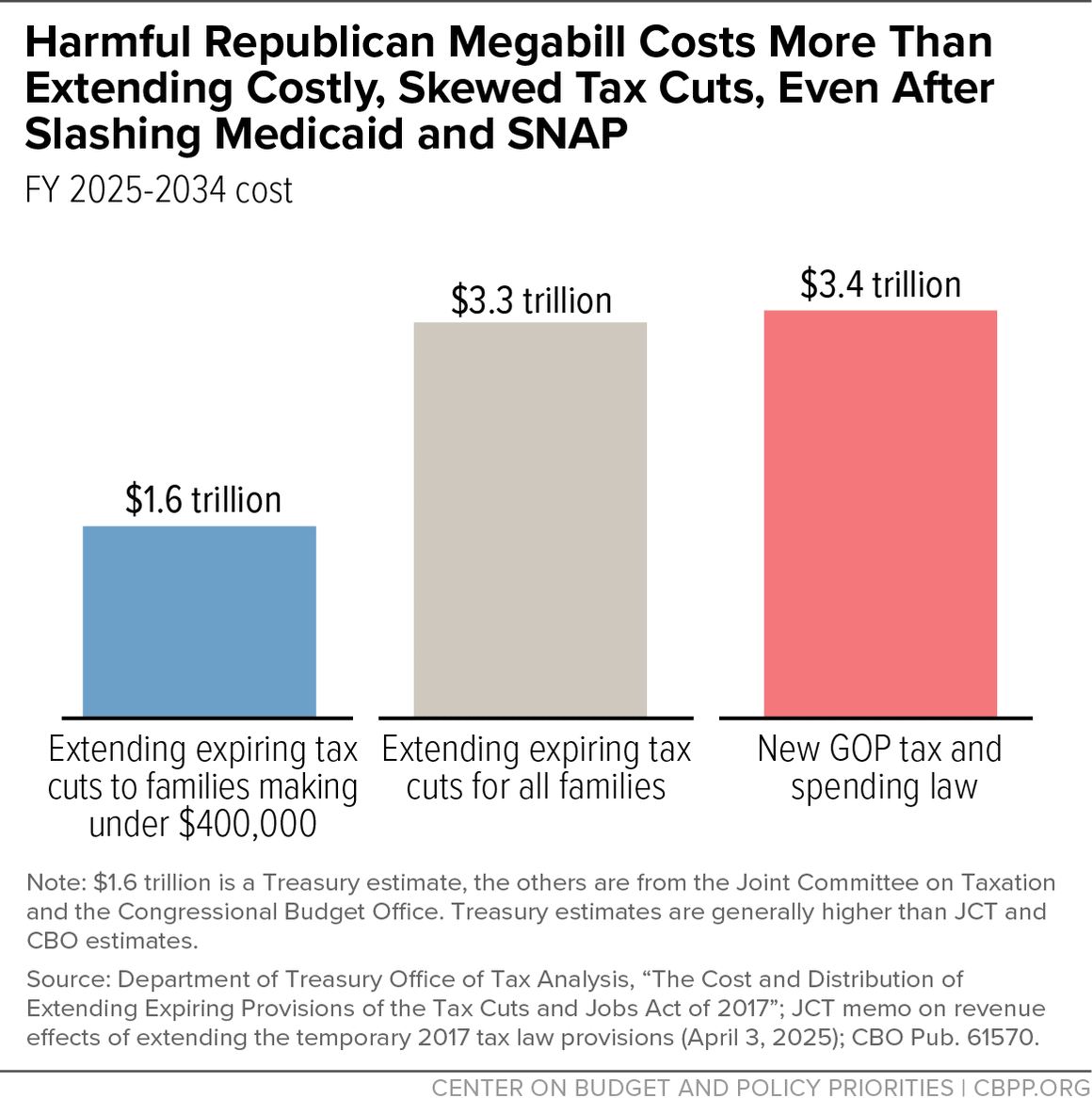
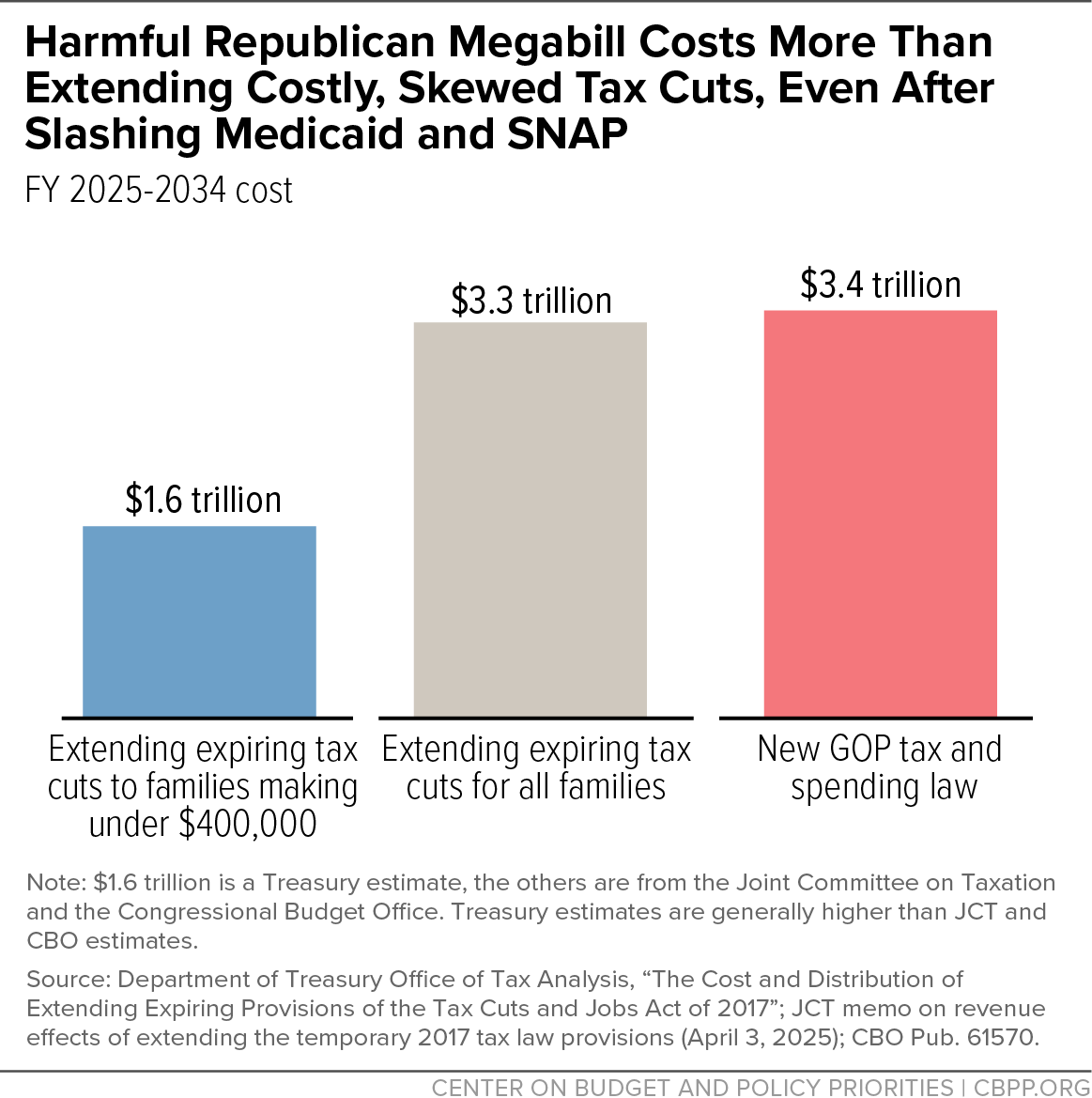
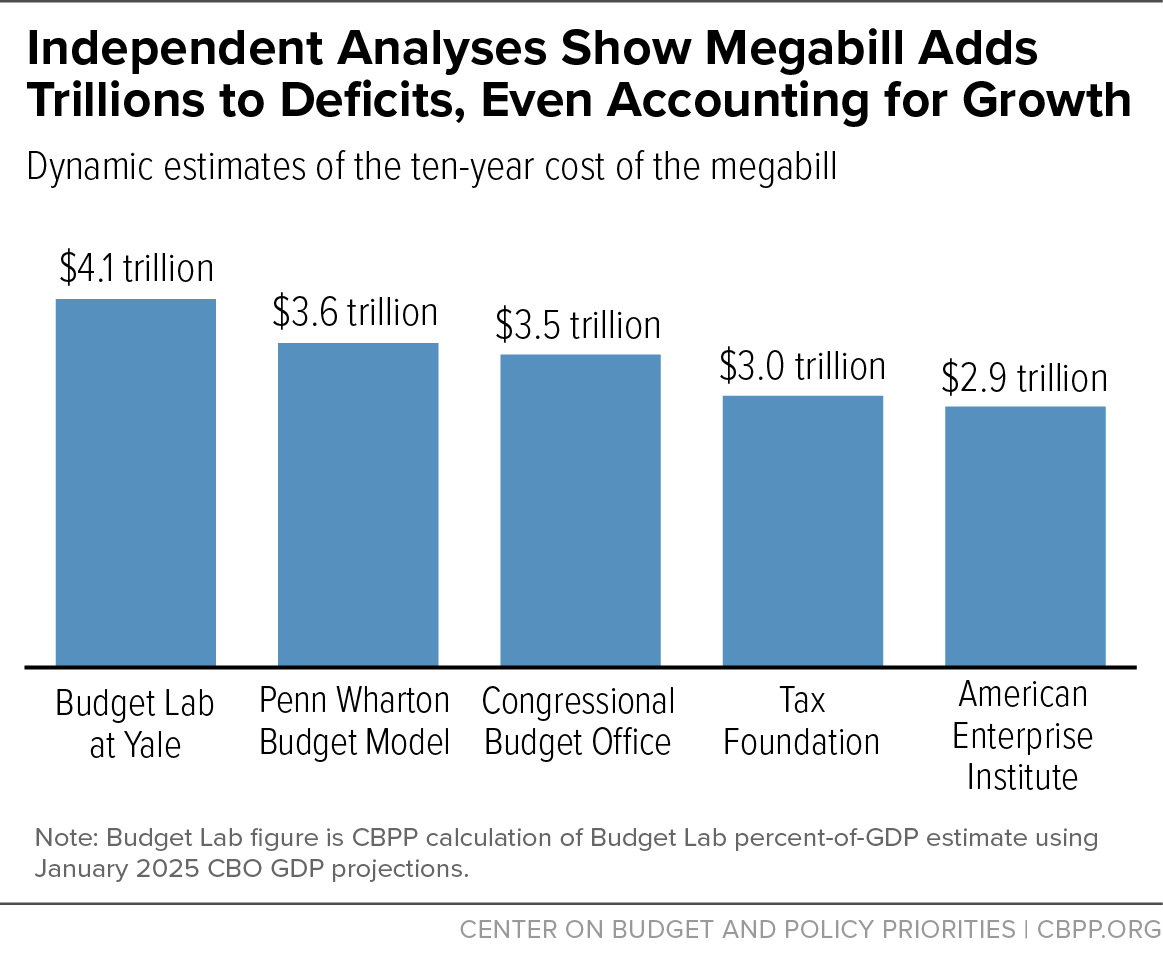
Bigger deficits and debt. The megabill will add $3.4 trillion to our deficits over ten years and $4.1 trillion to our debt, including interest payments on the additional borrowing. Proponents’ claims that it is fiscally responsible rest on implausible estimates of economic growth; a range of independent analyses, using a variety of analytical approaches, estimate that the new law will cost between $2.9 and $4.1 trillion after accounting for growth. A more plausible claim is that additional revenue from tariffs could offset much of the cost, but the combination of tariffs and the megabill leaves most households worse off.
Megabill Makes Low-Income People Worse Off to Finance Tax Cuts for Wealthy
A key question for any piece of legislation is whom it makes better off and whom it makes worse off. This type of distributional analysis has become central to tax policy debates, and several organizations have released analyses of the megabill’s $4.5 trillion in tax cuts. But analyses of its tax provisions alone provide an incomplete picture since the bill also includes enormous cuts to programs like Medicaid and SNAP. A pure tax analysis, for example, would show a family with a $100 tax cut as better off even if they lose health insurance and nutrition benefits worth thousands of dollars.
CBO has published a full distributional analysis of the megabill by income decile, including the effects of its changes to tax, nutrition, health, and student loan policy through 2034.[4] It finds that the new law will make households with incomes in the bottom 20 percent worse off, while providing the largest benefits in both dollars and as a percent of income to households with incomes in the top 10 percent. The megabill will reduce the incomes of households with incomes in the bottom 10 percent by an average of $1,200 (3.1 percent) a year over the period, while increasing the incomes of households with incomes in the top 10 percent by an average of $13,600 (2.7 percent).
These figures actually understate the harm that the megabill will cause low- and middle-income households. The new law, as written, adds $4.1 trillion to the federal debt; therefore, much of the income gain CBO shows for certain groups simply reflects increased federal borrowing, which ultimately must be financed with spending cuts and/or tax increases while raising interest rates in the interim. [5] In other words, the CBO distributional analysis reflects the lower taxes resulting from deficit-financed tax cuts but not the costs of the deficits that finance them.[6]
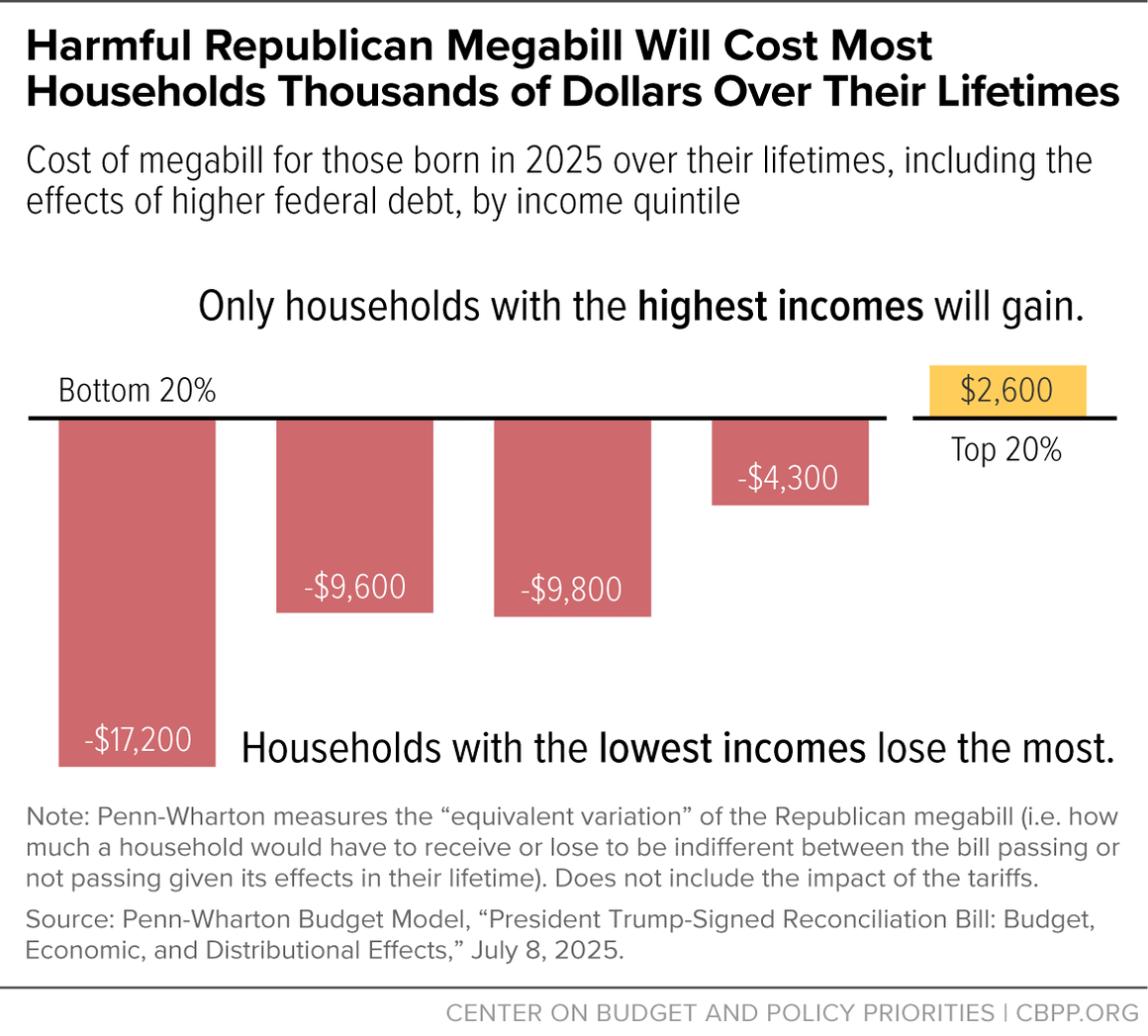
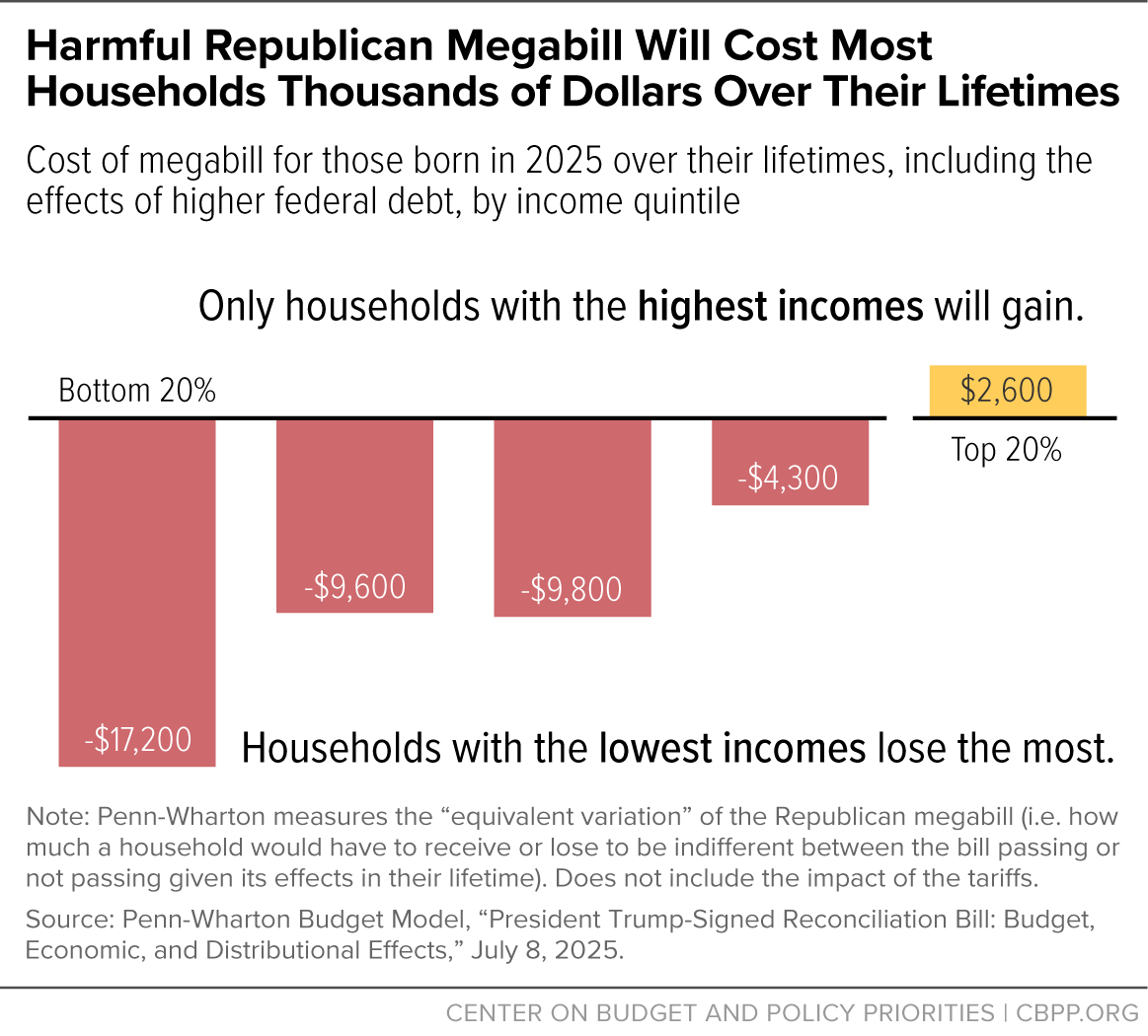
One analysis tries to take the costs of deficit financing into account. The Penn Wharton Budget Model finds that, in the long run, the megabill will make most households worse off because they will lose more from the spending cuts and negative economic effects of higher debt than they will gain from the tax cuts.[7] The effect grows over time. In fact, among children born today, the new law will make households with incomes in the bottom 80 percent worse off over their lifetimes. (See Figure 2.)
The Trump Administration argues that the law was part of a package that would reduce deficits because much of its cost will be covered by the sweeping tariffs the President has imposed via executive fiat.[8] But it is then only fair to consider the tariffs as part of the overall distribution of that package. Tariffs, one of the most regressive forms of taxation, function like sales taxes: they place a heavier immediate burden on families with low and moderate incomes than income taxes do since the tax rate does not increase with income and these families spend a larger share of their income than higher-income families.
The Budget Lab at Yale supplemented CBO’s distributional analysis of the megabill by adding the effects of the tariffs the Administration had imposed as of November 17, 2025. [9] It found that households with incomes in the bottom 70 percent are worse off under this fiscal agenda. (See Figure 3.)

15 Million People Projected to Lose Health Coverage
The megabill cuts health care funding by more than $1 trillion through 2034: over $900 billion from Medicaid and around $200 billion from Affordable Care Act (ACA) marketplace coverage.[10] Also, it failed to extend premium tax credit enhancements for marketplace coverage, which then expired at the end of 2025. (See box, “Expiration of Premium Tax Credit Enhancements Expire Is Driving Up Families’ Premium Costs.”) The combination of the law’s health care cuts, its failure to extend the tax credit enhancements, and other ACA marketplace changes by the Administration will result in roughly 15 million fewer people having health coverage in 2034, according to CBO estimates.[11] (See Figure 4.)
These health care cuts and coverage losses will cause people to lose access to preventive and primary care, care for life-threatening conditions, and treatments for chronic conditions.
Cuts to Medicaid
Nearly 70 million people with low incomes receive health coverage through Medicaid,[12] which covers roughly 2 in 5 of the nation’s children, 1 in 6 non-elderly adults, almost 1 in 6 adults 65 or older, and 2 in 5 non-elderly adults with disabilities.[13] CBO estimates that the megabill’s cut of more than $900 billion (17 percent in 2034) will result in 7.5 million people losing Medicaid coverage and becoming uninsured in 2034.[14]
The megabill’s most harmful Medicaid cut is the imposition of a harsh work requirement. Beginning in 2027, states must deny coverage to Medicaid applicants if their monthly income does not equal at least 80 hours times the federal minimum wage (which currently amounts to $580 per month) or if they are not able to document that they are already working (or participating in another qualifying activity) at least 80 hours per month. Similarly, states must terminate coverage for Medicaid enrollees if they cannot document that they are meeting the work requirement or have an allowable exemption. The provision applies to people aged 19 to 64 enrolled through the ACA’s Medicaid expansion, as well as to non-elderly adults in several non-expansion states with waiver-based, comprehensive coverage.[15]
Almost all Medicaid enrollees currently either work or should qualify for an exemption under the megabill, such as people who have a disability or are caring for dependent children aged 13 or younger.[16] Nevertheless, experience shows that a large share of enrollees are likely to lose coverage due to administrative burden and red tape. When Arkansas implemented similar work requirements, about 1 in 4 enrollees subject to them — many of whom were supposed to be exempt — lost coverage in only seven months in 2018 before a federal court halted the program.[17]
Meanwhile, research shows — and CBO previously concluded — that work requirements do not increase employment. Instead, they lead to large coverage losses that, in turn, force people to take on more medical debt, delay getting needed medical care, and delay taking medications.[18]
CBO estimates that 5.3 million adults will lose Medicaid and become uninsured by 2034 due to the new work requirement.[19] Many analysts think the number could be higher. We estimate that 9.9 million to 14.9 million people will be at risk of losing Medicaid coverage and will have to take action to stay enrolled.[20]
The work requirement is just one of several megabill provisions that use red tape to cut health coverage. The new law requires Medicaid expansion enrollees to renew their coverage every six months, instead of yearly. More frequent renewals will lead an estimated 700,000 people to lose coverage in 2034 — in many cases, not because they no longer qualify but because they didn’t receive a notice or didn’t complete the paperwork by the deadline, or because eligibility workers didn’t process their forms on time.[21] Similarly, the law blocks implementation of portions of two eligibility and enrollment rules that would simplify Medicaid enrollment, particularly for seniors and people with disabilities. The rules would not have expanded eligibility.[22] CBO estimates that blocking one of the rules will cause Medicaid enrollment among the lowest-income Medicare enrollees (those who are dually eligible for both programs) to drop by 800,000 people in 2034, exposing people to higher health care costs.[23]
The megabill also sharply limits the health-care-related taxes, assessments, or fees — often known as provider taxes — that every state but Alaska uses to raise state funds to help pay for Medicaid. States already had to comply with federal rules to ensure that the taxes are broad-based, uniformly imposed, and do not hold providers harmless. The revenue from these taxes plays a significant role in states’ ability to support the program overall.
The megabill substantially restricts this long-standing state revenue tool. It immediately bars states from instituting any new provider taxes or raising existing tax rates, codifies a new rule that will prohibit certain provider taxes in certain states, and requires states that adopted the ACA Medicaid expansion to phase down some of their provider taxes over time. As a result, many states will find it harder to fund their Medicaid programs. These states will have three choices: raise other taxes and fees to fill the gap, cut other state-funded public services, or shrink their Medicaid programs over time by cutting eligibility, benefits, and provider payment rates (or some combination of those approaches). CBO estimates that the number of people without health insurance will increase by 1.1 million in 2034 due to this change.[24]
These changes to provider taxes produced strong initial resistance from Senate Republicans who worried that the changes, along with the megabill’s other enormous cuts in health coverage, would devastate rural health care providers. To soften that resistance, the new law includes a one-time $50 billion “Rural Health Transformation Program” that will be allocated over five years. Half of the fund will go to all 50 states, while the other half will be distributed at the discretion of the Centers for Medicare & Medicaid Services’ (CMS) Administrator based on state applications that will be assessed on how well they align with CMS goals. The fund was sold as a way to help rural hospitals and other providers (like nursing centers and community health clinics) shoulder the burdens imposed by the megabill, but the funding will last only five years while the Medicaid cuts are permanent. Moreover, CMS has a great deal of discretion in allocating the funding and its guidance has been clear that the funding is not designed to backfill deep Medicaid cuts, providing no reason to believe it will significantly stem the tide of hospital closures.[25]
The megabill also directly raises Medicaid expansion enrollees’ out-of-pocket health care costs. It requires states to charge those with incomes just above the poverty line (about $16,000 year for an individual) new cost-sharing charges for many services when they go to the doctor.[26] This will take money out of the pockets of people with low incomes — many of whom may also face cuts in food assistance due to the new law — while encouraging them to defer needed care.
Cuts to ACA Marketplaces
The megabill not only fails to extend the premium tax credit enhancements that have made coverage far more affordable for more than 20 million people, but also cuts ACA marketplaces by around $200 billion through various provisions that will reduce health coverage by making it harder for millions of working people to enroll or stay enrolled.
For example, the law imposes new burdensome verification requirements and red tape that will make it harder for exchange enrollees to maintain coverage. It effectively eliminates special enrollment periods (SEPs) based on income by barring people from receiving premium tax credits if they use these SEPs. It eliminates caps on excess premium credit amounts that people must repay if their income for the year turns out to be higher than they had anticipated, exposing people whose circumstances change during the year to large, unexpected repayments. Finally, it cuts ACA subsidies for immigrants with legal status, as discussed below.
Millions of People Will Lose Some or All SNAP Food Assistance
Each month SNAP helps more than 40 million low-income people, including 16 million children (1 in 5 children in the country), 8 million seniors, and 4 million non-elderly adults with disabilities, afford a nutritionally adequate diet. The megabill cuts SNAP by $187 billion over ten years (more than 20 percent by 2034), which will affect all SNAP participants.[27] (See Figure 5.)
A centerpiece of the SNAP cuts is an unprecedented structural change to the program that requires states to pay part of food benefit costs. The federal government will no longer ensure that the lowest-income families with children, older adults, and people with disabilities in every state have access to the food assistance they need. (States already help shoulder SNAP administrative costs, and the megabill also cuts the federal reimbursement for such costs in half, from 50 percent to 25 percent.)
Most states will be required to pay 5 to 15 percent of food benefit costs starting in 2028 — shares that translate into real costs in the context of state budgets. In Kansas, for example, a 5 percent match ($20 million) is more than double state spending on the Office of Veterans Services, while in North Carolina, a 15 percent match ($438 million) is more than 50 percent larger than state spending on child development and early education.[28]
If states prove unable or unwilling to make up for these new federally imposed costs by raising additional revenue from taxes and fees, they will have three choices: cut services elsewhere in their budget, like education and infrastructure; shrink their SNAP program, such as by restricting eligibility or making it harder for people to enroll; or opting out of the program entirely, terminating food assistance in the state.
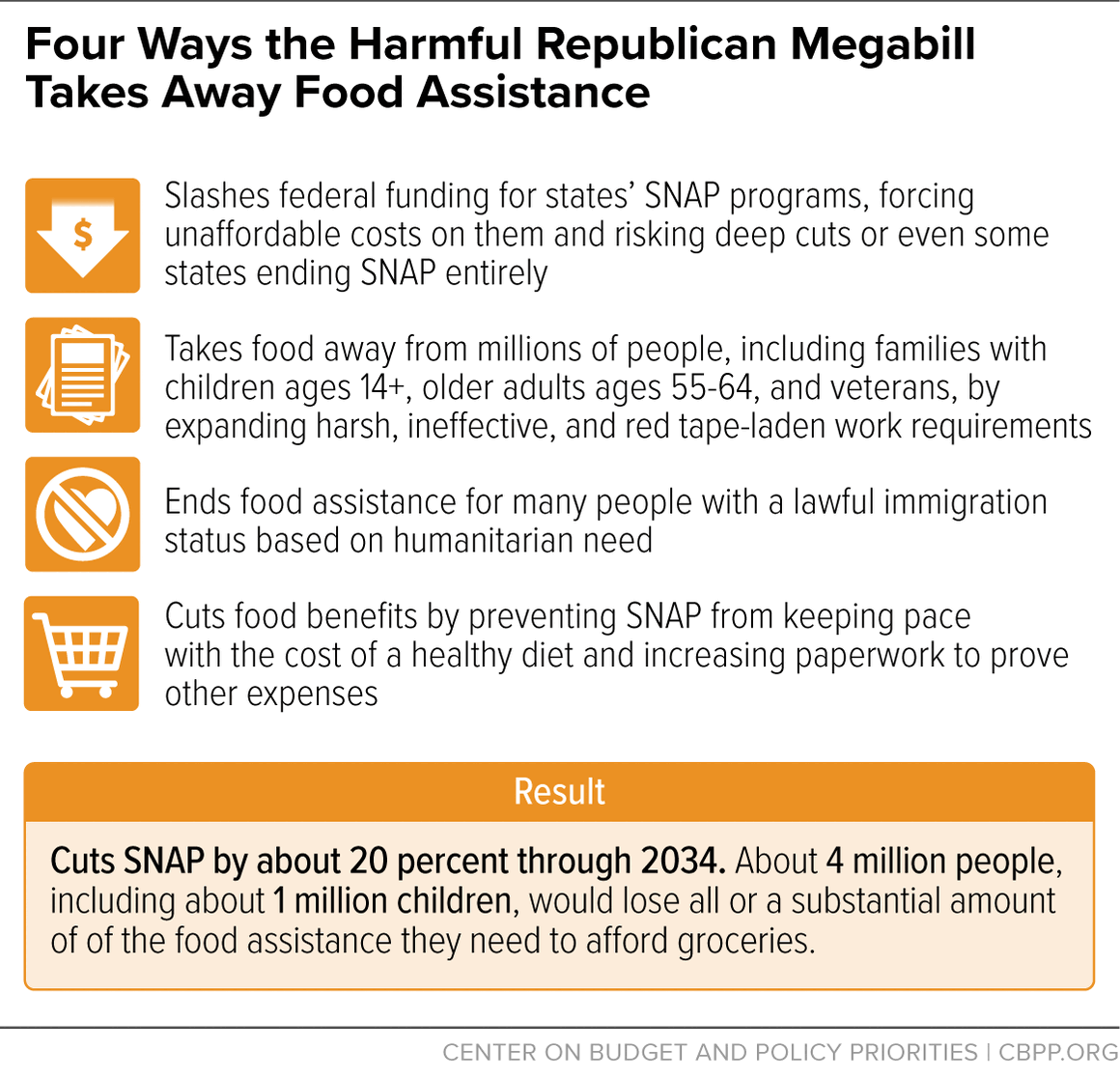
Another significant megabill cut to SNAP is the expansion of punitive work requirements. Before the megabill, most non-elderly, non-disabled adults without children in their homes could not receive SNAP benefits for more than three months out of every three years if they didn’t document they were working at least 20 hours per week or prove they qualified for an exemption. Effective upon enactment on July 4, 2025, the megabill expanded this restriction to older adults ages 55-64, parents whose youngest child is at least 14 years old, veterans, and others, while also significantly limiting states’ flexibility to seek waivers for areas with poor economic conditions.
Evidence shows that these work requirements do not improve employment outcomes.[29] Instead, they take away food assistance due to red tape from many people who already work or should be exempt, as well as taking help away from people who are out of work. CBO has indicated that about 2.4 million people will be cut from SNAP under the provision in a typical month, including roughly 1 million people who live where jobs are scarce, 800,000 adults aged 55-64 who don’t live with children, and 300,000 parents, grandparents, and other caregivers living with children 14 years and older. The new law also cuts off more than 300,000 veterans, people experiencing homelessness, and former foster youth by ending these groups’ exemptions from the work requirement, which were put in place in a bipartisan bill in 2023.[30]
The megabill also takes SNAP away from certain immigrants in the U.S. lawfully, as discussed below.
Finally, the megabill shrinks SNAP benefits of people who retain SNAP coverage. It cuts food benefits by an average of $100 per month for about 600,000 low-income households — which contain more than 500,000 children — by eliminating an administrative simplification that many households use to calculate their utility expenses.[31] Over time, the new law will also cut food assistance for all 40 million participants and make SNAP benefits increasingly inadequate to afford a healthy diet by restricting future updates to the Thrifty Food Plan, the basis for SNAP benefits.
Shifting Responsibilities From Federal to State Governments
One of the prime ways the megabill achieves budgetary savings is by shifting considerable responsibilities from the federal government to state governments. This represents the federal government stepping back from its responsibility to help struggling families afford food and health care. State governments face difficult choices about how to respond — do they take steps to mitigate the damage to essential public services and reduce harm to people and families, or do they eschew mitigation options as their residents lose food assistance and health coverage?
The CBO estimates of how many people will lose nutrition assistance and health care incorporate CBO’s best guess of how states will answer these questions. The damage to people and communities could be larger than CBO estimated if states completely refuse to accept these new responsibilities, or it could be smaller if states commit resources to contain the damage. The decisions states make over the coming months and years will ultimately determine the megabill’s impact.
The prime example of these new responsibilities is that states, as noted above, must now pay part of SNAP food benefit costs starting October 2027 (fiscal year 2028) — added costs that would total into the hundreds of millions of dollars per year in most states.[32] States that refuse to pay these costs could have to end their SNAP programs altogether. At the same time, the megabill will also squeeze state budgets by making it harder for many states to fund their share of Medicaid costs over the next few years by imposing strict limits on provider taxes.
Especially over the long run, considerable indirect costs will also accumulate from the megabill’s cuts in health coverage as well as the failure to extend the enhancements to premium tax credits, when people who have lost coverage show up in local emergency rooms, requiring costly uncompensated care. Meanwhile, a number of states are already grappling with fiscal fallout from the megabill’s tax changes, such as the new deductions for certain forms of income and faster depreciation schedules, due to technical “conformity” linkages between state and federal tax codes.[33]
Because states (and localities) must balance their budgets each year, taking on additional costs requires them to either raise an equal amount of revenue or cut funding for programs and services.
Some of the megabill’s provisions, like new or expanded work requirements and more frequent eligibility renewals, will take health coverage away from people who need it and, in many cases, otherwise remain eligible. Fiscal pressures could tempt some policymakers to oppose committing the resources needed to reduce the number of people who lose coverage from these provisions, since fewer Medicaid enrollees means lower state budget costs. This would be extremely misguided — while the state may realize budget savings, state residents would lose health coverage they need to stay healthy and contribute to their communities, and indirect costs such as uncompensated care would rise.
The risk of policymakers taking that approach is real. State and local finances face considerable pressures apart from the megabill: softening revenues, the recent expiration of pandemic-era fiscal aid, rising natural disaster costs and uncertainty about the availability of federal disaster aid, and the swelling price tag for regressive policies that many states have adopted in recent years, such as costly income tax cuts and school voucher programs.[34]
The combination of fiscal pressures states face and the megabill’s shift of responsibility will force states to make tradeoffs. Nevertheless, the soundest approach for lawmakers committed to meeting their constituents’ needs would be to raise new resources to blunt the impact of the law on low-income families’ ability to access medical care, groceries, and other vital services.[35]
Many Immigrants Lawfully in U.S. Will Lose Assistance
An anti-immigrant focus runs throughout the megabill, which singles out immigrants with lawful status and their families for particularly cruel restrictions on assistance. The new law provides more than $170 billion in additional funding for immigration detention and border enforcement.[36] The Administration’s deportation dragnet is separating families, harming immigrants and others who are being swept up by harsh Administration policies and practices, and inflicting violence on entire communities.
Congressional Republicans claim that the immigrants whose food assistance and health care have been stripped away are people without a documented immigration status, but in reality, people who lack documentation already didn’t qualify for these benefits. Instead, the megabill will take away food assistance through SNAP and affordable health coverage through Medicare, Medicaid, CHIP, and the ACA marketplaces from people living lawfully in the United States.
In particular, people granted humanitarian protection will be barred from these programs, including refugees, people granted asylum, and certain victims of domestic violence or labor or sex trafficking, among others living lawfully in the U.S. This is a stark departure from our nation's long-standing, bipartisan commitment to people fleeing violence and persecution.
- Health coverage: The megabill takes away health coverage from many immigrants living lawfully in the U.S. by disqualifying most groups outside of those with lawful permanent resident status (and a few other groups that remain eligible) from receiving premium tax credits for marketplace coverage and from receiving Medicare, and by further limiting the immigration statuses that are eligible for Medicaid or CHIP with a federal match. Refugees and asylees, among others with humanitarian protection, are ineligible under the megabill.
- Nutrition assistance: The megabill denies SNAP food assistance to many immigrants living lawfully in the U.S. who have been granted humanitarian protection. (People who lack documentation already are ineligible for SNAP.) CBO estimates that 90,000 people living lawfully in this country will lose an average of $210 per month in food assistance in a typical month under the new law.[37]
- Child Tax Credit: The 2017 tax law newly required each child claimed for the Child Tax Credit to have a Social Security number, which blocked even children who came to the United States at a very young age from receiving this support. The megabill extends that requirement and goes a step further, taking away eligibility from children who are U.S. citizens or have a lawful immigration status unless at least one of their parents also has a Social Security number. One estimate projects that roughly 2.7 million children may fall within this category.[38]
At the same time, the Trump Administration is taking steps to terminate lawful status for hundreds of thousands of people granted humanitarian parole, Temporary Protected Status holders, and others who have sought refuge in this country. The combination of these changes and the megabill’s new immigration-related restrictions will leave many people in immigrant families less healthy, less able to afford food for themselves and their children (who are often U.S. citizens), and less able to contribute to their communities.
Student Loan Changes Hurt Borrowers With the Lowest Incomes
The megabill also restructures student loan repayment plans in a manner that will spike millions of borrowers’ monthly payments, resulting in $270 billion in savings that help finance its tax cuts. In particular, it consolidates all income-based repayment plans for new borrowers — plans that help borrowers with lower incomes relative to their debt levels keep their payments manageable — into a single Repayment Assistance Plan (RAP) that requires far higher monthly payments than other income-based repayment plans.[39]
Most concerningly, the RAP abandons the “income protection” approach featured in all other income-based repayment plans, which shields a certain amount of a borrower’s income from being considered in calculating their payments. All previous income-based repayment plans only calculated the payments based on the borrower’s income above at least 100 percent of the federal poverty level (about $16,000 for an individual); the SAVE plan introduced by the Biden Administration based payments on income exceeding 225 percent of the federal poverty level.
Under the RAP, in contrast, even the lowest-income new borrowers will have to make payments. Abandoning income protection directly undermines the point of income-based repayment, where the monthly payments must actually be affordable.
The result of the new RAP formula is higher monthly payments across the board. For example, a single earner making $32,000 annually, who would have faced no monthly payment under the SAVE Plan, will owe $80 a month ($960 a year) under the RAP formula.
The RAP will also ensnare new borrowers with persistently low incomes into longer repayment periods. All previous income-based repayment plans set a maximum repayment term of 10-25 years — if someone makes the monthly payments for that entire period but without eliminating the debt, the remaining amount is forgiven. The megabill extends that period to 30 years. The group that will enter this three-decade debt trap is new borrowers whose incomes remain low for their entire lives — many making less than $10,000 a year — and in many cases who do not complete their degree.[40]
Rollback in Climate and Energy Progress Will Hurt Families, Communities
In addition to its massive cuts in Medicaid and SNAP, another key way the megabill offsets part of the cost of its tax cuts is by cutting tax credits and other investments designed to promote clean energy by roughly $500 billion through 2034. Those cuts — including more than $280 billion in clean energy tax credits, $170 billion for efforts to adopt less-polluting vehicles, and over $13 billion in funding for climate-related programs enacted in the 2022 Inflation Reduction Act (IRA) — will have negative impacts on households and the broader economy.
First, the cuts will raise energy costs for households and businesses at a time when energy demand is projected to grow, especially in the face of growing artificial intelligence-related energy demands. By terminating clean energy tax credits prematurely, the megabill will reduce the supply of solar and wind energy, resulting in higher electricity prices. The new law’s funding cuts for energy efficiency and clean energy programs will also increase electricity prices, while its cuts to electric vehicle funding and termination of vehicle regulations will result in higher demand for gasoline, increasing its price. One estimate projects that households will face a 7.5 percent increase in household energy bills by 2030, or $165 per year, rising to a 13 percent increase, or $280 per year, in 2035.[41]
These cuts will also reduce economic opportunity, especially in vulnerable communities. The IRA’s clean energy tax credits have spurred new investment and created new economic opportunities across the country: three-quarters of private-sector investments in clean energy following the IRA’s enactment occurred in counties with household incomes below the national median, and clean energy investment doubled in communities connected to fossil fuel industries or polluted by industrial activity, which are predominantly in rural areas.[42] The megabill’s cuts threaten these investments. The new law could result in a decline of well more than half in new clean energy capacity through 2035, relative to baseline.[43]
Megabill Doubles Down on Costly, Regressive 2017 Tax Cuts
The megabill’s cuts of $1.3 trillion to nutrition assistance and health care were designed to partially offset the cost of its $4.5 trillion in tax cuts. Those tax cuts are heavily tilted to the wealthy. Put another way, the groups that will bear the largest burden of the program cuts will not be the main beneficiaries of the tax cuts.

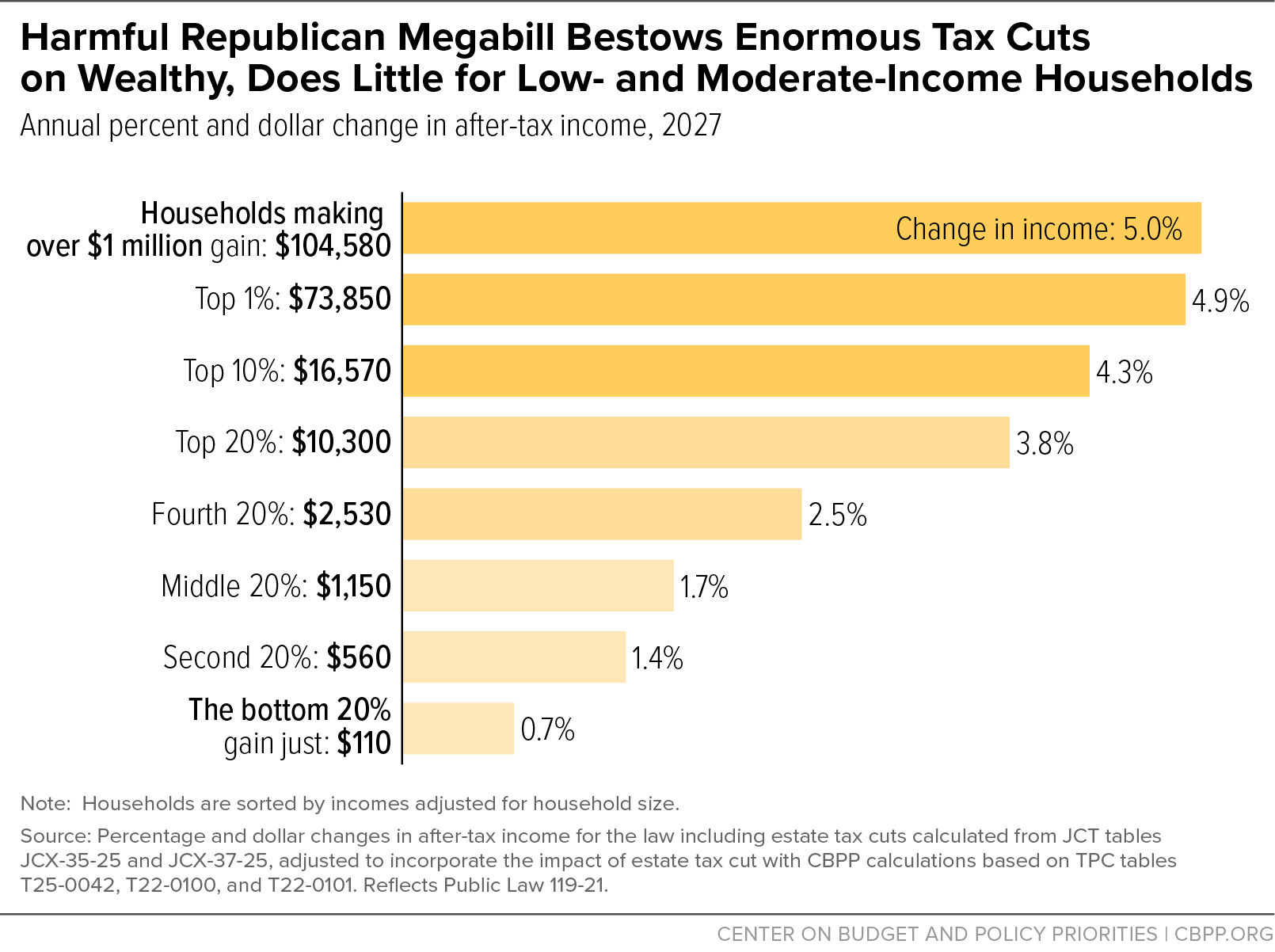
Households with incomes in the top 1 percent will receive tax cuts roughly three times the size of those for households with incomes in the bottom 60 percent, measured as a share of after-tax income. (See Figure 6.) The 1.2 million households with annual incomes above $1 million will receive more total tax cuts than the 127 million households with incomes below $100,000.
High-Income Tax Cuts Go Beyond 2017 Tax Law
Several megabill provisions primarily or exclusively benefit the highest-income households:
- The new law increases the amount a wealthy couple can pass on tax-free to their heirs to $30 million, $1.7 million more than under a simple extension of the 2017 law. Because of the large exemption, fewer than 1 in 1,000 estates are wealthy enough to owe any estate tax.
- The new law extends the 2017 law’s deduction for “pass-through” business income, which is taxed on the business owner’s individual income tax returns. More than half of the deduction’s benefits go to owners with annual incomes over $1 million.
- The new law extends the 2017 law’s across-the-board cuts in individual income tax rates, which benefit the highest-income families the most. For example, a married couple with $1 million in taxable income receives a $32,200 tax cut from the rate cuts alone, while a married couple with $50,000 receives just $790. And the new law further bolsters the tax rate cuts for the highest earners by weakening the Alternative Minimum Tax, which was designed to ensure that higher-income people who take large deductions and other tax breaks pay at least a minimum level of tax.
The new law increases the amount of state and local taxes (SALT) that households can deduct, from $10,000 under the 2017 law to $40,000 (including retroactively for tax year 2025).[44] This gives a married couple making $500,000 a $7,200 tax cut on top of the other tax cuts they will receive from the megabill, though the increase phases out for households over $500,000.
This is but one example of why the megabill’s cuts to health coverage and food assistance were an unnecessary policy choice. By simply extending the $10,000 SALT cap rather than increasing it, congressional Republicans would have reduced the megabill’s cost by $140 billion, or an amount equal to 75 percent of the cut to SNAP.[45]
- The new law reverses most of the business tax increases that congressional Republicans added to the 2017 tax law to partially offset the cost of its large, permanent cut in the corporate tax rate, but it leaves the corporate rate cut in place. For example, it reverses a 2017 law requirement that businesses amortize their research and experimentation costs over time instead of immediately expensing them. [46] Retaining the corporate rate cut while gutting the increases that helped pay for it gives another windfall to corporate shareholders and adds around $700 billion to the bill’s cost — an amount equal to over 75 percent of the Medicaid cuts in the megabill.[47]
Tax Benefits for Low- and Moderate-Income Families Much Smaller Than Advertised
Congressional Republicans have framed the megabill’s tax benefits as targeted to families with low or moderate incomes, emphasizing provisions such as its tax exemptions for tips and overtime pay and increase in the Child Tax Credit maximum. These benefits, however, are modest.
The new law as a whole only gives a $610 average tax cut in 2027 to households with incomes in the bottom 60 percent of the distribution, amounting to a 1.5 percent increase in after-tax income. The highly touted tax breaks are dwarfed by the law’s tax cuts for the wealthy. The law’s exemptions for tips, overtime pay, and auto loans will cost $152 billion through 2034, while the tax cuts just for the highest-income 1 percent will cost $1 trillion. (See Figure 7.)

The megabill’s new tax breaks are also ineffective at helping low-paid workers. Fewer than 5 percent of low-paid workers receive any tips, and about a third of tipped workers earn too little to pay federal income taxes so won’t benefit from the new tax break. As a result, well over 97 percent of low-paid workers will receive no benefit from this provision.[48] Policymakers have far better ways to boost the incomes of low-paid workers; expanding the Earned Income Tax Credit, for example, would help not only tipped workers like waiters and hairdressers but also security guards, home health aides, and janitors.
Similarly, the megabill’s expansion of the maximum Child Tax Credit — from $2,000 under a simple extension of the 2017 tax law to $2,200 for 2025, indexed to inflation thereafter — does little to nothing for 19 million children whose families don’t have enough income to qualify for the full $2,200 credit. The vast majority of them, 17 million children, will get nothing at all from the megabill changes.[49] A single parent with two children earning $16,000 a year as a home health aide gets no increase in her Child Tax Credit under the new law, while a married couple with two children earning $400,000 a year receives the full $400 increase.
There is bipartisan support for helping families whose incomes are too low to receive the full Child Tax Credit. In 2024, 169 House Republicans voted for legislation championed by Ways and Means Chair Jason Smith and Senate Finance Committee Chair Ron Wyden that would have increased the credit for most of the children who didn’t qualify for the full credit. But congressional Republicans crafting the megabill chose not to include these children in their Child Tax Credit provision.
Megabill Worsens Long-Term Fiscal Outlook
CBO estimates that the megabill will cost $3.4 trillion through 2034, adding $4.1 trillion to the debt after including the additional interest payments from more borrowing.[50] As Figure 8 shows, simply extending the 2017 tax law’s expiring provisions for families, without any cuts to Medicaid and SNAP or other offsets, would have cost slightly less, and extending the 2017 tax cuts for the 98 percent of households making under $400,000 would have cost far less.
Independent modelers have found that the megabill’s cost, after accounting for its impact on economic growth, ranges between $2.8 to $4.1 trillion. Multiple organizations have found that the new law’s economic effects actually increase its price tag; the Budget Lab at Yale and the Penn Wharton Budget Model, for example, both find that the law is more costly in the long run ($4.1 trillion and $3.6 trillion, respectively) because the increase in deficits and ensuing rise in interest rates will slow economic growth.
CBO estimates that the megabill will modestly increase economic growth but still finds that it costs more after incorporating its economic effects because the resulting higher interest rates from increased borrowing will increase the federal government’s interest burden on its existing debt. In addition, several conservative analysts, including the Tax Foundation and Kyle Pomerleau of the American Enterprise Institute, find that the new law costs trillions even after accounting for a positive impact on economic growth.[51]
Proponents of the megabill have ignored these independent analyses of its cost, only relying on a White House Council of Economic Advisers (CEA) analysis of an earlier version of the bill. It estimated the bill would cost $3.3 trillion before accounting for its effects on the size of the economy but that those effects would be so positive as to reduce its cost to $1.5 trillion. The CEA analysis relied on several non-credible assumptions, including that trillions of additional borrowing will have no effect on interest rates. (See Figure 9.)

Also, it is worth noting that CBO’s $3.4 trillion cost estimate for the megabill assumes policymakers will not extend several provisions that are scheduled to sunset in 2028 or 2029, such as the exemption for tips and increase in the SALT cap. CBO estimates that extending these provisions without offsets would increase the new law’s cost to $4.2 trillion, or nearly $5 trillion after accounting for interest costs. The danger exists that megabill proponents will seek to employ the same strategy to extend these provisions that they used when they argued, successfully, that the 2017 tax cuts must be extended and even expanded, and that Congress should help pay for them by cutting programs that low- and moderate-income people rely on.
End Notes
[1] Congressional Budget Office (CBO), “How the 2025 Reconciliation Act (Public Law 119-21) Will Affect the Distribution of Resources Available to Households,” August 11, 2025, https://www.cbo.gov/interactive/2025-reconciliation-act.
[2] Yale Budget Lab, “Combined Distributional Effects of the One Big Beautiful Bill Act and of Tariffs,” December 2025 update, https://budgetlab.yale.edu/research/combined-distributional-effects-one-big-beautiful-bill-act-and-tariffs-0.
[3]Jesse Jenkins, Jamil Farbes, and Ben Haley, “Impacts of the One Big Beautiful Bill on the US Energy Transition,” Princeton University ZERO Lab, July 3, 2025, https://zenodo.org/records/15801701.
[4] CBO, op. cit.
[5] CBO, “Effects on Deficits and the Debt of Public Law 119-21 and of Making Certain Tax Policies in the Act Permanent,” August 4, 2025, https://www.cbo.gov/system/files/2025-08/61466-DebtService.pdf.
[6] Greg Leiserson, “Distributional Analysis as Welfare Analysis,” Washington Center for Equitable Growth, June 5, 2020, https://equitablegrowth.org/working-papers/distribution-analysis-as-welfare-analysis/.
[7] Penn Wharton Budget Model, “President Trump-Signed Reconciliation Bill: Budget, Economic, and Distributional Effects,” July 8, 2025, https://budgetmodel.wharton.upenn.edu/issues/2025/7/8/president-trump-signed-reconciliation-bill-budget-economic-and-distributional-effects. Note that the analysis is relative to a future counterfactual where the megabill did not become law. Children born today will likely be better off than previous generations because of underlying economic growth, but the megabill will make most of them poorer than they otherwise would have been.
[8] Council of Economic Advisers, “The One Big Beautiful Bill Slashes Deficits, National Debt While Unleashing Economic Growth,” June 30, 2025, https://www.whitehouse.gov/articles/2025/06/the-one-big-beautiful-bill-slashes-deficits-national-debt-while-unleashing-economic-growth/.
[9] Yale Budget Lab, op. cit.
[10] CBO, “Public Law 119-21, to Provide for Reconciliation Pursuant to Title II of H. Con. Res. 14 Title VII, Finance, Subtitle B, Health, Chapter 1, Medicaid,” July 4, 2025, https://www.cbo.gov/publication/61837; CBO, “Estimated Budgetary Effects of Public Law 119-21, to Provide for Reconciliation Pursuant to Title II of H. Con. Res. 14, Relative to CBO’s January 2025 Baseline,” July 21, 2025, https://www.cbo.gov/publication/61570.
[11] CBPP, “By the Numbers: Harmful Republican Megabill Will Take Health Coverage Away From Millions of People and Raise Families’ Costs,” August 27, 2025, https://www.cbpp.org/research/health/by-the-numbers-harmful-republican-megabill-will-take-health-coverage-away-from.
[12] Centers for Medicare & Medicaid Services (CMS), “September 2025 Medicaid & CHIP Enrollment Data Highlights,” December 2025, https://www.medicaid.gov/medicaid/program-information/medicaid-and-chip-enrollment-data/report-highlights.
[13] Allison Orris and Gideon Lukens, “Medicaid Threats in the Upcoming Congress,” CBPP, December 13, 2024, https://www.cbpp.org/research/health/medicaid-threats-in-the-upcoming-congress.
[14]CBO, “Public Law 119-21, to Provide Reconciliation Pursuant to Title II of H. Con. Res. 14 Title VII, Finance, Subtitle B, Health, Chapter 1, Medicaid,” October 28, 2025; CBO, “The Budget and Economic Outlook: 2025 to 2035,” January 17, 2025, https://www.cbo.gov/publication/60870.
[15]Jennifer Wagner, Symonne Singleton, and Maani Stewart, “A Guide to Reducing Coverage Losses Through Effective Implementation of Medicaid’s New Work Requirement,” CBPP, November 3, 2025, https://www.cbpp.org/research/health/a-guide-to-reducing-coverage-losses-through-effective-implementation-of-medicaids.
[16] Gideon Lukens, “Research Note: Most Medicaid Enrollees Work, Refuting Proposals to Condition Medicaid on Unnecessary Work Requirements,” CBPP, November 12, 2024, https://www.cbpp.org/research/health/most-medicaid-enrollees-work-refuting-proposals-to-condition-medicaid-on; Laura Harker, “Pain But No Gain: Arkansas’ Failed Medicaid Work-Reporting Requirements Should Not Be a Model,” CBPP, August 8, 2023, https://www.cbpp.org/research/health/pain-but-no-gain-arkansas-failed-medicaid-work-reporting-requirements-should-not-be.
[17] Laura Harker, “Pain But No Gain: Arkansas’ Failed Medicaid Work-Reporting Requirements Should Not Be a Model,” CBPP, August 8, 2023, https://www.cbpp.org/research/health/pain-but-no-gain-arkansas-failed-medicaid-work-reporting-requirements-should-not-be.
[18] Benjamin D. Sommers et al., “Medicaid Work Requirements in Arkansas: Two-Year Impacts on Coverage, Employment, and Affordability of Care,” Health Affairs, September 2020, https://www.healthaffairs.org/doi/10.1377/hlthaff.2020.00538; Benjamin D. Sommers et al., “Medicaid Work Requirements – Results From the First Year in Arkansas,” New England Journal of Medicine, June 19, 2019, https://www.nejm.org/doi/full/10.1056/NEJMsr1901772; CBO, “Estimate of the Budgetary Effects of Medicaid Work Requirements Under H.R. 2811, the Limit, Save, Grow Act of 2023,” April 26, 2023, https://www.cbo.gov/publication/59109.
[19] CBO, “Public Law 119-21, to Provide Reconciliation Pursuant to Title II of H. Con. Res. 14 Title VII, Finance, Subtitle B, Health, Chapter 1, Medicaid” October 28, 2025, https://www.cbo.gov/publication/61837.
[20] Elizabeth Zhang and Gideon Lukens, “Medicaid Work Requirements Will Take Away Coverage From Millions: State and Congressional District Estimates,” CBPP, July 22, 2025, https://www.cbpp.org/research/health/medicaid-work-requirements-will-take-away-coverage-from-millions-state-and.
[21] Jennifer Wagner, “More Frequent Medicaid Renewals Would Increase Errors and Lead Eligible People to Lose Health Coverage,” CBPP, May 12, 2025, https://www.cbpp.org/blog/more-frequent-medicaid-renewals-would-increase-errors-and-lead-eligible-people-to-lose-health; CBO, “Public Law 119-21, to Provide Reconciliation Pursuant to Title II of H. Con. Res. 14 Title VII, Finance, Subtitle B, Health, Chapter 1, Medicaid,” October 28, 2025, https://www.cbo.gov/system/files/2025-10/PL-119-21-Medicaid%20_0.pdf.
[22] Farah Erzouki, “Medicaid Eligibility and Enrollment Rules Lay Framework for Program Improvements States Can Still Adopt, Despite Moratorium,” CBPP, September 24, 2025, https://www.cbpp.org/research/health/medicaid-eligibility-and-enrollment-rules-lay-framework-for-program-improvements; Jennifer Wagner, “Setting the Record Straight on the Medicaid Eligibility and Enrollment Rules,” CBPP, January 21, 2025, https://www.cbpp.org/blog/setting-the-record-straight-on-the-medicaid-eligibility-and-enrollment-rules.
[23] CBO, “Public Law 119-21, to Provide Reconciliation Pursuant to Title II of H. Con. Res. 14 Title VII, Finance, Subtitle B, Health, Chapter 1, Medicaid,” October 28, 2025, https://www.cbo.gov/publication/61837.
[24]Ibid.
[25] Allison Orris and Gbenga Ajilore, “Rural Health Fund Will Do Little to Offset Harm to Rural Providers in Republican Megabill,” CBPP, September 26, 2025, https://www.cbpp.org/blog/rural-health-fund-will-do-little-to-offset-harm-to-rural-providers-in-republican-megabill.
[26] CBPP, op. cit.
[27] Katie Bergh and Dottie Rosenbaum, “Congressional Delay of SNAP Cost Shift Urgently Needed to Protect Food Assistance for Low-Income Families,” CBPP, January 8, 2026, https://www.cbpp.org/research/food-assistance/congressional-delay-of-snap-cost-shift-urgently-needed-to-protect-food.
[28] Katie Bergh, Dottie Rosenbaum, and Wesley Tharpe, “House Reconciliation Bill Proposes Deepest SNAP Cut in History, Would Take Food Assistance Away From Millions of Low-Income Families,” CBPP, May 28, 2025, https://www.cbpp.org/research/food-assistance/house-reconciliation-bill-proposes-deepest-snap-cut-in-history-would-take.
[29] Lauren Bauer and Chloe N. East, “A primer on SNAP work requirements,” Hamilton Project, April 2025, https://www.hamiltonproject.org/publication/paper/a-primer-on-snap-work-requirements.
[30] CBO, “Estimated Effects of Public Law 119-21 on Participation and Benefits Under the Supplemental Nutrition Assistance Program,” August 11, 2025, https://www.cbo.gov/system/files/2025-08/61367-SNAP.pdf.
[31] CBPP, op. cit.
[32] Katie Bergh, “Senate Republican Leaders’ Proposal Risks Deep Cuts to Food Assistance, Some States Ending SNAP Entirely,” CBPP, updated June 30, 2025, https://www.cbpp.org/research/food-assistance/senate-republican-leaders-proposal-risks-deep-cuts-to-food-assistance-some#how-could-states-meet-the-cbpp-anchor.
[33] Institute on Taxation and Economic Policy, “The ITEP Guide to State & Local Taxes: How Does Federal-State Tax Conformity Work?” https://itep.org/how-does-federal-state-tax-conformity-work/. A growing number of states, including Arizona, California, Colorado, Delaware, D.C., Illinois, Maine, Michigan, Pennsylvania, Rhode Island, and Utah, have already taken initial steps to decouple from some of the megabill’s most costly tax breaks.
[34] Wesley Tharpe, “States Should Prioritize Long-Term Stability Over More Tax Cuts,” Bloomberg Tax, January 17, 2025, https://news.bloombergtax.com/tax-insights-and-commentary/states-should-prioritize-long-term-stability-over-more-tax-cuts.
[35] Wesley Tharpe, “States Must Prioritize Revenue to Support People and Communities in Wake of Harmful Republican Megabill,” CBPP, November 17, 2025, https://www.cbpp.org/blog/states-must-prioritize-revenue-to-support-people-and-communities-in-wake-of-harmful-republican.
[36] American Immigration Council, “What’s in the Big Beautiful Bill? Immigration and Border Security Unpacked,” July 14, 2025, https://www.americanimmigrationcouncil.org/fact-sheet/big-beautiful-bill-immigration-border-security/.
[37] CBO, “Estimated Effects of Public Law 119-21 on Participation and Benefits Under the Supplemental Nutrition Assistance Program,” August 11, 2025, https://www.cbo.gov/system/files/2025-08/61367-SNAP.pdf.
[38] https://taxpolicycenter.org/taxvox/one-big-beautiful-bill-child-tax-credit-would-exclude-millions-american-children This figure overstates the number of children affected by not accounting for families' income but understates the number of children affected by counting only U.S. citizen children. (Children who are lawfully present and have an SSN but who do not have at least one parent with an SSN will also lose eligibility.) “Julia Gelatt’s Post,” LinkedIn, November 2025, https://www.linkedin.com/posts/julia-gelatt-86105953_millions-of-us-kids-live-in-mixed-status-activity-7394407282366681090-bHou/
[39] This analysis of student loans is based on the work of Michele Zampini of The Institute for College Access & Success. See Michele Zampini, “How the Reconciliation Law Changes the Federal Student Loan Repayment System,” Institute for College Access & Success, July 24, 2025, https://ticas.org/affordability-2/reconciliation-2025-student-loans/.
[40] Ibid.
[41] Jenkins, Farbes, and Haley, op. cit.
[42] Department of the Treasury, “FACT SHEET: Two Years In, the Inflation Reduction Act is Lowering Costs for Millions of Americans, Tackling the Climate Crisis, and Creating Jobs,” August 16, 2024, https://bidenwhitehouse.archives.gov/briefing-room/statements-releases/2024/08/16/fact-sheet-two-years-in-the-inflation-reduction-act-is-lowering-costs-for-millions-of-americans-tackling-the-climate-crisis-and-creating-jobs/.
[43] Ben King et al., “What Passage of the ‘One Big Beautiful Bill’ Means for US Energy and the Economy,” Rhodium Group, July 11, 2025, https://rhg.com/research/assessing-the-impacts-of-the-final-one-big-beautiful-bill/.
[44] In tax year 2026 (with taxes due in April 2027) the SALT cap will rise to $40,400 and the income limit to $505,000; both amounts will then increase by 1 percent each year through 2029. In 2030 and after, the SALT cap is $10,000 for all taxpayers.
[45] Joint Committee on Taxation (JCT), "Estimated Revenue Effects Relative To The Current Policy Baseline Of The Tax Provisions In ‘Title VII – Finance’ Of The Substitute Legislation As Passed By The Senate To Provide For Reconciliation Of The Fiscal Year 2025 Budget," July 1, 2025, https://www.jct.gov/publications/2025/jcx-34-25/.
[46] Chuck Marr and Samantha Jacoby, “Policymakers Should Focus on the True Cost of an Item on Corporate Lobby’s Tax Break Wish List,” CBPP, November 7, 2023, https://www.cbpp.org/blog/policymakers-should-focus-on-the-true-cost-of-an-item-on-corporate-lobbys-tax-break-wish-list.
[47] JCT, op. cit.
[48] Ernie Tedeschi, "The ‘No Tax on Tips Act’: Background on Tipped Workers," Yale Budget Lab, June 24, 2024, https://budgetlab.yale.edu/news/240624/no-tax-tips-act-background-tipped-workers.
[49] Samantha Jacoby , Chuck Marr, and Kris Cox, “Republican Megabill Tax Provisions Are Skewed to the Rich, Fail to Deliver for Families, and Are Fiscally Irresponsible,” CBPP, December 17, 2025, https://www.cbpp.org/research/federal-tax/republican-megabill-tax-provisions-are-skewed-to-the-rich-fail-to-deliver-for#bill-fails-to-deliver-for-cbpp-anchor.
[50] CBO, August 4, 2025, op. cit.
[51] Kyle Pomerleau, “A Preliminary Macroeconomic Analysis of the “One Big Beautiful Bill Act,” American Enterprise Institute,” June 12, 2025, https://www.aei.org/articles/a-preliminary-macroeconomic-analysis-of-the-one-big-beautiful-bill-act/; Garrett Watson et al, “One Big Beautiful Bill Act Tax Policies: Details and Analysis,” The Tax Foundation, July 4, 2025, https://taxfoundation.org/research/all/federal/big-beautiful-bill-senate-gop-tax-plan/