

Republican Megabill Tax Provisions Are Skewed to the Rich, Fail to Deliver for Families, and Are Fiscally Irresponsible
Policymakers Should Reverse Course
The tax provisions of the Republican megabill double down on the failures of the 2017 tax law, which was skewed in favor of the richest people in the country, was expensive and eroded the nation’s revenue base, and didn’t produce the promised economic gains for working people.[1] Instead of changing course and prioritizing people with low and moderate incomes as Republicans’ campaign rhetoric about supporting hard-pressed working families suggested, the new law again gives enormous, permanent tax cuts to wealthy households while failing to deliver for individuals and families with low and middle incomes, many of whom will be hurt by the law’s cuts to health care and food assistance.[2] The combined impact of the megabill and the Trump Administration’s sweeping and regressive tariffs will leave households with incomes in the bottom 70 percent worse off.[3] The end result will be increased income inequality and economic hardship.[4]
The megabill’s tax provisions:
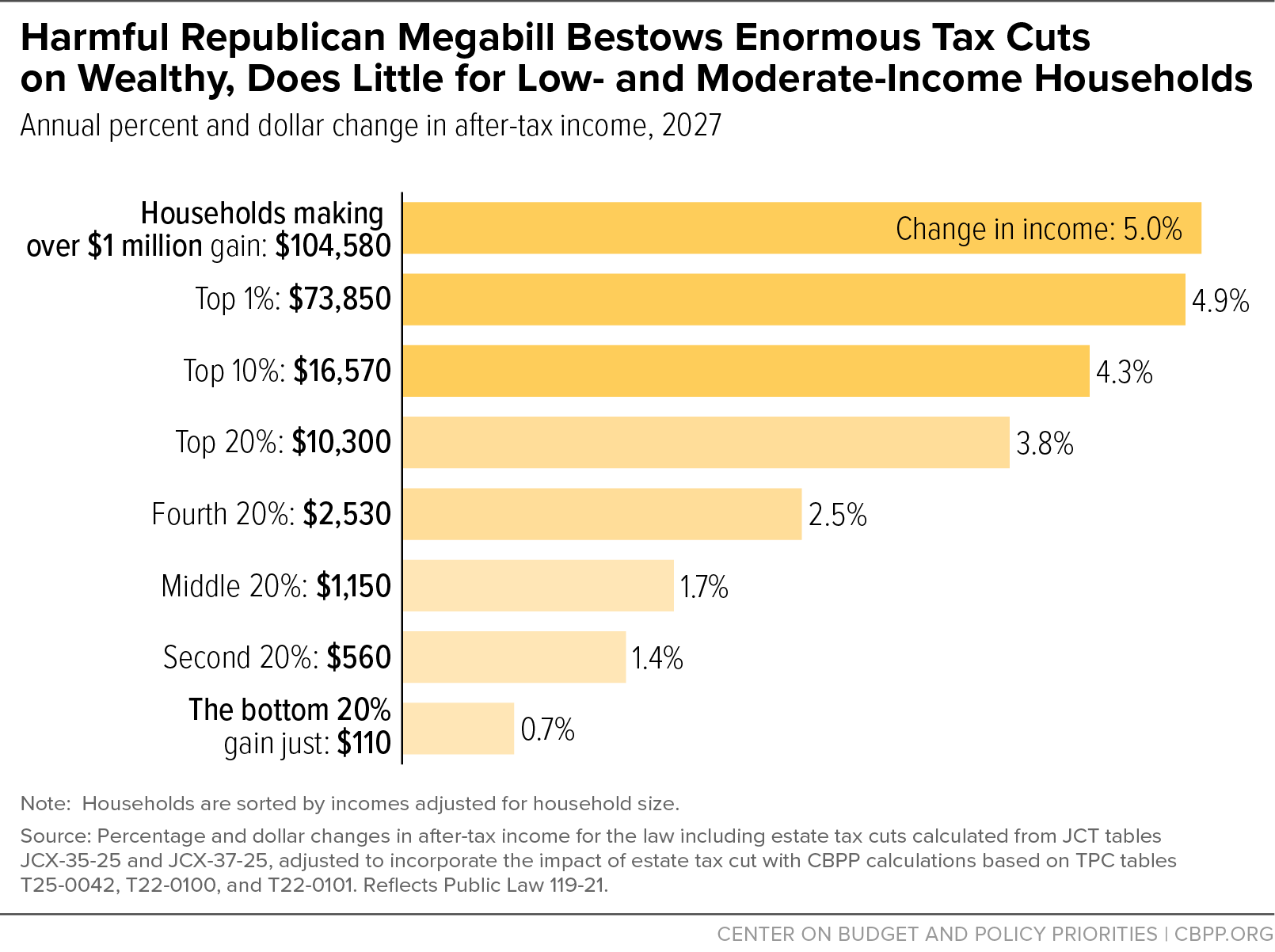
- Are heavily skewed to the wealthy. Households with incomes in the top 1 percent will receive tax cuts over three times the size of those for households with incomes in the bottom 60 percent, measured as a share of after-tax income. (See Figure 1.) The 1.2 million households (about 0.6 percent) with annual incomes above $1 million will receive more total tax cuts than the 127 million households with incomes below $100,000. These imbalances are even greater when taking into account the law’s massive cuts to Medicaid and marketplace coverage and SNAP that will take away crucial health care and food assistance, and the Trump Administration’s tariffs on imported goods, which will hit low- and moderate-income families particularly hard.
- Fail to deliver for working people struggling to pay their bills. Instead of using the megabill to substantially help households with low and middle incomes who face serious affordability challenges, Republicans enacted one of the most regressive pieces of fiscal legislation in history.[5] The new law excludes millions of children from its increase in the Child Tax Credit, fails to extend premium tax credit enhancements that are vital to households buying private health coverage through the marketplace, takes health coverage and food assistance away from millions of people, and singles out immigrants with lawful status and their families for particularly harsh restrictions on assistance. Republicans have emphasized the megabill’s provisions exempting tipped income, overtime pay, and car loan interest from income taxes as targeted to households with low or moderate incomes, but these are highly flawed policies that do little to alter the law’s overall distributional impact.
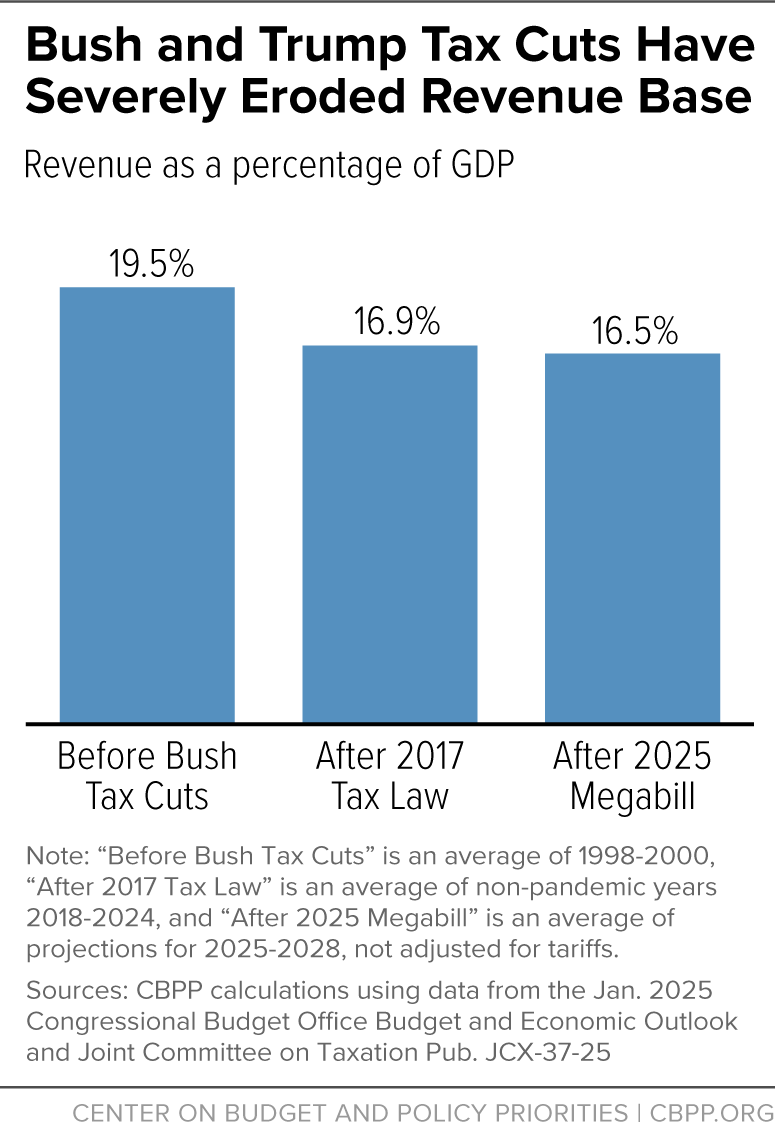
- Have a very high price tag. The megabill’s tax provisions will cost $4.5 trillion through 2034, and even with the law’s devastating cuts to Medicaid and food assistance for families, the law will add $3.4 trillion to the deficit through 2034. Combined with other large tax cuts enacted over more than two decades, the megabill will further erode the nation’s revenue base. Revenue as a share of GDP fell from about 19.5 percent in the years immediately preceding the Bush tax cuts to 16.9 percent in the years following the 2017 Trump tax cuts, and revenues are expected to fall to 16.5 percent, on average, in 2025-2028.[6] This is simply not enough revenue given the nation’s investment needs and our commitments to seniors through Social Security, Medicare, and Medicaid.
The megabill puts the country on a harmful and risky fiscal path. Reversing this path would mean undoing the regressive tilt of the Trump tax cuts, raising more revenue, and correcting priorities to advance the interests of low- and moderate-income families instead of those of wealthy shareholders.
Megabill’s Skewed Tax Cuts Will Exacerbate Inequality
The Republican megabill’s tax provisions continue the failed trickle-down tax policies enacted over the last 25 years that gave enormous tax cuts to wealthy households while doing little or nothing for low- and moderate-income households.
Under the enacted megabill, the average household earning less than $50,000 will get about $250 in tax cuts in 2027, less than $1 a day, while the average household with $1 million or more in income will receive over $100,000 in tax breaks. Measured as a share of after-tax income, households with incomes in the top 1 percent will receive tax cuts over three times the size of those for households with incomes in the bottom 60 percent (i.e., a rough proxy for the “working-class” that Republicans purport to prioritize).[7] In dollar terms, households with incomes in the bottom 20 percent will receive just $110. (See Figure 1.)

These imbalances are even greater when taking into account the law’s massive cuts to crucial health care and food assistance through Medicaid and marketplace coverage and SNAP. These harsh cuts are roughly equal in size to the bill’s tax cuts for households with incomes above $500,000. (See Figure 2.)

These figures also ignore the Trump Administration’s tariffs on imported goods, which will hit low- and moderate-income households particularly hard, erasing much or all of the tax benefit they will receive from the megabill. (See Figure 3.)

On balance the megabill worsens income inequality, both overall and across racial and ethnic groups. Because of racial barriers to economic opportunity, households of color are overrepresented at the lower end of the income and wealth distributions, while white households are overrepresented among the wealthy.[8]
Law Extends and Expands Skewed 2017 Tax Cuts
The core of the megabill’s $4.5 trillion in tax cuts is the extension of the 2017 tax law’s expiring individual income and estate tax provisions, which were scheduled to expire at the end of 2025 before being made permanent. A handful of major provisions lose considerable revenue while primarily benefiting wealthy households, including:
- 20 percent deduction for pass-through income. The law makes permanent the 2017 law’s 20 percent deduction for certain income that owners of pass-through businesses (partnerships, S corporations, and sole proprietorships) report on their individual tax returns, which previously was generally taxed at the same rates as wage and salary income.[9] This provision alone will cost $737 billion through 2034,[10] and despite being often mistaken as a tax benefit for “small business,” around half of its benefits go to households with more than $1 million in income in 2024, according to JCT.[11]
- Cutting individual income tax rates for those at the top. The law permanently extends the 2017 law’s cut in the top individual income tax rate from 39.6 percent to 37 percent for married couples with over $600,000 in taxable income. Adjusted for inflation, the 37 percent top tax rate only applies to incomes over $768,700 (for married couples) in 2026. The law also continues the dramatic weakening of the alternative minimum tax, which was designed to ensure that higher-income people who take large amounts of deductions and other tax breaks pay at least a minimum level of tax.
- Expanding the estate tax-free exemption. The megabill permanently extends — and expands — the 2017 law’s large estate tax cut. The 2017 law doubled the amount that the wealthiest households can pass on tax free to their heirs, from $11 million per couple to $22 million (indexed for inflation); in 2025 a couple can pass on an estate worth up to $28 million tax free. The megabill raises the exemption to $30 million in 2026, or $1.7 million more than under a simple extension of the 2017 law.[12] Extending the 2017 law’s exemption level alone would have given a $5.7 million tax cut to the nation’s wealthiest estates; the final bill’s even-larger exemption expands this amount to $6.3 million.[13]
- Weakened SALT Cap. The 2017 law capped the amount of state and local taxes (SALT) that households can deduct at $10,000. The megabill establishes a weaker SALT cap for tax years 2025 through 2029, raising it to $40,400 for filers making up to $505,000, with a phaseout above that amount.[14] This change will lose around $30 billion per year of revenue from 2026-2029 compared to extending the 2017 law’s $10,000 cap.[15] Moreover, Republicans in the Senate removed a limit on pass-through businesses’ SALT deductions that earlier versions of the bill included,[16] which will let wealthy business owners continue claiming unlimited SALT deductions.
These large, disproportionate income and estate tax cuts for high-income and high-wealth households come on top of the large benefits those households continue to receive from the 2017 law’s permanent corporate tax cuts. (See box.)
Additional Corporate Tax Breaks Benefit Shareholders
In the 2017 law, congressional Republicans added several business tax increases to partially offset the cost of the large cut in the corporate tax rate. These provisions included, for example, requiring businesses’ research and experimentation costs to be amortized over time instead of immediately expensed, phasing out full expensing for capital investments, and imposing stricter limitations on deductions for interest expenses. [17] The megabill not only leaves the permanent corporate tax rate cut in place but also reverses most of those business tax increases that had been included as offsets — giving yet another windfall to corporate shareholders and adding around $700 billion to the bill’s cost.[18]
Bill Fails to Deliver for People With Lower and Middle Incomes
Republicans could have used the megabill to substantially help households with lower and middle incomes by boosting existing tax code provisions that improve the living standards of millions of working people — namely, the Child Tax Credit, premium tax credit (PTC) enhancements for marketplace health coverage, and the Earned Income Tax Credit (EITC). Instead, the megabill not only fails to improve credits for these households, but also takes certain credits away from many children and families that include immigrants.
Millions of families are left out of the megabill’s Child Tax Credit increase. An estimated 17 million children — roughly 1 in 4 children under age 17 — will receive nothing from the megabill’s increase in the Child Tax Credit maximum from $2,000 to $2,200 per child because their families’ incomes are too low to qualify. (See Figure 4.) Another 2 million children will receive a small increase, but not the megabill’s full $200 per-child increase.[19]
A total of 19 million children will receive less than the full $2,200 credit for 2025. They include half of Black children, more than 4 in 10 Native American children, and more than 1 in 3 Latino children, whose families often face the effects of past and current discrimination and barriers to opportunity that have left them overrepresented in low-paying work. Also left out of the full credit are roughly 1 in 5 white and 1 in 6 Asian children. (See Appendix Table 1 for estimates by state and by race or ethnicity.)
Figure 4 Imagen
The megabill breaks with a bipartisan record of progress toward expanding the Child Tax Credit for children in low- and moderate-income families. For example, the 2001 Bush tax cuts made the credit partially refundable, and the 2017 tax law also modestly increased the credit for these families.[20] Most recently, in January 2024, 169 House Republicans voted for legislation championed by House Ways and Means Chair Jason Smith and Senate Finance Committee Chair Ron Wyden that would have increased the credit for most of the children left out of the full $2,000-per-child credit because their families’ earnings were too low. If the megabill had simply adopted that bill’s framework, a single mother with a toddler and a second grader who makes $16,000 working part-time as a home health aide would have received an increase of $2,025 for 2025.[21]
- Takes away eligibility for the Child Tax Credit for certain children who are U.S. citizens or have a lawful immigration status. The megabill ends eligibility for the credit for children who are U.S. citizens or have a lawful immigration status unless at least one of their parents has a Social Security number. One estimate projects that roughly 2.7 million children may fall within this category.[22]
Fails to extend premium tax credit enhancements for ACA marketplace health coverage. While the megabill extends and even expands the expiring 2017 tax cuts for wealthy people, it does not extend premium tax credit enhancements that help more than 20 million low- and middle-income people afford marketplace health coverage. This group includes an estimated 5 million small business owners and self-employed workers.[23] If the enhancements expire at the end of 2025 as currently scheduled, nearly all marketplace enrollees will face significantly higher premium costs, which will more than double on average.[24] Roughly 4 million people will lose their health insurance and become uninsured as their out-of-pocket premium costs rise to unaffordable levels, the Congressional Budget Office (CBO) has estimated.[25] As a result, many will forgo necessary care or incur significant medical debt.
Policymakers should address this urgent issue to prevent these large premium increases and resulting coverage losses. Open enrollment for 2026 is underway, and many enrollees are experiencing sticker shock as they shop for coverage and find that their premium costs are rising steeply. Those price spikes will mean many families have to make impossible choices between taking care of their health and affording other basic needs, like food or housing.
- Takes away premium tax credits from people with lawful immigration statuses. Starting in 2027, the megabill severely restricts the categories of lawful immigration statuses that qualify people for premium tax credits that help pay for marketplace health coverage. The law newly excludes groups including refugees, people granted asylum, and certain victims of domestic violence or trafficking, among others. An estimated 900,000 people will become uninsured by 2034 as a result, according to CBO.[26] In addition, the megabill takes away premium tax credit eligibility from people with lawful immigration status with incomes below the poverty line who don’t meet Medicaid’s harsh immigration-related eligibility requirements.[27]
Ignores the Earned Income Tax Credit, a critical tool for boosting workers’ incomes. While Republicans promised in their 2024 campaigns to improve the economic circumstances of people across races who work for low pay, they did not take the opportunity in the megabill to strengthen the Earned Income Tax Credit (EITC) for working adults not raising children, which could have been at the forefront of an effort to boost workers’ incomes.
Policymakers could have expanded the size of the EITC, the age range for the credit, and the income level to be eligible. Adopting the temporary 2021 expansion of the EITC into permanent law would have boosted the credit for more than 14 million workers across a range of occupations, including tipped and non-tipped work. For example, the expansion would have helped 772,000 cashiers, 584,000 retail salespeople, 529,000 cooks, 498,000 janitors, and 446,000 waiters and waitresses in 2026, among others.[28]
Adds costly new tax breaks that won’t significantly help most low-income households. The megabill includes temporary tax policies, like special deductions for certain tip and overtime income, that favor some types of income over others with no economic rationale. The law also adds a new $6,000 deduction for taxpayers aged 65 and over and a new deduction for individuals who incur debt to purchase certain automobiles. In each case, these policies will do little for most households with low incomes and add to the bill’s cost.
For example, exempting certain tips from the income tax only helps about 1 percent of low-paid workers, and those workers’ gains will be quite modest — or non-existent, when the megabill’s cuts to Medicaid, marketplace coverage, food assistance, and education are included.[29] The new deduction for seniors will not help most low- and middle-income seniors, and it depletes the Social Security trust funds faster.[30]
The Law Puts the Nation on a Precarious Fiscal Path and Risks Future Economic Harm
The 2017 tax law and other large tax cuts enacted over more than two decades have eroded the nation’s revenue base, undermining investments, driving up deficits and debt, and, in turn, increasing future economic risks associated with higher debt, including higher interest rates and reduced private investment.[31] The megabill will deepen the damage.
Even With Its Cruel Spending Cuts, the Megabill Is Costly
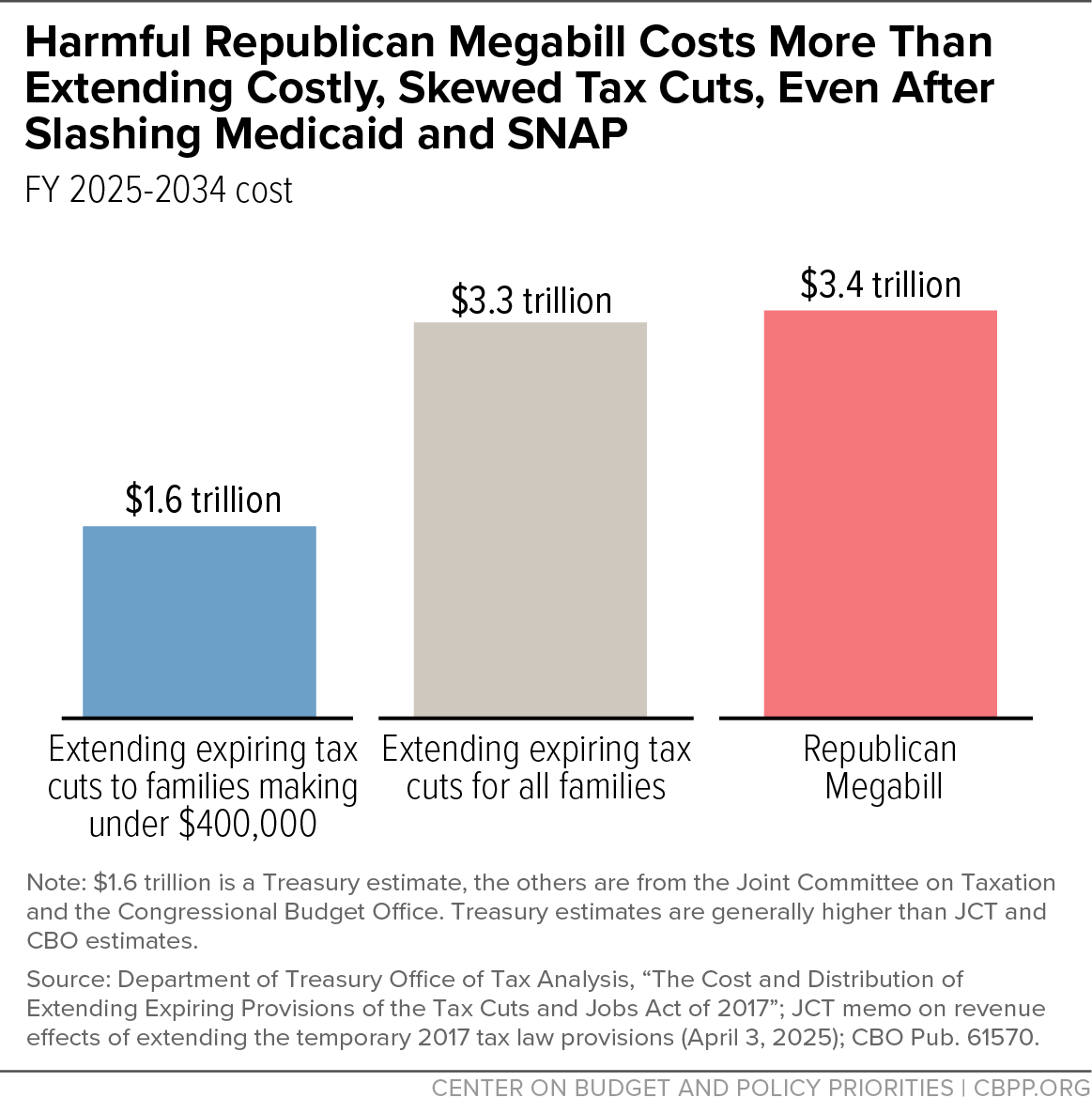
The megabill’s tax provisions will cost $4.5 trillion through 2034, fully $1.2 trillion more than the $3.3 trillion cost of extending all the 2017 law’s expiring provisions through 2034.[32] Even with the law’s devastating cuts to Medicaid and marketplace coverage and food assistance for families, the law will add $3.4 trillion to the deficit over ten years and $4.1 trillion to the nation’s debt, including interest payments on the additional borrowing.[33] This assumes policymakers will not extend several provisions that are scheduled to sunset in 2028 or 2029, such as the exemption for tips and increase in the SALT cap. Extending these provisions without offsetting cost savings or new revenue would increase the law’s cost to $4.2 trillion, or nearly $5 trillion after accounting for interest costs, according to CBO.[34]
Republicans could have taken a less harmful path. A bill making all of the 2017 tax law’s temporary individual income and estate tax provisions permanent (that is, the core of the megabill’s tax provisions) would have cost $3.3 trillion over ten years.[35] That means Republicans could have passed a bill making all of those tax cuts permanent — without extra tax cuts and without any of the harmful cuts to health care, education, food assistance, or clean energy — and the resulting bill would have cost less than the megabill. Better yet, extending the 2017 law’s tax cuts only for households with incomes below $400,000 would have cost $1.6 trillion, less than half of the cost of the megabill and an amount in line with the ten-year cost of the 2017 tax law. (See Figure 5.) Policymakers could have used available revenue-raising provisions to fully pay for a $1.6 trillion tax cut package.
Instead, Republicans enacted one of the most regressive pieces of fiscal legislation in history,[36] putting the country on a harmful and risky fiscal path.
While not part of the legislation, the Trump Administration has cited its tariff policies as an offset for the megabill’s budgetary costs. Tariffs do raise revenue and therefore could mitigate the fiscal cost of the megabill (if they remain in place). But this revenue comes at a steep economic cost that particularly burdens families with low and moderate incomes. As discussed in greater detail below, policymakers should replace the tariff revenue with more economically efficient and equitable tax policies.

We Need More Revenues, Not Less
Republicans often contend that cutting program spending would erase the U.S.’s fiscal mismatch between revenues and spending. But their megabill makes deep cuts in health and food assistance, and still, the tax cuts dwarf the size of these spending cuts. The $4.5 trillion revenue loss from the tax cuts is more than three times the size of the cuts to health care and food assistance.
Combined with other failed trickle-down tax cuts first enacted under President George W. Bush and then largely made permanent during the Obama Administration, the erosion in revenue from the Trump tax cuts has been severe. Revenue as a share of GDP fell from about 19.5 percent in the years immediately preceding the Bush tax cuts to 16.9 percent in the years following the 2017 Trump tax cuts, and revenues are expected to fall to 16.5 percent, on average, in 2025-2028.[37] (See Figure 6.) The difference is also stark in dollar terms: revenues would be roughly $700 billion higher in 2025 if they were still at 19.5 percent of GDP, as in the years before the Bush tax cuts.



The U.S. needs higher revenues to support existing commitments and unmet investment needs. Forty years ago members of the baby boom generation (those born between 1946 and 1964) were in or still approaching their “prime working years;” today they are in their “prime retirement years,” with all but the very youngest now eligible for Social Security and Medicare. And over the next 40 years, this trend of an aging population will continue.
The combination of population aging and basic arithmetic means we will face a choice: either we raise revenue, or we make drastic cuts to programs and go back on commitments we’ve made, including to seniors in Medicare, Social Security, and Medicaid (which is the largest payer of long-term care services in the country).
With Social Security, Medicare, long-term care in Medicaid, defense spending, and spending on veterans comprising two-thirds of federal program spending,[38] there is simply no way to significantly flatten the debt trajectory while shielding these programs from cuts without additional revenue.
Moreover, the U.S. underinvests in people, communities, and the building blocks of the economy in ways that shortchange opportunity, exacerbate inequality, widen racial and ethnic inequities, and limit the nation’s potential. Inadequate revenues have constrained policymakers’ willingness to address needs that require greater investment, such as climate change, housing, child care, and child poverty. Policymakers should prioritize investments that would yield significant short- and long-term benefits to people, communities, and the economy as a whole, including investing in children through a Child Tax Credit that fully reaches children in low-income families. Yet, as described above, policymakers rejected the opportunity to make such investments as part of the Republican megabill.
Needed Course Correction Would Raise Revenue Through Progressive, Not Regressive, Tax Policies
Additional revenue-raising efforts are needed to help meet the nation’s large revenue needs. These revenue increases should be progressive, which would be appropriate given widening income and wealth inequality over the last four decades.[39] Typical middle-income households with children had almost 50 percent more income after taxes in 2019 than such households had in 1984, after adjusting for inflation. But for the households with incomes in the top 1 percent, their already disproportionate incomes grew three times as fast over that period, by almost 150 percent.[40] Revenue-raising efforts should therefore focus on those who have gained the most over the last four decades, and go toward solving national problems and improving the fiscal outlook.
Sound tax policies exist to raise revenues that can support investments and reduce fiscal risks. These policies include:
Scaling back corporate tax cuts. Proponents of the 2017 law’s steep corporate rate cut promised economic benefits that failed to materialize, and the megabill’s reversal of business tax increases are another reason why policymakers should at least partially reverse the corporate tax rate cut. Raising the corporate rate to 28 percent — halfway between the current rate and the pre-2017 rate — would make the tax code more progressive while raising around $1 trillion over ten years (2025-2034).[41]
The 2017 law’s international tax rules also require reforms to better deter costly profit shifting.[42] The Biden Administration proposed reforms to international tax rules that would address these flaws and would raise around $600 billion over ten years (2025-2034) from large multinational corporations, according to the Treasury Department.[43]
Requiring the wealthy to pay a fairer share of tax. A fairer tax code would ensure that wealthy people, who derive much of their income from unrealized capital gains that are largely not taxed, pay some income tax on their vast gains. In just one year, “the 400 richest people in the U.S. are worth a record $6.6 trillion after getting $1.2 trillion richer over the past year amid surging stock markets and AI mania,” according to Forbes.[44] This increase in wealth, or income, raises asset owners’ purchasing power and makes them better off in real ways, whether or not they realize those gains in a particular year. Yet, much of this income will never be taxed under our current individual income tax. Policymakers should fix this glaring tax policy flaw by imposing an annual minimum tax for wealthy people that is levied on all of their income, including unrealized capital gains.[45] At a minimum, policymakers should eliminate the stepped-up basis loophole, which effectively erases wealthy people’s tax liability when they die.
Future tax reforms should also reduce or eliminate special tax breaks wealthy people get when they do pay taxes. Two such examples include taxing capital gains and dividends at higher rates that are equal, or at least closer, to taxes on salaries, and closing a loophole that allows certain pass-through business owners to avoid a 3.8 percent Medicare tax that others, including high-income wage earners, must pay.
Undoing the Trump Administration’s regressive tax and tariff policies. In recent years — before the second Trump Administration — revenue-raising policies were generally limited to high-income people, such as people making over $400,000. But the Trump Administration’s tariffs raise taxes on people at all income levels, with their greatest impacts falling on those with low incomes. These economically harmful tariffs should be replaced with more equitable and efficient revenue raising tax policies.
Though policymakers should prioritize ensuring the wealthiest and large corporations pay a fairer share of tax, as discussed above, the nation’s significant fiscal deficit and large investment needs will also require policymakers to collect more revenues from affluent households with incomes outside the top 1 or 5 percent.
Households with incomes in the top 20 percent, for example, have experienced higher-than-average wage growth[46] and greater economic opportunity in recent decades and can generally afford their monthly expenses while saving for future goals. These households can afford to pay modestly more in taxes: households with incomes in the 80-90th percentile, for example, currently pay average federal income tax rates (that is, after deductions, credits, and other tax reductions) of less than 10 percent.[47] This could be increased by reexamining tax rates in the upper brackets.
Ending the megabill’s inefficient, base eroding tax breaks. The megabill’s temporary tax policies, like special deductions for certain tip and overtime income and the enhanced senior deduction, do little for households with low incomes and add to the bill’s cost. They are also inefficient and encourage tax gaming by favoring some types of income over others with no economic rationale. For example, tip income is income just like wages or salaries, and there is no good reason to tax bartenders at lower rates than daycare teachers.
These provisions should be repealed or allowed to expire on schedule after 2028, and policymakers should resist any effort to expand special tax breaks for certain types of income or certain types of workers. We can employ far better tax policies to bolster the incomes of households with low and moderate incomes.
Enacting an equitable carbon tax. The Trump Administration has pursued a disastrous energy policy, attacking efforts to address climate change, propping up the fossil fuel industry, and walking away from investments in clean energy technologies.[48] But decades of research and court rulings confirm the role of greenhouse gases in causing climate change and climate change’s impact on human health and well-being.[49] Members of Congress should reject the Trump Administration’s approach and embrace policies that will both encourage the use of clean energy while also raising revenue from polluting industries that harm human health, such as a carbon tax or a carbon border adjustment that accounts for carbon intensity in trade.[50]
Though critics often point to the higher costs that such policies could impose on low-income households, the ultimate distributional effects of a carbon tax or other carbon pricing policy would depend on its scope and how its revenues are used. Well-designed carbon pricing policies can generate enough revenue to fully offset the impact of higher energy prices on the most vulnerable households’ budgets, cushion the impact for many other households, and leave plenty to spare for other uses.[51] And investing in technologies that ultimately lower energy prices can benefit those same households in the future.
Replenishing and extending mandatory IRS funding to reduce the tax gap. After a decade of budget cuts severely undermined the IRS,[52] the Inflation Reduction Act (IRA) created an $80 billion, ten-year stream of mandatory funding — that is, funding provided directly in authorizing law — to provide stable funding that the IRS could count on over a longer period. Through a series of rescissions, however, congressional Republicans eliminated virtually all the enforcement money that was part of the mandatory funding stream.[53] Staff cuts and voluntary departures through the deferred resignation program have resulted in a quarter of the IRS workforce leaving the agency since January.[54]
Because every dollar spent on IRS enforcement raises multiple dollars in revenue from increased tax collections, these cuts to IRS funding and staff increase deficits. Instead of decimating the IRS, policymakers should rebuild the agency so it can perform its basic function of government. They should take steps including fully restoring the IRS funding first enacted in the IRA and making the mandatory funding stream permanent.
| Appendix table 1 | |||||||
|---|---|---|---|---|---|---|---|
More Than 19 Million Children Are Left Out of the Megabill’s Full $2,200 Child Tax Credit Estimates of children under 17 by state, race, and ethnicity for tax year 2026 | |||||||
| Total | White | Latino | Black | Asian | American Indian or Alaska Native | Another race or multiple races | |
| Total U.S. | 19,300,000 | 6,584,000 | 6,207,000 | 4,621,000 | 542,000 | 619,000 | 941,000 |
| Of all children in racial/ethnic group, percent left out | 28% | 19% | 35% | 50% | 17% | 42% | 29% |
| Alabama | 387,000 | 150,000 | 31,000 | 186,000 | 2,000 | 4,000 | 15,000 |
| Alaska | 41,000 | 11,000 | N/A | N/A | N/A | 19,000 | N/A |
| Arizona | 491,000 | 110,000 | 275,000 | 30,000 | 6,000 | 70,000 | 15,000 |
| Arkansas | 245,000 | 124,000 | 31,000 | 73,000 | N/A | 6,000 | 11,000 |
| California | 2,363,000 | 330,000 | 1,594,000 | 181,000 | 147,000 | 69,000 | 84,000 |
| Colorado | 230,000 | 82,000 | 111,000 | 17,000 | 5,000 | 13,000 | 9,000 |
| Connecticut | 153,000 | 40,000 | 69,000 | 31,000 | 4,000 | 3,000 | 7,000 |
| Delaware | 50,000 | 16,000 | 10,000 | 20,000 | N/A | N/A | 2,000 |
| District of Columbia | 43,000 | N/A | 4,000 | 38,000 | N/A | N/A | N/A |
| Florida | 1,206,000 | 336,000 | 421,000 | 368,000 | 17,000 | 12,000 | 56,000 |
| Georgia | 752,000 | 198,000 | 123,000 | 378,000 | 12,000 | 11,000 | 35,000 |
| Hawai’i | 65,000 | 7,000 | 15,000 | N/A | 8,000 | N/A | 34,000 |
| Idaho | 101,000 | 68,000 | 25,000 | N/A | N/A | 5,000 | 2,000 |
| Illinois | 684,000 | 218,000 | 198,000 | 215,000 | 19,000 | 6,000 | 32,000 |
| Indiana | 414,000 | 234,000 | 58,000 | 84,000 | 6,000 | 3,000 | 29,000 |
| Iowa | 140,000 | 83,000 | 22,000 | 21,000 | N/A | 4,000 | 8,000 |
| Kansas | 154,000 | 82,000 | 36,000 | 18,000 | 4,000 | 5,000 | 11,000 |
| Kentucky | 325,000 | 238,000 | 17,000 | 46,000 | 4,000 | N/A | 18,000 |
| Louisiana | 433,000 | 128,000 | 24,000 | 255,000 | 4,000 | 7,000 | 16,000 |
| Maine | 54,000 | 45,000 | N/A | N/A | N/A | 3,000 | N/A |
| Maryland | 250,000 | 62,000 | 42,000 | 118,000 | 10,000 | 3,000 | 17,000 |
| Massachusetts | 261,000 | 91,000 | 104,000 | 35,000 | 14,000 | 4,000 | 16,000 |
| Michigan | 625,000 | 310,000 | 66,000 | 187,000 | 10,000 | 15,000 | 38,000 |
| Minnesota | 231,000 | 92,000 | 33,000 | 66,000 | 14,000 | 16,000 | 13,000 |
| Mississippi | 291,000 | 83,000 | 11,000 | 184,000 | N/A | 4,000 | 8,000 |
| Missouri | 376,000 | 224,000 | 28,000 | 87,000 | 3,000 | 8,000 | 27,000 |
| Montana | 60,000 | 37,000 | 5,000 | N/A | N/A | 17,000 | N/A |
| Nebraska | 88,000 | 41,000 | 25,000 | 10,000 | 3,000 | 4,000 | 5,000 |
| Nevada | 179,000 | 40,000 | 82,000 | 35,000 | 6,000 | 6,000 | 13,000 |
| New Hampshire | 42,000 | 33,000 | 5,000 | N/A | N/A | N/A | N/A |
| New Jersey | 381,000 | 104,000 | 154,000 | 92,000 | 15,000 | 4,000 | 15,000 |
| New Mexico | 184,000 | 26,000 | 122,000 | N/A | N/A | 39,000 | N/A |
| New York | 1,149,000 | 367,000 | 397,000 | 246,000 | 83,000 | 18,000 | 44,000 |
| North Carolina | 656,000 | 223,000 | 123,000 | 243,000 | 12,000 | 24,000 | 35,000 |
| North Dakota | 26,000 | 13,000 | N/A | N/A | N/A | 9,000 | N/A |
| Ohio | 749,000 | 402,000 | 62,000 | 204,000 | 8,000 | 11,000 | 64,000 |
| Oklahoma | 282,000 | 117,000 | 53,000 | 40,000 | 3,000 | 63,000 | 14,000 |
| Oregon | 192,000 | 108,000 | 53,000 | 9,000 | 6,000 | 11,000 | 10,000 |
| Pennsylvania | 676,000 | 307,000 | 145,000 | 161,000 | 18,000 | 10,000 | 39,000 |
| Rhode Island | 47,000 | 15,000 | 22,000 | 7,000 | N/A | N/A | 3,000 |
| South Carolina | 356,000 | 117,000 | 31,000 | 183,000 | 2,000 | 4,000 | 20,000 |
| South Dakota | 49,000 | 19,000 | 3,000 | N/A | N/A | 25,000 | N/A |
| Tennessee | 487,000 | 254,000 | 48,000 | 151,000 | 4,000 | 6,000 | 25,000 |
| Texas | 2,079,000 | 352,000 | 1,280,000 | 344,000 | 42,000 | 22,000 | 51,000 |
| Utah | 154,000 | 88,000 | 43,000 | N/A | N/A | 7,000 | 9,000 |
| Vermont | 22,000 | 19,000 | N/A | N/A | N/A | N/A | N/A |
| Virginia | 385,000 | 146,000 | 52,000 | 144,000 | 10,000 | 5,000 | 27,000 |
| Washington | 318,000 | 143,000 | 94,000 | 24,000 | 14,000 | 22,000 | 26,000 |
| West Virginia | 135,000 | 114,000 | 3,000 | 8,000 | N/A | N/A | 9,000 |
| Wisconsin | 260,000 | 123,000 | 44,000 | 62,000 | 7,000 | 12,000 | 14,000 |
| Wyoming | 26,000 | 16,000 | 6,000 | N/A | N/A | 3,000 | N/A |
Notes: Estimates count children under 17 in families that lack earnings or have earnings that are too low to receive the maximum $2,200 per child, excluding those who do not meet the megabill’s requirement that children and at least one parent have a Social Security number. Figures are rounded to the nearest 1,000. N/A indicates reliable data are not available due to small sample size; data are included in totals. Figures may not sum to totals due to group overlap, lack of reliable data in certain cells, and/or rounding. Percentages in the “Total U.S.” row represent the share of all children under 17 in that racial/ethnic group getting less than the full $2,200 Child Tax Credit. Individuals are classified as white only, not Latino; Latino (any race); Black only, not Latino; Asian only, not Latino; American Indian or Alaska Native alone or in combination with other races, regardless of Latino ethnicity (AIAN); or another race or multiple races, not Latino. Latino includes all people of Hispanic, Latino, or Spanish origin regardless of race. AIAN estimates are particularly sensitive to definition; AIAN figures here include those who share another race or ethnicity. (A total of 1.5 million children under 17 are identified as AIAN alone or in combination with other races, regardless of Latino ethnicity. If we apply the non-overlapping categories this report uses for other groups, about 520,000 children under 17 are considered AIAN alone, not Latino; an estimated 260,000 of these children would get less than the full $2,200 Child Tax Credit.) Children in the five U.S. Territories — Puerto Rico, Guam, U.S. Virgin Islands, Northern Mariana Islands, and American Samoa — are not included due to data limitations. Source: Tax Policy Center (TPC) national estimate for 2026 allocated by state and race or ethnicity based on CBPP analysis of American Community Survey for 2017-2019, using 2026 tax parameters and incomes adjusted to 2026 projected levels. Percentages listed in the “Total U.S.” row are children left out of the full $2,200 Child Tax Credit as a share of the average 2017-2019 ACS population under 17 in each racial/ethnic group. We use January 2025 Congressional Budget Office projections to project 2026 tax parameters, adjust earnings and rental, interest, and dividend income for real growth through 2026, and adjust other income for inflation through 2026. TPC, “T25-0258 – Distribution of Tax Units, Children, and Dependents by Size of Child Tax Credit (CTC), 2026,” August 5, 2025, https://taxpolicycenter.org/model-estimates/T25-0258. | |||||||
End Notes
[1] Chuck Marr, Samantha Jacoby, and George Fenton, “The 2017 Tax Law Was Skewed to the Rich, Expensive, and Failed to Deliver on Its Promises,” CBPP, June 13, 2024, https://www.cbpp.org/research/federal-tax/the-2017-trump-tax-law-was-skewed-to-the-rich-expensive-and-failed-to-deliver.
[2] We generally use “households” to refer to tax units throughout this paper.
[3] Yale Budget Lab, “Combined Distributional Effects of the One Big Beautiful Bill Act and of Tariffs,” September 2025 update, https://budgetlab.yale.edu/research/combined-distributional-effects-one-big-beautiful-bill-act-and-tariffs-0.
[4] Danilo Trisi, “After-Tax Income Gaps Are Large Already; Megabill Will Redistribute Upwards, CBO Projects,” CBPP, September 11, 2025, https://www.cbpp.org/blog/analyzing-the-census-bureaus-2024-poverty-income-and-health-insurance-data?entry_uuid=c60d635e-4a7c-4c3b-88bf-4e1afde4c14a#entry.
[5] Emily Badger, Alicia Parlapiano, and Margot Sanger-Katz, “Trump’s Big Bill Would Be More Regressive Than Any Major Law in Decades,” The New York Times, June 12, 2025, https://www.nytimes.com/interactive/2025/06/12/upshot/gop-megabill-distribution-poor-rich.html.
[6] Revenue projections exclude the effects of the Trump Administration’s tariffs, which are subject to significant uncertainty.
[7] The bottom 60 percent of households will see a change in after-tax income of 1.5 percent ($610), on average, in 2027 as a result of the tax cuts.
[8]See Chye-Ching Huang and Roderick Taylor, “How the Federal Tax Code Can Better Advance Racial Equity,” CBPP, July 25, 2019, https://www.cbpp.org/research/federal-tax/how-the-federal-tax-code-can-better-advance-racial-equity.
[9] Chuck Marr, Samantha Jacoby, and George Fenton, “The Pass-Through Deduction Is Skewed to the Rich, Costly, and Failed to Deliver on Its Promises,” CBPP, June 6, 2024, https://www.cbpp.org/research/federal-tax/the-pass-through-deduction-is-skewed-to-the-rich-costly-and-failed-to-deliver.
[10] Joint Committee on Taxation, JCX-35-25, July 1, 2025, https://www.jct.gov/publications/2025/jcx-35-25/.
[11] Joint Committee on Taxation, “Tables Related to the Federal Tax System as in Effect 2017 through 2026,” JCX-32r-18, April 24, 2018, https://www.jct.gov/publications/2018/jcx-32r-18/.
[12] Chuck Marr, “Yet Another Estate Tax Cut on Massive Inheritances Is a Poor Choice,” CBPP, March 11, 2025, https://www.cbpp.org/blog/yet-another-estate-tax-cut-on-massive-inheritances-is-a-poor-choice.
[13] Samantha Jacoby, “House Republican Tax Bill Extends — and Expands — Costly Tax Breaks for the Wealthy,” June 4, 2025, https://www.cbpp.org/blog/house-republican-tax-bill-extends-and-expands-costly-tax-breaks-for-the-wealthy.
[14] The $40,400 SALT cap and $505,000 income threshold are set for tax year 2026 and increase by 1 percent each year through 2029. In 2030 and after, the SALT cap is $10,000 for all taxpayers. There is also a retroactive SALT cap increase (to $40,000 for households making $500,000) for tax year 2025.
[15] JCT, JCX-34-25, https://www.jct.gov/publications/2025/jcx-34-25/.
[16] Miles Johnson and Michael Kaercher, “Ways and Means Bill Curtails SALT Cap Workarounds for All Passthrough Entities,” The Tax Law Center, May 19, 2025, https://taxlawcenter.org/blog/ways-and-means-bill-curtails-salt-cap-workarounds-for-all-passthrough-entities.
[17] Chuck Marr and Samantha Jacoby, “Policymakers Should Focus on the True Cost of an Item on Corporate Lobby’s Tax Break Wish List,” CBPP, November 7, 2023, https://www.cbpp.org/blog/policymakers-should-focus-on-the-true-cost-of-an-item-on-corporate-lobbys-tax-break-wish-list.
[18] JCT, op. cit.
[19] Sophie Collyer et al., “Children Left Behind by the H.R.1 ‘One Big Beautiful Bill Act’ Child Tax Credit,” Center on Poverty and Social Policy at Columbia University, August 6, 2025, https://povertycenter.columbia.edu/sites/povertycenter.columbia.edu/files/content/Publications/Children-Left-Behind-OBBBA-Child-Tax-Credit-CPSP-2025.pdf. The megabill increased the maximum credit amount from $2,000 to $2,200 for 2025 and indexed the amount for inflation starting in 2026.
[20] Making the credit partially refundable means that families whose credit exceeds their tax liability can receive part of the credit as a refund. The 2017 tax law increased the maximum credit to $2,000 per child for those with sufficient tax liability but introduced a $1,400-per-child (indexed for inflation) cap on the amount families could receive as a refund.
[21] The bipartisan legislation phased-in changes to the Child Tax Credit over three years: 2023-2025. We use the proposed parameters for 2025 to calculate the credit amount for this example.
[22] This figure overstates the number of children affected by not accounting for families' income but understates the number of children affected by counting only U.S. citizen children. (Children who are lawfully present and have an SSN but who do not have at least one parent with an SSN will also lose eligibility.) Julia Gelatt, Migration Policy Institute, November 2025, https://www.linkedin.com/posts/julia-gelatt-86105953_millions-of-us-kids-live-in-mixed-status-activity-7394407282366681090-bHou.
[23] “By the Numbers: Republican Reconciliation Law Will Take Health Coverage Away From Millions of People and Raise Families’ Costs,” CBPP, updated August 27, 2025, https://www.cbpp.org/research/health/by-the-numbers-republican-reconciliation-law-will-take-health-coverage-away-from.
[24] Justin Lo et al., “ACA Marketplace Premium Payments Would More than Double on Average Next Year if Enhanced Premium Tax Credits Expire,” KFF, September 30, 2025, https://www.kff.org/affordable-care-act/aca-marketplace-premium-payments-would-more-than-double-on-average-next-year-if-enhanced-premium-tax-credits-expire/. For example, a family of four with income of $66,000 will be forced to pay $3,000 more for their annual premium. Gideon Lukens and Elizabeth Zhang, “Health Insurance Premium Spikes Imminent as Tax Credit Enhancements Set to Expire,” CBPP, Updated November 3, 2025, https://www.cbpp.org/research/health/health-insurance-premium-spikes-imminent-as-tax-credit-enhancements-set-to-expire.
[25] CBO, “Estimated Budgetary Effects of S. 3385, the Lower Health Care Costs Act,” December 10, 2025, https://www.cbo.gov/publication/61938.
[26] CBO, “Distributional Effects of Public Law 119-21,” Estimate of Annual Changes in the Number of People Without Health Insurance Under Title VII, P.L. 119-21, August 11, 2025, https://www.cbo.gov/publication/61367#data.
[27] Margot Danker et al., “Harmful Republican Megabill Takes Away Health Coverage, Food Assistance, Tax Credits From Millions of Immigrants and Their Families,” CBPP, December 11, 2025, https://www.cbpp.org/research/immigration/harmful-republican-megabill-takes-away-health-coverage-food-assistance-tax.
[28] Chuck Marr et al., “What a Better Tax Bill Would Look Like,” CBPP, April 23, 2025, https://www.cbpp.org/research/federal-tax/what-a-better-tax-bill-would-look-like.
[29] Ernie Tedeschi, “The ‘No Tax on Tips Act’: Background on Tipped Workers,” The Budget Lab, June 24, 2024, https://www.americanprogress.org/article/despite-no-tax-on-tips-trumps-big-beautiful-bill-is-bad-for-tipped-workers/
[30] Josephine Cureton and Kathleen Romig, “Contrary to Administration’s Misleading Claims, New Senior Deduction Doesn’t Help Low- and Middle-Income Seniors, Does Deplete Social Security Trust Funds,” CBPP, July 28, 2025, https://www.cbpp.org/blog/contrary-to-administrations-misleading-claims-new-senior-deduction-doesnt-help-low-and-middle.
[31] Richard Kogan et al., “More Revenue Is Required to Meet the Nation’s Commitments, Needs, and Challenges,” CBPP, June 17, 2024, https://www.cbpp.org/research/federal-budget/more-revenue-is-required-to-meet-the-nations-commitments-needs-and#managing-risks-associated-with-a-cbpp-anchor.
[32] White House Council of Economic Advisers, “The One Big Beautiful Bill: Legislation for Historic Prosperity and Deficit Reduction,” June 2025, https://www.whitehouse.gov/wp-content/uploads/2025/03/The-One-Big-Beautiful-Bill-Legislation-for-Historic-Prosperity-and-Deficit-Reduction-1.pdf; White House, "FACT: One, Big, Beautiful Bill Cuts Spending, Fuels Growth," May 28, 2025, https://www.whitehouse.gov/articles/2025/05/fact-one-big-beautiful-bill-cuts-spending-fuels-growth/
[33] CBO, “Effects on Deficits and the Debt of Public Law 119-21 and of Making Certain Tax Policies in the Act Permanent,” August 4, 2025, https://www.cbo.gov/system/files/2025-08/61466-DebtService.pdf.
[34] Ibid.
[35] Thomas A. Barthold, Letter to Sens. Whitehouse and Wyden and Reps. Neal and Boyle, April 3, 2025, https://democrats-waysandmeans.house.gov/sites/evo-subsites/democrats-waysandmeans.house.gov/files/evo-media-document/2025-4-3-jct-letter-to-boyle-neal-merkley-wyden.pdf. The $3.3 trillion cost refers to the cost through 2034 of extending the individual and estate tax provisions from the 2017 tax law and does not include the cost of reversing the 2017 tax law’s scheduled business tax increases.
[36] Emily Badger, Alicia Parlapiano, and Margot Sanger-Katz, “Trump’s Big Bill Would Be More Regressive Than Any Major Law in Decades,” New York Times, June 12, 2025, https://www.nytimes.com/interactive/2025/06/12/upshot/gop-megabill-distribution-poor-rich.html.
[37] CBPP calculations using data from Congressional Budget Office, “Historical Budget Data and Revenue Projections by Category,” January 2025, https://www.cbo.gov/data/budget-economic-data#2 and Joint Committee on Taxation, ”Distribution Of The Estimated Revenue Effects Relative To The Present Law Baseline Of The Tax Provisions In Public Law 119-21,” July 29, 2025, https://www.jct.gov/publications/2025/jcx-37-25/.Revenue projections exclude any positive revenue impacts of the Trump Administration’s tariff policies, which, if left in place, could raise revenue equal to 0.2 to 0.8 percent of GDP through 2034. Committee for a Responsible Federal Budget, “Tariffs Are Generating Meaningful New Revenue,” August 11, 2025, https://www.crfb.org/blogs/tariffs-are-generating-meaningful-new-revenue.
[38] CBPP, “Where Do Our Federal Tax Dollars Go?” updated January 28, 2025, https://www.cbpp.org/research/federal-budget/where-do-our-federal-tax-dollars-go.
[39] Arloc Sherman, Danilo Trisi, and Josephine Cureton, “A Guide to Statistics on Historical Trends in Income Inequality,” CBPP, updated December 11, 2024, https://www.cbpp.org/research/poverty-and-inequality/a-guide-to-statistics-on-historical-trends-in-income-inequality.
[40] CBPP analysis of CBO’s distribution of household income for households with children, at CBO, “The Distribution of Household Income in 2020,” November 14, 2023, https://www.cbo.gov/publication/59509. We use CBO’s data through 2019 because 2020 and 2021 are distorted by COVID-19 effects. Amounts are after taxes, exclude medical benefits, include other means-tested government transfers, and are adjusted for inflation to 2019 dollars. Incomes are ranked by post-tax, post-transfer incomes.
[41] Treasury Department, “General Explanations of the Administration’s Fiscal Year 2025 Revenue Proposals,” March 11, 2024, https://home.treasury.gov/system/files/131/General-Explanations-FY2025.pdf; Joint Committee on Taxation, “Description of the Revenue Proposals Contained in the President’s Fiscal Year 2025 Budget Proposal,” JCS-1-24, November 22, 2024, https://www.jct.gov/publications/2024/jcs-1-24/.
[42] Kimberly A. Clausing, “Lessons from the 2017 Tax Law for the Future of U.S. Corporate Taxation,” CBPP, October 17, 2024, https://www.cbpp.org/research/federal-tax/lessons-from-the-2017-tax-law-for-the-future-of-us-corporate-taxation.
[43] Treasury Department, “General Explanations of the Administration’s Fiscal Year 2025 Revenue Proposals,” March 11, 2024, https://home.treasury.gov/system/files/131/General-Explanations-FY2025.pdf. For analysis, see Clausing, op. cit.
[44] Chase Peterson-Withorn with Matt Durot, “Forbes 400,” Forbes, https://www.forbes.com/forbes-400/.
[45] Chuck Marr and Samantha Jacoby, “Arguments Against Taxing Unrealized Capital Gains of Very Wealthy Fall Flat,” CBPP, September 11, 2024, https://www.cbpp.org/research/federal-tax/arguments-against-taxing-unrealized-capital-gains-of-very-wealthy-fall-flat.
[46] CBO, “The Distribution of Household Income in 2021,” Supplemental Data, September 11, 2024, https://www.cbo.gov/publication/60341.
[47] Treasury Department, “Distribution Table: 2025 001, Distribution of Families, Cash Income, and Federal Taxes under 2025 Current Law,” June 12, 2024, https://home.treasury.gov/policy-issues/tax-policy/office-of-tax-analysis. The 80-90th percentile corresponds to two-person households with cash incomes (adjusted for family size) ranging from around $157,222 to $228,060.
[48] Rachel Jacobson and Mikaela Tajo, “Cuts to Climate, Energy Funding in House Bill Would Mean Higher Costs, Fewer Jobs, Poorer Health,” CBPP, June 10, 2025, https://www.cbpp.org/research/climate-change/cuts-to-climate-energy-funding-in-house-bill-would-mean-higher-costs-fewer.
[49] David Doniger, “Can Trump Reverse the Climate Endangerment Finding?” Natural Resources Defense Council, August 14, 2025, https://www.nrdc.org/bio/david-doniger/can-trump-reverse-climate-endangerment-finding
[50] John Bistline et al., “Climate Policy Reform Options in 2025,” March 24, 2024, https://papers.ssrn.com/sol3/papers.cfm?abstract_id=4735984.
[51] Kimberly A. Clausing and Natasha Sarin, “The Coming Fiscal Cliff: A Blueprint for Tax Reform in 2025,” The Hamilton Project, September 2023, https://www.hamiltonproject.org/wp-content/uploads/2023/09/20230927_THP_SarinClausing_FullPaper_Tax.pdf.
[52] CBPP, “Chart Book: The Need to Rebuild the Depleted IRS,” CBPP, revised December 16, 2022, https://www.cbpp.org/research/federal-tax/the-need-to-rebuild-the-depleted-irs.
[53] Treasury Inspector General for Tax Administration (TIGTA), “Snapshot: The IRS’s Inflation Reduction Act Spending Through March 31, 2025,” August 1, 2025, https://www.tigta.gov/sites/default/files/reports/2025-08/2025ier026fr.pdf.
[54] TIGTA, “Snapshot Report: IRS Workforce Reductions as of May 2025,” July 18, 2025, https://web.archive.org/web/20250722133858/https:/www.tigta.gov/sites/default/files/reports/2025-07/2025ier027fr.pdf.